REVIEW 3 major objections 6 minor 59 references
Optimized Quantum Circuit Partitioning Across Multiple Quantum Processors
T0 review · 3 major / 6 minor · reviewed 2026-08-10 · deepseek-v4-flash
Pith's one-line read Window-based circuit partitioning cuts EPR pair counts across QPUs, with an exact nm/2 cost for distributed QFT.
desk verdict The window-based partitioning heuristic is a genuine new combination and the QFT count is concrete, but the ILP mapping is broken for real networks and the numerical evidence is overstated. read the letter →
The pith
A machine-rendered reading of the paper's core claim, the machinery that carries it, and where it could break.
The reading
What carries the argument
The load-bearing object is the window-based circuit partitioning (WBCP) algorithm, which turns a circuit into a sequence of graphs whose vertices are qubits and whose edge weights count CNOT gates, then partitions each window using the Kernighan-Lin heuristic or a multilevel partitioner; between windows, qubits may be teleported in one direction without returning. A second load-bearing piece is the QFT movement schedule: each qubit tours a fixed sequence of QPUs while controlled rotations are applied, which makes the final swap gates unnecessary and yields the EPR-pair count $nm/2$. A third piece is the integer linear program that maps the abstract demand graph $G'$ of a partitioned circuit onto the physical QPU graph $G$, minimizing the weighted sum of link infidelity times demand, with a linearized quadratic consistency constraint.
What would settle it
Run Algorithm 5 for an 8-qubit QFT on 4 QPUs and count the EPR pairs consumed; the paper's formula $nm/2$ predicts 16, so any count different from 16 would refute the central QFT claim. As a separate check, feed the Section V.A ILP a demand graph with 2 QPUs and a physical graph with 3 QPUs and observe that constraints (5)-(6) force an infeasible assignment.
Extended reading notes
Core claim
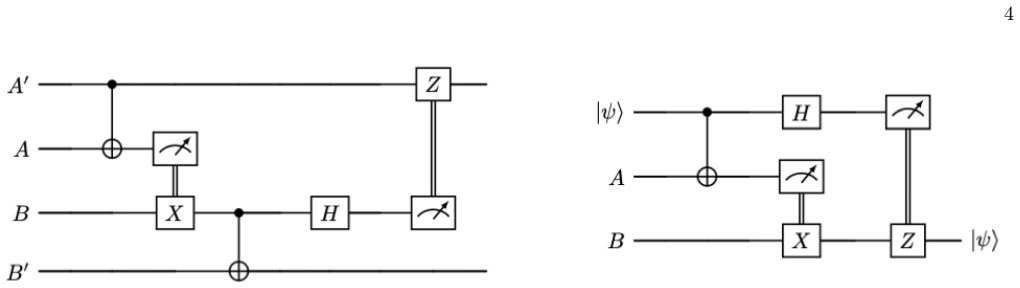
The paper's central claim is that letting qubit assignments change during circuit execution, rather than fixing each qubit to one QPU for the whole run, reduces the EPR-pair cost of distributed quantum circuits. The window-based algorithm divides the circuit into sub-circuits, builds a weighted graph per window whose edges count CNOT gates, partitions that graph with a graph-partitioning heuristic, and allows qubit teleportation between windows; it also weights edges according to previous partitions to discourage unnecessary movement. The authors claim this beats the static edge-cut baseline on QAOA, Quantum Volume, and many benchmark circuits, while acknowledging that shallow circuits such as MCMTV gain nothing. For QFT, they claim an exact count: an n-qubit QFT divided across m QPUs requires $nm/2$ EPR pairs under their protocol, with no end-of-circuit swap gates needed, compared to $nm/2 + n/2$ for the natural generalization of the prior two-processor method.
Load-bearing premise
The network-mapping optimization assumes the number of physical QPUs and links exactly matches the number of QPUs and links the circuit demands, so real data centers with extra processors or spare links make it infeasible as written.
Editorial extensions
If this is right
- For an n-qubit QFT across m QPUs, the described method consumes exactly $nm/2$ EPR pairs, and no swap gates are needed at the end of the circuit.
- This beats the generalized earlier protocol, which costs $nm/2 + n/2$ EPR pairs when the final swaps are included.
- On QAOA and Quantum Volume circuits, the window-based algorithm uses fewer EPR pairs than the static edge-cut baseline, with the gap widening as the number of QPUs grows.
- The network ILP lowers the weighted entanglement cost relative to random placement, and the improvement increases when both link infidelities and EPR demands are more skewed.
- Shallow circuits like MCMTV do not benefit from windowing; the gain depends on circuit depth and structure.
Reading between the lines
- The $nm/2$ formula for distributed QFT suggests a potential lower bound for any teleportation-based scheme that must move each qubit across all other blocks; testing that bound would clarify whether the schedule is optimal among all distributed implementations.
- The ILP as written requires the demand graph and physical graph to have the same number of vertices and edges, so it does not directly handle data centers with more QPUs or spare links than a circuit needs; a relaxation with dummy nodes or slack constraints would be needed.
- The window length is swept exhaustively, but an adaptive rule that sets the window from circuit locality or entanglement-rate information could remove that tuning step.
- The multi-QPU QFT analysis assumes m even and n divisible by m; extending to odd m or unbalanced block sizes is a natural next test.
Editorial analysis
A structured set of objections, weighed in public.
Referee Report
Summary. The manuscript addresses distributed execution of quantum circuits across multiple QPUs. It proposes a window-based circuit partitioning (WBCP) heuristic that alternates gate teleportation within windows and qubit teleportation between windows, an integer linear program (ILP) for mapping the resulting EPR-pair demand graph onto a physical QPU network, and a structured protocol for distributing the Quantum Fourier Transform, culminating in the claim that an n-qubit QFT across m QPUs can be executed with nm/2 EPR pairs. Numerical results compare WBCP with a static graph-partitioning baseline on QAOA, Quantum Volume, and other circuits.
Significance. If established, the WBCP heuristic and the structured QFT protocol would be useful additions to distributed quantum computing: the dynamic one-way teleportation idea is sensible, the QFT entanglement count is concrete, and the paper honestly notes that not all circuits benefit from windowing. The ILP placement objective is practically motivated. However, as written, the ILP is only a bijective vertex-and-edge mapping, the main empirical improvement is selected from a window-length sweep on the same circuits, and the QFT count is not rigorously verified. These issues currently prevent the paper from supporting its advertised scope.
major comments (3)
- [Section V.A, Eqs. (5)-(8)] The constraints in Eqs. (5)-(8) are bijections: Eq. (5) forces every vertex of the physical graph G to be assigned to exactly one vertex of the demand graph G', Eq. (6) forces the converse, and Eqs. (7)-(8) do the same for edges. Feasible solutions therefore exist only when |V(G)|=|V(G')| and |E(G)|=|E(G')|. This contradicts the problem statement in Section V, where G is the data-center network and G' is the subgraph of QPUs needed by the circuit; in an overprovisioned data center, or when the demand graph has a different number of links, the ILP is infeasible. Equation (9) also maps demand edges only onto physical edges, so a demand between two QPUs cannot be routed over a path. The numerical experiments in Section V.B therefore test a permutation problem on equal-size graphs rather than the stated placement problem. The formulation should be revised to allow assignment with slack or dummy nodes and path routing, or the claims should be explicitly restricted to the equal-size isomorphic case.
- [Section III.C, Figs. 4-6, Table I] The reported WBCP counts are the minima over swept window lengths l for the same circuits on which the results are reported, since the text states 'to optimize the EPR count, we evaluate various window sizes.' This is post-hoc selection on the evaluation circuits, so the comparison with Algorithm 1 is optimistic and does not establish a predictive improvement. The window length should be treated as a hyperparameter chosen on a validation set, or fixed a priori, and results should be reported as a function of l or as a distribution over instances rather than as the best value found on the test circuits.
- [Section IV.B, Eq. (3) and Algorithm 5] Equation (3) is derived as an upper bound, but the text immediately summarizes the result as 'the number of EPR pairs required by the described method is nm/2.' The derivation does not show that the bound is tight, and the movement schedule in Algorithm 5 is not detailed enough to verify the count: in particular, step 9 says 'Apply CR gate with l as control in QPU i' without specifying where the target qubit is located, and the second loop refers to the cat-entangler mechanism without stating how its EPR cost is included. The claimed equality therefore needs either a rigorous counting argument with a clear invariant, or a correction to an explicit upper bound.
minor comments (6)
- [Section III.A, Algorithm 3] The factor 2 used for intra-partition edge weights is introduced without justification or sensitivity analysis; because the decision in line 18 also adds the number of qubits moved, the relative scale of these two costs determines the partition choices and should be discussed.
- [Table I] The reported values are single numbers with no indication of the window length used or the spread over random circuit instances, so it is not possible to assess the stability of the WBCP improvement.
- [Section IV.B] The derivation assumes m is even, but the abstract and the concluding summary state the result for an arbitrary number of QPUs without this parity restriction; the statement should be qualified to even m or the odd-m extension should be given.
- [Section V.B, Figs. 8-9] Several axis labels and legend entries are missing or ambiguous: the legend of Fig. 8 does not identify which distribution the beta values refer to, Fig. 9 has no axis labels, and the number of random trials used to produce the averages is not stated.
- [References] References [26], [39], and [52] all refer to the same 'Generalized GHZ states and distributed quantum computing' paper with different formatting; they should be consolidated.
- [Section II] The statement that any two-qubit gate can be decomposed into a CNOT gate and single-qubit rotations is imprecise; a general two-qubit gate requires up to three CNOTs, although this does not affect the subsequent arguments.
Circularity Check
WBCP comparison is partly a fitted minimum over the swept window length; otherwise the derivation chain is self-contained.
-
fitted input called prediction
[Section III.A, Algorithm 3 description; results reported in Section III.C]
"It is important to note that the outcome of the algorithm is highly dependent on the window length l. To obtain the optimal value, we sweep through various window lengths. When the window length equals the circuit length, the window-based graph partitioning algorithm becomes equivalent to Algorithm 1."
The reported WBCP EPR counts are not the output of a single fixed algorithm: they are minima over the swept window length l, with l selected to minimize exactly the reported EPR metric on the same circuits. The text itself states that l = circuit length makes WBCP equivalent to Algorithm 1, so the baseline is a special case of the swept family. Presenting the minimum as the method's 'required EPR pairs' makes the claimed advantage over the baseline statistically forced by the fitting protocol rather than a prediction of a predetermined method. This is a fitted input reported as an optimized result, not a self-contained derivation.
full rationale
The core derivation chain is otherwise self-contained. The QFT EPR count in Section IV.B follows by counting qubit movements in Algorithms 4 and 5; it is an upper bound of nm/2 and is not equivalent to its inputs. The ILP in Section V.A has a genuine feasibility limitation: constraints (5)-(8) force equal vertex and edge counts between G and G', so the formulation effectively computes a graph isomorphism rather than an embedding into an overprovisioned network. That is a correctness and scoping gap, not circularity. The self-citation [21] is used only as an example quantum data-center architecture and is not load-bearing. The only circularity-adjacent element is the window-length fitting in Section III, where the reported WBCP numbers are best-case values over the swept hyperparameter rather than the cost of a fixed method; this lowers the score moderately but does not infect the QFT or ILP results.
Assumptions & free parameters
free parameters (2)
- Window length l =
Swept per circuit; best value reported. Typical sweep up to one-fourth of two-qubit gates.
- History edge-weight factor =
2
assumptions (7)
- domain assumption Two-qubit gates are decomposed into CNOT gates and single-qubit rotations, and the input circuit is given in this form.
- domain assumption Each non-local CNOT implemented via gate teleportation consumes exactly one EPR pair, and each qubit state teleportation between QPUs consumes exactly one EPR pair.
- domain assumption The entanglement cost of a partition equals the sum of weights of edges crossing the partition, with one EPR pair per inter-partition CNOT gate.
- domain assumption Moving a qubit between QPUs between windows costs one EPR pair, independent of the QPUs involved.
- ad hoc to paper The weight-doubling factor of 2 for intra-partition edges correctly balances the benefit of keeping qubits together against the cost of moving them.
- domain assumption For the multi-QPU QFT, the gates in the second phase can be implemented with the CAT entangler/disentangler at a cost of (i-1) EPR pairs per qubit for QPU i.
- ad hoc to paper The physical network graph G and the demand graph G' have the same number of vertices and edges, so that constraints (5)-(8) are feasible.
Cite this review
Pith. "Pith review of Optimized Quantum Circuit Partitioning Across Multiple Quantum Processors." pith.science (2026). https://pith.science/paper/ZP3YZ5K7
@misc{pith2026250114947,
  author       = {Pith},
  title        = {Pith review of: Optimized Quantum Circuit Partitioning Across Multiple Quantum Processors},
  year         = {2026},
  howpublished = {\url{https://pith.science/paper/ZP3YZ5K7}},
  note         = {Machine review of arXiv:2501.14947}
}
read the original abstract
This paper addresses the challenge of scaling quantum computing by employing distributed quantum algorithms across multiple processors. We propose a novel circuit partitioning method that leverages graph partitioning to optimize both qubit and gate teleportation, minimizing the required Einstein-Podolsky-Rosen (EPR) pairs for executing general quantum circuits. Additionally, we formulate an integer linear program to further reduce entanglement requirements by mapping the logical resources of partitioned circuits to the physical constraints of the quantum network. Finally, we analyze the entanglement cost of implementing the Quantum Fourier Transform (QFT) across multiple QPUs, exploiting the circuit's structure to minimize total entanglement consumption.
Figures


Figures from the paper (5 more)


Reference graph
Works this paper leans on
- [49]
-
[40]
R. G Sundaram, H. Gupta, and C. R. Ramakrishnan, in 35th International Symposium on Distributed Computing (DISC 2021), Leibniz International Proceedings in Infor- matics (LIPIcs), Vol. 209 (Dagstuhl, Germany, 2021) pp. 41:1–41:20
work page 2021
-
[1]
Inputs: The algorithm takes as inputs a quantum circuit C and a window lengthl
-
[2]
Divide the Circuit: The circuitC is divided into smaller sub-circuits {Ci}m i=1, where m = ⌈n/l⌉ and n is the total number of two-qubit gates in the cir- cuit
-
[3]
Each subcircuit Ci is processed sequentially
Initialize the Entanglement Cost: The process begins byinitializing the entanglement cost (EC)to zero. Each subcircuit Ci is processed sequentially. For the first subcircuit (i = 1), the algorithm executes Algorithm 1, which returns the partition{P j 1 }m j=1. For every subsequent subcircuit Ci (i > 1), the process involves several steps. A graphGi is con...
-
[4]
Output: The algorithm outputs the total entan- glement costEC, and qubit allocation for each win- dow. 5 FIG. 3: In this figure, we illustrate an application of the WBCP on a five-qubit circuit. The circuit is divided into sub-circuits of lengthl. Within each sub-circuit, remote gates are implemented using gate teleportation. Between sub-circuits, qubits ...
-
[5]
A. Peruzzo, J. McClean, P. Shadbolt, M.-H. Yung, X.-Q. Zhou, P. J. Love, A. Aspuru-Guzik, and J. L. O’Brien, Nature Communications5 (2014), 10.1038/ncomms5213
-
[6]
R. Ur Rasool, H. F. Ahmad, W. Rafique, A. Qayyum, J. Qadir, and Z. Anwar, Future Internet15, 94 (2023)
work page 2023
Show all 59 references
-
[7]
EPR calculation The total number of EPR pairs required by the Algo- rithm 5 is determined by considering the movement and interaction of qubits across QPUs. For the first for loop, we can calculate the EPR pairs as Total EPR pairs first loop≤ k m/2X i=1 (m + 1− i) (1) To under...
-
[8]
P. W. Shor, SIAM Journal on Computing26, 1484–1509 (1997)
1997
-
[9]
A. W. Harrow, A. Hassidim, and S. Lloyd, Phys. Rev. Lett. 103, 150502 (2009)
2009
-
[10]
The development of the number field sieve (Springer Berlin Heidelberg, 1993)
1993
-
[11]
G. H. Low and I. L. Chuang, Quantum3, 163 (2019)
2019
-
[12]
Ibm quantum roadmap,
IBM, “Ibm quantum roadmap,” (2024), accessed: 2024- 08-07
2024
-
[13]
Ionq achieves critical first step towards developing future quantum networks,
IonQ, “Ionq achieves critical first step towards developing future quantum networks,” (2024), accessed: 2024-08-07
2024
-
[14]
Woerner and D
S. Woerner and D. J. Egger, npj Quantum Information 5 (2019), 10.1038/s41534-019-0130-6
2019 doi
-
[15]
Arute, K
F. Arute, K. Arya, R. Babbush, D. Bacon, J. C. Bardin, R. Barends, R. Biswas, S. Boixo, F. G. S. L. Brandao, D. A. Buell, B. Burkett, Y. Chen, Z. Chen, B. Chiaro, R. Collins, W. Courtney, A. Dunsworth, E. Farhi, B. Foxen, A. Fowler, C. Gidney, M. Giustina, R. Graff, K. Guerin,...
2019
-
[16]
The computational power of random quantum cir- cuits in arbitrary geometries,
M. DeCross, R. Haghshenas, M. Liu, E. Rinaldi, J. Gray, Y. Alexeev, C. H. Baldwin, J. P. Bartolotta, M. Bohn, E. Chertkov, J. Cline, J. Colina, D. DelVento, J. M. Dreiling, C. Foltz, J. P. Gaebler, T. M. Gatterman, C. N. Gilbreth, J. Giles, D. Gresh, A. Hall, A. Hankin, A. Han...
2024 arXiv
-
[17]
A tweezer array with 6100 highly coherent atomic qubits,
H. J. Manetsch, G. Nomura, E. Bataille, K. H. Leung, X. Lv, and M. Endres, “A tweezer array with 6100 highly coherent atomic qubits,” (2024), arXiv:2403.12021 [quant-ph]
2024 arXiv
-
[18]
L. J. Stephenson, D. P. Nadlinger, B. C. Nichol, S. An, P. Drmota, T. G. Ballance, K. Thirumalai, J. F. Good- win, D. M. Lucas, and C. J. Ballance, Phys. Rev. Lett. 124, 110501 (2020)
2020
-
[19]
C. M. Knaut, A. Suleymanzade, Y.-C. Wei, D. R. As- sumpcao, P.-J. Stas, Y. Q. Huan, B. Machielse, E. N. Knall, M. Sutula, G. Baranes, N. Sinclair, C. De- Eknamkul, D. S. Levonian, M. K. Bhaskar, H. Park, M. Lončar, and M. D. Lukin, Nature 629, 573–578 (2024)
2024
-
[20]
Liu, X.-Y
J.-L. Liu, X.-Y. Luo, Y. Yu, C.-Y. Wang, B. Wang, Y. Hu, J. Li, M.-Y. Zheng, B. Yao, Z. Yan, D. Teng, J.-W. Jiang, X.-B. Liu, X.-P. Xie, J. Zhang, Q.-H. Mao, X. Jiang, Q. Zhang, X.-H. Bao, and J.-W. Pan, Nature 629, 579–585 (2024)
2024
-
[21]
A. Y. Kitaev, Russian Mathematical Surveys 52, 1191–1249 (1997)
1997
-
[22]
Veldhorst, C
M. Veldhorst, C. H. Yang, J. C. C. Hwang, W. Huang, J. P. Dehollain, J. T. Muhonen, S. Simmons, A. Laucht, F. E. Hudson, K. M. Itoh, A. Morello, and A. S. Dzurak, Nature 526, 410–414 (2015)
2015
-
[23]
C. A. Sackett, D. Kielpinski, B. E. King, C. Langer, V. Meyer, C. J. Myatt, M. Rowe, Q. A. Turchette, W. M. Itano, D. J. Wineland, and C. Monroe, Nature 404, 256–259 (2000)
2000
-
[24]
S. J. Evered, D. Bluvstein, M. Kalinowski, S. Ebadi, T. Manovitz, H. Zhou, S. H. Li, A. A. Geim, T. T. Wang, N. Maskara, H. Levine, G. Semeghini, M. Greiner, V. Vuletić, and M. D. Lukin, Nature 622, 268–272 (2023)
2023
-
[25]
Levine, A
H. Levine, A. Keesling, G. Semeghini, A. Omran, T. T. Wang, S. Ebadi, H. Bernien, M. Greiner, V. Vuletić, H. Pichler, and M. D. Lukin, Phys. Rev. Lett. 123, 170503 (2019). 12
2019
-
[26]
Generalized GHZ states and distributed quantum computing,
A. Yimsiriwattana and S. J. Lomonaco, “Generalized GHZ states and distributed quantum computing,” (2004)
2004
-
[27]
An evolutionary ap- proach to optimizing communication cost in distributed quantum computation,
M. Houshmand, Z. Mohammadi, M. Zomorodi- Moghadam, and M. Houshmand, “An evolutionary ap- proach to optimizing communication cost in distributed quantum computation,” (2019)
2019
-
[28]
Shapourian, E
H. Shapourian, E. Kaur, J. Zhao, M. Kiltzer, R. Kom- pella, and R. Nejabati, ArXiv:2501.05598
-
[29]
Andreev and H
K. Andreev and H. Racke, Theory of Computing Systems 39, 929–939 (2006)
2006
-
[30]
Zomorodi-Moghadam, M
M. Zomorodi-Moghadam, M. Houshmand, and M. Houshmand, International Journal of Theoretical Physics 57, 848–861 (2017)
2017
-
[31]
Andrés-Martínez and C
P. Andrés-Martínez and C. Heunen, Physical Review A 100 (2019), 10.1103/physreva.100.032308
2019 doi
-
[32]
Schlag,High-Quality Hypergraph Partitioning, Ph.D
S. Schlag,High-Quality Hypergraph Partitioning, Ph.D. thesis, Karlsruhe Institute of Technology, Germany (2020)
2020
-
[33]
Distribution of quantum circuits over general quantum networks,
R. G. Sundaram, H. Gupta, and C. R. Ramakrishnan, “Distribution of quantum circuits over general quantum networks,” (2022), arXiv:2206.06437 [cs.ET]
2022 arXiv
-
[34]
A dynamic programming approach for distributing quantum circuits by bipartite graphs,
Z. Davarzani, M. Zomorodi-Moghadam, M. Houshmand, and M. Nouri-baygi, “A dynamic programming approach for distributing quantum circuits by bipartite graphs,” (2020), arXiv:2005.01052 [quant-ph]
2020 arXiv
-
[35]
O. Daei, K. Navi, and M. Zomorodi-Moghadam, Inter- national Journal of Theoretical Physics 59, 3804–3820 (2020)
2020
-
[36]
Nikahd, N
E. Nikahd, N. Mohammadzadeh, M. Sedighi, and M. S. Zamani, Physica Scripta96, 035102 (2021)
2021
-
[37]
Deep reinforcement learning was utilized for circuit partitioning on multi-core architectures in [38]
to propose a heuristic for the qubit assignment prob- lem. Deep reinforcement learning was utilized for circuit partitioning on multi-core architectures in [38]. In [39], the authors considered the distribution of Quantum Fourier Transform (QFT) across two QPUs, calculating th...
-
[38]
J.-Y. Wu, K. Matsui, T. Forrer, A. Soeda, P. Andrés- Martínez, D. Mills, L. Henaut, and M. Murao, Quantum 7, 1196 (2023)
2023
-
[39]
Dis- tributing circuits over heterogeneous, modular quantum computing network architectures,
P. Andres-Martinez, T. Forrer, D. Mills, J.-Y. Wu, L. He- naut, K. Yamamoto, M. Murao, and R. Duncan, “Dis- tributing circuits over heterogeneous, modular quantum computing network architectures,” (2023)
2023
-
[41]
C. H. Bennett, G. Brassard, C. Crépeau, R. Jozsa, A. Peres, and W. K. Wootters, Phys. Rev. Lett. 70, 1895 (1993)
1993
-
[42]
J. M. Baker, C. Duckering, A. Hoover, and F. T. Chong, in Proceedings of the 17th ACM International Conference on Computing Frontiers, CF ’20 (ACM, 2020)
2020
-
[43]
Generalised cir- cuit partitioning for distributed quantum computing,
F. Burt, K.-C. Chen, and K. Leung, “Generalised cir- cuit partitioning for distributed quantum computing,” (2024), arXiv:2408.01424 [quant-ph]
2024 arXiv
-
[44]
Escofet, A
P. Escofet, A. Ovide, C. G. Almudever, E. Alarcón, and S. Abadal, IEEE Computer Architecture Letters22, 161 (2023)
2023
-
[45]
Pastor, P
A. Pastor, P. Escofet, S. Ben Rached, E. Alarcón, P. Barlet-Ros, and S. Abadal, in 2024 IEEE Inter- national Symposium on Circuits and Systems (ISCAS) (IEEE, 2024)
2024
-
[46]
Generalized ghz states and distributed quantum computing,
A. Yimsiriwattana and S. J. L. Jr, “Generalized ghz states and distributed quantum computing,” (2004), arXiv:quant-ph/0402148 [quant-ph]
2004 arXiv
-
[47]
As discussed, the algorithm is very sensi- tive to the chosen window size
in Fig 4. As discussed, the algorithm is very sensi- tive to the chosen window size. Therefore, to optimize the EPR count, we evaluate various window sizes. For the test algorithms considered, it is generally sufficient to sweep up to one-fourth of the total number of two-qubi...
2000
-
[48]
Im- perfect distributed quantum phase estimation,
N. M. P. Neumann, R. van Houte, and T. Attema, “Im- perfect distributed quantum phase estimation,” inCom- putational Science – ICCS 2020(Springer International Publishing, 2020) p. 605–615
2020
-
[50]
Eisert, K
J. Eisert, K. Jacobs, P. Papadopoulos, and M. B. Plenio, Phys. Rev. A62, 052317 (2000)
2000
-
[51]
B. W. Kernighan and S. Lin, The Bell System Technical Journal 49, 291 (1970)
1970
-
[52]
Karypis and V
G. Karypis and V. Kumar, SIAM Journal on Scientific Computing 20, 359–392 (1998)
1998
-
[53]
T. N. Bui and B. R. Moon, IEEE Transactions on Com- puters 45, 841 (1996)
1996
-
[54]
A quan- tum approximate optimization algorithm,
E. Farhi, J. Goldstone, and S. Gutmann, “A quan- tum approximate optimization algorithm,” (2014), arXiv:1411.4028 [quant-ph]
2014 arXiv
-
[55]
A. W. Cross, L. S. Bishop, S. Sheldon, P. D. Nation, and J. M. Gambetta, Phys. Rev. A100, 032328 (2019)
2019
-
[56]
A. Li, S. Stein, S. Krishnamoorthy, and J. Ang, ACM Transactions on Quantum Computing 4 (2023), 10.1145/3550488
2023 doi
-
[57]
Quantum computing with Qiskit,
A. Javadi-Abhari, M. Treinish, K. Krsulich, C. J. Wood, J. Lishman, J. Gacon, S. Martiel, P. D. Nation, L. S. Bishop, A. W. Cross, B. R. Johnson, and J. M. Gambetta, “Quantum computing with Qiskit,” (2024), arXiv:2405.08810 [quant-ph]
2024 arXiv
-
[58]
An approximate fourier transform useful in quantum factoring,
D. Coppersmith, “An approximate fourier transform useful in quantum factoring,” (2002), arXiv:quant- ph/0201067 [quant-ph]
2002
-
[59]
Yimsiriwattana and S
A. Yimsiriwattana and S. J. Lomonaco Jr., inQuantum Information and Computation II(SPIE, 2004)
2004
Reviewed August 10, 2026 · model on record in the stance chip above.
Discussion (0). Continue with ORCID to comment.