REVIEW 4 major objections 5 minor 39 references
Hybrid Near/Far-Field Frequency-Dependent Beamforming via Joint Phase-Time Arrays
T0 review · 4 major / 5 minor · reviewed 2026-08-10 · deepseek-v4-flash
Pith's one-line read A joint phase-time array with one RF chain can split its beam by frequency to serve near-field and far-field users simultaneously, achieving measurable rate gains over conventional phased arrays.
desk verdict Useful JPTA extension to hybrid near/far-field with a real, fixable reproducibility flaw in the DL normalization that must be addressed before the headline numbers are trusted. read the letter →
The pith
A machine-rendered reading of the paper's core claim, the machinery that carries it, and where it could break.
The reading
What carries the argument
The engine is the true-time delay unit, whose phase response $-2\pi f_m \tau_i$ makes the beam pattern frequency-dependent so that one analog front end realizes different beams on different subbands. The paper's key optimization target is the phase-aligned beamformer $w_m = \frac{1}{\sqrt{N}}\sum_{k=1}^K b_{m,k}\exp(j\angle h_{m,k})$, which says what each subband's ideal beam should look like before the hardware is fit to it. The alternating optimization cycles through subband allocation via successive convex approximation, fitting the phase-shifter and delay hardware to $w_m$ via block coordinate descent, and power allocation via water-filling. The learning variant encodes the JPTA as a graph with subband, phase-shifter, and time-delay nodes, then uses a node-wise graph attention network with a Gumbel-softmax normalization to output allocations and beamformers directly from channel information.
What would settle it
Run the same utility maximization on channels with strong multipath or with a user placed inside the Fresnel region where the quadratic distance approximation fails; if JPTA's rate gain over phase arrays falls well below the reported 8% or reverses, then the phase-aligned target in Eq. (16) is not adequate for those channels.
Extended reading notes
Core claim
The paper's central claim is that JPTA can multiplex users in the hybrid near/far field by exploiting beam-splitting: because a true-time delay of $\tau_i$ contributes phase $-2\pi f_m \tau_i$ that scales with subband frequency, the analog front end can point different subbands at different targets without a per-antenna RF chain. The design target at each subband is the phase-aligned beamformer $w_m = \frac{1}{\sqrt{N}}\sum_{k=1}^K b_{m,k}\exp(j\angle h_{m,k})$, and the analog hardware is then fitted to approximate each $w_m$ by the product of the frequency-independent phase-shifter matrix $\Phi$ and the frequency-dependent delay vector $T_m$. On this basis the paper formulates a network-utility maximization over subband allocation, power, and analog beamformers, solves it with a 3-step alternating optimization, and learns the same mapping with a graph attention network that treats subbands, phase-shifter groups, and TTDs as nodes. The numerical evidence is that JPTA outperforms phase-array baselines in user rate and fairness and lands between phase arrays and fully digital arrays in energy efficiency.
Load-bearing premise
The channel model assumes a single dominant line-of-sight path for every user, with near-field distances truncated at the Fresnel quadratic term; the beam-splitting gain is built on phase alignment to that one path.
Editorial extensions
If this is right
- Under proportional-fairness (logarithmic) utility, JPTA's average user-rate gain over phase-array beamforming is 8.21% with two users and 8.07% with five users; under sum-rate utility the gains are 6.97% and 7.15%.
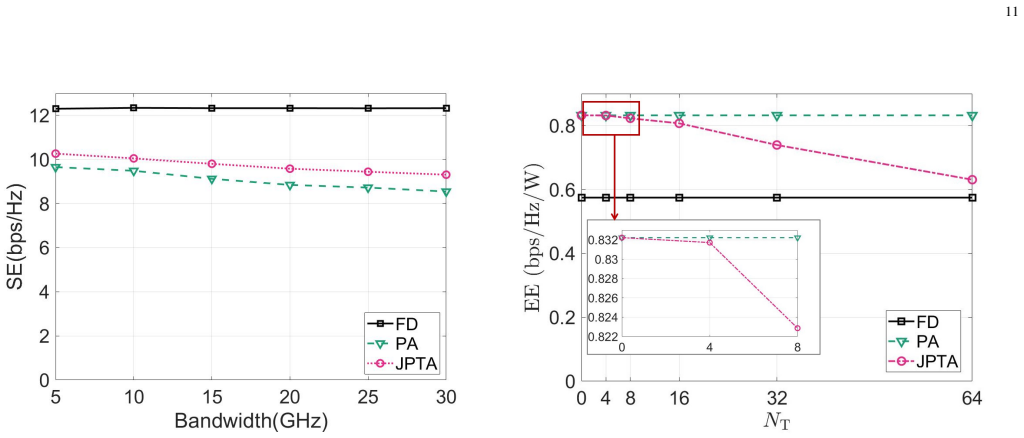
- Using more TTDs improves array gain and rates: with one TTD per antenna ($N_T=64$) and a 5 ns delay range, JPTA closes 26.4% of the logarithmic-rate gap between phase arrays and fully digital beamforming, and even a 0.05 ns delay range still closes 17.3% of that gap.
- The graph attention network reaches essentially the same logarithmic rate as the alternating optimization in the 5-user test (118.525 vs 118.531) while dropping average CPU runtime from 7.11 minutes to 0.11 seconds per sample.
- JPTA's energy efficiency sits between phase-array and fully-digital designs, and increasing the number of TTDs reduces energy efficiency because the added delay hardware consumes more power than the spectral-efficiency gain it buys.
Reading between the lines
- Editorial inference: under a measured multipath channel, the beam-splitting gain should shrink or vanish because the phase-aligned target is matched to a single line-of-sight path.
- Editorial inference: the graph encoding of subbands, phase-shifter groups, and TTDs is a general pattern for coupling discrete resource decisions with continuous analog constraints, and could transfer to antenna selection or OFDMA scheduling with hardware-imposed phase ties.
- Editorial inference: the same frequency-splitting hardware could be tested for integrated sensing and communication by assigning some subbands to data users and others to distance-focused sensing beams.
Editorial analysis
A structured set of objections, weighed in public.
Referee Report
Summary. The paper considers a single-RF-chain joint phase-time array (JPTA) base station serving multiple users located in both the near-field and far-field regions over a wideband OFDM downlink. The authors formulate a network utility maximization problem over subband allocation, transmit power, PS-based beamformers, and TTD-based beamformers, with sum-rate and proportional fairness as special cases. They propose a 3-step alternating optimization (AO) algorithm in which subband allocation is handled by successive convex approximation with an exact penalty, the analog beamformer is approximated via a closed-form per-subband target followed by block coordinate descent, and power is allocated by water-filling. They also propose an unsupervised deep-learning approach combining a CNN feature extractor, a node-wise graph attention network, and a normalization module, and they report that the DL method matches the AO method at much lower complexity and that JPTA improves user rates by about 8% over conventional phased arrays.
Significance. If the numerical claims are reliable, the paper makes a useful contribution by extending JPTA beam-splitting to multi-user hybrid near/far-field scenarios with a single RF chain, and by demonstrating a scalable GAT-based alternative to iterative optimization. The problem decomposition is clean, the complexity analysis is provided, and the unsupervised learning formulation is interesting. However, the central quantitative claims currently rest on the DL branch, and the DL normalization as written in Eq. (37) violates the unit-modulus constraint, which puts the reported 8% rate gains and the DL/AO parity in doubt. Because the issue is localized and potentially fixable by correcting the normalization and re-running the DL experiments, the manuscript warrants major revision rather than rejection.
major comments (4)
- [Section IV-D, Eq. (37)] The normalization in Eq. (37) does not enforce the unit-modulus constraint (9f). The formula phi_i = (phi_tilde_i^Re + j phi_tilde_i^Im) / ||phi_tilde_i^Re + j phi_tilde_i^Im|| normalizes the entire (N/N_T)-dimensional vector to unit Euclidean norm, so each entry has magnitude approximately 1/sqrt(N/N_T), not 1. For N = 64 and N_T = 16 this is a factor-of-4 (6 dB) reduction in array gain relative to a unit-modulus vector. Since Section V explicitly states that 'in subsequent simulations, we shall only showcase the performance of the DL method,' the reported JPTA gains of 8.21% and 8.07% and the DL/AO parity in Table IV are not supported by the algorithm as written. Please either use a per-element unit-modulus normalization (for example, phi_{i,j} = exp(j * angle(...))) or, if the implementation used such a normalization, correct Eq. (37) so that the paper is reproducible from the text.
- [Section III-B, Eq. (16)] The optimal analog beamformer w_m is asserted to be directly optimized as w_m = (1/sqrt(N)) sum_k b_{m,k} exp(j angle(h_{m,k})), but no derivation is given. Because the objective in (P2.1) applies a concave utility F to each user's sum of rates over subbands, the decoupling of subbands is not immediate. Please provide a proof, or at least a clear argument that for each subband m the only active term is the one for the user with b_{m,k}=1 and that maximizing |h^H_{m,k} w_m| subject to |[w_m]_n| = 1/sqrt(N) leads to this expression.
- [Section III-D, Algorithm 1] The convergence of the 3-step AO algorithm is not established. The algorithm combines SCA with a penalty factor updated as rho = 5*rho, an inner BCD loop for the PS/TTD matching problem, and water-filling, but no monotonic improvement or limit-point argument is provided. The paper calls the result 'near-optimal' without supporting analysis. Please either state explicitly that the algorithm is heuristic and validate it empirically (for example, by plotting objective versus outer iteration), or provide a convergence guarantee under the stated assumptions.
- [Section IV-D and Section V, Gumbel-softmax at inference] The paper does not specify how the subband allocation variables b_{m,k} are obtained at inference time. If the continuous Gumbel-softmax outputs are used directly in the rate expression (10), the binary constraint (9a) and the one-subband-per-user constraint (9b) are violated and the computed rates are not achievable. If instead an argmax or sampling step is applied at test time, that step and its effect on the reported rates should be described explicitly. This is necessary for the reproducibility of Table IV and Fig. 5.
minor comments (5)
- [Section II-B, Eq. (11)] The equivalence in Eq. (11) should be stated more carefully; as written, it can be read as an equivalence for a single b_{m,k}, when in fact it is the conjunction of the sum constraint and the box constraint over all m,k that forces each b_{m,k} to be binary.
- [Section V-B, Fig. 4 caption] The caption 'Array gain for 2-user scenario at the distance of 1 meters achieved by different approaches' contains a typo ('1 meters' should be '1 meter') and is ambiguous about whether both users are at 1 m; please clarify.
- [Table IV] The complexity expressions in Table IV are typeset in a way that splits formulas across lines and obscures the intended expressions; please format the table so that the AO and DL complexity formulas are readable and complete.
- [Section I, last paragraph] There is a typo in the sentence 'The aim of this work is to explore the potential of JPTA architecture to generate frequency-dependent beamformers for hybird near-far field communications.' Please change 'hybird' to 'hybrid'.
- [Section IV-D, Eq. (38)] The loss function includes the term -lambda_3 * sum b_{m,k} log b_{m,k}; the text says this drives b closer to 0 or 1, but this behavior should be stated explicitly in terms of the entropy interpretation to avoid confusion about the sign convention.
Circularity Check
No significant circularity: the novel hybrid near/far-field JPTA formulation, the AO decomposition, and the GAT-based solver are derived in-paper and benchmarked externally; the cited prior JPTA work is a published architecture, not an unverified premise that forces the conclusions.
full rationale
The paper's derivation chain is self-contained for its novel claims. The JPTA signal model (Eqs. (5)-(7)), the phase-aligned target w_m in Eq. (16), and the block-coordinate-descent fitting of PS/TTD beamformers in Eqs. (17)-(21) are all specified in-paper; Eq. (16) is an explicit phase-alignment construction, not a fitted parameter renamed as a prediction, and the reported rates are evaluated on the actual PS/TTD beamformers rather than on the auxiliary w_m. The subband-allocation step is a convexified SCA problem, the power-allocation step is standard water-filling, and the numerical comparisons are against PA and FD baselines under the same channel model, so the 8.21% and 8.07% JPTA-over-PA gains are simulation outputs rather than consequences of the definitions. The only reliance on [13] is for the JPTA architecture and the block-coordinate-descent inner loop; [13] is an externally published IEEE Access paper, and although J. Mo is a co-author of both works, this is a normal self-citation that does not make the present result circular, because the paper's contributions are the hybrid near/far-field problem formulation, the MINLP solution, and the GAT-based unsupervised solver, none of which is assumed in [13]. No uniqueness theorem is imported, no ansatz is smuggled in via self-citation, and no known result is merely renamed. The possible inconsistency in Eq. (37), where vector-Euclidean normalization would violate the per-element unit-modulus constraint (9f), is a correctness/reproducibility concern rather than a circularity, since it does not make any derived quantity identical to an input by construction.
Assumptions & free parameters
free parameters (5)
- Penalty factor rho in SCA/AO =
initial 1e-5, updated as rho = 5*rho
- DL loss weights lambda1, lambda2, lambda3 =
1e10, 0.5, 1
- Gumbel-softmax temperature mu =
not specified
- TTD linear-search step IT =
2000
- Simulation operating point (fc, B, N, M, Pt, noise density) =
100 GHz, 10 GHz, 64, 16, 40 dBm, -174 dBm/Hz
assumptions (6)
- domain assumption Near-field channel distance uses the Fresnel approximation in Eq. (1).
- domain assumption Far-field channel distance uses the planar wave approximation in Eq. (2).
- domain assumption The channel is single line-of-sight, h = beta * a in Eq. (3).
- domain assumption Every subband is frequency-flat and allocated to exactly one user, Eq. (9b).
- domain assumption The JPTA signal model and the block coordinate descent solver are adopted from [13].
- ad hoc to paper The 3-step AO and the penalty update rho=5rho converge to a feasible point.
Cite this review
Pith. "Pith review of Hybrid Near/Far-Field Frequency-Dependent Beamforming via Joint Phase-Time Arrays." pith.science (2026). https://pith.science/paper/LXZ6WIMC
@misc{pith2026250115207,
  author       = {Pith},
  title        = {Pith review of: Hybrid Near/Far-Field Frequency-Dependent Beamforming via Joint Phase-Time Arrays},
  year         = {2026},
  howpublished = {\url{https://pith.science/paper/LXZ6WIMC}},
  note         = {Machine review of arXiv:2501.15207}
}
read the original abstract
Joint phase-time arrays (JPTA) emerge as a cost-effective and energy-efficient architecture for frequency-dependent beamforming in wideband communications by utilizing both true-time delay units and phase shifters. This paper exploits the potential of JPTA to simultaneously serve multiple users in both near- and far-field regions with a single radio frequency chain. The goal is to jointly optimize JPTA-based beamforming and subband allocation to maximize overall system performance. To this end, we formulate a system utility maximization problem, including sum-rate maximization and proportional fairness as special cases. We develop a 3-step alternating optimization (AO) algorithm and an efficient deep learning (DL) method for this problem. The DL approach includes a 2-layer convolutional neural network, a 3-layer graph attention network (GAT), and a normalization module for resource and beamforming optimization. The GAT efficiently captures the interactions between resource allocation and analog beamformers. Simulation results confirm that JPTA outperforms conventional phased arrays (PA) in enhancing user rate and strikes a good balance between PA and fully-digital approach in energy efficiency. Employing a logarithmic utility function for user rates ensures greater fairness than maximizing sum-rates. Furthermore, the DL network achieves comparable performance to the AO approach, while having orders of magnitude lower computational complexity.
Figures


Figures from the paper (4 more)



Reference graph
Works this paper leans on
-
[1]
Y . Cai, M. Tao, and S. Sun, “Frequency-Dependent Beamforming for Hybrid Near-Far Field Communications Through Joint Phase-Time Arrays,” accepted by IEEE Wireless Communications and Networking Conference, 2025
work page 2025
-
[2]
On the road to 6G: Visions, requirements, key technologies, and testbeds,
C.-X. Wang, X. You, X. Gao, X. Zhu, Z. Li, C. Zhang, H. Wang, Y . Huang, Y . Chen, H. Haas et al. , “On the road to 6G: Visions, requirements, key technologies, and testbeds,” IEEE Communications Surveys & Tutorials , vol. 25, no. 2, pp. 905–974, 2023
2023
-
[3]
T. S. Rappaport, Y . Xing, O. Kanhere, S. Ju, A. Madanayake, S. Mandal, A. Alkhateeb, and G. C. Trichopoulos, “Wireless communications and applications above 100 GHz: Opportunities and challenges for 6G and beyond,” IEEE access , vol. 7, pp. 78 729–78 757, 2019
work page 2019
-
[4]
Millimeter-wave massive MIMO communication for future wireless systems: A survey,
S. A. Busari, K. M. S. Huq, S. Mumtaz, L. Dai, and J. Rodriguez, “Millimeter-wave massive MIMO communication for future wireless systems: A survey,” IEEE Communications Surveys & Tutorials , vol. 20, no. 2, pp. 836–869, 2017
work page 2017
-
[5]
Massive MIMO is a reality—What is next?: Five promis- ing research directions for antenna arrays,
E. Bj ¨ornson, L. Sanguinetti, H. Wymeersch, J. Hoydis, and T. L. Marzetta, “Massive MIMO is a reality—What is next?: Five promis- ing research directions for antenna arrays,” Digital Signal Processing , vol. 94, pp. 3–20, 2019. 12
work page 2019
-
[6]
Hybrid beamforming for massive MIMO: A survey,
A. F. Molisch, V . V . Ratnam, S. Han, Z. Li, S. L. H. Nguyen, L. Li, and K. Haneda, “Hybrid beamforming for massive MIMO: A survey,” IEEE Communications magazine , vol. 55, no. 9, pp. 134–141, 2017
work page 2017
-
[7]
Spatially sparse precoding in millimeter wave MIMO systems,
O. El Ayach, S. Rajagopal, S. Abu-Surra, Z. Pi, and R. W. Heath, “Spatially sparse precoding in millimeter wave MIMO systems,” IEEE transactions on wireless communications , vol. 13, no. 3, pp. 1499–1513, 2014
work page 2014
-
[8]
True time delay in phased arrays,
R. Rotman, M. Tur, and L. Yaron, “True time delay in phased arrays,” Proceedings of the IEEE , vol. 104, no. 3, pp. 504–518, 2016
2016
Show all 39 references
-
[9]
Near- field communications: A tutorial review,
Y . Liu, Z. Wang, J. Xu, C. Ouyang, X. Mu, and R. Schober, “Near- field communications: A tutorial review,” IEEE Open Journal of the Communications Society , 2023
2023
-
[10]
Near-field communica- tions: What will be different?
Y . Liu, J. Xu, Z. Wang, X. Mu, and L. Hanzo, “Near-field communica- tions: What will be different?” arXiv preprint arXiv:2303.04003 , 2023
2023 arXiv
-
[11]
6G wireless communications: From far-field beam steering to near-field beam focusing,
H. Zhang, N. Shlezinger, F. Guidi, D. Dardari, and Y . C. Eldar, “6G wireless communications: From far-field beam steering to near-field beam focusing,” IEEE Communications Magazine , vol. 61, no. 4, pp. 72–77, 2023
2023
-
[12]
Delay-phase precoding for wideband THz massive MIMO,
L. Dai, J. Tan, Z. Chen, and H. V . Poor, “Delay-phase precoding for wideband THz massive MIMO,” IEEE Transactions on Wireless Communications, vol. 21, no. 9, pp. 7271–7286, 2022
2022
-
[13]
Joint phase-time arrays: A paradigm for frequency-dependent analog beamforming in 6G,
V . V . Ratnam, J. Mo, A. Alammouri, B. L. Ng, J. Zhang, and A. F. Molisch, “Joint phase-time arrays: A paradigm for frequency-dependent analog beamforming in 6G,” IEEE Access , vol. 10, pp. 73 364–73 377, 2022
2022
-
[14]
3D Beamforming Through Joint Phase-Time Arrays,
O. Yildiz, A. AlAmmouri, J. Mo, Y . Nam, E. Erkip et al. , “3D Beamforming Through Joint Phase-Time Arrays,” arXiv preprint arXiv:2401.00819, 2024
2024 arXiv
-
[15]
Extending uplink coverage of mmwave and terahertz systems through joint phase-time arrays,
A. Alammouri, J. Mo, V . V . Ratnam, B. L. Ng, R. W. Heath, J. Lee, and J. Zhang, “Extending uplink coverage of mmwave and terahertz systems through joint phase-time arrays,” IEEE Access , vol. 10, pp. 88 872–88 884, 2022
2022
-
[16]
mmflexible: Flexible directional frequency multiplexing for multi-user mmwave networks,
I. K. Jain, R. R. Vennam, R. Subbaraman, and D. Bharadia, “mmflexible: Flexible directional frequency multiplexing for multi-user mmwave networks,” in IEEE INFOCOM 2023-IEEE Conference on Computer Communications. IEEE, 2023, pp. 1–10
2023
-
[17]
Fast Frequency- Direction Mapping Design for Data Communication With True-Time- Delay Array Architecture,
D. Zhao, I. Pehlivan, A. Wadaskar, and D. Cabric, “Fast Frequency- Direction Mapping Design for Data Communication With True-Time- Delay Array Architecture,” in 2024 International Conference on Com- puting, Networking and Communications (ICNC) . IEEE, 2024, pp. 1071–1076
2024
-
[18]
Fast and Accurate Terahertz Beam Management via Frequency-Dependent Beamforming,
S. Kim, J. Park, J. Moon, and B. Shim, “Fast and Accurate Terahertz Beam Management via Frequency-Dependent Beamforming,” IEEE Transactions on Wireless Communications , vol. 23, no. 3, pp. 1699– 1712, 2024
2024
-
[19]
Integrated sensing and communications with joint beam-squint and beam-split for mmWave/THz massive MIMO,
F. Gao, L. Xu, and S. Ma, “Integrated sensing and communications with joint beam-squint and beam-split for mmWave/THz massive MIMO,” IEEE Transactions on Communications , vol. 71, no. 5, pp. 2963–2976, 2023
2023
-
[20]
Beam Squint Assisted User Localization in Near-Field Integrated Sensing and Communications Systems,
H. Luo, F. Gao, W. Yuan, and S. Zhang, “Beam Squint Assisted User Localization in Near-Field Integrated Sensing and Communications Systems,” IEEE Transactions on Wireless Communications , vol. 23, no. 5, pp. 4504–4517, 2024
2024
-
[21]
Near-field rainbow: Wideband beam training for XL-MIMO,
M. Cui, L. Dai, Z. Wang, S. Zhou, and N. Ge, “Near-field rainbow: Wideband beam training for XL-MIMO,”IEEE Transactions on Wireless Communications, vol. 22, no. 6, pp. 3899–3912, 2022
2022
-
[22]
Near-Field Wideband Beamforming for Extremely Large Antenna Arrays,
M. Cui and L. Dai, “Near-Field Wideband Beamforming for Extremely Large Antenna Arrays,” IEEE Transactions on Wireless Communica- tions, pp. 1–1, 2024
2024
-
[23]
Wideband Beamforming for Near-Field Communications with Circular Arrays,
Y . Guo, Y . Zhang, Z. Wang, and Y . Liu, “Wideband Beamforming for Near-Field Communications with Circular Arrays,” arXiv preprint arXiv:2404.02811, 2024
2024 arXiv
-
[24]
TTD Configurations for Near- Field Beamforming: Parallel, Serial, or Hybrid?
Z. Wang, X. Mu, Y . Liu, and R. Schober, “TTD Configurations for Near- Field Beamforming: Parallel, Serial, or Hybrid?” IEEE Transactions on Communications, vol. 72, no. 6, pp. 3783–3799, 2024
2024
-
[25]
Adaptive TTD Configurations for Near- Field Communications: An Unsupervised Transformer Approach,
H. Ting, Z. Wang, and Y . Liu, “Adaptive TTD Configurations for Near- Field Communications: An Unsupervised Transformer Approach,” arXiv preprint arXiv:2403.18146, 2024
2024 arXiv
-
[26]
Deep learning of near field beam focusing in terahertz wideband massive MIMO systems,
Y . Zhang and A. Alkhateeb, “Deep learning of near field beam focusing in terahertz wideband massive MIMO systems,” IEEE Wireless Commu- nications Letters , vol. 12, no. 3, pp. 535–539, 2023
2023
-
[27]
Beamforming design for large-scale antenna arrays using deep learning,
T. Lin and Y . Zhu, “Beamforming design for large-scale antenna arrays using deep learning,” IEEE Wireless Communications Letters , vol. 9, no. 1, pp. 103–107, 2019
2019
-
[28]
Deep unsupervised learning for joint antenna selection and hybrid beamforming,
Z. Liu, Y . Yang, F. Gao, T. Zhou, and H. Ma, “Deep unsupervised learning for joint antenna selection and hybrid beamforming,” IEEE Transactions on Communications , vol. 70, no. 3, pp. 1697–1710, 2022
2022
-
[29]
Graph neural networks for wireless communications: From theory to practice,
Y . Shen, J. Zhang, S. Song, and K. B. Letaief, “Graph neural networks for wireless communications: From theory to practice,” IEEE Transac- tions on Wireless Communications , vol. 22, no. 5, pp. 3554–3569, 2022
2022
-
[30]
GNN-based beamforming for sum-rate maximization in MU-MISO networks,
Y . Li, Y . Lu, B. Ai, O. A. Dobre, Z. Ding, and D. Niyato, “GNN-based beamforming for sum-rate maximization in MU-MISO networks,” IEEE Transactions on Wireless Communications , 2024
2024
-
[31]
Graph Attention Networks,
P. Veli ˇckovi´c, G. Cucurull, A. Casanova, A. Romero, P. Li `o, and Y . Bengio, “Graph Attention Networks,” in International Conference on Learning Representations , 2018
2018
-
[32]
Near-field communications: A comprehensive survey,
Y . Liu, C. Ouyang, Z. Wang, J. Xu, X. Mu, and A. L. Swindlehurst, “Near-field communications: A comprehensive survey,” arXiv preprint arXiv:2401.05900, 2024
2024 arXiv
-
[33]
Charging and rate control for elastic traffic,
F. Kelly, “Charging and rate control for elastic traffic,” European Transactions on Telecommunications , vol. 8, no. 1, pp. 33–37, 1997
1997
-
[34]
CVX: Matlab software for disciplined convex programming, version 2.1,
M. Grant and S. Boyd, “CVX: Matlab software for disciplined convex programming, version 2.1,” 2014
2014
-
[35]
Boyd and L
S. Boyd and L. Vandenberghe, Convex optimization . Cambridge university press, 2004
2004
-
[36]
Goldsmith, Wireless communications
A. Goldsmith, Wireless communications. Cambridge university press, 2005
2005
-
[37]
Categorical Reparameterization with Gumbel-Softmax,
E. Jang, S. Gu, and B. Poole, “Categorical Reparameterization with Gumbel-Softmax,” in International Conference on Learning Represen- tations, 2017
2017
-
[38]
Hybrid MIMO Architectures for Millimeter Wave Communica- tions: Phase Shifters or Switches?
R. M ´endez-Rial, C. Rusu, N. Gonz ´alez-Prelcic, A. Alkhateeb, and R. W. Heath, “Hybrid MIMO Architectures for Millimeter Wave Communica- tions: Phase Shifters or Switches?” IEEE Access , vol. 4, pp. 247–267, 2016
2016
-
[39]
A true time delay-based SiGe bi- directional T/R chipset for large-scale wideband timed array antennas,
M.-K. Cho, I. Song, and J. D. Cressler, “A true time delay-based SiGe bi- directional T/R chipset for large-scale wideband timed array antennas,” in 2018 IEEE Radio Frequency Integrated Circuits Symposium (RFIC) . IEEE, 2018, pp. 272–275
2018
Reviewed August 10, 2026 · model on record in the stance chip above.
Discussion (0). Continue with ORCID to comment.