REVIEW 3 major objections 6 minor 80 references
ReInc: Scaling Training of Dynamic Graph Neural Networks
T0 review · 3 major / 6 minor · reviewed 2026-08-10 · deepseek-v4-flash
Pith's one-line read ReInc claims that distributed training of dynamic graph neural networks can be made communication-free in the forward pass and up to 17.7x faster than prior systems by reusing intermediate aggregations and placing graph snapshots as…
desk verdict Correct incremental-aggregation core, plausible speedups, but the headline zero-communication claim rests on an unevaluated snapshot-overlap branch the paper itself only mentions in passing. read the letter →
The pith
A machine-rendered reading of the paper's core claim, the machinery that carries it, and where it could break.
The reading
What carries the argument
The load-bearing identity is incremental aggregation over delta graphs: $\mathrm{Agg}_t = \mathrm{Agg}_{t-1} - F_{t-1} \ast_{\text{aggr}} G^-_t + F_t \ast_{\text{aggr}} G^+_t$, where $G^-_t$ and $G^+_t$ collect edge deletions and insertions between consecutive snapshots and feature changes are rewritten as deletions plus insertions. This turns recomputing each snapshot from scratch into a small correction, which is effective because real-world dynamic graphs change slowly relative to their size. The accompanying machinery is a two-level cache store with a DGNN-aware priority score based on future access count, imminence, and size, plus consecutive-block snapshot placement with seq-first mini-batch iteration so that cached aggregations are reused while sequences stay local. The identity carries the computational savings; the placement carries the communication savings.
What would settle it
Run the same four DGNNs with a sequence length larger than the per-machine snapshot budget on a graph whose snapshots exceed one machine's host memory, and compare per-epoch time and network bytes against the paper's zero-communication claim; if remote snapshot fetch dominates, the claimed scaling does not hold. Alternatively, train a max()-aggregation model on a graph with frequent edge deletions, where the paper's own fallback to from-scratch aggregation should eliminate the incremental speedup.
Extended reading notes
Core claim
REINC's central claim is that the execution of a DGNN, whether the GNN and RNN are stacked or integrated into a GraphRNN, can be made communication-free in the forward pass by placing consecutive snapshots as blocks on machines: because time dependencies exist only within a training sequence and sequences are independent, each machine holds the full sequence of snapshots its mini-batch needs, so no remote feature pulls or intermediate redistribution occur. On top of this placement, REINC avoids recomputation by caching and reusing aggregations and by computing each snapshot's aggregation from the previous one using only the changed edges, with feature changes encoded as edge deletions and insertions. The paper supports the claim with experiments showing 2.9–12.8× and 2.8–17.7× epoch-time speedups over DynaGraph and ESDGNN respectively across GCRN-M1, CD-GCN, GCRN-M2, and T-GCN on four large graphs, and identical test MAE on METR-LA-LARGE with 2.9× and 8.1× speedups.
Load-bearing premise
The load-bearing premise is that each machine's assigned training sequences are fully local after snapshot placement; if a machine lacks memory to hold overlapping snapshots, it must fetch remote snapshots, which would replace the headline zero communication with network traffic.
Editorial extensions
If this is right
- REINC's reuse and incremental aggregation make integrated GraphRNN architectures trainable at scale, closing the gap that previous systems left for stacked-only or integrated-only optimization.
- Longer sequences and larger feature or hidden dimensions no longer create proportional communication and recomputation overhead, so DGNN training can scale to more history and richer features.
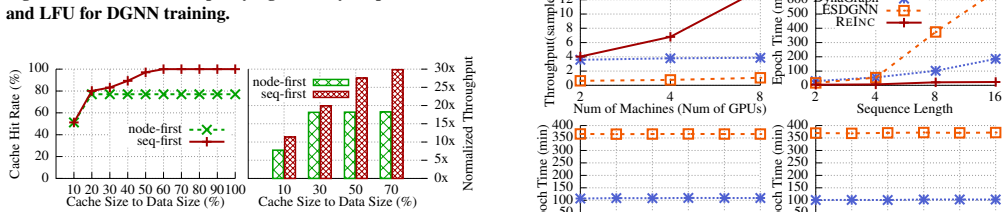
- The seq-first mini-batch order enables near-complete cache reuse at modest cache sizes, reducing GPU memory pressure during training.
- Because the correctness run matches prior test MAE, the distributed strategy and optimizations can be adopted without changing model accuracy.
Reading between the lines
- An implication the paper leaves implicit is that the zero-communication forward pass is contingent on sequence locality; for sequences longer than a machine's snapshot block, the fallback of remote snapshot fetch would reintroduce network traffic and should be measured.
- The same delta-graph incremental aggregation could be applied to streaming or continuous-time GNN training, where changes arrive as edge events rather than discrete snapshots, but attention-style weighted aggregations would need re-aggregation after weight updates.
- If change ratios are high in a deployment, the incremental speedup shrinks toward the from-scratch baseline; the paper's own fallback threshold makes the benefit workload-dependent, so the reported speedups generalize best to slowly evolving graphs.
- The seq-first mini-batch strategy is a general scheduling idea for any sequence-of-snapshots workload: iterating over time before sampling nodes maximizes reuse of cached intermediate results.
Editorial analysis
A structured set of objections, weighed in public.
Referee Report
Summary. The paper presents ReInc, a system for distributed training of discrete dynamic graph neural networks (DGNNs). It identifies three reuse opportunities (across RNN gates, across overlapping sliding-window sequences, and between encoder/decoder teacher-forcing inputs), proposes incremental aggregation through delta graphs, introduces a two-level cache with a DGNN-aware eviction policy, and proposes a consecutive-block snapshot placement with sequence-first mini-batching that is claimed to eliminate remote feature access and intermediate-result redistribution. The evaluation compares ReInc with DynaGraph and ESDGNN on four DGNN architectures and four large graph datasets, reporting speedups of 2.9--12.8x and 2.8--17.7x respectively, and identical test MAE on a correctness check.
Significance. If the claims hold, ReInc addresses a real bottleneck in scaling DGNN training: the combination of graph structure and temporal dependencies causes redundant computation and communication in existing systems. The incremental aggregation identity in Eq. (2) is correct for sum aggregation, and the reuse-based computation preserves exact aggregate values, so the core optimization is mathematically sound. The paper also provides a broad empirical comparison across multiple architectures and baselines, and it explicitly checks correctness against an independent baseline with matching MAE. The main limitations are that the headline zero-communication distributed claim is conditional on an unmeasured memory-replication branch, the incremental aggregation treatment is incomplete for mean (and partly for max/min), and the two largest datasets are synthetic dynamizations of static graphs. These issues are fixable but currently prevent the central claims from being accepted as stated.
major comments (3)
- [§3.2, Eq. (2)] Equation (2) is presented as the general incremental aggregation rule, but it is only valid for sum aggregation. For mean aggregation, Agg_t is defined in Eq. (1) as the mean of neighbor features, yet subtracting and adding raw neighbor features does not account for the change in degree. Concretely, if at t-1 a node has neighbor features {1,3} with mean 2, and at t the edge to feature 3 is deleted and an edge to feature 5 is inserted, Eq. (2) gives 2 - 3 + 5 = 4, whereas the true new mean is (1+5)/2 = 3. If ReInc internally stores unnormalized sums and divides by degree only at consumption, that design must be stated and Eq. (2) must be rewritten accordingly; otherwise the claim that mean() is a supported built-in incremental aggregation is unsupported.
- [§3.4.1 and Table 1] The '0 GB communication' entry in Table 1 and the abstract's claim of eliminating remote feature access apply only to the overlapped snapshot placement branch of §3.4.1. The paper does not report whether the distributed experiments used overlapped placement, how much additional host memory the overlap required, or the network bytes and time incurred when the fallback branch ('retrieves remote snapshots from other machines during training as needed') is used. For the evaluation configuration with T=100 snapshots, M=8 machines, and L=8, the overlap branch requires roughly (M-1)(L-1)=49 additional snapshot copies across the cluster, and on OGB-Papers a single snapshot already has 1.6B edges and 111M nodes. This is load-bearing because the central distributed claim is that ReInc eliminates communication; please report branch selection, memory overhead, and fallback communication cost, or qualify the abstract and Table 1.
- [§5, Experimental Setup] The two largest datasets, OGB-Products and OGB-Papers, are static graphs converted into dynamic ones by randomly modifying edges and features with change ratios drawn uniformly from 0% to 100%, and the traffic datasets are scaled by replication. The headline speedups are therefore measured on synthetic dynamism rather than on real large dynamic graphs, and random rewiring at 100% change is not the 'slowly changing' regime that motivates incremental aggregation. This limits the external validity of the central performance claim. The paper acknowledges the scarcity of public large DGNN datasets, but the abstract's phrase 'real-world graph datasets' overstates the evidence; please add at least one real large dynamic dataset or a sensitivity analysis that varies the structure of changes.
minor comments (6)
- [§3.2] The user-defined threshold for falling back to from-scratch aggregation when the change ratio is high is never given a default value, and the experiments in Fig. 13 that vary change ratio do not report when the fallback was triggered.
- [§3.3] The text says 'cached aggregations in the global cache can be assessed across layers'; 'assessed' should be 'accessed'.
- [§3.3.3] Equation (3), Priority = F(Agg)/S(Agg) - I(Agg), mixes dimensionless future access count, size, and timestep-based imminence without specifying normalization, and the claim of equal weights is not tested via an ablation.
- [§5.6] Correctness is shown only for METR-LA-LARGE; the statement that convergence curves on all other datasets 'align consistently' with the baselines is not accompanied by a figure or quantitative comparison.
- [Table 1] Table 1 reports epoch communication volume and time but does not describe the dataset, model, sequence length, or hardware configuration used to produce those numbers; a caption or a pointer to the experimental setup is needed.
- [Title/Abstract] The title uses 'ReInc' while the body and abstract consistently use 'REINC'; please unify the notation.
Circularity Check
No significant circularity: REINC's gains come from algebraic reuse and measured comparisons; the sole self-citation (DynaGraph) is a re-implemented baseline, not a load-bearing premise.
full rationale
REINC's derivation chain is not circular. The incremental-aggregation identity (Eq. 2) is an algebraic rewriting of the from-scratch aggregation (Eq. 1) for additive aggregators, with explicit fallbacks to from-scratch computation for max/min, attention weights, and high-change-ratio snapshots; it is not a fitted parameter renamed as a prediction. The reuse, caching, and seq-first mini-batching claims are evaluated as measured system optimizations against DGL-based execution, LRU/LFU policies, and node-first mini-batching, respectively, rather than being assumed by construction. The zero-communication claim is conditional on the overlapped snapshot placement branch of Section 3.4.1; the paper does not quantify the extra memory required for that branch or the network traffic of the fallback branch. That is an unmeasured assumption that weakens the headline distributed-communication claim, but it is a scope/robustness concern, not circularity, because the claim is not used as evidence for itself. The only self-citation is DynaGraph [15], which shares authors with REINC; it appears as a re-implemented baseline, and the paper states that REINC's mini-batch techniques were ported to the baseline, reducing rather than manufacturing the speedup. Correctness is checked against baseline MAE curves on the same prediction task, and no uniqueness theorem or prior self-cited result is invoked to forbid alternative designs. A score of 1 reflects a minor non-load-bearing self-citation, while the central computational and distributed design has independent empirical content.
Assumptions & free parameters
free parameters (2)
- change ratio fallback threshold =
not specified
- cache scoring weights =
equal weights for F/S and imminence
assumptions (4)
- standard math Linearity of sum and mean aggregation
- domain assumption Discrete snapshot representation with constant node set within a sequence
- domain assumption Sequences are independent training samples
- domain assumption Neighborhood sampling preserves task correctness
Cite this review
Pith. "Pith review of ReInc: Scaling Training of Dynamic Graph Neural Networks." pith.science (2026). https://pith.science/paper/L3UES7JC
@misc{pith2026250115348,
  author       = {Pith},
  title        = {Pith review of: ReInc: Scaling Training of Dynamic Graph Neural Networks},
  year         = {2026},
  howpublished = {\url{https://pith.science/paper/L3UES7JC}},
  note         = {Machine review of arXiv:2501.15348}
}
read the original abstract
Dynamic Graph Neural Networks (DGNNs) have gained widespread attention due to their applicability in diverse domains such as traffic network prediction, epidemiological forecasting, and social network analysis. In this paper, we present ReInc, a system designed to enable efficient and scalable training of DGNNs on large-scale graphs. ReInc introduces key innovations that capitalize on the unique combination of Graph Neural Networks (GNNs) and Recurrent Neural Networks (RNNs) inherent in DGNNs. By reusing intermediate results and incrementally computing aggregations across consecutive graph snapshots, ReInc significantly enhances computational efficiency. To support these optimizations, ReInc incorporates a novel two-level caching mechanism with a specialized caching policy aligned to the DGNN execution workflow. Additionally, ReInc addresses the challenges of managing structural and temporal dependencies in dynamic graphs through a new distributed training strategy. This approach eliminates communication overheads associated with accessing remote features and redistributing intermediate results. Experimental results demonstrate that ReInc achieves up to an order of magnitude speedup compared to state-of-the-art frameworks, tested across various dynamic GNN architectures and real-world graph datasets.
Figures


Figures from the paper (8 more)



Reference graph
Works this paper leans on
-
[1]
https://dot.ca.gov/programs/ traffic-operations/mpr/pems-source
Performance Measurement System (PeMS) Data Source. https://dot.ca.gov/programs/ traffic-operations/mpr/pems-source
-
[2]
Tesseract: distributed, general graph pattern mining on evolving graphs
Laurent Bindschaedler, Jasmina Malicevic, Baptiste Lep- ers, Ashvin Goel, and Willy Zwaenepoel. Tesseract: distributed, general graph pattern mining on evolving graphs. In Proceedings of the Sixteenth European Conference on Computer Systems, EuroSys ’21, page 458–473, New York, NY , USA, 2021. Association for Computing Machinery
work page 2021
-
[3]
Structural temporal graph neural networks for anomaly detection in dynamic graphs
Lei Cai, Zhengzhang Chen, Chen Luo, Jiaping Gui, Jingchao Ni, Ding Li, and Haifeng Chen. Structural temporal graph neural networks for anomaly detection in dynamic graphs. In Proceedings of the 30th ACM International Conference on Information & Knowledge Management, CIKM ’21, page 3747–3756, New York, NY , USA, 2021. Association for Computing Machinery
work page 2021
-
[4]
Venkatesan T. Chakaravarthy, Shivmaran S. Pandian, Saurabh Raje, Yogish Sabharwal, Toyotaro Suzumura, and Shashanka Ubaru. Efficient scaling of dynamic graph neural networks. In Proceedings of the Inter- national Conference for High Performance Computing, Networking, Storage and Analysis, SC ’21, New York, NY , USA, 2021. Association for Computing Machinery
work page 2021
-
[5]
Gc-lstm: Graph convolution embedded lstm for dynamic link pre- diction, 2021
Jinyin Chen, Xueke Wang, and Xuanheng Xu. Gc-lstm: Graph convolution embedded lstm for dynamic link pre- diction, 2021
work page 2021
-
[6]
Powerlyra: Differentiated graph computation and parti- tioning on skewed graphs
Rong Chen, Jiaxin Shi, Yanzhe Chen, and Haibo Chen. Powerlyra: Differentiated graph computation and parti- tioning on skewed graphs. In Proceedings of the Tenth European Conference on Computer Systems, EuroSys ’15, New York, NY , USA, 2015. Association for Com- puting Machinery
work page 2015
-
[7]
Improving WWW proxies per- formance with greedy-dual-size-frequency caching pol- icy
Ludmila Cherkasova. Improving WWW proxies per- formance with greedy-dual-size-frequency caching pol- icy. Hewlett-Packard Laboratories Palo Alto, CA, USA, 1998
work page 1998
-
[8]
One trillion edges: Graph processing at facebook-scale
Avery Ching, Sergey Edunov, Maja Kabiljo, Dionysios Logothetis, and Sambavi Muthukrishnan. One trillion edges: Graph processing at facebook-scale. Proc. VLDB Endow., 8(12):1804–1815, August 2015
work page 2015
Show all 80 references
-
[9]
Learning phrase representations using RNN encoder-decoder for statistical machine translation
Kyunghyun Cho, Bart van Merrienboer, Çaglar Gülçehre, Fethi Bougares, Holger Schwenk, and Yoshua Bengio. Learning phrase representations using RNN encoder-decoder for statistical machine translation. CoRR, abs/1406.1078, 2014. 13
2014 arXiv
-
[10]
Convolutional neural networks on graphs with fast localized spectral filtering
Michaël Defferrard, Xavier Bresson, and Pierre Van- dergheynst. Convolutional neural networks on graphs with fast localized spectral filtering. In D. Lee, M. Sugiyama, U. Luxburg, I. Guyon, and R. Garnett, editors, Advances in Neural Information Processing Sys- tems, volume 29...
2016
-
[11]
Matthias Fey and Jan E. Lenssen. Fast graph repre- sentation learning with PyTorch Geometric. In ICLR Workshop on Representation Learning on Graphs and Manifolds, 2019
2019
-
[12]
P3: Dis- tributed deep graph learning at scale
Swapnil Gandhi and Anand Padmanabha Iyer. P3: Dis- tributed deep graph learning at scale. In 15th USENIX Symposium on Operating Systems Design and Imple- mentation (OSDI 21), pages 551–568. USENIX Associ- ation, July 2021
2021
-
[13]
Automating incremental graph processing with flexible memoization
Shufeng Gong, Chao Tian, Qiang Yin, Wenyuan Yu, Yanfeng Zhang, Liang Geng, Song Yu, Ge Yu, and Jin- gren Zhou. Automating incremental graph processing with flexible memoization. Proceedings of the VLDB Endowment, 14(9):1613–1625, 2021
2021
-
[14]
Powergraph: Distributed graph-parallel computation on natural graphs
Joseph E Gonzalez, Yucheng Low, Haijie Gu, Danny Bickson, and Carlos Guestrin. Powergraph: Distributed graph-parallel computation on natural graphs. In Pre- sented as part of the 10th {USENIX} Symposium on Op- erating Systems Design and Implementation ({OSDI} 12), pages 17–30, 2012
2012
-
[15]
Dynagraph: Dynamic graph neural networks at scale
Mingyu Guan, Anand Padmanabha Iyer, and Taesoo Kim. Dynagraph: Dynamic graph neural networks at scale. In Proceedings of the 5th ACM SIGMOD Joint International Workshop on Graph Data Management Experiences & Systems (GRADES) and Network Data Analytics (NDA), GRADES-NDA ’22, Ne...
2022
-
[16]
Attention based spatial-temporal graph convolutional networks for traffic flow forecast- ing
Shengnan Guo, Youfang Lin, Ning Feng, Chao Song, and Huaiyu Wan. Attention based spatial-temporal graph convolutional networks for traffic flow forecast- ing. In Proceedings of the AAAI conference on artificial intelligence, volume 33, pages 922–929, 2019
2019
-
[17]
In- ductive representation learning on large graphs
Will Hamilton, Zhitao Ying, and Jure Leskovec. In- ductive representation learning on large graphs. In I. Guyon, U. V . Luxburg, S. Bengio, H. Wallach, R. Fer- gus, S. Vishwanathan, and R. Garnett, editors,Advances in Neural Information Processing Systems, volume 30, pages 102...
2017
-
[18]
Hamilton, Rex Ying, and Jure Leskovec
William L. Hamilton, Rex Ying, and Jure Leskovec. Representation Learning on Graphs: Methods and Ap- plications. IEEE Data Engineering Bulletin , page arXiv:1709.05584, September 2017
2017 arXiv
-
[19]
Long Short- Term Memory
Sepp Hochreiter and Jürgen Schmidhuber. Long Short- Term Memory. Neural Computation, 9(8):1735–1780, 11 1997
1997
-
[21]
Open graph benchmark: Datasets for machine learning on graphs
Weihua Hu, Matthias Fey, Marinka Zitnik, Yuxiao Dong, Hongyu Ren, Bowen Liu, Michele Catasta, and Jure Leskovec. Open graph benchmark: Datasets for machine learning on graphs. CoRR, abs/2005.00687, 2020
2005 arXiv
-
[22]
T-gcn: A sampling based streaming graph neural network system with hybrid ar- chitecture
Chengying Huan, Shuaiwen Leon Song, Yongchao Liu, Heng Zhang, Hang Liu, Charles He, Kang Chen, Jin- lei Jiang, and Yongwei Wu. T-gcn: A sampling based streaming graph neural network system with hybrid ar- chitecture. In Proceedings of the International Confer- ence on Parallel...
-
[23]
Lsgcn: Long short-term traffic prediction with graph convolutional networks
Rongzhou Huang, Chuyin Huang, Yubao Liu, Genan Dai, and Weiyang Kong. Lsgcn: Long short-term traffic prediction with graph convolutional networks. In IJCAI, volume 7, pages 2355–2361, 2020
2020
-
[24]
ASAP: Fast, approximate graph pattern mining at scale
Anand Padmanabha Iyer, Zaoxing Liu, Xin Jin, Shiv- aram Venkataraman, Vladimir Braverman, and Ion Sto- ica. ASAP: Fast, approximate graph pattern mining at scale. In 13th USENIX Symposium on Operating Systems Design and Implementation (OSDI 18), pages 745–761, Carlsbad, CA, Oc...
2018
-
[25]
Gonzalez, and Ion Stoica
Anand Padmanabha Iyer, Qifan Pu, Kishan Patel, Joseph E. Gonzalez, and Ion Stoica. TEGRA: Effi- cient Ad-Hoc analytics on evolving graphs. In 18th USENIX Symposium on Networked Systems Design and Implementation (NSDI 21), pages 337–355. USENIX Association, April 2021
2021
-
[26]
H. V . Jagadish, Johannes Gehrke, Alexandros Labrini- dis, Yannis Papakonstantinou, Jignesh M. Patel, Raghu Ramakrishnan, and Cyrus Shahabi. Big data and its technical challenges. Commun. ACM, 57(7):86–94, jul 2014
2014
-
[27]
Improving the accuracy, scalability, and performance of graph neural networks with roc
Zhihao Jia, Sina Lin, Mingyu Gao, Matei Zaharia, and Alex Aiken. Improving the accuracy, scalability, and performance of graph neural networks with roc. In I. Dhillon, D. Papailiopoulos, and V . Sze, editors,Pro- ceedings of Machine Learning and Systems, volume 2, pages 187–19...
2020
-
[29]
Ex- amining COVID-19 forecasting using spatio-temporal graph neural networks
Amol Kapoor, Xue Ben, Luyang Liu, Bryan Perozzi, Matt Barnes, Martin Blais, and Shawn O’Banion. Ex- amining COVID-19 forecasting using spatio-temporal graph neural networks. CoRR, abs/2007.03113, 2020
2007 arXiv
-
[30]
A fast and high qual- ity multilevel scheme for partitioning irregular graphs
George Karypis and Vipin Kumar. A fast and high qual- ity multilevel scheme for partitioning irregular graphs. SIAM J. Sci. Comput., 20(1):359–392, December 1998
1998
-
[31]
A fast and high qual- ity multilevel scheme for partitioning irregular graphs
George Karypis and Vipin Kumar. A fast and high qual- ity multilevel scheme for partitioning irregular graphs. SIAM Journal on scientific Computing, 20(1):359–392, 1998
1998
-
[32]
Representation learning for dynamic graphs: A survey, 2020
Seyed Mehran Kazemi, Rishab Goel, Kshitij Jain, Ivan Kobyzev, Akshay Sethi, Peter Forsyth, and Pascal Poupart. Representation learning for dynamic graphs: A survey, 2020
2020
-
[33]
Zipg: A memory-efficient graph store for interactive queries
Anurag Khandelwal, Zongheng Yang, Evan Ye, Rachit Agarwal, and Ion Stoica. Zipg: A memory-efficient graph store for interactive queries. In Proceedings of the 2017 ACM International Conference on Management of Data, pages 1149–1164, 2017
2017
-
[34]
Farzad Khorasani, Keval V ora, Rajiv Gupta, and Laxmi N. Bhuyan. Cusha: Vertex-centric graph pro- cessing on gpus. In Proceedings of the 23rd Interna- tional Symposium on High-Performance Parallel and Distributed Computing, HPDC ’14, pages 239–252, New York, NY , USA, 2014. As...
2014
-
[35]
GRIP: A Graph Neural Network Accelerator Architec- ture
Kevin Kiningham, Christopher Re, and Philip Levis. GRIP: A Graph Neural Network Accelerator Architec- ture. arXiv e-prints, page arXiv:2007.13828, July 2020
2007 arXiv
-
[36]
Kipf and Max Welling
Thomas N. Kipf and Max Welling. Semi-Supervised Classification with Graph Convolutional Networks. In Proceedings of the 5th International Conference on Learning Representations, ICLR ’17, 2017
2017
-
[37]
Howie Huang
Pradeep Kumar and H. Howie Huang. GraphOne: A data store for real-time analytics on evolving graphs. In 17th USENIX Conference on File and Storage Technologies (FAST 19), pages 249–263, Boston, MA, February 2019. USENIX Association
2019
-
[38]
Professor forcing: A new algorithm for training recurrent networks
Alex M Lamb, Anirudh Goyal ALIAS PARTH GOY AL, Ying Zhang, Saizheng Zhang, Aaron C Courville, and Yoshua Bengio. Professor forcing: A new algorithm for training recurrent networks. Advances in neural information processing systems, 29, 2016
2016
-
[39]
Dynamic graph convolutional recurrent network for traffic prediction: Benchmark and solution
Fuxian Li, Jie Feng, Huan Yan, Guangyin Jin, Fan Yang, Funing Sun, Depeng Jin, and Yong Li. Dynamic graph convolutional recurrent network for traffic prediction: Benchmark and solution. ACM Trans. Knowl. Discov. Data, 17(1), feb 2023
2023
-
[40]
Cache-based gnn system for dynamic graphs
Haoyang Li and Lei Chen. Cache-based gnn system for dynamic graphs. In Proceedings of the 30th ACM International Conference on Information & Knowledge Management, CIKM ’21, page 937–946, New York, NY , USA, 2021. Association for Computing Machinery
2021
-
[41]
Dif- fusion convolutional recurrent neural network: Data- driven traffic forecasting
Yaguang Li, Rose Yu, Cyrus Shahabi, and Yan Liu. Dif- fusion convolutional recurrent neural network: Data- driven traffic forecasting. In International Conference on Learning Representations (ICLR ’18), 2018
2018
-
[42]
Pagraph: Scaling gnn training on large graphs via computation-aware caching
Zhiqi Lin, Cheng Li, Youshan Miao, Yunxin Liu, and Yinlong Xu. Pagraph: Scaling gnn training on large graphs via computation-aware caching. In Proceed- ings of the 11th ACM Symposium on Cloud Computing, SoCC ’20, pages 401–415, New York, NY , USA, 2020. Association for Computi...
2020
-
[43]
Rensi, Wen Torng, and Russ B
Yu-Chen Lo, Stefano E. Rensi, Wen Torng, and Russ B. Altman. Machine learning in chemoinformatics and drug discovery. Drug Discovery Today, 23(8):1538 – 1546, 2018
2018
-
[44]
Kilmer, and Haim Avron
Osman Asif Malik, Shashanka Ubaru, Lior Horesh, Misha E. Kilmer, and Haim Avron. Dynamic graph convolutional networks using the tensor m-product. In Proceedings of the 2021 SIAM International Confer- ence on Data Mining (SDM), pages 729–737. Society for Industrial and Applied ...
2021
-
[45]
Dynamic graph convolutional networks
Franco Manessi, Alessandro Rozza, and Mario Manzo. Dynamic graph convolutional networks. Pattern Recog- nition, 97:107000, Jan 2020
2020
-
[46]
Graphbolt: Dependency-driven synchronous processing of stream- ing graphs
Mugilan Mariappan and Keval V ora. Graphbolt: Dependency-driven synchronous processing of stream- ing graphs. In Proceedings of the Fourteenth EuroSys Conference 2019, EuroSys ’19, pages 25:1–25:16, New York, NY , USA, 2019. ACM
2019
-
[47]
Marius: Learning massive graph embeddings on a single ma- chine
Jason Mohoney, Roger Waleffe, Henry Xu, Theodoros Rekatsinas, and Shivaram Venkataraman. Marius: Learning massive graph embeddings on a single ma- chine. In 15th USENIX Symposium on Operating Sys- tems Design and Implementation (OSDI 21), pages 533–
-
[48]
Pinner- sage: Multi-modal user embedding framework for rec- ommendations at pinterest
Aditya Pal, Chantat Eksombatchai, Yitong Zhou, Bo Zhao, Charles Rosenberg, and Jure Leskovec. Pinner- sage: Multi-modal user embedding framework for rec- ommendations at pinterest. In Proceedings of the 26th 15 ACM SIGKDD International Conference on Knowledge Discovery & Data ...
2020
-
[49]
Transfer graph neural networks for pandemic forecasting
George Panagopoulos, Giannis Nikolentzos, and Michalis Vazirgiannis. Transfer graph neural networks for pandemic forecasting. In Proceedings of the AAAI Conference on Artificial Intelligence, volume 35, pages 4838–4845, 2021
2021
-
[50]
Schardl, and Charles E
Aldo Pareja, Giacomo Domeniconi, Jie Chen, Tengfei Ma, Toyotaro Suzumura, Hiroki Kanezashi, Tim Kaler, Tao B. Schardl, and Charles E. Leiserson. Evolvegcn: Evolving graph convolutional networks for dynamic graphs, 2019
2019
-
[51]
Estimating node impor- tance in knowledge graphs using graph neural networks
Namyong Park, Andrey Kan, Xin Luna Dong, Tong Zhao, and Christos Faloutsos. Estimating node impor- tance in knowledge graphs using graph neural networks. In Proceedings of the 25th ACM SIGKDD International Conference on Knowledge Discovery & Data Mining, KDD ’19, pages 596–606...
2019
-
[52]
Community dis- covery in dynamic networks: A survey
Giulio Rossetti and Rémy Cazabet. Community dis- covery in dynamic networks: A survey. ACM Comput. Surv., 51(2), feb 2018
2018
-
[53]
PyTorch Geometric Temporal: Spatiotemporal Signal Processing with Neu- ral Machine Learning Models
Benedek Rozemberczki, Paul Scherer, Yixuan He, George Panagopoulos, Alexander Riedel, Maria Aste- fanoaei, Oliver Kiss, Ferenc Beres, , Guzman Lopez, Nicolas Collignon, and Rik Sarkar. PyTorch Geometric Temporal: Spatiotemporal Signal Processing with Neu- ral Machine Learning ...
2021
-
[54]
Dysat: Deep neural representation learn- ing on dynamic graphs via self-attention networks
Aravind Sankar, Yanhong Wu, Liang Gou, Wei Zhang, and Hao Yang. Dysat: Deep neural representation learn- ing on dynamic graphs via self-attention networks. In Proceedings of the 13th international conference on web search and data mining, pages 519–527, 2020
2020
-
[55]
Structured sequence modeling with graph convolutional recurrent networks, 2016
Youngjoo Seo, Michaël Defferrard, Pierre Van- dergheynst, and Xavier Bresson. Structured sequence modeling with graph convolutional recurrent networks, 2016
2016
-
[56]
Accelerating dynamic graph analytics on gpus
Mo Sha, Yuchen Li, Bingsheng He, and Kian-Lee Tan. Accelerating dynamic graph analytics on gpus. Proc. VLDB Endow., 11(1):107–120, September 2017
2017
-
[57]
Foundations and modelling of dynamic networks using dynamic graph neural networks: A survey
Joakim Skarding, Bogdan Gabrys, and Katarzyna Mu- sial. Foundations and modelling of dynamic networks using dynamic graph neural networks: A survey. CoRR, abs/2005.07496, 2020
2005 arXiv
-
[58]
Session-based social recommendation via dynamic graph attention networks
Weiping Song, Zhiping Xiao, Yifan Wang, Laurent Char- lin, Ming Zhang, and Jian Tang. Session-based social recommendation via dynamic graph attention networks. In Proceedings of the Twelfth ACM international con- ference on web search and data mining, pages 555–563, 2019
2019
-
[59]
Session-based social recommendation via dynamic graph attention networks
Weiping Song, Zhiping Xiao, Yifan Wang, Laurent Char- lin, Ming Zhang, and Jian Tang. Session-based social recommendation via dynamic graph attention networks. In Proceedings of the Twelfth ACM International Con- ference on Web Search and Data Mining, WSDM ’19, page 555–563, N...
2019
-
[60]
Stokes, Kevin Yang, Kyle Swanson, Wen- gong Jin, Andres Cubillos-Ruiz, Nina M
Jonathan M. Stokes, Kevin Yang, Kyle Swanson, Wen- gong Jin, Andres Cubillos-Ruiz, Nina M. Donghia, Craig R. MacNair, Shawn French, Lindsey A. Car- frae, Zohar Bloom-Ackermann, Victoria M. Tran, Anush Chiappino-Pepe, Ahmed H. Badran, Ian W. Andrews, Emma J. Chory, George M. Ch...
2020
-
[61]
Dorylus: Affordable, scalable, and accurate GNN train- ing with distributed CPU servers and serverless threads
John Thorpe, Yifan Qiao, Jonathan Eyolfson, Shen Teng, Guanzhou Hu, Zhihao Jia, Jinliang Wei, Keval V ora, Ravi Netravali, Miryung Kim, and Guoqing Harry Xu. Dorylus: Affordable, scalable, and accurate GNN train- ing with distributed CPU servers and serverless threads. In 15th...
2021
-
[62]
Graph attention networks
Petar Veliˇckovi´c, Guillem Cucurull, Arantxa Casanova, Adriana Romero, Pietro Liò, and Yoshua Bengio. Graph attention networks. In International Conference on Learning Representations, 2018
2018
-
[63]
Pipad: Pipelined and parallel dynamic gnn training on gpus
Chunyang Wang, Desen Sun, and Yuebin Bai. Pipad: Pipelined and parallel dynamic gnn training on gpus. In Proceedings of the 28th ACM SIGPLAN Annual Sympo- sium on Principles and Practice of Parallel Program- ming, PPoPP ’23, page 405–418, New York, NY , USA,
-
[64]
Flex- graph: A flexible and efficient distributed framework for gnn training
Lei Wang, Qiang Yin, Chao Tian, Jianbang Yang, Rong Chen, Wenyuan Yu, Zihang Yao, and Jingren Zhou. Flex- graph: A flexible and efficient distributed framework for gnn training. In Proceedings of the Sixteenth Euro- pean Conference on Computer Systems, EuroSys ’21, page 67–82,...
2021
-
[65]
Deep Graph Library: A Graph- Centric, Highly-Performant Package for Graph Neu- ral Networks
Minjie Wang, Da Zheng, Zihao Ye, Quan Gan, Mufei Li, Xiang Song, Jinjing Zhou, Chao Ma, Lingfan Yu, Yu Gai, Tianjun Xiao, Tong He, George Karypis, Jinyang 16 Li, and Zheng Zhang. Deep Graph Library: A Graph- Centric, Highly-Performant Package for Graph Neu- ral Networks. arXiv...
1909 arXiv
-
[66]
Association for Computing Machinery
-
[67]
Williams and David Zipser
Ronald J. Williams and David Zipser. A learning al- gorithm for continually running fully recurrent neural networks. Neural Computation, 1(2):270–280, 1989
1989
-
[68]
Fast and Accu- rate Optimizer for Query Processing over Knowledge Graphs, page 503–517
Jingqi Wu, Rong Chen, and Yubin Xia. Fast and Accu- rate Optimizer for Query Processing over Knowledge Graphs, page 503–517. Association for Computing Ma- chinery, New York, NY , USA, 2021
2021
-
[69]
GNNAdvisor: An adaptive and efficient runtime system for GNN ac- celeration on GPUs
Yuke Wang, Boyuan Feng, Gushu Li, Shuangchen Li, Lei Deng, Yuan Xie, and Yufei Ding. GNNAdvisor: An adaptive and efficient runtime system for GNN ac- celeration on GPUs. In 15th USENIX Symposium on Operating Systems Design and Implementation (OSDI 21), pages 515–531. USENIX As...
2021
-
[70]
Gnnlab: a factored system for sample-based gnn training over gpus
Jianbang Yang, Dahai Tang, Xiaoniu Song, Lei Wang, Qiang Yin, Rong Chen, Wenyuan Yu, and Jingren Zhou. Gnnlab: a factored system for sample-based gnn training over gpus. In Proceedings of the Seventeenth European Conference on Computer Systems, EuroSys ’22, page 417–434, New Y...
2022
-
[71]
Hamilton, and Jure Leskovec
Rex Ying, Ruining He, Kaifeng Chen, Pong Eksombat- chai, William L. Hamilton, and Jure Leskovec. Graph convolutional neural networks for web-scale recom- mender systems. In Proceedings of the 24th ACM SIGKDD International Conference on Knowledge Dis- covery & Data Mining, KDD ...
2018
-
[72]
How powerful are graph neural networks? CoRR, abs/1810.00826, 2018
Keyulu Xu, Weihua Hu, Jure Leskovec, and Stefanie Jegelka. How powerful are graph neural networks? CoRR, abs/1810.00826, 2018
2018 arXiv
-
[73]
Agl: A scalable system for industrial-purpose graph machine learning
Dalong Zhang, Xin Huang, Ziqi Liu, Jun Zhou, Zhiyang Hu, Xianzheng Song, Zhibang Ge, Lin Wang, Zhiqiang Zhang, and Yuan Qi. Agl: A scalable system for industrial-purpose graph machine learning. Proc. VLDB Endow., 13(12):3125–3137, aug 2020
2020
-
[74]
Under- standing GNN computational graph: A coordinated com- putation, io, and memory perspective
Hengrui Zhang, Zhongming Yu, Guohao Dai, Guyue Huang, Yufei Ding, Yuan Xie, and Yu Wang. Under- standing GNN computational graph: A coordinated com- putation, io, and memory perspective. In Diana Mar- culescu, Yuejie Chi, and Carole-Jean Wu, editors,Pro- ceedings of Machine Le...
2022
-
[75]
Spatio- temporal graph convolutional neural network: A deep learning framework for traffic forecasting
Bing Yu, Haoteng Yin, and Zhanxing Zhu. Spatio- temporal graph convolutional neural network: A deep learning framework for traffic forecasting. CoRR, abs/1709.04875, 2017
2017 arXiv
-
[76]
Dynamic graph neural networks for sequential recommendation
Mengqi Zhang, Shu Wu, Xueli Yu, Qiang Liu, and Liang Wang. Dynamic graph neural networks for sequential recommendation. IEEE Transactions on Knowledge and Data Engineering, 35(5):4741–4753, 2022
2022
-
[77]
Exploring the hidden dimension in graph processing
Mingxing Zhang, Yongwei Wu, Kang Chen, Xuehai Qian, Xue Li, and Weimin Zheng. Exploring the hidden dimension in graph processing. In OSDI, volume 16, pages 285–300, 2016
2016
-
[78]
Gaan: Gated attention net- works for learning on large and spatiotemporal graphs
Jiani Zhang, Xingjian Shi, Junyuan Xie, Hao Ma, Irwin King, and Dit-Yan Yeung. Gaan: Gated attention net- works for learning on large and spatiotemporal graphs. arXiv preprint arXiv:1803.07294, 2018
2018 arXiv
-
[79]
T-gcn: A tempo- ral graph convolutional network for traffic prediction
Ling Zhao, Yujiao Song, Chao Zhang, Yu Liu, Pu Wang, Tao Lin, Min Deng, and Haifeng Li. T-gcn: A tempo- ral graph convolutional network for traffic prediction. IEEE Transactions on Intelligent Transportation Sys- tems, 21(9):3848–3858, Sep 2020
2020
-
[80]
Tgl: A general framework for temporal gnn training on billion-scale graphs
Hongkuan Zhou, Da Zheng, Israt Nisa, Vasileios Ioanni- dis, Xiang Song, and George Karypis. Tgl: A general framework for temporal gnn training on billion-scale graphs. Proc. VLDB Endow. , 15(8):1572–1580, apr 2022. 17
2022
-
[81]
Egraph: Efficient concurrent gpu-based dynamic graph processing
Yu Zhang, Yuxuan Liang, Jin Zhao, Fubing Mao, Lin Gu, Xiaofei Liao, Hai Jin, Haikun Liu, Song Guo, Yangqing Zeng, Hang Hu, Chen Li, Ji Zhang, and Biao Wang. Egraph: Efficient concurrent gpu-based dynamic graph processing. IEEE Transactions on Knowledge and Data Engineering, 35...
2023
-
[549]
USENIX Association, July 2021
2021
Reviewed August 10, 2026 · model on record in the stance chip above.
Discussion (0). Continue with ORCID to comment.