REVIEW 3 major objections 4 minor 46 references
RLER-TTE: An Efficient and Effective Framework for En Route Travel Time Estimation with Reinforcement Learning
T0 review · 3 major / 4 minor · reviewed 2026-08-10 · deepseek-v4-flash
Pith's one-line read A reinforcement-learning gate decides when to skip recomputing an en-route travel-time estimate, and the paper reports this cuts expensive model invocations by roughly fourfold while lowering prediction error on three real-world…
desk verdict The efficiency gating is a genuine contribution, but the reward in Eq. (1) does not measure accuracy, so the headline accuracy gains are not attributable to the RL agent. read the letter →
The pith
A machine-rendered reading of the paper's core claim, the machinery that carries it, and where it could break.
The reading
What carries the argument
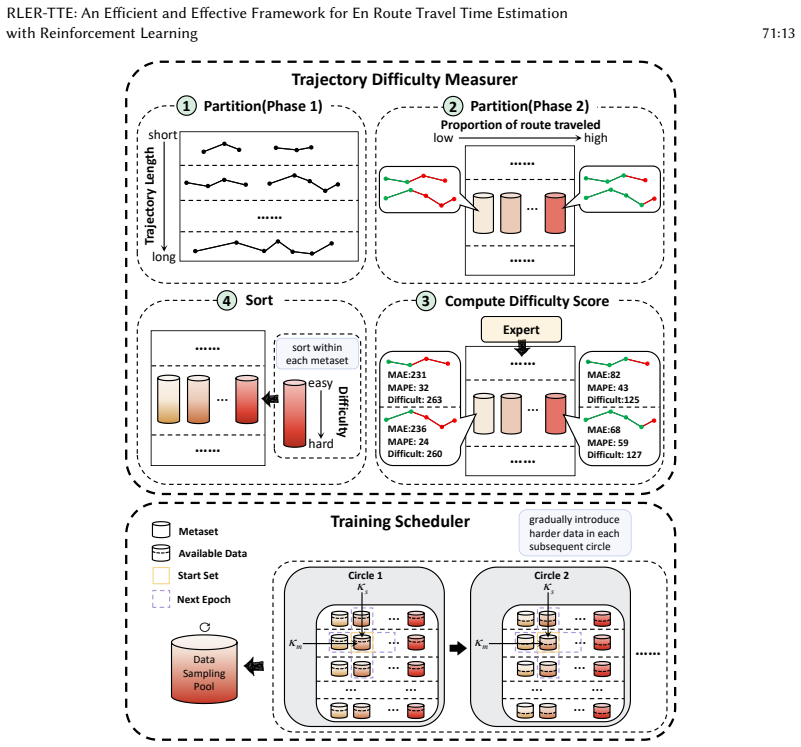
The central object is the Decision Maker/Predictor pipeline. The Decision Maker is a Double-DQN network that maps a fused state—offline embeddings of road-network structure, time slots, and historical traffic, plus online embeddings of driving behavior and past decisions—through separate multi-head self-attention encoders, an online-offline attention fusion, and an InfoNCE contrastive-alignment loss, to choose one of two actions: re-predict or look up the cached estimate. The reward (Eqs. 1–4) combines a prediction-difference term $r_p$, an efficiency penalty $r_e$ for using the Predictor, and a linear frequency reward $r_f$ that encourages re-prediction after a long gap. The Predictor is trained end-to-end with a curriculum that partitions trajectories by length and traveled proportion, ranks samples within each metaset by an expert model's MAE plus MAPE, and gradually introduces harder data. The complexity analysis shows the Decision Maker is an order of magnitude cheaper than the Predictor, which is what makes the gate viable.
What would settle it
Take the trained Decision Maker to a held-out set of en-route requests, and at each state compare its chosen action with the action that actually yields lower absolute error against the true remaining travel time; if the agent's choices track the sign of $\hat{y}_{dl} - \hat{y}_{rp}$ rather than which estimate is closer to ground truth, the reward is not measuring accuracy.
Extended reading notes
Core claim
The central claim is that en-route travel time estimation should be recast as a learned cache-versus-recompute decision rather than an unconditional re-prediction at every request. The RLER-TTE framework places a lightweight Double-DQN agent, the Decision Maker, in front of a heavy estimation model, the Predictor, instantiated with either MetaER-TTE or SSML. At each request the agent receives a state built from attention-encoded offline route features and online driving-behavior and decision-history features, then chooses between re-prediction and direct lookup from an Inference Memory that stores the most recent prediction. The reward is the signed difference between the two estimates, plus an efficiency penalty and a recency term. On the paper's end-to-end evaluation over all requests along each trajectory, RLER-TTE reports lower MAE, RMSE, and MAPE than MetaER-TTE on all three datasets while using the expensive Predictor for only about a quarter of requests, which the paper attributes to the Decision Maker selectively feeding useful real-time information to the Predictor.
Load-bearing premise
The reward the Decision Maker learns from compares the two predictor outputs to each other, never to the true remaining travel time, so the entire policy assumes that choosing the numerically smaller estimate is the same as choosing the more accurate one.
Editorial extensions
If this is right
- At the claimed utilization rates (22.8–25.6%), an ER-TTE service can serve roughly four times as many real-time requests with the same predictor compute, because only about a quarter of requests trigger re-prediction.
- Under the paper's end-to-end protocol, each trajectory contributes many training requests with different traveled proportions, so a model trained this way is evaluated on the full range of online requests rather than one fixed proportion.
- The framework is portable across predictors: swapping MetaER-TTE for SSML still improves over the SSML baseline, so the gate does not depend on one estimation model.
- Within this two-action discrete setting, the paper's Double-DQN agent beats PPO and A3C variants, which suggests value-based RL is the better fit for cache-versus-recompute decisions.
- Longer request intervals raise MAPE for both the proposed method and MetaER-TTE, and raise the model utilization rate, so update frequency is a real operating parameter for ER-TTE systems.
Reading between the lines
- The reward in Eq. (1) uses only the signed difference between the two predictor outputs; an obvious unstated test is whether a reward based on true remaining-time error changes the learned policy and the reported accuracy/efficiency trade-off.
- The same learned gate could be dropped into other online prediction services where cached outputs can be reused—ETA widgets, route re-optimization, or real-time arrival estimates—since it needs only two outputs, a diff-like reward, and a recency term.
- The paper's interval experiments imply system operators could tune the request interval as a compute-quality knob; the authors do not provide a cost model that translates MUR and MAPE into server cost, but the data make such a model straightforward to build.
- A useful extension would compare the trained agent against simple threshold heuristics, such as skipping re-prediction when average speed barely changed, to see how much of the gain comes from learning rather than from the gate structure itself.
Editorial analysis
A structured set of objections, weighed in public.
Referee Report
Summary. The paper proposes RLER-TTE, a framework for en-route travel time estimation that separates online inference into a lightweight Decision Maker and a Predictor. The Decision Maker, trained with Double DQN, chooses at each request whether to invoke the expensive prediction model or reuse the last stored result; the Predictor is an existing ER-TTE model (SSML or MetaER-TTE). The state representation combines offline route features with online driving-behavior features using self-attention, contrastive learning, and cross-attention fusion. Training includes experience replay, an end-to-end multi-request evaluation protocol, and a curriculum-learning scheduler for the Predictor. Experiments on Chengdu, Xi'an, and Porto report lower MAE, RMSE, and MAPE than several baselines, with a model utilization rate around 23-26% and reduced estimation latency.
Significance. If the accuracy and efficiency claims hold, the paper addresses a practically important problem: large-scale TTE services receive many en-route requests, and a learned selective-invocation policy could reduce expensive model calls by roughly a factor of four. The paper has clear strengths: the end-to-end evaluation with multiple requests per trajectory is more realistic than the fixed-proportion protocol used by prior ER-TTE work; the ablations (ND, NU, NA) and the PPO/A3C variants test several design choices; and the use of two different Predictors supports the claim that the framework is predictor-agnostic. The efficiency numbers in Table 4 are directly measured and plausible. However, the accuracy claims are seriously weakened by the reward misspecification in Eq. (1), which trains the Decision Maker to prefer the smaller of two predictor outputs rather than the estimate closer to the ground-truth remaining time. Because that reward is the only accuracy signal for the agent, the paper's central accuracy claim is not currently supported.
major comments (3)
- [Sec. 4.1, Eq. (1), and Algorithm 1, line 6] The performance reward is r_p = -(y_hat_dl - y_hat_rp) for direct lookup and r_p = -(y_hat_rp - y_hat_dl) for re-prediction. Expanding, the reward is y_hat_rp - y_hat_dl when a_i=0 and y_hat_dl - y_hat_rp when a_i=1, so in both cases the reward is maximized by taking the action whose output estimate is the smaller of the two numbers. No ground-truth remaining time Y_remain appears anywhere in Eqs. (1)-(4) or in the reward computation in Algorithm 1. The statement in Sec. 4.1 that the performance reward 'directly reflects the accuracy' is therefore false as written: minimizing MAE/MAPE requires comparing against Y_remain, not between the two candidate estimates. Because the Decision Maker is the only component that changes invocation decisions, this misspecification is load-bearing for the accuracy improvements claimed in Table 3 and Sec. 6.4. The reward should be redefined using each action's error against the ground truth (the labels Y are already inputs to Algorithm 1), or the authors must demonstrate empirically that choosing the smaller of the two estimates is a valid accuracy proxy for their predictors; in either case the experiments in Table 3 must be rerun.
- [Sec. 6.4, Table 3] The experimental comparison lacks policy-level control baselines. The paper compares RLER-TTE against full re-prediction baselines (MUR = 100%) and against architecture ablations (ND, NU, NA), but not against random decision-making, an always-lookup policy, an always-re-predict policy, or the trivial rule that always selects the smaller of the two estimates. Given the reward issue in Eq. (1), the reported accuracy gains could in principle be produced by a simple minimum-selection rule rather than by the learned state-dependent Double DQN policy. Adding these controls, or reporting per-action error conditioned on the learned policy, is necessary to support the attribution in Sec. 6.4, observation (6), and to make the MUR results interpretable.
- [Sec. 6.4, Table 3; Sec. 6.6, Table 4] All accuracy and efficiency numbers are reported from a single run, with no standard deviations or significance tests. The improvements over the strongest baseline are modest in several metrics (e.g., Chengdu MAPE 30.83% vs. MetaER-TTE's 33.87%; MAE 84.76s vs. 90.74s), so seed variability could change the conclusions. Please report means and standard deviations over multiple seeds (at least 3-5) and, where appropriate, paired significance tests for MAE, RMSE, MAPE, and MUR on all three datasets.
minor comments (4)
- [Sec. 5.1, Eq. (8)] The difficulty score mu_i = MAE + MAPE sums quantities with different units and scales (seconds and percentage), which makes the score sensitive to the arbitrary scaling of the two terms; please normalize the components or justify the additive combination.
- [Sec. 6.4, observation (2)] The sentence 'Avg performs worse compared to deep learning methods, because the former can approximately fit any function' is garbled: it should say that deep learning methods can approximate complex functions, while the historical-average method cannot.
- [Sec. 6.6, Table 4] The paper claims in Sec. 6.4, observation (7), a roughly fourfold reduction in computational load based on MUR, but the measured end-to-end latency reductions in Table 4 are closer to 2.5-3x (e.g., Chengdu 0.29s vs. 0.78s; Porto 0.27s vs. 0.86s). Please reconcile the MUR-based claim with the measured latency by reporting the Decision Maker's per-request overhead and end-to-end throughput.
- [Sec. 4.3, Table 1] The statement that the Decision Maker's complexity is 'an order of magnitude lower' than the baselines is not supported by the table: the Decision Maker's O(b n^2 d + b n d^2) is asymptotically comparable to MetaER-TTE's O(b n w d^2 + b n^2 d + b d^2 + b K d) when w and K are constants. Please qualify the complexity claim.
Circularity Check
No significant circularity: the reported accuracy gains are evaluated against ground truth, and the Eq. (1) reward, though an ungrounded proxy, does not by construction define the reported MAE/RMSE/MAPE improvements.
full rationale
I walked the paper's claimed derivation chain: the Decision Maker is a Double DQN agent whose reward (Eqs. 1-4) uses the Predictor's two outputs, yhat_dl and yhat_rp; the Predictor is an external ER-TTE model (SSML or MetaER-TTE); and the final evaluation (Table 3) computes MAE, RMSE, and MAPE against the true remaining travel time. No step reduces to its own input by construction: the agent's policy is trained to maximize a proxy reward, but the headline accuracy claims are measured against ground truth, so they are not forced by the reward definition. The skeptical observation about Eq. (1) is correct as a correctness critique: r_p = -(yhat_dl - yhat_rp) for lookup and r_p = -(yhat_rp - yhat_dl) for re-prediction is maximized by choosing the smaller of the two estimates, with no term involving the true remaining time, so the 'performance reward directly reflects the accuracy' statement is not established. However, this is an ungrounded or miscalibrated reward/proxy problem, not circularity: the reward does not define the evaluation metric, and the paper's reported gains could in principle be true or false independently of the reward's validity. The curriculum-learning difficulty score (Eq. 8) uses an expert model's MAE+MAPE to order training data, but the expert is a separate randomly trained model and the final predictor is evaluated on held-out ground truth, so this is also not circular. No load-bearing self-citation or imported uniqueness theorem appears; the baselines (SSML, MetaER-TTE, ConST, etc.) are external prior works. I therefore find no significant circularity and set the score to 0, while noting that the reward-grounding issue is a substantive correctness risk that should be addressed in a revision.
Assumptions & free parameters
free parameters (5)
- omega_p (efficiency penalty) =
not reported
- alpha, beta (frequency reward coefficients) =
not reported
- lambda (contrastive loss weight) =
0.1 (Chengdu, Xi'an), 0.2 (Porto)
- N, M, kappa_s, kappa_m (curriculum partition and start) =
N=8,M=4,kappa_s=0.5,kappa_m=0.4 (Chengdu); N=10,M=5,kappa_s=0.5,kappa_m=0.4 (Xi'an); N=6,M=4,kappa_s=0.5,kappa_m=0.3…
- tau (InfoNCE temperature) =
not reported
assumptions (4)
- ad hoc to paper The reward r_p in Eq. (1) is a valid indicator of prediction quality.
- domain assumption The en-route decision process is Markovian, so the current state s_t contains all information relevant for the next decision.
- domain assumption Users issue prediction requests at fixed time intervals.
- domain assumption Map matching and linear interpolation yield link-level travel times that adequately represent ground-truth route states.
Cite this review
Pith. "Pith review of RLER-TTE: An Efficient and Effective Framework for En Route Travel Time Estimation with Reinforcement Learning." pith.science (2026). https://pith.science/paper/LCRA2QJE
@misc{pith2026250115493,
  author       = {Pith},
  title        = {Pith review of: RLER-TTE: An Efficient and Effective Framework for En Route Travel Time Estimation with Reinforcement Learning},
  year         = {2026},
  howpublished = {\url{https://pith.science/paper/LCRA2QJE}},
  note         = {Machine review of arXiv:2501.15493}
}
read the original abstract
En Route Travel Time Estimation (ER-TTE) aims to learn driving patterns from traveled routes to achieve rapid and accurate real-time predictions. However, existing methods ignore the complexity and dynamism of real-world traffic systems, resulting in significant gaps in efficiency and accuracy in real-time scenarios. Addressing this issue is a critical yet challenging task. This paper proposes a novel framework that redefines the implementation path of ER-TTE to achieve highly efficient and effective predictions. Firstly, we introduce a novel pipeline consisting of a Decision Maker and a Predictor to rectify the inefficient prediction strategies of current methods. The Decision Maker performs efficient real-time decisions to determine whether the high-complexity prediction model in the Predictor needs to be invoked, and the Predictor recalculates the travel time or infers from historical prediction results based on these decisions. Next, to tackle the dynamic and uncertain real-time scenarios, we model the online decision-making problem as a Markov decision process and design an intelligent agent based on reinforcement learning for autonomous decision-making. Moreover, to fully exploit the spatio-temporal correlation between online data and offline data, we meticulously design feature representation and encoding techniques based on the attention mechanism. Finally, to improve the flawed training and evaluation strategies of existing methods, we propose an end-to-end training and evaluation approach, incorporating curriculum learning strategies to manage spatio-temporal data for more advanced training algorithms. Extensive evaluations on three real-world datasets confirm that our method significantly outperforms state-of-the-art solutions in both accuracy and efficiency.
Figures


Figures from the paper (6 more)


Reference graph
Works this paper leans on
- [1]
-
[2]
2024. OpenStreetMap. https://www.openstreetmap.org Proc. ACM Manag. Data, Vol. 3, No. 1 (SIGMOD), Article 71. Publication date: February 2025. RLER-TTE: An Efficient and Effective Framework for En Route Travel Time Estimation with Reinforcement Learning 71:25
work page 2024
-
[3]
Ritesh Ahuja, Sepanta Zeighami, Gabriel Ghinita, and Cyrus Shahabi. 2023. A Neural Approach to Spatio-Temporal Data Release with User-Level Differential Privacy. In SIGMOD, Vol. 1. 21:1–21:25
work page 2023
-
[4]
Sotiris Brakatsoulas, Dieter Pfoser, Randall Salas, and Carola Wenk. 2005. On Map-Matching Vehicle Tracking Data. In VLDB, Klemens Böhm, Christian S. Jensen, Laura M. Haas, Martin L. Kersten, Per-Åke Larson, and Beng Chin Ooi (Eds.). ACM, 853–864
work page 2005
-
[5]
Minxiao Chen, Haitao Yuan, Nan Jiang, Zhifeng Bao, and Shangguang Wang. 2024. Urban Traffic Accident Risk Prediction Revisited: Regionality, Proximity, Similarity and Sparsity. In Proceedings of the 33rd ACM International Conference on Information and Knowledge Management, CIKM 2024, Boise, ID, USA, October 21-25, 2024 . ACM, 281–290
work page 2024
-
[6]
Yu Fan, Jiajie Xu, Rui Zhou, Jianxin Li, Kai Zheng, Lu Chen, and Chengfei Liu. 2022. MetaER-TTE: An Adaptive Meta-learning Model for En Route Travel Time Estimation. In IJCAI, Luc De Raedt (Ed.). ijcai.org, 2023–2029
work page 2022
-
[7]
Xiaomin Fang, Jizhou Huang, Fan Wang, Lihang Liu, Yibo Sun, and Haifeng Wang. 2021. SSML: Self-Supervised Meta-Learner for En Route Travel Time Estimation at Baidu Maps. InSIGKDD, Feida Zhu, Beng Chin Ooi, and Chunyan Miao (Eds.). ACM, 2840–2848
work page 2021
-
[8]
Xiaomin Fang, Jizhou Huang, Fan Wang, Lingke Zeng, Haijin Liang, and Haifeng Wang. 2020. ConSTGAT: Contextual Spatial-Temporal Graph Attention Network for Travel Time Estimation at Baidu Maps. In SIGKDD, Rajesh Gupta, Yan Liu, Jiliang Tang, and B. Aditya Prakash (Eds.). ACM, 2697–2705
work page 2020
Show all 46 references
-
[9]
Chelsea Finn, Pieter Abbeel, and Sergey Levine. 2017. Model-Agnostic Meta-Learning for Fast Adaptation of Deep Networks. In ICML (Proceedings of Machine Learning Research, Vol. 70) , Doina Precup and Yee Whye Teh (Eds.). PMLR, 1126–1135
2017
-
[10]
Kun Fu, Fanlin Meng, Jieping Ye, and Zheng Wang. 2020. CompactETA: A Fast Inference System for Travel Time Prediction. In SIGKDD, Rajesh Gupta, Yan Liu, Jiliang Tang, and B. Aditya Prakash (Eds.). ACM, 3337–3345
2020
-
[11]
Aditya Grover and Jure Leskovec. 2016. node2vec: Scalable Feature Learning for Networks. In SIGKDD, Balaji Krishnapuram, Mohak Shah, Alexander J. Smola, Charu C. Aggarwal, Dou Shen, and Rajeev Rastogi (Eds.). ACM, 855–864
2016
-
[12]
Jindong Han, Hao Liu, Shui Liu, Xi Chen, Naiqiang Tan, Hua Chai, and Hui Xiong. 2023. iETA: A Robust and Scalable Incremental Learning Framework for Time-of-Arrival Estimation. In SIGKDD, Ambuj K. Singh, Yizhou Sun, Leman Akoglu, Dimitrios Gunopulos, Xifeng Yan, Ravi Kumar, Fa...
2023
-
[13]
Zhixiang He, Chi-Yin Chow, and Jia-Dong Zhang. 2019. STANN: A Spatio-Temporal Attentive Neural Network for Traffic Prediction. In IEEE Access, Vol. 7. 4795–4806
2019
-
[14]
Huiqi Hu, Guoliang Li, Zhifeng Bao, Jianhua Feng, Yongwei Wu, Zhiguo Gong, and Yaoqiang Xu. 2016. Top-k spatio-textual similarity join. In ICDE. IEEE Computer Society, 1576–1577
2016
-
[15]
Nan Jiang, Haitao Yuan, Jianing Si, Minxiao Chen, and Shangguang Wang. 2024. Towards Effective Next POI Prediction: Spatial and Semantic Augmentation with Remote Sensing Data. In ICDE. IEEE, 5061–5074
2024
-
[16]
Nokleby, and Jieping Ye
Ishan Jindal, Zhiwei (Tony) Qin, Xue-wen Chen, Matthew S. Nokleby, and Jieping Ye. 2017. A Unified Neural Network Approach for Estimating Travel Time and Distance for a Taxi Trip. CoRR abs/1710.04350 (2017)
2017 arXiv
-
[17]
Kingma and Jimmy Ba
Diederik P. Kingma and Jimmy Ba. 2015. Adam: A Method for Stochastic Optimization. In ICLR, Yoshua Bengio and Yann LeCun (Eds.)
2015
-
[18]
Yaguang Li, Kun Fu, Zheng Wang, Cyrus Shahabi, Jieping Ye, and Yan Liu. 2018. Multi-task Representation Learning for Travel Time Estimation. In SIGKDD, Yike Guo and Faisal Farooq (Eds.). ACM, 1695–1704
2018
-
[19]
Yan Lin, Huaiyu Wan, Jilin Hu, Shengnan Guo, Bin Yang, Youfang Lin, and Christian S. Jensen. 2023. Origin-Destination Travel Time Oracle for Map-based Services. In SIGMOD, Vol. 1. 217:1–217:27
2023
-
[20]
Zhao Liu, Mengquan Li, Mincan Li, Lei Liao, and Kenli Li. 2023. An Efficient Hierarchical-Reduction Architecture for Aggregation in Route Travel Time Estimation. In TPDS, Vol. 34. 2541–2552
2023
-
[21]
Yingtao Luo, Qiang Liu, and Zhaocheng Liu. 2021. STAN: Spatio-Temporal Attention Network for Next Location Recommendation. In WWW, Jure Leskovec, Marko Grobelnik, Marc Najork, Jie Tang, and Leila Zia (Eds.). ACM / IW3C2, 2177–2185
2021
-
[22]
Lillicrap, Tim Harley, David Silver, and Koray Kavukcuoglu
Volodymyr Mnih, Adrià Puigdomènech Badia, Mehdi Mirza, Alex Graves, Timothy P. Lillicrap, Tim Harley, David Silver, and Koray Kavukcuoglu. 2016. Asynchronous Methods for Deep Reinforcement Learning. In ICML (JMLR Workshop and Conference Proceedings, Vol. 48) , Maria-Florina Ba...
2016
-
[23]
John Schulman, Filip Wolski, Prafulla Dhariwal, Alec Radford, and Oleg Klimov. 2017. Proximal Policy Optimization Algorithms. In CoRR, Vol. abs/1707.06347
2017 arXiv
-
[24]
Cheng Tan, Zhangyang Gao, Lirong Wu, Yongjie Xu, Jun Xia, Siyuan Li, and Stan Z. Li. 2023. Temporal Attention Unit: Towards Efficient Spatiotemporal Predictive Learning. In CVPR. IEEE, 18770–18782
2023
-
[25]
Tran, Minyoung Mun, Matthew Lim, Jonah Yamato, Nathan Huh, and Cyrus Shahabi
Luan V. Tran, Minyoung Mun, Matthew Lim, Jonah Yamato, Nathan Huh, and Cyrus Shahabi. 2020. DeepTRANS: A Deep Learning System for Public Bus Travel Time Estimation using Traffic Forecasting. In VLDB, Vol. 13. 2957–2960
2020
-
[26]
Bertini, and James Rucker
Kristin Tufte, Jin Li, David Maier, Vassilis Papadimos, Robert L. Bertini, and James Rucker. 2007. Travel time estimation using NiagaraST and latte. In SIGMOD, Chee Yong Chan, Beng Chin Ooi, and Aoying Zhou (Eds.). ACM, 1091–1093. Proc. ACM Manag. Data, Vol. 3, No. 1 (SIGMOD),...
2007
-
[27]
Hado van Hasselt, Arthur Guez, and David Silver. 2016. Deep Reinforcement Learning with Double Q-Learning. In AAAI, Dale Schuurmans and Michael P. Wellman (Eds.). AAAI Press, 2094–2100
2016
-
[28]
J. W. C. van Lint. 2008. Online Learning Solutions for Freeway Travel Time Prediction. In TITS, Vol. 9. 38–47
2008
-
[29]
Gomez, Lukasz Kaiser, and Illia Polosukhin
Ashish Vaswani, Noam Shazeer, Niki Parmar, Jakob Uszkoreit, Llion Jones, Aidan N. Gomez, Lukasz Kaiser, and Illia Polosukhin. 2017. Attention is All you Need. In NIPS. 5998–6008
2017
-
[30]
Chenxing Wang, Fang Zhao, Haichao Zhang, Haiyong Luo, Yanjun Qin, and Yuchen Fang. 2022. Fine-Grained Trajectory-Based Travel Time Estimation for Multi-City Scenarios Based on Deep Meta-Learning. In TITS, Vol. 23. 15716–15728
2022
-
[31]
Dong Wang, Junbo Zhang, Wei Cao, Jian Li, and Yu Zheng. 2018. When Will You Arrive? Estimating Travel Time Based on Deep Neural Networks. In AAAI, Sheila A. McIlraith and Kilian Q. Weinberger (Eds.). AAAI Press, 2500–2507
2018
-
[32]
Hongjian Wang, Xianfeng Tang, Yu-Hsuan Kuo, Daniel Kifer, and Zhenhui Li. 2019. A Simple Baseline for Travel Time Estimation using Large-scale Trip Data. In TITS, Vol. 10. 19:1–19:22
2019
-
[33]
Yong Wang, Guoliang Li, Kaiyu Li, and Haitao Yuan. 2022. A Deep Generative Model for Trajectory Modeling and Utilization. Proc. VLDB Endow. 16, 4 (2022), 973–985
2022
-
[34]
Yilun Wang, Yu Zheng, and Yexiang Xue. 2014. Travel time estimation of a path using sparse trajectories. In SIGKDD, Sofus A. Macskassy, Claudia Perlich, Jure Leskovec, Wei Wang, and Rayid Ghani (Eds.). ACM, 25–34
2014
-
[35]
Zheng Wang, Kun Fu, and Jieping Ye. 2018. Learning to Estimate the Travel Time. In SIGKDD, Yike Guo and Faisal Farooq (Eds.). ACM, 858–866
2018
-
[36]
Carola Wenk, Randall Salas, and Dieter Pfoser. 2006. Addressing the Need for Map-Matching Speed: Localizing Globalb Curve-Matching Algorithms. In SSDBM. IEEE Computer Society, 379–388
2006
-
[37]
Xinle Wu, Dalin Zhang, Miao Zhang, Chenjuan Guo, Bin Yang, and Christian S. Jensen. 2023. AutoCTS+: Joint Neural Architecture and Hyperparameter Search for Correlated Time Series Forecasting. In SIGMOD, Vol. 1. 97:1–97:26
2023
-
[38]
Haitao Yuan, Gao Cong, and Guoliang Li. 2024. Nuhuo: An Effective Estimation Model for Traffic Speed Histogram Imputation on A Road Network. In VLDB, Vol. 17. 1605–1617
2024
-
[39]
Haitao Yuan and Guoliang Li. 2019. Distributed In-memory Trajectory Similarity Search and Join on Road Network. In ICDE. IEEE, 1262–1273
2019
-
[40]
Haitao Yuan and Guoliang Li. 2021. A Survey of Traffic Prediction: from Spatio-Temporal Data to Intelligent Trans- portation. Data Sci. Eng. 6, 1 (2021), 63–85
2021
-
[41]
Haitao Yuan, Guoliang Li, and Zhifeng Bao. 2022. Route Travel Time Estimation on A Road Network Revisited: Heterogeneity, Proximity, Periodicity and Dynamicity. InVLDB, Vol. 16. 393–405
2022
-
[42]
Haitao Yuan, Guoliang Li, Zhifeng Bao, and Ling Feng. 2020. Effective Travel Time Estimation: When Historical Trajectories over Road Networks Matter. In SIGMOD, David Maier, Rachel Pottinger, AnHai Doan, Wang-Chiew Tan, Abdussalam Alawini, and Hung Q. Ngo (Eds.). ACM, 2135–2149
2020
-
[43]
Haitao Yuan, Guoliang Li, Zhifeng Bao, and Ling Feng. 2021. An Effective Joint Prediction Model for Travel Demands and Traffic Flows. In ICDE. IEEE, 348–359
2021
-
[44]
Hanyuan Zhang, Hao Wu, Weiwei Sun, and Baihua Zheng. 2018. DeepTravel: a Neural Network Based Travel Time Estimation Model with Auxiliary Supervision. In IJCAI, Jérôme Lang (Ed.). ijcai.org, 3655–3661
2018
-
[45]
Wen Zhang, Yang Wang, Xike Xie, Chuancai Ge, and Hengchang Liu. 2020. Real-time Travel Time Estimation with Sparse Reliable Surveillance Information. In Proc. ACM Interact. Mob. Wearable Ubiquitous Technol. , Vol. 4. 36:1–36:23
2020
-
[46]
Haifeng Zheng, Feng Lin, Xinxin Feng, and Youjia Chen. 2021. A Hybrid Deep Learning Model With Attention-Based Conv-LSTM Networks for Short-Term Traffic Flow Prediction. In TITS, Vol. 22. 6910–6920. Received July 2024; revised September 2024; accepted November 2024 Proc. ACM M...
2021
Reviewed August 10, 2026 · model on record in the stance chip above.
Discussion (0). Continue with ORCID to comment.