REVIEW 3 major objections 4 minor 1 cited by
Estimating Committor Functions via Deep Adaptive Sampling on Rare Transition Paths
T0 review · 3 major / 4 minor · reviewed 2026-08-10 · deepseek-v4-flash
Pith's one-line read DASTR breaks the transition-data bottleneck in neural committor estimation by sampling from the gradient-weighted Boltzmann density, and its autoencoder variant makes the scheme usable on molecules.
desk verdict Solid adaptive sampling scheme with convincing synthetic gains, but the latent-space variant's stated target distribution is unjustified and needs work before the molecular claims stand. read the letter →
The pith
A machine-rendered reading of the paper's core claim, the machinery that carries it, and where it could break.
The reading
What carries the argument
The load-bearing object is the target density $p_{V,q}(x)=|\nabla q_\theta(x)|^2 e^{-\beta V(x)}/C$ (or with a bias potential added), which assigns more weight where the committor changes fastest, that is, in the transition-state region. The second object is a normalizing-flow density model (the paper uses KRnet) that approximates this target by minimizing cross-entropy with importance weights and generates new training points through the inverse flow. The third is a trained autoencoder whose latent variables serve as automatically selected collective variables, so that flow samples can be decoded into molecular geometries and then filtered by an energy threshold. Together these pieces turn the variational loss into an adaptive importance-sampling loop: train $q_\theta$, locate where its gradient is large, generate fresh samples there, retrain.
What would settle it
Replace the latent-space identification with the exact change-of-variables formula, multiplying the target density by the encoder Jacobian determinant, and compare the decoded samples and committor error on alanine dipeptide against the reported results; if the corrected sampler does not match or improve the accuracy, the stated mechanism is not what produces the gains. A cheaper check is to compare histograms of $|\nabla q_\theta|^2 e^{-\beta V}$ at decoded versus directly sampled configurations.
Extended reading notes
Core claim
The committor $q(x)$ is the probability that a trajectory starting at $x$ reaches $B$ before $A$; it solves a high-dimensional linear PDE. DASTR's central move is to define an adaptive target $p_{V,q}(x) \propto |\nabla q_\theta(x)|^2 e^{-\beta V(x)}$, optionally with a bias potential that lowers the barrier, approximate this target by a normalizing-flow model, draw new training points from it, retrain $q_\theta$, and repeat. Because the gradient of the committor concentrates near the transition state, the generated points land preferentially on rare transition paths. For realistic molecular systems the same loop is run on low-dimensional latent collective variables: an autoencoder maps atomic coordinates to latent variables, the flow samples in latent space, and a decoder reconstructs molecular configurations, which are then filtered by potential energy. The paper reports that this latent-space DASTR produces physically valid alanine dipeptide configurations with high probability while reducing molecular sampling time by more than 95% relative to DASTR combined with umbrella sampling.
Load-bearing premise
The load-bearing premise is Eq. (11), which treats the sampling density on the autoencoder's latent variables as equal to the density on atomic coordinates without correcting for the fact that many atomic configurations can map to the same latent point; if that identification fails, the autoencoder version of DASTR samples from a distribution that is not the intended importance target.
Editorial extensions
If this is right
- At fixed sample size, DASTR reduces the $L^2$ error of the estimated committor by roughly an order of magnitude on the rugged Mueller test, with faster error decay as the sample budget grows.
- The autoencoder variant removes the need to hand-pick collective variables and avoids SDE-based umbrella sampling for generating transition-state molecules, making the pipeline more general for molecular systems.
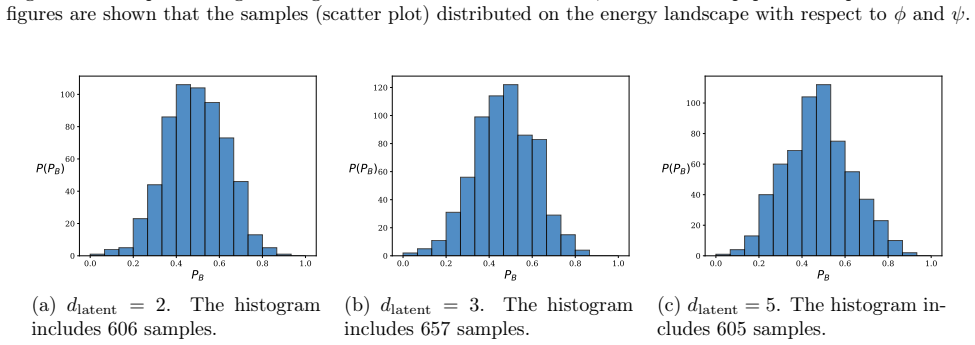
- In the alanine dipeptide test, committor values on the 0.5 level set produced by DASTR cluster around 0.5, whereas a network trained on metadynamics samples alone spreads widely, indicating better resolution of the transition-state ensemble.
- In the latent-space setting, over 97% of decoded molecular configurations pass the 150 kJ/mol energy filter, while direct flow sampling on heavy-atom coordinates yields almost no physically valid configurations, so the latent space is what makes the construction physical.
Reading between the lines
- The paper's identification $p_{V,q}(s(x))=p_{V,q}(x)$ in Eq. (11) drops the encoder's Jacobian and many-to-one structure; a corrected target that accounts for the change of variables is a natural extension and could be tested on the same benchmarks.
- Because the sampling target is driven by the current network's gradient, DASTR is a form of self-training; a stopping rule or convergence analysis based on successive changes of the flow target would clarify when the iterative loop has extracted the available transition information.
- The energy threshold is applied as a post-processing filter rather than being built into the sampling density; including a truncated or reweighted target might raise the fraction of usable samples further.
- The same 'gradient as density' recipe applies to any variational loss with a nonnegative integrand, so a similar adaptive collocation principle should transfer to other high-dimensional PDE solvers beyond committor estimation.
Editorial analysis
A structured set of objections, weighed in public.
Referee Report
Summary. The paper proposes DASTR, an iterative deep adaptive sampling method for training neural-network approximations of the committor function. Starting from a standard variational formulation, DASTR defines a sampling density proportional to |∇q_θ|^2 e^{-βV}, approximates it with a normalizing flow (KRnet), and uses newly generated samples to refine the training set. For high-dimensional molecular systems the algorithm is applied in a reduced latent space, either with hand-picked collective variables combined with umbrella sampling or with autoencoder-learned latent variables decoded back to atomic coordinates. Numerical experiments cover a 10D rugged Mueller potential, a 20D Brownian-motion problem, and alanine dipeptide (d=66), reporting improved L2 errors relative to SDE, uniform, and artificial-temperature baselines, as well as a 97% molecular-validity rate and more than 95% sampling-time reduction for the autoencoder variant.
Significance. If the claims hold, DASTR addresses a real bottleneck in neural committor estimation: the scarcity of transition-region data. The paper has clear strengths: the variational loss is standard and correctly derived; the synthetic benchmarks use external reference solutions (FEniCS and an analytic formula); implementation details in Appendix B are unusually complete; and the KRnet sampling procedure is fully specified. The comparison of sampling-time in Table 3 is a useful practical metric. The main technical risk is the latent-space density identification in Section 3.4, which is load-bearing for the alanine-dipeptide claim. The evaluation on the 1/2-isosurface is informative but not sufficient to establish global accuracy. The absence of comparisons with the closest adaptive committor methods [11,14] limits the strength of the claimed improvement. These issues are fixable, so the correct disposition is major revision rather than rejection.
major comments (3)
- [Section 3.4, Eq. (11)] The identity p_{V,q}(s(x)) = p_{V,q}(x) is not a valid density transformation. Since the encoder s: R^d -> R^m is many-to-one with m < d, the density induced by p_{V,q} on the latent coordinates is the pushforward ρ(s) = ∫_{x: s(x)=s} p_{V,q}(x) (det(J_s(x) J_s(x)^T))^{-1/2} dσ(x), not p_{V,q}(x) evaluated at a single preimage. As a result, Eq. (14) and Algorithm 2 train the latent KRnet on an inconsistent objective, and the decoded samples are not, in general, samples from a distribution proportional to |∇q|^2 e^{-βV}. The reported alanine-dipeptide results may still hold empirically, but the stated mechanism for the autoencoder variant is not justified by the equations as written. Please derive the correct pushforward and the associated importance weights, or explicitly reformulate the latent-space objective as an approximation and validate it, for example by comparing weighted moments or effective sample sizes against the intended target.
- [Section 4.3, Figures 11 and 15] The realistic-system evaluation rests entirely on the 1/2-isosurface of q_θ: test points are selected by the condition |q_θ(x) - 0.5| ≤ 5 × 10^{-5}, and their committor values are then estimated by short SDE simulations. This is a necessary condition but not a sufficient one: a systematically biased q_θ can have a level set on which the empirical PB concentrates near 0.5 while the function is inaccurate elsewhere, and the filtering step uses q_θ itself to select the test points. To support the claim that the latent autoencoder variant provides a good approximation of the committor, the authors should add a more global check, such as evaluating PB on multiple isosurfaces (for example 0.3 and 0.7) with points selected independently of q_θ, or comparing against a reference obtained by an independent method.
- [Section 1.1 and Section 4] The closest adaptive committor methods — active importance sampling for variational objectives [11] and deep adaptive committor sampling [14], and arguably the committor-to-committor method [13] — are cited but never used as baselines. The numerical comparisons are limited to SDE sampling, uniform sampling, artificial temperature, and umbrella/metadynamics. Since the paper's central claim concerns the advantage of adaptive sampling over non-adaptive and potential-modification strategies, at least one direct numerical comparison with [14] or [11] is needed to calibrate the significance of the reported gains. Without such a comparison, the improvement over 'baseline methods' is not benchmarked against the state of the art.
minor comments (4)
- [Throughout] Typographical errors such as 'commttor', 'standaredd-dimensional', and 'committer' should be corrected.
- [Eq. (12)] The proposal density is written as p_IS(s(x_i)) = e^{-βV_modified(x_i)}, which is not a normalized density on the collective variable s. If unnormalized weights are intentional because constant normalization factors cancel in the cross-entropy minimization, this should be stated explicitly.
- [Table 2] In the DASTR row with 20 neurons and |S| = 5 × 10^3, the reported mean is 0.0266 with standard deviation 0.1396, so the standard deviation is larger than the mean. This indicates high variance across runs and should be discussed or addressed with more seeds.
- [Section 4.3.2] The support or bounding box of the KRnet in the latent space is not specified; since the decoder may map out-of-support latent points to unphysical states, a sentence on how the latent range is determined would improve reproducibility.
Circularity Check
No significant circularity: DASTR's accuracy is checked against external references; adaptive use of q_theta is training feedback, not a relabeled fit.
full rationale
The paper's central derivation is self-contained: DASTR defines a sampling density p_V,q(x) = |nabla q_theta(x)|^2 e^{-beta V(x)} / C that depends on the current neural approximation q_theta, uses a normalizing flow (KRnet) to draw fresh collocation points, and retrains q_theta. This is an adaptive importance-sampling loop rather than a prediction forced by construction, because the reported accuracies are measured against independent references: a finite-element solution for the 10D rugged Mueller potential, the analytical solution for 20D Brownian motion, and SDE-estimated first-hitting probabilities on the 1/2-isosurface for alanine dipeptide. The isosurface validation does select points using q_theta, but the empirical hitting probabilities come from new stochastic simulations, so a wrong q_theta would produce histograms not centered at 0.5. Self-citations to KRnet and to the authors' earlier DAS-PINNs papers describe standard tools and a general adaptive-sampling framework; no uniqueness theorem or unverified prior result is load-bearing, and the text explicitly notes other exact-likelihood generative models could replace KRnet. The main caveat is not circularity: Eq. (11), p_V,q(s(x)) = p_V,q(x), equates a density on atomic coordinates with a density on latent collective variables without a Jacobian or fiber-integration factor, so the latent-space target in Eq. (14) is not the true pushforward measure. This is an omitted mathematical justification for the autoencoder variant, and it should be weighed as a correctness risk, but the empirical claims (97% validity, timing reduction, isosurface histograms) are not equivalent to the inputs of the method. Hence no circular step is exhibited, and the circularity score is 0.
Assumptions & free parameters
free parameters (4)
- Energy threshold for generated configuration filtering =
150 kJ/mol
- Boundary penalty weight λ =
10 or 1000
- Umbrella force constant k_us =
200 to 400 kJ/mol
- Metadynamics deposition parameters =
w = 1.0 kJ/mol, σ = 0.1 rad, period = 1000 steps
assumptions (5)
- standard math The committor function satisfies the Fokker-Planck PDE (2), and the variational problem (3) is equivalent to it.
- ad hoc to paper The sampling target p_{V,q} ∝ |∇q|² e^{-βV} is a suitable importance-sampling distribution for the variational loss.
- ad hoc to paper In the latent space, p_{V,q}(s(x)) = p_{V,q}(x) defines a valid sampling density on collective variables.
- domain assumption Autoencoder-decoded latent samples produce physically reasonable molecular configurations after an energy filter.
- domain assumption Metadynamics samples provide a sufficient initial training set covering the transition region.
invented entities (1)
-
Latent collective variables learned by the autoencoder
Cite this review
Pith. "Pith review of Estimating Committor Functions via Deep Adaptive Sampling on Rare Transition Paths." pith.science (2026). https://pith.science/paper/XLSJOCBQ
@misc{pith2026250115522,
  author       = {Pith},
  title        = {Pith review of: Estimating Committor Functions via Deep Adaptive Sampling on Rare Transition Paths},
  year         = {2026},
  howpublished = {\url{https://pith.science/paper/XLSJOCBQ}},
  note         = {Machine review of arXiv:2501.15522}
}
read the original abstract
The committor functions are central to investigating rare but important events in molecular simulations. It is known that computing the committor function suffers from the curse of dimensionality. Recently, using neural networks to estimate the committor function has gained attention due to its potential for high-dimensional problems. Training neural networks to approximate the committor function needs to sample transition data from straightforward simulations of rare events, which is very inefficient. The scarcity of transition data makes it challenging to approximate the committor function. To address this problem, we propose an efficient framework to generate data points in the transition state region that helps train neural networks to approximate the committor function. We design a Deep Adaptive Sampling method for TRansition paths (DASTR), where deep generative models are employed to generate samples to capture the information of transitions effectively. In particular, we treat a non-negative function in the integrand of the loss functional as an unnormalized probability density function and approximate it with the deep generative model. The new samples from the deep generative model are located in the transition state region and fewer samples are located in the other region. This distribution provides effective samples for approximating the committor function and significantly improves the accuracy. We demonstrate the effectiveness of the proposed method through both simulations and realistic examples.
Figures


Figures from the paper (12 more)


Forward citations
Cited by 1 Pith paper
-
Commitment Before Realization: When Classifier-Free Guidance Becomes Unnecessary in Masked Diffusion Language Models
A prompt-specific commitment horizon, identified by comparing guided versus base-only continuations, marks an early point where classifier-free guidance can be removed with little loss in constraint success.
Reference graph
Works this paper leans on
-
[11]
G. M. Rotskoff, A. R. Mitchell, E. Vanden-Eijnden, Active importance sampling for vari- ational objectives dominated by rare events: Consequences for optimization and general- ization, in: Mathematical and Scientific Machine Learning, PMLR, 2022, pp. 757–780. 23
work page 2022
-
[14]
B. Lin, W. Ren, Deep learning method for computing committor functions with adaptive sampling, arXiv preprint arXiv:2404.06206 (2024)
arXiv 2024
-
[13]
P. Kang, E. Trizio, M. Parrinello, Computing the committor with the committor to study the transition state ensemble, Nature Computational Science (2024) 1–10
work page 2024
-
[1]
N. Okuyama-Yoshida, M. Nagaoka, T. Yamabe, Transition-state optimization on free en- ergy surface: Toward solution chemical reaction ergodography, International Journal of Quantum Chemistry 70 (1) (1998) 95–103
work page 1998
-
[2]
W. E, E. Vanden-Eijnden, Towards a theory of transition paths, Journal of Statistical Physics 123 (3) (2006) 503–523
work page 2006
-
[3]
A. Berteotti, A. Cavalli, D. Branduardi, F. L. Gervasio, M. Recanatini, M. Parrinello, Pro- tein conformational transitions: the closure mechanism of a kinase explored by atomistic simulations, Journal of the American Chemical Society 131 (1) (2009) 244–250
work page 2009
-
[4]
W. E, E. Vanden-Eijnden, Transition-path theory and path-finding algorithms for the study of rare events., Annual Review of Physical Chemistry 61 (2010) 391–420
work page 2010
-
[5]
R. Lai, J. Lu, Point cloud discretization of Fokker–Planck operators for committor func- tions, Multiscale Modeling & Simulation 16 (2) (2018) 710–726
work page 2018
Show all 55 references
-
[6]
Q. Li, B. Lin, W. Ren, Computing committor functions for the study of rare events using deep learning, The Journal of Chemical Physics 151 (5) (2019) 054112
2019
-
[7]
Y. Chen, J. Hoskins, Y. Khoo, M. Lindsey, Committor functions via tensor networks, Journal of Computational Physics 472 (2023) 111646
2023
-
[8]
Y. Khoo, J. Lu, L. Ying, Solving for high-dimensional committor functions using artificial neural networks, Research in the Mathematical Sciences 6 (1) (2019) 1–13
2019
-
[9]
H. Li, Y. Khoo, Y. Ren, L. Ying, A semigroup method for high dimensional committor functions based on neural network, in: Mathematical and Scientific Machine Learning, PMLR, 2022, pp. 598–618
2022
-
[10]
H. Li, Y. Khoo, Y. Ren, L. Ying, Solving for high dimensional committor functions using neural network with online approximation to derivatives, arXiv preprint arXiv:2012.06727 (2020)
2020 arXiv
-
[12]
M. R. Hasyim, C. H. Batton, K. K. Mandadapu, Supervised learning and the finite- temperature string method for computing committor functions and reaction rates, The Journal of Chemical Physics 157 (18) (2022)
2022
-
[15]
W. Gao, C. Wang, Active learning based sampling for high-dimensional nonlinear partial differential equations, Journal of Computational Physics 475 (2023) 111848
2023
-
[16]
K. Tang, X. Wan, C. Yang, DAS-PINNs: A deep adaptive sampling method for solv- ing high-dimensional partial differential equations, Journal of Computational Physics 476 (2023) 111868
2023
-
[17]
X. Wang, K. Tang, J. Zhai, X. Wan, C. Yang, Deep Adaptive Sampling for Surrogate Modeling Without Labeled Data, Journal of Scientific Computing 101 (3) (2024) 77.doi: 10.1007/s10915-024-02711-1
2024 doi
-
[18]
K. Tang, J. Zhai, X. Wan, C. Yang, Adversarial adaptive sampling: Unify PINN and op- timal transport for the approximation of PDEs, in: The Twelfth International Conference on Learning Representations, 2024
2024
-
[19]
Z. Gao, L. Yan, T. Zhou, Failure-informed adaptive sampling for pinns, SIAM Journal on Scientific Computing 45 (4) (2023) A1971–A1994
2023
-
[20]
Y. Jiao, D. Li, X. Lu, J. Z. Yang, C. Yuan, A Gaussian mixture distribution-based adap- tive sampling method for physics-informed neural networks, Engineering Applications of Artificial Intelligence 135 (2024) 108770
2024
-
[21]
Czibula, A.-I
G. Czibula, A.-I. Albu, M. I. Bocicor, C. Chira, Autoppi: An ensemble of deep autoen- coders for protein–protein interaction prediction, Entropy 23 (6) (2021) 643
2021
-
[22]
F. F. Alam, T. Rahman, A. Shehu, Learning reduced latent representations of protein structure data, in: Proceedings of the 10th ACM International Conference on Bioinfor- matics, Computational Biology and Health Informatics, 2019, pp. 592–597
2019
-
[23]
Hawkins-Hooker, F
A. Hawkins-Hooker, F. Depardieu, S. Baur, G. Couairon, A. Chen, D. Bikard, Generating functional protein variants with variational autoencoders, PLoS Computational Biology 17 (2) (2021) e1008736
2021
-
[24]
Sirignano, K
J. Sirignano, K. Spiliopoulos, DGM: A deep learning algorithm for solving partial differ- ential equations, Journal of Computational Physics 375 (2018) 1339–1364
2018
-
[25]
Raissi, P
M. Raissi, P. Perdikaris, G. E. Karniadakis, Physics-informed neural networks: A deep learning framework for solving forward and inverse problems involving nonlinear partial differential equations, Journal of Computational Physics 378 (2019) 686–707. 24
2019
-
[26]
G. E. Karniadakis, I. G. Kevrekidis, L. Lu, P. Perdikaris, S. Wang, L. Yang, Physics- informed machine learning, Nature Reviews Physics 3 (6) (2021) 422–440
2021
-
[27]
W. E, B. Yu, The deep Ritz method: A deep learning-based numerical algorithm for solving variational problems, Communications in Mathematics and Statistics 6 (1) (2018) 1–12
2018
-
[28]
Y. Liao, P. Ming, Deep Nitsche Method: Deep Ritz Method with Essential Boundary Conditions, Communications in Computational Physics 29 (5) (2021) 1365–1384
2021
-
[29]
Y. Lu, J. Lu, M. Wang, A priori generalization analysis of the deep Ritz method for solving high dimensional elliptic partial differential equations, in: Conference on Learning Theory, PMLR, 2021, pp. 3196–3241
2021
-
[30]
J.Kästner, Umbrellasampling, WileyInterdisciplinaryReviews: ComputationalMolecular Science 1 (6) (2011) 932–942
2011
-
[31]
Bussi, A
G. Bussi, A. Laio, Using metadynamics to explore complex free-energy landscapes, Nature Reviews Physics 2 (4) (2020) 200–212
2020
-
[32]
A.Barducci, G.Bussi, M.Parrinello, Well-temperedmetadynamics: asmoothlyconverging and tunable free-energy method, Physical Review Letters 100 (2) (2008) 020603
2008
-
[33]
L. Dinh, J. Sohl-Dickstein, S. Bengio, Density estimation using real NVP, arXiv preprint arXiv:1605.08803 (2016)
2016 arXiv
-
[34]
D. P. Kingma, P. Dhariwal, Glow: Generative flow with invertible 1x1 convolutions, in: Advances in Neural Information Processing Systems, 2018, pp. 10215–10224
2018
-
[35]
T. Q. Chen, Y. Rubanova, J. Bettencourt, D. K. Duvenaud, Neural ordinary differential equations, in: Advances in Neural Information Processing Systems, 2018, pp. 6571–6583
2018
-
[36]
Y. Song, J. Sohl-Dickstein, D. P. Kingma, A. Kumar, S. Ermon, B. Poole, Score-based generative modeling through stochastic differential equations, in: International Conference on Learning Representations, 2021
2021
-
[37]
K.Tang, X.Wan, Q.Liao, Deepdensityestimationviainvertibleblock-triangularmapping, Theoretical & Applied Mechanics Letters 10 (2020) 143–148
2020
-
[38]
X. Wan, S. Wei, VAE-KRnet and its applications to variational Bayes, Communications in Computational Physics 31 (4) (2022) 1049–1082
2022
-
[39]
K. Tang, X. Wan, Q. Liao, Adaptive deep density approximation for Fokker-Planck equa- tions, Journal of Computational Physics 457 (2022) 111080
2022
-
[40]
De Boer, D
P.-T. De Boer, D. P. Kroese, S. Mannor, R. Y. Rubinstein, A tutorial on the cross-entropy method, Annals of Operations Research 134 (1) (2005) 19–67
2005
-
[41]
R. Y. Rubinstein, D. P. Kroese, The cross-entropy method: a unified approach to combi- natorial optimization, Monte-Carlo simulation and machine learning, Springer Science & Business Media, 2013. 25
2013
-
[42]
Fiorin, M
G. Fiorin, M. L. Klein, J. Hénin, Using collective variables to drive molecular dynamics simulations, Molecular Physics 111 (22-23) (2013) 3345–3362
2013
-
[43]
Schrödinger, The PyMOL Molecular Graphics System, Version 1.8., (No Title) (2015)
L. Schrödinger, The PyMOL Molecular Graphics System, Version 1.8., (No Title) (2015)
2015
-
[44]
Alnæs, J
M. Alnæs, J. Blechta, J. Hake, A. Johansson, B. Kehlet, A. Logg, C. Richardson, J. Ring, M.E.Rognes, G.N.Wells, TheFEniCSProjectVersion1.5, ArchiveofNumericalSoftware 3 (100) (2015)
2015
-
[45]
Logg, K.-A
A. Logg, K.-A. Mardal, G. Wells, Automated solution of differential equations by the finite element method: The FEniCS book, Vol. 84, Springer Science & Business Media, 2012
2012
-
[46]
Hartmann, O
C. Hartmann, O. Kebiri, L. Neureither, L. Richter, Variational approach to rare event simulation using least-squares regression, Chaos 29 (6) (2019)
2019
-
[47]
Nüsken, L
N. Nüsken, L. Richter, Interpolating between BSDEs and PINNs: Deep learning for elliptic and parabolic boundary value problems, Journal of Machine Learning 2 (1) (2023) 31–64
2023
-
[48]
Vershynin, High-dimensional probability: An introduction with applications in data science, Vol
R. Vershynin, High-dimensional probability: An introduction with applications in data science, Vol. 47, Cambridge University Press, 2018
2018
-
[49]
Ma, High-dimensional data analysis with low-dimensional models: Principles, Computation, and Applications, Cambridge University Press, 2022
J.Wright, Y. Ma, High-dimensional data analysis with low-dimensional models: Principles, Computation, and Applications, Cambridge University Press, 2022
2022
-
[50]
S. Jo, T. Kim, V. G. Iyer, W. Im, Charmm-gui: a web-based graphical user interface for charmm, Journal of Computational Chemistry 29 (11) (2008) 1859–1865
2008
-
[51]
B. R. Brooks, C. L. Brooks III, A. D. Mackerell Jr, L. Nilsson, R. J. Petrella, B. Roux, Y. Won, G. Archontis, C. Bartels, S. Boresch, et al., Charmm: the biomolecular simulation program, Journal of Computational Chemistry 30 (10) (2009) 1545–1614
2009
-
[52]
J. Lee, X. Cheng, S. Jo, A. D. MacKerell, J. B. Klauda, W. Im, Charmm-gui input generator for namd, gromacs, amber, openmm, and charmm/openmm simulations using the charmm36 additive force field, Biophysical Journal 110 (3) (2016) 641a
2016
-
[53]
McInnes, J
L. McInnes, J. Healy, J. Melville, Umap: Uniform manifold approximation and projection for dimension reduction, arXiv preprint arXiv:1802.03426 (2018)
2018 arXiv
-
[54]
L. Zeng, X. Wan, T. Zhou, Bounded KRnet and its applications to density estimation and approximation, arXiv:2305.09063 (2023)
2023 arXiv
-
[55]
Eastman, J
P. Eastman, J. Swails, J. D. Chodera, R. T. McGibbon, Y. Zhao, K. A. Beauchamp, L.-P. Wang, A. C. Simmonett, M. P. Harrigan, C. D. Stern, et al., Openmm 7: Rapid development of high performance algorithms for molecular dynamics, PLoS Computational Biology 13 (7) (2017) e100565...
2017
Reviewed August 10, 2026 · model on record in the stance chip above.
Discussion (0). Continue with ORCID to comment.