REVIEW 2 major objections 4 minor 40 references
Absence of two-phonon quasi-elastic scattering in the normal state of doped--SrTiO$_3$ by THz pump-probe spectroscopy
T0 review · 2 major / 4 minor · reviewed 2026-08-10 · deepseek-v4-flash
Pith's one-line read Two-phonon scattering is ruled out as the origin of the T^2 resistivity of doped SrTiO3, according to THz pump-probe measurements.
desk verdict New energy-relaxation data in doped SrTiO3, but the claim to rule out two-phonon scattering is unsupported because the measured temperatures sit below the soft-phonon scale. read the letter →
The pith
A machine-rendered reading of the paper's core claim, the machinery that carries it, and where it could break.
The reading
What carries the argument
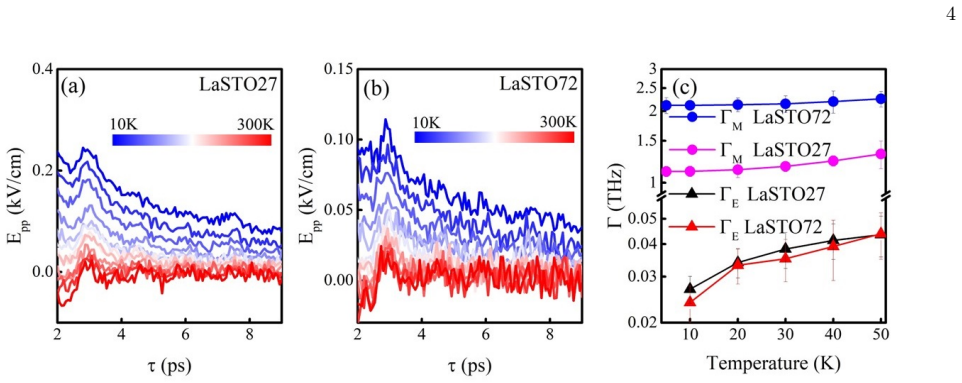
The key object is the energy relaxation rate Γ_E, extracted by fitting the long-time tail of the THz pump-probe response to a single exponential A $e^{{-2π Γ_E t}}$. THz 2D coherent spectroscopy identifies the nonlinear signal as a pump-probe (population-decay) χ(3) process, and the energy relaxation rate is contrasted with the momentum relaxation rate Γ_M from Drude fits to linear THz conductivity. The paper uses the temperature dependence of Γ_E, expected to be 1/T for quasi-elastic phonon scattering, as the diagnostic that rules out the two-phonon mechanism.
What would settle it
Measure the energy relaxation rate at temperatures above the soft-phonon energy (roughly 100–150 K in these films). If Γ_E turns over and decreases as 1/T, the two-phonon quasi-elastic mechanism would be compatible with the data; if Γ_E keeps increasing, the mechanism is ruled out.
Extended reading notes
Core claim
The central claim is that the $T^{2}$ resistivity observed in the dilute metallic phase of doped SrTiO3 is not produced by two-phonon quasi-elastic scattering. In the proposed two-phonon scenario, scattering from a soft transverse optical phonon becomes quasi-elastic above the phonon energy, and the energy relaxation rate of the electron system should fall as 1/T as temperature increases. The paper instead observes an energy relaxation rate that rises with temperature, while remaining far smaller than the momentum relaxation rate extracted from optical conductivity. This is stated as evidence that the resistive $T^{2}$ scattering does not share the energy-relaxation channel, and that the resistivity originates in electron-electron interactions.
Load-bearing premise
The argument assumes that the measured temperature range (5–50 K) lies above the characteristic energy of the soft phonon, so that two-phonon scattering would already be quasi-elastic; in these films the soft transverse optical phonon is near 2–3 THz (about 100–150 K), so the quasi-elastic regime may not have been reached.
Editorial extensions
If this is right
- If the two-phonon mechanism is absent, the T^2 resistivity must come from electron-electron scattering, which is surprising given the small, single isotropic Fermi surface.
- Energy and momentum relaxation are decoupled, so models of the T^2 scattering must explain why resistive scattering does not carry energy out of the electron system.
- The observed temperature dependence of Γ_E (increasing) matches electron-electron scattering expectations and supports a Fermi-liquid-like picture with unconventional scaling.
- The contrast between Γ_E and Γ_M gives a new empirical constraint: any proposed scattering mechanism must reproduce a 30–50 times smaller energy relaxation rate.
Reading between the lines
- If the soft phonon in these strained films is stiffer than in bulk SrTiO3, the measurement may not have reached the quasi-elastic regime; testing softer samples (or higher temperatures) could change the ruling.
- The same pump-probe technique could be applied to other T^2-resistivity materials, such as Bi2O2Se, to test whether a non-phonon mechanism is general.
- A full theoretical treatment of electron-electron scattering in a dilute single-band system could predict the ratio Γ_E/Γ_M and offer a direct quantitative comparison with these data.
Signed reviews
Editorial analysis
A structured set of objections, weighed in public.
Referee Report
Summary. This paper reports THz 2D coherent spectroscopy and THz pump-probe measurements on doped SrTiO3 thin films with carrier densities between 1.8 and 7.3×10^20 cm^-3. The authors identify a pump-probe χ(3) process and fit its decay to a single exponential to extract an energy relaxation rate Γ_E that increases with temperature up to 50 K and is much smaller than the momentum relaxation rate Γ_M obtained from the Drude conductivity. On this basis they argue that quasi-elastic two-phonon scattering is absent and that the T^2 resistivity in these films likely originates from electron-electron interactions.
Significance. The experimental implementation is careful: the 2DCS data support the assignment to a pump-probe process, the single-exponential fits are shown in the supplemental material, and the comparison of Γ_E with Γ_M is a clean and potentially valuable observation. If the rule-out of two-phonon scattering were established, the paper would make an important contribution to the long-standing puzzle of T^2 resistivity in dilute doped SrTiO3. However, as detailed in the major comments, the central inference is not supported by the data in their current temperature range, so the paper's main claim does not stand.
major comments (2)
- [Fig. 4(c) and 'Temperature dependence' paragraph (p.4)] The rule-out argument requires the measurement to be in the quasi-elastic (equipartition) regime, T ≳ ħΩ/k_B, for the soft TO phonon. The manuscript itself states that this phonon is at 2-3 THz (~96-145 K) in these films, with only a hint near 2 THz for the lowest doping. The Γ_E data are fitted and presented for 5-50 K (Fig. 4(c) and Fig. S7). Thus the data lie below the phonon characteristic temperature, where the two-phonon quasi-elastic scattering is exponentially suppressed and the predicted 1/T energy relaxation does not apply. The observed increasing Γ_E is the conventional low-temperature behavior for inelastic electron-phonon scattering, so it does not contradict the two-phonon proposal. The conclusion stated in the title and abstract is therefore not supported.
- [p.4, paragraph beginning 'The temperature dependence is also interesting'] The paper claims that Γ_E increases 'in the same temperature range that the resistivity goes as T^2'. However, the T^2 resistivity is reported below ~120 K, while Γ_E is only extracted up to 50 K. Even in the overlapping 5-50 K range, the system is below the phonon characteristic temperature, so the correlation between increasing Γ_E and T^2 resistivity is not diagnostic for the quasi-elastic two-phonon scenario.
minor comments (4)
- [Abstract and p.4] The statement that an increasing Γ_E indicates the excitations are not quasi-elastic should be qualified by the condition that the system is in the equipartition regime; without that qualification it is misleading.
- [Fig. 4(c)] The caption says 'temperature range 5-300K', but the fits are shown only up to 50 K in Fig. S7; please clarify the temperature range over which Γ_E was extracted.
- [p.4] The phrase 'Γ_M is nearly 30-50 times larger than Γ_E over the measured temperature range' would benefit from an explicit statement of the temperature interval used.
- [p.4, references [29] and [38]] When citing Ref. [29] for the low-temperature T^3 energy relaxation law and Ref. [38] for optical phonons, the paper could explicitly give the predicted Γ_E temperature dependence in the quasi-elastic two-phonon regime to make the contrast with the 1/T prediction more transparent.
Circularity Check
No circularity: the energy relaxation rate is a direct measurement, and the two-phonon rule-out rests on external theory rather than on self-fitted inputs.
full rationale
The paper's central observable, the energy relaxation rate ΓE, is obtained by a direct exponential fit to measured THz pump-probe time traces, ENL(t) = Ae^(−2πΓE t), and is not extracted from a model that already assumes the conclusion. The comparison ΓE << ΓM uses two independently measured quantities: ΓE from the pump-probe decay and ΓM from Drude fits to linear THz conductivity; no fitted parameter is renamed as a prediction. The rule-out of quasi-elastic two-phonon scattering is based on the theoretically expected 1/T behavior of ΓE in the equipartition regime, cited to the external literature (Allen 1987; the two-phonon proposal of Kumar, Yudson, and Maslov), not on a self-citation chain. The identification of the long-time pump-probe decay with energy relaxation does refer to the authors' prior works [33,37], but the paper also supplies an in-paper argument in the Supplemental Material: uniform A1g-like decays from larger to smaller momentum are only possible for simple Fermi surfaces by electrons losing energy, so the interpretation is not solely imported from self-citations. The scientific objection that the measured 5–50 K range lies below the 2–3 THz soft-phonon energy scale is a validity concern about whether the equipartition assumption is met, not a circularity of the derivation. No equation in the paper is equivalent by construction to its own input, and no fitted quantity is relabeled as a prediction.
Assumptions & free parameters
assumptions (4)
- domain assumption Pump-probe decay at long times measures the energy relaxation rate of the electronic system.
- domain assumption For quasi-elastic two-phonon scattering above the phonon characteristic temperature, the energy relaxation rate decreases as 1/T.
- domain assumption The soft transverse optical phonon in the measured films lies at 2-3 THz, so the equipartition regime is not reached below 50K.
- standard math Drude model with a single scattering rate describes the linear THz conductivity.
Cite this review
Pith. "Pith review of Absence of two-phonon quasi-elastic scattering in the normal state of doped--SrTiO$_3$ by THz pump-probe spectroscopy." pith.science (2026). https://pith.science/paper/YGWAWAO5
@misc{pith2026250115771,
  author       = {Pith},
  title        = {Pith review of: Absence of two-phonon quasi-elastic scattering in the normal state of doped--SrTiO$_3$ by THz pump-probe spectroscopy},
  year         = {2026},
  howpublished = {\url{https://pith.science/paper/YGWAWAO5}},
  note         = {Machine review of arXiv:2501.15771}
}
abstract
Multi-pulse nonlinear THz spectroscopies enable a new understanding of interacting metallic systems via their sensitivity to novel correlation functions. Here, we investigated the THz nonlinear properties of the dilute metallic phase of doped-SrTiO$_3$ thin films using nonlinear terahertz 2D coherent spectroscopy. We observed a large $\chi^{(3)}$ response in the low temperature region where the dc electrical resistivity follows a T$^2$-dependence. This is largely a pump-probe response, which we find is governed by a single energy relaxation rate that is much smaller at all temperatures than the momentum relaxation rates obtained from the optical conductivity. This indicates that the processes that dominate the resistive scattering are not the same as those that remove energy from the electronic system. Moreover the fact that the energy relaxation rate is an increasing function of temperature indicates that the excitations that do carry away energy from the electronic system cannot be considered as quasi-elastic and as such soft two-phonon electron scattering does not play a major role in the physics as proposed. This indicates that these materials' resistive T$^2$ scattering likely originates in electron-electron interactions despite the very small Fermi wave vectors at the lowest dopings.
Figures


Figures from the paper (10 more)


Reference graph
Works this paper leans on
-
[1]
for (a) LaSTO27 (2 .7 × 1020/cm3) and (b) LaSTO72 (7.2 × 10²⁰/cm3), respectively. Fourier transform of the sig- nal in panels (a) and (b) is shown in (c) LaSTO27 and (d) LaSTO72, respectively. FIG. 2. (a) Temperature dependent THz nonlinear spec- tral weight (NLSW) integrated over the range 0.2-1.4THz for doped-SrTiO 3 thin films at various carrier concen...
-
[2]
L. D. Landau, J. Exptl. Theoret. Phys. (U.S.S.R.) 30, 1058 (1956)
work page 1956
-
[3]
W. G. Baber, Proc.R.Soc.A 158, 383 (1937)
work page 1937
-
[4]
M. E. Barber, A. S. Gibbs, Y. Maeno, A. P. Mackenzie, and C. W. Hicks, Phys. Rev. Lett. 120, 076602 (2018)
work page 2018
-
[5]
D. Stricker, J. Mravlje, C. Berthod, R. Fittipaldi, A. Vec- chione, A. Georges, and D. van der Marel, Phys. Rev. Lett. 113, 087404 (2014)
work page 2014
-
[6]
C. J. Pethick, D. Pines, K. F. Quader, K. S. Bedell, and G. E. Brown, Phys. Rev. Lett. 57, 1955 (1986)
work page 1986
-
[7]
F. Rullier-Albenque, D. Colson, A. Forget, and H. Al- loul, Phys. Rev. Lett. 109, 187005 (2012)
work page 2012
-
[8]
V. Taufour, N. Foroozani, M. A. Tanatar, J. Lim, U. Kaluarachchi, S. K. Kim, Y. Liu, T. A. Lograsso, V. G. Kogan, R. Prozorov, S. L. Bud’ko, J. S. Schilling, and P. C. Canfield, Phys. Rev. B 89, 220509 (2014)
work page 2014
Show all 40 references
-
[9]
Behnia, Annalen der Physik 534, 2100588 (2022)
K. Behnia, Annalen der Physik 534, 2100588 (2022)
2022
-
[10]
MacDonald, Physical Review Letters 44, 489 (1980)
A. MacDonald, Physical Review Letters 44, 489 (1980)
1980
-
[11]
Van Der Marel, J
D. Van Der Marel, J. L. M. van Mechelen, and I. Mazin, Physical Review B—Condensed Matter and Materials Physics 84, 205111 (2011)
2011
-
[12]
Klimin, J
S. Klimin, J. Tempere, D. van der Marel, and J. T. De- vreese, Physical Review B—Condensed Matter and Ma- terials Physics 86, 045113 (2012)
2012
-
[13]
A. J. Schofield, Contemporary Physics 40, 95 (1999)
1999
-
[14]
Stewart, Reviews of Modern Physics 73, 797 (2001)
G. Stewart, Reviews of Modern Physics 73, 797 (2001)
2001
-
[15]
J. F. Schooley, W. R. Hosler, and M. L. Cohen, Phys. Rev. Lett. 12, 474 (1964)
1964
-
[16]
M. N. Gastiasoro, J. Ruhman, and R. M. Fernandes, Annals of Physics 417, 168107 (2020)
2020
-
[17]
Collignon, X
C. Collignon, X. Lin, C. W. Rischau, B. Fauqu´ e, and K. Behnia, Annual Review of Condensed Matter Physics 10, 25 (2019)
2019
-
[18]
Yamada and G
Y. Yamada and G. Shirane, Journal of the Physical So- ciety of Japan 26, 396 (1969)
1969
-
[19]
Fleury and J
P. Fleury and J. Worlock, Physical Review 174, 613 (1968)
1968
-
[20]
Van Mechelen, D
J. Van Mechelen, D. Van der Marel, C. Grimaldi, A. Kuz- menko, N. Armitage, N. Reyren, H. Hagemann, and I. Mazin, Physical review letters 100, 226403 (2008)
2008
-
[21]
Weaver, Journal of Physics and Chemistry of Solids 11, 274 (1959)
H. Weaver, Journal of Physics and Chemistry of Solids 11, 274 (1959)
1959
-
[22]
Mikheev, S
E. Mikheev, S. Raghavan, J. Y. Zhang, P. B. Marshall, A. P. Kajdos, L. Balents, and S. Stemmer, Scientific reports 6, 20865 (2016)
2016
-
[23]
X. Lin, B. Fauqu´ e, and K. Behnia, Science 349, 945 (2015)
2015
-
[24]
Kumar, V
A. Kumar, V. I. Yudson, and D. L. Maslov, Physical Review Letters 126, 076601 (2021)
2021
-
[25]
Y. Yu, H. Y. Hwang, S. Raghu, and S. B. Chung, npj Quantum Materials 7, 63 (2022)
2022
-
[26]
Ngai, Physical Review Letters 32, 215 (1974)
K. Ngai, Physical Review Letters 32, 215 (1974)
1974
-
[27]
J. Wang, J. Wu, T. Wang, Z. Xu, J. Wu, W. Hu, Z. Ren, S. Liu, K. Behnia, and X. Lin, Nature Communications 11, 3846 (2020)
2020
-
[28]
Jiang, B
S. Jiang, B. Fauqu´ e, and K. Behnia, Phys. Rev. Lett. 131, 016301 (2023)
2023
-
[29]
K. S. Kumar, D. Lee, S. Varshney, B. Jalan, and N. Ar- mitage, Physical Review Letters 133, 136003 (2024)
2024
-
[30]
P. B. Allen, Phys. Rev. Lett. 59, 1460 (1987)
1987
-
[31]
J. Yue, Y. Ayino, T. K. Truttmann, M. N. Gastia- soro, E. Persky, A. Khanukov, D. Lee, L. R. Thoutam, B. Kalisky, R. M. Fernandes, et al., Science advances 8, eabl5668 (2022)
2022
-
[32]
T. Wang, K. Ganguly, P. Marshall, P. Xu, and B. Jalan, Applied Physics Letters 103, 212904 (2013)
2013
-
[33]
Mahmood, D
F. Mahmood, D. Chaudhuri, S. Gopalakrishnan, R. Nandkishore, and N. P. Armitage, Nature Physics 17, 627 (2021)
2021
-
[34]
Barbalas, R
D. Barbalas, R. Romero III, D. Chaudhuri, F. Mahmood, H. P. Nair, N. J. Schreiber, D. G. Schlom, K. Shen, and N. Armitage, Physical Review Letters 134, 036501 (2025). 6
2025
-
[35]
Kozina, M
M. Kozina, M. Fechner, P. Marsik, T. van Driel, J. M. Glownia, C. Bernhard, M. Radovic, D. Zhu, S. Bonetti, U. Staub, et al., Nature Physics 15, 387 (2019)
2019
-
[36]
Sirenko, C
A. Sirenko, C. Bernhard, A. Golnik, A. M. Clark, J. Hao, W. Si, and X. Xi, Nature 404, 373 (2000)
2000
-
[37]
Marsik, K
P. Marsik, K. Sen, J. Khmaladze, M. Yazdi-Rizi, B. P. Mallett, and C. Bernhard, Applied Physics Letters 108, 052901 (2016)
2016
-
[38]
Bhandia, D
R. Bhandia, D. Barbalas, R. Xiao, J. R. Chamorro, T. Berry, T. M. McQueen, N. Samarth, and N. Armitage, Physical Review B 110, 075131 (2024)
2024
-
[39]
Glorioso and S
P. Glorioso and S. A. Hartnoll, SciPost Physics 13, 095 (2022)
2022
-
[40]
Kuehn, K
W. Kuehn, K. Reimann, M. Woerner, T. Elsaesser, and R. Hey, The Journal of Physical Chemistry B 115, 5448 (2011). 1 Supplemental Material: Absence of two-phonon quasi-elastic scattering in the normal state of doped–SrTiO3 by THz pump-probe spectroscopy EXPERIMENT AL DET AILS E...
2011
Reviewed August 10, 2026 · model on record in the stance chip above.
Discussion (0). Continue with ORCID to comment.