REVIEW 3 major objections 5 minor 125 references
Quantum Transport with Spin Orbit Coupling: New Developments in TranSIESTA
T0 review · 3 major / 5 minor · reviewed 2026-08-10 · deepseek-v4-flash
Pith's one-line read This paper reports the extension of the open-source DFT+NEGF transport code TranSIESTA to full spinor wave functions, enabling first-principles calculations of transport in devices with spin-orbit coupling and non-collinear magnetism.
desk verdict Solid spinor NEGF implementation with a genuinely new transmission projector; needs reproducibility and buffer-convergence checks before acceptance. read the letter →
The pith
A machine-rendered reading of the paper's core claim, the machinery that carries it, and where it could break.
The reading
What carries the argument
The load-bearing object is the retarded Green's function in spinor form, $G_k(z)=[zS_k-H_k-\sum_e\Sigma_{e,k}(z)]^{-1}$, where $S_k$, $H_k$, and the self-energies $\Sigma_{e,k}$ are built with each orbital matrix element expanded as a $2\times2$ block in spin space; this is what couples the spin channels. The central analysis identity is the spin-channel projected transmission $T^{\sigma\vec n,\sigma'\vec m}_{e,e'}(z)=\int_{\mathrm{BZ}} dk\,\mathrm{Tr}\{\Gamma^{\sigma\vec n}_{e,k}(z)\,A^{\sigma'\vec m}_{e',k}(z)\}$, expressed through spin-selective broadening matrices $\Gamma^{\sigma\vec n}_{e,k}=\Gamma^{1/2}_{e,k}|\sigma\vec n\rangle\langle\sigma\vec n|\Gamma^{1/2}_{e,k}$ and the corresponding spectral density $A^{\sigma\vec n}_{e,k}=G_k\Gamma^{\sigma\vec n}_{e,k}G_k^\dagger$. This object lets the user resolve transmission into same-spin and spin-flip channels for arbitrary quantization axes in each electrode, which is the key new observable enabled by the implementation.
What would settle it
Compute the zero-bias transmission of the Fe/MgO/Fe junction with 5, 6, and 7 fixed iron layers between the MgO barrier and the electrode region; if the transmission changes by more than the numerical tolerance instead of converging, the bulk-electrode assumption is violated and the spinor transport results are not converged. The same screening test applied to the TMD heterojunction (40 vs 56 atoms) is the only place in the paper where this assumption is explicitly checked.
Extended reading notes
Core claim
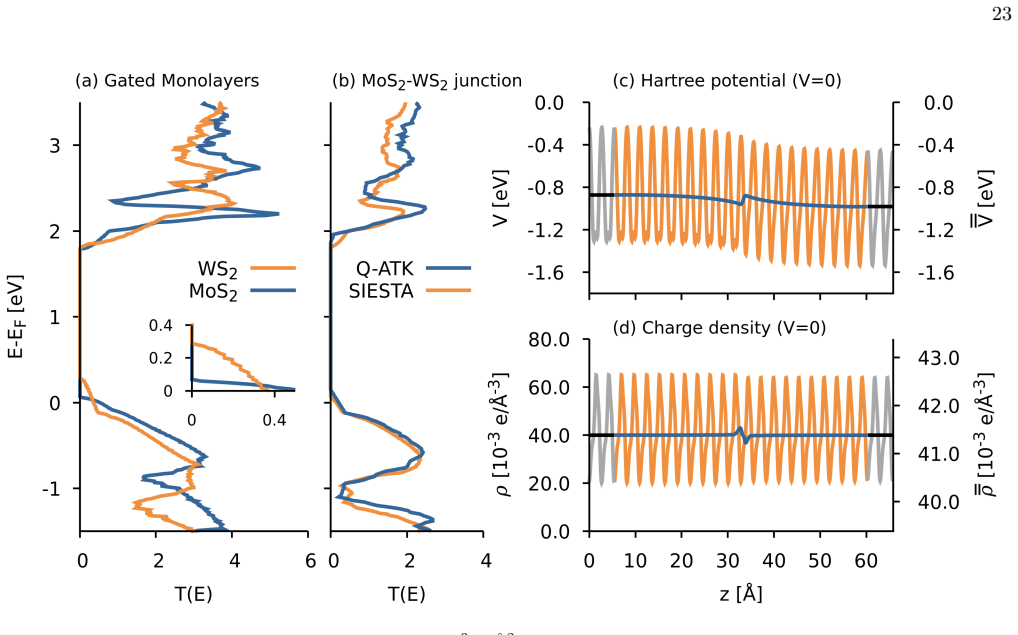
The paper's central claim is that TranSIESTA can now perform self-consistent DFT+NEGF calculations for general spinors, not just collinear spins. In the collinear case the Hamiltonian is block diagonal in spin and the two channels can be treated independently; with spin-orbit coupling or non-collinear magnetization the off-diagonal spin blocks couple the channels, and the old code could not handle this. The implementation therefore expands each orbital matrix element $A_{ij}$ into a $2\times2$ spin block, keeps the sparse-matrix bandwidth small by interleaving spin indices, reuses the Sancho-Sancho-Rubio algorithm for surface self-energies (which is agnostic to spin indices), and supports both full and block-tridiagonal inversion of the spinor Green's function $G_k(z)=[zS_k-H_k-\sum_e\Sigma_{e,k}(z)]^{-1}$. The post-processing tool TBTrans is extended with a spin-channel projected transmission that projects the scattering matrix onto spin eigenstates along arbitrary axes, and the authors show that a cheaper alternative that projects the broadening matrix instead gives unphysical results wherever the electrode spin texture is non-collinear. Validation runs reproduce reference band structures and transmissions, and reveal SOC-induced effects such as band splitting, avoided crossings, spin-flip transmission through domain walls, a 1% ballistic anisotropic magnetoresistance in bulk iron, and diode-like IV behavior in the gated MoS2/WS2 junction.
Load-bearing premise
The method assumes the electrodes remain bulk-like and undisturbed by the device, so surface self-energies from a converged bulk DFT calculation stay valid; the paper directly verifies this screening only for the TMD heterojunction, not for the iron chains, Fe/MgO/Fe, or the carbon-nanotube systems.
Editorial extensions
If this is right
- TranSIESTA can now model finite-bias, multi-terminal devices with spin-orbit coupling or non-collinear spins without a collinear-spin approximation, so topological-material and spintronics devices become accessible to open-source first-principles transport simulation.
- Spin-flip transmission between electrodes with different magnetization directions can be computed and decomposed by quantization axis, making domain-wall resistance, anisotropic magnetoresistance, and tunneling magnetoresistance calculations routine.
- The implementation inherits the block-tridiagonal inversion and parallel scaling of the current TranSIESTA, so the spinor capability is available for large systems (tested up to 816 atoms and 11088 orbitals).
- For semiconductor heterojunctions, the TMD example shows that uniform gating can supply enough screening for the bulk-electrode assumption to hold, allowing self-consistent NEGF studies of lateral 2D junctions with strong spin-orbit coupling.
- The open-system treatment of molecule-functionalized carbon nanotubes gives a converged magnetic moment for {Co4}-CNT where periodic supercell calculations did not converge, implying that transport geometry itself can be necessary for correct magnetic ground states in these hybrids.
Reading between the lines
- The spin-channel projection machinery could be applied beyond total transmission, for example to decompose conductances into spin-valley or spin-momentum-locking contributions in topological surface states; the paper does not attempt this, but Eq. (28) already supplies the operator form.
- The demonstrated failure of broadening-matrix projection for non-collinear electrode states is a caution for any transport code that uses such a shortcut; the scattering-matrix projection may be the needed default wherever electrode spin textures are energy-dependent.
- A testable extension would be to compute the domain-wall spin-flip transmission as a function of domain-wall width and SOC strength; the code now permits this systematically, and the paper only reports widths of 4-6 atoms.
- The {Co4}-CNT result suggests that for molecule-nanotube hybrids, transport simulations with semi-infinite electrodes may be needed to converge magnetic properties, not merely transport functions; this could be checked by computing the PBC magnetic moment for even larger supercells.
Editorial analysis
A structured set of objections, weighed in public.
Referee Report
Summary. This paper reports an implementation of spinor (non-collinear and spin-orbit) DFT+NEGF in the open-source TranSIESTA code. The authors extend the Green's function, density matrix, self-energy, and transmission routines from independent spin channels to 2x2 spin blocks, implement spin-channel projected transmission via scattering-matrix projectors, and apply the code to monatomic Fe chains with domain walls, Fe/MgO/Fe junctions, a gated MoS2/WS2 lateral heterojunction, and carbon nanotubes with magnetic clusters. The results are compared with QuantumATK and previous DFT studies.
Significance. If the implementation is correct, it fills a genuine gap: an open-source DFT+NEGF code capable of multi-terminal finite-bias transport with full spinor wavefunctions. The formalism is standard and the manuscript contains useful methodological contributions, including the spin-projected transmission based on the scattering matrix (Eq. 28) and the demonstration that direct broadening-matrix projection (Eq. 29) fails for non-collinear electrode states. The cross-checks against QuantumATK and existing band-structure literature are a strength. However, the validation is uneven: key quantitative claims (TMR, MAE) are not backed by direct comparisons, and the screening assumption underpinning the NEGF construction is tested only in one system.
major comments (3)
- [Sec. VII.B.2] The abstract and Sec. VII.B state that the Fe/MgO/Fe junction is used to test whether the implementation reproduces previous predictions for tunneling magnetoresistance, but no quantitative TMR ratio is reported anywhere in the manuscript. Only the parallel-state Fermi-level transmission (T about 0.0044) and spin-channel decompositions are given; the antiparallel transmission and the TMR ratio are absent. Please provide T_AP, the TMR ratio (T_P - T_AP)/T_AP at the Fermi level (or over the bias window), and compare with Refs. [74,75] and other DFT results. Without this, the headline validation claim for magnetoresistance is unsubstantiated.
- [Sec. VII.A.3 and Sec. IV] The iron-chain transport calculations use a scattering region of only 4 Fe atoms between semi-infinite electrodes (Sec. VII.A.3), with no buffer-size convergence test for the electrode self-energy. In Sec. IV the method assumes that electrodes are bulk-like and that screening regions ensure transferability of the bulk self-energy (Fig. 1, Eq. 5). For a 1D metallic chain, screening is weak and the domain wall is a non-collinear perturbation extending over several atoms; the abrupt connection to the bulk electrode could affect the transmission. Please report convergence of the domain-wall transmission with the number of buffer atoms, or state this limitation explicitly with an estimate of its effect on the reported conductances.
- [Sec. VII.A.1] The MAE of the infinite Fe chain is reported to be a factor of 2 lower than Refs. [86,87] and is attributed to bond-length sensitivity. Since no bond-length dependence is shown, this discrepancy is not actually resolved. Please provide the MAE at the same lattice constant as the reference calculations or a plot of MAE versus bond length, so the reader can judge whether the discrepancy is a parameterization effect rather than an implementation error.
minor comments (5)
- [Abstract] The abstract contains a typo: "Exisiting" should be "Existing".
- [Sec. III] The spin-box Hermiticity condition is stated as H^{σσ'}_{ij} = (H^{σ'σ}_{ij})^*, but the orbital indices should also be exchanged: H^{σσ'}_{ij} = (H^{σ'σ}_{ji})^*. As written, the condition is only correct for i = j.
- [Sec. VII.C.3 and Sec. VII.B.2] There are typos in the text: "QunatumATK" should be "QuantumATK", and "previously obta,ined results" should be "previously obtained results".
- [Sec. VII.C.2 / Fig. 19] The 40-versus-56-atom screening test is performed on heavily hole-doped metallic monolayers; a sentence clarifying that this does not validate the undoped semiconducting case would help set expectations for the reader.
- [Sec. V.E] The weighting scheme in Eqs. 22-24 uses only the charge-density variance; a sentence explaining why the spin-block off-diagonal terms can be neglected in the weights (while still being included in the density matrix) would clarify the numerical rationale.
Circularity Check
No circularity: spinor DFT+NEGF implementation is benchmarked against independent codes and prior results; self-citations are foundational, not load-bearing.
full rationale
The paper is an implementation and validation study of spinor DFT+NEGF in TranSIESTA. The central quantities (Green's function, transmission, current) are computed from the standard NEGF equations (Eqs. 5-12) with no fitted parameters later reported as predictions. Validation is anchored to independent external references: QuantumATK for TMD band structures and transmissions, and previously published DFT results for Fe chains, Fe/MgO/Fe TMR, and domain-wall resistance. The self-citations ([19], [37]) introduce the pre-existing TranSIESTA formalism and algorithms; they are foundational implementation references, not uniqueness arguments or ansatz justifications that force the reported results. The screening-region assumption (Sec. IV) is a physical/numerical assumption and is explicitly convergence-tested for the TMD junction (Fig. 19); lack of such a test for other systems is a completeness/robustness concern, not circularity. I find no step in which a 'prediction' reduces by construction to a fit or to a self-citation chain.
Assumptions & free parameters
free parameters (6)
- Hubbard U for Mn (Mn4 clusters) =
6 eV
- Hubbard U for Co (Co4 clusters) =
4 eV
- Gate charge density for TMD heterojunction =
5.76e-3 e/A^2
- Lattice strain in MoS2/WS2 heterojunction =
0.4%
- Fixed-layer count in Fe/MgO/Fe junction =
1 fixed layer
- Complex contour parameters for iron chain density matrix =
circle from (-20+0.1i) eV, line at -10 k_B eV, 10 poles, 32 Fermi poles
assumptions (5)
- standard math NEGF partition of the system into electrodes and scattering region with self-energies
- domain assumption Electrodes are bulk-like and unperturbed by the scattering region
- domain assumption Spin-box Hermiticity holds for non-collinear spins without SOC
- domain assumption Sancho-Sancho-Rubio algorithm remains valid for 2x2 spin-block matrices
- domain assumption Electrodes remain in equilibrium under applied bias
Cite this review
Pith. "Pith review of Quantum Transport with Spin Orbit Coupling: New Developments in TranSIESTA." pith.science (2026). https://pith.science/paper/2KDJZ6RK
@misc{pith2026250116162,
  author       = {Pith},
  title        = {Pith review of: Quantum Transport with Spin Orbit Coupling: New Developments in TranSIESTA},
  year         = {2026},
  howpublished = {\url{https://pith.science/paper/2KDJZ6RK}},
  note         = {Machine review of arXiv:2501.16162}
}
read the original abstract
We present the implementation of spinor quantum transport within the non-equilibrium Green's function (NEGF) code TranSIESTA based on Density Functional Theory (DFT). First-principles methods play an essential role in molecular and material modelling, and the DFT+NEGF approach has become a widely-used tool for quantum transport simulation. Exisiting (open source) DFT-based quantum transport codes either model non-equilibrium/finite-bias cases in an approximate way or rely on the collinear spin approximation. Our new implementation closes this gap and enables the TranSIESTA code to use full spinor-wave functions. Thereby it provides a method for transport simulation of topological materials and devices based on spin-orbit coupling (SOC) or non-collinear spins. These materials hold enormous potential for the development of ultra-low energy electronics urgently needed for the design of sustainable technology. The new feature is tested for relevant systems determining magnetoresistance in iron nanostructures and transport properties of a lateral transition metal dichalcogenide heterojunction.
Figures


Figures from the paper (23 more)




Reference graph
Works this paper leans on
-
[1]
We observe small differences in the total energy depending on the alignment of the spin moments relative to the chain axis
Magnetic Anisotropy in the Ideal Iron Chain The ground state of an iron chain is characterized by an interatomic spacing of 2.26 ˚A and ferromagnetic alignment of spin magnetic moments with 3.35 µB per iron atom. We observe small differences in the total energy depending on the alignment of the spin moments relative to the chain axis. This MAE favors an a...
-
[2]
7) with non-parallel spin moments to model a constrained domain wall
Domain Wall Conductivity Next we set up a transport system with two electrodes (orange atoms in Fig. 7) with non-parallel spin moments to model a constrained domain wall. We then relax the direction and amplitude of the spin moments of the atoms between the electrodes (blue atoms in Fig. 7). The NEGF approach serves two purposes in these calculations: it ...
-
[3]
The simulation cell contains 12 atoms: 4 atoms on each side correspond to one principal electrode layer and the 4 atoms in the center represent the scattering device
Computational Details Our transport setup consists of an infinite chain with Fe atoms. The simulation cell contains 12 atoms: 4 atoms on each side correspond to one principal electrode layer and the 4 atoms in the center represent the scattering device. In the electrode calculations, we sample the reciprocal space along the chain axis with 101 k points. W...
-
[4]
With this system, we check whether our code also works for a more realistic application with three- dimensional electrodes and a non-homogenous geometry in the scattering device
Magneto Resistance of Bulk Iron Fe/MgO/Fe is periodic in the two directions parallel to the interface and therefore requires sampling at k points in these directions. With this system, we check whether our code also works for a more realistic application with three- dimensional electrodes and a non-homogenous geometry in the scattering device. Fe/MgO/Fe t...
-
[5]
The MgO[110] plane is parallel to the Fe[100], creating a clean interface between the two materials
Magneto Resistance in Fe/MgO/Fe Tunneling Junctions Fe/MgO/Fe tunneling junction consists of a few layers of MgO sandwiched between multiple layers of iron (Figure 12). The MgO[110] plane is parallel to the Fe[100], creating a clean interface between the two materials. The iron 18 FIG. 12. Ball and stick model of a Fe/MgO/Fe junction in side view (left) a...
-
[6]
Computation Details For bulk iron, our transport setup consists of 4 MgO layers sandwiched between 13 layers of iron on each side. In the electrode calculations, we sample the reciprocal space using a Monkhorst-Pack grid with 100 k points along the semi-infinite direction and 16 × 16 transverse k points along the transversal direction. We use the same num...
-
[7]
In MoS 2 this band gap is 1.79 eV wide and WS2 1.48 eV
Monolayer MoS 2 and WS 2 MoS2 and WS 2 monolayers exhibit a direct band gap at K and K ′. In MoS 2 this band gap is 1.79 eV wide and WS2 1.48 eV. Around the valence band maximum (VBM) the bands of MoS 2 and WS 2 are split by 0.15 eV and 0.45 eV, respectively (Fig. 16). SOC acts as a magnetic field perpendicular to the monolayer affecting the top valence b...
-
[8]
Lateral MoS 2-WS2 Heterojunction Simulations of bulk semiconductors within the NEGF formalism are unproblematic. However, when two different semiconductors come into contact, problems arise because it is unclear how to match the potentials of the two materials to those of the different bulk electrodes. Furthermore, the low carrier density in semiconductor...
Show all 125 references
-
[9]
InTranSIESTA we calculate the bulk transmission using the primitive unit cells of the monolayers
Computational details We calculate the transmission function of the bulk monolayers along the primitive unit cell vector. InTranSIESTA we calculate the bulk transmission using the primitive unit cells of the monolayers. Since QuantumATK only supports electrodes with rectangula...
-
[10]
Materials Design at the Exascale
Computational Details To account for the strong correlation of the 3d electrons and avoid the excessive delocalization of the d-states predicted in the Local Density Approximation, Hubbard-like corrections with U=6 eV and U=4 eV were used for Mn and Co, respectively. The same ...
2017
-
[11]
How to stop data centres from gobbling up the world’s electricity
Jones N. How to stop data centres from gobbling up the world’s electricity. Nature 561 (2018) 163–166. doi: 10.1038/d41586-018-06610-y
2018 doi
-
[12]
Spintronics: Fundamentals and applications
ˇZuti´ c I, Fabian J, Das Sarma S. Spintronics: Fundamentals and applications. Reviews of Modern Physics 76 (2004) 323–410. doi:10.1103/RevModPhys.76.323
2004 doi
-
[13]
Low energy consumption spintronics using multiferroic heterostructures
Trassin M. Low energy consumption spintronics using multiferroic heterostructures. Journal of Physics: Condensed Matter 28 (2016) 033001. doi:10.1088/0953-8984/28/3/033001
2016 doi
-
[14]
Review on spintronics: Principles and device applications
Hirohata A, Yamada K, Nakatani Y, Prejbeanu IL, Di´ eny B, Pirro P, et al. Review on spintronics: Principles and device applications. Journal of Magnetism and Magnetic Materials 509 (2020) 166711. doi:10.1016/j.jmmm.2020.166711
2020
-
[15]
Spintronic devices for energy-efficient data storage and energy harvesting
Puebla J, Kim J, Kondou K, Otani Y. Spintronic devices for energy-efficient data storage and energy harvesting. Com- munications Materials 1 (2020) 1–9. doi:10.1038/s43246-020-0022-5
2020 doi
-
[16]
Current-driven excitation of magnetic multilayers
Slonczewski J. Current-driven excitation of magnetic multilayers. Journal of Magnetism and Magnetic Materials 159 (1996) L1–L7. doi:10.1016/0304-8853(96)00062-5
1996 doi
-
[17]
Emission of spin waves by a magnetic multilayer traversed by a current.Physical Review B 54 (1996) 9353–9358
Berger L. Emission of spin waves by a magnetic multilayer traversed by a current.Physical Review B 54 (1996) 9353–9358. doi:10.1103/PhysRevB.54.9353
1996 doi
-
[18]
Current-Driven Magnetization Reversal and Spin-Wave Excitations in Co / Cu / Co Pillars
Katine JA, Albert FJ, Buhrman RA, Myers EB, Ralph DC. Current-Driven Magnetization Reversal and Spin-Wave Excitations in Co / Cu / Co Pillars. Physical Review Letters 84 (2000) 3149–3152. doi:10.1103/PhysRevLett.84.3149
2000 doi
-
[19]
The Promise of Nanomagnetics and Spintronics for Future Logic and Universal Memory
Wolf SA, Lu J, Stan MR, Chen E, Treger DM. The Promise of Nanomagnetics and Spintronics for Future Logic and Universal Memory. Proceedings of the IEEE 98 (2010) 2155–2168. doi:10.1109/JPROC.2010.2064150
2010
-
[20]
Nobel Lecture: Origin, development, and future of spintronics
Fert A. Nobel Lecture: Origin, development, and future of spintronics. Reviews of Modern Physics 80 (2008) 1517–1530. doi:10.1103/RevModPhys.80.1517
2008 doi
-
[21]
Spin-transfer torque RAM technology: Review and prospect
Kawahara T, Ito K, Takemura R, Ohno H. Spin-transfer torque RAM technology: Review and prospect. Microelectronics Reliability 52 (2012) 613–627. doi:10.1016/j.microrel.2011.09.028
2012 doi
-
[22]
Basic principles of STT-MRAM cell oper- ation in memory arrays
Khvalkovskiy A V, Apalkov D, Watts S, Chepulskii R, Beach RS, Ong A, et al. Basic principles of STT-MRAM cell oper- ation in memory arrays. Journal of Physics D: Applied Physics 46 (2013) 074001. doi:10.1088/0022-3727/46/7/074001
2013 doi
-
[23]
Spin torque switching of 20 nm magnetic tunnel junctions with perpendicular anisotropy
Gajek M, Nowak JJ, Sun JZ, Trouilloud PL, O’Sullivan EJ, Abraham DW, et al. Spin torque switching of 20 nm magnetic tunnel junctions with perpendicular anisotropy. Applied Physics Letters 100 (2012) 132408. doi:10.1063/1.3694270
2012 doi
-
[24]
A new spin on magnetic memories
Kent AD, Worledge DC. A new spin on magnetic memories. Nature Nanotechnology 10 (2015) 187–191. doi: 10.1038/nnano.2015.24
2015 doi
-
[25]
Topological spintronics and magnetoelectronics.Nature Materials 21 (2022) 15–23
He QL, Hughes TL, Armitage NP, Tokura Y, Wang KL. Topological spintronics and magnetoelectronics.Nature Materials 21 (2022) 15–23. doi:10.1038/s41563-021-01138-5
2022 doi
-
[26]
Density functional theory: Its origins, rise to prominence, and future
Jones RO. Density functional theory: Its origins, rise to prominence, and future. Reviews of Modern Physics 87 (2015) 897–923. doi:10.1103/RevModPhys.87.897
2015 doi
-
[27]
Review Article on Density Functional Theory
Kapil J, Shukla P, Pathak A. Review Article on Density Functional Theory. Jain VK, Rattan S, Verma A, editors, Recent Trends in Materials and Devices (Singapore: Springer) (2020), 211–220. doi:10.1007/978-981-15-8625-5˙22
2020 doi
-
[28]
Conceptual Density Functional Theory
Geerlings P, Proft FD, Langenaeker W. Conceptual Density Functional Theory. Chemical Reviews 103 (2003) 1793–1874. doi:10.1021/cr990029p
2003 doi
-
[29]
Density-functional method for nonequilibrium electron trans- port
Brandbyge M, Mozos JL, Ordej´ on P, Taylor J, Stokbro K. Density-functional method for nonequilibrium electron trans- port. Physical Review B 65 (2002) 165401. doi:10.1103/PhysRevB.65.165401
2002 doi
-
[30]
Theoretical and Computational Aspects of Electronic Transport at the Nanoscale
Rocha AR. Theoretical and Computational Aspects of Electronic Transport at the Nanoscale. Ph.D. thesis, Trinity College Dublin (2007)
2007
-
[31]
Ab Initio modeling of quantum transport properties of molecular electronic devices
Taylor J, Guo H, Wang J. Ab Initio modeling of quantum transport properties of molecular electronic devices. Physical Review B 63 (2001) 245407. doi:10.1103/PhysRevB.63.245407
2001 doi
-
[32]
First-principles approach to electrical transport in atomic-scale nanostructures
Palacios JJ, P´ erez-Jim´ enez AJ, Louis E, SanFabi´ an E, Verg´ es JA. First-principles approach to electrical transport in atomic-scale nanostructures. Physical Review B 66 (2002) 035322. doi:10.1103/PhysRevB.66.035322
2002 doi
-
[33]
Ab Initio Green-function formulation of the transfer matrix: Application to complex band structures
Wortmann D, Ishida H, Bl¨ ugel S. Ab Initio Green-function formulation of the transfer matrix: Application to complex band structures. Physical Review B 65 (2002) 165103. doi:10.1103/PhysRevB.65.165103. 32
2002 doi
-
[34]
Towards molecular spintronics
Rocha AR, Garc ´ ıa-su´ arez VM, Bailey SW, Lambert CJ, Ferrer J, Sanvito S. Towards molecular spintronics. Nature Materials 4 (2005) 335–339. doi:10.1038/nmat1349
2005 doi
-
[35]
Elastic quantum transport calculations for molecular nanodevices using plane waves.Physical Review B 74 (2006) 245404
Garcia-Lekue A, Wang L W. Elastic quantum transport calculations for molecular nanodevices using plane waves.Physical Review B 74 (2006) 245404. doi:10.1103/PhysRevB.74.245404
2006 doi
-
[36]
Physical Review B 76 (2007) 075413
Wohlthat S, Pauly F, Viljas JK, Cuevas JC, Sch¨ on G.Ab Initio study of charge transport through single oxygen molecules in atomic aluminum contacts. Physical Review B 76 (2007) 075413. doi:10.1103/PhysRevB.76.075413
2007 doi
-
[37]
Non-equilibrium Green’s functions in density functional tight binding: Method and applications
Pecchia A, Penazzi G, Salvucci L, Di Carlo A. Non-equilibrium Green’s functions in density functional tight binding: Method and applications. New Journal of Physics 10 (2008) 065022. doi:10.1088/1367-2630/10/6/065022
2008 doi
-
[38]
First-principles methodology for quantum transport in multiterminal junctions
Saha KK, Lu W, Bernholc J, Meunier V. First-principles methodology for quantum transport in multiterminal junctions. The Journal of Chemical Physics 131 (2009) 164105. doi:10.1063/1.3247880
2009 doi
-
[39]
Efficient implementation of the nonequilibrium Green function method for electronic transport calculations
Ozaki T, Nishio K, Kino H. Efficient implementation of the nonequilibrium Green function method for electronic transport calculations. Physical Review B 81 (2010) 035116. doi:10.1103/PhysRevB.81.035116
2010 doi
-
[40]
Ab Initio nonequilibrium quantum transport and forces with the real-space projector augmented wave method
Chen J, Thygesen KS, Jacobsen KW. Ab Initio nonequilibrium quantum transport and forces with the real-space projector augmented wave method. Physical Review B 85 (2012) 155140. doi:10.1103/PhysRevB.85.155140
2012 doi
-
[41]
GOLLUM: A next-generation simulation tool for electron, thermal and spin transport
Ferrer J, Lambert CJ, Garc ´ ıa-Su´ arez VM, Manrique DZ, Visontai D, Oroszlany L, et al. GOLLUM: A next-generation simulation tool for electron, thermal and spin transport. New Journal of Physics 16 (2014) 093029. doi:10.1088/1367- 2630/16/9/093029
2014 doi
-
[42]
G´ omez MC.Ab Initio Electronic Transport in Single-Molecule Junctions: Quantum Interference Effects and Spin-Orbit Torque. Ph.D. thesis, University of Regensburg, Regensburg (2021)
2021
-
[43]
Nonequilibrium Magneto-Conductance as a Manifestation of Spin Filtering in Chiral Nanojunctions
Garc ´ ıa-Bl´ azquez MA, Dednam W, Palacios JJ. Nonequilibrium Magneto-Conductance as a Manifestation of Spin Filtering in Chiral Nanojunctions. The Journal of Physical Chemistry Letters 14 (2023) 7931–7939. doi:10.1021/acs.jpclett.3c01922
2023 doi
-
[44]
Ab Initio modeling of open systems: Charge transfer, electron conduction, and molecular switching of a C 60 device
Taylor J, Guo H, Wang J. Ab Initio modeling of open systems: Charge transfer, electron conduction, and molecular switching of a C 60 device. Physical Review B 63 (2001) 121104. doi:10.1103/PhysRevB.63.121104
2001 doi
-
[45]
Physical Review B 60 (1999) 1989–1999
Corbel S, Cerd´ a J, Sautet P.Ab Initio calculations of scanning tunneling microscopy images within a scattering formalism. Physical Review B 60 (1999) 1989–1999. doi:10.1103/PhysRevB.60.1989
1999 doi
-
[46]
Ab Initio pseudopotential method for the calculation of conductance in quantum wires
Joon Choi H, Ihm J. Ab Initio pseudopotential method for the calculation of conductance in quantum wires. Physical Review B 59 (1999) 2267–2275. doi:10.1103/PhysRevB.59.2267
1999 doi
-
[47]
Improvements on non-equilibrium and transport Green function techniques: The next-generation transiesta
Papior N, Lorente N, Frederiksen T, Garc ´ ıa A, Brandbyge M. Improvements on non-equilibrium and transport Green function techniques: The next-generation transiesta. Computer Physics Communications 212 (2017) 8–24. doi: 10.1016/j.cpc.2016.09.022
2017 doi
-
[48]
The SIESTA method for ab initio order- N materials simulation
Soler JM, Artacho E, Gale JD, Garc ´ ıa A, Junquera J, Ordej´ on P, et al. The SIESTA method for ab initio order- N materials simulation. Journal of Physics: Condensed Matter 14 (2002) 2745–2779. doi:10.1088/0953-8984/14/11/302
2002 doi
-
[49]
Siesta: Recent developments and applications
Garc ´ ıa A, Papior N, Akhtar A, Artacho E, Blum V, Bosoni E, et al. Siesta: Recent developments and applications. The Journal of Chemical Physics 152 (2020) 204108. doi:10.1063/5.0005077
2020 doi
-
[50]
Fully relativistic pseudopotential formalism under an atomic orbital basis: Spin–orbit splittings and magnetic anisotropies
Cuadrado R, Cerd´ a JI. Fully relativistic pseudopotential formalism under an atomic orbital basis: Spin–orbit splittings and magnetic anisotropies. Journal of Physics: Condensed Matter 24 (2012) 086005. doi:10.1088/0953-8984/24/8/086005
2012 doi
-
[51]
Elementary Atomic Structure (Oxford: Clarendon Press), 2
Woodgate GK. Elementary Atomic Structure (Oxford: Clarendon Press), 2. ed., reprinted edn. (1992)
1992
-
[52]
Magnetic anisotropy in metallic multilayers
Johnson MT, Bloemen PJH, den Broeder FJA, de Vries JJ. Magnetic anisotropy in metallic multilayers. Reports on Progress in Physics 59 (1996) 1409–1458. doi:10.1088/0034-4885/59/11/002
1996 doi
-
[53]
Spin dynamics in semiconductors
Wu MW, Jiang JH, Weng MQ. Spin dynamics in semiconductors. Physics Reports (2010) 176
2010
-
[54]
Spin Damping in Ultrathin Magnetic Films
Mills DL, Rezende SM. Spin Damping in Ultrathin Magnetic Films. Hillebrands B, Ounadjela K, editors, Spin Dynamics in Confined Magnetic Structures II (Berlin, Heidelberg: Springer), Topics in Applied Physics (2003), 27–59. doi:10.1007/3- 540-46097-7˙2
2003 doi
-
[55]
Anisotropic magnetoresistance in ferromagnetic 3d alloys
McGuire T, Potter R. Anisotropic magnetoresistance in ferromagnetic 3d alloys. IEEE Transactions on Magnetics 11 (1975) 1018–1038. doi:10.1109/TMAG.1975.1058782
1975
-
[56]
Anomalous Hall effect
Nagaosa N, Sinova J, Onoda S, MacDonald AH, Ong NP. Anomalous Hall effect. Reviews of Modern Physics 82 (2010) 1539–1592. doi:10.1103/RevModPhys.82.1539
2010 doi
-
[57]
Electronic Transport in Mesoscopic Systems (Cambridge University Press), first edn
Datta S. Electronic Transport in Mesoscopic Systems (Cambridge University Press), first edn. (1995). doi: 10.1017/CBO9780511805776
1995 doi
-
[58]
Highly convergent schemes for the calculation of bulk and surface Green functions
Sancho MPL, Sancho JML, Rubio J. Highly convergent schemes for the calculation of bulk and surface Green functions. Journal of Physics F: Metal Physics 15 (1985) 851–858. doi:10.1088/0305-4608/15/4/009
1985 doi
-
[59]
Complex band structures of crystalline solids: An eigenvalue method
Chang YC, Schulman JN. Complex band structures of crystalline solids: An eigenvalue method. Physical Review B 25 (1982) 3975–3986. doi:10.1103/PhysRevB.25.3975
1982 doi
-
[60]
Green’s function and generalized phase shift for surface and interface problems
Allen RE. Green’s function and generalized phase shift for surface and interface problems. Physical Review B 19 (1979) 917–924. doi:10.1103/PhysRevB.19.917
1979 doi
-
[61]
Green’s functions for surface physics
Allen RE. Green’s functions for surface physics. Physical Review B 20 (1979) 1454–1472. doi:10.1103/PhysRevB.20.1454
1979 doi
-
[62]
General recursive relation for the calculation of the local Green’s function in the resolvent- matrix approach
Wu SY, Cocks J, Jayanthi CS. General recursive relation for the calculation of the local Green’s function in the resolvent- matrix approach. Physical Review B 49 (1994) 7957–7963. doi:10.1103/PhysRevB.49.7957
1994 doi
-
[63]
Numerical computation of tunneling fluxes
Galperin M, Toledo S, Nitzan A. Numerical computation of tunneling fluxes. The Journal of Chemical Physics 117 (2002) 10817–10826. doi:10.1063/1.1522404
2002 doi
-
[64]
Closed-form solutions to surface Green’s functions
Umerski A. Closed-form solutions to surface Green’s functions. Physical Review B 55 (1997) 5266–5275. doi: 10.1103/PhysRevB.55.5266
1997 doi
-
[65]
Exact solution for the resolvent matrix of a generalized tridiagonal Hamiltonian
Dy KS, Wu SY, Spratlin T. Exact solution for the resolvent matrix of a generalized tridiagonal Hamiltonian. Physical Review B 20 (1979) 4237–4243. doi:10.1103/PhysRevB.20.4237. 33
1979 doi
-
[66]
Simple scheme for surface-band calculations
Lee DH, Joannopoulos JD. Simple scheme for surface-band calculations. II. The Green’s function. Physical Review B 23 (1981) 4997–5004. doi:10.1103/PhysRevB.23.4997
1981 doi
-
[67]
Complex band structure, decay lengths, and Fermi level alignment in simple molecular electronic systems
Tomfohr JK, Sankey OF. Complex band structure, decay lengths, and Fermi level alignment in simple molecular electronic systems. Physical Review B 65 (2002) 245105. doi:10.1103/PhysRevB.65.245105
2002 doi
-
[68]
Relation between conductivity and transmission matrix
Fisher DS, Lee PA. Relation between conductivity and transmission matrix. Physical Review B 23 (1981) 6851–6854. doi:10.1103/PhysRevB.23.6851
1981 doi
-
[69]
Variational Principles for Scattering Processes
Lippmann BA, Schwinger J. Variational Principles for Scattering Processes. I. Physical Review 79 (1950) 469–480. doi:10.1103/PhysRev.79.469
1950 doi
-
[70]
Relation between nonequilibrium green’s function and lippmann-schwinger formalism in the first- principles quantum transport theory
Wang J, Guo H. Relation between nonequilibrium green’s function and lippmann-schwinger formalism in the first- principles quantum transport theory. Phys. Rev. B 79 (2009) 045119. doi:10.1103/PhysRevB.79.045119
2009 doi
-
[71]
Linear-Scaling ab-initio Calculations for Large and Complex Systems
Artacho E, S´ anchez-Portal D, Ordej´ on P, Garc ´ ıa A, Soler JM. Linear-Scaling ab-initio Calculations for Large and Complex Systems. physica status solidi (b) 215 (1999) 809–817. doi:10.1002/(SICI)1521-3951(199909)215:1¡809::AID- PSSB809¿3.0.CO;2-0
1999 doi
-
[72]
Systematic generation of finite-range atomic basis sets for linear-scaling calculations
Anglada E, M Soler J, Junquera J, Artacho E. Systematic generation of finite-range atomic basis sets for linear-scaling calculations. Physical Review B 66 (2002) 205101. doi:10.1103/PhysRevB.66.205101
2002 doi
-
[73]
Numerical atomic orbitals for linear-scaling calculations
Junquera J, Paz ´O, S´ anchez-Portal D, Artacho E. Numerical atomic orbitals for linear-scaling calculations. Physical Review B 64 (2001) 235111. doi:10.1103/PhysRevB.64.235111
2001 doi
-
[74]
LAPACK Users’ Guide (Philadelphia, PA: Society for Industrial and Applied Mathematics), third edn
Anderson E, Bai Z, Bischof C, Blackford S, Demmel J, Dongarra J, et al. LAPACK Users’ Guide (Philadelphia, PA: Society for Industrial and Applied Mathematics), third edn. (1999)
1999
-
[75]
ScaLAPACK Users’ Guide (Philadelphia, PA: Society for Industrial and Applied Mathematics) (1997)
Blackford LS, Choi J, Cleary A, D’Azevedo E, Demmel J, Dhillon I, et al. ScaLAPACK Users’ Guide (Philadelphia, PA: Society for Industrial and Applied Mathematics) (1997)
1997
-
[76]
A Fully Asynchronous Multifrontal Solver Using Distributed Dynamic Scheduling
Amestoy PR, Duff IS, L’Excellent JY, Koster J. A Fully Asynchronous Multifrontal Solver Using Distributed Dynamic Scheduling. SIAM Journal on Matrix Analysis and Applications 23 (2001) 15–41. doi:10.1137/S0895479899358194
2001 doi
-
[77]
Performance and Scalability of the Block Low-Rank Multifrontal Factor- ization on Multicore Architectures
Amestoy PR, Buttari A, L’Excellent JY, Mary T. Performance and Scalability of the Block Low-Rank Multifrontal Factor- ization on Multicore Architectures. ACM Transactions on Mathematical Software 45 (2019) 1–26. doi:10.1145/3242094
2019 doi
-
[78]
Transmission eigenchannels from nonequilibrium Green’s functions
Paulsson M, Brandbyge M. Transmission eigenchannels from nonequilibrium Green’s functions. Physical Review B 76 (2007) 115117. doi:10.1103/PhysRevB.76.115117
2007 doi
-
[79]
Quantum loop current in a c-60 molecular bridge
Nakanishi S, Tsukada M. Quantum loop current in a c-60 molecular bridge. Physical Review Letters 87 (2001) 126801
2001
-
[80]
Exploring local currents in molecular junctions
Solomon GC, Herrmann C, Hansen T, Mujica V, Ratner MA. Exploring local currents in molecular junctions. Nature Chemistry 2 (2010) 223–228. doi:10.1038/nchem.546
2010 doi
-
[81]
Tight-binding simulation of current-carrying nanostructures
Todorov TN. Tight-binding simulation of current-carrying nanostructures. Journal of Physics: Condensed Matter 14 (2002) 3049–3084. doi:10.1088/0953-8984/14/11/314
2002 doi
-
[82]
Magnetoresistance of atomic-sized contacts: An ab initio study
Bagrets A, Papanikolaou N, Mertig I. Magnetoresistance of atomic-sized contacts: An ab initio study. Physical Review B 70 (2004) 064410. doi:10.1103/PhysRevB.70.064410
2004 doi
-
[83]
Very Large Tunneling Anisotropic Magnetoresistance of a (Ga,Mn)As/GaAs/(Ga,Mn)As Stack
R¨ uster C, Gould C, Jungwirth T, Sinova J, Schott GM, Giraud R, et al. Very Large Tunneling Anisotropic Magnetoresistance of a (Ga,Mn)As/GaAs/(Ga,Mn)As Stack. Physical Review Letters 94 (2005) 027203. doi: 10.1103/PhysRevLett.94.027203
2005 doi
-
[84]
Spin-dependent tunneling conductance of Fe — MgO — Fe sandwiches
Butler WH, Zhang XG, Schulthess TC, MacLaren JM. Spin-dependent tunneling conductance of Fe — MgO — Fe sandwiches. Physical Review B 63 (2001) 054416. doi:10.1103/PhysRevB.63.054416
2001 doi
-
[85]
Theory of tunneling magnetoresistance of an epitaxial Fe/MgO/Fe(001) junction
Mathon J, Umerski A. Theory of tunneling magnetoresistance of an epitaxial Fe/MgO/Fe(001) junction. Physical Review B 63 (2001) 220403. doi:10.1103/PhysRevB.63.220403
2001 doi
-
[86]
Vertical and in-plane heterostructures from WS2/MoS2 monolayers
Gong Y, Lin J, Wang X, Shi G, Lei S, Lin Z, et al. Vertical and in-plane heterostructures from WS2/MoS2 monolayers. Nature Materials 13 (2014) 1135–1142. doi:10.1038/nmat4091
2014 doi
-
[87]
Enhancement of Photovoltaic Response in Multilayer MoS 2 Induced by Plasma Doping
Wi S, Kim H, Chen M, Nam H, Guo LJ, Meyhofer E, et al. Enhancement of Photovoltaic Response in Multilayer MoS 2 Induced by Plasma Doping. ACS Nano 8 (2014) 5270–5281. doi:10.1021/nn5013429
2014 doi
-
[88]
Facile synthesis of hierarchical MoS 2 microspheres composed of few-layered nanosheets and their lithium storage properties
Ding S, Zhang D, Chen JS, Lou XWD. Facile synthesis of hierarchical MoS 2 microspheres composed of few-layered nanosheets and their lithium storage properties. Nanoscale 4 (2012) 95–98. doi:10.1039/C1NR11552A
2012 doi
-
[89]
MoS 2 Nanoparticles Grown on Graphene: An Advanced Catalyst for the Hydrogen Evolution Reaction
Li Y, Wang H, Xie L, Liang Y, Hong G, Dai H. MoS 2 Nanoparticles Grown on Graphene: An Advanced Catalyst for the Hydrogen Evolution Reaction. Journal of the American Chemical Society 133 (2011) 7296–7299. doi:10.1021/ja201269b
2011 doi
-
[90]
Colloquium: Excitons in atomically thin transition metal dichalcogenides
Wang G, Chernikov A, Glazov MM, Heinz TF, Marie X, Amand T, et al. Colloquium: Excitons in atomically thin transition metal dichalcogenides. Reviews of Modern Physics 90 (2018) 021001. doi:10.1103/RevModPhys.90.021001
2018 doi
-
[91]
Anisotropic magnetoresistance in nanocontacts.Physical Review B 77 (2008) 165412
Jacob D, Fern´ andez-Rossier J, Palacios JJ. Anisotropic magnetoresistance in nanocontacts.Physical Review B 77 (2008) 165412. doi:10.1103/PhysRevB.77.165412
2008 doi
-
[92]
Systematic ab initio study of the magnetic and electronic properties of all 3 d transition metal linear and zigzag nanowires
Tung JC, Guo GY. Systematic ab initio study of the magnetic and electronic properties of all 3 d transition metal linear and zigzag nanowires. Physical Review B 76 (2007) 094413. doi:10.1103/PhysRevB.76.094413
2007 doi
-
[93]
Magnetic Anisotropy of One-Dimensional Nanostructures of Transition Metals
Dorantes-D´ avila J, Pastor GM. Magnetic Anisotropy of One-Dimensional Nanostructures of Transition Metals. Physical Review Letters 81 (1998) 208–211. doi:10.1103/PhysRevLett.81.208
1998 doi
-
[94]
Magnetism in systems with various dimensionalities: A comparison between Fe and Co
Ederer C, Komelj M, F¨ ahnle M. Magnetism in systems with various dimensionalities: A comparison between Fe and Co. Physical Review B 68 (2003) 052402. doi:10.1103/PhysRevB.68.052402
2003 doi
-
[95]
Magnetism of iron: from the bulk to the monatomic wire
Autes G, Barreteau C, Spanjaard D, Desjonqueres MC. Magnetism of iron: from the bulk to the monatomic wire. Journal of Physics: Condensed Matter 18 (2006) 6785–6813
2006
-
[96]
3d, 4d and 5d Elements, Alloys and Compounds , Landolt-B¨ ornstein - Group III Condensed Matter, vol
Wijn H, editor. 3d, 4d and 5d Elements, Alloys and Compounds , Landolt-B¨ ornstein - Group III Condensed Matter, vol. 19a (Berlin/Heidelberg: Springer-Verlag) (1986). doi:10.1007/b29710. 34
1986 doi
-
[97]
Anisotropic magnetism and magnetoresistance in iron nanowire arrays
Ou M, Yang T, Chen Y, et al. Anisotropic magnetism and magnetoresistance in iron nanowire arrays. Chinese Journal of Physics 47 (2009) 847–852
2009
-
[98]
Conditions for quantized anisotropic magnetoresistance
Hu C, Teng J, Yu G, Lu W, Ji W. Conditions for quantized anisotropic magnetoresistance. Physical Review B 91 (2015) 045438. doi:10.1103/PhysRevB.91.045438
2015 doi
-
[99]
Composition dependence of exchange stiffness in Fe x Pt 1 - x alloys
Antoniak C, Lindner J, Fauth K, Thiele JU, Min´ ar J, Mankovsky S, et al. Composition dependence of exchange stiffness in Fe x Pt 1 - x alloys. Physical Review B 82 (2010) 064403. doi:10.1103/PhysRevB.82.064403
2010 doi
-
[100]
Complex magnetic structure of clusters and chains of Ni and Fe on Pt(111)
Bezerra-Neto MM, Ribeiro MS, Sanyal B, Bergman A, Muniz RB, Eriksson O, et al. Complex magnetic structure of clusters and chains of Ni and Fe on Pt(111). Scientific Reports 3 (2013) 3054. doi:10.1038/srep03054
2013 doi
-
[101]
Electronic transport in iron atomic contacts: From the infinite wire to realistic geometries
Aut` es G, Barreteau C, Spanjaard D, Desjonqu` eres MC. Electronic transport in iron atomic contacts: From the infinite wire to realistic geometries. Physical Review B 77 (2008) 155437. doi:10.1103/PhysRevB.77.155437
2008 doi
-
[102]
Domain-wall resistance in metal nanocontacts
Velev J, Butler WH. Domain-wall resistance in metal nanocontacts. Physical Review B 69 (2004) 094425. doi: 10.1103/PhysRevB.69.094425
2004 doi
-
[103]
Generalized Gradient Approximation Made Simple
Perdew JP, Burke K, Ernzerhof M. Generalized Gradient Approximation Made Simple. Physical Review Letters 77 (1996) 3865–3868. doi:10.1103/PhysRevLett.77.3865
1996 doi
-
[104]
Efficient pseudopotentials for plane-wave calculations
Troullier N, Martins JL. Efficient pseudopotentials for plane-wave calculations. Physical Review B 43 (1991) 1993–2006
1991
-
[105]
Effect of interface states on spin-dependent tunneling in Fe / Mg O / Fe tunnel junctions
Belashchenko KD, Velev J, Tsymbal EY. Effect of interface states on spin-dependent tunneling in Fe / Mg O / Fe tunnel junctions. Physical Review B 72 (2005) 140404. doi:10.1103/PhysRevB.72.140404
2005 doi
-
[106]
First Principles Modeling of Tunnel Magnetoresistance of Fe / MgO / Fe Trilayers
Waldron D, Timoshevskii V, Hu Y, Xia K, Guo H. First Principles Modeling of Tunnel Magnetoresistance of Fe / MgO / Fe Trilayers. Physical Review Letters 97 (2006) 226802. doi:10.1103/PhysRevLett.97.226802
2006 doi
-
[107]
Thickness dependence of the tunneling current in the coherent limit of transport
Heiliger C, Zahn P, Yavorsky BY, Mertig I. Thickness dependence of the tunneling current in the coherent limit of transport. Physical Review B 77 (2008) 224407. doi:10.1103/PhysRevB.77.224407
2008 doi
-
[108]
Anisotropic magnetoresistance in Fe/MgO/Fe tunnel junctions
Khan MN, Henk J, Bruno P. Anisotropic magnetoresistance in Fe/MgO/Fe tunnel junctions. Journal of Physics: Condensed Matter 20 (2008) 155208. doi:10.1088/0953-8984/20/15/155208
2008 doi
-
[109]
Calculating scattering matrices by wave function matching
Zwierzycki M, Khomyakov PA, Starikov AA, Xia K, Talanana M, Xu PX, et al. Calculating scattering matrices by wave function matching. physica status solidi (b) 245 (2008) 623–640. doi:10.1002/pssb.200743359
2008 doi
-
[110]
Quantumatk: an integrated platform of electronic and atomic-scale modelling tools
Smidstrup S, Markussen T, Vancraeyveld P, Wellendorff J, Schneider J, Gunst T, et al. Quantumatk: an integrated platform of electronic and atomic-scale modelling tools. Journal of Physics: Condensed Matter 32 (2020) 015901
2020
-
[111]
A generic tight-binding model for monolayer, bilayer and bulk MoS 2
Zahid F, Liu L, Zhu Y, Wang J, Guo H. A generic tight-binding model for monolayer, bilayer and bulk MoS 2. AIP Advances 3 (2013) 052111. doi:10.1063/1.4804936
2013 doi
-
[112]
Optical signature of symmetry variations and spin-valley coupling in atomically thin tungsten dichalcogenides
Zeng H, Liu GB, Dai J, Yan Y, Zhu B, He R, et al. Optical signature of symmetry variations and spin-valley coupling in atomically thin tungsten dichalcogenides. Scientific Reports 3 (2013) 1608. doi:10.1038/srep01608
2013 doi
-
[113]
One-Step Synthesis of a Bilayer MoS2 /WS 2 Lateral Heterojunction for Photoelectric Detection
Wang S, Chen Y, Tan T, Sui Y, Tian C, Kong Z, et al. One-Step Synthesis of a Bilayer MoS2 /WS 2 Lateral Heterojunction for Photoelectric Detection. ACS Applied Nano Materials 5 (2022) 17203–17211. doi:10.1021/acsanm.2c04189
2022 doi
-
[114]
Lateral Built-In Potential of Monolayer MoS 2 -WS 2 In-Plane Heterostructures by a Shortcut Growth Strategy
Chen K, Wan X, Xie W, Wen J, Kang Z, Zeng X, et al. Lateral Built-In Potential of Monolayer MoS 2 -WS 2 In-Plane Heterostructures by a Shortcut Growth Strategy. Advanced Materials 27 (2015) 6431–6437. doi:10.1002/adma.201502375
2015 doi
-
[115]
Manipulating the voltage drop in graphene nanojunctions using a gate potential
Papior N, Gunst T, Stradi D, Brandbyge M. Manipulating the voltage drop in graphene nanojunctions using a gate potential. Phys. Chem. Chem. Phys. 18 (2016) 1025–1031. doi:10.1039/C5CP04613K
2016 doi
-
[116]
Band Offsets in Lattice-Matched Heterojunctions: A Model and First-Principles Calculations for GaAs/AlAs
Baldereschi A, Baroni S, Resta R. Band Offsets in Lattice-Matched Heterojunctions: A Model and First-Principles Calculations for GaAs/AlAs. Physical Review Letters 61 (1988) 734–737. doi:10.1103/PhysRevLett.61.734
1988 doi
-
[117]
The PseudoDojo: Training and grading a 85 element optimized norm-conserving pseudopotential table
van Setten M, Giantomassi M, Bousquet E, Verstraete M, Hamann D, Gonze X, et al. The PseudoDojo: Training and grading a 85 element optimized norm-conserving pseudopotential table. Computer Physics Communications 226 (2018) 39–54
2018
-
[118]
Ligand-Controlled Magnetic Interactions in Mn 4 Clusters
Kampert E, Janssen FFBJ, Boukhvalov DW, Russcher JC, Smits JMM, de Gelder R, et al. Ligand-Controlled Magnetic Interactions in Mn 4 Clusters. Inorganic Chemistry 48 (2009) 11903–11908. doi:10.1021/ic901930w
2009 doi
-
[119]
Magnetic properties of coordination clusters with{Mn 4 } and {Co 4 } antiferromagnetic cores
Achilli S, Besson C, He X, Ordej´ on P, Meyer C, Zanolli Z. Magnetic properties of coordination clusters with{Mn 4 } and {Co 4 } antiferromagnetic cores. Physical Chemistry Chemical Physics 24 (2022) 3780–3787. doi:10.1039/D1CP03904K
2022 doi
-
[120]
Independent and coherent tran- sitions between antiferromagnetic states of few-molecule systems
Besson C, Stegmann P, Schnee M, Zanolli Z, Achilli S, Wittemeier N, et al. Independent and coherent tran- sitions between antiferromagnetic states of few-molecule systems. Physical Review B 107 (2023) 245414. doi: 10.1103/PhysRevB.107.245414
2023 doi
-
[121]
Indirect exchange coupling between magnetic adatoms in carbon nanotubes
Costa AT, Kirwan DF, Ferreira MS. Indirect exchange coupling between magnetic adatoms in carbon nanotubes. Physical Review B 72 (2005) 085402. doi:10.1103/PhysRevB.72.085402
2005 doi
-
[122]
Sudden decay of indirect exchange coupling between magnetic atoms on carbon nanotubes
Kirwan DF, Rocha CG, Costa AT, Ferreira MS. Sudden decay of indirect exchange coupling between magnetic atoms on carbon nanotubes. Physical Review B 77 (2008) 085432. doi:10.1103/PhysRevB.77.085432
2008 doi
-
[123]
Spin transport in carbon nanotubes with magnetic vacancy-defects
Zanolli Z, Charlier JC. Spin transport in carbon nanotubes with magnetic vacancy-defects. Physical Review B 81 (2010) 165406. doi:10.1103/PhysRevB.81.165406
2010 doi
-
[124]
Defective carbon nanotubes for single-molecule sensing
Zanolli Z, Charlier JC. Defective carbon nanotubes for single-molecule sensing. Physical Review B 80 (2009) 155447. doi:10.1103/PhysRevB.80.155447
2009 doi
-
[125]
Single-Molecule Sensing Using Carbon Nanotubes Decorated with Magnetic Clusters
Zanolli Z, Charlier JC. Single-Molecule Sensing Using Carbon Nanotubes Decorated with Magnetic Clusters. ACS Nano 6 (2012) 10786–10791. doi:10.1021/nn304111a
2012 doi
Reviewed August 10, 2026 · model on record in the stance chip above.
Discussion (0). Continue with ORCID to comment.