REVIEW 4 major objections 6 minor 24 references
DynAlign: Unsupervised Dynamic Taxonomy Alignment for Cross-Domain Segmentation
T0 review · 4 major / 6 minor · reviewed 2026-08-10 · deepseek-v4-flash
Pith's one-line read DynAlign claims a fully unsupervised pipeline can segment images into a target label space that differs from the source label space, using GPT-4 taxonomy mapping, SAM masks, and CLIP fusion.
desk verdict A useful integration of UDA with foundation models for taxonomy shift, but the novel-class discovery claim is undermined by a candidate-set restriction that depends on coarse UDA predictions. read the letter →
The pith
A machine-rendered reading of the paper's core claim, the machinery that carries it, and where it could break.
The reading
What carries the argument
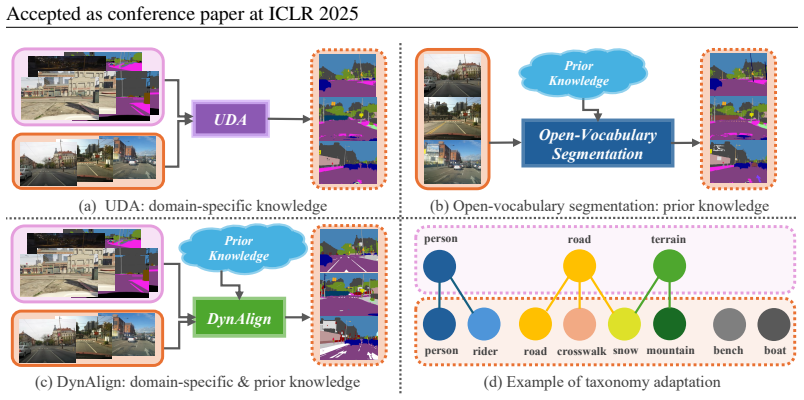
The load-bearing mechanism is the knowledge-fusion equation: each SAM mask $m$ gets a multi-scale visual feature $F_V$, formed as a similarity-weighted sum of local and global CLIP features (Eq. 5–6), and is assigned to the target class whose GPT-4-context-averaged text feature maximizes $\langle F_V, F_T\rangle$ (Eq. 7). The taxonomy mapping $c_s^i \to C_t^i \subseteq C_t$ lets a source label open onto several target labels, and Eq. 2 encodes each target label as the average CLIP text feature of context descriptions such as “road bridge” versus “pedestrian bridge.” SAM supplies the regions, CLIP supplies the semantic comparison, and the UDA model supplies the initial source label that selects both the candidate target set and the padding scale for global context.
What would settle it
Run the per-class evaluation in Tables 9 and 10 and check the classes the framework itself fails on: banner (0.5 mIoU), phone booth (0.8), traffic sign frame (0.1), bench (1.2) on Mapillary, and drivable fallback (2.9) on IDD. A controlled experiment that replaces the GPT-4 context names with oracle synonyms for exactly those classes and measures whether mIoU jumps would pinpoint whether the bottleneck is the text descriptions or CLIP's visual discrimination; if the gap persists with oracle names, the central reassignment mechanism is the limiting factor.
Extended reading notes
Core claim
On its own terms, the paper's discovery is that the label-level domain gap can be closed by turning the UDA model's source-space prediction into a prior for a foundation-model reassignment step. Given a target image, the UDA model produces a source-space label map; SAM segments the image into fine regions; for each region the majority source label selects a subset of allowed target labels via the LLM taxonomy mapping; and CLIP reclassifies the region by comparing a multi-scale regional visual embedding against context-averaged text embeddings of the candidate target classes. This produces pseudo-labels in the target taxonomy with no target annotations, and the paper reports that they are accurate enough to improve over naive HRDA-plus-open-vocabulary combinations and to train a target-space Mask2Former that is faster and slightly more accurate than direct DynAlign inference.
Load-bearing premise
The framework works only if CLIP's text-image similarity, using GPT-4's context phrases, can tell apart the fine-grained target classes; when it cannot, the reassignment fails and those classes collapse to near-zero accuracy.
Editorial extensions
If this is right
- A model trained on one taxonomy can produce predictions in a completely different target label space without any target-domain annotations.
- Unseen classes receive concrete labels rather than a generic “unknown” class, with unknown-class mIoU more than three points above the strongest HRDA-plus-open-vocabulary baseline on IDD.
- When the target taxonomy changes, only the taxonomy mapping and context names need to be updated; direct inference works without retraining, and pseudo-label training yields both higher accuracy and much faster inference.
- The same framework preserves or slightly improves traditional UDA performance when source and target label spaces coincide, as shown by GTA-to-Cityscapes mIoU of 75.9 versus 74.9 for the HRDA baseline.
Reading between the lines
- The per-class tables show reassignment fails precisely where CLIP's text names are visually confusable (banner, phone booth, traffic sign frame, bench on Mapillary); a likely next step is replacing global CLIP features with region-specific or fine-grained visual features rather than richer text.
- The taxonomy mapping is initiated by GPT-4 but human-refined in the appendix, so the pipeline is unsupervised in pixel labels but not fully autonomous in mapping construction; automating this refinement is a natural extension.
- The modularity suggests the same UDA-plus-SAM-plus-CLIP recipe could transfer to other dense prediction settings where target label sets evolve, such as medical imaging or remote sensing, provided the text descriptions carry enough context.
Editorial analysis
A structured set of objections, weighed in public.
Referee Report
Summary. The paper proposes DynAlign, a framework for unsupervised taxonomy-adaptive cross-domain semantic segmentation in which the source and target label sets differ and no target annotations are available. The method combines a UDA segmentation model (HRDA) that produces coarse predictions in the source label space with foundation models: GPT-4 is used to map source labels to target labels and to generate context-aware text descriptions, SAM generates fine-grained mask proposals, and CLIP is used to assign each mask a target label by text-image similarity. The core technical novelty is the knowledge-fusion mechanism that conditions CLIP's classification on the candidate target classes retrieved from the coarse UDA prediction. Experiments are reported on GTA to Mapillary Vistas and GTA to IDD, with headline mIoU values of 36.7 and 41.7, respectively, compared with 32.9 and 40.2 for the best naive HRDA-plus-open-vocabulary baselines. The paper also includes ablations, per-class tables, computational-efficiency measurements, and a pseudo-label training variant.
Significance. If the central claims hold, the paper addresses a genuinely useful and understudied problem: adapting a semantic segmentation model across both image-level domain shift and label-taxonomy mismatch without target supervision. The modular design, integrating any UDA model with SAM and CLIP, is an attractive and likely to be influential recipe. The manuscript is commendably explicit about its problem definition, provides per-class results in the appendix, and reports an ablation study for each main design choice; the planned code release is also a strength. However, the novelty-discovery claim is weakened by an internal inconsistency in the candidate-set mechanism, and the headline evaluation excludes a substantial fraction of the target label space. These issues are load-bearing for the paper's 'fully unsupervised taxonomy adaptation' claim and need to be addressed before the results can be accepted at face value.
major comments (4)
- [§4.4, Eq. (7), and Appendix A.7, Tables 11–12] The mechanism in Eq. (7) does not let CLIP reassign a mask to the full target label space: the argmax is taken only over the candidate subset C_t^i induced by the majority source label of the mask through Eq. (1). Therefore correct novel-class assignment is possible only if the coarse UDA prediction is one of the source labels to which the true target class is mapped. Section 4.2 states that novel classes are mapped to 'each source label,' but Appendix A.7 (Tables 11 and 12) actually maps each novel class to one or two source labels (e.g., bench only under 'unlabeled' on Mapillary, boat only under 'car'). This is an internal inconsistency, and it makes the claimed discovery of novel classes depend on the unverified accuracy of the coarse UDA prediction. The per-class failures in Table 9 (banner 0.5, phone booth 0.8, traffic sign frame 0.1, bench 1.2) are consistent with candidate-set exclusion rather than CLIP feature confusion: if the correct target class is not in the candidate set, no confidence threshold or text prompt can recover it. Please either allow CLIP to consider all target labels (or a broader learned candidate set) or provide an explicit analysis showing that candidate retrieval succeeds for novel classes; as written, the central novelty-discovery claim is not supported.
- [§5.1, Table 1, and Tables 9–10] The evaluation covers only 45 of the 66 Mapillary Vistas classes and 24 of the 25 IDD classes, with the excluded categories described only as 'small-scale or less informative' (Section 5.1). Since the target taxonomy is a central input to the problem, omitting 21 of 66 classes can materially inflate the reported mIoU and weakens the claim of seamless adaptation to arbitrary taxonomies. In addition, the 'known' versus 'unknown' split used in Table 1 is never defined in the main text or appendix; the per-class tables do not indicate which classes are considered unknown. Please report results over the full label space (or justify the exclusion with per-class numbers for the omitted classes) and state precisely how the known/unknown partition is computed.
- [Appendix A.7] The paper repeatedly describes the method as 'fully unsupervised' and 'without requiring any manual annotations,' but Appendix A.7 states that the GPT-4 taxonomy mapping is 'introduce[d] with human intervention to refine these mappings.' The taxonomy mapping is a core component of the method, so human refinement of this mapping is a form of dataset-specific supervision, even if it is not pixel-level annotation. Please clarify the exact role of human intervention, report the prompts and refinement protocol, and temper or qualify the 'fully unsupervised' claim accordingly.
- [§5.2, Table 1] The comparison is limited to two open-vocabulary systems and their naive combination with HRDA. No comparison is made to existing taxonomy-adaptive DA methods (Gong et al., 2022; Fan et al., 2023a) even under their supervised or few-shot settings, nor to a closed-set UDA oracle in which source labels are manually mapped to target labels. Moreover, the reported gains over the best baseline are 3.8 mIoU on Mapillary but only 1.5 mIoU on IDD, and all numbers appear to come from a single run with no error bars or multiple seeds. Given the known run-to-run variance of self-training UDA models, the 'significant improvement' claim on IDD would be more convincing with repeated trials or statistical significance information.
minor comments (6)
- [§2.2] The citation placeholder '(Ghiasi et al., 2022; ?)' should be replaced with the intended reference.
- [Abstract] The word 'publically' should be 'publicly'.
- [§2.1] The sentence beginning 'Typically, In the field of cross-domain semantic segmentation' has a capitalization and punctuation error; 'Typically,' should be lowercase and integrated into the sentence.
- [§5.4, Table 4] The text above Table 4 reads 'Table 4 shows shows the performance'; the duplicated word should be removed.
- [References] The reference 'Matthias Minderer, Alexey Gritsenko. Scaling open-vocabulary object detection. NeurIPS, 2023' is incomplete; the full author list and venue information are needed.
- [Appendix A.6] Please add a note in the appendix specifying which target classes are treated as 'known' and which as 'unknown' in Table 1, since this partition is used throughout the results discussion.
Circularity Check
No evidence of circular reasoning; DynAlign's predictions are evaluated against held-out target annotations, and the intermediate taxonomy mappings and CLIP features are external priors rather than re-used outputs.
full rationale
The paper makes an empirical systems claim: DynAlign reassigns SAM mask regions to a known target label set using GPT-4-generated taxonomy mappings and context names, SAM mask proposals, and CLIP feature similarity, then evaluates against held-out Mapillary Vistas and IDD validation annotations. No step in Sections 4.1-4.4 is defined in terms of the final mIoU or the target ground truth. Eq. 1 is the input taxonomy mapping; Eq. 2 encodes externally generated context descriptions; Eqs. 3-6 extract CLIP visual features from SAM masks and the image; Eq. 7 takes an argmax over the mapped target labels. The output is therefore not forced by construction, and no fitted parameter is renamed as a prediction. The only self-reference is a background citation to coauthor prior work (Gong et al. 2022, TACS), used to distinguish the setting rather than to justify a load-bearing premise. Two appended passages are worth flagging as non-circular correctness concerns: Appendix A.7 states that GPT-4 mapping proposals were refined with human intervention and that ambiguous classes were excluded, which weakens the 'fully unsupervised' description; and Section 4.2's statement that novel classes are mapped to 'each source label' is inconsistent with Tables 11-12, where novel classes appear only under a subset of source labels, meaning the candidate-set restriction depends on the UDA prediction. These are scope and consistency issues, not circularity: the final accuracy is still measured against external validation labels and is not an input to the method.
Assumptions & free parameters
free parameters (3)
- CLIP confidence threshold =
0.5 (default, ablated in Appendix A.4)
- Per-class padding sizes for multi-scale visual features =
Not specified numerically
- Number of GPT-4 context names per target label =
10
assumptions (6)
- domain assumption The target label set Ct is known but unlabeled.
- domain assumption CLIP text-image cosine similarity is a valid semantic classifier for street-scene categories.
- domain assumption SAM mask proposals correspond to semantically coherent regions covering all relevant objects.
- domain assumption GPT-4 with human refinement produces correct and complete taxonomy mappings.
- ad hoc to paper Evaluation on a subset of target classes is representative.
- domain assumption Street-scene context descriptions from GPT-4 are domain appropriate.
Cite this review
Pith. "Pith review of DynAlign: Unsupervised Dynamic Taxonomy Alignment for Cross-Domain Segmentation." pith.science (2026). https://pith.science/paper/TNADXBED
@misc{pith2026250116410,
  author       = {Pith},
  title        = {Pith review of: DynAlign: Unsupervised Dynamic Taxonomy Alignment for Cross-Domain Segmentation},
  year         = {2026},
  howpublished = {\url{https://pith.science/paper/TNADXBED}},
  note         = {Machine review of arXiv:2501.16410}
}
read the original abstract
Current unsupervised domain adaptation (UDA) methods for semantic segmentation typically assume identical class labels between the source and target domains. This assumption ignores the label-level domain gap, which is common in real-world scenarios, thus limiting their ability to identify finer-grained or novel categories without requiring extensive manual annotation. A promising direction to address this limitation lies in recent advancements in foundation models, which exhibit strong generalization abilities due to their rich prior knowledge. However, these models often struggle with domain-specific nuances and underrepresented fine-grained categories. To address these challenges, we introduce DynAlign, a framework that integrates UDA with foundation models to bridge both the image-level and label-level domain gaps. Our approach leverages prior semantic knowledge to align source categories with target categories that can be novel, more fine-grained, or named differently (e.g., vehicle to {car, truck, bus}). Foundation models are then employed for precise segmentation and category reassignment. To further enhance accuracy, we propose a knowledge fusion approach that dynamically adapts to varying scene contexts. DynAlign generates accurate predictions in a new target label space without requiring any manual annotations, allowing seamless adaptation to new taxonomies through either model retraining or direct inference. Experiments on the street scene semantic segmentation benchmarks GTA to Mapillary Vistas and GTA to IDD validate the effectiveness of our approach, achieving a significant improvement over existing methods. Our code will be publicly available.
Figures


Figures from the paper (3 more)


Reference graph
Works this paper leans on
-
[1]
Josh Achiam, Steven Adler, Sandhini Agarwal, Lama Ahmad, Ilge Akkaya, Florencia Leoni Ale- man, Diogo Almeida, Janko Altenschmidt, Sam Altman, Shyamal Anadkat, et al. Gpt-4 technical report. arXiv preprint arXiv:2303.08774,
-
[4]
Scaling open-vocabulary image segmentation with image-level labels
11 Accepted as conference paper at ICLR 2025 Golnaz Ghiasi, Xiuye Gu, Yin Cui, and Tsung-Yi Lin. Scaling open-vocabulary image segmentation with image-level labels. In European Conference on Computer Vision , pp. 540–557. Springer,
work page 2025
-
[5]
Class-incremental domain adaptation
Jogendra Nath Kundu, Rahul Mysore Venkatesh, Naveen Venkat, Ambareesh Revanur, and R Venkatesh Babu. Class-incremental domain adaptation. In Computer Vision–ECCV 2020: 16th European Conference, Glasgow, UK, August 23–28, 2020, Proceedings, Part XIII 16 , pp. 53–69. Springer,
work page 2020
-
[6]
Language-driven semantic segmentation
Boyi Li, Kilian Q Weinberger, Serge Belongie, Vladlen Koltun, and Ren´e Ranftl. Language-driven semantic segmentation. arXiv preprint arXiv:2201.03546, 2022a. Wuyang Li, Xinyu Liu, and Yixuan Yuan. Sigma: Semantic-complete graph matching for domain adaptive object detection. In Proceedings of the IEEE/CVF Conference on Computer Vision and Pattern Recognit...
-
[7]
Cross-domain adaptive teacher for object detection
Yu-Jhe Li, Xiaoliang Dai, Chih-Yao Ma, Yen-Cheng Liu, Kan Chen, Bichen Wu, Zijian He, Kris Kitani, and Peter Vajda. Cross-domain adaptive teacher for object detection. In Proceedings of the IEEE/CVF Conference on Computer Vision and Pattern Recognition, pp. 7581–7590, 2022c. 12 Accepted as conference paper at ICLR 2025 Feng Liang, Bichen Wu, Xiaoliang Dai...
work page 2025
-
[8]
Instance adaptive self-training for unsuper- vised domain adaptation
Ke Mei, Chuang Zhu, Jiaqi Zou, and Shanghang Zhang. Instance adaptive self-training for unsuper- vised domain adaptation. In Computer Vision–ECCV 2020: 16th European Conference, Glasgow, UK, August 23–28, 2020, Proceedings, Part XXVI 16, pp. 415–430. Springer,
work page 2020
-
[10]
Playing for data: Ground truth from computer games
Stephan R Richter, Vibhav Vineet, Stefan Roth, and Vladlen Koltun. Playing for data: Ground truth from computer games. In Computer Vision–ECCV 2016: 14th European Conference, Amsterdam, The Netherlands, October 11-14, 2016, Proceedings, Part II 14, pp. 102–118. Springer,
work page 2016
-
[11]
Cheng Shi and Sibei Yang. The devil is in the object boundary: towards annotation-free instance segmentation using foundation models. arXiv preprint arXiv:2404.11957,
Show all 24 references
-
[12]
Llama: Open and efficient foundation language models
13 Accepted as conference paper at ICLR 2025 Hugo Touvron, Thibaut Lavril, Gautier Izacard, Xavier Martinet, Marie-Anne Lachaux, Timoth ´ee Lacroix, Baptiste Rozi `ere, Naman Goyal, Eric Hambro, Faisal Azhar, et al. Llama: Open and efficient foundation language models. arXiv p...
2025 arXiv
-
[15]
Betrayed by captions: Joint caption grounding and generation for open vo- cabulary instance segmentation
Jianzong Wu, Xiangtai Li, Henghui Ding, Xia Li, Guangliang Cheng, Yunhai Tong, and Chen Change Loy. Betrayed by captions: Joint caption grounding and generation for open vo- cabulary instance segmentation. In Proceedings of the IEEE/CVF International Conference on Computer Vis...
-
[16]
Opendas: Domain adaptation for open-vocabulary segmentation
Gonca Yilmaz, Songyou Peng, Francis Engelmann, Marc Pollefeys, and Hermann Blum. Opendas: Domain adaptation for open-vocabulary segmentation. arXiv preprint arXiv:2405.20141,
-
[17]
Open- vocabulary sam: Segment and recognize twenty-thousand classes interactively
Haobo Yuan, Xiangtai Li, Chong Zhou, Yining Li, Kai Chen, and Chen Change Loy. Open- vocabulary sam: Segment and recognize twenty-thousand classes interactively. arXiv preprint arXiv:2401.02955,
-
[18]
14 Accepted as conference paper at ICLR 2025 Pan Zhang, Bo Zhang, Ting Zhang, Dong Chen, Yong Wang, and Fang Wen
arXiv preprint arXiv:2306.14289. 14 Accepted as conference paper at ICLR 2025 Pan Zhang, Bo Zhang, Ting Zhang, Dong Chen, Yong Wang, and Fang Wen. Prototypical pseudo label denoising and target structure learning for domain adaptive semantic segmentation. In Pro- ceedings of t...
2025 arXiv
-
[19]
A.1 includes more implementation details
15 Accepted as conference paper at ICLR 2025 A A PPENDIX OVERVIEW The supplementary material presents the following sections to strengthen the main manuscript: — Sec. A.1 includes more implementation details. — Sec. A.2 presents memory usage and computational efficiency compar...
2025
-
[20]
The reported total memory usage corresponds to the memory allocated during the complete inference process for a single image
The total model parameter count of our method includes the UDA model parameters, plus 308M for SAM (ViT-L) and 351M for CLIP (ConvNeXt-Large). The reported total memory usage corresponds to the memory allocated during the complete inference process for a single image. Overall,...
2025
-
[21]
Overall, DynAlign demonstrates robustness and is not very sensitive to the confidence threshold within a certain value range
The results show that while the mAcc improves with a lower confidence threshold for assigning new class labels, the mIoU may decrease correspondingly. Overall, DynAlign demonstrates robustness and is not very sensitive to the confidence threshold within a certain value range. ...
2025
-
[22]
We utilizes GPT-4 to generate an initial proposal for potentially correlated taxonomy mappings between the source and target domains and introduce human intervention to refine these mappings due to the differing definitions of classes across datasets. For example, in the Mapil...
2025
-
[23]
Use synonyms or subcategories of the original class that make sense within this context, and if the class has multiple meanings, add specific context to avoid ambi- guity
We generate those names by providing GPT-4 with the instruction: 19 Accepted as conference paper at ICLR 2025 Table 10: Per-class semantic segmentation evaluation results on IDD Grounded- SAM Grounded- SAM + HRDA OwlVIT- SAM OwlVIT-SAM + HRDA Ours IoU Acc IoU Acc IoU Acc IoU A...
2025
-
[24]
Target Label Context Names Road road, main road, driving lane, paved road, highway, residential street, arterial road, rural road, city road, thoroughfare Snow snow, snow pile, street snow, roadside snow, accumulated snow, snowbank, plowed snow, urban snow, compacted snow, sno...
2025
-
[2018]
Idd: A dataset for exploring problems of autonomous navigation in unconstrained envi- ronments
Girish Varma, Anbumani Subramanian, Anoop Namboodiri, Manmohan Chandraker, and CV Jawa- har. Idd: A dataset for exploring problems of autonomous navigation in unconstrained envi- ronments. In 2019 IEEE winter conference on applications of computer vision (WACV) , pp. 1743–1751. IEEE,
2019
-
[2019]
Sclip: Rethinking self-attention for dense vision-language inference
Feng Wang, Jieru Mei, and Alan Yuille. Sclip: Rethinking self-attention for dense vision-language inference. arXiv preprint arXiv:2312.01597,
-
[2021]
Grounded sam: Assembling open-world models for diverse visual tasks
Tianhe Ren, Shilong Liu, Ailing Zeng, Jing Lin, Kunchang Li, He Cao, Jiayu Chen, Xinyu Huang, Yukang Chen, Feng Yan, et al. Grounded sam: Assembling open-world models for diverse visual tasks. arXiv preprint arXiv:2401.14159,
-
[2023]
Taxonomy adaptive cross-domain adaptation in medical imaging via optimization trajectory distillation
Jianan Fan, Dongnan Liu, Hang Chang, Heng Huang, Mei Chen, and Weidong Cai. Taxonomy adaptive cross-domain adaptation in medical imaging via optimization trajectory distillation. In Proceedings of the IEEE/CVF International Conference on Computer Vision , pp. 21174–21184, 2023...
2023
-
[2024]
Open-vocabulary universal image segmentation with maskclip
Zheng Ding, Jieke Wang, and Zhuowen Tu. Open-vocabulary universal image segmentation with maskclip. arXiv preprint arXiv:2208.08984,
Reviewed August 10, 2026 · model on record in the stance chip above.
Discussion (0). Continue with ORCID to comment.