REVIEW 5 major objections 5 minor 120 references
Cosmic Bulk Flow Analysis in Modified Gravity Theories: $f(R)$ and Perturbed $f(R)$ Models with Neutrino Coupling
T0 review · 5 major / 5 minor · reviewed 2026-08-10 · deepseek-v4-flash
Pith's one-line read Neutrino coupling in perturbed f(R) gravity amplifies cosmic bulk flow to over 3000 km/s at high redshift.
desk verdict The claimed neutrino-driven bulk flow enhancement is a fitted-parameter comparison that is not significant in the paper's own error bars. read the letter →
The pith
A machine-rendered reading of the paper's core claim, the machinery that carries it, and where it could break.
The reading
What carries the argument
The engine of the calculation is a modified neutrino continuity equation in an $f(R)$ background, $\rho'_\nu + 3H(\rho_\nu + P_\nu) = -\Gamma\rho_\nu$, where $\Gamma = u^\mu\nabla_\mu f_R$ measures how the additional scalar degree of freedom of $f(R)$ gravity interacts with the neutrino fluid. The paper evaluates this coupling in the Hu-Sawicki form of $f(R)$, rewrites the linear perturbation equations as a first-order autonomous system in variables $\xi_1,\dots,\xi_8$, and feeds the resulting distance-redshift relation into a dipole formula for the luminosity distance, $d_L^{\rm(dipole)}(z) = \frac{1+z}{H}\,(\mathbf{n}\cdot\mathbf{v}_{\rm Bulk})$. A $\chi^2$ fit to Pantheon supernova distance moduli, binned by redshift, then returns the amplitude and direction of the bulk flow for each model.
What would settle it
A direct test is to refit the same Pantheon distance moduli with the full covariance matrix and check whether the $0.8<z<1.4$ dipole still has amplitude near $3086\,\mathrm{km/s}$ pointing at $(l,b)=(330^\circ,-16^\circ)$; a null or misdirected dipole would falsify the central claim.
Extended reading notes
Core claim
The paper's central claim is that the bulk flow, the coherent motion of matter averaged over large volumes, is a discriminating probe of modified gravity, and that neutrinos make it visibly stronger. In the Hu-Sawicki $f(R)$ model, a modified-gravity model whose $f(R)$ is a rational function of the Ricci scalar, adding scalar perturbations and then a neutrino coupling of the form $Q_\nu = -\Gamma\rho_\nu$ with $\Gamma = u^\mu \nabla_\mu f_R$ produces a systematic increase in the fitted bulk flow velocity in every redshift bin studied. The highest bin, $0.8<z<1.4$, gives $V_{\rm bulk} = 3086 \pm 286\,\mathrm{km/s}$ directed at $(l,b) = (330^\circ \pm 15^\circ, -16^\circ \pm 17^\circ)$, which the authors identify with the dark energy dipole; at $0.1<z<0.2$ the flow points toward the Sloan Great Wall, and at $0.4<z<0.6$ toward the King Ghidorah Supercluster, a massive supercluster at $z\sim0.5$. The authors interpret these alignments and the velocity boost as evidence that neutrinos interacting with the modified gravity sector shape cosmic flows and influence cosmic acceleration.
Load-bearing premise
The whole result rests on the assumption that neutrinos interact with the modified-gravity scalar exactly through the proposed coupling $Q_\nu = -\Gamma\rho_\nu$ with $\Gamma\approx0.6$; if that interaction has a different form or strength, the reported bulk-flow enhancement collapses.
Editorial extensions
If this is right
- In the neutrino-coupled perturbed $f(R)$ model, high-redshift bulk flow exceeds $3000\,\mathrm{km/s}$ in $0.8<z<1.4$, a signature that future peculiar-velocity surveys could test.
- At $z>0.4$ the bulk flow direction tracks the dark energy dipole, meaning the same sector that drives cosmic acceleration is claimed to steer large-scale velocities.
- At lower redshifts the flow points toward the Sloan Great Wall ($0.1<z<0.2$) and the King Ghidorah Supercluster ($0.4<z<0.6$), so the model connects the velocity field to specific observed superclusters.
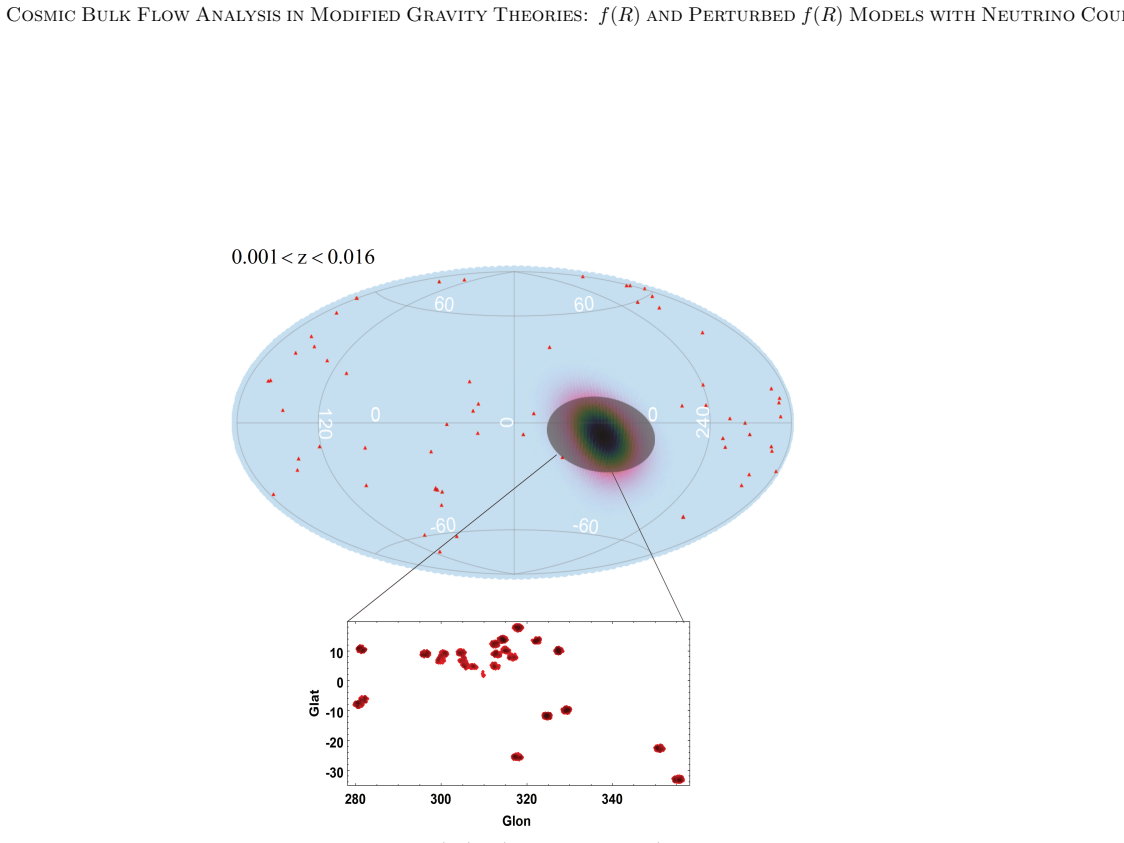
- The neutrino coupling raises bulk flow even in the local universe (from $147\,\mathrm{km/s}$ to $173\,\mathrm{km/s}$ in $0.001<z<0.016$), leaving a local kinematic imprint of the coupling.
- The fit yields $\sum m_\nu < 0.142\,\mathrm{eV}$ at 95% confidence and $\Gamma = 0.6\pm0.25$, giving concrete parameters for future modified-gravity analyses.
Reading between the lines
- If the proposed coupling is real, the same dipole should survive a full-covariance re-analysis of the Pantheon+ sample; that re-analysis is a direct and inexpensive check.
- The claimed high-redshift alignment with the dark energy dipole, if confirmed by independent data, would connect bulk-flow measurements to the long-standing dark-flow and CMB-frame anomalies and give modified gravity a single observable that addresses both.
- The linear coupling $Q_\nu=-\Gamma\rho_\nu$ is a parameterization rather than a derived Lagrangian; testing other functional forms would show whether the $>3000\,\mathrm{km/s}$ prediction is generic to neutrino-modified gravity or specific to this choice.
Editorial analysis
A structured set of objections, weighed in public.
Referee Report
Summary. The paper analyzes bulk flow in f(R) gravity, perturbed f(R) gravity, and perturbed f(R) gravity with a neutrino coupling, using Pantheon Type Ia supernova data and the Bonvin dipole formalism. For each redshift bin, the bulk flow velocity and direction are obtained by minimizing a chi-square over the Pantheon magnitude residuals. The authors report that the neutrino-coupled model yields the largest bulk flow velocities, exceeding 3000 km/s at 0.8<z<1.4, and that its direction aligns with the Sloan Great Wall, the King Ghidorah Supercluster, and the dark energy dipole. The central claim is that neutrino interactions with modified gravity substantially enhance bulk flow and align it with large-scale structure.
Significance. If the central claim were a genuine model prediction, it would be of interest because it would connect neutrino-modified gravity to an observable large-scale velocity field. However, the bulk flow velocity and direction are free parameters fitted separately in each redshift bin, so the reported 'increase' is a comparison of best-fit amplitudes, not a prediction of the neutrino coupling. Moreover, the differences between models are within the quoted 1-sigma uncertainties in every bin, and no significance test is presented. The direction results also rest on an apparent error in the galactic coordinate transformation. The paper does provide a useful compilation of redshift-binned bulk-flow results and a clear description of the fitting procedure, but those strengths do not overcome the statistical and methodological problems with the headline claim.
major comments (5)
- [Sec. 6, Eq. (56), Tables 5-7] The bulk flow velocity and direction are free parameters minimized independently in each redshift bin via Eq. (56). The model dependence enters only through the Hubble parameter and the background luminosity distance in the dipole term of Eq. (51). Therefore, the statement that incorporating neutrinos 'results in a substantial increase in bulk flow velocities' is a statement about fitted values, not a dynamical prediction. To support the claim, the paper would need to show that the perturbation equations of Sec. 4 predict a larger bulk flow amplitude in the neutrino-coupled model without using the Pantheon dipole as input.
- [Tables 5-7 and Sec. 7.1] The reported enhancements are not statistically significant even within the paper's own errors. For 0.8<z<1.4, the neutrino model gives 3086±286 km/s versus 2780±282 km/s for f(R); the difference is 306 km/s with combined error about 401 km/s, i.e., roughly 0.8 sigma. For 0.4<z<0.6 the difference is 40±326 km/s, and for 0.1<z<0.2 it is 123±202 km/s. No bin exceeds 1 sigma, and the chi-square differences between models are small (e.g., Delta chi^2 about 1.9 for the highest bin). The conclusion that neutrinos substantially increase bulk flow is therefore not supported by the analysis as presented.
- [Sec. 6, Eqs. (53)-(55)] The Cartesian unit vector for galactic coordinates appears to be incorrect. For a source at galactic longitude l and latitude b, the standard expression is (cos b cos l, cos b sin l, sin b), but Eq. (53) uses (cos l sin b, sin l sin b, cos b), and Eq. (55) repeats the same convention. As written, sources with b=0 are all assigned to the pole, and the fitted bulk flow directions, including the claimed alignments with the Sloan Great Wall, King Ghidorah Supercluster, and dark energy dipole, are therefore suspect.
- [Secs. 3 and 4, Eqs. (19), (23)-(25)] The neutrino coupling is introduced as Q_nu = -Gamma rho_nu with Gamma = u^mu grad_mu f_R, but no derivation from the interaction Lagrangian in Eq. (17) is given, and the sign and functional form are simply assumed. The manuscript then uses Gamma = 0.6 ± 0.25, quoted as a best fit to Pantheon+ data in Sec. 5, without explaining how this value is obtained or whether it is re-fit in Eq. (56). If Gamma is a global best fit to the same Pantheon sample used for the bulk-flow dipole, the subsequent enhancement is at least partly circular.
- [Sec. 5, Eqs. (42)-(45)] The constraint on the sum of neutrino masses, Sigma m_nu < 0.142 eV, and the quoted Gamma = 0.6 ± 0.25 are not supported by any presented likelihood, priors, dataset, or fitting procedure. Equations (42)-(45) define a dimensionless density variable but do not by themselves yield a mass constraint. Since Gamma is the only new parameter in the neutrino-coupled model, this missing support is load-bearing for the model comparison.
minor comments (5)
- [Secs. 2-3, Eqs. (2)-(9)] Several equations contain apparent typographical or OCR errors, such as the term '-g_mu_nu 2 f_R(R)' in Eq. (2) and similar expressions in Eq. (9), which likely should involve the d'Alembertian operator. The notation for derivatives is also inconsistent (fR, f'_R, f''_R) and should be defined uniformly.
- [Sec. 6, text following Eq. (50)] The text says 'Inserting this in Eq. (21)' when referring to the dipole formula; the intended equation number appears to be Eq. (51) or (52).
- [Sec. 7 and Appendix] The direction uncertainties in Tables 5-7 are large, e.g., b = 69 ± 18 degrees for the 0.4<z<0.6 bin, so statements such as 'near-perfect congruence' with the dark energy dipole or superclusters overstate the precision of the measurement.
- [Appendix, Fig. 11] The CMB power-spectrum discussion is not connected to the bulk-flow fitting procedure, and no Boltzmann solver or parameter choices are described. As presented, the figure and appendix do not add quantitative support to the main claims.
- [References] The reference list contains many duplicated and incomplete entries, including multiple Kashlinsky entries, inconsistent spellings such as 'Watkin' versus 'Watkins', and garbled citations. The paper would need a careful editorial pass before publication.
Circularity Check
The paper's central claim of neutrino-enhanced bulk flow is a comparison of best-fit values from Eq. (56), not a model prediction, and the quoted errors make the enhancement statistically insignificant.
-
fitted input called prediction
[Sec. 6, Eq. (56); Sec. 7, Tables 5-7]
"Next, we constrain the the direction and velocity of the bulk flow across different redshift ranges,by employing χ2, χ2 = \sum_i |\mu_i - 5 log10((d^0_L(z_i) - d^{dipole}_L(z, \upsilon_{BF}, \theta_i)/10pc|^2 / \sigma^2_i ... From the data presented in the tables, it is evident that the inclusion of neutrinos has a significant impact on the bulk flow velocity."
In Eq. (56), v_BF and the direction (l,b) are free parameters minimized against the same Pantheon data, and Eq. (51) makes the dipole term linear in v_BF. Therefore the larger V_bulk in the neutrino-coupled model (e.g., 3086 vs 2780 km/s in the 0.8<z<1.4 bin) is simply the larger best-fit amplitude, not a velocity computed from the f(R)+neutrino equations. The abstract's 'substantial increase' is a restatement of the fitted parameter, not an independent test of the model, especially since the paper gives no significance test or covariance propagation for the difference.
-
fitted input called prediction
[Sec. 5, 'Constraint on Total Mass of Neutrinos'; Eqs. (19), (23)-(25)]
"Additionally, for the parameter Γ, the best-fit value is Γ = 0.6 ± 0.25, derived from the Pantheon+ catalog. This result are in good agreement with Yarahmadi et al. (2025)."
The coupling parameter Γ is fitted to supernova distance data (Pantheon+) and then inserted into the modified neutrino continuity equation used to construct the model's H(z). The bulk-flow dipole is then fitted to the closely related Pantheon supernova sample using this model. The 'neutrino-induced' enhancement in V_bulk is therefore not an out-of-sample prediction: a free parameter of the model has already been tuned to supernova data, and the same type of data is used to claim the effect. The paper presents this fitted input as the physical cause of the fitted output.
1 more flagged steps
-
renaming known result
[Sec. 7.1 and Sec. 8, Fig. 8]
"Remarkably, this direction coincides precisely with the observed dark energy dipole. This alignment suggests that the inclusion of neutrinos in the perturbed f (R) gravity model not only enhances the bulk flow velocity but also aligns the direction of the flow with the large-scale structure indicated by the dark energy dipole"
The direction (l,b) = (330°±15°, −16°±17°) is one of the parameters minimized in Eq. (56). Presenting the fitted direction as 'coinciding precisely with the observed dark energy dipole' is not a model prediction; it is a match between the fitted dipole direction and a named direction that is not independently derived or measured in this paper. Unless the dark energy dipole direction has an independent error budget, this 'remarkable' alignment reduces to identifying the fit output with a known direction, i.e., renaming the best-fit dipole as a physical alignment with dark energy.
full rationale
The paper self-contains a coupled set of equations, but its headline result is not derived from those equations in the sense of a prediction. Equation (56) minimizes χ² over V_bulk and (l,b), and the dipole luminosity-distance term d_L^dipole = (1+z)/H (n·v_Bulk) makes V_bulk a fitted amplitude. The model dependence enters only through H(z) and d0_L(z); the velocity itself is free. Thus the conclusion that neutrinos 'result in a substantial increase' is a comparison of best-fit values, not a dynamical output of the f(R)+neutrino perturbation system. Moreover, the paper's own error bars undermine the claim: for 0.8<z<1.4 the difference is 3086−2780 = 306 km/s with quadrature error ≈401 km/s, about 0.8σ; other bins are similarly sub-significant. The coupling parameter Γ=0.6±0.25 is fitted to Pantheon+ supernova data and then used to construct the model that is applied to Pantheon data, so the neutrino effect is partly built in rather than independently predicted. The coupling ansatz is additionally anchored to the authors' own prior work (Yarahmadi et al. 2025), making the self-citation load-bearing for the central physical premise. No exact Eq.-to-Eq. identity or uniqueness-importation pattern was found, so the paper is not fully circular; however, the central claim does reduce substantially to fitted parameters, warranting a score of 7.
Assumptions & free parameters
free parameters (4)
- Bulk flow velocity V_bulk per redshift bin =
e.g., 147-3086 km/s depending on model and bin
- Bulk flow direction (l, b) per redshift bin =
angles in Tables 1-7
- Gamma (neutrino coupling strength) =
0.6 +/- 0.25
- Hu-Sawicki parameters c1, c2, f0, n =
c1=0.00125, c2=0.0000656, f0=0.99 or 0.988, n=4
assumptions (4)
- standard math Flat FRW metric and the scalar perturbation equations for f(R) gravity are correct as written.
- domain assumption The Hu-Sawicki functional form and the chosen best-fit parameters describe the late-time universe.
- ad hoc to paper The neutrino coupling parameterization Q_nu = -Gamma rho_nu, with Gamma = u^mu grad_mu f_R, is physically appropriate.
- domain assumption Pantheon supernovae are standardizable candles and the quoted sigma_i fully characterize the magnitude uncertainties.
invented entities (1)
-
Neutrino-f(R) coupling term Q_nu = -Gamma rho_nu
Cite this review
Pith. "Pith review of Cosmic Bulk Flow Analysis in Modified Gravity Theories: $f(R)$ and Perturbed $f(R)$ Models with Neutrino Coupling." pith.science (2026). https://pith.science/paper/MJSFRV54
@misc{pith2026250116492,
  author       = {Pith},
  title        = {Pith review of: Cosmic Bulk Flow Analysis in Modified Gravity Theories: $f(R)$ and Perturbed $f(R)$ Models with Neutrino Coupling},
  year         = {2026},
  howpublished = {\url{https://pith.science/paper/MJSFRV54}},
  note         = {Machine review of arXiv:2501.16492}
}
abstract
In this study, we explore the characteristics of bulk flow across various redshift ranges within the frameworks of $f(R)$ gravity, perturbed $f(R)$ gravity, and perturbed $f(R)$ gravity coupled with neutrinos. Our investigation reveals profound insights into large-scale cosmic flows and their interactions with major cosmic structures, such as the Sloan Great Wall (SGW) and the King Ghidorah Supercluster (KGSc). We find that incorporating neutrinos into the perturbed $f(R)$ gravity model results in a substantial increase in bulk flow velocities across all redshifts, with notable enhancements in the higher redshift ranges, where velocities can exceed $3000 \, \mathrm{km/s}$ in the $0.8 < z < 1.4$ range. Moreover, the direction of the bulk flow in this model closely aligns with the dark energy dipole, especially at redshifts $z > 0.4$, showing near-perfect congruence with cosmic superclusters. This suggests a significant interaction between neutrinos and cosmic structures, influencing cosmic acceleration. At lower redshifts, such as $0.1 < z < 0.2$, the bulk flow aligns with the SGW, while in the $0.4 < z < 0.6$ range, it aligns with the KGSc. In the low redshift range $0.001 < z < 0.016$, although velocities are lower, neutrinos still subtly increase the bulk flow velocity and maintain alignment with nearby cosmic structures, like the Local Supercluster. Our results underscore the critical role of neutrinos in shaping cosmic flows and offer new insights into the interplay between dark energy, neutrinos, and modified gravity models.
Figures


Figures from the paper (8 more)


Reference graph
Works this paper leans on
-
[1]
, " * write output.state after.block = add.period write newline
ENTRY address archivePrefix author booktitle chapter doi edition editor eprint howpublished institution journal key month number organization pages publisher school series title misctitle type volume year version url label extra.label sort.label short.list INTEGERS output.state before.all mid.sentence after.sentence after.block FUNCTION init.state.consts ...
-
[2]
write newline
" write newline "" before.all 'output.state := FUNCTION format.url url empty "" new.block "" url * "" * if FUNCTION format.eprint eprint empty "" archivePrefix empty "" archivePrefix "arXiv" = new.block " " eprint * " " * new.block " " eprint * " " * if if if FUNCTION format.doi doi empty "" " " doi * " " * if FUNCTION format.pid doi empty eprint empty ur...
-
[3]
2V[ 4ZLOMa?\⎽
thebibliography [1] 20pt to REFERENCES 6pt =0pt -12pt 10pt plus 3pt =0pt =0pt =1pt plus 1pt =0pt =0pt -12pt =13pt plus 1pt =20pt =13pt plus 1pt \@M =10000 =-1.0em =0pt =0pt 0pt =0pt =1.0em @enumiv\@empty 10000 10000 `\.\@m \@noitemerr \@latex@warning Empty `thebibliography' environment \@ifnextchar \@reference \@latexerr Missing key on reference command E...
2021
-
[4]
G., et al., (1998), Observational Evidence from Supernovae for an Accelerating Universe and a Cosmological Constant, The Astronomical Journal, 116(3), 1009
Riess, A. G., et al., (1998), Observational Evidence from Supernovae for an Accelerating Universe and a Cosmological Constant, The Astronomical Journal, 116(3), 1009
1998
-
[5]
Perlmutter, S., et al., (1999), Measurements of and from 42 High-Redshift Supernovae, The Astrophysical Journal, 517(2), 565
1999
-
[6]
Planck Collaboration, (2018), Planck 2018 results. VI. Cosmological parameters, Astronomy & Astrophysics, 641, A6
2018
-
[7]
Weinberg, S., (1989), The Cosmological Constant Problem, Reviews of Modern Physics, 61(1), 1-23
1989
-
[8]
Martin, J., (2012), Everything You Always Wanted To Know About The Cosmological Constant Problem (But Were Afraid To Ask), Comptes Rendus Physique, 13(6-7), 566-665
2012
Show all 120 references
-
[9]
J., (1999), Quintessence, Cosmic Coincidence, and the Cosmological Constant, Physical Review Letters, 82(5), 896-899
Zlatev, I., Wang, L., and Steinhardt, P. J., (1999), Quintessence, Cosmic Coincidence, and the Cosmological Constant, Physical Review Letters, 82(5), 896-899
1999
-
[10]
Yarahmadi, M., and Salehi, A., (2023), EPJC, 83, 910
2023
-
[11]
Yarahmadi, M., and Salehi, A., (2023), Communications in Theoretical Physics, 75, 055401
2023
-
[12]
and Odintsov S
Nojiri S. and Odintsov S. D.,(2006), eConf C0602061 , 06 [arXiv:hep-th/0601213 [hep-th]]
2006 arXiv
-
[13]
D.,(2003), Phys
Nojir S.i and Odintsov S. D.,(2003), Phys. Rev. D 68 , 123512 [arXiv:hep-th/0307288 [hep-th]]
2003 arXiv
-
[14]
Sotiriou T. P. and Faraoni V.,(2010), Rev. Mod. Phys. 82 , 451-497 [arXiv:0805.1726 [gr-qc]]
2010 arXiv
-
[15]
and Tsujikawa S.,(2010), Living Rev
De Felice A. and Tsujikawa S.,(2010), Living Rev. Rel. 13 , 3 [arXiv:1002.4928 [gr-qc]]
2010 arXiv
-
[16]
and De Laurentis M.,(2011), Phys
Capozziello S. and De Laurentis M.,(2011), Phys. Rept. 509 , 167-321 [arXiv:1108.6266 [gr-qc]]
2011 arXiv
-
[17]
Capozziello S.,(2002), Int. J. Mod. Phys. D 11 , 483-492 [arXiv:gr-qc/0201033 [gr-qc]]
2002 arXiv
-
[18]
and Troisi A., Recent Res
Capozziello S., Carloni S. and Troisi A., Recent Res. Dev. Astron. Astrophys. 1 (2003), 625 [arXiv:astro-ph/0303041 [astro-ph]]
2003 arXiv
-
[20]
M., 1993, ApJ, 413, L105
Phillips M. M., 1993, ApJ, 413, L105
1993
-
[21]
G., (1968), Comments on the Scalar-Tensor Theory, International Journal of Theoretical Physics, 1(1), 25–36, doi: 10.1007/BF00668828
Bergmann, P. G., (1968), Comments on the Scalar-Tensor Theory, International Journal of Theoretical Physics, 1(1), 25–36, doi: 10.1007/BF00668828
1968 doi
-
[22]
Liu, H., Lü, H., and Wang, Z.-L., (2012), f(R) Gravities, Killing Spinor Equations, ‘BPS’ Domain Walls and Cosmology, Journal of High Energy Physics, 2012(2), 83, doi: 10.1007/JHEP02(2012)083
2012 doi
-
[23]
A., (1970), Non-Linear Lagrangians and Cosmological Theory, Monthly Notices of the Royal Astronomical Society, 150(1), 1–8, doi: 10.1093/mnras/150.1.1
Buchdahl, H. A., (1970), Non-Linear Lagrangians and Cosmological Theory, Monthly Notices of the Royal Astronomical Society, 150(1), 1–8, doi: 10.1093/mnras/150.1.1
1970 doi
-
[24]
L., Tully R
Aaronson M., Huchra J., Mould J., Schechter P. L., Tully R. B., 1982, ApJ, 258, 64
1982
-
[25]
Astashenok, A.V and del Popolo, A.,(2012) Classical and Quantum Gravity 2012, 29, 085014, [arXiv:gr-qc/1203.2290]
2012 arXiv
-
[26]
& Burns, J.O., 1985, ApJ, 299, 5
Batuski, D.J. & Burns, J.O., 1985, ApJ, 299, 5
1985
-
[27]
, Durrer R., and Kunz M.,(2006), Phys.Rev.Lett
Bonvin C. , Durrer R., and Kunz M.,(2006), Phys.Rev.Lett. 96 191302. arXiv:astro-ph/0603240
2006 arXiv
-
[28]
Bonvin C., Durrer R., Gasparini M.,2006, Phys.Rev.D73:023523
2006
-
[29]
415, L40?L44, [arXiv:astro-ph.CO/1103.0007]
Boylan-Kolchin, M.; Bullock, J.S.; Kaplinghat, M.,(2011) MNRAS. 415, L40?L44, [arXiv:astro-ph.CO/1103.0007]
2011 arXiv
-
[30]
Boylan-Kolchin, M.; Bullock, J.S.; Kaplinghat, M.,(2012) MNRAS, 422, 1203?1218, [arXiv:astro-ph.CO/1111.2048]
2012 arXiv
-
[31]
Buchdahl H. A. , (1970)
1970
-
[32]
Cai Rong-Gen , Ma Yin-Zhe , Tang Bo , Tuo Zhong-Liang , Phys. Rev. D 87, 123522 2013 arXiv:1303.0961v4 [astro-ph.CO]
2013 arXiv
-
[33]
and Francaviglia M.,(2008) , Gen
8 Capozziello S. and Francaviglia M.,(2008) , Gen. Rel. Grav. 40 357-420, arXiv:0706.1146 [astro-ph]. 3, 16, 39, 50
2008 arXiv
-
[34]
, Li M.-H
Chang Z. , Li M.-H. , Li X. and Wang S. , Cosmological model with local symmetry of very special relativity and constraints on it from supernovae, Eur. Phys. J. C 73 2013 2459[arXiv:1303.1593] [INSPIRE]
2013 arXiv
-
[35]
Chincarini, G.L., Giovanelli, R., Haynes, M.P., 1983, A&A, 121, 5
1983
-
[36]
Peebles , P. J. E. Clutton, B , 1983,The Origin and Evolution of Galaxies, 1983, Volume 97 ISBN : 978-90-277-1517-3
1983
-
[37]
Colin J., Mohayaee R., Sarkar S., Shafieloo A., 2011, MNRAS, 414, 264
2011
-
[38]
Conklin, E.K., Nature, 222, 971 1969
1969
-
[39]
A., Strauss, M
Courteau, S., Willick, J. A., Strauss, M. A., Schlegel, D., & Postman, M. 2000,ApJ, 544, 636
2000
-
[40]
1983, ARA&A, 21,109
Davis, M., & Peebles, J. 1983, ARA&A, 21,109
1983
-
[41]
1982, ApJ, 254, 437
Davis, M., & Huchra, J. 1982, ApJ, 254, 437
1982
-
[42]
Davis T. M. et al. (2007), Astrophys.J.666:716-725,2007
2007
-
[43]
1987, ApJ, 313, L37
Dressier, A., Faber, S., Burstein, D., Davies, R., Lynden-Bell, D., Terlevich, R., & Wegner, G. 1987, ApJ, 313, L37
1987
-
[44]
Einstein A.,(1915), (Math.Phys.) 778-786.3, 15
1915
-
[45]
Einstein A., Sitzungsber.Preuss.Akad.Wiss.Berlin, (1917), (Math.Phys.) 142-152. 3
1917
-
[46]
Gregory, S.A., Thompson, L.A., Tifft, W.G., 1981, ApJ, 243, 411
1981
-
[47]
A., Watkins R., Hudson M
Feldman H. A., Watkins R., Hudson M. J., 2010, MNRAS, 407, 2328
2010
-
[48]
et al., 2013, AA, 560, A90
Feindt U. et al., 2013, AA, 560, A90
2013
-
[49]
S., 1971, Nature, 231, 516
Henry P. S., 1971, Nature, 231, 516
1971
-
[50]
et al., 2014, MNRAS, 445, 402392, 743
Hong T. et al., 2014, MNRAS, 445, 402392, 743
2014
-
[51]
Hoffman Y., Eldar A., Zaroubi S., Dekel A., 2001, preprint (astro-ph/ 0102190)
2001
-
[52]
J., Smith, R
Hudson, M. J., Smith, R. J., Lucey, J. R., & Branchini, E. 2004, MNRAS, 352,61
2004
-
[53]
Einasto, J., 1978, IAU Symp
Joeveer, M. Einasto, J., 1978, IAU Symp. 79, 241
1978
-
[54]
Joeveer, M., Einasto, J., Tago, E., 1978, MNRAS, 185, 357
1978
-
[55]
Kashlinsky A., Atrio-Barandela F., Ebeling H., Edge A., Kocevski D., 2010, ApJ, 712, L81
2010
-
[56]
, Kocevski D
Kashlinsky A., Atrio-Barandela F. , Kocevski D. , and Ebeling H. , Astrophys. J. 686, L49(2008)
2008
-
[57]
2009, ApJ, 691, 1479
Kashlinsky, A., Atrio-Barandela, F., Kocevski, D., & Ebeling, H. 2009, ApJ, 691, 1479
2009
-
[58]
, Ebeling H
Kashlinsky A., Atrio-Barandela F. , Ebeling H. , Edge A. , and Kocevski D. , Astrophys. J. 712,L81 (2010)
2010
-
[59]
2011, ApJ, 732, 1
Kashlinsky, A., Atrio-Barandela, F., & Ebeling, H. 2011, ApJ, 732, 1
2011
-
[60]
2012, ArXiv e-prints
Kashlinsky, A., Atrio-Barandela, F., & Ebeling, H. 2012, ArXiv e-prints
2012
-
[61]
et al., 1993, ApJ, 419, 1
Kogut A. et al., 1993, ApJ, 419, 1
1993
-
[62]
Kocevski, D. D. & Ebeling, H. 2006, ApJ, 645, 1043
2006
-
[63]
1990, ApJ, 352,448
Lahav, O., Kaiser, N., & Hoffman, Y. 1990, ApJ, 352,448
1990
-
[64]
B., Mohayaee, R., & Colombi, S
Lavaux, G., Tully, R. B., Mohayaee, R., & Colombi, S. 2010, ApJ, 709, 483
2010
-
[65]
Lineweaver C. H. , in Microwave background anisotropies. Proceedings, 31st Rencontres de Moriond, 16th Moriond Astrophysics Meeting, Les Arcs, France, March 16-23,
-
[66]
M., Burstein D., Davies R
Lynden-Bell D., Faber S. M., Burstein D., Davies R. L., Dressler A., Terlevich R. J., Wegner G., 1988, ApJ, 326, 19
1988
-
[67]
1989, MNRAS, 241, 325
Lynden-Bell, D., Lahav, O., & Burstein, D. 1989, MNRAS, 241, 325
1989
-
[68]
& Scott, D
Ma, Y.-Z. & Scott, D. 2013, MNRAS, 428, 2017
2013
-
[69]
A., Ferreira P
Macaulay E., Feldman H. A., Ferreira P. G., Jaffe A. H., Agarwal S., Hudson M. J., Watkins R., 2012, MNRAS, 425, 1709
2012
-
[70]
and Perivolaropoulos L
Mariano A. and Perivolaropoulos L. , Is there correlation between Fine Structure and Dark Energy Cosmic Dipoles, Phys. Rev. D 86 2012 083517 [arXiv:1206.4055] [INSPIRE]
2012 arXiv
-
[71]
Martin, J., Comptes Rendus Physique 2012, 13, 566?665, [arXiv:astro-ph.CO/1205.3365]
2012 arXiv
-
[72]
Moore, B.,(1994),Nature 1994, 370, 629?631
1994
-
[73]
Moore, B.; Quinn, T.; Governato, F.; Stadel, J.; Lake, G.,(1999), MNRAS, 310, 1147?1152, [astro-ph/9903164]
1999 arXiv
-
[74]
& Davis, M
Nusser, A. & Davis, M. 2011, ApJ, 736, 93
2011
-
[75]
2011, ApJ, 735, 77
Nusser, A., Branchini, E., & Davis, M. 2011, ApJ, 735, 77
2011
-
[76]
Oh S,Brook Ch,Governato F,Brinks E, Mayer L, de Blok W. J. G., Brooks A, and Walter F,(2011),Astro. J. 2011, 142, 24, [1011.2777]
2011 arXiv
-
[77]
Ostriker, J.P.; Steinhardt, P.,(2003), Science 2003, 300, 1909?1914, [astro-ph/0306402]
2003 arXiv
-
[78]
Peebles, P. J. E.Astrophysical Journal, Part 2 - Letters to the Editor, vol. 243, Feb. 1, 1981, p. L119-L122. NSF-supported research.1981ApJ...243L.119P
1981
-
[79]
et al.,(1999), ApJ, 517(2):565, 1999
Perlmutter S. et al.,(1999), ApJ, 517(2):565, 1999
1999
-
[80]
Riess A. G. et al.,(1998), ApJ, 116:1009-1038, 1998, arXiv:astroph/9805201
1998
-
[81]
1990, MNRAS, 247, 1
Rowan-Robinson, M., et al. 1990, MNRAS, 247, 1
1990
-
[82]
C., Edge, A
Raychaudhury, S., Fabian, A. C., Edge, A. C., Jones, C., & Forman, W. 1991,MNRAS, 248, 101
1991
-
[83]
(2021),MNRAS.909 arXiv:2001.01743 [astro-ph.CO]
Salehi A., Yarahmadi M., and Fathi S., Bamba K. (2021),MNRAS.909 arXiv:2001.01743 [astro-ph.CO]
2021 arXiv
-
[84]
1989, Nature, 338, 562
Scaramella, R., Baiesi-Pillastrini, G., Chincarini, G., Vettolani, G., & Zamorani,G. 1989, Nature, 338, 562
1989
-
[85]
Scolnic D. M. , 2018, ApJ 859 101
2018
-
[86]
Seiler J, Parkinson D, MNRAS, Volume 462, Issue 1, 11 October 2016,
2016
-
[87]
1930, Harvard College Observatory Bulletin, 874, 9
Shapley, H. 1930, Harvard College Observatory Bulletin, 874, 9
1930
-
[88]
J., Peebles P
Shaya E. J., Peebles P. J. E., Tully R. B., 1995, ApJ, 454, 15
1995
-
[89]
Shelton,R. L. , Williams, M. E., Parker, M. C. ,Galyardt, J. E., Fukui, Y., Tachihara, K.(2022),ApJ, 925 190
2022
-
[90]
Sivanandam, N.,(2013) Phys. Rev. 2013, D87, 083514, [arXiv:astro-ph.CO/1203.4197]
2013 arXiv
-
[91]
F., Gorenstein, M
Smoot, G. F., Gorenstein, M. V., & Muller, R. A. 1977, Phys. Rev. Lett., 39,898
1977
-
[92]
M., Masters K
Springob C. M., Masters K. L., Haynes M. P., Giovanelli R., Marinoni C., 2007a, ApJS, 172, 599
-
[93]
A., (December 1979)
Starobinsky A. A., (December 1979). Journal of Experimental and Theoretical Physics Letters. 30: 682
1979
-
[94]
Huchra, John P
Strauss, Michael A. ; Huchra, John P. ; Davis, Marc ; Yahil, Amos ; Fisher, Karl B. ; Tonry, John 1992, ApJ, 83, 29
1992
-
[95]
Tammann,G.and Sandage,A.1985,ApJ294,81
1985
-
[96]
Tonry J. L. and Davis M., 1981, ApJ, 246, 680
1981
-
[97]
B., Shaya E
Tully R. B., Shaya E. J., Karachentsev I. D., Courtois H. M., Kocevski D. D., Rizzi L., Peel A., 2008, ApJ, 676, 184
2008
-
[98]
J., Hudson, M
Turnbull, S. J., Hudson, M. J., Feldman, H. A., Hicken M., Kirshner R. P. , Watkins R. . 2012, MNRAS, 420, 447
2012
-
[99]
P.,(2010), Gen.Rel
Uzan J. P.,(2010), Gen.Rel. Grav. 42 2219-2246, arXiv:0908.2243 [astro-ph.CO]. 3, 9
2010 arXiv
-
[100]
,(2009), Lect.Notes Phys.800:147-177,2010
Verde L. ,(2009), Lect.Notes Phys.800:147-177,2010
2009
-
[101]
1987, ApJ, 322, 37
Villumsen, J., & Strauss, M. 1987, ApJ, 322, 37
1987
-
[102]
Vittorio N., Juszkiewicz R., Davis M., 1986, Nat, 323, 132
1986
-
[103]
S., Wang F
Wang J. S., Wang F. Y., 2014, MNRAS, 443, 1680
2014
-
[104]
A., Hudson M
Watkins R., Feldman H. A., Hudson M. J., 2009, MNRAS,MNRAS, Volume 392, Issue 2, January 2009, Pages 743–756,
2009
-
[105]
A., & Hudson, M
Watkins, R., Feldman, H. A., & Hudson, M. J. 2009, MNRAS, 392, 743
2009
-
[106]
,(1989)Reviews of Modern Physics 1989, 61, 1?23
Weinberg, S. ,(1989)Reviews of Modern Physics 1989, 61, 1?23
1989
-
[107]
A., Courteau S., Faber S
Willick J. A., Courteau S., Faber S. M., Burstein D., Dekel A., Strauss M. A., 1997, ApJS, 109, 333
1997
-
[108]
Yahil, A., Sandage, A., & Tamman, G. A. 1980, ApJ, 242, 448
1980
-
[109]
1986, ApJ, 301, L1
Yahil, A., Walker, D., & Rowan-Robinson, M. 1986, ApJ, 301, L1
1986
-
[110]
and Chu Z., Searching for a preferred direction with Union2.1 data, Mon
Yang X., Wang F.Y. and Chu Z., Searching for a preferred direction with Union2.1 data, Mon. Not. Roy. Astron. Soc. 437 2014 1840 [arXiv:1310.5211] [INSPIRE]
2014 arXiv
-
[111]
M Yarahmadi, A Salehi.2023,EPJC,83910
2023
-
[112]
Rhythm Shimakawa, Nobuhiro Okabe, Masato Shirasaki,2023,MNRAS,519, L45–L50
2023
-
[113]
Yarahmadi M, A Salehi , H Farajollahi.2024,MNRAS , 527 (4), 11840-11854
2024
-
[114]
Yarahmadi M, A Salehi.2024, APJ 964, 87
2024
-
[115]
W., & Turner, M
Kolb, E. W., & Turner, M. S. (1990). The Early Universe. Frontiers in Physics. Addison-Wesley Publishing Company. ISBN: 0201626748
1990
-
[116]
De Felice, A., & Tsujikawa, S. (2010). f(R) Theories. Living Reviews in Relativity, 13(3). https://doi.org/10.12942/lrr-2010-3
2010 doi
-
[117]
P., & Faraoni, V
Sotiriou, T. P., & Faraoni, V. (2010). f(R) Theories of Gravity. Reviews of Modern Physics, 82(1), 451. https://doi.org/10.1103/RevModPhys.82.451
2010 doi
-
[118]
Nojiri, S., & Odintsov, S. D. (2011). Unified cosmic history in modified gravity: from f(R) theory to Lorentz non-invariant models. Physics Reports, 505(2-4), 59-144. https://doi.org/10.1016/j.physrep.2011.04.001
2011 doi
-
[119]
Lesgourgues, J., & Pastor, S. (2006). Physics Reports, 429(6), 307-379. https://doi.org/10.1016/j.physrep.2006.04.001
2006 doi
-
[120]
Yarahmadi et al
M. Yarahmadi et al. ,2025,physics of dark universe, https://doi.org/10.1016/j.dark.2025.101824
2025
-
[121]
Salehi et al
A. Salehi et al. ,2020,EPJC, Volume 80, article number 753, (2020)
2020
Reviewed August 10, 2026 · model on record in the stance chip above.
Discussion (0). Continue with ORCID to comment.