Heat-dissipation decomposition and free-energy generation in a non-equilibrium dot with multi-electron states
Pith reviewed 2026-05-23 05:18 UTC · model grok-4.3
The pith
Decomposing total heat into housekeeping and excess parts in a driven nanodot shows direct correlation with generated free energy.
A machine-rendered reading of the paper's core claim, the machinery that carries it, and where it could break.
Core claim
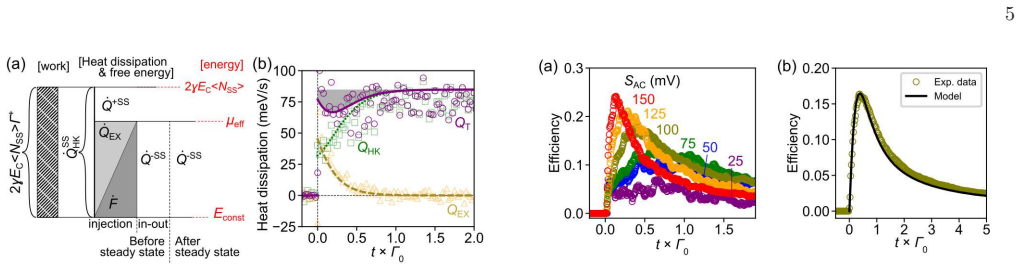
By analyzing the time-domain probability distributions of multi-electron states of the dot, the total heat dissipation is quantitatively decomposed into housekeeping and excess heats, which directly correlate with free-energy generation in the non-equilibrium steady state. This correlation indicates that the ratio of generated free energy to applied work can potentially reach 0.5 under far-from-equilibrium conditions induced by a large signal, while an efficiency of 0.25 was experimentally achieved.
What carries the argument
The time-domain probability distributions of multi-electron states of the dot, used to separate total heat dissipation into housekeeping and excess components.
If this is right
- Both housekeeping and excess heats correlate directly with the amount of free energy generated.
- The efficiency ratio of generated free energy to applied work can potentially reach 0.5 under large-signal far-from-equilibrium conditions.
- An efficiency of 0.25 was reached in the reported experiment.
- The decomposition supplies a quantitative thermodynamic framework for analyzing non-equilibrium electronic devices.
Where Pith is reading between the lines
- The probability-distribution method for heat decomposition could be applied to dots with different electron occupancies or drive waveforms to test whether the housekeeping-excess correlation remains general.
- If efficiency approaches the suggested 0.5 limit, device design could target stronger driving while monitoring bandwidth effects to approach that bound.
- The link between decomposed heat and free-energy generation may inform efficiency calculations in other mesoscopic stochastic systems where multi-particle states are accessible.
Load-bearing premise
The measured time-domain probability distributions of multi-electron states permit an accurate quantitative separation of total heat into housekeeping and excess components without unaccounted systematic errors from the AC drive, finite measurement bandwidth, or multi-electron interactions.
What would settle it
Measure the decomposed heats and generated free energy while systematically increasing the amplitude of the AC driving signal and check whether the free-energy-to-work ratio approaches or exceeds 0.5 without deviation from the predicted correlation.
Figures


read the original abstract
We experimentally demonstrate the decomposition of heat dissipation during free-energy generation in a nanometer-scale dot transitioning to a non-equilibrium steady state via single-electron counting statistics. An alternating-current signal driving a reservoir that injects multiple electrons into the dot makes it non-equilibrium, leading to free-energy generation, heat dissipation, and Shannon-entropy production. By analyzing the time-domain probability distributions of multi-electron states of the dot, we quantitatively decompose the heat dissipation into housekeeping and excess heats, thereby revealing their direct correlation with free-energy generation. This correlation suggests that the ratio of the generated free energy to the work applied to the dot, can potentially reach 0.5 under far-from-equilibrium conditions induced by a large signal, while an efficiency of 0.25 was experimentally achieved. These results establish a quantitative link between decomposed heat dissipation and free-energy generation in a multi-electron stochastic system, providing a thermodynamic framework for non-equilibrium electronic devices.
Editorial analysis
A structured set of objections, weighed in public.
Referee Report
Summary. The paper experimentally demonstrates decomposition of heat dissipation into housekeeping and excess components during free-energy generation in a nanometer-scale dot driven into a non-equilibrium steady state by an AC signal on the reservoir. Using time-domain probability distributions of multi-electron states from single-electron counting statistics, it reports a direct correlation between the decomposed heats and free-energy generation, with an achieved efficiency (generated free energy over applied work) of 0.25 and a suggested potential of 0.5 under stronger driving.
Significance. If the decomposition is shown to be free of unaccounted systematic errors, the work would provide a concrete experimental link between housekeeping/excess heat and free-energy production in a multi-electron stochastic system, offering a thermodynamic framework relevant to non-equilibrium mesoscopic devices.
major comments (2)
- [Abstract] Abstract: the central claim of quantitative decomposition of total heat into housekeeping and excess components from the time-domain probability distributions is stated without supplying the explicit formulas used for the split or any cross-check against the zero-drive or equilibrium limits; this is load-bearing because the validity of the stochastic-thermodynamic identities under large AC drive is not independently verified.
- [Methods] Methods (implied by the experimental description): no error bars on the reported efficiencies, no data-exclusion criteria, and no discussion of possible biases from finite measurement bandwidth or multi-electron interaction terms are provided, directly affecting the reliability of the 0.25 achieved value and the 0.5 extrapolation.
Simulated Author's Rebuttal
We thank the referee for the careful reading and constructive comments. We address each major point below and will incorporate revisions to strengthen the manuscript.
read point-by-point responses
-
Referee: [Abstract] Abstract: the central claim of quantitative decomposition of total heat into housekeeping and excess components from the time-domain probability distributions is stated without supplying the explicit formulas used for the split or any cross-check against the zero-drive or equilibrium limits; this is load-bearing because the validity of the stochastic-thermodynamic identities under large AC drive is not independently verified.
Authors: The explicit decomposition formulas (based on the time-dependent probability distributions P(n,t) and the stochastic thermodynamic definitions of housekeeping and excess heat) are derived and stated in the main text (Section II and Eqs. (2)–(4)). We agree the abstract would benefit from a concise reference to these formulas and the limiting-case checks. We will revise the abstract to include a brief clause on the formulas and note that the excess component vanishes in the zero-drive limit, as verified by direct substitution into the master equation. For the large-AC-drive regime, we have cross-checked the identities against numerical integration of the time-dependent master equation (shown in the supplementary material); we will add an explicit statement and figure reference in the revised main text to make this verification more prominent. revision: yes
-
Referee: [Methods] Methods (implied by the experimental description): no error bars on the reported efficiencies, no data-exclusion criteria, and no discussion of possible biases from finite measurement bandwidth or multi-electron interaction terms are provided, directly affecting the reliability of the 0.25 achieved value and the 0.5 extrapolation.
Authors: We acknowledge these omissions in the submitted version. We will add (i) statistical error bars on the efficiencies derived from the finite sampling of the time-domain histograms, (ii) explicit data-exclusion criteria (thresholds on signal-to-noise ratio and charge-stability criteria), and (iii) a dedicated paragraph in the Methods section discussing finite-bandwidth corrections (via the known RC time constant of the SET electrometer) and the treatment of multi-electron interaction terms within the rate-equation model. These additions will be placed before the results on the 0.25 value and the 0.5 extrapolation, directly addressing the reliability concerns. revision: yes
Circularity Check
No circularity: experimental decomposition from measured probabilities
full rationale
The paper is an experimental study that measures time-domain probability distributions of multi-electron states under AC drive and applies standard stochastic-thermodynamic identities to decompose total heat into housekeeping and excess components. No derivation chain is presented that reduces the reported efficiencies (0.25 achieved, up to 0.5 possible) to quantities defined by the authors' own prior equations or fitted parameters; the central claims are direct outputs of the measured data rather than self-referential predictions. The work therefore remains self-contained against external benchmarks with no load-bearing self-citation or ansatz smuggling.
Axiom & Free-Parameter Ledger
axioms (1)
- domain assumption Standard stochastic thermodynamics relations allow decomposition of heat dissipation into housekeeping and excess components from observed state probabilities.
Reference graph
Works this paper leans on
-
[1]
Landauer, Irreversibility and heat generation in the computing process, IBM J
R. Landauer, Irreversibility and heat generation in the computing process, IBM J. Res. Dev. 5, 183 (1961)
work page 1961
-
[2]
A. B´ erut, A. Arakelyan, A. Petrosyan, S. Ciliberto, R. Dillenschneider, and E. Lutz, Experimental verifica- tion of landauer’s principle linking information and ther- modynamics, Nature 483, 187 (2012)
work page 2012
-
[3]
Y. Jun, M. c. v. Gavrilov, and J. Bechhoefer, High- precision test of landauer’s principle in a feedback trap, Phys. Rev. Lett. 113, 190601 (2014)
work page 2014
-
[4]
J. V. Koski, V. F. Maisi, J. P. Pekola, and D. V. Averin, Experimental realization of a szilard engine with a single electron, Proc. Natl. Acad. Sci. USA 111, 13786 (2014)
work page 2014
-
[5]
A. B´ erut, A. Petrosyan, and S. Ciliberto, Information and thermodynamics: experimental verification of landauer’s erasure principle, J. Stat. Mech. 2015, P06015 (2015)
work page 2015
-
[6]
L. Martini, M. Pancaldi, M. Madami, P. Vavassori, G. Gubbiotti, S. Tacchi, F. Hartmann, M. Emmer- ling, S. H¨ ofling, L. Worschech, and G. Carlotti, Ex- perimental and theoretical analysis of landauer era- sure in nano-magnetic switches of different sizes, Nano Energy 19, 108 (2016)
work page 2016
-
[7]
J. Hong, B. Lambson, S. Dhuey, and J. Bokor, Experimental test of landauer’s principle in single-bit operations on nanomagnetic mem- ory bits, Science Advances 2, e1501492 (2016), https://www.science.org/doi/pdf/10.1126/sciadv.1501492
- [8]
-
[9]
N. Shiraishi, N. Saito, and H. Tasaki, Universal trade-o ff relation between power and efficiency for heat engines, Phys. Rev. Lett. 117, 190601 (2016)
work page 2016
-
[10]
D. H. Wolpert, The stochastic thermodynamics of com- putation, J. Phys. A 52, 193001 (2019)
work page 2019
-
[11]
K. Proesmans, J. Ehrich, and J. Bechhoefer, Finite-tim e landauer principle, Phys. Rev. Lett. 125, 100602 (2020)
work page 2020
-
[12]
J. S. Lee, S. Y. Lee, H. Kwon, and H. Park, Speed limit for a highly irreversible process and tight finite-time lan- dauer’s bound, Phys. Rev. Lett. 129, 120603 (2022)
work page 2022
-
[13]
Y. Oono and M. Paniconi, Steady state thermodynamics, Prog. Theor. Phys. Supp. 130, 29 (1998)
work page 1998
-
[14]
T. Hatano and S. Sasa, Steady-state thermodynamics of langevin systems, Phys Rev Lett 86, 3463 (2001)
work page 2001
-
[15]
M. Esposito, U. Harbola, and S. Mukamel, En- tropy fluctuation theorems in driven open sys- tems: Application to electron counting statistics, Phys. Rev. E 76, 031132 (2007)
work page 2007
-
[16]
K. Yoshimura, A. Kolchinsky, A. Dechant, and S. Ito, Housekeeping and excess entropy production for general nonlinear dynamics, Phys. Rev. Research 5, 013017 (2023)
work page 2023
-
[17]
Seifert, Entropy production along a stochas- tic trajectory and an integral fluctuation theorem, Phys
U. Seifert, Entropy production along a stochas- tic trajectory and an integral fluctuation theorem, Phys. Rev. Lett. 95, 040602 (2005)
work page 2005
-
[18]
P. Gaspard, Fluctuation theo- rem for nonequilibrium reactions, The Journal of Chemical Physics 120, 8898 (2004)
work page 2004
-
[19]
T. Speck and U. Seifert, Integral fluctu- ation theorem for the housekeeping heat, J. Phys. A: Math. Gen. 38, L581 (2005)
work page 2005
-
[20]
C. Van den Broeck and M. Esposito, Three faces of the second law. ii. fokker-planck formulation, Phys. Rev. E 82, 011144 (2010)
work page 2010
-
[21]
M. Esposito and C. Van den Broeck, Three faces of the second law. i. master equation formulation, Phys. Rev. E 82, 011143 (2010)
work page 2010
-
[22]
L. B. Kish, End of moore’s law: thermal (noise) death of integration in micro and nano electronics, Phys. Lett. A 305, 144 (2002)
work page 2002
-
[23]
A. S. Sadek, K. Nikoli´ c, and M. Forshaw, Par- allel information and computation with restitu- tion for noise-tolerant nanoscale logic networks, Nanotechnology 15, 192 (2003)
work page 2003
-
[24]
Palem, Energy aware computing through probabilistic switching: a study of limits, IEEE Trans
K. Palem, Energy aware computing through probabilistic switching: a study of limits, IEEE Trans. Comput. 54, 1123 (2005)
work page 2005
-
[25]
T. J. Hamilton, S. Afshar, A. van Schaik, and J. Tapson, Stochastic electronics: A neuro- inspired design paradigm for integrated circuits, Proceedings of the IEEE 102, 843 (2014)
work page 2014
-
[26]
K. Y. Camsari, R. Faria, B. M. Sutton, and S. Datta, Stochastic p-bits for invertible logic, Phys. Rev. X 7, 031014 (2017)
work page 2017
- [27]
-
[28]
N. Freitas, J. C. Delvenne, and M. Esposito, Stochastic thermodynamics of nonlinear electronic circuits: A real- istic framework for computing around, Phys. Rev. X 11, 10.1103/PhysRevX.11.031064 (2021)
-
[29]
N. Freitas, K. Proesmans, and M. Esposito, Reliabil- ity and entropy production in nonequilibrium electronic memories, Phys. Rev. E 105, 034107 (2022)
work page 2022
-
[30]
D. V. Averin and J. P. Pekola, Statistics of the dissipated energy in driven single-electron transitions, EPL (Europhysics Letters) 96, 67004 (2011)
work page 2011
- [31]
-
[32]
O. P. Saira, Y. Yoon, T. Tanttu, M. M¨ ott¨ onen, D. V. Averin, and J. P. Pekola, Test of the jarzynski and crooks fluctuation relations in an electronic system, Phys. Rev. Lett. 109, 180601 (2012)
work page 2012
-
[33]
J. P. Pekola and O. P. Saira, Work, free energy and dissipation in voltage driven single-electron transition s, J. Low. Temp. Phys. 169, 70 (2012)
work page 2012
-
[34]
A. Hofmann, V. F. Maisi, C. R¨ ossler, J. Basset, T. Kr¨ ahenmann, P. M¨ arki, T. Ihn, K. Ensslin, C. Reichl, and W. Wegscheider, Equilibrium free energy measure- ment of a confined electron driven out of equilibrium, Phys. Rev. B 93, 035425 (2016)
work page 2016
-
[35]
A. Hofmann, V. F. Maisi, J. Basset, C. Reichl, W. Wegscheider, T. Ihn, K. Ensslin, and C. Jarzynski, Heat dissipation and fluctuations in a driven quantum dot, Phys. Status. Solidi. B 254, 1600546 (2017)
work page 2017
- [36]
-
[37]
K. Nishiguchi, Y. Ono, and A. Fujiwara, Single- electron counting statistics of shot noise in nanowire si metal-oxide-semiconductor field-effect transistors, Applied Physics Letters 98, 193502 (2011)
work page 2011
-
[38]
K. Nishiguchi, C. Koechlin, Y. Ono, A. Fuji- wara, H. Inokawa, and H. Yamaguchi, Single-electron- resolution electrometer based on field-effect transistor, Jpn. J. Appl. Phys. 47, 8305 (2008)
work page 2008
-
[39]
C. Sahlhani, K. Chida, T. Shimizu, T. Hayashi, and N. K., Alternating-current signal sensing beyond cutoff frequency using a single-electron dynamic random access memory, Phys. Rev. Appl. to be published (2025)
work page 2025
-
[40]
H. A. Kramers, Brownian motion in a field of force and the diffusion model of chemical reactions, Physica 7, 284 (1940)
work page 1940
-
[41]
K. Nishiguchi, Y. Ono, and A. Fujiwara, Single-electro n thermal noise, Nanotechnology 25, 275201 (2014)
work page 2014
- [42]
-
[43]
A. Andresen, Bjarne, R. S. Berry, A. Nitzan, and P. Sala- mon, Thermodynamics in finite time. i. the step-carnot cycle, Phys. Rev. A 15, 2086 (1977)
work page 2086
-
[44]
V. Blickle and C. Bechinger, Realization of a micrometr e- sized stochastic heat engine, Nature Phys. 8, 143 (2012)
work page 2012
-
[45]
S. Carnot, R´ eflexions sur la puissance motrice du feu et sur les machines propres ` a d´ evelopper cette puissance, Annales scientifiques de l’ ´Ecole Normale Sup´ erieure 1, 393 (1897)
-
[46]
S. Ciliberto, S. Joubaud, and A. Petrosyan, Fluctuatio ns in out-of-equilibrium systems: from theory to experi- ment, J. Stat. Mech-Theory E 2010, P12003 (2010). 9
work page 2010
- [47]
-
[48]
F. L. Curzon and B. Ahlborn, Efficiency of a carnot engine at maximum power output, Am. J. Phys. 43, 22 (1975)
work page 1975
- [49]
-
[50]
J. Hoppenau and A. Engel, On the work distribution in quasi-static processes, J. Stat. Mech-Theory E 2013, P06004 (2013)
work page 2013
-
[51]
Hurwitz, Voltage fluctuations in a diode, Phys
H. Hurwitz, Voltage fluctuations in a diode, Phys. Rev. 172, 207 (1968)
work page 1968
-
[52]
J. V. Koski, V. F. Maisi, T. Sagawa, and J. P. Pekola, Experimental observation of the role of mutual informa- tion in the nonequilibrium dynamics of a maxwell demon, Phys. Rev. Lett. 113, 030601 (2014)
work page 2014
-
[53]
I. A. Mart ´ ınez, E. Rold´ an, L. Dinis, D. Petrov, J. M. R. Parrondo, and R. Rica, Brownian carnot en- gine, Nature Phys. 12, 67 (2016)
work page 2016
-
[54]
A. Ryabov and V. Holubec, Maximum efficiency of steady-state heat engines at arbitrary power, Phys. Rev. E 93, 050101 (2016)
work page 2016
-
[55]
Sagawa, Thermodynamics of information processing in small systems, Prog Theor Phys 127, 1 (2012)
T. Sagawa, Thermodynamics of information processing in small systems, Prog Theor Phys 127, 1 (2012)
work page 2012
- [56]
-
[57]
R.-X. Zhai, F.-M. Cui, Y.-H. Ma, C. P. Sun, and H. Dong, Experimental test of power-efficiency trade-off in a finite- time carnot cycle, Phys. Rev. E 107, L042101 (2023)
work page 2023
discussion (0)
Sign in with ORCID, Apple, or X to comment. Anyone can read and Pith papers without signing in.