REVIEW 4 major objections 5 minor 46 references
Inhomogeneous Electric Fields for Precise Control and Displacement of Polar Textures
T0 review · 4 major / 5 minor · reviewed 2026-08-10 · deepseek-v4-flash
Pith's one-line read Spatially modulated electric fields deterministically nucleate, switch, and move ferroelectric domain textures in bulk PbTiO3, with creep-like wall motion and an intrinsic speed ceiling near 3000 m/s.
desk verdict The static control of polar textures via modulated fields is solid and new, but the claimed intrinsic 3000 m/s speed limit is unsupported by the data shown. read the letter →
The pith
A machine-rendered reading of the paper's core claim, the machinery that carries it, and where it could break.
The reading
What carries the argument
The central object is the periodic, traveling electric-field waveform of Eq. (3), a cosine with independently chosen spatial periodicities $\lambda_x,\lambda_y,\lambda_z$ and temporal period $T$, whose phase velocity $v = (1/\lambda_x^2 + 1/\lambda_y^2 + 1/\lambda_z^2)^{-1/2}/T$ acts as a moving handle on the polarization texture. The field is coupled to the atoms through the Born effective charge tensor $Z^*$, giving each atom a force $F_{\kappa,\beta} = Z^*_{\kappa,\alpha\beta} E_\alpha(\mathbf{r})$; in effect the field imposes a traveling periodic potential landscape on the material. The second-principles atomistic model, fitted to DFT data, supplies the energy landscape on which this potential acts, and the molecular dynamics then reveal how the texture responds. The machinery's job is to show that the polarization's response—nucleation of a new domain patch, wall advance, lag, and arrest—is controlled by this external waveform, and that the speed ceiling follows from the field's phase velocity rather than from material inertia.
What would settle it
Repeat the moving-field MD protocol in supercells of 64 or more unit cells, or with open boundaries, sweeping field amplitude and temperature over wider ranges; if the fragmentation velocity (near 3000 m/s for $\lambda_x = 16$ u.c.) shifts with cell size, amplitude, or temperature, the claimed intrinsic bound is an artifact of the periodic supercell rather than a material property.
Extended reading notes
Core claim
Under a space- and time-modulated electric field of the form $E(\mathbf{r},t) = A \cos(2\pi x/\lambda_x + 2\pi y/\lambda_y + 2\pi z/\lambda_z + 2\pi t/T)$, 180° domain walls in PbTiO3 move with the wave rather than by uniform sideways advance. The paper reports that this motion proceeds by diffuse-boundary nucleation: a patch of the new domain appears ahead of the wall and the wall then follows, a signature previously identified for homogeneous fields. The response is asymmetric: a lag of about 4 ps at 5 K (for a 16 unit-cell periodicity) appears when the field is switched on, but the domains halt immediately when the field is removed, with no residual momentum. The lag shrinks with rising temperature and becomes negligible by 200 K. Doubling the domain periodicity to 32 unit cells leaves the walls immobile unless the field amplitude is also doubled, in line with the creep law. Above a wave velocity of about 3000 m/s the domain structure fragments chaotically, and this limiting velocity does not change with field amplitude or temperature; the authors read it as an intrinsic, material-related bound on domain-wall motion.
Load-bearing premise
The simulations assume that periodic supercells of 16 to 32 unit cells, described by the fitted second-principles potential, capture the intrinsic bulk dynamics of PbTiO3—including the claimed speed limit.
Editorial extensions
If this is right
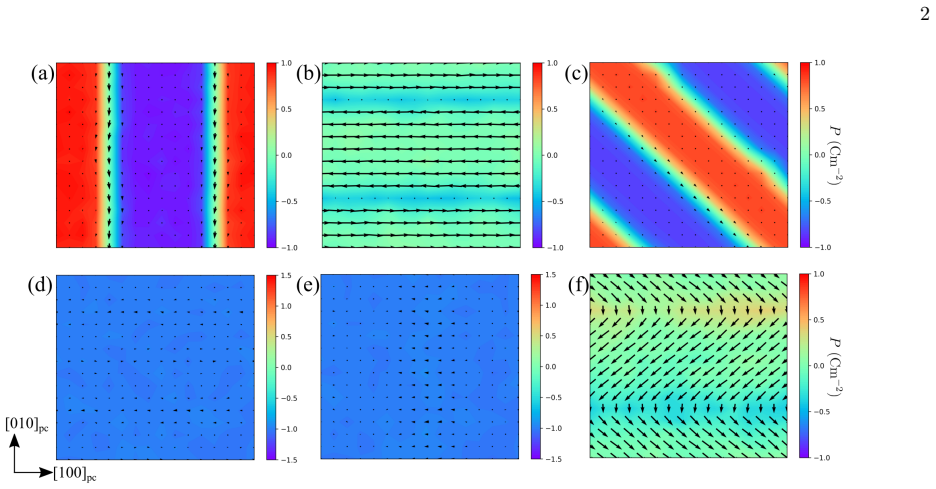
- A sequence of modulated-field pulses can write a stripe domain, erase it with a homogeneous field, rewrite it along another direction, and convert it into a skyrmion lattice without changing growth conditions.
- A traveling sinusoidal field can displace 180° domain walls and bubble domains coherently; bubble domains move isotropically by elongation and contraction, like liquid droplets.
- Domain-wall speeds saturate near 3000 m/s under these conditions, so faster operation would require a different material or a modified domain-wall energy landscape.
- Larger domains need proportionally larger driving fields, so field amplitude can selectively move small domains while leaving larger ones stationary.
- The onset lag that grows at low temperature and the instantaneous stop on field removal identify nucleation-barrier-controlled dynamics rather than momentum-driven motion.
Reading between the lines
- The same waveform-control strategy should transfer to other ferroelectric perovskites and to ferroelectric/dielectric superlattices, where the speed ceiling may differ because domain walls are stabilized electrostatically rather than by the external field.
- The reported onset lag at 5, 100, and 200 K could be used to extract an activation energy for wall nucleation; such an Arrhenius-style analysis would test the creep interpretation quantitatively.
- A phased array of electrodes or a moving laser-generated field pattern could mimic the traveling cosine wave in experiments, turning the predicted 3000 m/s ceiling into a measurable quantity.
- If the ceiling is set by the domain wall's internal stiffness, strain engineering that softens the wall should shift the limit, offering a materials-design knob that the paper does not itself explore.
Editorial analysis
A structured set of objections, weighed in public.
Referee Report
Summary. The manuscript reports second-principles molecular dynamics simulations of bulk PbTiO3 subjected to spatially and temporally modulated electric fields. The authors show that cosine-modulated fields (Eq. 1) stabilize stripe domains, skyrmion lattices, vortex/antivortex lattices, and bubble domains, and that these textures can be switched reversibly by changing the field profile (Fig. 3). They then study domain-wall motion under a moving cosine field (Eq. 3), reporting a lag at the onset of motion that disappears at steady state, an immediate stop upon field removal, diffuse-boundary nucleation, behavior they describe as consistent with creep dynamics, and an 'intrinsic upper bound' on domain-wall speed of about 3000 m/s that is claimed to be independent of field amplitude and temperature. The abstract and conclusions advertise the speed limit as a central result.
Significance. If the control scheme works as described, the paper offers a simple and potentially useful route to deterministic, in-situ manipulation of polar textures in a prototypical ferroelectric, which is of interest for nanoelectronic applications. The static and switching results are the strongest part: they are grounded in a DFT-fitted second-principles model (3644 configurations, DFPT harmonic terms) and are supported by qualitative real-space snapshots for several distinct field profiles. The dynamic claims, especially the universal speed limit, are the most novel but are not backed by quantitative evidence in the current manuscript. The paper would be significantly strengthened by systematic parameter scans and finite-size checks, and by a quantified creep-law analysis or a clearly softened interpretation.
major comments (4)
- [Section III, 'Dynamics of ferroelectric domains'] The central dynamical claim, that the limiting velocity is an intrinsic upper bound of about 3000 m/s that is independent of field amplitude and temperature, is not supported by the data presented. The text states that with λx = 16 u.c. and A = 2 MV/cm the limiting velocity is approximately 3000 m/s and immediately asserts that this value 'remains unaffected by changes in the electric field magnitude or temperature' and constitutes an 'intrinsic upper bound', but no figure, table, or supplementary scan of amplitude or temperature is provided. The conclusion appears to rest on a single trajectory at one amplitude and one periodicity; please provide a systematic scan of A and T, define the fragmentation threshold quantitatively, and report uncertainties.
- [Section III, 'Dynamics of ferroelectric domains'] The identification of creep dynamics is qualitative. The text says that doubling the domain periodicity requires doubling the field to restore mobility and that this 'is consistent with the predictions of the creep law', but no creep-law fit is presented: there is no measurement of velocity versus field or temperature, no extraction of the creep exponent μ, and no analysis of pinning. Either provide such a quantitative analysis or explicitly label the statement as a qualitative analogy rather than a demonstrated creep-law behavior.
- [Section III and Fig. 4] The simulation setup is commensurate with the applied modulation: the moving cosine field has λx = 16 u.c. and, based on the methods and figure description, the supercell period is also 16 u.c., so the domain walls propagate around a ring and interact with their periodic images. The threshold for losing phase-locking under this protocol may therefore be a property of the finite cell and the driving waveform rather than an intrinsic material limit. Please perform finite-size checks (for example, 32 and 64 u.c. cells with the same λx) and, if possible, compare with a protocol in which the domain wall is not wrapped around the cell.
- [Section III, 'Dynamics of ferroelectric domains'] The asymmetric inertial response is asserted mainly on the basis of visual inspection of snapshots. The text reports a lag of 4 ps at T = 5 K, reduced by half at 100 K and negligible at 200 K, but no quantitative time series of domain-wall position versus the field node, no velocity curves, and no statistical measure over independent runs are provided. To make the asymmetry claim (onset lag vs. immediate stop) robust, please provide time-resolved position data for both the turn-on and turn-off transients, with multiple thermal seeds.
minor comments (5)
- [Fig. 3 caption] The word 'strucutre' should be 'structure'.
- [Introduction] 'computational approches' should be 'computational approaches'.
- [Eq. (2)] The Gaussian field expression uses µ−r−vt without clarifying whether r and vt are vectors; please define the norm or vector operation explicitly.
- [Methods] It would be helpful to state the thermostat used for the conventional MD simulations and the number of independent trajectories or thermal seeds for the dynamical runs.
- [Section III, 'Stabilization of stripe domains'] The statement that for λ = 8 u.c. the dipoles 'tilt towards the direction perpendicular to the modulation' is qualitative; a quantitative order parameter (e.g., the average in-plane polarization angle) would strengthen the description.
Circularity Check
No significant circularity: the textures and domain-wall velocities are emergent outputs of a DFT-fitted second-principles model driven by imposed fields, not quantities that were fitted or defined in terms of the results.
full rationale
The paper's derivation chain is: DFT reference data and DFPT dynamical matrices are used to construct a second-principles (SP) potential in Multibinit; MD simulations then apply spatially and temporally modulated electric fields and the polarization textures and their motion are observed. The SP potential is fitted to 3644 DFT configurations, not to the stabilized textures or to the 3000 m/s limiting velocity, so the central simulation outputs are not fitted inputs renamed as predictions. The claim that the limiting velocity 'remains unaffected by changes in the electric field magnitude or temperature' is an assertion based on the simulations but, even if under-supported, it is not circular: it is not derived from an equation whose parameters were fit to that velocity. The self-citations to the authors' own APEX paper (Ref. 25) and BaTiO3 preprint (Ref. 38) are contextual comparisons, not load-bearing justifications for the PbTiO3 results; the diffuse-boundary nucleation interpretation is attributed to the external Shin et al. work (Ref. 44). No equation in the paper reduces by construction to the claimed outputs, and no uniqueness theorem or ansatz is imported from the authors' prior work to force the conclusions. The main caveat, that the intrinsic speed limit is inferred from a single 16-unit-cell periodic trajectory without an amplitude/temperature scan or finite-size check, is a robustness/correctness concern rather than a circularity defect. Accordingly, the circularity score is 0.
Assumptions & free parameters
free parameters (1)
- Second-principles potential parameters (anharmonic SATs, strain-phonon coupling) =
fitted to 3644 DFT configurations
assumptions (3)
- domain assumption The second-principles model fitted to DFT accurately represents the energy landscape of bulk PbTiO3 for the fields and temperatures studied.
- domain assumption The external field couples to the atoms linearly through the Born effective charge tensor Z*.
- domain assumption Periodic supercells of 16 or 32 unit cells reproduce intrinsic bulk behavior, including the limiting velocity.
Cite this review
Pith. "Pith review of Inhomogeneous Electric Fields for Precise Control and Displacement of Polar Textures." pith.science (2026). https://pith.science/paper/ARLMFADZ
@misc{pith2026250117057,
  author       = {Pith},
  title        = {Pith review of: Inhomogeneous Electric Fields for Precise Control and Displacement of Polar Textures},
  year         = {2026},
  howpublished = {\url{https://pith.science/paper/ARLMFADZ}},
  note         = {Machine review of arXiv:2501.17057}
}
read the original abstract
Since the discovery of polar topological textures, achieving efficient control and manipulation of them has emerged as a significant challenge for their integration into nanoelectronic devices. In this study, we use second principles molecular dynamic simulations to demonstrate the precise and reversible control of domain arrangements stabilizing diverse polarization textures through the application of various inhomogeneous electric fields. Furthermore, we conduct an in-depth study of ferroelectric domain motion under such fields, revealing features consistent with creep dynamics and establishing an upper limit for their propagation speed. Notably, our findings show that domain walls exhibit an asymmetric inertial response, present at the onset of the dynamics but absent during their cessation. These findings provide valuable insights into the dynamic behavior of polar textures, paving the way for the development of high-speed, low-power nanoelectronic applications.
Figures


Figures from the paper (1 more)

Reference graph
Works this paper leans on
-
[1]
Junquera, Y
J. Junquera, Y. Nahas, S. Prokhorenko, L. Bellaiche, J. ´I˜ niguez, D. G. Schlom, L.-Q. Chen, S. Salahuddin, D. A. Muller, L. W. Martin, and R. Ramesh, Topological phases in polar oxide nanostructures, Rev. Mod. Phys. 95, 025001 (2023)
2023
-
[2]
G. Catalan, J. Seidel, R. Ramesh, and J. F. Scott, Do- main wall nanoelectronics, Rev. Mod. Phys. 84, 119 (2012)
work page 2012
-
[3]
´I˜ niguez, P
J. ´I˜ niguez, P. Zubko, I. Luk’yanchuk, and A. Cano, Fer- roelectric negative capacitance, Nat. Rev. Mater. 4, 243 (2019)
2019
-
[4]
Louis, I
L. Louis, I. Kornev, G. Geneste, B. Dkhil, and L. Bellaiche, Novel complex phenomena in ferroelectric nanocomposites, J. Phys.: Condens. Matter 24, 402201 (2012)
2012
-
[5]
Shafer, P
P. Shafer, P. Garc ´ ıa-Fern´ andez, P. Aguado-Puente, A. R. Damodaran, A. K. Yadav, C. T. Nelson, S.-L. Hsu, J. C. Wojde l, J. ´I˜ niguez, L. W. Martin, E. Arenholz, J. Jun- quera, and R. Ramesh, Emergent chirality in the electric polarization texture of titanate superlattices, Proc. Natl. Acad. Sci. U.S.A. 115, 915 (2018)
2018
-
[6]
D. Daranciang, M. J. Highland, H. Wen, S. M. Young, N. C. Brandt, H. Y. Hwang, M. Vattilana, M. Nicoul, F. Quirin, J. Goodfellow, and et al., Ultrafast photo- voltaic response in ferroelectric nanolayers, Physical Re- view Letters 108, 087601 (2012)
work page 2012
-
[7]
Q. Li, V. A. Stoica, M. Pa´ sciak, Y. Zhu, Y. Yuan, T. Yang, M. R. McCarter, S. Das, A. K. Yadav, S. Park, C. Dai, H. J. Lee, Y. Ahn, S. D. Marks, S. Yu, C. Kadlec, T. Sato, M. C. Hoffmann, M. Chollet, M. E. Kozina, S. Nelson, D. Zhu, D. A. Walko, A. M. Lindenberg, P. G. Evans, L.-Q. Chen, R. Ramesh, L. W. Martin, V. Gopalan, J. W. Freeland, J. Hlinka, an...
2021
-
[8]
S. K. Streiffer, J. A. Eastman, D. D. Fong, C. Thompson, A. Munkholm, M. V. Ramana Murty, O. Auciello, G. R. Bai, and G. B. Stephenson, Observation of nanoscale 180◦ stripe domains in ferroelectric PbTiO 3 thin films, Phys. Rev. Lett. 89, 067601 (2002)
work page 2002
Show all 46 references
-
[9]
S. Das, Y. L. Tang, Z. Hong, M. A. P. Gon¸ calves, M. R. McCarter, C. Klewe, K. X. Nguyen, F. G´ omez-Ortiz, P. Shafer, E. Arenholz, V. A. Stoica, S.-L. Hsu, B. Wang, C. Ophus, J. F. Liu, C. T. Nelson, S. Saremi, B. Prasad, A. B. Mei, D. G. Schlom, J.´I˜ niguez, P. Garc ´ ıa-F...
2019
-
[10]
Zhang, L
Q. Zhang, L. Xie, G. Liu, S. Prokhorenko, Y. Nahas, X. Pan, L. Bellaiche, A. Gruverman, and N. Valanoor, Nanoscale bubble domains and topological transitions in ultrathin ferroelectric films, Advanced Materials 29, 1702375 (2017)
2017
-
[11]
Meier, J
D. Meier, J. ´I˜ niguez Gonz´ alez, D. Rodrigues, and K. Everschor-Sitte, Editorial: Focus issue on topological solitons for neuromorphic systems, Neuromorphic Com- puting and Engineering 4, 010202 (2024)
2024
-
[12]
Aramberri and J
H. Aramberri and J. ´I˜ niguez Gonz´ alez, Brownian elec- tric bubble quasiparticles, Phys. Rev. Lett. 132, 136801 (2024)
2024
-
[13]
S. Das, Z. Hong, V. A. Stoica, M. A. P. Gon¸ calves, Y. T. Shao, E. Parsonnet, E. J. Marksz, S. Saremi, M. R. McCarter, A. Reynoso, C. J. Long, A. M. Hagerstrom, D. Meyers, V. Ravi, B. Prasad, H. Zhou, Z. Zhang, H. Wen, F. G´ omez-Ortiz, P. Garc ´ ıa-Fern´ andez, J. Bokor, J. ...
2021
-
[14]
Govinden, S
V. Govinden, S. Rijal, Q. Zhang, Y. Nahas, L. Bel- laiche, N. Valanoor, and S. Prokhorenko, Stability of fer- roelectric bubble domains, Phys. Rev. Mater. 7, L011401 (2023)
2023
-
[15]
Prokhorenko, Y
S. Prokhorenko, Y. Nahas, V. Govinden, Q. Zhang, N. Valanoor, and L. Bellaiche, Motion and teleportation of polar bubbles in low-dimensional ferroelectrics, Nature Communications 15, 412 (2024)
2024
-
[16]
G´ omez-Ortiz, M
F. G´ omez-Ortiz, M. Graf, J. Junquera, J. ´I˜ niguez Gonz´ alez, and H. Aramberri, Liquid-crystal-like dynamic transition in ferroelectric-dielectric superlattices, Phys. Rev. Lett. 133, 066801 (2024)
2024
-
[17]
Nahas, S
Y. Nahas, S. Prokhorenko, Q. Zhang, V. Govinden, N. Valanoor, and L. Bellaiche, Topology and control of self-assembled domain patterns in low-dimensional ferro- electrics, Nature Communications 11, 5779 (2020)
2020
-
[18]
S. S. P. Parkin, M. Hayashi, and L. Thomas, Magnetic domain-wall racetrack memory, Science 320, 190 (2008)
2008
-
[19]
Pinna, F
D. Pinna, F. Abreu Araujo, J.-V. Kim, V. Cros, D. Quer- lioz, P. Bessiere, J. Droulez, and J. Grollier, Skyrmion gas manipulation for probabilistic computing, Phys. Rev. Appl. 9, 064018 (2018)
2018
-
[20]
Jibiki, M
Y. Jibiki, M. Goto, E. Tamura, J. Cho, S. Miki, R. Ishikawa, H. Nomura, T. Srivastava, W. Lim, S. Auf- 8 fret, C. Baraduc, H. Bea, and Y. Suzuki, Skyrmion Brow- nian circuit implemented in continuous ferromagnetic thin film, Applied Physics Letters 117, 082402 (2020)
2020
-
[21]
X. Li, T. Qiu, J. Zhang, E. Baldini, J. Lu, A. M. Rappe, and K. A. Nelson, Terahertz field induced ferroelectric- ity in quantum paraelectric SrTiO 3, Science 364, 1079 (2019)
2019
-
[22]
Prosandeev, S
S. Prosandeev, S. Prokhorenko, Y. Nahas, J. Grollier, D. Talbayev, B. Dkhil, and L. Bellaiche, Ultrafast acti- vation and tuning of topological textures in ferroelectric nanostructures, Adv. Electron. Mater. 8, 2200808 (2022)
2022
-
[23]
Prosandeev, S
S. Prosandeev, S. Prokhorenko, Y. Nahas, Y. Yang, C. Xu, J. Grollier, D. Talbayev, B. Dkhil, and L. Bel- laiche, Designing polar textures with ultrafast neuromor- phic features from atomistic simulations, Neuromorphic Computing and Engineering 3, 012002 (2023)
2023
-
[24]
Zajac, T
M. Zajac, T. Zhou, T. Yang, S. Das, Y. Cao, B. Guzel- turk, V. Stoica, M. J. Cherukara, J. W. Freeland, V. Gopalan, R. Ramesh, L. W. Martin, L.-Q. Chen, M. V. Holt, S. O. Hruszkewycz, and H. Wen, Optical con- trol of adaptive nanoscale domain networks, Advanced Materials n/a, ...
2024
-
[25]
Bastogne, F
L. Bastogne, F. G´ omez-Ortiz, S. Anand, and P. Ghosez, Dynamical manipulation of polar topolo- gies from acoustic phonon excitations, Nano Letters 10.1021/acs.nanolett.4c04125 (2024)
2024 doi
-
[26]
Tybell, P
T. Tybell, P. Paruch, T. Giamarchi, and J.-M. Triscone, Domain wall creep in epitaxial ferroelectric Pb(Zr0.2Ti0.8)O3 thin films, Phys. Rev. Lett. 89, 097601 (2002)
2002
-
[27]
Paruch and J
P. Paruch and J. Guyonnet, Nanoscale studies of fer- roelectric domain walls as pinned elastic interfaces, Comptes Rendus Physique 14, 667 (2013), disordered systems / Syst` emes d´ esordonn´ es
2013
-
[28]
Jiang, X
W. Jiang, X. Zhang, G. Yu, W. Zhang, X. Wang, M. Ben- jamin Jungfleisch, J. E. Pearson, X. Cheng, O. Heinonen, K. L. Wang, Y. Zhou, A. Hoffmann, and S. G. E. te Velthuis, Direct observation of the skyrmion hall ef- fect, Nature Physics 13, 162 (2017)
2017
-
[29]
V. T. Pham, N. Sisodia, I. D. Manici, J. Urrestarazu- Larra˜ naga, K. Bairagi, J. Pelloux-Prayer, R. Guedas, L. D. Buda-Prejbeanu, S. Auffret, A. Locatelli, T. O. Mente¸ s, S. Pizzini, P. Kumar, A. Finco, V. Jacques, G. Gaudin, and O. Boulle, Fast current-induced skyrmion moti...
2024
-
[30]
Gonze, B
X. Gonze, B. Amadon, G. Antonius, F. Arnardi, L. Baguet, J.-M. Beuken, J. Bieder, F. Bottin, J. Bouchet, E. Bousquet, et al. , The abinit project: Im- pact, environment and recent developments, Computer Physics Communications 248, 107042 (2020)
2020
-
[31]
Hamann, Optimized norm-conserving vanderbilt pseu- dopotentials, Physical Review B 88, 085117 (2013)
D. Hamann, Optimized norm-conserving vanderbilt pseu- dopotentials, Physical Review B 88, 085117 (2013)
2013
-
[32]
M. J. Van Setten, M. Giantomassi, E. Bousquet, M. J. Verstraete, D. R. Hamann, X. Gonze, and G.-M. Rig- nanese, The pseudodojo: Training and grading a 85 ele- ment optimized norm-conserving pseudopotential table, Computer Physics Communications 226, 39 (2018)
2018
-
[33]
Duane, A
S. Duane, A. D. Kennedy, B. J. Pendleton, and D. Roweth, Hybrid monte carlo, Physics letters B 195, 216 (1987)
1987
- [34]
-
[35]
Gonze and C
X. Gonze and C. Lee, Dynamical matrices, born effective charges, dielectric permittivity tensors, and interatomic force constants from density-functional perturbation the- ory, Phys. Rev. B 55, 10355 (1997)
1997
-
[36]
J. C. Wojde l and J. Iniguez, Ferroelectric transitions at ferroelectric domain walls found from first principles, Physical review letters 112, 247603 (2014)
2014
-
[37]
Stepkova, P
V. Stepkova, P. Marton, and J. Hlinka, Ising lines: Nat- ural topological defects within ferroelectric bloch walls, Phys. Rev. B 92, 094106 (2015)
2015
-
[38]
G´ omez-Ortiz, L
F. G´ omez-Ortiz, L. Bastogne, S. Anand, M. Yu, X. He, and P. Ghosez, Switchable skyrmion-antiskyrmion tubes in rhombohedral BaTiO 3 and related materials (2024), arXiv:2411.16395 [cond-mat.mtrl-sci]
2024 arXiv
-
[39]
M. A. P. Gon¸ calves, C. Escorihuela-Sayalero, P. Garca- Fern´ andez, J. Junquera, and J. ´I˜ niguez, Theoretical guidelines to create and tune electric skyrmion bubbles, Science Advances 5, eaau7023 (2019)
2019
-
[40]
C. Dai, Z. Hong, S. Das, Y.-L. Tang, L. W. Mar- tin, R. Ramesh, and L.-Q. Chen, Strain effects on sta- bility of topological ferroelectric polar configurations in (PbTiO 3)n/(SrTiO3)n superlattices, Applied Physics Letters 123, 052903 (2023)
2023
-
[41]
Z. Hong, A. R. Damodaran, F. Xue, S.-L. Hsu, J. Britson, A. K. Yadav, C. T. Nelson, J.-J. Wang, J. F. Scott, L. W. Martin, R. Ramesh, and L.-Q. Chen, Stability of polar vortex lattice in ferroelectric superlattices, Nano Letters 17, 2246 (2017)
2017
-
[42]
W. J. Merz, Domain formation and domain wall motions in ferroelectric BaTiO 3 single crystals, Phys. Rev. 95, 690 (1954)
1954
-
[43]
R. C. Miller and G. Weinreich, Mechanism for the side- wise motion of 180 ° domain walls in barium titanate, Phys. Rev. 117, 1460 (1960)
1960
-
[44]
Y.-H. Shin, I. Grinberg, I.-W. Chen, and A. M. Rappe, Nucleation and growth mechanism of ferroelec- tric domain-wall motion, Nature 449, 881 (2007)
2007
-
[45]
´I˜ niguez Gonz´ alez and H
J. ´I˜ niguez Gonz´ alez and H. Aramberri, Creating cur- rents of electric bubbles (2024), arXiv:2412.15074 [cond- mat.mtrl-sci]
2024 arXiv
-
[46]
S. Liu, I. Grinberg, and A. M. Rappe, Exploration of the intrinsic inertial response of ferroelectric domain walls via molecular dynamics simulations, Applied Physics Letters 103, 232907 (2013)
2013
Reviewed August 10, 2026 · model on record in the stance chip above.
Discussion (0). Continue with ORCID to comment.