REVIEW 3 major objections 6 minor 23 references
A Kernelized Operator Approach to Nonlinear Data-Enabled Predictive Control
T0 review · 3 major / 6 minor · reviewed 2026-08-10 · deepseek-v4-flash
Pith's one-line read The paper turns nonlinear DeePC into a low-dimensional one-shot optimization by parameterizing the system with a product kernel, cutting per-action computation by about a factor of one hundred.
desk verdict A useful Kronecker-product computational trick buried under an overstated equivalence claim and an unfair speed comparison. read the letter →
The pith
A machine-rendered reading of the paper's core claim, the machinery that carries it, and where it could break.
The reading
What carries the argument
The central object is the product kernel $k_\otimes((u_1,x_1),(u_2,x_2))=k_u(u_1,u_2)k_x(x_1,x_2)$ on the product space of input trajectories and initial states, which generates a product reproducing kernel Hilbert space and a Gram matrix $K_\otimes=K_u\otimes K_x$ whose inverse factors as $K_u^{-1}\otimes K_x^{-1}$. The load-bearing identity is the reduction $\Omega(x)=\big(I_{T_u}\otimes k_x^\top(x)/\|k_x(x)\|_2^2\big)K_\otimes$, which replaces the $T_xT_u$-dimensional kernel equation by a $T_u$-dimensional one, and the companion projection $\hat g=Y^\dagger\tilde g$ that moves decision variables into the $pN$-dimensional output space. This machinery is what decouples the input and state data, cuts the optimization size, and makes the Gram inversion and construction much cheaper.
What would settle it
Take a nonlinear benchmark with a non-smooth or discontinuous map (for example a relay or dead-zone nonlinearity), generate data with Algorithm 2, and check whether the multi-step prediction error (18) keeps decreasing as $T_x$ and $T_u$ grow; if the error plateaus above the measurement noise, the universal-approximation premise is violated for that system.
Extended reading notes
Core claim
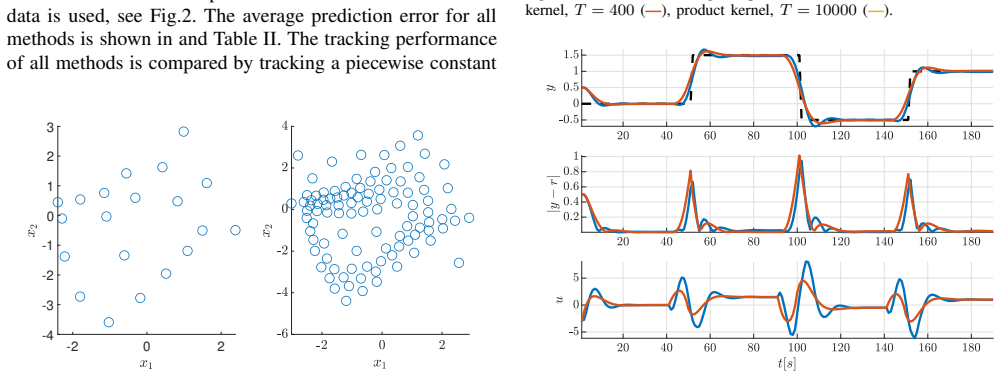
The paper claims that a nonlinear discrete-time system's behavior can be parameterized as $G(u)(x)=\Theta^* k_\otimes(u,x)$ in the product reproducing kernel Hilbert space built from the kernel $k_\otimes((u_1,x_1),(u_2,x_2))=k_u(u_1,u_2)k_x(x_1,x_2)$, with Gram matrix $K_\otimes=K_u\otimes K_x$. It then shows that the DeePC prediction equations $K_\otimes g=k_\otimes(u,x)$, $Yg=y$ are equivalent to the reduced system $\Omega(x)g=k_u(u)$, $Yg=y$ with $\Omega(x)=\big(I_{T_u}\otimes k_x^\top(x)/\|k_x(x)\|_2^2\big)K_\otimes$, and that projecting $g$ through $g=Y^\dagger\tilde g$ into the $pN$-dimensional output space yields a one-shot efficient formulation (Problem 4.4). The equivalence is established by Lemma 4.3 under the condition that the output data annihilate the null space of $\Omega(x)$. The numerical section reports per-control-action computation times of $0.3319\,\mathrm{s}$ versus $33.8668\,\mathrm{s}$ for the stacked-kernel formulation at $T=400$, and shows that $T=10000$ datasets are tractable with the product formulation while the stacked formulation is not.
Load-bearing premise
Everything rests on the inherited premise that the product reproducing kernel Hilbert space is dense enough to represent the true system's input-to-output operator on the relevant domain; if the real system is not well approximated there, the predictor is biased no matter how the optimization is sped up.
Editorial extensions
If this is right
- For the same dataset of 400 trajectories, the efficient product-kernel DeePC computes a control action in 0.3319 seconds whereas the stacked-kernel formulation needs 33.8668 seconds, a speedup of roughly two orders of magnitude.
- The product formulation remains solvable online for 10,000 trajectories (about 1.35 seconds per action), while the stacked formulation cannot handle that dataset online, so users can train on 25 times more data.
- With 10,000 trajectories, the product-kernel controller's mean tracking error drops from 0.0994 to 0.0835 and its mean prediction error from 0.0216 to 0.0157, and the paper shows tracking performance comparable to nonlinear MPC.
- Under the conditions of Lemma 4.3, the reduced model predicts the same outputs as the original product-kernel model, so the computational savings do not change the predicted trajectories.
Reading between the lines
- Because the state and input data enter through separate kernels, the same library of input sequences can be reused with many different initial-condition sets; one could update $K_x$ and the corresponding part of $K_\otimes$ without recomputing the whole pipeline when adding new operating regions.
- The projection $g=Y^\dagger\tilde g$ buys speed at the cost of limiting the decision space to the row space of the output data, so systems with many outputs or poor output richness may need feature selection in the output space to keep enough flexibility.
- The k-means choice of initial conditions suggests a testable extension: distributing initial conditions along unstable or strongly nonlinear regions could improve the operator approximation for systems that are not globally stable, since the density theorem does not say where data must be sampled.
Editorial analysis
A structured set of objections, weighed in public.
Referee Report
Summary. This paper proposes a kernelized operator approach to nonlinear data-enabled predictive control. It models the input-output behavior of a nonlinear system as a product reproducing kernel Hilbert space operator G(u)(x) = Θ*k⊗(u,x), building on a result from a companion preprint. The KerODeePC problem (Problem 3.2) enforces K⊗g = k⊗(u,x) and Yg = y. To reduce computation, Lemma 4.1 rewrites the first constraint into a lower-dimensional equality Ω(x)g = ku(u), and Lemma 4.3 gives a condition under which the reduced system is output-equivalent. Problem 4.4 further projects the decision variable onto the output space, resulting in an efficient formulation. Numerical experiments on a Van der Pol oscillator show order-of-magnitude speedups relative to a stacked kernel DeePC and comparable performance to NMPC when more data are used.
Significance. The structural idea of factorizing the kernel into input and state parts to reduce the equality constraints from TxTu to Tu is original and potentially valuable. The numerical results are impressive: a reduction from 33.87s to 0.33s per control action at T=400 and the ability to handle T=10000 online. The paper also contributes a systematic data-generation procedure. However, the value of the contribution depends critically on whether Problem 4.4 is a faithful and controllable approximation of Problem 3.2; the current manuscript does not establish this. If the equivalence issues are resolved, the method could be a practical tool for large-scale kernel-based predictive control.
major comments (3)
- [Section IV, Lemma 4.1 and Lemma 4.3] Lemma 4.1's claim that (11) is 'equivalently re-written' from (7) is too strong. The left-multiplication by the pseudo-inverse (I_Tu ⊗ kx(x))† is not invertible: from (11a) one can only conclude that P_{range(I⊗kx)} K⊗ g = (I⊗kx)ku(u), not that K⊗g = k⊗(u,x). The reduced system (11) therefore admits extra solutions, namely all g ∈ K⊗^{-1}(range(I⊗kx))^⊥. Lemma 4.3 correctly identifies the necessary and sufficient condition for output equivalence (Y annihilates N(Ω(x))), but this condition is not verified anywhere in the manuscript and is generically false for the reported data dimensions. For the T=400 example with Tx=20 and Tu=20, dim N(Ω(x)) = Tu(Tx-1) = 380 while Y ∈ R^{10×400}; the requirement that a 10-row matrix annihilate a 380-dimensional subspace is a restrictive condition that should be checked numerically. The paper neither checks it nor discusses its plausibility, so the claim that Problem 4.4 preserves the original operator model is not supported.
- [Section IV, Problem 4.4 and the paragraph after (15)] Problem 4.4 is not an equivalent reformulation of Problem 3.2. It replaces the decision variable ĝ by Y†˜g, which restricts the search to row(Y), and it changes the regularization term from ||g||² to ||˜g||². Moreover, the constraint (15b) is only a relaxation of the requirement that ĝ ∈ N(Ω(x)); it enforces that Ω(x)Y†˜g=0, i.e., that the output-space variable lies in Y N(Ω(x)). The only formal connection to Problem 3.2 established in the text is the λ→∞ limit, where ˜g→0 and y tends to the unregularized operator predictor. Since the finite value of λ used in the experiments is not reported, the speedups in Table I cannot be attributed to solving the original KerODeePC problem; they are for a modified controller. The manuscript should either provide a bound on the suboptimality/approximation error for finite λ, or explicitly present Problem 4.4 as a relaxation and study its closed-loop behavior as a function of λ.
- [Section II, eq. (5)-(7); Section III-A] The paper's central modeling assumption is that the product RKHS H(k⊗, X×U) is universal in the space of nonlinear system operators and that the minimizer of (9) is a universal approximator. This theorem is imported from the companion preprint [18] and is neither stated with its assumptions nor proven in the present manuscript. The paper also does not verify the conditions of that theorem for the Van der Pol oscillator and the data generated by Algorithms 1 and 2. If the universality result does not apply, the prediction model (10) is biased and the claimed nonlinear generalization is unsupported. At minimum, the authors should state the theorem precisely (including the required assumptions on the system, the kernel, and the data) and indicate how their data-generation procedure meets those assumptions. Relying on an unpublished self-cited preprint for such a load-bearing step is risky for the reader.
minor comments (6)
- [Section I, Notation] The definition of 1n is garbled: 'A square n × n matrix where all elements of 1/n is denoted by 1n' should read 'A square n × n matrix whose elements are all equal to 1/n is denoted by (1/n)1_n1_n^T' or similar, and the vector 1_n should be defined separately.
- [Section II, eq. (3) and (4)] Equations (3) and (4) use k(z1, z1) on the left-hand side; they should be k(z1, z2).
- [Definition 2.2] In Definition 2.2, item (i) says 'k(z, ·) ∈ H(k, X)' but the space should be H(k, Z); likewise item (ii) should refer to H(k, Z).
- [End of Section IV] The sentence 'when λ → ∞, we have that ˜gk → 0 and thus ˆgk → 0 by Lemma 4.1' incorrectly invokes Lemma 4.1; the implication follows from the definition ˆg = Y†˜g, not from Lemma 4.1.
- [Problem 4.4, eq. (15c)] Constraint (15c) contains an extra closing parenthesis after 'u[0,N−1](k)))'; it should read 'YΩ†(xk)ku(u[0,N−1](k)) + ˜gk = y[1,N](k)'.
- [Section V, Table I] The entry 'X' for the stacked Gram inversion at T=10000 could be clearer: state explicitly that the stacked formulation is not solvable online at that size, and give the corresponding product-kernel time in the same row.
Circularity Check
The operator-representation premise is imported from a same-author preprint; the computational reformulation is derived independently.
-
uniqueness imported from authors
[Section I (Introduction) and Section II, eqs. (5)-(7)]
"Therein, it was proven that for positive definite kernels [19] the resulting product RKHS is dense in the space of nonlinear systems operators and that its unique minimizer is a universal approximator. ... As pointed out in [18], through the prism of Willems' fundamental lemma, we consider the following system of equations: K⊗g = k⊗(u,x), Yg = y."
The prediction mechanism (7) is not derived in this paper; it is lifted from [18], a preprint by co-author M. Lazar. The universal-approximation and uniqueness theorem from [18] is load-bearing: without it, the product RKHS representation K⊗g = k⊗(u,x), Yg = y has no more justification than any arbitrary kernel interpolation choice. The paper provides no proof, numerical verification, or independent external reference for this theorem; the only support is the same-author citation. The efficient reformulation in Lemma 4.1 and Problem 4.4 is developed in this paper and is independent, so the circularity is confined to the foundational operator-representation premise.
full rationale
The paper's central computational contribution, the Kronecker-product reduction and the efficient KerODeePC formulation, is independently derived and benchmarked against a stacked-kernel baseline and NMPC, so the speed claim is not circular. The foundational premise, however, is the product-RKHS universality result from [18], a same-author preprint; the paper merely cites it and builds equations (5)-(7) on it without re-deriving or independently verifying it. This is a load-bearing self-citation, but it does not by itself make the computational derivation circular. There is also an omitted-proof risk: Lemma 4.1 proves only the forward direction of the claimed equivalence, and Lemma 4.3's condition Y g-hat = 0 on the null space of Omega(x) is never verified, while the finite lambda used in experiments is not reported; these are correctness concerns rather than circularity. Overall, the result is partially dependent on an imported same-author theorem, but the main algorithmic development stands on its own, so a moderate score of 4 is appropriate.
Assumptions & free parameters
free parameters (3)
- Gaussian kernel widths =
sigma_u = 50, sigma_x = 3
- Regularization weight lambda =
not specified numerically
- Cost matrices P, Q, R =
not specified
assumptions (5)
- ad hoc to paper Product RKHS H(k⊗, X × U) is dense in the space of nonlinear system operators, and the unique minimizer of (9) is a universal approximator.
- domain assumption K⊗ is positive definite for the collected data (Lemma 4.3 uses K⊗ ≻ 0).
- domain assumption The output data matrix Y has full row rank (Np ≤ TxTu), needed for the pseudo-inverse Y† in Problem 4.4.
- domain assumption System (1) is deterministic with measured states and unknown f and h.
- domain assumption Assumption 3.3: X and U are polytopes containing the equilibrium points or references of interest in their interior.
Cite this review
Pith. "Pith review of A Kernelized Operator Approach to Nonlinear Data-Enabled Predictive Control." pith.science (2026). https://pith.science/paper/EXQJE7ET
@misc{pith2026250117500,
  author       = {Pith},
  title        = {Pith review of: A Kernelized Operator Approach to Nonlinear Data-Enabled Predictive Control},
  year         = {2026},
  howpublished = {\url{https://pith.science/paper/EXQJE7ET}},
  note         = {Machine review of arXiv:2501.17500}
}
read the original abstract
This paper considers the design of nonlinear data-enabled predictive control (DeePC) using kernel functions. Compared with existing methods that use kernels to parameterize multi-step predictors for nonlinear DeePC, we adopt a novel, operator-based approach. More specifically, we employ a universal product kernel parameterization of nonlinear systems operators as a prediction mechanism for nonlinear DeePC. We show that by using a product reproducing kernel Hilbert space (RKHS) to learn the system trajectories, big data sets can be handled effectively to construct the corresponding product Gram matrix. Moreover, we show that the structure of the adopted product RKHS representation allows for a computationally efficient DeePC formulation. Compared to existing methods, our approach achieves substantially faster computation times for the same data size. This allows for the use of much larger data sets and enhanced control performance.
Figures


Reference graph
Works this paper leans on
-
[18]
A universal reproducing kernel Hilbert spac e for learning nonlinear systems operators,
M. Lazar, “A universal reproducing kernel Hilbert spac e for learning nonlinear systems operators,” arXiv, 2024, presented at the SysDo 2024 Symposium, October, Stuttgart, Germany, to appear in S pringer Nature (original manuscript submitted in April 2024). [Onl ine]. Available: https://arxiv.org/abs/2412.18360
arXiv 2024
-
[1]
A note on persistency of excitation,
J. C. Willems, P . Rapisarda, I. Markovsky, and B. L. De Moo r, “A note on persistency of excitation,” Systems & Control Letters , vol. 54, no. 4, pp. 325–329, 2005
work page 2005
-
[2]
Data-enabled pr edictive control: In the shallows of the deepc,
J. Coulson, J. Lygeros, and F. D¨ orfler, “Data-enabled pr edictive control: In the shallows of the deepc,” in 2019 18th European Control Conference (ECC) . IEEE, 2019, pp. 307–312
work page 2019
-
[3]
On the relationship between dat a-enabled predictive control and subspace predictive control,
F. Fiedler and S. Lucia, “On the relationship between dat a-enabled predictive control and subspace predictive control,” in 2021 European Control Conference (ECC) . IEEE, 2021, pp. 222–229
work page 2021
-
[4]
M. Lazar, “Basis-functions nonlinear data-enabled pre dictive control: Consistent and computationally efficient formulations,” i n 2024 Euro- pean Control Conference (ECC) . IEEE, 2024, pp. 888–893
work page 2024
-
[5]
Koopman based data-dri ven predictive control,
Y . Lian, R. Wang, and C. N. Jones, “Koopman based data-dri ven predictive control,” arXiv preprint arXiv:2102.05122 , 2021
arXiv 2021
-
[6]
Neural data–enabled predictive control,
M. Lazar, “Neural data–enabled predictive control,” IF AC- PapersOnLine, vol. 58, no. 15, pp. 91–96, 2024, 20th IFAC Symposium on System Identification SYSID 2024
work page 2024
-
[7]
Koopman Data-Driven Predictive Control with Robust Stability and Recursive Feasibility Guarantees
T. de Jong, V . Breschi, M. Schoukens, and M. Lazar, “Koopm an data- driven predictive control with robust stability and recurs ive feasibility guarantees,” arXiv preprint arXiv:2405.01292 , 2024
work page Pith review arXiv 2024
Show all 23 references
-
[8]
Ker- nel methods in system identification, machine learning and f unction estimation: A survey,
G. Pillonetto, F. Dinuzzo, T. Chen, G. De Nicolao, and L. L jung, “Ker- nel methods in system identification, machine learning and f unction estimation: A survey,” Automatica, vol. 50, no. 3, pp. 657–682, 2014
2014
-
[9]
A generaliz ed represen- ter theorem,
B. Sch¨ olkopf, R. Herbrich, and A. J. Smola, “A generaliz ed represen- ter theorem,” in International conference on computational learning theory. Springer, 2001, pp. 416–426
2001
-
[10]
Kernel methods and gaussian processes for system identific ation and control: A road map on regularized kernel-based learning fo r control,
A. Car` e, R. Carli, A. Dalla Libera, D. Romeres, and G. Pi llonetto, “Kernel methods and gaussian processes for system identific ation and control: A road map on regularized kernel-based learning fo r control,” IEEE Control Systems Magazine , vol. 43, no. 5, pp. 69–110, 2023
2023
-
[11]
Guarantees f or data- driven control of nonlinear systems using semidefinite prog ramming: A survey,
T. Martin, T. B. Sch¨ on, and F. Allg¨ ower, “Guarantees f or data- driven control of nonlinear systems using semidefinite prog ramming: A survey,” Annual Reviews in Control , p. 100911, 2023
2023
-
[12]
Learning controllers f rom data via kernel-based interpolation,
Z. Hu, C. De Persis, and P . Tesi, “Learning controllers f rom data via kernel-based interpolation,” in 2023 62nd IEEE Conference on Decision and Control (CDC) . IEEE, 2023, pp. 8509–8514
2023
-
[13]
Kpc: Learning-based model predictive control with determinist ic guaran- tees,
E. T. Maddalena, P . Scharnhorst, Y . Jiang, and C. N. Jone s, “Kpc: Learning-based model predictive control with determinist ic guaran- tees,” in Learning for Dynamics and Control . PMLR, 2021, pp. 1015–1026
2021
-
[14]
Robust and kernel ized data- enabled predictive control for nonlinear systems,
L. Huang, J. Lygeros, and F. D¨ orfler, “Robust and kernel ized data- enabled predictive control for nonlinear systems,” IEEE Transactions on Control Systems Technology , 2023
2023
-
[15]
Koopman model predictive contr ol of nonlinear dynamical systems,
M. Korda and I. Mezi´ c, “Koopman model predictive contr ol of nonlinear dynamical systems,” The Koopman Operator in Systems and Control: Concepts, Methodologies, and Applications , pp. 235– 255, 2020
2020
-
[16]
Exploring the links be tween the fundamental lemma and kernel regression,
O. Molodchyk and T. Faulwasser, “Exploring the links be tween the fundamental lemma and kernel regression,” IEEE Control Systems Letters, vol. 8, pp. 2045–2050, 2024
2024
-
[17]
Kernel-based models for system analysis,
H. J. V an Waarde and R. Sepulchre, “Kernel-based models for system analysis,” IEEE Transactions on Automatic Control , vol. 68, no. 9, pp. 5317–5332, 2022
2022
-
[19]
Universal kernels,
C. Micchelli, Y . Xu, and H. Zhang, “Universal kernels,” Mathematics, vol. 7, 12 2006
2006
-
[20]
Nonlinear data-enabled predic tion and control,
Y . Lian and C. N. Jones, “Nonlinear data-enabled predic tion and control,” in Learning for Dynamics and Control . PMLR, 2021, pp. 523–534
2021
-
[21]
Approximation capability to funct ions of several variables, nonlinear functionals, and operators b y radial basis function neural networks,
T. Chen and H. Chen, “Approximation capability to funct ions of several variables, nonlinear functionals, and operators b y radial basis function neural networks,” IEEE Transactions on Neural Networks , vol. 6, no. 4, pp. 904–910, 1995
1995
-
[22]
Towards a representer t heorem for identification of passive systems,
B. M. Shali and H. J. van Waarde, “Towards a representer t heorem for identification of passive systems,” arXiv preprint arXiv:2404.08297 , 2024
2024 arXiv
-
[23]
Steinwart, Support V ector Machines
I. Steinwart, Support V ector Machines. Springer, 2008
2008
Reviewed August 10, 2026 · model on record in the stance chip above.
Discussion (0). Continue with ORCID to comment.