REVIEW 3 major objections 5 minor 1 cited by
Beyond Turn-taking: Introducing Text-based Overlap into Human-LLM Interactions
T0 review · 3 major / 5 minor · reviewed 2026-08-10 · deepseek-v4-flash
Pith's one-line read The paper claims that text-based human-LLM chat need not follow strict turn-taking: a chatbot that overlaps with the user's typing by preemptive answering and backchanneling was perceived as more communicative, immersive, faster, and more…
desk verdict A credible design exploration of text-based overlap in human-LLM chat, but the main user study is confounded: the overlap interface and the finetuned model change together, so the perceived benefits can't be cleanly pinned on overlap itself. read the letter →
The pith
A machine-rendered reading of the paper's core claim, the machinery that carries it, and where it could break.
The reading
What carries the argument
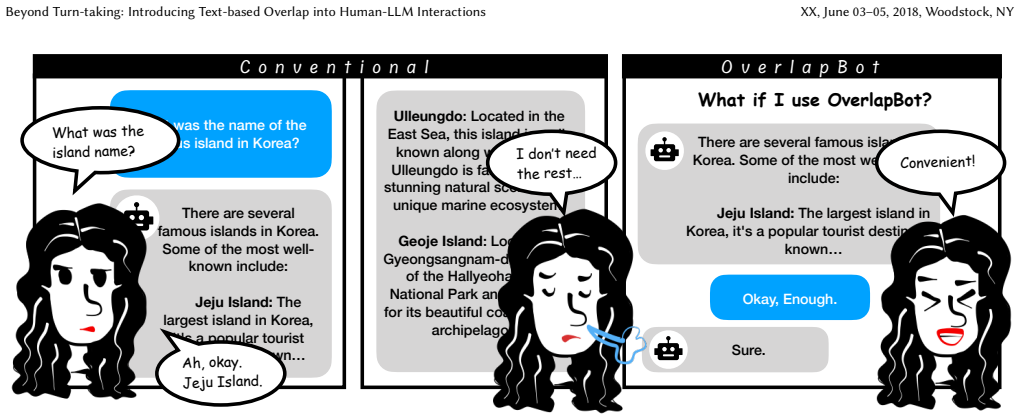
The central object is OverlapBot, a prototype web chatbot built on Llama3-8B finetuned with customized datasets. The mechanism has three parts: real-time typing display (every keystroke visible, chatbot output streamed character by character); a finetuned model that decides at each point whether to [Await] or [Overlap], and if overlapping whether to produce [Understanding] (backchannel) or [Answer] (preemptive response); and interruption handling, where the user's overlap causes the chatbot to delete its prior text and regenerate, with a 130-character threshold that leaves '...' to signal continuation. This machinery is what translates observed human overlap behaviors into an LLM policy.
What would settle it
Run the same 18-participant design with two conditions that differ only in whether typing is visible and overlap is allowed, holding the model, response style, and response length identical; if users do not rate the overlap condition as more communicative and immersive, the central claim fails.
Extended reading notes
Core claim
The central claim is that text-based overlap is not only possible in human-LLM interaction but is instinctively adopted and positively valued. OverlapBot lets both parties type simultaneously: the user sees the chatbot's words appear in real time and can interrupt it, and the chatbot backchannels ('yeah') or gives preemptive answers before the user finishes a sentence, deleting its own unfinished response when interrupted. In the user study, participants produced more turns per minute, sent shorter messages, and described the experience as like talking to a real person; they read preemptive answers as evidence of listening, acknowledged backchanneling without replying, and used brief commands like 'stop' or 'okay' to cut the chatbot off. The paper concludes that overlap-capable interfaces make text-based human-LLM conversation more natural and efficient than strict turn-taking.
Load-bearing premise
The load-bearing premise is that the perceived benefits come from the overlapping capability itself and not from other differences between the two chatbots, since OverlapBot was finetuned and produced shorter responses than the unfinetuned baseline it was compared against.
Editorial extensions
If this is right
- Text-based LLM interfaces can be built so that typing visibility alone creates overlap opportunities, and users will use them without explicit instruction.
- Conversations with overlap-capable chatbots move faster: the study measured higher turns per minute and shorter messages for both the user and the chatbot.
- Users interpret a chatbot's mid-typing responses as active listening, which drives the perceived humanness and immersion.
- Interruptions can replace stop buttons: users naturally type short commands to halt the chatbot, and the chatbot can regenerate based on the interruption.
- Overlap designs need user control, since some users find frequent or poorly timed overlaps intrusive; adjustable frequency and typing visibility are implied design requirements.
Reading between the lines
- If overlap reduces the need for complete prompts, prompt engineering may become less central: users can start half-formed questions and let the chatbot's early responses guide them, a shift the paper hints at but does not test directly.
- The same overlap mechanisms could be transplanted to voice agents or multimodal interfaces, where timing and interruption cues already exist; the paper's deletion-based resolution suggests text offers a unique repair channel that speech lacks.
- A testable extension would measure whether overlap benefits persist in task-oriented settings like summarization or time-critical information seeking, where the paper's design discussion predicts moderate benefits at best.
- Overlap could change trust dynamics: if users read preemptive answers as listening, then confidently wrong early guesses might be treated as more credible than they should be—a risk the paper does not address.
Editorial analysis
A structured set of objections, weighed in public.
Referee Report
Summary. The paper proposes replacing strict turn-taking in text-based human-LLM chat with an interface that supports simultaneous typing and overlapping messages. Study 1 (a formative probe with seven dyads) identifies preemptive answering, backchanneling, and deletion as natural overlap behaviors. The authors then build OverlapBot, a Llama3-8B model fine-tuned with Switchboard and instruction-tuning data to reproduce these behaviors. Study 2 (a within-subject user study with 18 participants) compares OverlapBot to a conventional turn-taking chatbot and reports that OverlapBot produced shorter messages, more turns, and qualitative perceptions of being more communicative, immersive, and fast. The paper concludes that overlap capability fosters faster and more natural interactions and offers design insights for overlap-capable text-based AI systems.
Significance. If the causal attribution is accepted, the paper opens a useful design space for text-based human-LLM interaction, extending prior real-time human-human messaging results to LLM agents. The work has genuine strengths: the formative study is well motivated, the prototype is concretely described, the fine-tuning strategy uses public datasets and is evaluated automatically in Appendix A, and the user study includes behavioral logs and rich interview excerpts. However, the central claim is currently underdetermined because the Study 2 comparison varies both the interface and the underlying model, and because the quantitative evidence lacks inferential statistics. These issues directly affect the abstract's claim that overlap itself fosters faster and more natural interactions.
major comments (3)
- [Section 5, first two paragraphs; Appendix A] The central comparison is confounded: OverlapBot runs a Llama3-8B fine-tuned on Switchboard and instruction data, while the 'conventional chat system' uses 'the basic, unfinetuned Llama3-8B model.' The OverlapBot condition also adds real-time typing display, backchanneling, preemptive answers, and deletion. Consequently, the perceived differences in 'communicative' and 'immersive' interactions reported in Section 5.1.1 cannot be uniquely attributed to the overlapping capability; they may reflect the fine-tuned model's more conversational tone, its shorter responses, or the real-time streaming display. The abstract and Section 7 state the conclusion as if overlap is the active ingredient. Please add a condition that holds the model and response style fixed while toggling overlap, or substantially reframe the contribution as an evaluation of the OverlapBot system as a whole rather than a demonstration that overlap per se drives the effect.
- [Section 5.1.1, 'Brief Response'; Table 1] The paper's own 'Brief Response' theme undercuts the speed attribution. Table 1 shows OverlapBot produces notably shorter chatbot messages (133.40 vs. 177.64 characters) and shorter user messages (43.18 vs. 62.36), and participants explicitly praised speed while also criticizing brevity and lack of detail. The text says the brevity 'was likely influenced by a conversation dataset ... not a problem of overlapping itself,' but no control condition separates response brevity from overlap. A parsimonious alternative explanation is that the 'speedy' perception is driven by the fine-tuned model's concise, chat-style outputs rather than by overlap. At minimum, the analysis should examine whether perceived speed tracks the measured overlap rate or message length, and the discussion should acknowledge that the interface and the response style are not separated.
- [Table 1] The quantitative comparison in Table 1 reports only means and standard deviations for each condition, with no paired significance tests, confidence intervals, or effect sizes, despite the within-subject design. Statements such as OverlapBot 'facilitated shorter message lengths and a higher number of turns' and that the chatbot sent messages more frequently, 'indicating its ability to provide more information within the same timeframe,' are therefore descriptive rather than statistically supported. Please add appropriate paired inferential analyses (e.g., paired t-tests or Wilcoxon signed-rank tests with effect sizes), or explicitly restrict the quantitative section to descriptive observations and avoid drawing causal conclusions from it.
minor comments (5)
- [Section 5] The paper states that participants were asked which interface they preferred, but it does not report the number who preferred each condition or quote a preference statistic; adding this information would strengthen the qualitative preference claims.
- [Section 5.1] Thematic analysis is described as being conducted by three authors, but the paper does not report a codebook, coding procedure, or inter-rater agreement; a brief description and per-theme frequencies would aid reproducibility and interpretation.
- [Section 4.3] The 130-character response truncation threshold is justified only by 'empirical testing'; please report the test results or describe the threshold as a preliminary design parameter requiring further validation.
- [References] Reference [53] duplicates reference [52] (both are Skantze 2021, 'Turn-taking in Conversational Systems and Human-Robot Interaction'); the duplicate should be removed and subsequent numbering corrected.
- [Appendix A] The fine-tuning and evaluation section does not report decoding parameters such as temperature, max tokens, or the exact prompts used for generation; including these would improve reproducibility of the automatic evaluation in Table 3.
Circularity Check
No circularity: the central claim is an external user-study evaluation, not derived from fitted quantities or self-citations.
full rationale
The paper's central claim—that OverlapBot was perceived as more communicative and immersive than a traditional turn-taking chatbot—rests on a within-subject user study with 18 participants who interacted with both systems and provided qualitative and quantitative feedback. This is an external, human-judgment evaluation of a system the authors built, not a derivation from the training data or from a fitted parameter. The finetuned model in Appendix A is evaluated against GPT baselines on classification and generation metrics, but those results are presented as a capability check, not as the evidence for the user-perception claim. The paper does not define overlap in terms of perceived communicative value, nor does it fit a parameter from Study 2 and then predict the same judgment. The acknowledged confound—that Study 2 compared a finetuned OverlapBot against an unfinetuned Llama3-8B baseline, so the interface and the model both varied—is a threat to internal validity, not circularity. The paper explicitly notes the brevity difference and attributes it to the conversation dataset rather than overlap itself, which is a limitation statement rather than a circular move. No load-bearing self-citations are used; the authors are not relying on their own prior uniqueness theorems or ansatz smuggled in via citation. Accordingly, no circular step can be exhibited, and the appropriate finding is no significant circularity.
Assumptions & free parameters
free parameters (1)
- Response truncation threshold =
130 characters
assumptions (4)
- domain assumption Overlapping behaviors seen in human-human text conversations (preemptive response, backchanneling, deletion) transfer to human-LLM interactions and are perceived positively.
- domain assumption Self-reported impressions (communicative, immersive, natural) are treated as valid evidence of interaction quality.
- domain assumption The baseline conventional chatbot (unfinetuned Llama3-8B) is an appropriate control for isolating the effect of overlap.
- domain assumption Switchboard dialogue act labels can be consolidated and used to supervise overlap timing and dialogue act classification.
Cite this review
Pith. "Pith review of Beyond Turn-taking: Introducing Text-based Overlap into Human-LLM Interactions." pith.science (2026). https://pith.science/paper/QQRG4AIX
@misc{pith2026250118103,
  author       = {Pith},
  title        = {Pith review of: Beyond Turn-taking: Introducing Text-based Overlap into Human-LLM Interactions},
  year         = {2026},
  howpublished = {\url{https://pith.science/paper/QQRG4AIX}},
  note         = {Machine review of arXiv:2501.18103}
}
read the original abstract
Traditional text-based human-AI interactions often adhere to a strict turn-taking approach. In this research, we propose a novel approach that incorporates overlapping messages, mirroring natural human conversations. Through a formative study, we observed that even in text-based contexts, users instinctively engage in overlapping behaviors like "A: Today I went to-" "B: yeah." To capitalize on these insights, we developed OverlapBot, a prototype chatbot where both AI and users can initiate overlapping. Our user study revealed that OverlapBot was perceived as more communicative and immersive than traditional turn-taking chatbot, fostering faster and more natural interactions. Our findings contribute to the understanding of design space for overlapping interactions. We also provide recommendations for implementing overlap-capable AI interactions to enhance the fluidity and engagement of text-based conversations.
Figures


Figures from the paper (6 more)



Forward citations
Cited by 1 Pith paper
-
A Call for Collaborative Intelligence: Why Human-Agent Systems Should Precede AI Autonomy
A position paper arguing that LLM-based human-agent systems, not fully autonomous agents, should be the immediate goal for AI development.
Reference graph
Works this paper leans on
-
[1]
Weld, Mihaela Vorvoreanu, Adam Fourney, Besmira Nushi, Penny Collisson, Jina Suh, Shamsi T
Saleema Amershi, Daniel S. Weld, Mihaela Vorvoreanu, Adam Fourney, Besmira Nushi, Penny Collisson, Jina Suh, Shamsi T. Iqbal, Paul N. Bennett, Kori Inkpen, Jaime Teevan, Ruth Kikin-Gil, and Eric Horvitz. 2019. Guidelines for Human- AI Interaction. In Proceedings of the 2019 CHI Conference on Human Factors in Computing Systems, CHI 2019, Glasgow, Scotland,...
work page 2019
-
[2]
Matthew Peter Aylett and Marta Romeo. 2023. You Don’t Need to Speak, You Need to Listen: Robot Interaction and Human-Like Turn-Taking. In Proceedings of the 5th International Conference on Conversational User Interfaces, CUI 2023, Eindhoven, The Netherlands, July 19-21, 2023 , Minha Lee, Cosmin Munteanu, Martin Porcheron, Johanne Trippas, and Sarah Theres...
arXiv 2023
-
[3]
https://doi.org/10.1145/3290605.3300233
-
[4]
Fischer, and Gisela Reyes-Cruz
Matthew Peter Aylett, Éva Székely, Donald McMillan, Gabriel Skantze, Marta Romeo, Joel E. Fischer, and Gisela Reyes-Cruz. 2023. Why is my Agent so Slow? Deploying Human-Like Conversational Turn-Taking. In International Conference on Human-Agent Interaction, HAI 2023, Gothenburg, Sweden, December 4-7, 2023 . ACM, 490–492. https://doi.org/10.1145/3623809.3623976
arXiv 2023
-
[5]
Adrian Bennett. 1978. Interruptions and the interpretation of conversation. In Annual Meeting of the Berkeley Linguistics Society . 557–575
work page 1978
-
[6]
Richard E Boyatzis. 1998. Transforming qualitative information: Thematic analysis and code development. Sage
work page 1998
-
[7]
Sainath, Chao Zhang, Trevor Strohman, Qiao Liang, and Yanzhang He
Shuo-Yiin Chang, Bo Li, Tara N. Sainath, Chao Zhang, Trevor Strohman, Qiao Liang, and Yanzhang He. 2022. Turn-Taking Prediction for Natural Conversational Speech. In 23rd Annual Conference of the International Speech Communication Association, Interspeech 2022, Incheon, Korea, September 18-22, 2022 , Hanseok Ko and John H. L. Hansen (Eds.). ISCA, 1821–182...
work page 2022
-
[8]
Yupeng Chang, Xu Wang, Jindong Wang, Yuan Wu, Linyi Yang, Kaijie Zhu, Hao Chen, Xiaoyuan Yi, Cunxiang Wang, Yidong Wang, Wei Ye, Yue Zhang, Yi Chang, Philip S. Yu, Qiang Yang, and Xing Xie. 2024. A Survey on Evaluation of Large Language Models. ACM Trans. Intell. Syst. Technol. 15, 3 (2024), 39:1–39:45. https://doi.org/10.1145/3641289
doi:10.1145/3641289 2024
Show all 69 references
-
[9]
Patricia M Clancy, Sandra A Thompson, Ryoko Suzuki, and Hongyin Tao. 1996. The conversational use of reactive tokens in English, Japanese, and Mandarin. Journal of pragmatics 26, 3 (1996), 355–387
1996
-
[10]
Elizabeth Clark, Anne Spencer Ross, Chenhao Tan, Yangfeng Ji, and Noah A. Smith. 2018. Creative Writing with a Machine in the Loop: Case Studies on Slo- gans and Stories. In Proceedings of the 23rd International Conference on Intelligent User Interfaces, IUI 2018, Tokyo, Japan...
2018
-
[11]
Jennifer Coates. 1994. No gap, lots of overlap: Turn-taking patterns in the talk of women friends. Researching language and literacy in social context (1994), 177–192
1994
-
[12]
Hai Dang, Lukas Mecke, and Daniel Buschek. 2022. GANSlider: How Users Control Generative Models for Images using Multiple Sliders with and with- out Feedforward Information. In CHI ’22: CHI Conference on Human Factors in Computing Systems, New Orleans, LA, USA, 29 April 2022 -...
2022
-
[13]
Hai Dang, Lukas Mecke, Florian Lehmann, Sven Goller, and Daniel Buschek
-
[14]
Laurie P Dringus. 1991. A study of delayed-time and real-time text-based computer- mediated communication systems on group decision-making performance . Nova University
1991
-
[15]
Fung, Helen Meng, and Xiaojuan Ma
Zijian Ding, Jiawen Kang, Tinky Oi Ting Ho, Ka Ho Wong, Helene H. Fung, Helen Meng, and Xiaojuan Ma. 2022. TalkTive: A Conversational Agent Using Backchannels to Engage Older Adults in Neurocognitive Disorders Screening. In CHI ’22: CHI Conference on Human Factors in Computing...
2022
-
[16]
Olga Egorow and Andreas Wendemuth. 2022. On Emotions as Features for Speech Overlaps Classification. IEEE Trans. Affect. Comput. 13, 1 (2022), 175–186. https://doi.org/10.1109/TAFFC.2019.2925795
2022
-
[17]
Starkey Duncan. 1972. Some signals and rules for taking speaking turns in conversations. Journal of personality and social psychology 23, 2 (1972), 283
1972
-
[18]
John J Godfrey, Edward C Holliman, and Jane McDaniel. 1992. SWITCHBOARD: Telephone speech corpus for research and development. In Acoustics, speech, and signal processing, ieee international conference on , Vol. 1. IEEE Computer Society, 517–520
1992
-
[19]
Ermert, Chinthusa Mohanathasan, Sabine J
Jonathan Ehret, Andrea Bönsch, Patrick Nossol, Cosima A. Ermert, Chinthusa Mohanathasan, Sabine J. Schlittmeier, Janina Fels, and Torsten W. Kuhlen
-
[20]
Bettina Heinz. 2003. Backchannel responses as strategic responses in bilingual speakers’ conversations. Journal of pragmatics 35, 7 (2003), 1113–1142
2003
-
[21]
Hu, Yelong Shen, Phillip Wallis, Zeyuan Allen-Zhu, Yuanzhi Li, Shean Wang, Lu Wang, and Weizhu Chen
Edward J. Hu, Yelong Shen, Phillip Wallis, Zeyuan Allen-Zhu, Yuanzhi Li, Shean Wang, Lu Wang, and Weizhu Chen. 2022. LoRA: Low-Rank Adaptation of Large Language Models. In The Tenth International Conference on Learning Representations, ICLR 2022, Virtual Event, April 25-29, 20...
2022
-
[22]
Julia A Goldberg. 1990. Interrupting the discourse on interruptions: An analysis in terms of relationally neutral, power-and rapport-oriented acts. Journal of pragmatics 14, 6 (1990), 883–903
1990
-
[23]
Together but not together
Zainab Iftikhar, Yumeng Ma, and Jeff Huang. 2023. "Together but not together": Evaluating Typing Indicators for Interaction-Rich Communication. InProceedings of the 2023 CHI Conference on Human Factors in Computing Systems, CHI 2023, Hamburg, Germany, April 23-28, 2023, Albrec...
2023 doi
-
[24]
Kathrin Janowski and Elisabeth André. 2018. Decision-Theoretic Personality- Based Reasoning about Turn-Taking Conflicts. In Proceedings of the 18th Interna- tional Conference on Intelligent Virtual Agents, IV A 2018, Sydney, NSW, Australia, November 05-08, 2018, Anton Bogdanov...
2018
-
[25]
Jie Huang and Kevin Chen-Chuan Chang. 2023. Towards Reasoning in Large Language Models: A Survey. In Findings of the Association for Computational Linguistics: ACL 2023, Toronto, Canada, July 9-14, 2023 , Anna Rogers, Jordan L. Boyd-Graber, and Naoaki Okazaki (Eds.). Associati...
2023 doi
-
[26]
Byeonghun Kim, Eunji Kim, and Jongtae Rhee. 2022. Online Psychological Counseling Chatbot for Seniors. In 2022 The 6th International Conference on Advances in Artificial Intelligence, ICAAI 2022, Birmingham, United Kingdom, October 21-23, 2022. ACM, 154–157. https://doi.org/10...
2022
-
[27]
Chang-Min Kim, Hyeon-Beom Yi, Ji-Won Nam, and Geehyuk Lee. 2017. Applying Real-Time Text on Instant Messaging for a Rapid and Enriched Conversation Experience. In Proceedings of the 2017 Conference on Designing Interactive Systems, DIS ’17, Edinburgh, United Kingdom, June 10-1...
2017
-
[29]
Wang, Minae Kwon, Joon Sung Park, Hancheng Cao, Tony Lee, Rishi Bommasani, Michael S
Mina Lee, Megha Srivastava, Amelia Hardy, John Thickstun, Esin Durmus, Ashwin Paranjape, Ines Gerard-Ursin, Xiang Lisa Li, Faisal Ladhak, Frieda Rong, Rose E. Wang, Minae Kwon, Joon Sung Park, Hancheng Cao, Tony Lee, Rishi Bommasani, Michael S. Bernstein, and Percy Liang. 2023...
2023
-
[30]
Chin-Yew Lin. 2004. Rouge: A package for automatic evaluation of summaries. In Text summarization branches out. 74–81
2004
-
[31]
Divesh Lala, Koji Inoue, and Tatsuya Kawahara. 2019. Smooth Turn-taking by a Robot Using an Online Continuous Model to Generate Turn-taking Cues. In International Conference on Multimodal Interaction, ICMI 2019, Suzhou, China, October 14-18, 2019, Wen Gao, Helen Mei-Ling Meng,...
2019
-
[32]
Ryan Louie, Andy Coenen, Cheng Zhi Huang, Michael Terry, and Carrie J. Cai
-
[33]
Ziyang Ma, Yakun Song, Chenpeng Du, Jian Cong, Zhuo Chen, Yuping Wang, Yuxuan Wang, and Xie Chen. 2024. Language Model Can Listen While Speaking. arXiv:2408.02622 [cs.CL] https://arxiv.org/abs/2408.02622
2024 arXiv
- [34]
-
[35]
Bonan Min, Hayley Ross, Elior Sulem, Amir Pouran Ben Veyseh, Thien Huu Nguyen, Oscar Sainz, Eneko Agirre, Ilana Heintz, and Dan Roth. 2024. Recent Advances in Natural Language Processing via Large Pre-trained Language Models: A Survey. ACM Comput. Surv. 56, 2 (2024), 30:1–30:4...
2024
-
[36]
Hastie, and Oliver Lemon
Meriam Moujahid, Helen F. Hastie, and Oliver Lemon. 2022. Multi-party In- teraction with a Robot Receptionist. In ACM/IEEE International Conference on Human-Robot Interaction, HRI 2022, Sapporo, Hokkaido, Japan, March 7 - 10, 2022 , Daisuke Sakamoto, Astrid Weiss, Laura M. Hia...
2022
-
[37]
Kumiko Murata. 1994. Intrusive or co-operative? A cross-cultural study of interruption. Journal of pragmatics 21, 4 (1994), 385–400
1994
-
[39]
Maike Paetzel-Prüsmann and James Kennedy. 2023. Improving a Robot’s Turn- Taking Behavior in Dynamic Multiparty Interactions. In Companion of the 2023 ACM/IEEE International Conference on Human-Robot Interaction, HRI 2023, Stock- holm, Sweden, March 13-16, 2023 , Ginevra Caste...
2023 doi
-
[40]
Xingang Pan, Ayush Tewari, Thomas Leimkühler, Lingjie Liu, Abhimitra Meka, and Christian Theobalt. 2023. Drag Your GAN: Interactive Point-based Ma- nipulation on the Generative Image Manifold. In ACM SIGGRAPH 2023 Con- ference Proceedings, SIGGRAPH 2023, Los Angeles, CA, USA, ...
2023
-
[41]
Kishore Papineni, Salim Roukos, Todd Ward, and Wei-Jing Zhu. 2002. Bleu: a method for automatic evaluation of machine translation. In Proceedings of the 40th annual meeting of the Association for Computational Linguistics . 311–318
2002
- [42]
-
[44]
Bruce Phillips. 2000. Should we take turns?: a test of CMC turn-taking formats. In CHI ’00 Extended Abstracts on Human Factors in Computing Systems, CHI Extended Abstracts ’00, The Hague, The Netherlands, April 1-6, 2000 , Marilyn Tremaine (Ed.). ACM, 341–342. https://doi.org/...
2000
-
[45]
Mridumoni Phukon, Abhishek Shrivastava, and Bruce Balentine. 2022. Can VUI Turn-Taking Entrain User Behaviours?: Voice User Interfaces that Disallow Overlapping Speech Present Turn-Taking Challenges. In Proceedings of the 13th Indian Conference on Human Computer Interaction, I...
2022
-
[46]
Hae Won Park, Mirko Gelsomini, Jin Joo Lee, and Cynthia Breazeal. 2017. Telling Stories to Robots: The Effect of Backchanneling on a Child’s Storytelling. In Proceedings of the 2017 ACM/IEEE International Conference on Human-Robot Interaction, HRI 2017, Vienna, Austria, March ...
2017
-
[47]
Mark Rejhon, Christian Vogler, Norman Williams, and Gunnar Hellström. 2013. Standardization of real-time text in instant messaging. In The 15th International ACM SIGACCESS Conference on Computers and Accessibility, ASSETS ’13, Bellevue, W A, USA, October 21-23, 2013. ACM, 66:1...
2013 doi
-
[48]
Harvey Sacks, Emanuel A Schegloff, and Gail Jefferson. 1974. A simplest system- atics for the organization of turn-taking for conversation. language 50, 4 (1974), 696–735
1974
-
[49]
Human-AI Collaboration
Advait Sarkar. 2023. Enough With "Human-AI Collaboration". In Extended Ab- stracts of the 2023 CHI Conference on Human Factors in Computing Systems, CHI EA 2023, Hamburg, Germany, April 23-28, 2023, Albrecht Schmidt, Kaisa Väänänen, Tesh Goyal, Per Ola Kristensson, and Anicia ...
2023
-
[50]
Martin Podlubny, John Rooksby, Mattias Rost, and Matthew Chalmers. 2017. Synchronous Text Messaging: A Field Trial of Curtains Messenger. Proc. ACM Hum. Comput. Interact. 1, CSCW (2017), 86:1–86:20. https://doi.org/10.1145/ 3134721
2017
- [51]
-
[53]
Gabriel Skantze. 2021. Turn-taking in Conversational Systems and Human- Robot Interaction: A Review. Comput. Speech Lang. 67 (2021), 101178. https: //doi.org/10.1016/J.CSL.2020.101178
2021
-
[54]
Emanuel A Schegloff. 2000. Overlapping talk and the organization of turn-taking for conversation. Language in society 29, 1 (2000), 1–63
2000
-
[55]
Tanya Stivers, Nicholas J Enfield, Penelope Brown, Christina Englert, Makoto Hayashi, Trine Heinemann, Gertie Hoymann, Federico Rossano, Jan Peter De Ruiter, Kyung-Eun Yoon, et al. 2009. Universals and cultural variation in turn-taking in conversation. Proceedings of the Natio...
2009
-
[56]
Sangho Suh, Bryan Min, Srishti Palani, and Haijun Xia. 2023. Sensecape: En- abling Multilevel Exploration and Sensemaking with Large Language Models. In Proceedings of the 36th Annual ACM Symposium on User Interface Software and Technology, UIST 2023, San Francisco, CA, USA, 2...
2023
-
[57]
Maria Dolores C Tongco. 2007. Purposive sampling as a tool for informant selection. (2007)
2007
-
[58]
Newman, and Stephanie D
Jacob Solomon, Mark W. Newman, and Stephanie D. Teasley. 2010. Speaking through text: the influence of real-time text on discourse and usability in IM. In Proceedings of the 2010 International ACM SIGGROUP Conference on Supporting Group Work, GROUP 2010, Sanibel Island, Florid...
2010
-
[59]
Smith, and Steven Mark Drucker
David Vronay, Marc A. Smith, and Steven Mark Drucker. 1999. Alternative Interfaces for Chat. In Proceedings of the 12th Annual ACM Symposium on User Interface Software and Technology, UIST 1999, Asheville, North Carolina, USA, November 7-10, 1999, Brad T. Vander Zanden and Joe...
1999
-
[60]
McCarthy, Peter C
Jayne Wallace, John C. McCarthy, Peter C. Wright, and Patrick Olivier. 2013. Making design probes work. In 2013 ACM SIGCHI Conference on Human Factors in Computing Systems, CHI ’13, Paris, France, April 27 - May 2, 2013 , Wendy E. Mackay, Stephen A. Brewster, and Susanne Bødke...
2013
-
[61]
Chi, Quoc V
Jason Wei, Xuezhi Wang, Dale Schuurmans, Maarten Bosma, Brian Ichter, Fei Xia, Ed H. Chi, Quoc V. Le, and Denny Zhou. 2022. Chain-of-Thought Prompt- ing Elicits Reasoning in Large Language Models. In Advances in Neural Infor- mation Processing Systems 35: Annual Conference on ...
2022
-
[62]
Stefano Valtolina and Liliana Hu. 2021. Charlie: A chatbot to improve the elderly quality of life and to make them more active to fight their sense of loneliness. In Proceedings of the 14th Biannual Conference of the Italian SIGCHI Chapter, CHItaly ’21, Bozen-Bolzano, Italy, a...
2021
- [63]
-
[64]
Sarita Yardi. 2006. The Role of the Backchannel in Collaborative Learning Envi- ronments. In Making a Difference...: Proceedings of the 7th International Conference for the Learning Sciences, ICLS 2006, Bloomington, IN, USA, June 27 - July 1, 2006 , Sasha A. Barab, Kenneth E. ...
2006
-
[65]
Ann Yuan, Andy Coenen, Emily Reif, and Daphne Ippolito. 2022. Wordcraft: Story Writing With Large Language Models. In IUI 2022: 27th International Conference on Intelligent User Interfaces, Helsinki, Finland, March 22 - 25, 2022 , Giulio Jacucci, Samuel Kaski, Cristina Conati,...
2022
-
[66]
Weisz, Jessica He, Michael J
Justin D. Weisz, Jessica He, Michael J. Muller, Gabriela Hoefer, Rachel Miles, and Werner Geyer. 2024. Design Principles for Generative AI Applications. In Proceedings of the CHI Conference on Human Factors in Computing Systems, CHI 2024, Honolulu, HI, USA, May 11-16, 2024 , F...
2024
-
[67]
Qi Zhou, Bin Li, Lei Han, and Min Jou. 2023. Talking to a bot or a wall? How chatbots vs. human agents affect anticipated communication quality. Comput. Hum. Behav. 143 (2023), 107674. https://doi.org/10.1016/J.CHB.2023.107674
2023
-
[68]
how about doing someth,
Don H Zimmermann and Candace West. 1996. Sex roles, interruptions and silences in conversation. In Amsterdam Studies in the Theory and History of Linguistic Science Series 4 . John Benjamins BV, 211–236. A AI Chatbot To equip the chatbot with the overlapping capabilities, we a...
1996
-
[70]
Xinrong Zhang, Yingfa Chen, Shengding Hu, Xu Han, Zihang Xu, Yuanwei Xu, Weilin Zhao, Maosong Sun, and Zhiyuan Liu. 2024. Beyond the Turn-Based Game: Enabling Real-Time Conversations with Duplex Models. CoRR abs/2406.15718 (2024). https://doi.org/10.48550/ARXIV.2406.15718 arXi...
2024 doi
-
[73]
Please write me an essay about a random topic,
Given that the SWDA is primarily a conversational dataset, we recognized that a model finetuned solely on SWDA might strug- gle with task-oriented dialogues. At the same time, to better align instruction-tuning dataset with the requirements of overlapping tasks, we manipulated...
2018
-
[2020]
Novice-AI Music Co-Creation via AI-Steering Tools for Deep Generative Models. In CHI ’20: CHI Conference on Human Factors in Computing Systems, Honolulu, HI, USA, April 25-30, 2020 , Regina Bernhaupt, Florian ’Floyd’ Mueller, David Verweij, Josh Andres, Joanna McGrenere, Andy ...
2020
- [2022]
-
[2023]
Who’s next?: Integrating Non-Verbal Turn-Taking Cues for Embodied Conversational Agents. In Proceedings of the 23rd ACM International Confer- ence on Intelligent Virtual Agents, IV A 2023, Würzburg, Germany, September 19-22, 2023, Birgit Lugrin, Marc Erich Latoschik, Sebastion...
2023
Reviewed August 10, 2026 · model on record in the stance chip above.
Discussion (0). Continue with ORCID to comment.