REVIEW 3 major objections 6 minor 42 references
A multi-physics approach to probing plant responses: From calcium signaling to thigmonastic motion
T0 review · 3 major / 6 minor · reviewed 2026-08-10 · deepseek-v4-flash
Pith's one-line read An open-source, six-axis micromanipulator with four switchable probes delivers mechanical, electrostatic, optical, and chemical stimuli to plants, showing that these triggers produce distinct calcium signaling patterns in Arabidopsis and…
desk verdict Useful open-source multi-probe platform, but the 'electrostatic' probe is an uncharacterized arc discharge, so the stimulus-specific biology is weaker than claimed. read the letter →
The pith
A machine-rendered reading of the paper's core claim, the machinery that carries it, and where it could break.
The reading
What carries the argument
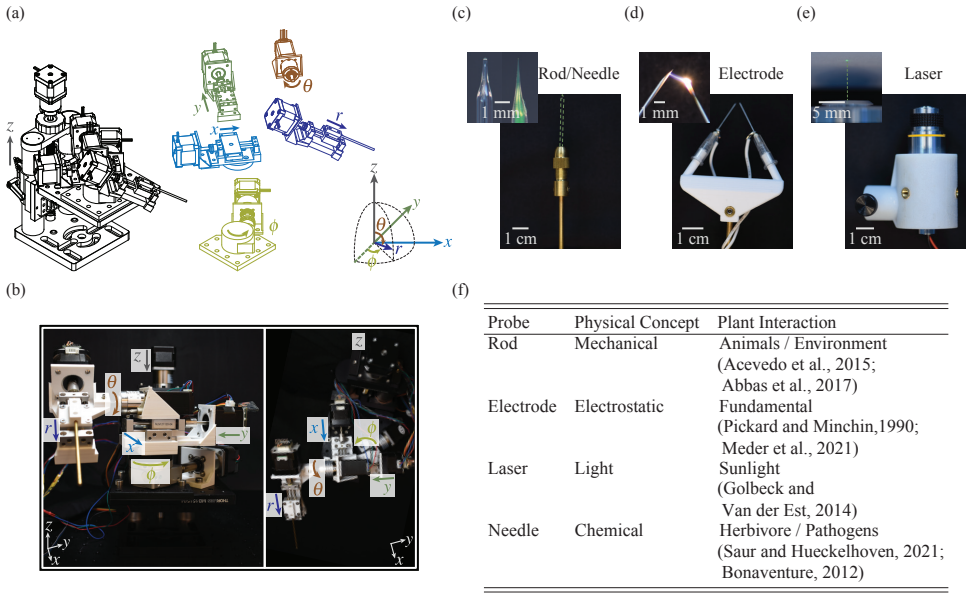
The central object is the multi-physics platform itself: a 3D-printed, six-axis micromanipulator with micrometer-resolution stepper control (about 4 µm resolution, with backlash up to 80 µm that must be corrected) and four interchangeable probes—a glass rod for mechanical contact, a pair of electrodes with ~6.75 kV potential difference for electrostatic stimulation, a 520 nm laser diode for optical stimulation, and a glass needle for chemical microinjection. Integrated open-source software controls motor positioning, probe triggering, and camera imaging, allowing precise, repeated, and time-controlled delivery of stimuli. The argument relies on this platform being able to apply each stimulus alone under otherwise identical conditions, so that differences in plant response can be attributed to the physical nature of the trigger.
What would settle it
Stimulate an Arabidopsis leaf with the electrode probe while measuring surface temperature with a thermal camera and staining the tissue with a cell-viability dye afterward; if the leaf warms measurably during the arc or dead cells appear in the stimulated region, the calcium-fatigue and stimulus-specific conclusions would need to be reassigned to non-electrostatic side effects.
Extended reading notes
Core claim
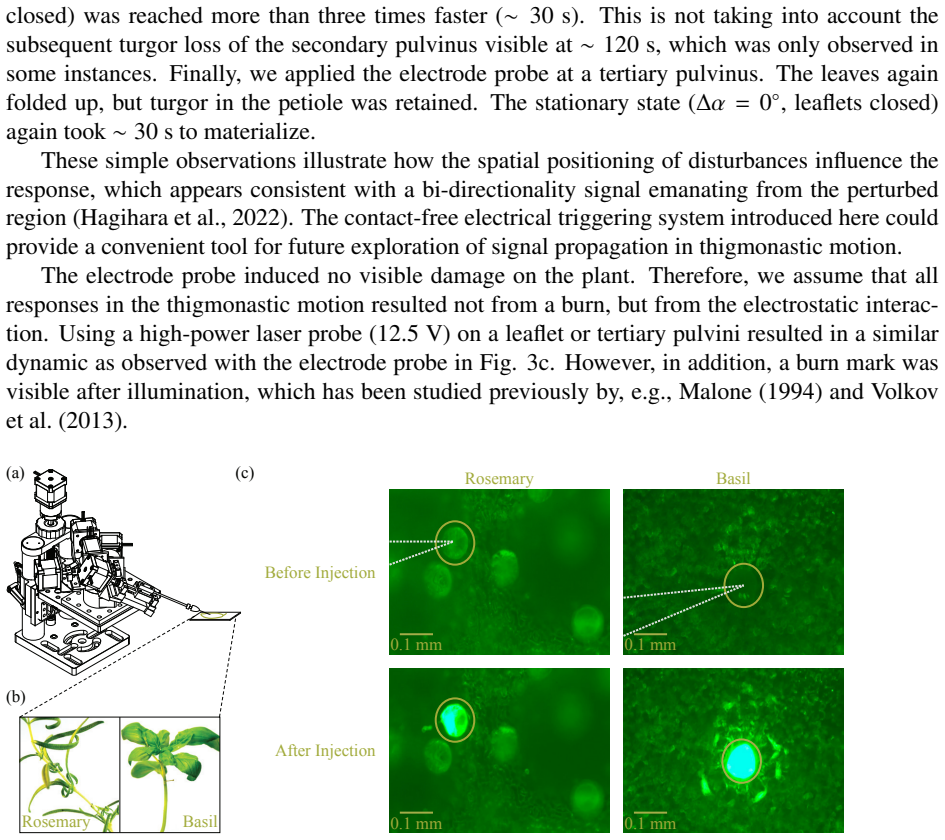
The central claim is that a single multi-physics platform—a six-axis micromanipulator with interchangeable probes—can systematically apply mechanical, electrostatic, optical, and chemical stimuli to plants and reveal stimulus-specific and spatially dependent responses. The empirical findings are that, in Arabidopsis, mechanical contact produces a localized calcium signal that propagates radially at about 0.01 mm/s and shows no systematic desensitization when repeated, whereas a ~6.75 kV electrostatic arc above the leaf produces a faster (up to ~1.3 mm/s), longer-range calcium signal that reaches the petiole and distal leaves, and repeated shocks elicit a fatigued response: the second shock gives about 40% of the first signal and the third about 1%, with recovery after about 2.5 hours. The low-power laser probe produces no calcium response beyond control levels. In Mimosa pudica, contact-free electrostatic stimulation of the petiole causes the petiole to pivot first and leaves to droop after ~120 s; stimulation of the secondary pulvinus makes both events happen almost simultaneously and reach steady state in ~30 s; stimulation of a tertiary pulvinus folds the leaves while the petiole retains turgor. Microinjection experiments demonstrate that the needle probe can load fluorescein into individual glandular trichomes of rosemary and basil.
Load-bearing premise
The paper assumes that the plant responses to the electrode probe are caused by the electrostatic interaction and not by heat, electric current, ozone, or unnoticed micro-damage, solely because no visible tissue damage was observed.
Editorial extensions
If this is right
- Electrostatic stimulation produces a stronger, faster, and longer-range calcium signal in Arabidopsis than mechanical touch, so future plant-signaling studies must control for stimulus history and the possibility of fatigue.
- The lack of desensitization in response to repeated touch contrasts with the fatigue seen in repeated electrostatic shocks, suggesting that different physical triggers engage distinct calcium-mobilization pathways.
- Contact-free electrostatic triggering of Mimosa pudica provides a non-damaging method to study signal propagation and the spatial dependence of thigmonastic motion in real time.
- Microinjection into glandular trichomes using the needle probe demonstrates the feasibility of targeted chemical perturbation of individual plant cells, enabling biochemical studies at cellular resolution.
- The platform's open-source design and approximate €3500 cost make multi-stimulus plant physiology accessible to laboratories without specialized commercial micromanipulation systems.
Reading between the lines
- The fatigue observed with repeated electrostatic stimulation may be partially caused by non-electrostatic side effects of the electrical arc, such as local heating, ozone generation, or micro-scale tissue damage; a controlled comparison with an arc-free electrostatic field source would test this directly.
- The distinct calcium dynamics between touch and electrostatic shock suggest that stimulus identity is encoded not only by whether a calcium wave occurs but by its speed, spatial extent, and repeatability—features that a multi-probe platform can systematically characterize.
- The platform’s modular design could be extended to deliver combined stimuli in tandem (for example, a mechanical touch followed by an electrostatic shock) to probe interactions between calcium, electrical, and hydraulic signaling pathways.
- Mapping the location-dependent Mimosa responses with faster imaging could reveal the direction and speed of the bi-directional calcium wave hypothesized by the authors, turning the platform into a quantitative tool for signal-propagation studies.
Editorial analysis
A structured set of objections, weighed in public.
Referee Report
Summary. The paper presents an open-source, low-cost, six-axis micromanipulator with four interchangeable probes (mechanical rod, electric-arc electrode, focused laser, and microinjection needle) for applying physical and chemical stimuli to plants. The platform is used in three demonstration experiments: calcium imaging in Arabidopsis thaliana (35S::GCaMP3) in response to mechanical, electric, and optical stimuli; thigmonastic motion in Mimosa pudica in response to electrical stimuli at different locations; and microinjection of fluorescein into glandular trichomes of rosemary and basil. The central claim is that the platform enables systematic comparison of multiple physical stimuli, and the authors report stimulus-specific calcium patterns, fatigue upon repeated electrical stimulation, spatial dependence of Mimosa movements, and successful microinjection. The engineering and feasibility aspects are supported by images and videos, and the open-source repository is a clear strength.
Significance. If the platform works as described, it fills a useful niche by combining motorized micromanipulation, probe triggering, and imaging in an open-source, reproducible system at a cost of approximately €3500. The paper's strengths are its explicit hardware/software sharing, the integration of four distinct stimulus modalities, and the use of established biosensors (GCaMP3) and model systems. The microinjection results and the qualitative description of stimulus-dependent responses are credible demonstrations of feasibility. However, the biological conclusions—especially 'electrostatic' specificity and fatigue—are preliminary and rely on untested assumptions and single-trace quantification. The manuscript is candid about some of these limitations (e.g., Section 3.1 acknowledges that cell death cannot be ruled out), which is commendable, but the abstract presents these findings without that caveat.
major comments (3)
- [Sections 2.1, 3.2, and Methods (Electrode)] The electrode probe is repeatedly labeled 'electrostatic,' but the Methods describe extracting the PCB from an electric lighter and applying ~6.75 kV between two needles, and Section 3.2 explicitly states that 'An electrical arc was applied.' An arc produces not only an electric field but also conduction and displacement currents, localized heating, UV radiation, ozone, and an acoustic shock. The only evidence that these side effects are negligible is the absence of visible damage (Section 3.2) and Appendix Fig. A2, which concedes that this 'does not exclude cell death on a smaller scale.' No measurements of leaf-surface current, temperature rise, ozone, or UV exposure are reported. Because the abstract's stimulus-specific conclusions—distinct calcium patterns and electrostatic fatigue—rest on attributing the response to the electric field, this attribution is not yet established. The authors should either rename the probe as 'electric arc' and soften the claims, or add control experiments (e.g., a heated probe without an arc, a UV-only source, or a true electrostatic field without current flow) and report the confounding physical quantities.
- [Section 3.1 and Fig. 2d] The quantitative fatigue statements—'the magnitude of the second response was only 40% of the primary response, while a third attempt yielded a response reduced to ~1%'—and the spread speed ('up to ~1.3 mm/s') are reported from what appears to be a single representative trace. No replicate counts, standard deviations, or statistical tests are provided for these ratios. The 2.5-h recovery experiment (Appendix Fig. A2c,d) is also described for a single plant. Because fatigue is a headline finding in the abstract, these numbers need to be supported by independent replicates with error bars, or the text should clearly state that they are illustrative single observations rather than established measurements.
- [Section 3.2 and Fig. 3] The conclusion that thigmonastic responses in Mimosa pudica depend on stimulus location is based on single trials at each location (petiole, secondary pulvinus, tertiary pulvinus); no replicate counts are reported. The angle changes (e.g., 'Δα ≈ 45–60°') appear as ranges but without n or error bars, and the timing differences are described qualitatively. To support the spatial-dependence claim, the authors should provide the number of independent replicates and quantitative summary statistics for response latency, amplitude, and the spread of the response for each stimulus location.
minor comments (6)
- [Methods (Plant Material)] The genus name is misspelled as 'Arabidosis' in the Plant Material subsection; it should be 'Arabidopsis.'
- [Methods (Microinjection)] The text uses 'Fluorescin' where the intended compound is 'fluorescein' (the dye is 5(6)-Carboxyfluorescein diacetate).
- [Section 2.1 and Methods (Electrode)] The relay is described as '1 Channel Relay Module, 6.75 kV,' which is an implausible rating for a relay; please clarify whether this is the relay's maximum switching voltage or a typo, and specify the actual current or energy delivered by the arc.
- [Discussion] The cost is given as 'approximately e3500'; the 'e' should be the Euro symbol (€) or the word 'Euro' to avoid ambiguity.
- [Section 3.2] The phrase 'after approximately ∼ 10 s' contains both 'approximately' and '∼'; please use one. Also, the ranges for Δα need explicit n values as noted in the major comments.
- [Methods (Calcium Measurements)] The imaging frame rate is described only as 'the highest possible frame rate'; please give the actual frame rate used, as it affects the reported spread speeds.
Circularity Check
No circularity: the platform claims and biological observations are direct experimental measurements, with self-citations used only for design inspiration and interpretive context.
full rationale
This paper contains no derivation chain in which an output is forced from inputs by equations, fits, or definitions. The central claims—that the micromanipulator delivers four probe types and that Arabidopsis calcium responses, Mimosa thigmonastic movements, and trichome microinjections differ under different stimuli—are direct experimental observations quantified from fluorescence imaging, angle measurements, and microscopy. The quantitative values reported (signal speed 'approximately 0.01 mm/s', propagation range 'about 0.25 mm', and fatigue ratios of '40%' and '~1%') are read off the measurements, not produced by a model fitted to those same measurements. Citations to the authors' prior work (Bellandi et al., 2022; Howell et al., 2023; Bae et al., 2021) are used as design inspiration and as interpretive context, e.g., 'consistent with previous observations (Bellandi et al., 2022; Howell et al., 2023)', but the present observations are independent and would stand without those citations; no conclusion is justified solely by a self-citation chain. The paper's limitation statements—'we can not rule out cell death as a reason for the decrease in signal' and Appendix Fig. A2 'does not exclude cell death on a smaller scale'—concern the validity of the electrostatic-fatigue interpretation, not circularity. Likewise, the attribution of the electrode response to 'the electrostatic interaction' is an explicit assumption rather than a derived result, so it is a correctness risk, not a self-referential step. No equation in the paper equals another by construction, and no fitted parameter is renamed as a prediction. Accordingly, the appropriate finding is no significant circularity.
Assumptions & free parameters
assumptions (4)
- domain assumption GCaMP3 fluorescence intensity is a valid reporter of cytosolic calcium concentration in Arabidopsis.
- domain assumption No visible tissue damage after electrode stimulation implies that the response is due to electrostatic interaction rather than burning or current-mediated injury.
- domain assumption Mimosa pudica thigmonastic movements are mediated by calcium signaling.
- domain assumption The electrode probe did not contact the plant and did not trap tissue between the electrodes.
Cite this review
Pith. "Pith review of A multi-physics approach to probing plant responses: From calcium signaling to thigmonastic motion." pith.science (2026). https://pith.science/paper/VCUR2B43
@misc{pith2026250118215,
  author       = {Pith},
  title        = {Pith review of: A multi-physics approach to probing plant responses: From calcium signaling to thigmonastic motion},
  year         = {2026},
  howpublished = {\url{https://pith.science/paper/VCUR2B43}},
  note         = {Machine review of arXiv:2501.18215}
}
read the original abstract
Plants respond to biotic and abiotic stresses through complex and dynamic mechanisms that integrate physical, chemical, and biological cues. Here, we present a multi-physics platform designed to systematically investigate these responses across scales. The platform combines a six-axis micromanipulator with interchangeable probes to deliver precise mechanical, electrostatic, optical, and chemical stimuli. Using this system, we explore calcium signaling in Arabidopsis thaliana, thigmonastic motion in Mimosa pudica, and chemical exchange via microinjection in Rosmarinus officinalis L. and Ocimum basilicum. Our findings highlight stimulus-specific and spatially dependent responses: mechanical and electrostatic stimuli elicit distinct calcium signaling patterns, while repeated electrostatic stimulation exhibited evidence of response fatigue. Thigmonastic responses in Mimosa pudica depend on the location of perturbation, highlighting the intricate bi-directional calcium signaling. Microinjection experiments successfully demonstrate targeted chemical perturbations in glandular trichomes, opening avenues for biochemical studies. This open-source platform provides a versatile tool for dissecting plant stress responses, bridging the gap between fundamental research and applied technologies in agriculture and bioengineering. By enabling precise, scalable, and reproducible studies of plant-environment interactions, this work offers new insights into the mechanisms underlying plant resilience and adaptability.
Figures


Figures from the paper (1 more)
Reference graph
Works this paper leans on
-
[1]
author Abbas, F. , author Ke, Y. , author Yu, R. , et al., year 2017 . title Volatile terpenoids: multiple functions, biosynthesis, modulation and manipulation by genetic engineering . journal Planta volume 246 , pages 803--816 . https://doi.org/10.1007/s00425-017-2749-x, :10.1007/s00425-017-2749-x
-
[2]
author Abdelrahman, D. , author Hasan, W. , author Da'as, S.I. , year 2021 . title Microinjection quality control in zebrafish model for genetic manipulations . journal MethodsX volume 8 , pages 101418 . :10.1016/j.mex.2021.101418
-
[3]
author Acevedo, F.E. , author Rivera-Vega, L.J. , author Chung, S.H. , author Ray, S. , author Felton, G.W. , year 2015 . title Cues from chewing insects—the intersection of damps, hamps, mamps and effectors . journal Current Opinion in Plant Biology volume 26 , pages 80--86
work page 2015
-
[4]
author Adam, G. , author Chidambaram, S. , author Reddy, S. , author Ramani, K. , author Cappelleri, D. , year 2021 . title Towards a comprehensive and robust micromanipulation system with force-sensing and vr capabilities . journal Micromachines volume 12 , pages 784 . :10.3390/mi12070784
-
[5]
author Bae, H. , author Paludan, M. , author Knoblauch, J. , author Jensen, K.H. , year 2021 . title Neural networks and robotic microneedles enable autonomous extraction of plant metabolites . journal Plant Physiology volume 186 , pages 1435--1441 . https://doi.org/10.1093/plphys/kiab178, :10.1093/plphys/kiab178
-
[6]
author Bellandi, A. , author Papp, D. , author Breakspear, A. , author Joyce, J. , author Johnston, M.G. , author de Keijzer, J. , author Raven, E.C. , author Ohtsu, M. , author Vincent, T.R. , author Miller, A.J. , author Sanders, D. , author Hogenhout, S.A. , author Morris, R.J. , author Faulkner, C. , year 2022 . title Diffusion and bulk flow of amino ...
-
[7]
author Bonaventure, G. , year 2012 . title Perception of insect feeding by plants . journal Plant Biology volume 14 , pages 872--880 . https://doi.org/10.1111/j.1438-8677.2012.00650.x, :10.1111/j.1438-8677.2012.00650.x. note epub 2012 Sep 7
-
[8]
author Erb, M. , author Reymond, P. , year 2019 . title Molecular interactions between plants and insect herbivores . journal Annual review of plant biology volume 70 , pages 527--557
work page 2019
Show all 42 references
-
[9]
, year 2014
author Farmer, E.E. , year 2014 . title Leaf defence . publisher OUP Oxford
2014
-
[10]
, author Gao, Y.Q
author Farmer, E.E. , author Gao, Y.Q. , author Lenzoni, G. , author Wolfender, J.L. , author Wu, Q. , year 2020 . title Wound- and mechanostimulated electrical signals control hormone responses . journal New Phytologist volume 227 , pages 1037--1050 . :10.1111/nph.16646
2020 doi
-
[11]
, author Mittler, R
author Fichman, Y. , author Mittler, R. , year 2021 . title Integration of electric, calcium, reactive oxygen species and hydraulic signals during rapid systemic signaling in plants . journal The Plant Journal volume 107 , pages 7--20 . https://doi.org/10.1111/tpj.15360, :10.1...
2021 doi
-
[12]
, editor Van der Est, A
editor Golbeck, J. , editor Van der Est, A. (Eds.), year 2014 . title The Biophysics of Photosynthesis . volume volume 465 . publisher Springer , address New York
2014
-
[13]
, author Mano, H
author Hagihara, T. , author Mano, H. , author Miura, T. , et al., year 2022 . title Calcium-mediated rapid movements defend against herbivorous insects in mimosa pudica . journal Nature Communications volume 13 , pages 6412 . :10.1038/s41467-022-34106-x
2022 doi
-
[14]
, author Heikkinen, I.T
author Hietanen, I. , author Heikkinen, I.T. , author Savin, H. , author Pearce, J.M. , year 2018 . title Approaches to open source 3-d printable probe positioners and micromanipulators for probe stations . journal HardwareX volume 4 . https://doi.org/10.1016/j.ohx.2018.e00042...
2018 doi
-
[15]
, author Krch n \'a k, P
author Hlav \'a c kov \'a , V. , author Krch n \'a k, P. , author Nau s , J. , et al., year 2006 . title Electrical and chemical signals involved in short-term systemic photosynthetic responses of tobacco plants to local burning . journal Planta volume 225 , pages 235--244 . :...
2006 doi
-
[16]
, author Völkner, C
author Howell, A.H. , author Völkner, C. , author McGreevy, P. , et al., year 2023 . title Pavement cells distinguish touch from letting go . journal Nature Plants volume 9 , pages 877--882 . :10.1038/s41477-023-01418-9
2023 doi
-
[17]
, author Smith, S.M
author Knight, M.R. , author Smith, S.M. , author Trewavas, A.J. , year 1992 . title Wind-induced plant motion immediately increases cytosolic calcium . journal Proceedings of the National Academy of Sciences of the United States of America volume 89 , pages 4967--4971 . https...
1992 doi
-
[18]
, author Seo, P.J
author Lee, K. , author Seo, P.J. , year 2022 . title Wound-induced systemic responses and their coordination by electrical signals . journal Frontiers in Plant Science volume 13 . :10.3389/fpls.2022.880680
2022
-
[19]
, year 1994
author Malone, M. , year 1994 . title Wound‐induced hydraulic signals and stimulus transmission in mimosa pudica l. journal New Phytologist volume 128 , pages 49--56
1994
-
[20]
, author Saar, S
author Meder, F. , author Saar, S. , author Taccola, S. , author Filippeschi, C. , author Mattoli, V. , author Mazzolai, B. , year 2021 . title Ultraconformable, self-adhering surface electrodes for measuring electrical signals in plants . journal Advanced Materials Technologi...
2021 doi
-
[21]
, author Thorpe, M.R
author Minchin, P.E.H. , author Thorpe, M.R. , year 1983 . title A rate of cooling response in phloem translocation . journal Journal of Experimental Botany volume 34 , pages 529--536
1983
-
[22]
, author Ohkura, M
author Nakai, J. , author Ohkura, M. , author Imoto, K. , year 2001 . title A high signal-to-noise ca2+ probe composed of a single green fluorescent protein . journal Nature Biotechnology volume 19 , pages 137--141 . :10.1038/84397
2001 doi
-
[23]
, author Zoberman, M
author Pan, P. , author Zoberman, M. , author Zhang, P. , et al., year 2024 . title Robotic microinjection enables large-scale transgenic studies of caenorhabditis elegans . journal Nature Communications volume 15 , pages 8848 . :10.1038/s41467-024-53108-5
2024 doi
-
[24]
, year 2000
author Pedley, T. , year 2000 . title Blood flow in arteries and veins . journal Perspectives in fluid dynamics: a collective introduction to current research , pages 105--158
2000
-
[25]
, author Minchin, P.E.H
author Pickard, W.F. , author Minchin, P.E.H. , year 1990 . title The Transient Inhibition of Phloem Translocation in Phaseolus vulgaris by Abrupt Temperature Drops, Vibration, and Electric Shock . journal Journal of Experimental Botany volume 41 , pages 1361--1369 . :10.1093/...
1990 doi
-
[26]
, author Trewavas, A.J
author Plieth, C. , author Trewavas, A.J. , year 2002 . title Reorientation of seedlings in the earth's gravitational field induces cytosolic calcium transients . journal Plant Physiology volume 129 , pages 786--796 . https://doi.org/10.1104/pp.011007, :10.1104/pp.011007
2002 doi
-
[27]
, author Nadeem, H
author Rasul, I. , author Nadeem, H. , author Siddique, M.H. , author Atif, R.M. , author Ali, M.A. , author Umer, A. , author Rashid, F. , author Afzal, M. , author Abid, M. , author Azeem, F. , year 2017 . title Plants sensory-response mechanisms for salinity and heat stress...
2017
-
[28]
, author Johnson, B.R
author Ryan, J. , author Johnson, B.R. , author Deitcher, D. , year 2020 . title Building your own neuroscience equipment: A precision micromanipulator and an epi-fluorescence microscope for calcium imaging . journal Journal of Undergraduate Neuroscience Education volume 19 , ...
2020
-
[29]
, author H \"u ckelhoven, R
author Saur, I.M. , author H \"u ckelhoven, R. , year 2021 . title Recognition and defence of plant-infecting fungal pathogens . journal Journal of Plant Physiology volume 256 , pages 153324
2021
-
[30]
, author Yeom, E
author Song, K. , author Yeom, E. , author Lee, S. , year 2014 . title Real-time imaging of pulvinus bending in mimosa pudica . journal Scientific Reports volume 4 , pages 6466 . https://doi.org/10.1038/srep06466, :10.1038/srep06466
2014 doi
-
[31]
, author Sch \"o nrogge, K
author Stone, G.N. , author Sch \"o nrogge, K. , year 2003 . title The adaptive significance of insect gall morphology . journal Trends in Ecology & Evolution volume 18 , pages 512--522
2003
-
[32]
, author Hires, S
author Tian, L. , author Hires, S. , author Mao, T. , et al., year 2009 . title Imaging neural activity in worms, flies, and mice with improved gcamp calcium indicators . journal Nature Methods volume 6 , pages 875--881 . :10.1038/nmeth.1398
2009 doi
-
[33]
, author Spencer, D
author Toyota, M. , author Spencer, D. , author Sawai-Toyota, S. , author Jiaqi, W. , author Zhang, T. , author Koo, A.J. , author Howe, G.A. , author Gilroy, S. , year 2018 . title Glutamate triggers long-distance, calcium-based plant defense signaling . journal Science volum...
2018 doi
-
[34]
, author Henry-Vian, C
author Vian, A. , author Henry-Vian, C. , author Davies, E. , year 1999 . title Rapid and systemic accumulation of chloroplast mrna-binding protein transcripts after flame stimulus in tomato . journal Plant Physiology volume 121 , pages 517--524 . :10.1104/pp.121.2.517
1999 doi
-
[35]
, author Foster, J.C
author Volkov, A.G. , author Foster, J.C. , author Ashby, T.A. , author Walker, R.K. , author Johnson, J.A. , author Markin, V.S. , year 2010 . title Mimosa pudica: Electrical and mechanical stimulation of plant movements . journal Plant, Cell & Environment volume 33 , pages 1...
2010
-
[36]
, author O’Neal, L
author Volkov, A.G. , author O’Neal, L. , author Volkova, M.I. , author Markin, V.S. , year 2013 . title Morphing structures and signal transduction in mimosa pudica l. induced by localized thermal stress . journal Journal of Plant Physiology volume 170 , pages 1317--1327 . ht...
2013 doi
-
[37]
, year 1952
author Weintraub, M. , year 1952 . title Leaf movements in mimosa pudica l. journal The New Phytologist volume 50 , pages 357--382
1952
-
[38]
, author Amarasinghe, Y.W.R
author Wijegunawardana, I. , author Amarasinghe, Y.W.R. , year 2021 . title The role of mems in in-vitro-fertilization . journal Advances in Technology volume 1 , pages 235--255 . :10.31357/ait.v1i1.4847
2021 doi
-
[39]
, author Tjallingii, W.F
author Will, T. , author Tjallingii, W.F. , author Th \"o nnessen, A. , author van Bel, A.J. , year 2007 . title Molecular sabotage of plant defense by aphid saliva . journal Proceedings of the National Academy of Sciences volume 104 , pages 10536--10541
2007
-
[40]
, author Gilbert, L.E
author Williams, K.S. , author Gilbert, L.E. , year 1981 . title Insects as selective agents on plant vegetative morphology: egg mimicry reduces egg laying by butterflies . journal Science volume 212 , pages 467--469
1981
-
[41]
, author Zhu, J
author Zhang, H. , author Zhu, J. , author Gong, Z. , author Zhu, J.K. , year 2022 . title Abiotic stress responses in plants . journal Nature Reviews Genetics volume 23 , pages 104--119
2022
-
[42]
, author Wang, X
author Zhang, Z. , author Wang, X. , author Liu, J. , author Dai, C. , author Sun, Y. , year 2019 . title Robotic micromanipulation: Fundamentals and applications . journal Annual Review of Control, Robotics, and Autonomous Systems volume 2 , pages 181--203 . :https://doi.org/...
2019 doi
Reviewed August 10, 2026 · model on record in the stance chip above.
Discussion (0). Continue with ORCID to comment.