REVIEW 3 major objections 4 minor 51 references
Fourier analysis of equivariant quantum cohomology
T0 review · 3 major / 4 minor · reviewed 2026-08-09 · deepseek-v4-flash
Pith's one-line read Equivariant quantum cohomology of a space determines the quantum cohomology of its quotients by Fourier transform.
desk verdict A clear, honest conjecture framework that reframes Teleman's conjecture as Fourier duality; the new conjectures are plausible but unproved, and the paper's main evidence is a re-reading of known toric results. read the letter →
The pith
A machine-rendered reading of the paper's core claim, the machinery that carries it, and where it could break.
The reading
What carries the argument
The central machinery is the shift operator, or Seidel representation, on equivariant quantum cohomology: a family of operators $S_\beta$ that shift equivariant parameters by $-z\beta$. These operators make equivariant quantum cohomology into a difference module, and the Fourier duality replaces them by multiplication by Novikov variables while sending equivariant bulk parameters to covariant derivatives of the quantum connection. The discrete Fourier transform sums $\kappa(S_{-\beta} J_X) S^{\beta}$ over the equivariant lattice, and the Givental cone, the Lagrangian submanifold of descendant Gromov-Witten invariants, is the target that detects whether the transformed series is a genuine quantum cohomology solution. The quantum volume $\Pi_X = \int_X J_X(-z) z^{n-\deg/2} z^{c_1(X)} \hat\Gamma_X$ provides the period-like quantity whose Fourier duality is the quantum analogue of classical volume reduction.
What would settle it
Compute the discrete Fourier transform $I_Y$ for a smooth GIT quotient $Y$ and check two conditions: every coefficient with $\beta$ outside the dual cone $C^{\vee}_{Y,N}$ cancels, and $zI_Y$ lies on the non-equivariant Givental cone $L_Y$; a single nonzero coefficient outside the dual cone or a series leaving $L_Y$ would disprove the reduction conjecture. A direct check in an empty-chamber case would also test the quantum-volume conjecture: the inverse Fourier transform of the equivariant quantum volume should have zero asymptotics for stability parameters with no quotient, as happens for $\mathbb{C}^n$ when $t<0$.
Extended reading notes
Core claim
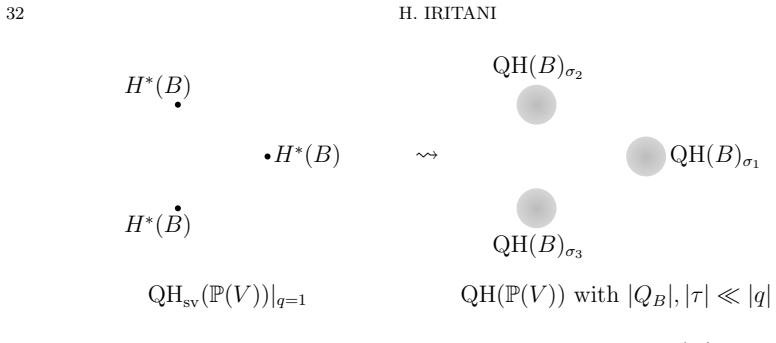
The central claim is a Fourier duality between difference and differential structures. On the equivariant side, shift operators move equivariant parameters by multiples of the loop-rotation variable $z$; on the quotient side, those same operators become Novikov variables while equivariant parameters become quantized derivatives. Concretely, the paper defines the discrete Fourier transform $I_Y = \sum_{[\beta]} \kappa(S_{-\beta} J_X) S^{\beta}$ and conjectures that it is supported on the dual cone $C^{\vee}_{Y,N}$ and that $zI_Y$ lies on the non-equivariant Givental cone $L_Y$. It also conjectures that the equivariant quantum volume, defined through the J-function and the $\hat\Gamma$-class, is Fourier-related to the quantum volume of the reduction after a mirror map. The paper establishes the picture in the projective-bundle and blowup cases through a decomposition of quantum D-modules, and recovers toric mirror symmetry as the special case where the quotient is a point.
Load-bearing premise
The definition of quantum volume starts from a path integral over the Floer fundamental cycle that the paper itself says is not yet mathematically rigorous, and the localization formula is adopted as the definition; if that heuristic is invalid, the quantum-volume Fourier duality loses its foundation.
Editorial extensions
If this is right
- If the reduction conjecture holds, the equivariant quantum D-module of $X$ determines, by discrete Fourier transform, the quantum D-module of every smooth GIT quotient $Y$, with no further Gromov-Witten computation on $Y$ required.
- The discrete Fourier transformation maps equivariant Givental cones to quotient Givental cones, giving a solution-level realization of the quantum Kirwan map.
- For toric varieties, the Fourier transform of the equivariant J-function produces the Landau-Ginzburg mirror potential, so toric mirror symmetry appears as the point-quotient case of the duality.
- For projective bundles and blowups, the duality yields a decomposition of big quantum cohomology into copies of the base or centre quantum D-modules, with the eigenvalues of quantum multiplication clustering into explicit groups.
- The construction of a global Kähler moduli space extends the equivariant D-module to a sheaf whose restrictions near cusps are the quantum D-modules of the different GIT chambers.
Reading between the lines
- A natural testable extension is to orbifold or non-abelian GIT quotients; the paper's formalism is stated for smooth manifolds, and the same discrete Fourier transform should produce the orbifold I-function with a stringy correction.
- The quantum-volume conjecture suggests a new interpretation of empty chambers: the inverse Fourier transform should have zero asymptotics there, smoothing the classical Duistermaat-Heckman measure; this could be probed in noncompact examples beyond $\mathbb{C}^n$.
- The continuous Fourier transforms attached to fixed components appear to be the same operation as the discrete ones when a fixed component and a GIT quotient coincide; making that coincidence systematic may yield a general decomposition theorem for extremal contractions.
- The $\hat\Gamma$-integral structure and the conjectural Fourier duality may imply semiorthogonal decompositions of derived categories for the same varieties, a possibility the paper explicitly anticipates.
Editorial analysis
A structured set of objections, weighed in public.
Referee Report
Summary. The paper proposes a Fourier-duality framework relating the T-equivariant quantum cohomology (and quantum D-module) of a smooth projective variety X with the quantum cohomology of a GIT quotient Y = X//T. Section 1 introduces a heuristic "quantum volume," defined through Givental's path integral, and states a naive Fourier-duality conjecture (Conjecture 11). Section 2 gives rigorous definitions of shift operators, the equivariant Givental cone, and the big equivariant J-function, and states the central Reduction Conjecture 43, which expresses the J-function of Y as a discrete Fourier transform of the equivariant J-function of X. Section 3 summarizes decomposition theorems for quantum D-modules of projective bundles and blowups, with a proof strategy via the master space and continuous Fourier transforms. The paper is partly a research announcement: several central items are conjectural and proof details are deferred to the unpublished joint work [23].
Significance. If the reduction conjecture and the Fourier-duality picture are correct, they would unify Teleman's conjecture, explain toric mirror symmetry through a global Kähler moduli space, and give a conceptual mechanism behind the decomposition of quantum D-modules for projective bundles and blowups. The rigorous infrastructure in Section 2, especially the localization formula for shift operators in Proposition 34 and the intertwining properties, is a genuine strength, as are the worked examples in Examples 47--49 that connect the conjecture to known mirror theorems. The paper is honest in labeling its conjectures and in flagging the heuristic nature of the quantum volume definition. The main caveat is that the load-bearing support condition in Conjecture 43(1) is not proved, and the general proof is deferred to an inaccessible reference.
major comments (3)
- [§2.6, Conjecture 43(1)] The support statement that I_Y is supported on the dual cone C^∨_{Y,N} is the load-bearing unproved step. Formula (2.7) and Proposition 34 give the localization formula for the shift operator, but the vanishing of κ(Ŝ_{-β}J_X) for β outside the dual cone is precisely the quantum analogue of the Jeffrey–Kirwan residue mentioned in Remark 9, and it is asserted rather than derived. If this vanishing fails, I_Y contains spurious S^β variables and part (2), that zI_Y lies on L_Y, is not well-formed. The examples in Section 2.6 are all in toric or projective-bundle settings where the statement reduces to Givental's mirror theorem or the Coates–Givental quantum Riemann–Roch theorem, so they do not test the general mechanism. The proof is deferred to unpublished joint work [23]. This is not an internal inconsistency, but it is the point where the central conjecture could fail, and the paper should either provide a proof, or state clearly that the conjecture is open and restrict the claims accordingly.
- [§1.3, equations (1.9)–(1.10)] The definition of the quantum volume rests on Givental's path integral (1.9), which the paper explicitly says has "currently no mathematically rigorous definition," and the localization computation leading to (1.10) is adopted as the definition. Moreover, Conjecture 11 is admitted in Remark 12 to be imprecise and not correct in general (e.g., when the quotient is empty), and the intended interpretation is only as an asymptotic expansion. Since the abstract and title foreground the Fourier duality of quantum volumes, the manuscript should sharply separate this heuristic part from the rigorously defined reduction conjecture, and should avoid suggesting that Conjecture 11 is a proven or precisely formulated result.
- [§3, Theorems 50 and 53] The decomposition theorems for projective bundles and blowups are quoted from the author's previous works [38] and [24], respectively, and the proof outline in §3.3 relies essentially on the reduction conjecture and on the unpublished paper [23]. As presented, this paper does not itself prove these theorems, nor does it prove the reduction conjecture in the needed generality. The manuscript should clarify the provenance of each result and explicitly state which parts are new to this paper, which are conditional on Conjecture 43, and which are already established in the cited references.
minor comments (4)
- [§2.6, Conjecture 43] In the definition of I_Y, the quotient N_T^1(X)/N_1(T) appears to be a typo; it should presumably be N_T^1(X)/N_1(X), since N_1(T) has not been defined and the identification with H_2^T(pt,Z) is via the exact sequence (2.2).
- [Throughout] There are several typographical errors that should be corrected in a revision: "Kähler" is misspelled as "Kähelr" in the caption of Figure 3, "complections" in Remark 41, "dicrete" in Remark 45, "semi-infnite" in §2.1, and "mononid" in Remark 37.
- [§2.5, Lemma 38] The statement of Lemma 38 cites [23] for the dual-cone identification. Since [23] is listed as "in preparation," the citation is not verifiable; it would be helpful to state which parts of Lemma 38 are proved elsewhere and which are part of the forthcoming joint work.
- [§1.4, Example 22] In the heuristic computation of shift operators for vector spaces, the infinite products over c ≤ 0 and c ≤ -k are formal and involve regularization; a short remark explaining the intended regularization would improve readability, especially since the same products are used later in Example 47.
Circularity Check
No significant circularity: the Fourier/reduction conjectures are genuine conjectures, and the proven examples rest on independent mirror theorems.
full rationale
The paper does not fit parameters to data, and its derived statements are not equivalent to their inputs. The quantum-volume Fourier duality (Conjecture 11) is a genuine conjecture: Π_X is defined via J_X and the bΓ-class in (1.10) independently of Π_Y, and Examples 16 and 17 verify it by residue and mirror-integral computations, not by renaming. The reduction conjecture (Conjecture 43) is explicitly presented as a conjecture; its support property is asserted as nontrivial and is not defined into existence, since I_Y is defined for all β and the vanishing outside C^∨_{Y,N} is an unproved statement. The paper's proven results (Examples 47–49, Theorems 50 and 53) are anchored in external results: Givental's mirror theorem [22], the Coates–Givental quantum Riemann–Roch theorem [32], Brown [39], Koto [40], and the prior blowup paper [24]. The main self-citation is to the unpublished companion work [23] for the conjecture itself and for Lemma 38; this affects provenance and completeness, not circularity, because the paper does not present a derivation that reduces to [23] as evidence. Section 1.3 explicitly admits that the Givental path integral (1.9) is not mathematically rigorous and that the localization computation is adopted as the definition of quantum volume; this is a foundational caveat, not a circular step.
Assumptions & free parameters
assumptions (4)
- ad hoc to paper The heuristic path integral (1.9) over the Floer fundamental cycle is valid and localizes to the quantum volume formula (1.10).
- domain assumption The Fourier integrals in Conjecture 11 make sense, at least as asymptotic expansions, and a mirror map σ_Y(τ) with the stated asymptotics exists.
- domain assumption The discrete Fourier sum in Conjecture 43 has support on the dual cone C^∨_{Y,N} and defines a point on the non-equivariant Givental cone L_Y.
- standard math Virtual localization and the quantum Riemann-Roch theorem of Coates-Givental are used as black boxes for shift operators and D-module decompositions.
Cite this review
Pith. "Pith review of Fourier analysis of equivariant quantum cohomology." pith.science (2026). https://pith.science/paper/ZXSTYNKK
@misc{pith2026250118849,
  author       = {Pith},
  title        = {Pith review of: Fourier analysis of equivariant quantum cohomology},
  year         = {2026},
  howpublished = {\url{https://pith.science/paper/ZXSTYNKK}},
  note         = {Machine review of arXiv:2501.18849}
}
read the original abstract
Equivariant quantum cohomology possesses the structure of a difference module by shift operators (Seidel representation) of equivariant parameters. Teleman's conjecture suggests that shift operators and equivariant parameters acting on QH_T(X) should be identified, respectively, with the Novikov variables and the quantum connection of the GIT quotient X//T. This can be interpreted as a form of Fourier duality between equivariant quantum cohomology (D-module) of X and quantum cohomology (D-module) of the GIT quotient X//T. We introduce the notion of "quantum volume," derived from Givental's path integral over the Floer fundamental cycle, and present a conjectural Fourier duality relationship between the T-equivariant quantum volume of X and the quantum volume of X//T. We also explore the "reduction conjecture," developed in collaboration with Fumihiko Sanda, which expresses the I-function of X//T as a discrete Fourier transform of the equivariant J-function of X. Furthermore, we demonstrate how to use Fourier analysis of equivariant quantum cohomology to observe toric mirror symmetry and prove a decomposition of quantum cohomology D-modules of projective bundles or blowups.
Figures


Figures from the paper (4 more)


Reference graph
Works this paper leans on
- [23]
-
[38]
H. Iritani and Y. Koto, Quantum cohomology of projective bundles (2023). arXiv:2307.03696
arXiv 2023
-
[24]
H. Iritani. Quantum cohomology of blowups. arXiv:2307.13555[math.AG] (2023)
arXiv 2023
-
[1]
C. Teleman. Gauge theory and mirror symmetry. In Proceedings of the International Congress of Mathematicians—Seoul 2014. Vol. II , pp. 1309–1332, Kyung Moon Sa, Seoul (2014)
work page 2014
-
[2]
D. Pomerleano and C. Teleman. Quantization commutes with reduction again: quantum GIT conjecture I. arXiv:2405.20301[math.AG] (2024)
arXiv 2024
-
[3]
A. B. Givental, Homological geometry. I. Projective hypersurfaces, Selecta Math. (N.S.) . 1(2), 325–345 (1995). ISSN 1022-1824
work page 1995
- [4]
-
[5]
A. Okounkov and R. Pandharipande, The quantum differential equation of the Hilbert scheme of points in the plane, Transform. Groups. 15(4), 965–982 (2010). ISSN 1083-4362
work page 2010
Show all 51 references
-
[6]
Braverman, D
A. Braverman, D. Maulik, and A. Okounkov, Quantum cohomology of the Springer resolution, Adv. Math. 227(1), 421–458 (2011). ISSN 0001-8708
2011
-
[7]
Maulik and A
D. Maulik and A. Okounkov, Quantum groups and quantum cohomology, Ast´ erisque. (408), ix+209 (2019). ISSN 0303-1179. arXiv:1211.1287[math.AG]
2019 arXiv
-
[8]
Seidel, π1 of symplectic automorphism groups and invertibles in quantum homology rings, Geom
P. Seidel, π1 of symplectic automorphism groups and invertibles in quantum homology rings, Geom. Funct. Anal. 7(6), 1046–1095 (1997). ISSN 1016-443X. FOURIER ANALYSIS OF EQUIV ARIANT QUANTUM COHOMOLOGY 41
1997
-
[9]
Gonz´ alez, C
E. Gonz´ alez, C. Y. Mak, and D. Pomerleano. Affine nil-Hecke algebras and quantum cohomology. arXiv:2202.05785 (2022)
2022 arXiv
-
[10]
C. T. Woodward, Quantum Kirwan morphism and Gromov-Witten invariants of quotients I, II, III, Transform. Groups . 20(2,3,4), 507–556,881–920,1155–1193 (2015). ISSN 1083-4362. arXiv:1204.1765
2015 arXiv
-
[11]
K. Fukaya. Unobstructed immersed Lagrangian correspondence and filtered A∞ functor. arXiv:1706.02131[math.AG] (2017)
2017 arXiv
-
[12]
Lau, N.-C
S.-C. Lau, N.-C. C. Leung, and Y.-L. L. Li. Equivariant Lagrangian correspondence and a con- jecture of Teleman. arXiv:2312.13926[math.AG] (2023)
2023 arXiv
-
[13]
Iritani, Shift operators and toric mirror theorem, Geom
H. Iritani, Shift operators and toric mirror theorem, Geom. Topol. 21(1), 315–343 (2017). ISSN 1465-3060. arXiv:1411.6840 [math.AG]
2017 arXiv
-
[14]
F. C. Kirwan, Cohomology of quotients in symplectic and algebraic geometry. vol. 31, Mathematical Notes, Princeton University Press, Princeton, NJ (1984). ISBN 0-691-08370-3
1984
-
[15]
L. C. Jeffrey and F. C. Kirwan, Localization for nonabelian group actions, Topology. 34(2), 291–327 (1995). ISSN 0040-9383
1995
-
[16]
Galkin and H
S. Galkin and H. Iritani. Gamma conjecture via mirror symmetry. In Primitive forms and related subjects—Kavli IPMU 2014, vol. 83, Adv. Stud. Pure Math., pp. 55–115. Math. Soc. Japan, [Tokyo] ([2019] ©2019). ISBN 978-4-86497-085-3
2014
-
[17]
Barannikov, Quantum periods, I: semi-infinite variations of Hodge structures, International Mathematics Research Notices
S. Barannikov, Quantum periods, I: semi-infinite variations of Hodge structures, International Mathematics Research Notices . 2001(23), 1243–1264 (01, 2001). ISSN 1073-7928. doi: 10.1155/ S1073792801000599. URL https://doi.org/10.1155/S1073792801000599
2001 doi
-
[18]
Coates, A
T. Coates, A. Corti, S. Galkin, V. Golyshev, and A. Kasprzyk. Mirror symmetry and Fano manifolds. In European Congress of Mathematics , pp. 285–300. Eur. Math. Soc., Z¨ urich (2013). ISBN 978-3-03719-120-0
2013
-
[19]
Iritani, An integral structure in quantum cohomology and mirror symmetry for toric orbifolds, Adv
H. Iritani, An integral structure in quantum cohomology and mirror symmetry for toric orbifolds, Adv. Math. 222(3), 1016–1079 (2009). ISSN 0001-8708
2009
-
[20]
Aleshkin, B
K. Aleshkin, B. Fang, and J. Wang. Mirror symmetric gamma conjecture for toric GIT quotients via Fourier transform. arXiv:2501.14222[math.AG] (2025)
2025
-
[21]
Galkin, V
S. Galkin, V. Golyshev, and H. Iritani, Gamma classes and quantum cohomology of Fano man- ifolds: gamma conjectures, Duke Math. J. 165(11), 2005–2077 (2016). ISSN 0012-7094. doi: 10.1215/00127094-3476593. URL https://doi.org/10.1215/00127094-3476593
2016 doi
-
[22]
A. B. Givental. A mirror theorem for toric complete intersections. In Topological field theory, primitive forms and related topics (Kyoto, 1996) , vol. 160, Progr. Math., pp. 141–175. Birkh¨ auser Boston, Boston, MA (1998)
1998
-
[25]
D. A. Cox and S. Katz, Mirror symmetry and algebraic geometry . vol. 68, Mathematical Surveys and Monographs, American Mathematical Society, Providence, RI (1999). ISBN 0-8218-1059-6
1999
-
[26]
A. B. Givental, Equivariant Gromov-Witten invariants, Internat. Math. Res. Notices . (13), 613– 663 (1996). ISSN 1073-7928
1996
-
[27]
McDuff and S
D. McDuff and S. Tolman, Topological properties of Hamiltonian circle actions, IMRP Int. Math. Res. Pap. pp. 72826, 1–77 (2006). ISSN 1687-3017
2006
-
[28]
Dubrovin, Geometry of 2D topological field theories
B. Dubrovin, Geometry of 2D topological field theories. 1620, 120–348 (1996)
1996
-
[29]
Graber and R
T. Graber and R. Pandharipande, Localization of virtual classes, Invent. Math. 135(2), 487–518 (1999). ISSN 0020-9910
1999
-
[30]
Pandharipande, Rational curves on hypersurfaces (after A
R. Pandharipande, Rational curves on hypersurfaces (after A. Givental), Ast´ erisque. (252), Exp. No. 848, 5, 307–340 (1998). ISSN 0303-1179. S´ eminaire Bourbaki. Vol. 1997/98
1998
-
[31]
Coates, A
T. Coates, A. Corti, H. Iritani, and H.-H. Tseng, Hodge-theoretic mirror symmetry for toric stacks, J. Differential Geom. 114(1), 41–115 (2020). ISSN 0022-040X
2020
-
[32]
Coates and A
T. Coates and A. Givental, Quantum Riemann-Roch, Lefschetz and Serre, Ann. of Math. (2) . 165(1), 15–53 (2007). ISSN 0003-486X. 42 H. IRITANI
2007
-
[33]
A. B. Givental. Symplectic geometry of Frobenius structures. In Frobenius manifolds, Aspects Math., E36, pp. 91–112. Friedr. Vieweg, Wiesbaden (2004)
2004
-
[34]
Coates, A
T. Coates, A. Corti, H. Iritani, and H.-H. Tseng, Computing genus-zero twisted Gromov-Witten invariants, Duke Math. J. 147(3), 377–438 (2009). ISSN 0012-7094
2009
-
[35]
I. V. Dolgachev and Y. Hu, Variation of geometric invariant theory quotients, Inst. Hautes ´Etudes Sci. Publ. Math. (87), 5–56 (1998). ISSN 0073-8301. With an appendix by Nicolas Ressayre
1998
-
[36]
Thaddeus, Geometric invariant theory and flips, J
M. Thaddeus, Geometric invariant theory and flips, J. Amer. Math. Soc. 9(3), 691–723 (1996). ISSN 0894-0347
1996
-
[37]
Saito, Period mapping associated to a primitive form, Publ
K. Saito, Period mapping associated to a primitive form, Publ. Res. Inst. Math. Sci. 19(3), 1231–1264 (1983). ISSN 0034-5318. doi: 10.2977/prims/1195182028. URL http://dx.doi.org/ 10.2977/prims/1195182028
1983
-
[39]
J. S. Brown, Gromov-Witten invariants of toric fibrations, Int. Math. Res. Not. IMRN . (19), 5437–5482 (2014). ISSN 1073-7928
2014
-
[40]
Koto, A mirror theorem for non-split toric bundles (2023)
Y. Koto, A mirror theorem for non-split toric bundles (2023). arXiv:2310.09888[math.AG]
2023 arXiv
-
[41]
Galkin, J
S. Galkin, J. Hu, H. Iritani, K. Huazhong, C. Li, and Z. Su. Revisiting Gamma conjecture I: counterexamples and modifications. arXiv:2405.16979[math.AG] (2024)
2024 arXiv
-
[42]
Iritani, Global mirrors and discrepant transformations for toric Deligne-Mumford stacks, SIGMA Symmetry Integrability Geom
H. Iritani, Global mirrors and discrepant transformations for toric Deligne-Mumford stacks, SIGMA Symmetry Integrability Geom. Methods Appl. 16, Paper No. 032, 111 (2020)
2020
-
[43]
H. Iritani. Gamma classes and quantum cohomology. In ICM—International Congress of Mathe- maticians. Vol. 4. Sections 5–8 , pp. 2552–2574. EMS Press, Berlin ([2023] ©2023)
2023
-
[44]
Kontsevich, Birational invariants from Gromov-Witten theory (2022)
M. Kontsevich, Birational invariants from Gromov-Witten theory (2022). Lecture Series at Institut des Hautes ´Etudes Scientifiques, 2023, videos available at https://www.youtube.com/watch?v= YQzltmJ0hN8&list=PLx5f8IelFRgHd0gjoolTDXakXQvLbVQPv
2022
-
[45]
Hinault, T
T. Hinault, T. Y. Yu, C. Zhang, and S. Zhang. Decomposition and framing of F -bundles and applications to quantum cohomology. arXiv:2411.02266[math.AG] (2024)
2024 arXiv
-
[46]
Fan and Y.-P
H. Fan and Y.-P. Lee, On Gromov-Witten theory of projective bundles, Michigan Math. J. 69 (1), 153–178 (2020). ISSN 0026-2285
2020
-
[47]
Hori and M
K. Hori and M. Romo. Exact Results In Two-Dimensional (2 , 2) Supersymmetric Gauge Theories With Boundary. arXiv:1308.2438[hep-th] (2013)
2013 arXiv
-
[48]
H. Iritani. Quantum cohomology and Fourier transformation. Lecture series at Kansu-Hoteishiki- Ron Summer Seminar on 7-8 August 2023, held at Kurobe, Toyama, Japan (2023)
2023
-
[49]
H. Iritani. Fourier analysis of equivariant quantum cohomology. Talk at Banff International Re- search Station on 19 October 2023, a video available at https://www.birs.ca/events/2023/ 5-day-workshops/23w5068/videos/watch/202310191401-Iritani.html (2023)
2023
-
[50]
H. Iritani. Fourier analysis of equivariant quantum cohomology. Lecture series at the Chinese Uni- versity of Hong-Kong, on 21-24 November 2023, Greater Bay Area Geometry and Mathematical Physics Conference - MIST 2023 Workshop (2023)
2023
-
[51]
H. Iritani. Fourier analysis of equivariant quantum cohomology. Lecture series at the Institute of the Mathematical Sciences of the Americas at the University of Miami, on 26-28 January 2024, Homological Mirror Symmetry, videos available at https://www.youtube.com/watch?v= CaB...
2024
Reviewed August 9, 2026 · model on record in the stance chip above.
Discussion (0). Continue with ORCID to comment.