REVIEW 4 major objections 4 minor 2 cited by
Rethinking Diffusion Posterior Sampling: From Conditional Score Estimator to Maximizing a Posterior
T0 review · 4 major / 4 minor · reviewed 2026-08-09 · deepseek-v4-flash
Pith's one-line read Diffusion Posterior Sampling is actually maximizing a posterior, not sampling one, and a faithful MAP implementation performs better.
desk verdict A useful empirical challenge to the conditional-score story for DPS, with an honest MAP hypothesis and solid algorithmic gains; the headline evidence has a statistical hole, but the paper earns a serious read. read the letter →
The pith
A machine-rendered reading of the paper's core claim, the machinery that carries it, and where it could break.
The reading
What carries the argument
The central machinery is the high-dimensional concentration of the conditional Gaussian transition: as dimension $d\to\infty$, the distribution $p_\theta(X_{t-1}|X_t)$ concentrates on the surface of a sphere centered at $E[X_{t-1}|X_t]$ with radius $\sqrt{d}\sigma_t$. This converts the MAP objective $\arg\max p_\theta(X_{t-1}|X_t,y)$ into a constrained optimization: maximize $\log p_\theta(y|X_{t-1})$ subject to $X_{t-1}$ lying on that sphere (Proposition 3). DMAP then alternates multiple gradient-ascent steps of $\log p_\theta(y|X_{t-1})$ with orthogonal projection onto the sphere, making it a faithful MAP solver where DPS (one gradient step, no projection) and DSG (projection, single step) are partial implementations. A second ingredient is a lightweight conditional score estimator $q_\theta(X_{t-1}|X_t,y)$—a ControlNet trained on 100 images—used only as the initialization of the constrained optimization, justified by Proposition 4 through a cross-entropy comparison with the unconditional prior.
What would settle it
Take a second, independently trained conditional score reference—for example, a pixel-space diffusion model trained on paired data for the same super-resolution task—and recompute the score-error and score-mean statistics over a large set of images. If DPS's score error is not consistently larger than the unconditional score's error, or its score mean returns near zero for the working hyperparameter setting, the MAP hypothesis loses its empirical foundation.
Extended reading notes
Core claim
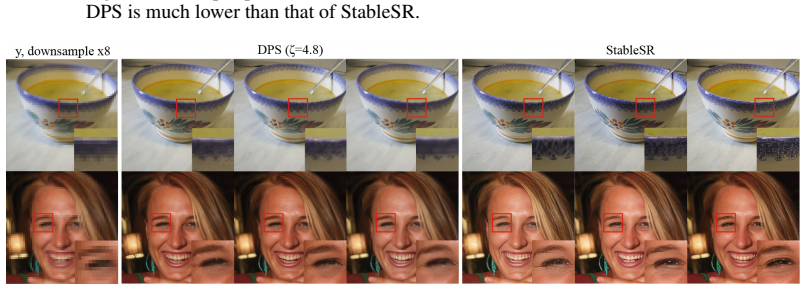
On the paper's own terms: DPS is not a conditional score estimator; it is a MAP optimizer. The authors state Hypothesis 2: instead of sampling $X_{t-1} \sim p_\theta(X_{t-1}|X_t, y)$, DPS in effect computes $X_{t-1} \leftarrow \arg\max p_\theta(X_{t-1}|X_t, y)$. They support this with three observations: (I) DPS's implied score $s_{\mathrm{DPS}}(X_t,t,y) = s_\theta(X_t,t) - \frac{\sqrt{\alpha_t}}{\beta_t}\zeta_t \nabla_{X_t}\|f(E[X_0|X_t])-y\|$ deviates far more from the score of StableSR, a trained conditional super-resolution model, than the unconditional score does; (II) the mean of DPS's score estimate is about 5.8 at $\zeta_t=4.8$, versus roughly 0.4 for the unconditional and StableSR scores, violating the zero-mean property expected of any score function; and (III) DPS exhibits markedly lower per-pixel sample variance than StableSR. They then prove (Proposition 3) that in the high-dimensional limit the MAP step is equivalent to $\arg\max \log p_\theta(y|X_{t-1})$ subject to $X_{t-1} \sim p_\theta(X_{t-1}|X_t)$, because the isotropic Gaussian transition concentrates on the surface of a sphere centered at $E[X_{t-1}|X_t]$ with radius $\sqrt{d}\sigma_t$. DMAP implements this by performing $K$ steps of gradient ascent on the likelihood term and then projecting back onto that sphere. A second improvement uses a ControlNet-based conditional score estimator trained on as few as 100 images (8 GPU hours) as a better initialization for the constrained optimization, justified by Proposition 4: any approximate posterior with lower cross-entropy to the true posterior yields a higher expected $\log p_\theta(y|X_{t-1})$ than the unconditional prior. On ImageNet 512 super-resolution, Gaussian deblurring, and non-linear deblurring, DMAP and DPS+CSE improve PSNR, LPIPS, and FID over DPS and prior DPS variants.
Load-bearing premise
The empirical case that DPS's score estimate is badly wrong relies on treating StableSR's score as a trustworthy proxy for the true conditional score; if StableSR is itself far from the true conditional score, the measured divergence may just say that DPS differs from StableSR rather than from the true score.
Editorial extensions
If this is right
- If DPS is MAP, then the sampling-based guarantees for posterior sampling (score approximation error bounds) are not the right lens for explaining DPS; the algorithm is solving an optimization problem, not approximating a sampler.
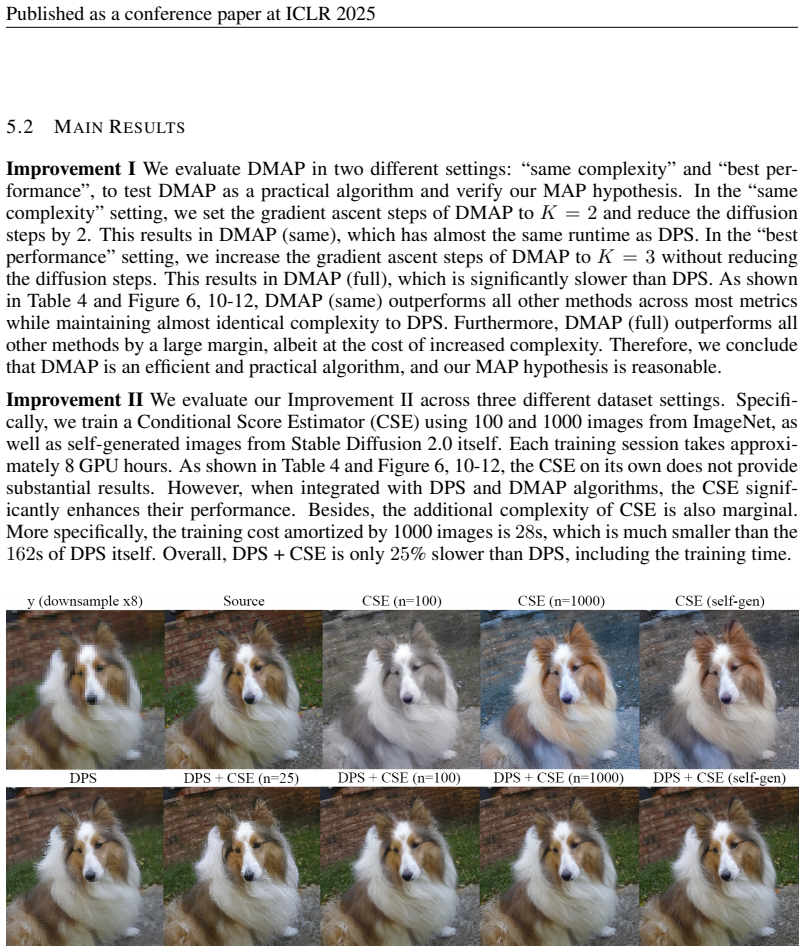
- DMAP with two gradient steps and half the diffusion steps matches DPS's runtime while improving PSNR, LPIPS, and FID, so the MAP interpretation yields a practical algorithm that is both faster and better.
- A conditional score estimator trained on as few as 100 images (8 GPU hours) substantially boosts DPS, and gains saturate around 1000 images or with self-generated data, indicating that very small training sets can provide useful conditioning information.
- The MAP view explains previously puzzling observations: why Adam helps DPS (adaptive step sizes are natural for optimization), why DPS has a large score-error lower bound in high dimensions, and why DPS samples lack diversity.
- DMAP continues to outperform DPS when the conditional score estimator is added, so the two improvements are complementary rather than redundant.
Reading between the lines
- If DPS is truly a MAP estimator, then comparisons against posterior samplers should be reframed: the diversity shortfall is a feature of optimization, not a bug, and applications that require diverse solutions would need explicit diversity-encouraging mechanisms on top of DMAP.
- The sphere-projection recipe could generalize beyond inverse problems: any guided diffusion update that pushes a sample away from the concentration sphere could benefit from an explicit projection step, a variant that could be tested on classifier guidance or classifier-free guidance.
- The 100-image ControlNet result suggests a few-shot inverse-problem pipeline: for a new forward operator, one could fine-tune a tiny conditional score estimator on a handful of real measurements rather than relying purely on zero-shot heuristics, and the paper's Proposition 4 gives a principled condition for when this helps.
- A natural testable extension is to measure whether DMAP's per-pixel variance goes exactly to zero in the limit of many gradient steps, which would confirm the deterministic MAP characterization and distinguish it from a sampler with low but nonzero entropy.
Editorial analysis
A structured set of objections, weighed in public.
Referee Report
Summary. The paper challenges the standard interpretation of Diffusion Posterior Sampling (DPS) as a conditional score estimator and proposes that DPS is better understood as implicitly maximizing a posterior (MAP). Three empirical observations are offered: (I) DPS's score estimate deviates more from a well-trained conditional score (StableSR) than the unconditional score does; (II) the empirical mean of DPS's score estimate is far from zero, which the authors take as evidence of invalidity; and (III) DPS samples have low diversity. Based on these observations, the authors hypothesize that DPS performs MAP estimation and introduce DMAP, a variant that performs multi-step gradient ascent with spherical projection, plus a lightweight ControlNet-based conditional score estimator (CSE) trained on 100 images in 8 GPU hours. Experiments on 512x512 ImageNet show that DMAP and DPS+CSE improve PSNR, LPIPS, and FID over DPS and several baselines across super-resolution and deblurring tasks.
Significance. If the MAP reinterpretation is correct, it would reframe how the community understands a widely used family of diffusion-based inverse problem solvers, with consequences for theory, hyperparameter choice, and algorithm design. The paper also delivers a practical algorithmic contribution: DMAP with multi-step gradient ascent and sphere projection, and a data-efficient CSE, yield consistent and sometimes large improvements across several tasks in Table 4. The authors provide source code and fairly extensive ablations, including training set size and compute time. However, the central conceptual claim rests on three observations whose statistical validity is currently incomplete; Observation II in particular is based on an invalid test. The empirical improvements are valuable regardless of the hypothesis, but the paper's main interpretive contribution needs stronger support.
major comments (4)
- [Section 3.3, Eq. (12), Table 2] The zero-mean identity for a valid score holds under expectation with respect to the conditional density p(X|y), i.e., E_{p(X|y)}[∇_X log p(X|y)] = 0. Table 2, however, reports means over 1000 samples of X_T drawn from the unconditional noise distribution N(0,I), which is independent of y. For a conditional score, E_{p(X_T)}[∇ log p(X_T|y)] = E_{p(X_T)}[∇ log p(y|X_T)] + E_{p(X_T)}[∇ log p(X_T)] = E_{p(X_T)}[∇ log p(y|X_T)], which is generically nonzero and can be large when the likelihood term is strongly weighted. The DPS update in Eq. (9) explicitly contains the likelihood gradient scaled by ζ_t, so the large mean for ζ_t=4.8 may simply reflect the expected likelihood gradient rather than an invalid score. The comparison with StableSR's near-zero mean is therefore not a valid test of score validity. The authors should either compute the mean under samples from p(X|y) (e.g., using a well-trained conditional model) or directly estimate the expected likelihood gradient term and subtract it before drawing conclusions.
- [Section 3.2, Figure 1, Appendix B.1] The quantitative score-error plot in Figure 1 is computed from a single ImageNet image (ILSVRC2012_val_00000013.png), as stated in Appendix B.1. No error bars, multiple images, or random seeds are reported, so the claim that DPS's score error is 'significantly larger' than the unconditional score is not established with any measure of variability. Additionally, the use of StableSR as the reference 'true' conditional score is an assumption; StableSR is a real-world super-resolution model, and its superiority in FID/KID/LPIPS does not logically imply that its score is closer to the true posterior score than DPS's estimate. The authors should provide score-error statistics over at least a handful of images with confidence intervals, and should discuss the limitations of using StableSR as ground truth.
- [Section 4.1, Algorithm 2, Proposition 3] The claim that DMAP is a 'faithful implementation' of the MAP problem in Eq. (15) is not fully supported. The gradient step in Algorithm 2 (line 6) uses ∇_{x_{t-1}} ||f(E[X0|x_{t-1}]) - y||, but E[X0|x_{t-1}] itself depends on x_{t-1} through the Tweedie formula (Eq. 4). The gradient of the composition is not equal to the gradient of log p(y|x_{t-1}) unless one ignores the Jacobian of E[X0|·] with respect to x_{t-1}. Thus the multi-step ascent is maximizing a heuristic proxy rather than the explicit posterior. The proof of Proposition 3 establishes a limiting equivalence for the constrained problem, but it does not justify replacing log p(y|X_{t-1}) with -||f(E[X0|X_{t-1}])-y||. The authors should state this approximation explicitly and, ideally, justify it or provide an ablation that uses the full Jacobian.
- [Section 3.5, Hypothesis 2, Section 5.2] The paper frames the MAP interpretation as a hypothesis and then uses the success of DMAP, which is built on that hypothesis, as evidence for it. This is a mild confirmation loop: the empirical gains of DMAP show that multi-step gradient ascent with projection helps, but they do not independently establish that DPS itself is a MAP estimator. The partial derivation for DSG in Appendix A.3 is a step in the right direction, but it relies on strong assumptions and does not cover DPS. To strengthen the central claim, the authors could provide a direct derivation of DPS as an approximate MAP update under explicit conditions, or compare DPS's behavior against a known MAP estimator in a controlled setting (e.g., the toy example in Appendix A.4) with quantitative agreement rather than just qualitative mode collapse.
minor comments (4)
- [Algorithm 3, Appendix A.1] Line 5 of Algorithm 3 (Latent DPS) writes 'x_{t-1} = x_{t-1} - ...' but should use the latent variable z_{t-1} for consistency.
- [Table 2 and Table 3] The value 0.3939 appears both as StableSR's score mean in Table 2 and as StableSR's per-pixel standard deviation in Table 3; this coincidence is suspicious and should be checked to rule out a copy-paste error.
- [Equation (8)] The text says the l2 norm is weighted by ζ_t, but Eq. (8) writes exp(-ζ_t ||f(E[X0|Xt])-y||), which is a plain l2 norm times ζ_t; the wording 'weighted l2 norm' is ambiguous.
- [Section 3.3] The authors state that any valid score has zero mean, but the empirical means of the unconditional score and StableSR are around 0.4, which is not particularly close to zero. A brief discussion of finite-sample effects, discretization, or the scale of typical score values would clarify why 0.4 is considered negligible.
Circularity Check
No significant circularity: the MAP reinterpretation is an explicitly labeled hypothesis, DMAP is independently implemented and tested against external baselines, and no load-bearing step reduces to its own inputs.
full rationale
The paper does not exhibit a circular derivation chain. The central claim (Hypothesis 2) is explicitly framed as a hypothesis, not a theorem: Section 3.5 states 'we hypothesize that DPS is closer to another paradigm of image restoration other than posterior sampling: the maximization of a posterior (MAP) estimate,' and Appendix A.3 concedes 'For now, we can not derive MAP directly from DPS.' The supporting observations are empirical comparisons against external references (StableSR, ControlNet, and standard baselines DPS/PSLD/FreeDOM/ReSample/DSG), and DMAP is not obtained by fitting a parameter to the data it later 'predicts'; it is a new algorithm built from the hypothesis and evaluated on held-out ImageNet images. The derivations that are present (Propositions 1, 3, 4) manipulate the paper's own definitions without importing a load-bearing self-citation or renaming a known result as a new one. The main caveat is statistical rather than circular: Observation II's zero-mean test (Eq. 12) is an identity under the conditional distribution p(X|y), whereas Table 2 reports means over X_T drawn from the unconditional noise prior, so the large mean for zeta=4.8 may partly reflect E[grad log p(y|X_T)] rather than establishing an invalid score; this weakens one pillar of the MAP case but does not make the argument circular. Because the paper is self-contained against external benchmarks and its core claim is an empirically supported hypothesis with an independent implementation, no circular step meets the evidentiary bar.
Assumptions & free parameters
free parameters (3)
- Guidance step size zeta_t =
4.8 for DPS SR, 0.6 for DPS deblur, 9.6 for DMAP(same) SR, 1.2 for DMAP(same) deblur
- Number of gradient ascent steps K =
2 for DMAP(same), 3 for DMAP(full)
- CSE training set size =
100, 1000, or self-generated images
assumptions (4)
- standard math As d grows, the isotropic Gaussian p(X_{t-1}|X_t) concentrates on a sphere of radius sqrt(d)*sigma_t and its log-likelihood converges in probability to a constant (Cover, Theorem 3.1.1).
- domain assumption The posterior mean E[X0|Xt] is a perfect approximation to posterior samples from p(X0|Xt) (Assumption 5.1).
- domain assumption log p(y|X_{t-1}) is locally linear within radius sqrt(n)*sigma_t and gradients w.r.t. X_{t-1} and X_t are approximately equal (Assumption 5.2).
- domain assumption StableSR provides a reliable estimate of the true conditional score p(X_t|y).
Cite this review
Pith. "Pith review of Rethinking Diffusion Posterior Sampling: From Conditional Score Estimator to Maximizing a Posterior." pith.science (2026). https://pith.science/paper/G2URZO24
@misc{pith2026250118913,
  author       = {Pith},
  title        = {Pith review of: Rethinking Diffusion Posterior Sampling: From Conditional Score Estimator to Maximizing a Posterior},
  year         = {2026},
  howpublished = {\url{https://pith.science/paper/G2URZO24}},
  note         = {Machine review of arXiv:2501.18913}
}
read the original abstract
Recent advancements in diffusion models have been leveraged to address inverse problems without additional training, and Diffusion Posterior Sampling (DPS) (Chung et al., 2022a) is among the most popular approaches. Previous analyses suggest that DPS accomplishes posterior sampling by approximating the conditional score. While in this paper, we demonstrate that the conditional score approximation employed by DPS is not as effective as previously assumed, but rather aligns more closely with the principle of maximizing a posterior (MAP). This assertion is substantiated through an examination of DPS on 512x512 ImageNet images, revealing that: 1) DPS's conditional score estimation significantly diverges from the score of a well-trained conditional diffusion model and is even inferior to the unconditional score; 2) The mean of DPS's conditional score estimation deviates significantly from zero, rendering it an invalid score estimation; 3) DPS generates high-quality samples with significantly lower diversity. In light of the above findings, we posit that DPS more closely resembles MAP than a conditional score estimator, and accordingly propose the following enhancements to DPS: 1) we explicitly maximize the posterior through multi-step gradient ascent and projection; 2) we utilize a light-weighted conditional score estimator trained with only 100 images and 8 GPU hours. Extensive experimental results indicate that these proposed improvements significantly enhance DPS's performance. The source code for these improvements is provided in https://github.com/tongdaxu/Rethinking-Diffusion-Posterior-Sampling-From-Conditional-Score-Estimator-to-Maximizing-a-Posterior.
Figures


Figures from the paper (8 more)




Forward citations
Cited by 2 Pith papers
-
DICT: Data Injection and Contrastive Trajectory Refinement for Conditional Image Generation with Diffusion Models
Noise-perturbed condition injection plus contrastive trajectory refinement improves training-free conditional diffusion sampling across style transfer, super-resolution and deblurring.
-
Local MAP Sampling for Diffusion Models
LMAPS frames reverse-diffusion inverse-problem solving as repeated local MAP estimation, unifying existing optimization-based solvers, and achieves strong PSNR gains on tasks like motion deblurring, JPEG restoration, ...
Reference graph
Works this paper leans on
-
[1]
Universal guidance for diffusion models
Arpit Bansal, Hong-Min Chu, Avi Schwarzschild, Soumyadip Sengupta, Micah Goldblum, Jonas Geiping, and Tom Goldstein. Universal guidance for diffusion models. 2023 IEEE/CVF Conference on Computer Vision and Pattern Recognition Workshops (CVPRW), pp.\ 843--852, 2023. URL https://api.semanticscholar.org/CorpusID:256846836
work page 2023
-
[2]
Sutherland, Michal Arbel, and Arthur Gretton
Mikolaj Binkowski, Danica J. Sutherland, Michal Arbel, and Arthur Gretton. Demystifying mmd gans. ArXiv, abs/1801.01401, 2018. URL https://api.semanticscholar.org/CorpusID:3531856
arXiv 2018
-
[3]
Tweedie moment projected diffusions for inverse problems
Benjamin Boys, Mark Girolami, Jakiw Pidstrigach, Sebastian Reich, Alan Mosca, and O Deniz Akyildiz. Tweedie moment projected diffusions for inverse problems. arXiv preprint arXiv:2310.06721, 2023
arXiv 2023
-
[4]
Monte carlo guided denoising diffusion models for bayesian linear inverse problems
Gabriel Cardoso, Yazid Janati el idrissi, Sylvain Le Corff, and Eric Moulines. Monte carlo guided denoising diffusion models for bayesian linear inverse problems. In The Twelfth International Conference on Learning Representations, 2024. URL https://openreview.net/forum?id=nHESwXvxWK
2024
-
[5]
McCann, Marc Louis Klasky, and J
Hyungjin Chung, Jeongsol Kim, Michael T. McCann, Marc Louis Klasky, and J. C. Ye. Diffusion posterior sampling for general noisy inverse problems. ArXiv, abs/2209.14687, 2022 a . URL https://api.semanticscholar.org/CorpusID:252596252
arXiv 2022
-
[6]
Hyungjin Chung, Byeongsu Sim, Dohoon Ryu, and J. C. Ye. Improving diffusion models for inverse problems using manifold constraints. ArXiv, abs/2206.00941, 2022 b . URL https://api.semanticscholar.org/CorpusID:249282628
arXiv 2022
-
[7]
Prompt-tuning latent diffusion models for inverse problems
Hyungjin Chung, Jong Chul Ye, Peyman Milanfar, and Mauricio Delbracio. Prompt-tuning latent diffusion models for inverse problems. ArXiv, abs/2310.01110, 2023. URL https://api.semanticscholar.org/CorpusID:263605744
arXiv 2023
-
[8]
From posterior sampling to meaningful diversity in image restoration
Noa Cohen, Hila Manor, Yuval Bahat, and Tomer Michaeli. From posterior sampling to meaningful diversity in image restoration. ArXiv, abs/2310.16047, 2023. URL https://api.semanticscholar.org/CorpusID:264439486
arXiv 2023
Show all 54 references
-
[9]
Elements of information theory
Thomas M Cover. Elements of information theory. John Wiley & Sons, 1999
1999
-
[10]
Closing the ode-sde gap in score-based diffusion models through the fokker-planck equation
Teo Deveney, Jan Stanczuk, Lisa Maria Kreusser, Chris Budd, and Carola-Bibiane Sch \"o nlieb. Closing the ode-sde gap in score-based diffusion models through the fokker-planck equation. arXiv preprint arXiv:2311.15996, 2023
2023 arXiv
-
[11]
Diffusion models beat gans on image synthesis
Prafulla Dhariwal and Alex Nichol. Diffusion models beat gans on image synthesis. ArXiv, abs/2105.05233, 2021. URL https://api.semanticscholar.org/CorpusID:234357997
2021 arXiv
-
[12]
Diffusion posterior sampling for linear inverse problem solving: A filtering perspective
Zehao Dou and Yang Song. Diffusion posterior sampling for linear inverse problem solving: A filtering perspective. In The Twelfth International Conference on Learning Representations, 2023
2023
-
[13]
Diffusion posterior sampling for linear inverse problem solving: A filtering perspective
Zehao Dou and Yang Song. Diffusion posterior sampling for linear inverse problem solving: A filtering perspective. In The Twelfth International Conference on Learning Representations, 2024
2024
-
[14]
Score-based diffusion models as principled priors for inverse imaging
Berthy T Feng, Jamie Smith, Michael Rubinstein, Huiwen Chang, Katherine L Bouman, and William T Freeman. Score-based diffusion models as principled priors for inverse imaging. arXiv preprint arXiv:2304.11751, 2023
2023 arXiv
-
[15]
Inverse problems with diffusion models: A map estimation perspective
Sai Bharath Chandra Gutha, Ricardo Vinuesa, and Hossein Azizpour. Inverse problems with diffusion models: A map estimation perspective. arXiv preprint arXiv:2407.20784, 2024
2024 arXiv
-
[16]
Fast and stable diffusion inverse solver with history gradient update
Linchao He, Hongyu Yan, Mengting Luo, Kunming Luo, Wang Wang, Wenchao Du, Hu Chen, Hong ling Yang, and Yan Zhang. Fast and stable diffusion inverse solver with history gradient update. 2023. URL https://api.semanticscholar.org/CorpusID:260124974
2023
-
[17]
Manifold preserving guided diffusion
Yutong He, Naoki Murata, Chieh-Hsin Lai, Yuhta Takida, Toshimitsu Uesaka, Dongjun Kim, Wei-Hsiang Liao, Yuki Mitsufuji, J Zico Kolter, Ruslan Salakhutdinov, et al. Manifold preserving guided diffusion. In The Twelfth International Conference on Learning Representations, 2024. ...
2024
-
[18]
Gans trained by a two time-scale update rule converge to a local nash equilibrium
Martin Heusel, Hubert Ramsauer, Thomas Unterthiner, Bernhard Nessler, and Sepp Hochreiter. Gans trained by a two time-scale update rule converge to a local nash equilibrium. In Neural Information Processing Systems, 2017. URL https://api.semanticscholar.org/CorpusID:326772
2017
-
[19]
Denoising diffusion probabilistic models
Jonathan Ho, Ajay Jain, and Pieter Abbeel. Denoising diffusion probabilistic models. Advances in neural information processing systems, 33: 0 6840--6851, 2020
2020
-
[20]
Divide-and-conquer posterior sampling for denoising diffusion priors
Yazid Janati, Alain Durmus, Eric Moulines, and Jimmy Olsson. Divide-and-conquer posterior sampling for denoising diffusion priors. arXiv preprint arXiv:2403.11407, 2024
2024 arXiv
-
[21]
Elucidating the design space of diffusion-based generative models
Tero Karras, Miika Aittala, Timo Aila, and Samuli Laine. Elucidating the design space of diffusion-based generative models. ArXiv, abs/2206.00364, 2022. URL https://api.semanticscholar.org/CorpusID:249240415
2022 arXiv
-
[22]
Denoising diffusion restoration models
Bahjat Kawar, Michael Elad, Stefano Ermon, and Jiaming Song. Denoising diffusion restoration models. ArXiv, abs/2201.11793, 2022. URL https://api.semanticscholar.org/CorpusID:246411364
2022 arXiv
-
[23]
Kingma and Jimmy Ba
Diederik P. Kingma and Jimmy Ba. Adam: A method for stochastic optimization. CoRR, abs/1412.6980, 2014. URL https://api.semanticscholar.org/CorpusID:6628106
2014 arXiv
-
[24]
Indoor scene layout estimation from a single image
Hung-Jin Lin, Sheng-Wei Huang, Shang-Hong Lai, and Chen-Kuo Chiang. Indoor scene layout estimation from a single image. 2018 24th International Conference on Pattern Recognition (ICPR), pp.\ 842--847, 2018. URL https://api.semanticscholar.org/CorpusID:54212984
2018
-
[25]
Flow matching for generative modeling
Yaron Lipman, Ricky TQ Chen, Heli Ben-Hamu, Maximilian Nickel, and Matt Le. Flow matching for generative modeling. arXiv preprint arXiv:2210.02747, 2022
2022 arXiv
-
[26]
Repaint: Inpainting using denoising diffusion probabilistic models
Andreas Lugmayr, Martin Danelljan, Andr \'e s Romero, Fisher Yu, Radu Timofte, and Luc Van Gool. Repaint: Inpainting using denoising diffusion probabilistic models. 2022 IEEE/CVF Conference on Computer Vision and Pattern Recognition (CVPR), pp.\ 11451--11461, 2022. URL https:/...
2022
-
[28]
A variational perspective on solving inverse problems with diffusion models
Morteza Mardani, Jiaming Song, Jan Kautz, and Arash Vahdat. A variational perspective on solving inverse problems with diffusion models. arXiv preprint arXiv:2305.04391, 2023 b
2023 arXiv
-
[29]
Pulse: Self-supervised photo upsampling via latent space exploration of generative models
Sachit Menon, Alexandru Damian, Shijia Hu, Nikhil Ravi, and Cynthia Rudin. Pulse: Self-supervised photo upsampling via latent space exploration of generative models. 2020 IEEE/CVF Conference on Computer Vision and Pattern Recognition (CVPR), pp.\ 2434--2442, 2020. URL https://...
2020
-
[30]
Variational inference for monte carlo objectives
Andriy Mnih and Danilo Rezende. Variational inference for monte carlo objectives. In International Conference on Machine Learning, pp.\ 2188--2196. PMLR, 2016
2016
-
[31]
Monte carlo gradient estimation in machine learning
Shakir Mohamed, Mihaela Rosca, Michael Figurnov, and Andriy Mnih. Monte carlo gradient estimation in machine learning. Journal of Machine Learning Research, 21 0 (132): 0 1--62, 2020
2020
-
[32]
Particle denoising diffusion sampler
Angus Phillips, Hai-Dang Dau, Michael John Hutchinson, Valentin De Bortoli, George Deligiannidis, and Arnaud Doucet. Particle denoising diffusion sampler. ArXiv, abs/2402.06320, 2024. URL https://api.semanticscholar.org/CorpusID:267616914
2024 arXiv
-
[33]
Training-free linear image inversion via flows
Ashwini Pokle, Matthew J Muckley, Ricky TQ Chen, and Brian Karrer. Training-free linear image inversion via flows. arXiv preprint arXiv:2310.04432, 2023
2023 arXiv
-
[34]
Muckley, Ricky T
Ashwini Pokle, Matthew J. Muckley, Ricky T. Q. Chen, and Brian Karrer. Training-free linear image inversion via flows, 2024. URL https://openreview.net/forum?id=3JoQqW35GQ
2024
-
[35]
Beyond first-order tweedie: Solving inverse problems using latent diffusion
Litu Rout, Yujia Chen, Abhishek Kumar, Constantine Caramanis, Sanjay Shakkottai, and Wen-Sheng Chu. Beyond first-order tweedie: Solving inverse problems using latent diffusion. ArXiv, abs/2312.00852, 2023. URL https://api.semanticscholar.org/CorpusID:265609906
2023 arXiv
-
[36]
Solving linear inverse problems provably via posterior sampling with latent diffusion models
Litu Rout, Negin Raoof, Giannis Daras, Constantine Caramanis, Alex Dimakis, and Sanjay Shakkottai. Solving linear inverse problems provably via posterior sampling with latent diffusion models. Advances in Neural Information Processing Systems, 36, 2024
2024
-
[37]
Deep unsupervised learning using nonequilibrium thermodynamics
Jascha Sohl-Dickstein, Eric Weiss, Niru Maheswaranathan, and Surya Ganguli. Deep unsupervised learning using nonequilibrium thermodynamics. In International conference on machine learning, pp.\ 2256--2265. PMLR, 2015
2015
-
[38]
Solving inverse problems with latent diffusion models via hard data consistency
Bowen Song, Soo Min Kwon, Zecheng Zhang, Xinyu Hu, Qing Qu, and Liyue Shen. Solving inverse problems with latent diffusion models via hard data consistency. arXiv preprint arXiv:2307.08123, 2023 a
2023 arXiv
-
[39]
Pseudoinverse-guided diffusion models for inverse problems
Jiaming Song, Arash Vahdat, Morteza Mardani, and Jan Kautz. Pseudoinverse-guided diffusion models for inverse problems. In International Conference on Learning Representations, 2022
2022
-
[40]
Pseudoinverse-guided diffusion models for inverse problems
Jiaming Song, Arash Vahdat, Morteza Mardani, and Jan Kautz. Pseudoinverse-guided diffusion models for inverse problems. In International Conference on Learning Representations, 2023 b
2023
-
[41]
Loss-guided diffusion models for plug-and-play controllable generation
Jiaming Song, Qinsheng Zhang, Hongxu Yin, Morteza Mardani, Ming-Yu Liu, Jan Kautz, Yongxin Chen, and Arash Vahdat. Loss-guided diffusion models for plug-and-play controllable generation. In International Conference on Machine Learning, 2023 c . URL https://api.semanticscholar....
2023
-
[42]
Score-based generative modeling through stochastic differential equations
Yang Song, Jascha Sohl-Dickstein, Diederik P Kingma, Abhishek Kumar, Stefano Ermon, and Ben Poole. Score-based generative modeling through stochastic differential equations. arXiv preprint arXiv:2011.13456, 2020
2011 arXiv
-
[43]
Exploiting diffusion prior for real-world image super-resolution
Jianyi Wang, Zongsheng Yue, Shangchen Zhou, Kelvin CK Chan, and Chen Change Loy. Exploiting diffusion prior for real-world image super-resolution. International Journal of Computer Vision, pp.\ 1--21, 2024
2024
-
[44]
Zero-shot image restoration using denoising diffusion null-space model
Yinhuai Wang, Jiwen Yu, and Jian Zhang. Zero-shot image restoration using denoising diffusion null-space model. ArXiv, abs/2212.00490, 2022. URL https://api.semanticscholar.org/CorpusID:254125609
2022 arXiv
-
[45]
Simple statistical gradient-following algorithms for connectionist reinforcement learning
Ronald J Williams. Simple statistical gradient-following algorithms for connectionist reinforcement learning. Machine learning, 8: 0 229--256, 1992
1992
-
[46]
Practical and asymptotically exact conditional sampling in diffusion models
Luhuan Wu, Brian Trippe, Christian Naesseth, David Blei, and John P Cunningham. Practical and asymptotically exact conditional sampling in diffusion models. Advances in Neural Information Processing Systems, 36, 2024
2024
-
[47]
Guidance with spherical gaussian constraint for conditional diffusion
Lingxiao Yang, Shutong Ding, Yifan Cai, Jingyi Yu, Jingya Wang, and Ye Shi. Guidance with spherical gaussian constraint for conditional diffusion. arXiv preprint arXiv:2402.03201, 2024
2024 arXiv
-
[48]
Freedom: Training-free energy-guided conditional diffusion model
Jiwen Yu, Yinhuai Wang, Chen Zhao, Bernard Ghanem, and Jian Zhang. Freedom: Training-free energy-guided conditional diffusion model. ArXiv, abs/2303.09833, 2023. URL https://api.semanticscholar.org/CorpusID:257622962
2023 arXiv
-
[49]
Improving diffusion inverse problem solving with decoupled noise annealing
Bingliang Zhang, Wenda Chu, Julius Berner, Chenlin Meng, Anima Anandkumar, and Yang Song. Improving diffusion inverse problem solving with decoupled noise annealing. arXiv preprint arXiv:2407.01521, 2024
2024 arXiv
-
[50]
Adding conditional control to text-to-image diffusion models
Lvmin Zhang, Anyi Rao, and Maneesh Agrawala. Adding conditional control to text-to-image diffusion models. ArXiv, abs/2302.05543, 2023. URL https://api.semanticscholar.org/CorpusID:256827727
2023 arXiv
-
[51]
Efros, Eli Shechtman, and Oliver Wang
Richard Zhang, Phillip Isola, Alexei A. Efros, Eli Shechtman, and Oliver Wang. The unreasonable effectiveness of deep features as a perceptual metric. 2018 IEEE/CVF Conference on Computer Vision and Pattern Recognition, pp.\ 586--595, 2018. URL https://api.semanticscholar.org/...
2018
-
[52]
write newline
" write newline "" before.all 'output.state := FUNCTION n.dashify 't := "" t empty not t #1 #1 substring "-" = t #1 #2 substring "--" = not "--" * t #2 global.max substring 't := t #1 #1 substring "-" = "-" * t #2 global.max substring 't := while if t #1 #1 substring * t #2 gl...
-
[53]
@esa (Ref
\@ifxundefined[1] #1\@undefined \@firstoftwo \@secondoftwo \@ifnum[1] #1 \@firstoftwo \@secondoftwo \@ifx[1] #1 \@firstoftwo \@secondoftwo [2] @ #1 \@temptokena #2 #1 @ \@temptokena \@ifclassloaded agu2001 natbib The agu2001 class already includes natbib coding, so you should ...
-
[54]
\@lbibitem[] @bibitem@first@sw\@secondoftwo \@lbibitem[#1]#2 \@extra@b@citeb \@ifundefined br@#2\@extra@b@citeb \@namedef br@#2 \@nameuse br@#2\@extra@b@citeb \@ifundefined b@#2\@extra@b@citeb @num @parse #2 @tmp #1 NAT@b@open@#2 NAT@b@shut@#2 \@ifnum @merge>\@ne @bibitem@firs...
-
[55]
@open @close @open @close and [1] URL: #1 \@ifundefined chapter * \@mkboth \@ifxundefined @sectionbib * \@mkboth * \@mkboth\@gobbletwo \@ifclassloaded amsart * \@ifclassloaded amsbook * \@ifxundefined @heading @heading NAT@ctr thebibliography [1] @ \@biblabel @NAT@ctr \@bibset...
Reviewed August 9, 2026 · model on record in the stance chip above.
Discussion (0). Continue with ORCID to comment.