REVIEW 3 major objections 6 minor 54 references
Multi-Frame Blind Manifold Deconvolution for Rotating Synthetic Aperture Imaging
T0 review · 3 major / 6 minor · reviewed 2026-08-09 · deepseek-v4-flash
Pith's one-line read Deconvolving each rotating-aperture frame, fitting a low-dimensional manifold to the results, and reconvolving before final deconvolution yields a sharper latent image than conventional multi-frame blind deconvolution.
desk verdict A coherent pipeline that combines known tools in a sensible order, but the reported gain is in-sample and the real-data case is unproven. read the letter →
The pith
A machine-rendered reading of the paper's core claim, the machinery that carries it, and where it could break.
The reading
What carries the argument
The load-bearing identity is Proposition A.1, which shows in the Fourier domain that the least-squares solution of the multi-frame convolution model is a weighted average of per-frame deconvolved images, with weights proportional to the estimated kernel power spectra. This makes the noise level of each individual deconvolved frame the bottleneck, which is exactly what the manifold-fitting step targets. The IMR procedure then runs: an IX-step (deconvolve each frame using the modified MAP blind deconvolution, with a hyper-Laplacian prior at alpha = 0.8, kernel reparameterisation by projection onto the probability simplex, and a lasso solved by Celer); an MF-step (manifold fitting in which each frame is moved toward the manifold: first estimate the contraction direction F(z_i) with distance-decaying weights, then a rank-one contraction matrix U_i, then a two-stage weighting of the u/v decomposition gives the projected point G(z_i)); and an RC-step (reconvolve the enhanced frames with estimated kernels to form denoised blurred images, then solve a final non-blind deconvolution under the same gradient prior).
What would settle it
A decisive check: run the same simulated frames but replace the manifold-fitting step with ordinary local averaging over the same r1/r2 neighbourhood with uniform weights. If the reported 3.4 dB PSNR gain over the baseline persists, the manifold geometry itself is not the active ingredient; if the gain vanishes, the contraction-direction scheme is essential.
Extended reading notes
Core claim
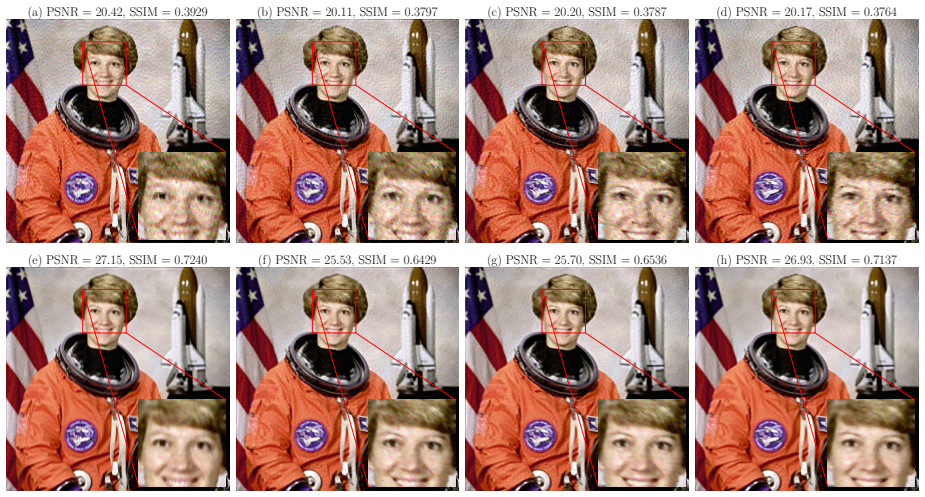
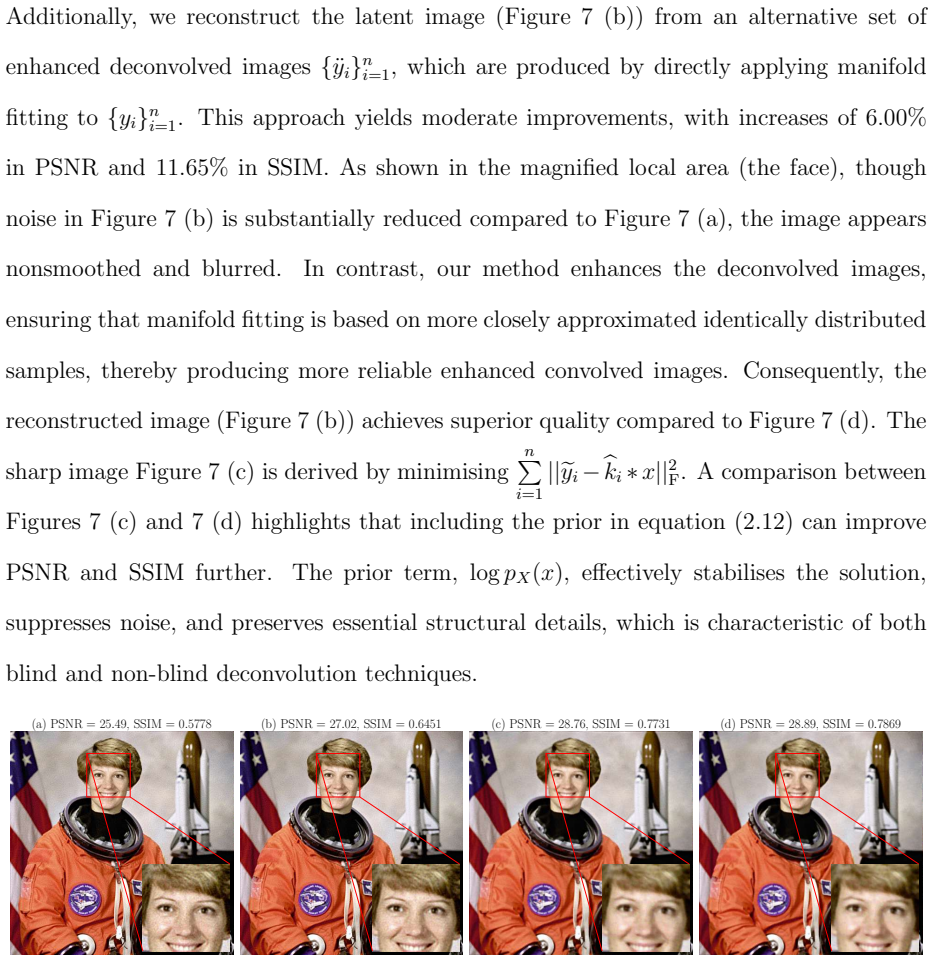
The central claim is that the intermediate deconvolved frames in multi-frame blind deconvolution are not just an algorithmic by-product but lie near a low-dimensional manifold that also contains the latent sharp image, so projecting those frames onto the manifold is a legitimate denoising step. The proposed IMR procedure implements this in three steps: first, a modified MAP blind deconvolution estimates per-frame blur kernels and produces deconvolved frames under a hyper-Laplacian gradient prior; second, each deconvolved frame is replaced by a weighted local average of its neighbours, with weights computed by a two-stage manifold-fitting scheme that estimates the contraction direction toward the manifold; third, the enhanced frames are reconvolved with their estimated kernels to form denoised blurred images, which are then fused by non-blind deconvolution under the same gradient prior. The paper reports that on its single simulated RSA dataset this pipeline outperforms the conventional method (PSNR 28.89 dB versus 25.49 dB; SSIM 0.7869 versus 0.5778) and also outperforms applying manifold fitting directly to the blurred frames, which the authors attribute to the deconvolved frames being more homogeneous and closer to the latent manifold.
Load-bearing premise
The load-bearing premise is that the deconvolved frames lie near a low-dimensional manifold that also contains the latent sharp image; if real RSA frames do not cluster this way, the manifold-fitting step will average away genuine detail instead of noise.
Editorial extensions
If this is right
- If the manifold assumption holds on real RSA data, the same pipeline could raise the resolution of small-satellite imagery without enlarging the optics, since it exploits angle-dependent information the rotating aperture already captures.
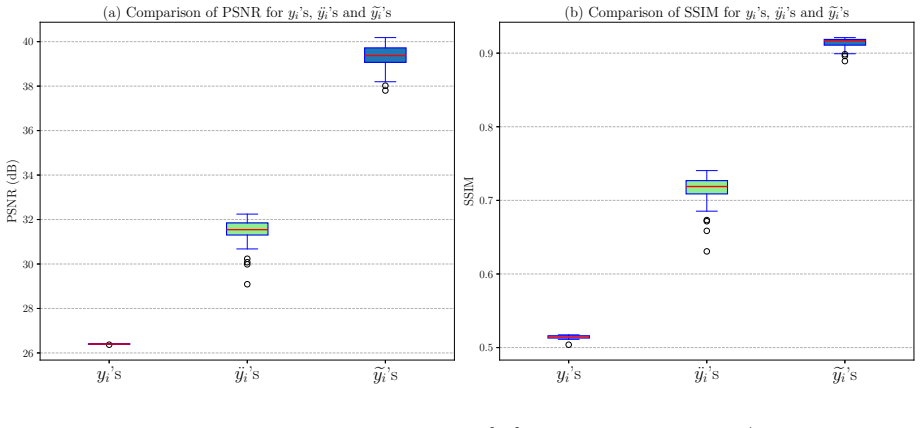
- Applying manifold fitting to deconvolved frames outperforms applying it to the raw blurred frames; the authors state this gap narrows as the number of frames grows, so the benefit is largest in the small-n regime typical of RSA capture.
- The final reconstruction with the gradient prior (equation 2.17) beats the prior-free weighted Fourier average (equation 2.8), showing the hyper-Laplacian prior contributes beyond the manifold denoising step.
- The framework is modular: the authors suggest deep-learning deblurring and image fusion could replace the algebraic deconvolution steps, making the manifold step a plug-in enhancement.
Reading between the lines
- An ablation test would isolate the active ingredient: replace the two-stage manifold weights with ordinary distance-weighted local averaging over the same r1/r2 neighbourhood; if PSNR/SSIM do not drop, the contraction-direction refinement in equations (2.10)-(2.15) is not what drives the gain.
- The validation is a single simulated RGB image with known kernels, and the reported PSNR fluctuates strongly when r1 is between 90 and 105; on real data, where kernel mismatch is unknown, the neighbourhood size may need re-tuning and the gains may not transfer directly.
- If real RSA frames contain rotation-dependent content beyond what one shared latent manifold can represent, such as specular reflections that move with angle, the MF-step could average away genuine detail rather than noise; a targeted simulation with angle-dependent scene content would test this.
- A second decomposition is possible: fix the kernels estimated by the conventional method and run only the non-blind deconvolution on the raw frames; comparing that output with the full IMR result would separate kernel-estimation gains from manifold-denoising gains.
Editorial analysis
A structured set of objections, weighed in public.
Referee Report
Summary. The paper proposes a multi-frame blind manifold deconvolution procedure (IMR) for rotating synthetic aperture (RSA) imaging. The method first deconvolves each acquired frame with estimated blur kernels (IX-step), then applies a manifold-fitting denoising step to the deconvolved frames (MF-step), and finally reconvolves the enhanced frames and performs a non-blind deconvolution to estimate the latent sharp image (RC-step). The optimization is implemented via half-quadratic splitting, an iteratively reweighted least-squares scheme, and a Lasso reformulation for kernel estimation solved with the Celer solver. The numerical section evaluates the method on a single simulated RGB astronaut image corrupted by 36 synthetic kernels and Gaussian noise, reporting PSNR/SSIM gains over a conventional multi-frame blind deconvolution baseline and over direct manifold fitting on the blurred frames. The paper concludes that the proposed method can outperform conventional multi-frame blind deconvolution in pixel-intensity estimation and structural-detail preservation.
Significance. If the empirical claims hold, the paper offers a principled way to combine blind deconvolution with manifold structure, and the algorithmic machinery in Appendices A-C is a useful contribution: the frequency-domain derivation of Proposition A.1 is careful, the reformulation of kernel estimation as a positive-definite Lasso problem is non-trivial, and the three-step IX-MF-RC pipeline is clearly described. The strength of the paper is its methodological framework rather than its current evidence base, because the empirical support is limited to one image, one noise level, and no real RSA data. The reported gains are plausible but not yet established at the level claimed in Section 4.
major comments (3)
- [§3.3, Fig. 8 and §3.2] The headline improvement (28.89 dB PSNR, 0.7869 SSIM, Figure 7(d)) is obtained with r1 = 108, and the same section identifies r1 = 110 as the optimal value by sweeping r1 on this single astronaut test image (Figure 8). The conventional baseline in Figure 7(a) is not given an equivalent parameter-selection procedure, and no held-out image is used to choose r1. The reported gain of +3.40 dB and +0.209 SSIM is therefore an in-sample, positively selected measure of the method's advantage, and the Section 4 claim that the method 'can outperform' conventional multi-frame blind deconvolution rests on this number. Please provide an out-of-sample evaluation, for example by selecting r1 on a separate validation image or by cross-validating over images, and report the resulting performance on held-out test images.
- [§3.1–§3.3, §4] The evaluation uses a single 512×512 RGB astronaut image, one noise level (σ = 0.05), and one noise realization, with no real RSA data. The conclusion in Section 4 generalizes to RSA imaging, but the evidence is too narrow to support that generalization. Additional experiments with multiple scenes, multiple noise levels, and multiple independent noise realizations (with mean and standard deviation of PSNR/SSIM reported) would make the empirical claim credible; alternatively, the conclusions should be explicitly limited to the single simulated example.
- [§2.2.2, MF-step] The load-bearing assumption of the MF-step is that the deconvolved frames {~x_i} lie near a low-dimensional manifold that also contains the latent sharp image, so that local weighted averaging (equations 2.10–2.15) moves each frame closer to the latent image. This assumption is not directly validated on real RSA data or even on a range of simulated scene contents. If the manifold structure is weak or if residual kernel errors create structured deviations rather than random noise, the MF-step could average away real detail. A concrete test would be to report, across several scenes, the change in per-frame PSNR/SSIM after manifold fitting relative to the ground truth, or to compare the method against a non-manifold denoising baseline with the same kernel estimates.
minor comments (6)
- [Throughout] The word 'angel' is repeatedly used where 'angle' is intended (for example, in Section 2 and in the Introduction: 'various angels').
- [Section 1, Contributions] The first contribution reads 'An muti-frame blind manifold convolution model is proposed'; it should be 'A multi-frame blind manifold deconvolution model'.
- [§3.2] The text says the deconvolved images {~x_i} are obtained 'via non-blind deconvolution (solving equation (2.16))', but equation (2.16) is the RC-step reconvolution; the correct reference is equation (2.9).
- [§3.3, Figure 7 discussion] The sentence 'Consequently, the reconstructed image (Figure 7 (b)) achieves superior quality compared to Figure 7 (d)' contradicts the reported metrics: Figure 7(b) has PSNR 27.02 and SSIM 0.6451, while Figure 7(d) has PSNR 28.89 and SSIM 0.7869. The comparison should be between Figure 7(b) and Figure 7(a), or the sentence should be corrected.
- [Figure 2 caption] The caption says 'First row: 12 estimated blur kernels', but the experiment uses 36 kernels; please clarify that only a representative subset of 12 is displayed.
- [Equations (2.8) and (2.16)] The symbol ~y_i is defined in two different places: in Section 2.1 as a denoised convolved image through F(ˆx*_i)⊙F(~k_i)=F(~y_i), and in Section 2.2.3 as ~y_i = ˆk_i ∗ ˆx*_i. These definitions are consistent only in the noiseless case; the notation should be unified or the distinction made explicit.
Circularity Check
No circular derivation: the IMR procedure is a genuine algorithmic composition, and the only concern (test-image hyperparameter tuning) is a statistical validity issue, not circular reasoning.
full rationale
I walked the paper's derivation chain and found no step that assumes its own conclusion. The blind deconvolution component (XK-procedure) follows the standard alternating MAP framework, and the IX-step deconvolves each frame using kernels estimated by that procedure. The MF-step applies the external manifold-fitting algorithm of Yao et al. (2023) to the deconvolved frames; this is an imported modeling assumption, not a self-citation or a disguised version of the target result. The RC-step reintroduces convolution via equation (2.16), モÂÅ¡~y_i = Â¥k_i * Â¥x*_i, and then solves a fresh non-blind deconvolution problem (2.17). This is a legitimate regularized averaging/fusion of the enhanced frames: the objective uses the same estimated kernels but does not encode the ground-truth image; it only measures fidelity to the reconvolved enhanced frames plus a hyper-Laplacian prior. Proposition A.1 is a standard DFT/Parseval identity, not a circular reduction. There is no load-bearing self-citation, no imported uniqueness theorem, and no ansatz smuggled in by citation. The only substantive concern is in Section 3.3, where r1 is swept on the single astronaut test image and the reported PSNR/SSIM improvement uses a radius from that same sweep (the text says PSNR 'peaking at r1 = 110' and the final reconstruction uses r1 = 108). This is in-sample hyperparameter selection and inflates the reported gain, but it is an evaluation-bias problem, not circularity: no equation or fitted parameter is being renamed as a prediction, and the algorithm's output is not defined in terms of the evaluation metric. Under the hard rule that circularity must be exhibited by a specific reduction, the correct finding is no significant circularity.
Assumptions & free parameters
free parameters (5)
- lambda_1 (regularization weight) =
667 for iterative kernel-image estimation; 2000 for per-frame and final deconvolution
- mu (kernel sparsity weight) =
0.04
- alpha (hyper-Laplacian exponent) =
0.80
- r1 (manifold neighborhood radius) =
108
- r2 (manifold contraction radius) =
10 times r1
assumptions (6)
- domain assumption Manifold hypothesis: natural images, and deconvolved RSA frames, lie near a low-dimensional manifold in the ambient pixel space.
- domain assumption Imaging model Yi = Ki * X + Ni with i.i.d. Gaussian noise, kernels on the probability simplex, and X independent of Ki.
- domain assumption Periodic (circular) convolution with padded kernels accurately represents the RSA blur.
- domain assumption Natural image gradients follow a hyper-Laplacian distribution with alpha in [0.5, 0.8].
- standard math Half-quadratic splitting solutions converge to the original objective as beta tends to infinity.
- standard math Convolution theorem and Parseval equality for the 2D discrete Fourier transform.
Cite this review
Pith. "Pith review of Multi-Frame Blind Manifold Deconvolution for Rotating Synthetic Aperture Imaging." pith.science (2026). https://pith.science/paper/ORJGHGZA
@misc{pith2026250119386,
  author       = {Pith},
  title        = {Pith review of: Multi-Frame Blind Manifold Deconvolution for Rotating Synthetic Aperture Imaging},
  year         = {2026},
  howpublished = {\url{https://pith.science/paper/ORJGHGZA}},
  note         = {Machine review of arXiv:2501.19386}
}
read the original abstract
Rotating synthetic aperture (RSA) imaging system captures images of the target scene at different rotation angles by rotating a rectangular aperture. Deblurring acquired RSA images plays a critical role in reconstructing a latent sharp image underlying the scene. In the past decade, the emergence of blind convolution technology has revolutionised this field by its ability to model complex features from acquired images. Most of the existing methods attempt to solve the above ill-posed inverse problem through maximising a posterior. Despite this progress, researchers have paid limited attention to exploring low-dimensional manifold structures of the latent image within a high-dimensional ambient-space. Here, we propose a novel method to process RSA images using manifold fitting and penalisation in the content of multi-frame blind convolution. We develop fast algorithms for implementing the proposed procedure. Simulation studies demonstrate that manifold-based deconvolution can outperform conventional deconvolution algorithms in the sense that it can generate a sharper estimate of the latent image in terms of estimating pixel intensities and preserving structural details.
Figures


Figures from the paper (6 more)




Reference graph
Works this paper leans on
-
[1]
Fan, J. (1991). On the optimal rates of convergence for nonp arametric deconvo- lution problems. Ann. Stat. , 19, 1257–1272. 32
work page 1991
-
[2]
Levin, A., Weiss, Y., Durand, F. and Freeman, W. T. (2009). Unde rstanding and evaluating blind deconvolution algorithms. IEEE Trans. Pattern Analysis and Machine Intelligence , 33, 1964-1971
work page 2009
-
[3]
Full aperture ima ge synthesis using rotating strip aperture image measurements US Patent 5,243,351
Rafanelli, Gerard L and Rehfield, Mark J (1993). Full aperture ima ge synthesis using rotating strip aperture image measurements US Patent 5,243,351
work page 1993
-
[4]
Fast image deconvolution using hyper- Laplacian priors
Krishnan, Dilip and Fergus, Rob (2009). Fast image deconvolution using hyper- Laplacian priors. Advances in neural information processing systems , 22, 1033– 1041
work page 2009
-
[5]
Sun, Yu and Zhi, Xiyang and Zhang, Lei and Jiang, Shikai and Shi, T ianjun and Wang, Nan and Gong, Jinnan (2023). Characterization and exp erimental verification of the rotating synthetic aperture optical imaging sys tem. Scientific Reports, 13, 17015
work page 2023
-
[6]
Osher, Stanley and Shi, Zuoqiang and Zhu, Wei (2017). Low dimen sional mani- fold model for image processing, SIAM Journal on Imaging Sciences , 10, 1669– 1690
work page 2017
-
[7]
Weinberger, Kilian Q and Saul, Lawrence K (2006). Unsupervised le arning of image manifolds by semidefinite programming, International journal of computer vision, 70, 77–90
work page 2006
-
[8]
Manifold Fitting, arXiv preprint arXiv:2304.07680
Yao, Zhigang and Su, Jiaji and Li, Bingjie (2023). Manifold Fitting, arXiv preprint arXiv:2304.07680
arXiv 2023
Show all 54 references
-
[9]
Bayesian denoising of visual images in the wavelet domain, at Lecture Notes in Statistics , Springer, pp.291-308
Simoncelli, Eero P (1999). Bayesian denoising of visual images in the wavelet domain, at Lecture Notes in Statistics , Springer, pp.291-308. 33
1999
-
[10]
and Li, Q
Zhou, H., Chen, Y., Feng, H., Lv, G., Xu, Z. and Li, Q. (2021). Rot ated rect- angular aperture imaging through multi-frame blind deconvolution wit h Hyper- Laplacian priors, Optics Express , 29, 12145–12159
2021
-
[11]
Adam: A method for sto chastic optimization, arXiv preprint arXiv:1412.6980
Kingma, Diederik P and Ba, Jimmy (2014). Adam: A method for sto chastic optimization, arXiv preprint arXiv:1412.6980
2014 arXiv
-
[12]
and Zhang, L
Zuo, W., Ren, D., Zhang, D., Gu, S. and Zhang, L. (2016). Learn ing iteration- wise generalized shrinkage–thresholding operators for blind decon volution, IEEE Transactions on Image Processing , 25, 1751–1764
2016
-
[13]
and Ramaswamy, N
Satish, P., Srikantaswamy, M. and Ramaswamy, N. (2020). A Co mprehensive Review of Blind Deconvolution Techniques for Image Deblurring, Traitement du Signal, 37, 527-539
2020
-
[14]
and Narayanan, H
Fefferman, C., Mitter, S. and Narayanan, H. (2016). Testing t he manifold hy- pothesis, Journal of the American Mathematical Society , 29, 983–1049,
2016
-
[15]
and Medioni, G
Gong, D., Sha, F. and Medioni, G. (2010). Locally linear denoising o n image manifolds, Proceedings of the Thirteenth International Conference on Artificial Intelligence and Statistics , pp. 265–272,
2010
-
[16]
and Li, Qi (2012)
Dong, W., Feng, H., Xu, Z. and Li, Qi (2012). Multi-frame blind dec onvolution using sparse priors, Optics Communications , 285, 2276–2288,
2012
-
[17]
and Velmurugan, R
Rameshan, R., Chaudhuri, S. and Velmurugan, R. (2012). Joint MAP estimation for blind deconvolution: When does it work?, Proceedings of the Eighth Indian Conference on Computer Vision, Graphics and Image Processi ng, pp. 1–7
2012
-
[18]
and MacKay, D
Miskin, J. and MacKay, D. (2000). Ensemble learning for blind imag e separation and deconvolution, Advances in independent component analysis , pp. 123–141, Springer. 34
2000
-
[19]
and Lee, S
Cho, S. and Lee, S. (2009). Fast motion deblurring, ACM SIGGRAPH Asia 2009 papers, pp. 1–8,
2009
-
[20]
and Zhang, D
Zuo, W., Meng, D., Zhang, L., Feng, X. and Zhang, D. (2013). A g eneralized iterated shrinkage algorithm for non-convex sparse coding, Proceedings of the IEEE international conference on computer vision , pp. 217–224
2013
-
[21]
and Gong, J
Zhi, X., Jiang, S., Zhang, L., Wang, D., Hu, J. and Gong, J. (2021) . Imaging mechanism and degradation characteristic analysis of novel rotat ing synthetic aperture system, Optics and Lasers in Engineering , 139, 106500
2021
-
[22]
and Gillett, P
Stepp, L., Daggert, L. and Gillett, P. (2003). Estimating the co sts of extremely large telescopes, Future giant telescopes, 4840, 309–321
2003
-
[23]
and Gong, J
Zhi, X., Jiang, S., Zhang, L., Hu, J., Yu, L., Song, X. and Gong, J. ( 2021). Multi- frame image restoration method for novel rotating synthetic ape rture imaging system, Results in Physics , 23, 103991
2021
-
[24]
and Zhang, W
Sun, Y., Zhi, X., Jiang, S., Fan, G., Yan, X. and Zhang, W. (2024). Image fusion for the novelty rotating synthetic aperture system based on visio n transformer, Information Fusion, 104, 102163
2024
-
[25]
A full-aperture image synthes is method for the rotating rectangular aperture system using fourier spec trum restoration, Photonics, 8, 522
Lv, Guomian and Xu, Hao and Feng, Huajun and Xu, Zhihai and Zh ou, Hao and Li, Qi and Chen, Yueting (2021). A full-aperture image synthes is method for the rotating rectangular aperture system using fourier spec trum restoration, Photonics, 8, 522
2021
-
[26]
Monreal, Benjamin and Rodriguez, Christian and Carney, Ama an d Halliday, Robert and Wang, Mingyuan (2018) Wide Aperture Exoplanet Telesc ope: a low-cost flat configuration for a 100+ meter ground based telesco pe, Journal of Astronomical Telescopes, Instruments, and Systems , 4...
2018
-
[27]
Testing a modified PCA-based sharpening approach for ima ge fusion, Remote Sensing , 8, 794
Jel´ enek, Jan and Kopaˇ ckov´ a, Veronika and Kouck´ a, Lucie and Miˇ surec, Jan (2016). Testing a modified PCA-based sharpening approach for ima ge fusion, Remote Sensing , 8, 794
2016
-
[28]
Extended dept h-of-field imag- ing employing integrated binary phase pupil mask and principal compo nent anal- ysis image fusion, Optics Express , 28, 23862–23873
Milgrom, Benjamin and Avrahamy, Roy and David, Tal and Caspi, A vi and Golovachev, Yosef and Engelberg, Shlomo (2020). Extended dept h-of-field imag- ing employing integrated binary phase pupil mask and principal compo nent anal- ysis image fusion, Optics Express , 28, 23862–23873
2020
-
[29]
Principal components colour display of ERTS imagery, NASA
Taylor, MM (1974). Principal components colour display of ERTS imagery, NASA. Goddard Space Flight Center 3d ERTS-1 Symp., Vol. 1, Se ct. B, PAPER- I12
1974
-
[30]
Extracting spectral con trast in Landsat Thematic Mapper image data using selective principal component ana lysis, Pho- togramm
Kwarteng, P and Chavez, A (1989). Extracting spectral con trast in Landsat Thematic Mapper image data using selective principal component ana lysis, Pho- togramm. Eng. Remote Sens , 55, 339–348
1989
-
[31]
Remote sensing image fusion via wavelet transform and spa rse represen- tation, ISPRS journal of photogrammetry and remote sensing , 104, 158–173
Cheng, Jian and Liu, Haijun and Liu, Ting and Wang, Feng and Li, Ho ngsheng (2015). Remote sensing image fusion via wavelet transform and spa rse represen- tation, ISPRS journal of photogrammetry and remote sensing , 104, 158–173
2015
-
[32]
Multisens or image fusion using the wavelet transform, Graphical models and image processing , 57, 235–245
Li, Hui and Manjunath, BS and Mitra, Sanjit K (1995). Multisens or image fusion using the wavelet transform, Graphical models and image processing , 57, 235–245
1995
-
[33]
Wavele t based image fusion techniques—An introduction, review and comparison, ISPRS Journal of photogrammetry and Remote Sensing , 62, 249–263
Amolins, Krista and Zhang, Yun and Dare, Peter (2007). Wavele t based image fusion techniques—An introduction, review and comparison, ISPRS Journal of photogrammetry and Remote Sensing , 62, 249–263. 36
2007
-
[34]
Proper image subtraction—optimal transient detection, photometry, and hyp othesis testing, The Astrophysical Journal , 830, 27
Zackay, Barak and Ofek, Eran O and Gal-Yam, Avishay (2016). Proper image subtraction—optimal transient detection, photometry, and hyp othesis testing, The Astrophysical Journal , 830, 27
2016
-
[35]
Stochastic deconvolution, Proceedings of the IEEE Conference on Computer Vision and Pattern Recognition , pp
Gregson, James and Heide, Felix and Hullin, Matthias B and Rouf, M ushfiqur and Heidrich, Wolfgang (2013). Stochastic deconvolution, Proceedings of the IEEE Conference on Computer Vision and Pattern Recognition , pp. 1043–1050
2013
-
[36]
Vari- ational Bayesian blind deconvolution using a total variation prior, IEEE Trans- actions on Image Processing , 18, 12–26
Babacan, S Derin and Molina, Rafael and Katsaggelos, Aggelos K (2008). Vari- ational Bayesian blind deconvolution using a total variation prior, IEEE Trans- actions on Image Processing , 18, 12–26
2008
-
[37]
Revisiting Bayesian blind d econvolu- tion, Journal of Machine Learning Research , 15, 3775–3814
Wipf, David and Zhang, Haichao (2014). Revisiting Bayesian blind d econvolu- tion, Journal of Machine Learning Research , 15, 3775–3814
2014
-
[38]
A piecewise local regularized Richardson–Lucy algorithm for remote sensing ima ge deconvo- lution, Optics & Laser Technology , 43, 926–933
Dong, Wende and Feng, Huajun and Xu, Zhihai and Li, Qi (2011) . A piecewise local regularized Richardson–Lucy algorithm for remote sensing ima ge deconvo- lution, Optics & Laser Technology , 43, 926–933
2011
-
[39]
Schneider, Dorian and van Ekeris, Tilo and zur Jacobsmuehlen, J oschka and Gross, Sebastian (2013). On benchmarking non-blind deconvolutio n algorithms: a sample driven comparison of image de-blurring methods for automa ted vi- sual inspection systems, IEEE International Instr...
2013
-
[40]
Kotera, Jan and ˇSroubek, Filip and Milanfar, Peyman (2013). Blind decon- volution using alternating maximum a posteriori estimation with heavy -tailed priors, Computer Analysis of Images and Patterns: 15th Internation al Confer- ence, CAIP 2013, York, UK, August 27-29, 2013, ...
2013
-
[41]
Robust multichanne l blind decon- volution via fast alternating minimization, IEEE Transactions on Image pro- cessing, 21, 1687–1700
Sroubek, Filip and Milanfar, Peyman (2011). Robust multichanne l blind decon- volution via fast alternating minimization, IEEE Transactions on Image pro- cessing, 21, 1687–1700
2011
-
[42]
l 0- regularized intensity and gradient prior for deblurring text images a nd beyond, IEEE transactions on pattern analysis and machine intellig ence, 39, 342–355
Pan, Jinshan and Hu, Zhe and Su, Zhixun and Yang, Ming-Hsuan ( 2016). l 0- regularized intensity and gradient prior for deblurring text images a nd beyond, IEEE transactions on pattern analysis and machine intellig ence, 39, 342–355
2016
-
[43]
Blind d econvolution using a normalized sparsity measure, CVPR 2011 , 233–240
Krishnan, Dilip and Tay, Terence and Fergus, Rob (2011). Blind d econvolution using a normalized sparsity measure, CVPR 2011 , 233–240
2011
-
[44]
Weighted nuclear norm minimization with application to image denoising, Pro- ceedings of the IEEE conference on computer vision and patte rn recognition, pp
Gu, Shuhang and Zhang, Lei and Zuo, Wangmeng and Feng, Xian gchu (2014). Weighted nuclear norm minimization with application to image denoising, Pro- ceedings of the IEEE conference on computer vision and patte rn recognition, pp. 2862–2869
2014
-
[45]
Single image ha ze removal using dark channel prior, IEEE transactions on pattern analysis and machine intelligence, 33, 2341–2353
He, Kaiming and Sun, Jian and Tang, Xiaoou (2010). Single image ha ze removal using dark channel prior, IEEE transactions on pattern analysis and machine intelligence, 33, 2341–2353
2010
-
[46]
Image deblurring via enha nced low- rank prior, IEEE Transactions on Image Processing , 25, 3426–3437
Ren, Wenqi and Cao, Xiaochun and Pan, Jinshan and Guo, Xiaojie and Zuo, Wangmeng and Yang, Ming-Hsuan (2016). Image deblurring via enha nced low- rank prior, IEEE Transactions on Image Processing , 25, 3426–3437
2016
-
[47]
Blind image de blurring using spectral properties of convolution operators, IEEE Transactions on image processing, 23, 5047–5056
Liu, Guangcan and Chang, Shiyu and Ma, Yi (2014). Blind image de blurring using spectral properties of convolution operators, IEEE Transactions on image processing, 23, 5047–5056
2014
-
[48]
Total variation blin d deconvolu- tion, IEEE transactions on Image Processing , 7, 370–375
Chan, Tony F and Wong, Chiu-Kwong (1998). Total variation blin d deconvolu- tion, IEEE transactions on Image Processing , 7, 370–375. 38
1998
-
[49]
Removing camer a shake via weighted fourier burst accumulation, IEEE Transactions on Image Processing , 24, 3293–3307
Delbracio, Mauricio and Sapiro, Guillermo (2015). Removing camer a shake via weighted fourier burst accumulation, IEEE Transactions on Image Processing , 24, 3293–3307
2015
-
[50]
Neural blind deconvolution using deep priors, Proceedings of the IEEE/CVF conference on computer vision and pattern re cognition, pp
Ren, Dongwei and Zhang, Kai and Wang, Qilong and Hu, Qinghua a nd Zuo, Wangmeng (2020). Neural blind deconvolution using deep priors, Proceedings of the IEEE/CVF conference on computer vision and pattern re cognition, pp. 3341–3350
2020
-
[51]
1954–1958
Kotera, Jan and ˇSroubek, Filip and ˇSm´ιdl, V´ aclav (2021).Improving neural blind deconvolution, IEEE International Conference on Image Processing (ICIP) , pp. 1954–1958
2021
-
[52]
Celer: a Fast Solver for the Lasso with Dual Extrapolation, Proceedings of the 35th International Conference on Machine Learning , 80, 3321–3330
Massias, Mathurin and Gramfort, Alexandre and Salmon, Josep h (2018). Celer: a Fast Solver for the Lasso with Dual Extrapolation, Proceedings of the 35th International Conference on Machine Learning , 80, 3321–3330
2018
-
[53]
Dual Extrapolation for Sparse GLMs , Journal of Machine Learn- ing Research, 21, 1-33
Mathurin Massias and Samuel Vaiter and Alexandre Gramfort an d Joseph Salmon (2020). Dual Extrapolation for Sparse GLMs , Journal of Machine Learn- ing Research, 21, 1-33
2020
-
[54]
Proje ction onto the probability simplex: An efficient algorithm with a simple proof, and an app lica- tion, arXiv preprint arXiv:1309.1541
Wang, Weiran and Carreira-Perpin´ an, Miguel A (2013). Proje ction onto the probability simplex: An efficient algorithm with a simple proof, and an app lica- tion, arXiv preprint arXiv:1309.1541 . 39
2013 arXiv
Reviewed August 9, 2026 · model on record in the stance chip above.
Discussion (0). Continue with ORCID to comment.