REVIEW 3 major objections 5 minor 46 references
Enhancing Highway Safety: Accident Detection on the A9 Test Stretch Using Roadside Sensors
T0 review · 3 major / 5 minor · reviewed 2026-08-09 · deepseek-v4-flash
Pith's one-line read A hybrid rule-based and learning-based pipeline detects highway accidents in real time from roadside sensors, validated on a new 48,144-frame real-world dataset.
desk verdict Valuable real-world accident dataset, but the detection evaluation overclaims reliability because the two-stage cascade's recall is capped by the rule stage. read the letter →
The pith
A machine-rendered reading of the paper's core claim, the machinery that carries it, and where it could break.
The reading
What carries the argument
The load-bearing mechanism is a two-stage gate. The first stage is a set of six simultaneous kinematic rules computed from fused roadside perception, including speed thresholds, velocity comparisons among nearby vehicles, distance-to-lead thresholds, and a time-to-collision threshold; only vehicles that satisfy all six are passed onward. The second stage is a YOLOv8 object detector acting as a verifier, with a confidence threshold of 0.8 and a requirement that the accident be detected in at least three consecutive frames, with multi-camera aggregation to reduce occlusion. The dataset annotations, produced with the 3D BAT and CVAT tools, are what make the learned verifier possible; the paper treats the 48,144-frame release as an enabling resource for the whole approach.
What would settle it
Run the full pipeline on a held-out set of accidents with lateral impacts, low-speed collisions, or non-lead-vehicle crashes, where the six rule conditions cannot all be satisfied. If end-to-end recall drops to zero or near zero on those frames, the gating assumption is falsified; the paper's own rule-based recall of 0.50 on the test set already suggests roughly half of labeled accidents will be missed.
Extended reading notes
Core claim
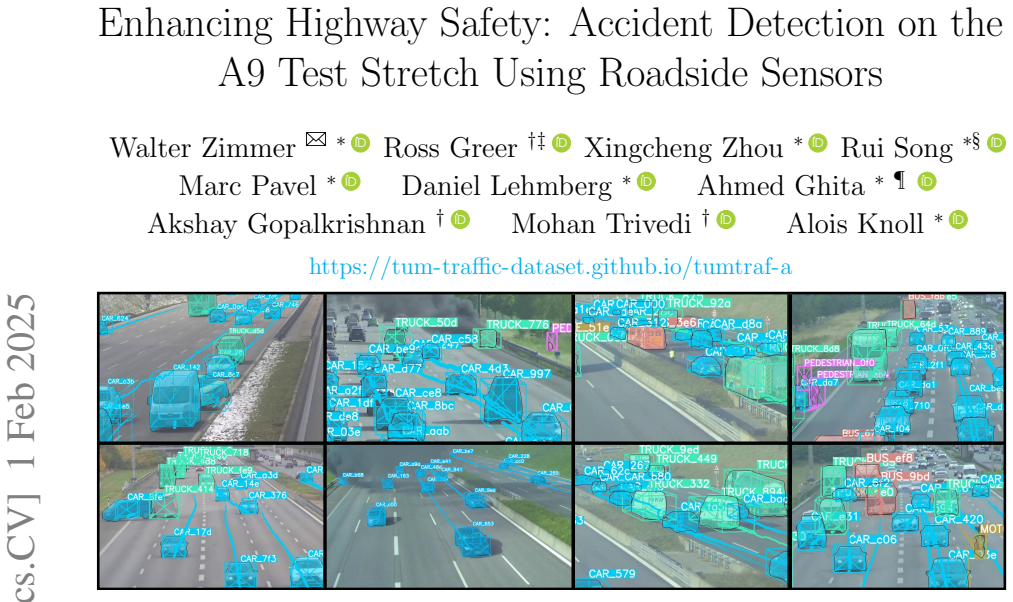
The paper's central claim is that accident detection on highways can be made reliable and real-time by combining an explicit trajectory-rule check with a learned visual verifier, rather than relying on either alone. The rule-based stage classifies a vehicle as accident-involved only when six conditions hold at once: a minimum speed threshold, velocity comparisons with the lead vehicle and nearby vehicles, distance-to-lead thresholds, and a time-to-collision threshold. When all six are met, a YOLOv8 detector trained on the custom dataset checks the image and confirms the accident if it appears for at least three consecutive frames, aggregating detections across cameras. In evaluation, the rule-based approach scored precision 1.0 and recall 0.5, while the learning-based verifier scored precision 0.8 and recall 1.0, with runtimes of 10.41 ms and 16.13 ms respectively. The dataset itself is a stated contribution: 48,144 labeled frames, 294,924 2D boxes, 93,012 3D boxes, track IDs, and ten object classes, released in OpenLABEL format for perception, tracking, fusion, and trajectory prediction research.
Load-bearing premise
The framework assumes every accident worth flagging produces a kinematic signature that satisfies all six rule-based conditions at the same time; any crash that does not meet all six thresholds is never passed to the learned verifier.
Editorial extensions
If this is right
- If the framework is correct, roadside infrastructure can automatically alert emergency services within tens of milliseconds of a crash, cutting response time.
- The released dataset gives the research community a real-world alternative to synthetic accident benchmarks like DeepAccident, supporting perception, tracking, and trajectory prediction work.
- The precision/recall split between stages suggests a division of labour: rule-based checks act as a high-precision filter, while the learned model supplies high recall.
- Multi-camera aggregation makes the system more robust to occlusion, a known weakness of single-view accident detection.
- Deployment on 12,290 recorded segments covering 831,969 unique vehicles found one real accident, demonstrating the pipeline can operate at scale on long-running roadside data.
Reading between the lines
- Inference: because the rule-based stage's recall is only 0.50 on the test set and the verifier never examines frames the rules reject, the end-to-end system likely inherits that ceiling for crashes that do not fit all six trajectory conditions, such as lateral impacts or low-speed collisions.
- Inference: the precision and recall numbers are measured on a 419-frame test split, not on the 12,290 deployment segments; a live deployment with rare events could show different operating characteristics.
- Inference: relaxing the rule conditions or adding a learned anomaly pre-filter would extend the framework from post-crash detection toward near-miss and pre-crash risk warning.
- Inference: with multi-camera, multi-modal annotations, the dataset could also serve as a cooperative-perception benchmark for fusion and digital-twin research, independent of accident detection.
Editorial analysis
A structured set of objections, weighed in public.
Referee Report
Summary. The manuscript proposes a two-stage highway accident detection framework for roadside infrastructure on the A9 test stretch. The first stage applies a set of six hand-set rule-based kinematic conditions to vehicle trajectories, and the second stage uses a YOLOv8 model to verify candidate frames flagged by the rules. The paper also introduces a real-world dataset of 48,144 labeled camera and LiDAR frames containing 294,924 2D boxes and 93,012 3D boxes across ten object classes, released in OpenLABEL format. On the custom test set the authors report rule-based precision 1.000 / recall 0.500 and learning-based precision 0.800 / recall 1.000, with runtimes of 10.41 ms and 16.13 ms per frame respectively. A 128-day deployment recorded one detected accident among 3,748 standing vehicles, 138 shoulder vehicles, and 120 breakdown events. The paper's stated contributions include the framework, the dataset, and the claim that experiments demonstrate reliability and top performance.
Significance. If the claims were fully supported, the dataset alone would be a valuable community asset: real-world, roadside, multi-modal highway accident sequences with dense 2D/3D annotations are rare, and releasing them in OpenLABEL with track IDs is a concrete contribution. The hybrid rule-and-learning architecture is also a sensible design for roadside deployment, and the reported per-component runtimes indicate real-time potential. However, the central reliability claim is not established by the evidence as presented: the cascade architecture's recall is bounded by the rule-based stage, the reported metrics are component-wise rather than end-to-end, and the long-term evaluation rests on a single accident. The paper is therefore better characterized as a dataset paper with a preliminary detection framework than as a validated accident detection system. With a revised evaluation and appropriately scoped claims, the work has clear value to the intelligent transportation and autonomous driving communities.
major comments (3)
- [3.2, Table 2] The reported evaluation does not support the integrated-system reliability claim. Section 3.2 states that the learning-based model verifies events only after the rule-based method flags them, yet Table 2 reports rule-based and learning-based metrics that appear to be computed separately. Because the rule-based stage has recall 0.500 on the test set, the two-stage cascade's recall is bounded by that value regardless of the learning stage's standalone recall of 1.0: half of the true accident frames are never passed to the YOLOv8 verifier. The manuscript does not report any integrated frame-level or event-level precision/recall for the cascade, nor does it state whether the learning-based metrics in Table 2 were computed on the full 419-frame test set or only on rule-flagged candidates. Without a cascade-level evaluation, the Introduction's claim that the experiments demonstrate reliability and top performance, and the Conclusion's analogous statement, are unsupported. Please provide end-to-end metrics or substantially qualify the claims.
- [4.2, 5] The long-term deployment evidence is too thin to support the reliability conclusion. Over 128 days the framework detected exactly one accident, and the paper provides no ground-truth accident inventory for that period, so neither the false-negative rate nor the operational value of the 3,748 standing-vehicle, 138 shoulder, and 120 breakdown detections can be assessed. A single detected accident cannot establish that the system reliably reduces emergency response time; this material should be presented as a case study or deployment illustration, not as validation of reliability.
- [3.1, 6] The rule-based stage applies a conjunction of six hand-set conditions, Eqs. (1)-(6), and the manuscript itself acknowledges in Section 6 that the approach does not yet detect lateral collisions or more complex accident scenarios. Since the rule stage determines the recall ceiling of the entire pipeline, this coverage restriction is load-bearing for the reliability claim. The paper should state this limitation prominently in the method and conclusion, and ideally report the distribution of accident types in the dataset together with rule-stage recall per type. Without that, the general framing as an 'accident detection framework' overstates the current scope.
minor comments (5)
- [3.1, Eq. (5)] The threshold in Eq. (5) is dimensionally unclear: a velocity difference in km/h is divided by 30 and squared, then compared to a distance, without specifying units or providing a derivation. Please define all quantities and their units explicitly.
- [3.1, Eq. (3)] The indexing condition in Eq. (3), 'velocity_i >= velocity_j for all i < j <= N', is ambiguous: it implies a total ordering among N vehicles but does not clarify how the leader is identified or how ties are handled. Please rewrite the condition in terms of explicit leader-follower relationships.
- [Table 2] Please clarify what precision and recall mean for the learning-based approach: per-frame accident classification, per-object accident bounding-box detection, or per-event detection. The definition matters for interpreting the AP value and the role of the 0.8 confidence threshold.
- [4.2] The runtime statement for the 15-minute rosbag file, with 22,500 ROS messages recorded at 25 FPS taking 234.25 seconds to process, should be reconciled with the 10 Hz frame rate used elsewhere in the paper; please specify which stream is processed and how the efficient runtime is achieved.
- [Author block, 7] The project website is mentioned in the author block but the reference list only links to the development kit repository; please provide a direct, stable link to the released accident dataset and detection framework.
Circularity Check
No circularity: the dataset and detection components are evaluated on an independent test split, and no reported metric is defined as a fitted input.
full rationale
The paper's derivation chain is not circular. The proposed framework combines a rule-based detector (Eqs. 1-6) with a YOLOv8 verifier trained on a custom dataset split into training (80%), validation (10%), and test (10%) sets. The reported metrics in Table 2 are computed on the held-out test split, and the rule-based recall of 0.50 is an empirical outcome rather than a consequence of how the rules are defined. The six rule conditions are detection heuristics with stated thresholds; no reported quantity is algebraically identical to one of those thresholds or to a fitted parameter. The learning-based model is trained on labeled accident frames and evaluated on unseen test frames, which is standard supervised evaluation. Self-citations to prior TUMTraf datasets and tools (Refs. 38-42) document dataset lineage and development infrastructure; they are not load-bearing for the accuracy, precision, recall, or runtime claims. The limitation that the two-stage cascade's integrated recall is bounded by the rule-based recall (since YOLOv8 only verifies rule-flagged candidates) is a real evaluation-validity concern, but it is a correctness and reporting issue, not a circularity of definition or a fitted-input-renamed-as-prediction. No equation in the paper reduces to its own input, and no claim depends on an unverified self-citation chain. Therefore no circular step is identified.
Assumptions & free parameters
free parameters (6)
- speed threshold =
15 km/h
- distance threshold =
not specified
- TTC threshold =
not specified
- YOLO confidence threshold =
0.8
- consecutive frame count =
3
- image resolution =
1280 px
assumptions (4)
- domain assumption An accident event is characterized by the simultaneous satisfaction of six kinematic rules: speed >= 15 km/h, velocity vs lead, velocity ordering, distance vs threshold, TTC formula, TTC threshold.
- standard math The time-to-collision formula in Eq. 5 uses a simplified kinematic model: distance_lead = ((velocity_i - velocity_lead)/30)^2.
- domain assumption The learning-based verifier processes only frames already flagged by the rule-based stage.
- domain assumption The annotated accident events in the training and test splits are representative of the real-world accident distribution on the A9 stretch.
Cite this review
Pith. "Pith review of Enhancing Highway Safety: Accident Detection on the A9 Test Stretch Using Roadside Sensors." pith.science (2026). https://pith.science/paper/V4C5BV6F
@misc{pith2026250200402,
  author       = {Pith},
  title        = {Pith review of: Enhancing Highway Safety: Accident Detection on the A9 Test Stretch Using Roadside Sensors},
  year         = {2026},
  howpublished = {\url{https://pith.science/paper/V4C5BV6F}},
  note         = {Machine review of arXiv:2502.00402}
}
read the original abstract
Road traffic injuries are the leading cause of death for people aged 5-29, resulting in about 1.19 million deaths each year. To reduce these fatalities, it is essential to address human errors like speeding, drunk driving, and distractions. Additionally, faster accident detection and quicker medical response can help save lives. We propose an accident detection framework that combines a rule-based approach with a learning-based one. We introduce a dataset of real-world highway accidents featuring high-speed crash sequences. It includes 294,924 labeled 2D boxes, 93,012 labeled 3D boxes, and track IDs across 48,144 frames captured at 10 Hz using four roadside cameras and LiDAR sensors. The dataset covers ten object classes and is released in the OpenLABEL format. Our experiments and analysis demonstrate the reliability of our method.
Figures

Reference graph
Works this paper leans on
-
[1]
Planning with occluded traffic agents using bi-level variational occlusion models,
F. Christianos, P. Karkus, B. Ivanovic, S. V. Albrecht, and M. Pavone, “Planning with occluded traffic agents using bi-level variational occlusion models,” in 2023 IEEE International Conference on Robotics and Automation (ICRA), pp. 5558–5565, IEEE, 2023
work page 2023
-
[2]
Activeanno3d-an active learning framework for multi-modal 3d object detection,
A. Ghita, B. Antoniussen, W. Zimmer, R. Greer, C. Creß, A. Møgelmose, M. Trivedi, and A. C. Knoll, “Activeanno3d-an active learning framework for multi-modal 3d object detection,” in 35th IEEE Intelligent Vehicles Symposium (IV) 2024 , 2024
2024
-
[3]
N. Kulkarni, A. Rangesh, J. Buck, J. Feltracco, M. Trivedi, N. Deo, R. Greer, S. Sar- raf, and S. Sathyanarayana, “Create a large-scale video driving dataset with detailed attributes using amazon sagemaker ground truth,” 2021
work page 2021
-
[4]
T. Fingscheidt, H. Gottschalk, and S. Houben, Deep neural networks and data for au- tomated driving: Robustness, uncertainty quantification, and insights towards safety . Springer Nature, 2022
work page 2022
-
[5]
Ips300+: a challenging multi-modal data sets for intersection perception system,
H. Wang, X. Zhang, Z. Li, J. Li, K. Wang, Z. Lei, and R. Haibing, “Ips300+: a challenging multi-modal data sets for intersection perception system,” in 2022 International Conference on Robotics and Automation (ICRA), pp. 2539–2545, IEEE, 2022
work page 2022
-
[6]
R. Greer, B. Antoniussen, M. V. Andersen, A. Møgelmose, and M. M. Trivedi, “The why, when, and how to use active learning in large-data-driven 3d object detection for safe autonomous driving: An empirical exploration,” arXiv preprint arXiv:2401.16634, 2024
arXiv 2024
-
[7]
Graphrelate3d: Context-dependent 3d object detection with inter- object relationship graphs,
M. Liu, E. Yurtsever, M. Brede, J. Meng, W. Zimmer, X. Zhou, B. L. Zagar, Y. Cui, and A. Knoll, “Graphrelate3d: Context-dependent 3d object detection with inter- object relationship graphs,” arXiv preprint arXiv:2405.06782 , 2024
arXiv 2024
-
[8]
Roadsense3d: A framework for roadside monocular 3d object detection,
S. Carta, M. Castrill´ on-Santana, M. Marras, S. Mohamed, A. S. Podda, R. Saia, M. Sau, and W. Zimmer, “Roadsense3d: A framework for roadside monocular 3d object detection,” in Adjunct Proceedings of the 32nd ACM Conference on User Modeling, Adaptation and Personalization , pp. 452–459, 2024
work page 2024
Show all 46 references
-
[9]
Infradet3d: Multi-modal 3d object detection based on roadside infrastructure camera and lidar sensors,
W. Zimmer, J. Birkner, M. Brucker, H. T. Nguyen, S. Petrovski, B. Wang, and A. C. Knoll, “Infradet3d: Multi-modal 3d object detection based on roadside infrastructure camera and lidar sensors,” in 2023 IEEE Intelligent Vehicles Symposium (IV) , IEEE, 2023
2023
-
[10]
Real-time and robust 3d object detection with roadside lidars,
W. Zimmer, J. Wu, X. Zhou, and A. C. Knoll, “Real-time and robust 3d object detection with roadside lidars,” in Proc. of Int. Scientific Conf. on Mobility and Transport: Mobility Innovations for Growing Megacities, pp. 199–219, Springer, 2023
2023
-
[11]
A survey of robust 3d object detection methods in point clouds,
W. Zimmer, E. Ercelik, X. Zhou, X. J. D. Ortiz, and A. Knoll, “A survey of robust 3d object detection methods in point clouds,” arXiv preprint arXiv:2204.00106 , 2022
2022 arXiv
-
[12]
Real-time and robust 3d object detection within road-side lidars using domain adaptation,
W. Zimmer, M. Grabler, and A. Knoll, “Real-time and robust 3d object detection within road-side lidars using domain adaptation,” arXiv preprint arXiv:2204.00132 , 2022
2022 arXiv
-
[13]
Traffic light detection: A learning algorithm and evaluations on challenging dataset,
M. P. Philipsen, M. B. Jensen, A. Møgelmose, T. B. Moeslund, and M. M. Trivedi, “Traffic light detection: A learning algorithm and evaluations on challenging dataset,” in 2015 IEEE 18th International Conference on Intelligent Transportation Systems, pp. 2341–2345, IEEE, 2015
2015
-
[14]
Laneaf: Robust multi-lane detection with affinity fields,
H. Abualsaud, S. Liu, D. B. Lu, K. Situ, A. Rangesh, and M. M. Trivedi, “Laneaf: Robust multi-lane detection with affinity fields,” IEEE Robotics and Automation Letters, vol. 6, no. 4, pp. 7477–7484, 2021
2021
-
[15]
PointCompress3d – a point cloud compression framework for roadside LiDARs in intelligent transportation systems
W. Zimmer, R. Pranamulia, X. Zhou, M. Liu, and A. C. Knoll, “PointCompress3d – a point cloud compression framework for roadside LiDARs in intelligent transportation systems.”
-
[16]
GraphRelate3d: Context-dependent 3d object detection with inter- object relationship graphs
M. Liu, E. Yurtsever, M. Brede, J. Meng, W. Zimmer, X. Zhou, B. L. Zagar, Y. Cui, and A. Knoll, “GraphRelate3d: Context-dependent 3d object detection with inter- object relationship graphs.”
-
[17]
Transfer learning from simulated to real scenes for monocular 3d object detection
S. Mohamed, W. Zimmer, R. Greer, A. A. Ghita, M. Castrillon-Santana, M. Trivedi, A. Knoll, S. M. Carta, and M. Marras, “Transfer learning from simulated to real scenes for monocular 3d object detection.”
-
[18]
Patterns of vehicle lights: Addressing complexities of camera-based vehicle light datasets and metrics,
R. Greer, A. Gopalkrishnan, M. Keskar, and M. M. Trivedi, “Patterns of vehicle lights: Addressing complexities of camera-based vehicle light datasets and metrics,” Pattern Recognition Letters, vol. 178, pp. 209–215, 2024
2024
-
[19]
Collaborative semantic occupancy prediction with hybrid feature fusion in connected automated vehicles,
R. Song, C. Liang, H. Cao, Z. Yan, W. Zimmer, M. Gross, A. Festag, and A. Knoll, “Collaborative semantic occupancy prediction with hybrid feature fusion in connected automated vehicles,” in 2024 IEEE/CVF Conference on Computer Vision and Pat- tern Recognition (CVPR), pp. 17996...
2024
-
[20]
A digital twin for teleoperation of vehicles in urban environments,
P. Kremer, N. Nourani-Vatani, and S. Park, “A digital twin for teleoperation of vehicles in urban environments,” in 2023 IEEE International Conference on Robotics and Automation (ICRA) , pp. 12521–12527, IEEE, 2023
2023
-
[21]
Safe control transi- tions: Machine vision based observable readiness index and data-driven takeover time prediction,
R. Greer, N. Deo, A. Rangesh, M. Trivedi, and P. Gunaratne, “Safe control transi- tions: Machine vision based observable readiness index and data-driven takeover time prediction,” in 27th International Technical Conference on the Enhanced Safety of Vehicles (ESV) National High...
2023
-
[22]
TAD: A large-scale benchmark for traffic accidents detection from video surveillance
Y. Xu, C. Huang, Y. Nan, and S. Lian, “TAD: A large-scale benchmark for traffic accidents detection from video surveillance.”
-
[23]
A survey on autonomous driving datasets: Statistics, annotation quality, and a future outlook,
M. Liu, E. Yurtsever, J. Fossaert, X. Zhou, W. Zimmer, Y. Cui, B. L. Zagar, and A. C. Knoll, “A survey on autonomous driving datasets: Statistics, annotation quality, and a future outlook,” IEEE Transactions on Intelligent Vehicles , 2024
2024
-
[24]
Application of a rule-based approach in real-time crash risk prediction model devel- opment using loop detector data,
A. Pirdavani, E. De Pauw, T. Brijs, S. Daniels, M. Magis, T. Bellemans, and G. Wets, “Application of a rule-based approach in real-time crash risk prediction model devel- opment using loop detector data,” vol. 16, no. 8, pp. 786–791. Publisher: Taylor & Francis eprint: https:/...
-
[25]
A data-driven approach for road accident detection in surveillance videos,
A. Zahid, T. Qasim, N. Bhatti, and M. Zia, “A data-driven approach for road accident detection in surveillance videos,” vol. 83, no. 6, pp. 17217–17231
-
[26]
Smart city transportation: Deep learning ensemble approach for traffic accident detection,
V. A. Adewopo and N. Elsayed, “Smart city transportation: Deep learning ensemble approach for traffic accident detection,” vol. 12, pp. 59134–59147. Conference Name: IEEE Access
-
[27]
DoTA: Unsupervised detection of traffic anomaly in driving videos,
Y. Yao, X. Wang, M. Xu, Z. Pu, Y. Wang, E. Atkins, and D. J. Crandall, “DoTA: Unsupervised detection of traffic anomaly in driving videos,” vol. 45, no. 1, pp. 444–
-
[28]
Freeway accident detec- tion and classification based on the multi-vehicle trajectory data and deep learning model,
D. Yang, Y. Wu, F. Sun, J. Chen, D. Zhai, and C. Fu, “Freeway accident detec- tion and classification based on the multi-vehicle trajectory data and deep learning model,” vol. 130, p. 103303
-
[29]
Vision-based traffic accident detection and anticipation: A survey,
J. Fang, J. Qiao, J. Xue, and Z. Li, “Vision-based traffic accident detection and anticipation: A survey,” vol. 34, no. 4, pp. 1983–1999. Conference Name: IEEE Transactions on Circuits and Systems for Video Technology
1983
-
[30]
Adaptive video- based algorithm for accident detection on highways,
B. Maaloul, A. Taleb-Ahmed, S. Niar, N. Harb, and C. Valderrama, “Adaptive video- based algorithm for accident detection on highways,” in2017 12th IEEE International Symposium on Industrial Embedded Systems (SIES) , pp. 1–6. ISSN: 2150-3117
-
[31]
Deepacci- dent: A motion and accident prediction benchmark for v2x autonomous driving,
T. Wang, S. Kim, J. Wenxuan, E. Xie, C. Ge, J. Chen, Z. Li, and P. Luo, “Deepacci- dent: A motion and accident prediction benchmark for v2x autonomous driving,” in Proceedings of the AAAI Conference on Artificial Intelligence, vol. 38, pp. 5599–5606, 2024
2024
-
[32]
CARLA: An open urban driving simulator,
A. Dosovitskiy, G. Ros, F. Codevilla, A. Lopez, and V. Koltun, “CARLA: An open urban driving simulator,” in Proceedings of the 1st Annual Conference on Robot Learning, pp. 1–16, PMLR. ISSN: 2640-3498
-
[33]
Greer and M
R. Greer and M. Trivedi, “Towards explainable, safe autonomous driving with lan- guage embeddings for novelty identification and active learning: Framework and experimental analysis with real-world data sets,” arXiv preprint arXiv:2402.07320 , 2024
2024 arXiv
-
[34]
Pedestrian behavior maps for safety advisories: Champ framework and real-world data analysis,
R. Greer, S. Desai, L. Rakla, A. Gopalkrishnan, A. Alofi, and M. Trivedi, “Pedestrian behavior maps for safety advisories: Champ framework and real-world data analysis,” in 2023 IEEE Intelligent Vehicles Symposium (IV) , pp. 1–8, IEEE, 2023
2023
-
[35]
Ultralytics yolov8,
G. Jocher, A. Chaurasia, and J. Qiu, “Ultralytics yolov8,” 2023
2023
-
[36]
Computer vision annotation tool (CV AT)
CV AT.ai Corporation, “Computer vision annotation tool (CV AT).” original-date: 2018-06-29T14:02:45Z
2018
-
[37]
3d bat: A semi-automatic, web-based 3d annotation toolbox for full-surround, multi-modal data streams,
W. Zimmer, A. Rangesh, and M. Trivedi, “3d bat: A semi-automatic, web-based 3d annotation toolbox for full-surround, multi-modal data streams,” in 2019 IEEE Intelligent Vehicles Symposium (IV) , pp. 1816–1821, IEEE, 2019
2019
-
[38]
A9-dataset: Multi-sensor infrastructure-based dataset for mobility re- search,
C. Creß, W. Zimmer, L. Strand, M. Fortkord, S. Dai, V. Lakshminarasimhan, and A. Knoll, “A9-dataset: Multi-sensor infrastructure-based dataset for mobility re- search,” in 2022 IEEE Intelligent Vehicles Symposium (IV) , pp. 965–970
2022
-
[39]
TUMTraf intersection dataset: All you need for urban 3d camera-LiDAR roadside perception,
W. Zimmer, C. Creß, H. T. Nguyen, and A. C. Knoll, “TUMTraf intersection dataset: All you need for urban 3d camera-LiDAR roadside perception,” in 2023 IEEE 26th International Conference on Intelligent Transportation Systems (ITSC) , pp. 1030–
2023
-
[40]
Tumtraf event: Calibration and fusion resulting in a dataset for roadside event-based and rgb cameras,
C. Creß, W. Zimmer, N. Purschke, B. N. Doan, S. Kirchner, V. Lakshminarasimhan, L. Strand, and A. C. Knoll, “Tumtraf event: Calibration and fusion resulting in a dataset for roadside event-based and rgb cameras,” IEEE Transactions on Intelligent Vehicles, 2024
2024
-
[41]
Tumtraf v2x cooperative perception dataset,
W. Zimmer, G. A. Wardana, S. Sritharan, X. Zhou, R. Song, and A. C. Knoll, “Tumtraf v2x cooperative perception dataset,” in Proceedings of the IEEE/CVF Conference on Computer Vision and Pattern Recognition , pp. 22668–22677, 2024
2024
-
[42]
W ARM-3d: A weakly-supervised sim2real domain adaptation framework for roadside monocular 3d object detection
X. Zhou, D. Fu, W. Zimmer, M. Liu, V. Lakshminarasimhan, L. Strand, and A. C. Knoll, “W ARM-3d: A weakly-supervised sim2real domain adaptation framework for roadside monocular 3d object detection.”
-
[43]
TUM traffic dataset development kit
W. Zimmer, C. Creß, X. Zhou, and A. Knoll, “TUM traffic dataset development kit.” https://github.com/tum-traffic-dataset/tum-traffic-dataset-dev-kit
-
[44]
Vision language models in autonomous driving: A survey and outlook,
X. Zhou, M. Liu, E. Yurtsever, B. L. Zagar, W. Zimmer, H. Cao, and A. C. Knoll, “Vision language models in autonomous driving: A survey and outlook,” pp. 1–20. Conference Name: IEEE Transactions on Intelligent Vehicles
-
[45]
AUTOtech.agil : Architecture and technologies for orchestrating automotive agility
R. van Kempen, “AUTOtech.agil : Architecture and technologies for orchestrating automotive agility.” Conference Name: 32. Aachen Colloquium Sustainable Mobility
-
[459]
Name: IEEE Trans
Conf. Name: IEEE Trans. on Pattern Analysis and Machine Intelligence
Reviewed August 9, 2026 · model on record in the stance chip above.
Discussion (0). Continue with ORCID to comment.