REVIEW 3 major objections 5 minor 30 references
Event-Triggered Newton-Based Extremum Seeking Control
T0 review · 3 major / 5 minor · reviewed 2026-08-09 · deepseek-v4-flash
Pith's one-line read An event-triggered Newton-based extremum seeking law drives a scalar static map to the extremum at a user-assigned exponential rate independent of the unknown Hessian, and provably avoids Zeno behavior.
desk verdict Interesting combination of Newton ES and event-triggered control, but the averaging proof has a time-scaling error that undermines Theorem 1 as written. read the letter →
The pith
A machine-rendered reading of the paper's core claim, the machinery that carries it, and where it could break.
The reading
What carries the argument
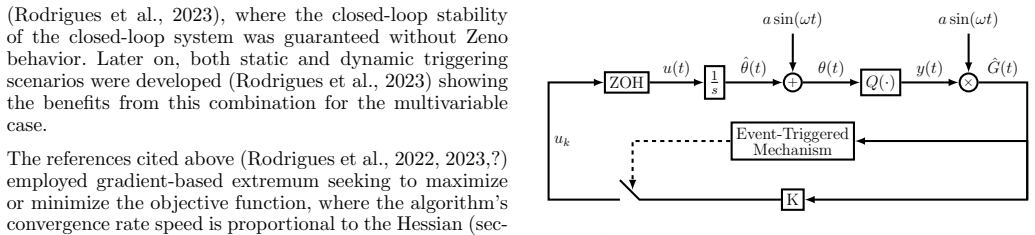
The load-bearing mechanism is the Riccati filter $\dot{\Gamma} = \omega_r\Gamma - \omega_r\hat{H}\Gamma^2$, which yields an online estimate $\Gamma$ of $1/H^*$ even when the raw Hessian estimate $\hat{H}$ passes through zero, and multiplies the gradient estimate so that the unknown curvature cancels from the linearized error dynamics. The event-triggered component is the condition $\Xi(\hat{G},e)=\sigma|\hat{G}|-\beta|e|<0$ (with $\sigma\in(0,1)$, $\beta>0$) that fires a zero-order-held control update; between updates it keeps $|e|\le(\sigma/\beta)|\hat{G}|$, which preserves a fixed fraction of the ideal Lyapunov decay. The proof's engine is the Lyapunov function $V=\hat{G}_{av}^2$ on the averaged system (42)-(44), and an averaging theorem for discontinuous systems transfers the exponential decay back to the original fast-oscillating closed loop. The averaged event trigger operates on $\hat{G}_{av}$ and $e_{av}$, so both the stability and the inter-event-time arguments are carried out in averaged coordinates.
What would settle it
Simulate the original (non-averaged) event-triggered Newton loop for two maps with $H^*=1$ and $H^*=100$ under identical $K$, $a$, $\sigma$, and $\omega$; if the measured exponential rate of $|\theta(t)-\theta^*|$ differs by more than the $O(a+1/\omega)$ residue, the claimed user-assignable and Hessian-independent rate does not survive outside the averaged model.
Extended reading notes
Core claim
The central claim is Theorem 1. For sufficiently large probing frequency $\omega$ and sufficiently small initial errors, the averaged closed-loop system (42)-(44) under the average trigger (48) is locally exponentially stable, and the original variables satisfy $$|\$\theta$(t)-\$\theta$^*| \le $e^{{-(1-\sigma)a^2K t/2}}$|\$\theta$(0)-\$\theta$^*| + O\left(a+\frac{1}{\omega}\right),$$ $$|y(t)-Q^*| \le $e^{{-(1-\sigma)a^2K t/2}}$|y(0)-Q^*| + O\left($a^{2}$+\frac{1}{\$omega^{2}$}\right),$$ and $$\left|\Gamma(t)-\frac{1}{H^*}\right| \le $e^{{-\omega_r t}}$\left|\Gamma(0)-\frac{1}{H^*}\right| + O\left(\frac{1}{\omega}\right).$$ The convergence exponent $(1-\sigma)a^2K/2$ contains no $H^*$, so the user can choose the speed through the gain $K$, the probing amplitude $a$, and the trigger parameter $\sigma$. The paper also derives a positive lower bound on inter-event times, so the event-triggered controller avoids Zeno behavior.
Load-bearing premise
The proof's load-bearing premise is that the discontinuous, fast-oscillating event-triggered loop is well approximated by its average system; the paper does not verify the averaging theorem's hypotheses for the zero-order-held error and event times, and the time scaling in Section 4 has an internal inconsistency between $\bar{t}=\omega t$ and the $\omega\bar{t}$ arguments, so the transfer from the averaged to the original system is the fragile link.
Editorial extensions
If this is right
- The convergence rate can be dialed in by the user through $K$, $a$, and $\sigma$ without knowing or estimating the Hessian $H^*$, removing the conservative tuning that the gradient version requires.
- For sufficiently large $\omega$, a positive minimum inter-event time exists, so the controller is compatible with networked actuation that needs a guaranteed spacing between updates.
- The final neighborhood shrinks as $O(a+1/\omega)$ for the optimizer and $O(a^2+1/\omega^2)$ for the map output, so probing amplitude and frequency can be traded against steady-state accuracy.
- In the paper's simulation, the event-triggered Newton controller reaches the optimum region within about 100 seconds with 43 updates, while the event-triggered gradient controller remains in transient over 500 seconds with 47 updates.
Reading between the lines
- A self-triggered implementation is a natural extension: the dwell-time formula in (A.38) gives an explicit rule for scheduling the next update in advance from current data, which the paper does not pursue.
- For multivariable static maps, the scalar Riccati filter would have to become a matrix-valued estimate of the inverse Hessian and the trigger would have to operate on a norm of the gradient error; the convergence-rate benefit would be larger in higher dimensions if the scalar argument carries over.
- Because the Hessian-independence bound is proven for the averaged system, a direct check on the original system with two very different Hessian values would test whether the assignable rate survives outside the averaging idealization; this is an experimental question the paper leaves open.
Editorial analysis
A structured set of objections, weighed in public.
Referee Report
Summary. The paper proposes a static event-triggered Newton-based extremum seeking (SET-NewtonES) scheme for scalar static maps. The control law uses a Riccati-filter estimate of the inverse Hessian and a zero-order hold updated by a static event-triggering rule based on the gradient estimate. The main claim (Theorem 1) is local exponential practical stability of the average closed-loop system with a user-assignable convergence rate independent of the unknown Hessian, together with O(a+1/omega) closeness of the original variables to the averaged ones and avoidance of Zeno behavior. The proof combines a Lyapunov argument for the averaged system with an averaging theorem for discontinuous systems attributed to Plotnikov, and the paper includes a numerical comparison with an earlier event-triggered gradient method.
Significance. If the main theorem were fully established, the contribution would be a useful combination of two known ideas: Newton-based extremum seeking with a Riccati inverse-Hessian estimator and event-triggered actuation. The claimed rate independent of the Hessian is standard for continuous Newton ES but has not been demonstrated in the event-triggered setting, so the paper addresses a meaningful gap. The explicit exponential bounds and the attempt to prove a positive dwell time are valuable. However, the manuscript does not provide machine-checked proofs or reproducible code, and the significance is moderated by the fact that the central proof steps, especially the time-scaling and the transfer from averaged to actual event times, are not rigorously justified as written.
major comments (3)
- [Section 4, Eqs. (24)-(31) and (27)-(28)] The time-scaling transformation \bar t = \omega t is applied inconsistently. After this transformation, 2\omega t becomes 2\bar t, but equations (27)-(28) contain cos(2\omega\bar t), sin(\omega\bar t), and cos(3\omega\bar t). More importantly, the original right-hand sides (18)-(19) contain terms of order O(\omega), such as -3a^2\omega H^*/8 cos(3\omega t) and a^2\omega H^* sin(2\omega t)\tilde\theta. When written as dX/d\bar t = (1/\omega) F(\bar t,X,1/\omega), these terms become O(1) forcing terms, so the right-hand side is not of the standard small-parameter form with uniformly bounded F required by the cited averaging theory. Consequently, the invocation of Plotnikov's theorem and the O(1/\omega) estimates (A.16)-(A.18) are unsupported. The proof must either correct the scaling and then handle the remaining zero-mean O(1) terms with an appropriate averaging lemma, or explicitly verify the hypotheses of the theorem it cites.
- [Appendix B, Eqs. (A.26)-(A.38)] The Zeno analysis is carried out for the averaged signals \hat G_av and e_av and then transferred to the original system through (A.35). However, the actual gradient estimate (8) contains the persistent O(a) sinusoidal terms (aQ^*+3a^3H^*/8) sin(\omega t) - a^3H^*/8 sin(3\omega t), which do not vanish as \tilde\theta converges and are not captured by the average \hat G_av = a^2H^*/2 \tilde\theta_av. The actual trigger condition (20) therefore sees zero crossings of \hat G(t) even near the optimum, and the lower bound (A.38) computed from the average system does not control the original inter-event times. In fact, if an event occurs exactly at a zero of \hat G(t) and \beta>\sigma, then immediately after the event |e(t)|=|\hat G(t)|, so \sigma|\hat G(t)|-\beta|e(t)|=(\sigma-\beta)|\hat G(t)|<0, which contradicts the claimed positive dwell time. The proof needs to analyze the actual event times rather than the averaged event times.
- [Appendix A, Eq. (A.2)] The stability argument uses the implicit condition \beta>|H^*| when bounding -a^2/\omega H^*K\hat G e by a^2/\omega \beta K|\hat G||e| and then combining this with the trigger bound |e|\le \sigma/\beta|\hat G|. This condition on the trigger gain \beta is not stated among Assumptions (A1)-(A5) nor in Theorem 1. Since H^* is unknown, the theorem should either include this explicit sufficient condition on \beta, or prove stability under a weaker and verifiable condition. Without it, the proof of exponential decay in (A.3) does not follow from the stated assumptions.
minor comments (5)
- [Section 6] The simulation description states that the map parameters satisfy \theta^*=5, but later the text says the green curve marks the desired optimum \theta^*=7. This inconsistency should be corrected.
- [Equation (29)] Equation (29) writes F_3 with t instead of \bar t in the arguments \Gamma(t) and \hat H(t); after the time-scaling, all occurrences should be expressed in the scaled variable \bar t before averaging.
- [Appendix B, Eqs. (A.27)-(A.30)] The derivative of \phi_av in (A.27) is computed without absolute-value signs and is only valid while e_av and \hat G_av have constant signs; the subsequent upper bound (A.30) should be derived using the subdifferential of the absolute value function or an alternative argument that does not assume sign invariance.
- [Appendix B, Eq. (A.38)] Solving (A.36) for the time at which \hat\phi reaches 1 gives a factor \beta/\sigma, not \beta^2/\sigma^2; the displayed lower bound in (A.38) contains this algebraic error and should be corrected.
- [Section 6] The simulation does not specify the trigger gain \beta, even though \beta appears in the trigger condition (20) and in the stability condition \beta>|H^*| used in the proof; this makes the numerical example incomplete as a verification of the theoretical assumptions.
Circularity Check
No significant circularity: the Newton-based convergence rate is obtained by direct Lyapunov algebra and standard averaging, not by fitting or by self-citation.
full rationale
The paper's central claim, inequality (50), follows from a Lyapunov analysis of the averaged system (42)-(44): V_av = G_av^2, the event-trigger bound |e_av| <= sigma/beta |G_av|, and the algebraic relation (45)-(46) that converts G_av-decay into theta_av-decay. This is a direct derivation, not a fit: no parameter is tuned to make the stated rate appear, and the Hessian-independence arises from cancellation of H* when (42)-(43) and (45) are combined. The Riccati inverse-Hessian estimator is taken from the independent prior work of Ghaffari et al., and the self-citations to Rodrigues et al. supply the baseline gradient event-triggered scheme, not the Newton result. No prediction is renamed, and no load-bearing uniqueness theorem is imported from the authors' own work. The main technical weakness is the application of Plotnikov's averaging theorem to (31): the time-scaling in Section 4 leaves O(omega) terms in F, so the hypotheses of the discontinuous averaging theorem may not be satisfied. That is a correctness/verification gap, not a circular reduction, because the theorem itself is an external mathematical result and the conclusion is not assumed as an input. Overall, no circular step is present.
Assumptions & free parameters
free parameters (1)
- beta (trigger gain)
assumptions (4)
- domain assumption The static map Q can be approximated locally by the quadratic Q(theta)=Q*+H*/2(theta-theta*)^2, with the Hessian H* constant.
- domain assumption The averaging theorem of Plotnikov (1980) applies to the discontinuous event-triggered closed loop and the approximation error is O(1/omega).
- ad hoc to paper The trigger gain beta can be chosen larger than |H*| even though H* is unknown.
- domain assumption The Riccati filter (13) is well-posed and converges to the equilibrium 1/H* for the allowed initial conditions.
Cite this review
Pith. "Pith review of Event-Triggered Newton-Based Extremum Seeking Control." pith.science (2026). https://pith.science/paper/N5RBRITZ
@misc{pith2026250200930,
  author       = {Pith},
  title        = {Pith review of: Event-Triggered Newton-Based Extremum Seeking Control},
  year         = {2026},
  howpublished = {\url{https://pith.science/paper/N5RBRITZ}},
  note         = {Machine review of arXiv:2502.00930}
}
read the original abstract
This paper proposes the incorporation of static event-triggered control in the actuation path of Newton-based extremum seeking and its comparison with the earlier gradient version. As in the continuous methods, the convergence rate of the gradient approach depends on the unknown Hessian of the nonlinear map to be optimized, whereas the proposed event-triggered Newton-based extremum seeking eliminates this dependence, becoming user-assignable. This is achieved by means of a dynamic estimator for the Hessian's inverse, implemented as a Riccati equation filter. Lyapunov stability and averaging theory for discontinuous systems are applied to analyze the closed-loop system. Local exponential practical stability is guaranteed to a small neighborhood of the extremum point of scalar and static maps. Numerical simulations illustrate the advantages of the proposed approach over the previous gradient method, including improved convergence speed, followed by a reduction in the amplitude and updating frequency of the control signals.
Figures

Reference graph
Works this paper leans on
-
[1]
N. O. Aminde, T. R. Oliveira, and L. Hsu. Global output-feedback extremum seeking control via monitoring functions. In 52nd IEEE Conference on Decision and Control (CDC), pages 1031--1036, 2013
work page 2013
-
[2]
T. Apostol. Mathematical Analysis - A Modern Approach to Advanced Calculus. Addison-Wesley Publishing Company, Massachusetts, 1957
work page 1957
-
[3]
K. B. Ariyur and M. Krsti \' c . Real-Time Optimization by Extremum-Seeking Control. Wiley, Canada, 2003
work page 2003
-
[4]
P. Frihauf, M. Krsti \' c , and T. Ba s ar. Nash Equilibrium Seeking in Noncooperative Games. IEEE Transactions on Automatic Control, 57:1192--1207, 2012
work page 2012
-
[5]
A. Ghaffari, M. Krsti \'c , and D. Ne s ic . Multivariable Newton-based Extremum Seeking. Automatica, 48:1759--1767, 2012
work page 2012
-
[6]
W. P. M. H. Heemels, K. H. Johansson, and P. Tabuada. An Introduction to Event-triggered and Self-triggered Control. Proceedings of the 51st IEEE Conference on Decision and Control (CDC), pages 3270--3285, 2012
work page 2012
-
[7]
J. P. Hespanha, P. Naghshtabrizi, and Y. Xu. A Survey of Recent Results in Networked Control Systems. Proceedings of the IEEE, 95(1):138--162, 2007
work page 2007
-
[8]
H.K. Khalil. Nonlinear Systems. Prentice Hall, Upper Saddle River, New Jersey, 2002
work page 2002
Show all 30 references
-
[9]
Krsti \'c
M. Krsti \'c . Extremum Seeking Control. In J. Baillieul and T. Samad, editors, Encyclopedia of Systems and Control, 1st edition, volume 1, pages 1--5. Springer, London, 2014
2014
-
[10]
Krsti \' c and H.-H
M. Krsti \' c and H.-H. Wang. Stability of Extremum Seeking Feedback for General Nonlinear Dynamic Systems. Automatica, 36:595--601, 2000
2000
-
[11]
M. Leblanc. Sur l' \' e lectrification des chemins de fer au moyen de courants alternatifs de fr \' e quence \' e lev \' e e. Revue G \' e n \' e rale de l'Electricit \' e , XII(8):275--277, 1922
1922
-
[12]
W. H. Moase, C. Manzie, and M. J. Brear. Newton-Like Extremum-Seeking for the Control of Thermoacoustic Instability. IEEE Transactions on Automatic Control, 55(9):2094--2105, 2010
2010
-
[13]
T. R. Oliveira, L. Fridman, and R. Ortega. From Adaptive Control to Variable Structure Systems -- Seeking Harmony. International Journal of Adaptive Control and Signal Processing, 30:1074--1079, 2016
2016
-
[14]
Oliveira and M
T.R. Oliveira and M. Krstic. Newton-based extremum seeking under actuator and sensor delays. IFAC-PapersOnLine, 48(12):304--309, 2015
2015
-
[15]
Oliveira and M
T.R. Oliveira and M. Krstic. Extremum Seeking through Delays and PDEs. SIAM, Philadelphia, USA, 2022
2022
-
[16]
T. R. Oliveira, A. C. Leite, A. J. Peixoto, and L. Hsu. Overcoming Limitations of Uncalibrated Robotics Visual Servoing by Means of Sliding Mode Control and Switching Monitoring Scheme. Asian Journal of Control, 16:752--764, 2014
2014
-
[17]
Oliveira, V.H.P
T.R. Oliveira, V.H.P. Rodrigues, M. Krstic, and T. Basar. Nash equilibrium seeking with players acting through heat PDE dynamics. In American Control Conference (ACC), pages 684--689, 2021a
-
[18]
Oliveira, V.H.P
T.R. Oliveira, V.H.P. Rodrigues, M. Krstic, and T. Basar. Nash equilibrium seeking in heterogeneous noncooperative games with players acting through heat PDE dynamics and delays. In 60th IEEE Conference on Decision and Control (CDC), pages 1167--1173, 2021b
-
[19]
Paz, T.R
P. Paz, T.R. Oliveira, A.V. Pino, and A.P. Fontana. Model-free neuromuscular electrical stimulation by stochastic extremum seeking. IEEE Transactions on Control Systems Technology, 28(1):238--253, 2020
2020
-
[20]
A. J. Peixoto, T. R. Oliveira, L. Hsu, F. Lizarralde, and R. R. Costa. Global Tracking Sliding Mode Control for a Class of Nonlinear Systems via Variable Gain Observer. International Journal of Robust and Nonlinear Control, 21:177--196, 2011
2011
-
[21]
V. A. Plotnikov. Averaging of Differential Inclusions. Ukrainian Mathematical Journal, 31:454--457, 1980
1980
-
[22]
V. H. P. Rodrigues, L. Hsu, T. R. Oliveira, and M. Diagne. Event-Triggered Extremum Seeking Control. IFAC-PapersOnLine, 55(12):555--560, 2022
2022
-
[23]
V. H. P. Rodrigues, L. Hsu, T. R. Oliveira, and M. Diagne. Dynamic Event-Triggered Extremum Seeking Feedback. IFAC-PapersOnLine, 56(2):10307--10314, 2023
2023
-
[24]
V. H. P. Rodrigues, T. R. Oliveira, L. Hsu, M. Diagne, and M. Krstic. Event-Triggered Extremum Seeking Control Systems. arXiv preprint, arXiv:2312.08512, 2023
2023 arXiv
-
[25]
Roux-Oliveira, L
T. Roux-Oliveira, L. R. Costa, A. V. Pino, and P. Paz. Extremum Seeking-based Adaptive PID Control applied to Neuromuscular Electrical Stimulation. Annals of the Brazilian Academy of Sciences, 21:1--20, 2019
2019
-
[26]
M. S. Stankovi \'c and D. M. Stipanovi \'c . Discrete time extremum seeking by autonomous vehicles in a stochastic environment. In 48th IEEE Conference on Decision and Control held jointly with 2009 28th Chinese Control Conference (CDC/CCC), pages 4541--4546, 2009
2009
-
[27]
P. Tabuada. Event-Triggered Real-Time Scheduling of Stabilizing Control Tasks. IEEE Transactions on Automatic Control, 52:1680--1685, 2007
2007
-
[28]
F. Warner. Foundations of Differentiable Manifolds and Lie Groups. Scott Foresman and Company, Chicago, Illinois, 1971
1971
-
[29]
Extremum-Seeking Control and Applications: A Numerical Optimization-Based Approach
Zhang, Chunlei and Ord \'o \ n ez, Ra \'u l. Extremum-Seeking Control and Applications: A Numerical Optimization-Based Approach. Springer, New York, NY, 2012
2012
-
[30]
Zhang, Q.-L
X.-M. Zhang, Q.-L. Han, X. Ge, D. Ding, L. Ding, D. Yue, and C. Peng. Networked Control Systems: A Survey of Trends and Techniques. IEEE/CAA Journal of Automatica Sinica, 7(1):1--17, 2020
2020
Reviewed August 9, 2026 · model on record in the stance chip above.
Discussion (0). Continue with ORCID to comment.