REVIEW 3 major objections 4 minor 24 references
Large deviations of geodesic midpoint fluctuations in last-passage percolation with general i.i.d. weights
T0 review · 3 major / 4 minor · reviewed 2026-08-09 · deepseek-v4-flash
Pith's one-line read This paper proves a large deviation principle for the geodesic midpoint in general last-passage percolation, with rate function $2J_t(\mu_0)$, and uses it to verify the exponential corner-path conjecture from [18].
desk verdict The general-weight midpoint LDP is a real contribution, but Section 3's upper bound has a false inequality that leaves Theorem 1.1 unproved as written. read the letter →
The pith
A machine-rendered reading of the paper's core claim, the machinery that carries it, and where it could break.
The reading
What carries the argument
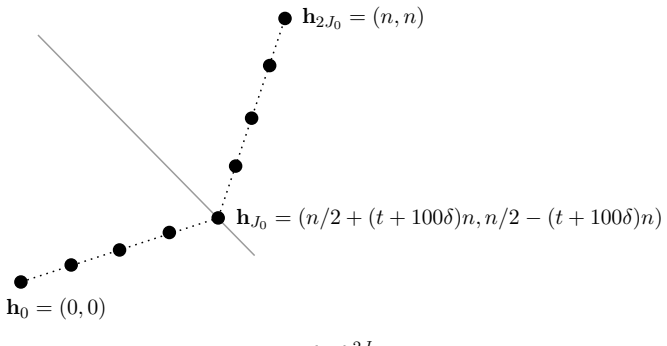
The central object is the right-tail rate function $J_t(r)=-\lim_{n\to\infty} n^{-1}\log P\bigl(G_{0,(\lfloor n/2+tn\rfloor,\lfloor n/2-tn\rfloor)}\ge rn\bigr)$ and the shape function $\mu_t$. The midpoint event is rewritten using the exact identity $$\{Mid_{0,n}=(n/2+tn,n/2-tn)\} = \{G_{0,(n/2+tn,n/2-tn)}+G_{(n/2+tn,n/2-tn),(n,n)}=G_{0,(n,n)}\}.$$ For the upper bound, the paper splits on the event $G_{0,(n,n)}\le 2\mu_0 n-2\delta n$, controlled by a Gaussian lower-tail estimate (Proposition 2.5, cited from [17] and adapted from [7]), and uses the right-tail large deviation bound (Proposition 2.4) on the complementary event. For the lower bound, the paper plants a sequence of high-weight geodesic segments between points spaced $2\delta^5 n$ apart, concatenates them, and uses a coalescence argument together with the BKR inequality to show the true geodesic must pass within $O(\delta n)$ of the planted midpoint. The case $t=1/2$ uses a separate corner-path planting argument.
What would settle it
Using the exact contour-integral formula in [18], compute $P((n,0)\in \Gamma_{0,n})$ for rate-one exponential weights at increasing $n$; Theorem 1.1 and Corollary 1.3 predict $-(1/n)\log P\to 2-2\log 2$, so a numerical sequence converging elsewhere would refute the claimed rate. Equally decisive: exhibit an i.i.d. weight distribution satisfying (1.2) for which $P(G_{0,(n/2,n/2)}\le \mu_0 n-\epsilon n)$ decays slower than $e^{-c\epsilon^2 n^2}$; that would break the upper-bound proof as written.
Extended reading notes
Core claim
Under the assumptions (1.2)---finite exponential moment, continuous weights, unbounded support---the paper proves Theorem 1.1: for any fixed $0<t\le 1/2$ with $\mu_0>\mu_t$ and any $\epsilon>0$, for all large $n$, $$$e^{{-2n(J_t(\mu_0)+\epsilon)}}$ \le P\bigl(Mid_{0,n}\cdot e_1 = \lfloor n/2+tn\rfloor\bigr) \le P\bigl(Mid_{0,n}\cdot e_1 \ge \lfloor n/2+tn\rfloor\bigr) \le $e^{{-2n(J_t(\mu_0)-\epsilon)}}$.$$ Thus the midpoint transversal fluctuation obeys a large deviation principle at speed $n$ with rate function $2J_t(\mu_0)$. The companion Proposition 1.2 gives the point-to-line endpoint the same statement with rate $J_t(\mu_0)$. For rate-one exponential weights, Corollary 1.3 follows immediately: $J_{1/2}(x)=x-\log x-1$ and $\mu_0=2$, so the probability that the geodesic from $(0,0)$ to $(n,n)$ contains the corner point $(n,0)$ is $(4/e^2)^{n+o(n)}$, verifying the conjecture in [18].
Load-bearing premise
The load-bearing premise is that the diagonal passage time has a much thinner lower tail than an exponential one: $P(G_{0,(n/2,n/2)}\le \mu_0 n-\epsilon n)\le e^{-c\epsilon^2 n^2}$, an estimate the paper cites from [17] and adapts from [7] but only sketches for its weight class; if that estimate fails for some weights satisfying (1.2), the upper bound in Theorem 1.1 would not be established.
Editorial extensions
If this is right
- For exponential weights, the probability that the geodesic from $(0,0)$ to $(n,n)$ uses the corner path $(0,0)\to(n,0)\to(n,n)$ is $(4/e^2)^{n+o(n)}$, larger by an exponential factor than the $2^{-2n+o(n)}$ rate for a uniformly chosen up-right path.
- For every direction $t$ with $\mu_0>\mu_t$, the large deviation rate of the midpoint is exactly $2J_t(\mu_0)$; the right-tail passage-time rate function therefore determines this geometric large deviation in full.
- The point-to-line geodesic endpoint fluctuates with rate $J_t(\mu_0)$, exactly half the midpoint rate, giving a clean comparison between point-to-point and point-to-line geometry.
- Because the proof requires only finite exponential moments and mild regularity, the same large deviation rate holds for all weight distributions in the class (1.2), not just solvable models.
Reading between the lines
- A direct asymptotic evaluation of the exact contour-integral formula in [18] at $t=1/2$ would give an independent check of the rate $2-2\log 2$ without relying on Theorem 1.1; the paper does not perform that evaluation.
- The lower-bound planting argument is flexible enough that the same rate function likely governs the probability that the entire geodesic stays far from the diagonal, not just the midpoint; the paper proves only the midpoint statement.
- If the conjectured inequality $2J_t(\mu_0)\le$ the corresponding rate for a uniformly chosen path holds for general weights, it would yield new constraints on the shape function $\mu_0$; testing both sides in exponential LPP is a finite calculation.
- The proof hinges on a Gaussian lower-tail estimate that is only sketched; finding a weight distribution satisfying (1.2) with a weaker lower tail would not disprove the theorem but would force a different upper-bound argument.
Editorial analysis
A structured set of objections, weighed in public.
Referee Report
Summary. The paper studies linear-scale transversal fluctuations of the geodesic midpoint in planar last-passage percolation with general i.i.d. weights satisfying a mild exponential-moment assumption. The main result, Theorem 1.1, asserts that for directions t with mu_0 > mu_t, both P(Mid_{0,n} . e1 >= n/2 + tn) and P(Mid_{0,n} . e1 = n/2 + tn) decay as exp(-2n J_t(mu_0) + o(n)), where J_t is the right-tail large-deviation rate function of the point-to-point passage time and mu_t is the shape function. The upper bound is proved by decomposing the midpoint event according to the total passage time and estimating a sum of two independent passage times; the lower bound is proved by planting a high-weight path and showing the geodesic stays near it. As an application, the paper derives the exponential-LPP corner-path probability (4/e^2)^{n+o(n)}, verifying a conjecture of Liu. The central upper-bound estimate contains an invalid inequality, the left-tail estimate on which it relies is only sketched, and the lower-bound section has a circular ordering in its averaging argument.
Significance. If the proof gap is repaired, the result would be a significant contribution: it would give the first large-deviation principle for geodesic midpoint fluctuations in a general non-integrable LPP setting, express the rate function in terms of the known passage-time rate function J_t and the shape function, and verify Liu's conjecture for exponential LPP. The paper is clearly written and uses standard tools; it introduces no fitted parameters or ad hoc objects. The lower-bound construction via planted paths is conceptually appealing. However, the current manuscript does not establish the upper bound because of the erroneous inequality in Section 3, and Proposition 2.5 requires a complete proof; these are central, not cosmetic, issues.
major comments (3)
- [Section 3, displayed estimate following (3.7)] The displayed inequality P(G_{0,p} + G_{p,(n+2tn,n-2tn)} >= 2m) <= P(G_{0,(n+2tn,n-2tn)} >= 2m)^2 is not valid. Writing A = G_{0,p} and B = G_{p,(n+2tn,n-2tn)}, the event {A + B >= 2m} is not contained in {A >= m} and {B >= m}; one variable can be less than m and the other sufficiently larger. For independent A and B with common upper-tail rate J_t, the probability {A + B >= 2m} is typically of order e^{-2n J_t(mu_0 - delta)}, whereas the printed square is of order e^{-4n J_t(mu_0 - delta)}. Thus the displayed bound is false and the upper bound in Theorem 1.1 does not follow as written. A correct proof needs a legitimate independent-sum large-deviation upper bound, for example via exponential Chebyshev optimized over theta, using the convexity of J_t; this argument is not supplied. This is the load-bearing gap in the paper.
- [Section 2, Proposition 2.5] The Gaussian left-tail estimate P(G_{0,(n/2,n/2)} <= mu_0 n - epsilon n) <= e^{-c epsilon^2 n^2} is load-bearing for the upper bound through its use at (3.6). The proof given, however, is only a sketch. In particular, the key estimate P(G^K_{0,(n/2,n/2)} <= (mu_0 - 3epsilon/4)n) <= e^{-cn} is cited to [7, Lemma 2.2] without a statement, and the adaptation from [7, Section 4.1] is noted in the text as not formally stated. The sketch also does not fully justify the independence of the strip-restricted passage times G^K across i, nor the precise relation between the parameters delta, K, and epsilon. Since this estimate is used to absorb the first term in the upper-bound decomposition, the paper should state it as a theorem or proposition with a complete proof, or give a precise reference that covers the general weight class (1.2).
- [Section 4, equations (4.9)-(4.10)] The averaging argument in the first part of Section 4 is circular as written. The chain leading to P(E_0) >= (1/(2n^2)) e^{-2n(J_t(mu_0)+3epsilon)} uses the lower bound P(H_0) >= e^{-2n(J_t(mu_0)+epsilon)}, which is exactly the weak lower bound (4.8) that is only proved later in Sections 4.1 and 4.2. The argument should be reordered: prove (4.8) first, and then use the translation-invariance and path-monotonicity argument to upgrade the '>=' lower bound to the exact equality lower bound in Theorem 1.1. The mathematical content is repairable, but the current logical order makes the proof unverifiable as written.
minor comments (4)
- [Section 3, first display after (3.7)] The equality replacing G_{p,(n,n)} by G_{p,(n+2tn,n-2tn)} is not an identity of random variables; at best it is an equality in distribution, using the reflection and translation symmetries of the i.i.d. weight field. This should be stated explicitly.
- [Section 4, notation] The notation involving '/BD' and the summation limits (for example, '2n sum' and 'n^2-1 sum') appears garbled and should be cleaned up so that the indices and ranges are unambiguous.
- [Section 2, Proposition 2.3] The proof of Proposition 2.3 uses the symmetry J_{-t}(r) = J_t(r) without stating it; this follows from the reflection symmetry of the i.i.d. model and should be noted.
- [Throughout] The paper repeatedly uses expressions such as n/2 + tn where n/2 + tn is not an integer; the floor notation in Theorem 1.1 is introduced, but the proofs should consistently verify that the displayed equalities and inequalities are unaffected by the rounding.
Circularity Check
No significant circularity: the midpoint LDP is reduced to the external passage-time rate function J_t, not to the conclusion.
full rationale
The paper's central claim is a large deviation principle for the geodesic midpoint with rate 2J_t(mu0), where J_t is the independently defined right-tail rate function for last-passage values in direction t (Section 2.1, Propositions 2.1-2.4). The upper bound conditions on the midpoint event and bounds it by an event involving passage times from (0,0) to (n/2+tn,n/2-tn) and to (n+2tn,n-2tn); the lower bound plants a high-weight path and argues the geodesic must follow it. In both directions, the quantities being estimated are passage-time probabilities whose rate function was not fit to midpoint data, so the prediction is not equivalent to its input by construction. The only author-overlap citation is Proposition 2.5 (Gaussian left tail), credited to Kesten [17] and adapted from Basu-Ganguly-Sly [7, Section 4.1]; it is a published, parameter-free external result and the paper supplies a proof sketch, so it is real evidence rather than a smuggled assumption. I note two apparent proof gaps that are not circular: the displayed inequality at (3.7) writing the sum event as a squared single-passage probability is not a valid consequence and would need a legitimate independent-sum bound, and Proposition 2.5 is only sketched. These affect correctness, not circularity. No fitted parameters, no renamed empirical patterns, and no self-citation chain forces the result.
Assumptions & free parameters
assumptions (6)
- domain assumption Weights are i.i.d. with E[e^{alpha omega_z}] < infinity for some alpha > 0
- domain assumption Weights have continuous CDF and unbounded support
- standard math Existence and properties of J_t(r) (continuity, convexity, monotonicity) from Georgiou-Seppaelaeinen and Kesten
- standard math Left tail Gaussian estimate for G_{0,(n/2,n/2)} (Proposition 2.5) from Kesten [17] and Basu-Ganguly-Sly [7]
- standard math BKR inequality and FKG inequality
- standard math Subadditivity and Kingman's theorem for shape function mu_t
Cite this review
Pith. "Pith review of Large deviations of geodesic midpoint fluctuations in last-passage percolation with general i.i.d. weights." pith.science (2026). https://pith.science/paper/JJFNJ64U
@misc{pith2026250200942,
  author       = {Pith},
  title        = {Pith review of: Large deviations of geodesic midpoint fluctuations in last-passage percolation with general i.i.d. weights},
  year         = {2026},
  howpublished = {\url{https://pith.science/paper/JJFNJ64U}},
  note         = {Machine review of arXiv:2502.00942}
}
abstract
The study of transversal fluctuations of the optimal path is a crucial aspect of the Kardar-Parisi-Zhang (KPZ) universality class. In this work, we establish the large deviation limit for the midpoint transversal fluctuations in a general last-passage percolation (LPP) model with mild assumption on the i.i.d. weights. The rate function is expressed in terms of the right tail large deviation rate function of the last-passage value and the shape function. When the weights are chosen to be i.i.d. exponential random variables, our result verifies a conjecture communicated to us by Liu [Liu'22], showing the asymptotic probability of the geodesic from $(0,0)$ to $(n,n)$ following the corner path $(0,0) \to (n,0) \to (n,n)$ is $({4}/{e^2})^{n+o(n)}$.
Figures


Reference graph
Works this paper leans on
-
[2]
Pranay Agarwal and Riddhipratim Basu, Sharp deviation bounds for midpoint and endpoint of geodesics in exponential last passage percolation , 2024, arXiv:2405.18056
work page Pith review arXiv 2024
-
[1]
Pranay Agarwal, Lower bound for large local transversal fluctuations of geod esics in last passage percolation, 2023, arXiv:2311.00360
work page Pith review arXiv 2023
-
[3]
Tom Alberts and Eric Cator, On the passage time geometry of the last passage percolation problem, ALEA Lat. Am. J. Probab. Math. Stat. 18 (2021), no. 1, 211–247. MR 4198875
work page 2021
-
[4]
Richard Arratia, Skip Garibaldi, and Alfred W. Hales, The van den Berg–Kesten-Reimer operator and inequality for infinite spaces , Bernoulli 24 (2018), no. 1, 433–448. MR 3706764
work page 2018
-
[5]
Antonio Auffinger and Michael Damron, A simplified proof of the relation between scaling exponents in first-passage percolation , Ann. Probab. 42 (2014), no. 3, 1197–1211. MR 3189069 14
work page 2014
-
[6]
68, American Mathematical Society, Providence, RI, 2017
Antonio Auffinger, Jack Hanson, and Michael Damron, 50 years of first passage percolation , University Lecture Series, vol. 68, American Mathematical Society, Providence, RI, 2017
work page 2017
-
[7]
Riddhipratim Basu, Shirshendu Ganguly, and Allan Sly, Delocalization of polymers in lower tail large deviation , Comm. Math. Phys. 370 (2019), no. 3, 781–806. MR 3995919
work page 2019
-
[8]
Riddhipratim Basu, Shirshendu Ganguly, and Lingfu Zhan g, Temporal correlation in last pas- sage percolation with flat initial condition via Brownian co mparison, Comm. Math. Phys. 383 (2021), no. 3, 1805–1888. MR 4244262
work page 2021
Show all 24 references
-
[9]
Riddhipratim Basu, Vladas Sidoravicius, and Allan Sly, Last passage percolation with a defect line and the solution of the slow bond problem , 2014, arXiv:1408.3464
2014 arXiv
-
[10]
Sourav Chatterjee, The universal relation between scaling exponents in first-pa ssage percola- tion, Ann. of Math. (2) 177 (2013), no. 2, 663–697. MR 3010809
2013
-
[11]
Sayan Das, Duncan Dauvergne, and B´ alint Vir´ ag, Upper tail large deviations of the directed landscape, 2024, arXiv:2405.14924
2024 arXiv
-
[12]
229 (2022), no
Duncan Dauvergne, Janosch Ortmann, and B´ alint Vir´ ag, The directed landscape, Acta Math. 229 (2022), no. 2, 201–285. MR 4554223
2022
-
[13]
Richard Durrett, Probability: theory and examples , second ed., Duxbury Press, Belmont, CA,
-
[14]
Nicos Georgiou and Timo Sepp¨ al¨ ainen,Large deviation rate functions for the partition function in a log-gamma distributed random potential , Ann. Probab. 41 (2013), no. 6, 4248–4286. MR 3161474
2013
-
[15]
Alan Hammond and Sourav Sarkar, Modulus of continuity for polymer fluctuations and weight profiles in Poissonian last passage percolation , Electron. J. Probab. 25 (2020), Paper No. 29,
2020
-
[16]
Mehran Kardar, Giorgio Parisi, and Yi-Cheng Zhang, Dynamic scaling of growing interfaces , Phys. Rev. Lett. 56 (1986), 889–892
1986
-
[17]
1180, Springer, Berl in, 1986, pp
Harry Kesten, Aspects of first passage percolation , ´Ecole d’´ et´ e de probabilit´ es de Saint-Flour, XIV—1984, Lecture Notes in Math., vol. 1180, Springer, Berl in, 1986, pp. 125–264. MR 876084
1984
-
[18]
Theory Related Fields 184 (2022), no
Zhipeng Liu, One-point distribution of the geodesic in directed last pas sage percolation, Probab. Theory Related Fields 184 (2022), no. 1-2, 425–491. MR 4498515
2022
-
[19]
Martin, Limiting shape for directed percolation models , Ann
James B. Martin, Limiting shape for directed percolation models , Ann. Probab. 32 (2004), no. 4, 2908–2937. MR 2094434
2004
-
[20]
Newman and Marcelo S
Charles M. Newman and Marcelo S. T. Piza, Divergence of shape fluctuations in two dimen- sions, Ann. Probab. 23 (1995), no. 3, 977–1005. MR 1349159
1995
-
[21]
Rost, Nonequilibrium behaviour of a many particle process: densi ty profile and local equi- libria, Z
H. Rost, Nonequilibrium behaviour of a many particle process: densi ty profile and local equi- libria, Z. Wahrsch. Verw. Gebiete 58 (1981), no. 1, 41–53. MR 635270
1981
-
[22]
Xiao Shen, Lower bound for large transversal fluctuations in exactly so lvable KPZ models , 2024, arXiv:2402.16332. 15
2024 arXiv
-
[23]
Julien Verges, Large deviation principle at speed n for the random metric in first-passage percolation, 2024, arXiv:2412.03320. 16
2024 arXiv
-
[1996]
MR 1609153 (98m:60001)
Reviewed August 9, 2026 · model on record in the stance chip above.
Discussion (0). Continue with ORCID to comment.