Training speedups via batching for geometric learning: an analysis of static and dynamic algorithms
Pith reviewed 2026-05-23 04:12 UTC · model grok-4.3
The pith
Changing the batching algorithm for graph neural networks can speed up training by up to 2.7 times, though the best choice depends on the data, model, batch size, hardware, and training length.
A machine-rendered reading of the paper's core claim, the machinery that carries it, and where it could break.
Core claim
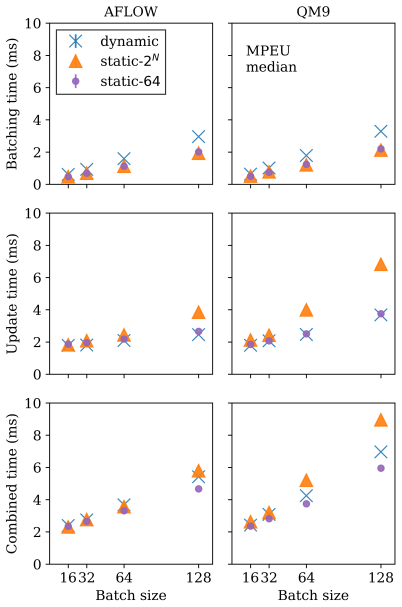
The authors establish that static and dynamic batching algorithms for graph neural networks yield different wall-clock training times on the QM9 and AFLOW datasets, with observed speed ratios reaching 2.7 in favor of one algorithm or the other depending on batch size, model, hardware, and total steps; they further report that, for selected combinations of these variables, the two algorithms produce statistically significant differences in model performance metrics.
What carries the argument
The direct comparison of static batching (precomputed fixed batches) versus dynamic batching (batches assembled on the fly) when applied to graph neural network training loops.
If this is right
- For any given GNN training job the faster batching method must be identified by direct timing rather than assumed in advance.
- Speed gains from the better batching choice are largest at particular batch sizes and early in training.
- In some dataset-model-batch-size triples the batching method also changes the final learned model quality.
- Hardware platform influences which batching algorithm finishes first.
Where Pith is reading between the lines
- An adaptive scheduler that switches between static and dynamic batching mid-training could capture the best of both for long runs.
- The same batching comparison could be repeated on non-graph geometric models such as point-cloud networks to test generality.
- Memory-access patterns in dynamic batching may explain part of the speed variation and could be measured separately.
Load-bearing premise
The measured speed differences and occasional metric differences come from the batching choice itself rather than from unmeasured differences in code implementation, random seeds, or hardware behavior.
What would settle it
Re-running the QM9 and AFLOW experiments with an independent code implementation of both batching methods on the same hardware and obtaining speed ratios near 1.0 with no metric differences would falsify the central claim.
Figures




read the original abstract
Graph neural networks (GNN) have shown promising results for several domains such as materials science, chemistry, and the social sciences. GNN models often contain millions of parameters, and like other neural network (NN) models, are often fed only a fraction of the graphs that make up the training dataset in batches to update model parameters. The effect of batching algorithms on training time and model performance has been thoroughly explored for NNs but not yet for GNNs. We analyze two different batching algorithms for graph-based models, namely static and dynamic batching for two datasets, the QM9 dataset of small molecules and the AFLOW materials database. Our experiments show that changing the batching algorithm can provide up to a 2.7x speedup, but the fastest algorithm depends on the data, model, batch size, hardware, and number of training steps run. Experiments show that for a select number of combinations of batch size, dataset, and model, significant differences in model learning metrics are observed between static and dynamic batching algorithms.
Editorial analysis
A structured set of objections, weighed in public.
Referee Report
Summary. The manuscript examines the effects of static versus dynamic batching algorithms on training time and model performance for graph neural networks on the QM9 molecular dataset and AFLOW materials database. Experiments indicate that switching batching algorithms can yield speedups up to 2.7x, but the fastest choice depends on the dataset, model, batch size, hardware, and number of training steps; for select combinations of these factors, significant differences in learning metrics are also observed between the algorithms.
Significance. If the experimental comparisons hold after addressing controls, the work extends batching analysis from standard neural networks to GNNs and supplies practical, factor-dependent guidance for training efficiency in chemistry and materials applications. The qualified claims avoid overgeneralization and the direct experimental focus on geometric models addresses a documented gap.
major comments (1)
- Experiments section: the central claim that observed speedups and metric differences arise from the static/dynamic batching choice requires explicit controls or ablations to exclude confounds such as implementation-specific data loading, memory allocation differences, or hardware variability; without these, attribution to batching remains unverified and load-bearing for the reported 2.7x figure and metric observations.
Simulated Author's Rebuttal
We thank the referee for the constructive feedback. The major comment highlights a valid concern about experimental controls, which we address below by outlining planned revisions to strengthen attribution of results to the batching algorithms.
read point-by-point responses
-
Referee: Experiments section: the central claim that observed speedups and metric differences arise from the static/dynamic batching choice requires explicit controls or ablations to exclude confounds such as implementation-specific data loading, memory allocation differences, or hardware variability; without these, attribution to batching remains unverified and load-bearing for the reported 2.7x figure and metric observations.
Authors: We agree that explicit controls are needed to isolate the batching effect. Both algorithms were implemented within the same PyTorch Geometric-based codebase, sharing identical data loaders, preprocessing, and memory allocation paths, with the sole difference being the batch construction method (precomputed static batches versus on-the-fly dynamic padding). Hardware was held constant by executing all runs on the same GPU cluster nodes. To further verify attribution, the revised manuscript will include: (1) timing breakdowns separating data loading from model forward/backward passes, (2) an ablation fixing batch sizes and padding patterns while varying only the algorithm, and (3) repeated runs with fixed seeds across multiple hardware instances to quantify variability. These additions will be reported in an expanded Experiments section with updated figures. revision: yes
Circularity Check
No significant circularity: purely empirical comparison
full rationale
The paper reports experimental timings and learning metrics for static versus dynamic batching on QM9 and AFLOW with GNN models. No derivation chain, equations, fitted parameters renamed as predictions, or self-citation load-bearing steps exist. All claims rest on direct runtime and accuracy measurements under varying batch sizes, hardware, and step counts, with explicit qualification that fastest algorithm is data- and configuration-dependent. This matches the reader's 0.0 assessment and contains none of the enumerated circularity patterns.
Axiom & Free-Parameter Ledger
Lean theorems connected to this paper
-
IndisputableMonolith/Cost/FunctionalEquation.leanwashburn_uniqueness_aczel unclear?
unclearRelation between the paper passage and the cited Recognition theorem.
We analyze two different batching algorithms for graph-based models, namely static and dynamic batching... changing the batching algorithm can provide up to a 2.7x speedup
-
IndisputableMonolith/Foundation/RealityFromDistinction.leanreality_from_one_distinction unclear?
unclearRelation between the paper passage and the cited Recognition theorem.
The effect of batching algorithms on training time and model performance has been thoroughly explored for NNs but not yet for GNNs.
What do these tags mean?
- matches
- The paper's claim is directly supported by a theorem in the formal canon.
- supports
- The theorem supports part of the paper's argument, but the paper may add assumptions or extra steps.
- extends
- The paper goes beyond the formal theorem; the theorem is a base layer rather than the whole result.
- uses
- The paper appears to rely on the theorem as machinery.
- contradicts
- The paper's claim conflicts with a theorem or certificate in the canon.
- unclear
- Pith found a possible connection, but the passage is too broad, indirect, or ambiguous to say the theorem truly supports the claim.
Reference graph
Works this paper leans on
-
[1]
ptgnn: A pytorch gnn library, 2022
ALLAMANIS, M., MIR, A.,ANDPATI, S. ptgnn: A pytorch gnn library, 2022
work page 2022
-
[2]
BECHTEL, T., SPECKHARD, D. T., GODWIN, J.,ANDDRAXL, C. Band-gap regression with architecture-optimized message-passing neural networks.arXiv preprint arXiv:2309.06348 (2023)
-
[3]
BISHOP, C. M.,ANDNASRABADI, N. M.Pattern recognition and machine learning, vol. 4. Springer, 2006
work page 2006
-
[4]
The tradeoffs of large scale learning.Advances in neural information processing systems 20(2007)
BOTTOU, L.,ANDBOUSQUET, O. The tradeoffs of large scale learning.Advances in neural information processing systems 20(2007)
work page 2007
-
[5]
Stochastic gradient learning in neural networks.Proceedings of Neuro- Nımes 91, 8 (1991), 12
BOTTOU, L.,ET AL. Stochastic gradient learning in neural networks.Proceedings of Neuro- Nımes 91, 8 (1991), 12
work page 1991
-
[6]
BRADBURY, J., FROSTIG, R., HAWKINS, P., JOHNSON, M. J., LEARY, C., MACLAURIN, D., NECULA, G., PASZKE, A., VANDERPLAS, J., WANDERMAN-MILNE, S.,ANDZHANG, Q. JAX: composable transformations of Python+NumPy programs, 2018
work page 2018
-
[7]
BYRD, R. H., CHIN, G. M., NOCEDAL, J.,ANDWU, Y. Sample size selection in optimization methods for machine learning.Mathematical programming 134, 1 (2012), 127–155
work page 2012
-
[8]
CHEN, C.,ANDONG, S. P. A universal graph deep learning interatomic potential for the periodic table.Nature Computational Science 2, 11 (2022), 718–728
work page 2022
-
[9]
CHOUDHARY, K., YILDIRIM, T., SIDERIUS, D. W., KUSNE, A. G., MCDANNALD, A.,AND ORTIZ-MONTALVO, D. L. Graph neural network predictions of metal organic framework co2 adsorption properties.Computational Materials Science 210(2022), 111388
work page 2022
-
[10]
L., JAHNATEK, M., CHEPULSKII, R
CURTAROLO, S., SETYAWAN, W., HART, G. L., JAHNATEK, M., CHEPULSKII, R. V., TAYLOR, R. H., WANG, S., XUE, J., YANG, K., LEVY, O.,ET AL. Aflow: An automatic framework for high-throughput materials discovery.Computational Materials Science 58 (2012), 218–226
work page 2012
-
[11]
DECARLO, L. T. On the meaning and use of kurtosis.Psychological methods 2, 3 (1997), 292
work page 1997
-
[12]
FERLUDIN, O., EIGENWILLIG, A., BLAIS, M., ZELLE, D., PFEIFER, J., SANCHEZ- GONZALEZ, A., LI, W. L. S., ABU-EL-HAIJA, S., BATTAGLIA, P., BULUT, N., HALCROW, J.,DEALMEIDA, F. M. G., GONNET, P., JIANG, L., KOTHARI, P., LATTANZI, S., LINHARES, A., MAYER, B., MIRROKNI, V., PALOWITCH, J., PARADKAR, M., SHE, J., TSITSULIN, A., VILLELA, K., WANG, L., WONG, D.,AND...
-
[13]
FEY, M.,ANDLENSSEN, J. E. Fast graph representation learning with pytorch geometric. arXiv preprint arXiv:1903.02428(2019)
work page internal anchor Pith review Pith/arXiv arXiv 1903
-
[14]
Graph neural architecture search
GAO, Y., YANG, H., ZHANG, P., ZHOU, C.,ANDHU, Y. Graph neural architecture search. In International joint conference on artificial intelligence(2021), International Joint Conference on Artificial Intelligence
work page 2021
-
[15]
Jraph: A library for graph neural networks in jax., 2020
GODWIN*, J., KECK*, T., BATTAGLIA, P., BAPST, V., KIPF, T., LI, Y., STACHENFELD, K., VELI ˇCKOVI ´C, P.,ANDSANCHEZ-GONZALEZ, A. Jraph: A library for graph neural networks in jax., 2020
work page 2020
-
[16]
Statistics and geodata analysis using r, 2023
HARTMANN, K., KROIS, J.,ANDRUDOLPH, A. Statistics and geodata analysis using r, 2023
work page 2023
-
[17]
HENNESSY, J. L.,ANDPATTERSON, D. A.Computer architecture: a quantitative approach. Elsevier, 2011
work page 2011
-
[18]
Neural Message Passing with Edge Updates for Predicting Properties of Molecules and Materials
JØRGENSEN, P. B., JACOBSEN, K. W.,ANDSCHMIDT, M. N. Neural message pass- ing with edge updates for predicting properties of molecules and materials.arXiv preprint arXiv:1806.03146(2018)
work page internal anchor Pith review Pith/arXiv arXiv 2018
-
[19]
Semi-Supervised Classification with Graph Convolutional Networks
KIPF, T. N.,ANDWELLING, M. Semi-supervised classification with graph convolutional networks.arXiv preprint arXiv:1609.02907(2016)
work page internal anchor Pith review Pith/arXiv arXiv 2016
-
[20]
KOCHURA, Y., GORDIENKO, Y., TARAN, V., GORDIENKO, N., ROKOVYI, A., ALIENIN, O.,ANDSTIRENKO, S. Batch size influence on performance of graphic and tensor processing units during training and inference phases. InInternational Conference on Computer Science, Engineering and Education Applications(2019), Springer, pp. 658–668
work page 2019
-
[21]
KOLLER, D.,ANDFRIEDMAN, N.Probabilistic graphical models: principles and techniques. MIT press, 2009
work page 2009
-
[22]
KOROLEV, V.,ANDMITROFANOV, A. The carbon footprint of predicting co2 storage capacity in metal-organic frameworks within neural networks.Iscience 27, 5 (2024)
work page 2024
-
[23]
KUBE ˇCKA, J., AYOUBI, D., TANG, Z., KNATTRUP, Y., ENGSVANG, M., WU, H.,ANDELM, J. Accurate modeling of the potential energy surface of atmospheric molecular clusters boosted by neural networks.Environmental Science: Advances 3, 10 (2024), 1438–1451
work page 2024
-
[24]
LI, S.-C., WU, H., MENON, A., SPIEKERMANN, K. A., LI, Y.-P.,ANDGREEN, W. H. When do quantum mechanical descriptors help graph neural networks to predict chemical properties? Journal of the American Chemical Society 146, 33 (2024), 23103–23120
work page 2024
-
[25]
LISTER, R.,ANDSTONE, J. V. An empirical study of the time complexity of various error functions with conjugate gradient backpropagation. InProceedings of ICNN’95-International Conference on Neural Networks(1995), vol. 1, IEEE, pp. 237–241
work page 1995
-
[26]
LIU, Z.,ANDZHOU, J.Introduction to graph neural networks. Springer Nature, 2022
work page 2022
-
[27]
Orb: A fast, scalable neural network potential.arXiv preprint arXiv:2410.22570(2024)
NEUMANN, M., GIN, J., RHODES, B., BENNETT, S., LI, Z., CHOUBISA, H., HUSSEY, A.,ANDGODWIN, J. Orb: A fast, scalable neural network potential.arXiv preprint arXiv:2410.22570(2024)
-
[28]
Carbon Emissions and Large Neural Network Training
PATTERSON, D., GONZALEZ, J., LE, Q., LIANG, C., MUNGUIA, L.-M., ROTHCHILD, D., SO, D., TEXIER, M.,ANDDEAN, J. Carbon emissions and large neural network training. arXiv preprint arXiv:2104.10350(2021)
work page internal anchor Pith review Pith/arXiv arXiv 2021
-
[29]
O., RUPP, M.,ANDVONLILIENFELD, O
RAMAKRISHNAN, R., DRAL, P. O., RUPP, M.,ANDVONLILIENFELD, O. A. Quantum chemistry structures and properties of 134 kilo molecules.Scientific data 1, 1 (2014), 1–7
work page 2014
- [30]
-
[31]
Learning to simulate complex physics with graph networks
SANCHEZ-GONZALEZ, A., GODWIN, J., PFAFF, T., YING, R., LESKOVEC, J.,AND BATTAGLIA, P. Learning to simulate complex physics with graph networks. InInternational conference on machine learning(2020), PMLR, pp. 8459–8468
work page 2020
-
[32]
SCHAARSCHMIDT, M., RIVIERE, M., GANOSE, A. M., SPENCER, J. S., GAUNT, A. L., KIRKPATRICK, J., AXELROD, S., BATTAGLIA, P. W.,ANDGODWIN, J. Learned force fields are ready for ground state catalyst discovery.arXiv preprint arXiv:2209.12466(2022)
-
[33]
Equivariant message passing for the prediction of tensorial properties and molecular spectra
SCHÜTT, K., UNKE, O.,ANDGASTEGGER, M. Equivariant message passing for the prediction of tensorial properties and molecular spectra. InInternational Conference on Machine Learning (2021), PMLR, pp. 9377–9388. 11
work page 2021
-
[34]
SCHÜTT, K. T., SAUCEDA, H. E., KINDERMANS, P.-J., TKATCHENKO, A.,ANDMÜLLER, K.-R. Schnet–a deep learning architecture for molecules and materials.The Journal of Chemical Physics 148, 24 (2018)
work page 2018
-
[35]
M., KUBAN, M., RIGAMONTI, S.,AND DRAXL, C
SPECKHARD, D., BECHTEL, T., GHIRINGHELLI, L. M., KUBAN, M., RIGAMONTI, S.,AND DRAXL, C. How big is big data?Faraday Discussions(2025)
work page 2025
-
[36]
SPECKHARD, D. T. Graph topology estimation of power grids using pairwise mutual informa- tion of time series data.arXiv preprint arXiv:2505.11517(2025)
work page internal anchor Pith review Pith/arXiv arXiv 2025
-
[37]
T., MISIUNAS, K., PEREL, S., ZHU, T., CARLILE, S.,ANDSLANEY, M
SPECKHARD, D. T., MISIUNAS, K., PEREL, S., ZHU, T., CARLILE, S.,ANDSLANEY, M. Neural architecture search for energy-efficient always-on audio machine learning.Neural Computing and Applications 35, 16 (2023), 12133–12144
work page 2023
-
[38]
The impact of padding on image classification by using pre-trained convolutional neural networks
TANG, H., ORTIS, A.,ANDBATTIATO, S. The impact of padding on image classification by using pre-trained convolutional neural networks. InImage Analysis and Processing–ICIAP 2019: 20th International Conference, Trento, Italy, September 9–13, 2019, Proceedings, Part II 20(2019), Springer, pp. 337–344
work page 2019
-
[39]
How Powerful are Graph Neural Networks?
XU, K., HU, W., LESKOVEC, J.,ANDJEGELKA, S. How powerful are graph neural networks? arXiv preprint arXiv:1810.00826(2018)
work page internal anchor Pith review Pith/arXiv arXiv 2018
-
[40]
ZHAO, H., LIU, F., LI, L.,ANDLUO, C. A novel softplus linear unit for deep convolutional neural networks.Applied Intelligence 48(2018), 1707–1720
work page 2018
-
[41]
Neural Architecture Search with Reinforcement Learning
ZOPH, B. Neural architecture search with reinforcement learning.arXiv preprint arXiv:1611.01578(2016). A Model descriptions In this section we describe the three models used to evaluate the batching algorithms in greater detail. The models take in a graph, G, composed of nodes (or vertices) and edges G(n, e) [26, 21, 36]. The nodes are represented by feat...
work page internal anchor Pith review Pith/arXiv arXiv 2016
discussion (0)
Sign in with ORCID, Apple, or X to comment. Anyone can read and Pith papers without signing in.