REVIEW 4 major objections 6 minor 1 cited by
XR-VIO: High-precision Visual Inertial Odometry with Fast Initialization for XR Applications
T0 review · 4 major / 6 minor · reviewed 2026-08-09 · deepseek-v4-flash
Pith's one-line read This paper claims that VIO initialization becomes fast, accurate, and robust when gyroscope rotation is tightly coupled into visual structure from motion, allowing stable startup from just four image frames and outperforming existing…
desk verdict Solid, incremental VIO engineering that overstates its 4-frame initialization success because 'success' means only that a pose was produced, not that it was usable. read the letter →
The pith
A machine-rendered reading of the paper's core claim, the machinery that carries it, and where it could break.
The reading
What carries the argument
The central object is VG-SfM (Visual-Gyroscope tightly coupled Structure from Motion), a three-stage pipeline in which rotation from gyroscope pre-integration is used as a hard prior throughout the visual reconstruction. In two-view reconstruction, known rotation turns the relative pose problem into a linear 2-DoF translation estimation solved by 2-Point-RANSAC; VG-PnP adds the gyro pre-integration cost to the 3D-2D pose residual; and VG-BA jointly optimizes poses, 3D points, and gyro bias with both reprojection and gyro pre-integration cost terms. This tight coupling is what removes the fragile 5-point relative pose step and lets the SfM survive with only four frames. A supporting mechanism is the disparity-dependent weighting in VI-BA, which up-weights the visual term when parallax is large enough (threshold 20 pixels) so the IMU degrees of freedom do not dominate when parallax is small.
What would settle it
Run the 4KF initialization on sequences where the gyroscope bias is deliberately mis-calibrated, or the device is strongly vibrated, so that the integrated rotation drifts by more than a few degrees over 0.3 seconds; if the success rate or scale error degrades substantially compared with the EuRoC results, the gyro-as-ground-truth assumption is falsified. A direct test is to compare the 2-point relative pose translation accuracy with a 5-point solver on the same fragments while perturbing gyro bias; the 2-point method should win only as long as the gyro rotation error stays small.
Extended reading notes
Core claim
The paper's central claim is that tightly coupling gyroscope measurements into visual structure from motion, rather than using the gyroscope only after a purely visual reconstruction, stabilizes VIO initialization in short fragments with small parallax. In VG-SfM, the integrated gyroscope rotation supplies the rotation in a 2-point relative pose solver, and the gyroscope pre-integration cost is added to PnP (VG-PnP) and bundle adjustment (VG-BA), which also estimates gyro bias. After this, the accelerometer is coupled loosely in a linear alignment (VA-Align) to recover scale, velocity, and gravity, and a disparity-dependent weighted VI-BA refines everything together. The authors claim that this scheme robustly handles complex scenarios and demonstrates stable performance even with only four image frames, reporting on EuRoC a 4KF scale error of 26.88%, ATE of 0.026 m, gravity error of 2.26 degrees, and success rate of 83.98%; the complete system achieves an average EuRoC trajectory ATE of 0.107 m.
Load-bearing premise
The whole scheme rests on the assumption that a consumer-grade gyroscope gives accurate rotation over short intervals, around 0.3 seconds, even without calibrated bias, so the gyro rotation can be treated as a reliable known quantity during SfM.
Editorial extensions
If this is right
- Initialization time drops to 0.3 seconds and four keyframes, an enabler for AR/VR apps that need tracking within milliseconds of launch.
- The gyro-tight SfM profits from rotation information even in low-parallax fragments where 5-point SfM is fragile; the paper reports an 83.98% 4KF success rate, well above the best compared loosely coupled baseline's 47.34%.
- Hybrid matching (optical flow prior plus ORB in a 10-pixel search window) roughly doubles track length relative to descriptor-only matching while keeping epipolar error below the optical-flow baseline.
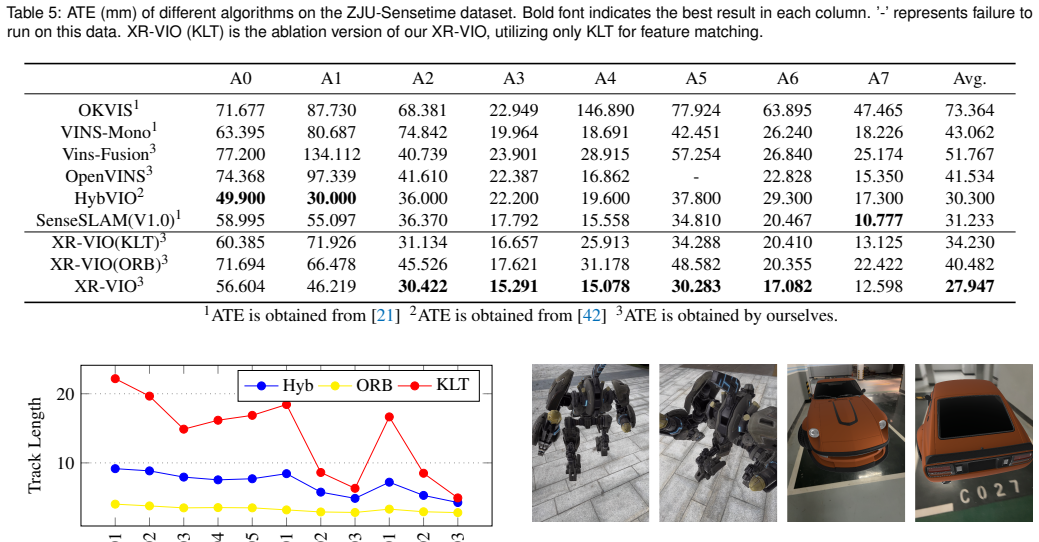
- The complete system reports an average EuRoC trajectory ATE of 0.107 m, the lowest among the feature-matching VIO systems compared, and runs in real time on mobile phones.
Reading between the lines
- The gyro-tight SfM idea could be applied to pure-rotation or nearly degenerate visual configurations, which the paper itself lists as limitations; replacing fragile visual rotation estimation with gyro rotation may extend VIO robustness there.
- The disparity-dependent weighting of the visual term suggests a general guideline: when parallax is low, the IMU cost should not be allowed to dominate, or the optimizer will fit IMU noise and distort the map.
- Because the initializer does not require calibrated gyro bias, it may tolerate per-device bias drift, but this is not tested; a natural check is to re-run the initializer on the same phone under different bias states and compare consistency.
Signed reviews
Editorial analysis
A structured set of objections, weighed in public.
Referee Report
Summary. The paper presents a monocular visual-inertial odometry system, XR-VIO, with two claimed contributions. The first is a fast visual-inertial initialization pipeline that tightly couples gyroscope measurements into structure-from-motion (VG-SfM, consisting of 2-point relative pose, VG-PnP, and VG-BA), followed by accelerometer-based alignment (VA-Align) and a final visual-inertial bundle adjustment (VI-BA) with a disparity-dependent weighting function. The second contribution is a hybrid feature-matching strategy that combines KLT optical flow and ORB descriptor matching with projection priors and optical-flow-guided descriptor search. Experiments on EuRoC and ZJU-Sensetime report lower initialization scale/ATE/gravity errors and lower trajectory ATE compared with several open-source baselines, and a mobile AR demo is described.
Significance. A reliable four-frame initialization procedure would be a practically valuable result for XR applications, where low-latency startup is important. The hybrid feature-matching scheme is a reasonable engineering contribution with consistent, if modest, trajectory-accuracy gains on both datasets. The paper's evaluation is broad: it uses public benchmarks, multiple baselines, and an ablation study, which strengthens the empirical case. However, the central success-rate claim rests on a weak definition of success, and the abstract overstates the state-of-the-art claim relative to the paper's own Table 2. If the claims are corrected and the success metric is made accuracy-aware, the underlying system appears sound and relevant to the VIO/AR community.
major comments (4)
- [Sec. 5.3, Tab. 2] The definition of 'success' in Sec. 5.3 is explicitly not tied to any accuracy threshold: 'Success does not necessarily imply that the initialization results meet a certain threshold, nor does it imply that the initialization poses are qualified for VIO tracking.' Under this definition, a fragment with a grossly wrong scale or a diverged pose still counts as a success. Consequently, the reported 83.98% 4KF success rate does not substantiate the abstract's claim of 'stable performance even with only four image frames,' which is the paper's principal contribution. The authors should report success rates under a practically meaningful accuracy bound (e.g., scale error below 10% and ATE below 0.1 m) and also report the fraction of fragments whose initialization would actually be usable by the VIO tracker.
- [Abstract; Tab. 2] The abstract states that the method demonstrates 'state-of-the-art performance in terms of accuracy and success rate,' but Tab. 2 shows DRT-t achieving a higher 4KF success rate (86.56% vs. 83.98%). The 5KF success rate is higher for XR-VIO, so the global wording is not supported by the presented evidence. The CDF in Fig. 6 is an unthresholded visualization and does not quantify the trade-off; a numerical comparison at fixed success-rate levels or at fixed error thresholds is needed. This overclaim directly affects the paper's headline contribution and must be corrected.
- [Sec. 5.3, Eq. (15)-(17)] The accuracy metrics (scale error, ATE, gravity error) are averaged only over successful fragments, while success rates differ substantially across methods (e.g., 2.17% for Closed-form vs. 83.98% for XR-VIO in the 4KF setting). This means the methods are evaluated on different fragment subsets; a method that fails on difficult fragments and succeeds only on easy ones will appear more accurate. The CDF in Fig. 6 is only a qualitative mitigation. The authors should provide a matched comparison on the subset of fragments where all compared methods succeed, or otherwise quantify accuracy at a common success-rate operating point.
- [Sec. 3.2] The entire VG-SfM pipeline rests on the assumption that consumer-grade gyroscope rotation provides sufficiently accurate relative orientation over short intervals, even without calibrated bias. The paper does not provide a sensitivity analysis of the 4KF initialization accuracy and success rate with respect to gyroscope noise, bias instability, or vibration. Since this assumption is the key enabler for the 2-point reconstruction, VG-PnP, and VG-BA steps, the authors should include an experiment with artificially degraded gyroscope measurements (e.g., added noise or bias) to delineate the operating range of the method.
minor comments (6)
- [Sec. 3.2] There is a typo in the sentence introducing VG-BA: 'we proceed to perform VG-BA, , a bundle adjustment' contains a double comma.
- [Sec. 3.4] In the description of the VI-BA weighting issue, 'the the degrees of freedom of the 4KF IMU are excessively high' contains a doubled article; please correct.
- [Sec. 5] The text says 'we run and evaluate overall trajectory's accuracy ont both MA V and phone datasets'; 'ont' should be 'on', and 'MA V' should be 'MAV'.
- [Tab. 5] Table 5 includes SenseSLAM(V1.0) as a baseline, but Sec. 5.1 does not describe this method; please add a citation and a brief description of its configuration.
- [Supplementary material] The paper references supplementary material for ADVIO results and a video demo, but no supplementary file appears to accompany the arXiv version; please ensure the supplementary material is provided and referenced correctly.
- [Fig. 5] The caption of Fig. 5 states that fragments are color-coded by scale error, but the figure has no colorbar; the reader cannot map colors to numerical error values.
Circularity Check
No significant circularity: the VG-SfM derivation is self-contained and validated against external ground truth; the Sec. 5.3 success-rate caveat is a metric-validity limitation, not a circular reduction.
full rationale
The paper's derivation chain is not circular. VG-SfM (Sec. 3.2) introduces a new objective (Eqs. 10 and 11) that combines gyroscope pre-integration with visual reprojection, and the 2-point relative pose uses gyroscope rotation as a known prior rather than as a fitted target. VA-Align (Sec. 3.3) follows the external VINS-Mono formulation [35] and preintegration [15], not a self-citation. The VI-BA weights in Eq. 14 are hand-set constants (wmax=e4, wmin=1, Pmin=20 px), not parameters fitted to the reported ATE, scale, or gravity outcomes. The central evaluation is against external benchmarks (EuRoC [5] and ZJU-Sensetime [21]) with ground-truth trajectories, so no reported 'prediction' reduces by construction to a fitted input. The self-citations ([2], [11], [21]) appear in related work or as baseline-data provenance and are not load-bearing for the claimed derivation. The Sec. 5.3 caveat that 'success' merely means the module processed the fragment and produced poses is an explicit metric-validity limitation: it weakens the abstract's robustness and state-of-the-art claims, but it is not a circular step because the success rate is not defined in terms of the claimed conclusion and no derived quantity is equated to its own input. Overall, no circularity found.
Assumptions & free parameters
free parameters (3)
- VI-BA visual weight parameters (wmax, wmin, Pmin) =
wmax = e^4, wmin = 1, Pmin = 20 pixels
- Static/motion detection thresholds =
not stated
- Hybrid matching parameters =
150 tracks, 10-pixel search radius, ratio test 0.7
assumptions (3)
- standard math IMU pre-integration model of Forster et al. and VINS-Mono residual definitions are assumed correct.
- domain assumption Consumer-grade gyroscopes provide accurate rotation over short time intervals even without calibrated bias.
- ad hoc to paper The VI-BA weighting function w(P) with Pmin = 20 pixels is a valid balance between visual and IMU terms.
Cite this review
Pith. "Pith review of XR-VIO: High-precision Visual Inertial Odometry with Fast Initialization for XR Applications." pith.science (2026). https://pith.science/paper/JICV4SUC
@misc{pith2026250201297,
  author       = {Pith},
  title        = {Pith review of: XR-VIO: High-precision Visual Inertial Odometry with Fast Initialization for XR Applications},
  year         = {2026},
  howpublished = {\url{https://pith.science/paper/JICV4SUC}},
  note         = {Machine review of arXiv:2502.01297}
}
read the original abstract
This paper presents a novel approach to Visual Inertial Odometry (VIO), focusing on the initialization and feature matching modules. Existing methods for initialization often suffer from either poor stability in visual Structure from Motion (SfM) or fragility in solving a huge number of parameters simultaneously. To address these challenges, we propose a new pipeline for visual inertial initialization that robustly handles various complex scenarios. By tightly coupling gyroscope measurements, we enhance the robustness and accuracy of visual SfM. Our method demonstrates stable performance even with only four image frames, yielding competitive results. In terms of feature matching, we introduce a hybrid method that combines optical flow and descriptor-based matching. By leveraging the robustness of continuous optical flow tracking and the accuracy of descriptor matching, our approach achieves efficient, accurate, and robust tracking results. Through evaluation on multiple benchmarks, our method demonstrates state-of-the-art performance in terms of accuracy and success rate. Additionally, a video demonstration on mobile devices showcases the practical applicability of our approach in the field of Augmented Reality/Virtual Reality (AR/VR).
Figures


Figures from the paper (4 more)


Forward citations
Cited by 1 Pith paper
-
Recent Advances and Future Directions in Extended Reality (XR): Exploring AI-Powered Spatial Intelligence
A survey-style preprint describes XR hardware, software, and products and argues that multi-modal AI and IoT digital twins will drive future spatial intelligence.
Reference graph
Works this paper leans on
-
[1]
J. Bang, D. Lee, Y . Kim, and H. Lee. Camera pose estimation using optical flow and orb descriptor in slam-based mobile ar game. In 2017 International Conference on Platform Technology and Service (PlatCon) , pp. 1–4. IEEE, 2017. 2, 5
work page 2017
-
[2]
H. Bao, W. Xie, Q. Qian, D. Chen, S. Zhai, N. Wang, and G. Zhang. Robust tightly-coupled visual-inertial odometry with pre-built maps in high latency situations. IEEE Transactions on Visualization and Computer Graphics, 28(5):2212–2222, 2022. 2
work page 2022
-
[3]
M. Bloesch, M. Burri, S. Omari, M. Hutter, and R. Siegwart. Iterated ex- tended kalman filter based visual-inertial odometry using direct photomet- ric feedback. The International Journal of Robotics Research, 36(10):1053– 1072, 2017. 2
work page 2017
-
[4]
G. Bradski. The OpenCV Library. Dr . Dobb’s Journal of Software Tools,
- [5]
-
[6]
Q. Cai, L. Zhang, Y . Wu, W. Yu, and D. Hu. A pose-only solution to visual reconstruction and navigation. IEEE Transactions on Pattern Analysis and Machine Intelligence, 45(1):73–86, 2021. 6
work page 2021
-
[7]
M. Calonder, V . Lepetit, C. Strecha, and P. Fua. Brief: Binary robust independent elementary features. In Computer Vision–ECCV 2010: 11th European Conference on Computer Vision, Heraklion, Crete, Greece, September 5-11, 2010, Proceedings, Part IV 11 , pp. 778–792. Springer,
work page 2010
- [8]
Show all 53 references
-
[9]
Campos, J
C. Campos, J. M. Montiel, and J. D. Tardós. Fast and robust initialization for visual-inertial slam. In 2019 International Conference on Robotics and Automation (ICRA), pp. 1288–1294. IEEE, 2019. 1
2019
-
[10]
Campos, J
C. Campos, J. M. Montiel, and J. D. Tardós. Inertial-only optimization for visual-inertial initialization. In 2020 IEEE International Conference on Robotics and Automation (ICRA) , pp. 51–57. IEEE, 2020. 1, 3, 6, 7
2020
-
[11]
D. Chen, N. Wang, R. Xu, W. Xie, H. Bao, and G. Zhang. RNIN-VIO: Robust neural inertial navigation aided visual-inertial odometry in chal- lenging scenes. In 2021 IEEE International Symposium on Mixed and Augmented Reality (ISMAR), pp. 275–283. IEEE, 2021. 2
2021
-
[12]
Cortés, A
S. Cortés, A. Solin, E. Rahtu, and J. Kannala. ADVIO: An authentic dataset for visual-inertial odometry. In Proceedings of the European Conference on Computer Vision (ECCV), pp. 419–434, 2018. 8
2018
-
[13]
Dong-Si and A
T.-C. Dong-Si and A. I. Mourikis. Estimator initialization in vision- aided inertial navigation with unknown camera-imu calibration. In 2012 IEEE/RSJ International Conference on Intelligent Robots and Systems , pp. 1064–1071, 2012. doi: 10.1109/IROS.2012.6386235 1, 2
2012
-
[14]
Engel, V
J. Engel, V . Koltun, and D. Cremers. Direct sparse odometry. IEEE transactions on pattern analysis and machine intelligence , 40(3):611–625,
-
[15]
Forster, L
C. Forster, L. Carlone, F. Dellaert, and D. Scaramuzza. On-manifold preintegration for real-time visual–inertial odometry. IEEE Transactions on Robotics, 33(1):1–21, 2017. 1, 2, 3, 4
2017
-
[16]
Geneva, K
P. Geneva, K. Eckenhoff, W. Lee, Y . Yang, and G. Huang. OpenVINS: A research platform for visual-inertial estimation. In 2020 IEEE Interna- tional Conference on Robotics and Automation (ICRA) , pp. 4666–4672. IEEE, 2020. 2, 3, 4, 5, 6, 7
2020
-
[17]
Geneva and G
P. Geneva and G. Huang. Openvins state initialization: Details and derivations. Technical report, Tech. Rep. RPNG-2022-INIT, University of Delaware, 2022. 2, 7
2022
-
[18]
M. Grupp. evo: Python package for the evaluation of odometry and slam. https://github.com/MichaelGrupp/evo, 2017. 6
2017
-
[19]
Y . He, B. Xu, and H. Li. A rotation-translation-decoupled solution for robust and efficient visual-inertial initialization. In Proceedings of the IEEE/CVF Conference on Computer Vision and Pattern Recognition , pp. 739–748, 2023. 1, 2, 3, 6, 7
2023
-
[20]
Huai and G
Z. Huai and G. Huang. Robocentric visual-inertial odometry. The Interna- tional Journal of Robotics Research, 41(7):667–689, 2022. 2
2022
-
[21]
Jinyu, Y
L. Jinyu, Y . Bangbang, C. Danpeng, W. Nan, Z. Guofeng, and B. Hujun. Survey and evaluation of monocular visual-inertial SLAM algorithms for augmented reality. Virtual Reality & Intelligent Hardware, 1(4):386–410,
-
[22]
Kneip, M
L. Kneip, M. Chli, and R. Siegwart. Robust real-time visual odometry with a single camera and an imu. In Procedings of the British Machine Vision Conference 2011, Dec 2010. doi: 10.5244/c.25.16 4
2011 doi
-
[23]
Kneip and S
L. Kneip and S. Lynen. Direct optimization of frame-to-frame rotation. In 2013 IEEE International Conference on Computer Vision , Nov 2013. doi: 10.1109/iccv.2013.292 6
2013 doi
-
[24]
Leutenegger, M
S. Leutenegger, M. Chli, and R. Y . Siegwart. Brisk: Binary robust invariant scalable keypoints. In 2011 International Conference on Computer Vision , pp. 2548–2555, 2011. doi: 10.1109/ICCV.2011.6126542 2
2011
-
[25]
Leutenegger, S
S. Leutenegger, S. Lynen, M. Bosse, R. Siegwart, and P. Furgale. Keyframe-based visual–inertial odometry using nonlinear optimization. The International Journal of Robotics Research , 34(3):314–334, 2015. 2, 5, 6, 7
2015
-
[26]
Lucas and T
B. Lucas and T. Kanade. An iterative image registration technique with an application to stereo vision. Aug 1981. 2, 4, 5
1981
-
[27]
Martinelli
A. Martinelli. Closed-form solution of visual-inertial structure from mo- tion. International journal of computer vision , 106(2):138–152, 2014. 1, 3, 6
2014
-
[28]
P. S. Maybeck. Stochastic models, estimation, and control . Academic press, 1982. 4
1982
-
[29]
Merrill, P
N. Merrill, P. Geneva, and S. K. C. C. G. Huang. Fast monocular visual- inertial initialization leveraging learned single-view depth. In Robotics: Science and Systems (RSS) , vol. 2, 2023. 2
2023
-
[30]
A. I. Mourikis and S. I. Roumeliotis. A multi-state constraint kalman filter for vision-aided inertial navigation. In Proceedings 2007 IEEE International Conference on Robotics and Automation , pp. 3565–3572, 4
2007
-
[31]
Mur-Artal, J
R. Mur-Artal, J. M. M. Montiel, and J. D. Tardós. ORB-SLAM: a versatile and accurate monocular SLAM system. IEEE Transactions on Robotics, 31(5):1147–1163, 2015. 5, 6
2015
-
[32]
Mur-Artal and J
R. Mur-Artal and J. D. Tardós. Visual-inertial monocular SLAM with map reuse. IEEE Robotics and Automation Letters , 2(2):796–803, 2017. 2, 8
2017
-
[33]
D. Nister. An efficient solution to the five-point relative pose prob- lem. IEEE Transactions on Pattern Analysis and Machine Intelligence , 26(6):756–770, June 2004. 4
2004
-
[34]
T. Qin, S. Cao, J. Pan, and S. Shen. A general optimization-based frame- work for global pose estimation with multiple sensors, 2019. 2
2019
-
[35]
T. Qin, P. Li, and S. Shen. VINS-Mono: A robust and versatile monocular visual-inertial state estimator. IEEE Transactions on Robotics, 34(4):1004– 1020, 2018. 1, 2, 3, 4, 5, 6, 7
2018
-
[36]
T. Qin, J. Pan, S. Cao, and S. Shen. A general optimization-based frame- work for local odometry estimation with multiple sensors, 2019. 2, 6, 7
2019
-
[37]
Qin and S
T. Qin and S. Shen. Robust initialization of monocular visual-inertial estimation on aerial robots. In 2017 IEEE/RSJ International Conference on Intelligent Robots and Systems (IROS) , Sep 2017. doi: 10.1109/iros. 2017.8206284 1
2017
-
[38]
Ranftl, K
R. Ranftl, K. Lasinger, D. Hafner, K. Schindler, and V . Koltun. Towards robust monocular depth estimation: Mixing datasets for zero-shot cross- dataset transfer. IEEE transactions on pattern analysis and machine intelligence, 44(3):1623–1637, 2020. 2
2020
-
[39]
Rublee, V
E. Rublee, V . Rabaud, K. Konolige, and G. Bradski. Orb: An efficient alternative to sift or surf. In 2011 International conference on computer vision, pp. 2564–2571. Ieee, 2011. 2
2011
-
[40]
Sarlin, D
P.-E. Sarlin, D. DeTone, T. Malisiewicz, and A. Rabinovich. Superglue: Learning feature matching with graph neural networks. In Proceedings of the IEEE/CVF conference on computer vision and pattern recognition , pp. 4938–4947, 2020. 2
2020
-
[41]
R. B. Schinazi. The Cumulative Distribution Function , pp. 159–168. Springer International Publishing, Cham, 2022. doi: 10.1007/978-3-030 -93635-8_15 7
2022 doi
-
[42]
Seiskari, P
O. Seiskari, P. Rantalankila, J. Kannala, J. Ylilammi, E. Rahtu, and A. Solin. Hybvio: Pushing the limits of real-time visual-inertial odometry. In Proceedings of the IEEE/CVF Winter Conference on Applications of Computer Vision, pp. 701–710, 2022. 6, 7, 8, 9
2022
-
[43]
Shi and Tomasi
J. Shi and Tomasi. Good features to track. In 1994 Proceedings of IEEE Conference on Computer Vision and Pattern Recognition , pp. 593–600, June 1994. 2
1994
-
[44]
J. Sun, Z. Shen, Y . Wang, H. Bao, and X. Zhou. Loftr: Detector-free local feature matching with transformers. In Proceedings of the IEEE/CVF conference on computer vision and pattern recognition , pp. 8922–8931,
-
[45]
Triggs, P
B. Triggs, P. F. McLauchlan, R. I. Hartley, and A. W. Fitzgibbon. Bundle adjustment—a modern synthesis. In International workshop on vision algorithms, pp. 298–372. Springer, 1999. 2
1999
-
[46]
von Stumberg and D
L. von Stumberg and D. Cremers. DM-VIO: Delayed marginalization visual-inertial odometry. IEEE Robotics and Automation Letters (RA-L) , 7(2):1408–1415, 2022. 2, 8
2022
-
[47]
V on Stumberg, V
L. V on Stumberg, V . Usenko, and D. Cremers. Direct sparse visual-inertial odometry using dynamic marginalization. In 2018 IEEE International Conference on Robotics and Automation (ICRA) , pp. 2510–2517. IEEE,
2018
-
[48]
K. Wu, A. M. Ahmed, G. A. Georgiou, and S. I. Roumeliotis. A square root inverse filter for efficient vision-aided inertial navigation on mobile devices. In Robotics: Science and Systems , vol. 2, p. 2. Rome, Italy, 2015. 3, 4
2015
-
[49]
Zhang and D
Z. Zhang and D. Scaramuzza. A tutorial on quantitative trajectory evalua- tion for visual(-inertial) odometry. In IEEE/RSJ Int. Conf. Intell. Robot. Syst. (IROS), 2018. 6
2018
-
[50]
Zhong, L
L. Zhong, L. Meng, W. Hou, and L. Huang. An improved visual odome- ter based on lucas-kanade optical flow and orb feature. IEEE Access , 11:47179–47186, 2023. 2, 5
2023
-
[51]
Y . Zhou, A. Kar, E. Turner, A. Kowdle, C. Guo, R. DuToit, and K. Tsotsos. Learned monocular depth priors in visual-inertial initialization. Apr 2022. 2, 6, 7
2022
-
[52]
L. Zong, H. Wang, B. Wang, Q. Fu, and X. Sun. An improved method of real-time camera pose estimation based on descriptor tracking. In 2017 IEEE 20th International Conference on Intelligent Transportation Systems (ITSC), pp. 903–908. IEEE, 2017. 2, 5
2017
-
[53]
Zuñiga-Noël, F.-A
D. Zuñiga-Noël, F.-A. Moreno, and J. Gonzalez-Jimenez. An analytical solution to the imu initialization problem for visual-inertial systems. IEEE Robotics and Automation Letters, 6(3):6116–6122, 2021. 1
2021
Reviewed August 9, 2026 · model on record in the stance chip above.
Discussion (0). Continue with ORCID to comment.