REVIEW 4 major objections 6 minor 27 references
End-to-end Training for Text-to-Image Synthesis using Dual-Text Embeddings
T0 review · 4 major / 6 minor · reviewed 2026-08-09 · deepseek-v4-flash
Pith's one-line read Splitting text embeddings into a realism branch and an alignment branch improves text-to-image GANs.
desk verdict Decoupling generator- and discriminator-side text embeddings is a plausible idea with a solid internal ablation, but the circular R-precision metric means the alignment claim doesn't hold up; the photo-realism gains do. read the letter →
The pith
A machine-rendered reading of the paper's core claim, the machinery that carries it, and where it could break.
The reading
What carries the argument
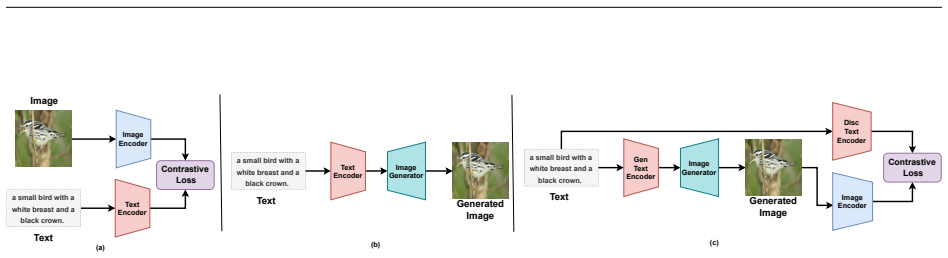
The central object is the dual text embedding setup: two independent word-embedding layers ($W_G$ and $W_D$) with two Bi-LSTM sentence encoders, one producing the generator-side sentence embedding $S_G$ and the other the discriminator-side sentence embedding $S_D$. The mechanism that makes the split work is gradient isolation: $S_G$ learns only from generation losses (adversarial loss plus multi-modal contrastive loss on fake images), while $S_D$ learns only from the multi-modal contrastive loss on real image-text pairs, with a stop-gradient preventing noisy generation gradients from flowing into $S_D$ when it is passed to the generator.
What would settle it
Run a strictly controlled comparison where the architecture is held fixed and only the embedding scheme changes—same generator and discriminator widths, losses, training schedule, and random seeds, with dual embeddings versus a single shared embedding—and test whether the dual version still improves FID and R-precision; alternatively, insert DTE-GAN's dual embeddings into DF-GAN's exact generator and discriminator and check whether FID improves over DF-GAN's reported 14.81 on CUB. If the gap disappears in either test, the dual-embedding claim is not responsible for the published advantage.
Extended reading notes
Core claim
The central claim is that decoupling text conditioning into two independently trained embeddings improves text-to-image generation. DTE-GAN uses separate word embeddings and Bi-LSTM sentence encoders for the generator and the discriminator: the generator-side embedding is updated only by the adversarial loss and by a contrastive loss computed on generated images, while the discriminator-side embedding is updated only by a contrastive loss computed on real image-text pairs. The generator additionally receives a detached copy of the discriminator-side sentence embedding, which the authors call a 'sneak peek' at a stable, alignment-focused representation. The paper reports that a shared embedding trained with both losses produces worse images, and that feeding the noisy generator-side embedding to the discriminator degrades performance, which it reads as evidence that separate, purpose-specific embeddings are the effective design choice.
Load-bearing premise
The conclusion that the dual-embedding design itself causes the reported gains rests on ablations performed inside DTE-GAN's own architecture; comparisons against earlier methods change the generator, discriminator, and parameter count simultaneously, so the dual embeddings may not be the actual source of the improvement over those baselines.
Editorial extensions
If this is right
- On CUB, DTE-GAN lowers FID to 13.67 and raises R-precision to 86.64, beating DF-GAN (14.81 FID) and AttnGAN (23.98 FID) on the same dataset.
- On Oxford-102, DTE-GAN lowers FID to 30.07 from DualAttn-GAN's 40.31 and raises Inception Score to 4.21.
- On MS-COCO, DTE-GAN reaches FID 25.17 with 11M parameters, and 19.69 with DTE-GAN+MAGP, matching DF-GAN and SSA-GAN while using roughly half their parameter count.
- Table 6 shows the dual-embedding configuration beats all shared-embedding variants of the same architecture on IS, FID, and R-precision.
- The learned dual embeddings transfer: used as fixed word embeddings in a lightweight text-guided manipulation GAN, they improve FID from 8.02 to 7.77 on CUB.
Reading between the lines
- If the decoupling principle generalizes, frozen pre-trained text encoders like CLIP may be leaving generative performance on the table: they are optimized for alignment and retrieval, not for driving a decoder toward realism. A testable extension would be to add a trainable realism branch to a diffusion-based text-to-image model while keeping a frozen alignment branch.
- The successful 'sneak peek'—feeding the generator a detached, contrastively trained sentence embedding—suggests a general design rule for conditional generative models: the cleanest representation of the condition is not necessarily the one that should be fine-tuned by the generator's own noisy gradients. This could be probed in other conditional GANs by adding or removing the stop-gradient on the
- The same dual-embedding split could transfer to other multimodal generation tasks, such as text-to-video or layout-to-image generation, where a single conditioning embedding currently has to serve both realism and semantic fidelity.
Signed reviews
Editorial analysis
A structured set of objections, weighed in public.
Referee Report
Summary. The manuscript proposes DTE-GAN, an end-to-end text-to-image GAN that learns two separate Bi-LSTM text embeddings: a generator-side embedding optimized through the adversarial/generation losses and a discriminator-side embedding optimized through a multi-modal contrastive loss on real image-text pairs. The generator conditions on both embeddings, while the discriminator uses the discriminator-side embedding for contrastive alignment and for adversarial criticism. The paper reports IS, FID, and R-precision on CUB, Oxford-102, and MS-COCO, presents an internal ablation (Table 6) showing that the dual-embedding configuration outperforms shared-embedding variants, demonstrates integration into AttnGAN (Table 4), and shows reuse of the learned embeddings for text-guided image manipulation (Table 5).
Significance. If the central claim holds, decoupling a text representation optimized for photo-realism from one optimized for text-image alignment is a useful, parameter-efficient design principle for lightweight GAN-based text-to-image synthesis. The paper has real strengths: Table 6 is a controlled internal ablation that isolates the embedding organization, Table 4 tests portability to an existing architecture, Table 5 shows downstream reuse, and DTE-GAN uses far fewer parameters (11M) than DF-GAN and SSA-GAN. The main reservation is that R-precision is computed with the same discriminator-side encoder that the generator is trained to align with, so the alignment benefit attributed to the dual-embedding design is not independently confirmed. An external-encoder evaluation would substantially strengthen the core claim.
major comments (4)
- [Appendix C.4; Eq. (6), Eq. (11)] The manuscript computes R-precision using text features from the D-side Bi-LSTM sentence encoder and image features from the discriminator network (Appendix C.4). These are exactly the encoder and image feature extractor optimized by the contrastive losses in Eq. (6) and Eq. (11), and the generator is trained to maximize similarity of generated images to SD under this same encoder. Consequently, the R-precision numbers in Tables 1, 3, 4, and 6 partly measure whether the generator conditions on the evaluation encoder rather than generic text-image alignment. The CUB jump from 63.79 to 86.64 between Table 6 row 3 and row 5 illustrates this dependence. Please re-evaluate R-precision (or at least the main comparisons) with an external frozen text/image encoder, such as CLIP or a DAMSM encoder not trained inside the DTE-GAN pipeline, and report both sets of numbers. This is necessary to support the abstract's and conclusion's claims about text-to-image alignment.
- [Section 1; Section 4.2; Table 1] The abstract and Section 4.2 state that DTE-GAN reduces CUB FID 'from 14.06 to 13.67', but no method in Table 1 has a FID baseline of 14.06: TIME is 14.30, DF-GAN is 14.81, and DAE-GAN is 15.19. Please identify the correct baseline or correct the number, because as written the improvement claim is not verifiable from the reported tables.
- [Section 4.2; Table 1; Table 6] The paper attributes part of its cross-method superiority to the dual-embedding design, but the comparisons in Tables 1 and 2 involve models with different generators, discriminators, loss terms, and parameter counts; the manuscript itself notes that DTE-GAN halves the width of DF-GAN/SSA-GAN blocks. Table 6 varies only the embedding organization within DTE-GAN's own architecture, so it cannot separate the effect of the embedding scheme from the effect of the overall architecture in the Table 1 and Table 2 comparisons. Please either add architecture-matched baseline models with shared embeddings for the external comparisons or qualify the attribution accordingly.
- [Section 4.2; Table 1] The sentence 'On MS-COCO, we achieve similar performance of DF-GAN and SSA-GAN with fewer parameters' is not supported by Table 1 unless it refers to DTE-GAN+MAGP: DTE-GAN itself reports COCO FID 25.17, while DF-GAN reports 19.32 and SSA-GAN reports 19.37; DTE-GAN+MAGP reports 19.69. Please correct the sentence or explicitly state that the comparable result is achieved by DTE-GAN+MAGP.
minor comments (6)
- [Title page/author line] The author line reads 'Y eruru Asrar Ahmed'; this appears to be a formatting artifact and should be corrected to 'Yeruru Asrar Ahmed'.
- [Throughout] There are numerous typos and garbled words, including 'covaraince', 'regualarisation', 'apporach', 'geandator', 'Futher', and 'perpal' in Figure 4; the manuscript needs a careful proofreading pass.
- [Table 3] The CLIP and CLIP+Gemb baselines are not fully specified: it should be stated explicitly whether they use the same DTE-GAN generator/discriminator architecture or a different GAN architecture, since otherwise the comparison is difficult to interpret.
- [Table 5] The method name 'MANIGAN' should be 'ManiGAN' for consistency with the referenced work.
- [Section 4.3.6/Table 8 caption] The caption 'Single embeddings with outLG training achieves superior performance' is grammatically unclear; it should likely read 'with LG training' or 'without LG training' as appropriate.
- [Table 2; Table 3; Table 6] Table 2 states that R-precision scores are not available in the literature for Oxford-102, yet Tables 3 and 6 report Oxford R-precision values for DTE and CLIP variants; this is not contradictory, but the manuscript should clarify that the literature comparison lacks such numbers while the paper independently reports them.
Circularity Check
R-precision is measured with the same D-side encoder that the generator is trained to match, so the text-image alignment claim is partly circular; FID/IS remain externally grounded.
-
fitted input called prediction
[Appendix C.4; Eqs. (6)-(7), Sec. 3.2]
"For R-precision, we obtain text features from D-side Bi-LSTM sentence encoder and image features from discriminator network. ... L^G_cont(ˆfvi,SDi) = − log exp(Sim(ˆfvi,SDi)) / ∑Nj=1 exp(Sim(ˆfvi,SDj)) ... Sim(fv,SD) = cos(fv,SD)/τ"
R-precision is not an independent probe of text-image alignment: its text encoder is the D-side Bi-LSTM and its image encoder is the discriminator network, i.e., the exact feature pair coupled by the contrastive losses. The generator is trained with L^G_cont to maximize cos(ˆfv, SD)/τ for the caption, so retrieval with the same pair measures how well the model optimizes its own objective. Table 6's R-precision jump from 63.79 to 86.64 when SD→G is switched on is therefore partly a metric artifact: the generator now conditions on the very SD whose encoder is used for scoring. The claim that the second embedding improves alignment is not independently established; only the FID/IS photo-realism gains escape this circularity.
full rationale
The paper contains no load-bearing self-citations and its architecture derivation is self-contained. The central issue is evaluative: the R-precision metric is computed with the discriminator-side encoder that is co-trained with the generator through the multi-modal contrastive loss, so the text-image alignment results reduce, in part, to the training objective by construction. The image-quality claims, however, rely on Inception-v3 based FID and IS, which are external and independently meaningful. Because the main photorealism benefit is externally grounded but the alignment benefit is partly self-referential, a partial circularity score of 6 is appropriate.
Assumptions & free parameters
free parameters (4)
- contrastive temperature tau =
unspecified
- loss weights lambda1, lambda2, lambda3 =
1, 1, 1
- EMA decay =
0.999
- truncation parameter =
unspecified
assumptions (4)
- domain assumption Multi-modal contrastive loss between real image-text pairs trains a text embedding that captures text-image alignment.
- domain assumption FID and IS computed with the fixed Inception-v3 network are valid proxies for generated image quality.
- domain assumption The separation of gradients (generator-side embeddings receive only generator losses; discriminator-side embeddings receive only contrastive loss) is implemented correctly at training time.
- domain assumption Reported baselines from prior papers use the same evaluation protocol and are directly comparable.
Cite this review
Pith. "Pith review of End-to-end Training for Text-to-Image Synthesis using Dual-Text Embeddings." pith.science (2026). https://pith.science/paper/KMX6ULIB
@misc{pith2026250201507,
  author       = {Pith},
  title        = {Pith review of: End-to-end Training for Text-to-Image Synthesis using Dual-Text Embeddings},
  year         = {2026},
  howpublished = {\url{https://pith.science/paper/KMX6ULIB}},
  note         = {Machine review of arXiv:2502.01507}
}
read the original abstract
Text-to-Image (T2I) synthesis is a challenging task that requires modeling complex interactions between two modalities ( i.e., text and image). A common framework adopted in recent state-of-the-art approaches to achieving such multimodal interactions is to bootstrap the learning process with pre-trained image-aligned text embeddings trained using contrastive loss. Furthermore, these embeddings are typically trained generically and reused across various synthesis models. In contrast, we explore an approach to learning text embeddings specifically tailored to the T2I synthesis network, trained in an end-to-end fashion. Further, we combine generative and contrastive training and use two embeddings, one optimized to enhance the photo-realism of the generated images, and the other seeking to capture text-to-image alignment. A comprehensive set of experiments on three text-to-image benchmark datasets (Oxford-102, Caltech-UCSD, and MS-COCO) reveal that having two separate embeddings gives better results than using a shared one and that such an approach performs favourably in comparison with methods that use text representations from a pre-trained text encoder trained using a discriminative approach. Finally, we demonstrate that such learned embeddings can be used in other contexts as well, such as text-to-image manipulation.
Figures


Figures from the paper (5 more)


Reference graph
Works this paper leans on
-
[2]
Jun Cheng, Fuxiang Wu, Yanling Tian, Lei Wang, and Dapeng Tao
URL https://arxiv.org/pd f/1810.01365.pdf. Jun Cheng, Fuxiang Wu, Yanling Tian, Lei Wang, and Dapeng Tao. Rifegan: Rich feature generation for text-to-image synthesis from prior knowledge. In2020 IEEE/CVF Conference on Computer Vision and Pattern Recognition (CVPR), pp. 10908–10917,
-
[5]
13 Oran Gafni, Adam Polyak, Oron Ashual, Shelly Sheynin, Devi Parikh, and Yaniv Taigman
URLhttps://arxiv.org/abs/2012.09841. 13 Oran Gafni, Adam Polyak, Oron Ashual, Shelly Sheynin, Devi Parikh, and Yaniv Taigman. Make-a-scene: Scene-based text-to-image generation with human priors,
arXiv 2012
-
[6]
Diederik P. Kingma and Jimmy Ba. Adam: A method for stochastic optimization. In Yoshua Bengio and Yann LeCun (eds.),3rd International Conference on Learning Representations, ICLR 2015, San Diego, CA, USA, May 7-9, 2015, Conference Track Proceedings,
work page 2015
-
[8]
Bowen Li, Xiaojuan Qi, Thomas Lukasiewicz, and Philip H.S. Torr. Manigan: Text-guided image manipula- tion. InProceedings of the IEEE/CVF Conference on Computer Vision and Pattern Recognition (CVPR), June 2020a. 14 Bowen Li, Xiaojuan Qi, Philip Torr, and Thomas Lukasiewicz. Lightweight generative adversarial networks for text-guided image manipulation. In...
work page 2020
-
[10]
Maria-Elena Nilsback and Andrew Zisserman
URLhttps: //arxiv.org/abs/2102.09672. Maria-Elena Nilsback and Andrew Zisserman. Automated flower classification over a large number of classes. In Indian Conference on Computer Vision, Graphics and Image Processing, Dec
-
[11]
URLhttps://arxiv.org/abs/2103.00020. Aditya Ramesh, Mikhail Pavlov, Gabriel Goh, Scott Gray, Chelsea Voss, Alec Radford, Mark Chen, and Ilya Sutskever. Zero-shot text-to-image generation.CoRR, abs/2102.12092,
-
[12]
Aditya Ramesh, Prafulla Dhariwal, Alex Nichol, Casey Chu, and Mark Chen
URLhttps://arxiv.org/ abs/2102.12092. Aditya Ramesh, Prafulla Dhariwal, Alex Nichol, Casey Chu, and Mark Chen. Hierarchical text-conditional image generation with clip latents,
-
[13]
Ali Razavi, Aaron van den Oord, and Oriol Vinyals
URLhttps://arxiv.org/abs/2204.06125. Ali Razavi, Aaron van den Oord, and Oriol Vinyals. Generating diverse high-fidelity images with vq-vae-2. In H. Wallach, H. Larochelle, A. Beygelzimer, F. d'Alché-Buc, E. Fox, and R. Garnett (eds.),Advances in Neural Information Processing Systems. Curran Associates, Inc.,
Show all 27 references
-
[14]
Tim Salimans, Ian Goodfellow, Wojciech Zaremba, Vicki Cheung, Alec Radford, and Xi Chen
URL https://arxiv.org/abs/2205.11487. Tim Salimans, Ian Goodfellow, Wojciech Zaremba, Vicki Cheung, Alec Radford, and Xi Chen. Improved techniques for training gans. InProceedings of the 30th International Conference on Neural Information Processing Systems, NIPS’16, pp. 2234–...
-
[16]
Hongchen Tan, Xiuping Liu, Baocai Yin, and Xin Li
doi: 10.1109/TIP.2020.3026728. Hongchen Tan, Xiuping Liu, Baocai Yin, and Xin Li. Cross-modal semantic matching generative adversarial networks for text-to-image synthesis.IEEE Transactions on Multimedia, 24:832–845, 2022a. doi: 10.110 9/TMM.2021.3060291. Hongchen Tan, Xiuping...
2020
-
[17]
Ming Tao, Hao Tang, Fei Wu, Xiao-Yuan Jing, Bing-Kun Bao, and Changsheng Xu
doi: 10.1109/ICIBA50161 .2020.9277299. Ming Tao, Hao Tang, Fei Wu, Xiao-Yuan Jing, Bing-Kun Bao, and Changsheng Xu. Df-gan: A simple and effective baseline for text-to-image synthesis. InProceedings of the IEEE/CVF Conference on Computer Vision and Pattern Recognition (CVPR), ...
2020
-
[21]
Stackgan++: Realistic image synthesis with stacked generative adversarial networks.IEEE Transactions on Pattern Analysis and Machine Intelligence, PP, 10 2017a
Han Zhang, Tao Xu, Hongsheng Li, Shaoting Zhang, Xiaogang Wang, Xiaolei Huang, and Dimitris Metaxas. Stackgan++: Realistic image synthesis with stacked generative adversarial networks.IEEE Transactions on Pattern Analysis and Machine Intelligence, PP, 10 2017a. doi: 10.1109/TP...
-
[23]
Zizhao Zhang, Yuanpu Xie, and Lin Yang
URLhttps://arxiv.org/abs/2011.02709. Zizhao Zhang, Yuanpu Xie, and Lin Yang. Photographic text-to-image synthesis with a hierarchically-nested adversarial network. InProceedings of the IEEE Conference on Computer Vision and Pattern Recognition (CVPR), June
2011 arXiv
-
[25]
A DTE-GAN with MA-GP Recent methods (Tao et al., 2022; Zhang & Schomaker, 2020; Liao et al.,
2022
-
[26]
of replicating sentence features and concatenating with image features to predict logit values for adversarial loss, the modified adversarial loss function of Discriminator for conditional loss with MA-GP is: LAdv D =− Ex∼Pdata[max(0, 1−D(x,SD))] + Eˆx∼PG[max(0, 1 +D(ˆx,SD))] ...
1997
-
[27]
(2017) in both the generator and discriminator text encoders, and we have reported the results in Table
with a 4-layer Transformer encoder Vaswani et al. (2017) in both the generator and discriminator text encoders, and we have reported the results in Table
2017
-
[28]
DTE-GAN architecture consists of a dual text embedding setup (Section C.1), a single-stage Generator (Section C.2) and a Discriminator (Section C.3)
framework. DTE-GAN architecture consists of a dual text embedding setup (Section C.1), a single-stage Generator (Section C.2) and a Discriminator (Section C.3). C.1 Dual Text Embeddings IntheDualText Embeddingssetup, bi-DirectionalLSTM(Schuster&Paliwal,1997)areusedastextencode...
1997
-
[29]
The generatorG takes noisez along with generator-side sentence embeddingsSG and the discriminator-side sentence embeddingSD and passes them through a set of linear layers followed by a set of upsampling blocks (UpBlocks). UpBlock at each stage is utilised for up sampling spati...
2019
-
[200]
Technical Report CNS-TR-2010-001, California Institute of Technology,
2010
-
[1997]
Jascha Sohl-Dickstein, Eric Weiss, Niru Maheswaranathan, and Surya Ganguli
doi: 10.1109/78.650093. Jascha Sohl-Dickstein, Eric Weiss, Niru Maheswaranathan, and Surya Ganguli. Deep unsupervised learning using nonequilibrium thermodynamics. In Francis Bach and David Blei (eds.),Proceedings of the 32nd International Conference on Machine Learning, volum...
-
[2015]
Alex Krizhevsky
URLhttp://arxiv.org/abs/1412.6980. Alex Krizhevsky. Learning multiple layers of features from tiny images. Technical report,
-
[2017]
URLhttps://proceedings.neurips.cc/paper/2017/file /3f5ee243547dee91fbd053c1c4a845aa-Paper.pdf. P. Welinder, S. Branson, T. Mita, C. Wah, F. Schroff, S. Belongie, and P. Perona. Caltech-UCSD Birds
2017
-
[2018]
Lafite: Towards language-free training for text-to-image generation.arXiv preprint arXiv:2111.13792,
Yufan Zhou, Ruiyi Zhang, Changyou Chen, Chunyuan Li, Chris Tensmeyer, Tong Yu, Jiuxiang Gu, Jinhui Xu, and Tong Sun. Lafite: Towards language-free training for text-to-image generation.arXiv preprint arXiv:2111.13792,
-
[2019]
Ting Chen, Mario Lučić, Neil Houlsby, and Sylvain Gelly
doi: 10.1109/ACCESS.2019.2958864. Ting Chen, Mario Lučić, Neil Houlsby, and Sylvain Gelly. On self-modulation for generative adversarial networks. InInternational Conference on Learning Representations,
2019
-
[2020]
Ayushman Dash, John Cristian Borges Gamboa, Sheraz Ahmed, Marcus Liwicki, and Muhammad Zeshan Afzal
doi: 10.1109/CVPR42600.2020.01092. Ayushman Dash, John Cristian Borges Gamboa, Sheraz Ahmed, Marcus Liwicki, and Muhammad Zeshan Afzal. Tac-gan - text conditioned auxiliary classifier generative adversarial network,
2020
-
[2022]
Lawrence Zitnick
Tsung-Yi Lin, Michael Maire, Serge Belongie, James Hays, Pietro Perona, Deva Ramanan, Piotr Dollár, and C. Lawrence Zitnick. Microsoft coco: Common objects in context. In David Fleet, Tomas Pajdla, Bernt Schiele, and Tinne Tuytelaars (eds.),Computer Vision – ECCV 2014, 2014a. ...
2014
-
[2024]
17 Guojun Yin, Bin Liu, Lu Sheng, Nenghai Yu, Xiaogang Wang, and Jing Shao
doi: 10.1109/TMM.2023.3266607. 17 Guojun Yin, Bin Liu, Lu Sheng, Nenghai Yu, Xiaogang Wang, and Jing Shao. Semantics disentangling for text-to-image generation. InProceedings of the IEEE/CVF Conference on Computer Vision and Pattern Recognition (CVPR), June
2023
Reviewed August 9, 2026 · model on record in the stance chip above.
Discussion (0). Continue with ORCID to comment.