REVIEW 3 major objections 5 minor 32 references
Design and Simulation of the Adaptive Continuous Entanglement Generation Protocol
T0 review · 3 major / 5 minor · reviewed 2026-08-09 · deepseek-v4-flash
Pith's one-line read A quantum network that continuously pre-generates entanglement with adaptively chosen neighbors and purifies stored pairs can cut request time-to-serve by 57%–94% while raising fidelity by 0.01–0.05.
desk verdict Solid simulation study of a TTS-reducing continuous entanglement protocol; the latency result is credible, but the fidelity gain is model-bound and the reporting needs error bars before it should be accepted. read the letter →
The pith
A machine-rendered reading of the paper's core claim, the machinery that carries it, and where it could break.
The reading
What carries the argument
The central object is the ACP protocol itself, defined by two finite-state machines running at a node and its neighbor: the node sleeps a random period, picks a neighbor from a probability table via roulette-wheel selection, and initiates link entanglement generation whenever memory is available. After each served request, nodes reward every neighbor that appeared on the entanglement path by adding a small step δ to that neighbor's probability and renormalizing the table, which is the adaptive mechanism that tracks traffic patterns. Stored entanglement is purified with an as-soon-as-possible policy that pairs a new EP with an older one and keeps the newer EP, and the simulator represents every two-qubit state as a Bell-diagonal state so that decoherence, swapping, and purification can be evolved analytically under a single-qubit Pauli error model.
What would settle it
Measure the same protocol on hardware, or in a simulator with arbitrary two-qubit noise instead of Bell-diagonal states, using the paper's parameter values; if delivered entanglement fidelity improves by less than 0.01 or time-to-serve falls by less than 57%, the central claim fails.
Extended reading notes
Core claim
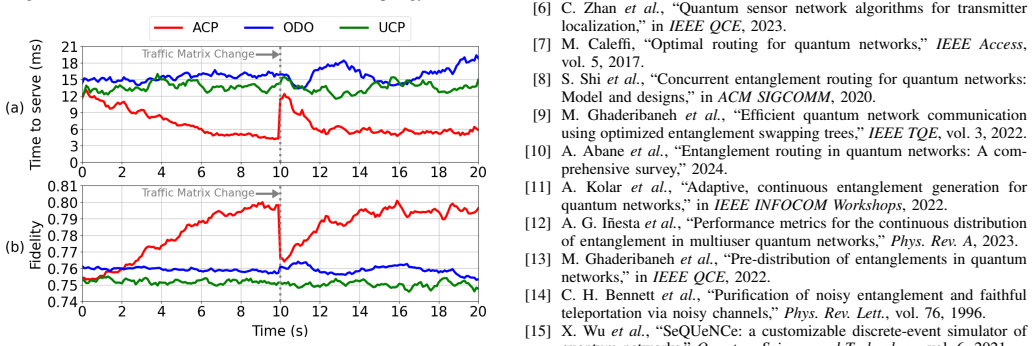
The paper's central claim is that continuously pre-generating link entanglement, steering neighbor selection by past request paths, and purifying stored entanglement as soon as possible is a practical way to shorten the time-to-serve for user requests. In the simulator the authors extend, ACP reduces average request time-to-serve by 57% to 94% relative to on-demand-only generation, depending on network scale, and simultaneously raises the fidelity of delivered end-to-end EPs by 0.01 to 0.05. The speedup comes from reusing existing link EPs instead of generating them after a request arrives, while purification offsets the decoherence that accumulates while EPs wait in memory. The same pattern holds in a two-node network, a 20-node bottleneck network, and a 200-node autonomous-system topology.
Load-bearing premise
The whole result depends on the simulator's model of how quantum memories decay: it assumes every stored pair can be treated as a Bell-diagonal state that loses fidelity through single-qubit Pauli errors, so if real memories decay in a different way, the reported gains may not appear.
Editorial extensions
If this is right
- In a single-link network, ACP brings average time-to-serve down to about the classical communication round-trip time (0.3 ms in the simulations), because no probabilistic link generation happens after the request arrives.
- After a change in traffic patterns, ACP's time-to-serve spikes briefly and then recovers, showing the adaptive probability table tracks shifting request paths without manual reconfiguration.
- Entanglement purification in ACP improves delivered fidelity by 0.01–0.05, with the largest gain appearing when raw fidelity is in the 0.7–0.8 range.
- The TTS reduction persists as the network grows: roughly 94% on two nodes, 70% on 20 nodes, and 57% on 200 nodes, compared with on-demand-only generation.
- Reusing pre-generated link EPs avoids the probabilistic delay of fresh generation, which is why most of the speedup appears in the link-generation phase rather than in swapping.
Reading between the lines
- The probability-table update is a simple reward rule; a natural extension would be to make the step size δ decay over time or adapt to request variance, which the paper does not explore.
- Because purification consumes two stored EPs to yield one, an aggressive purification policy could exhaust the pre-generated stock; the paper's chosen parameters avoid this, but the trade-off is not analyzed.
- The gains are demonstrated under static shortest-path routing; coupling ACP with dynamic or congestion-aware routing could either amplify the benefit or change which neighbors should be favored.
- The fidelity improvement depends on where the raw EP fidelity sits: the purification step helps most around 0.7–0.8, so on hardware with higher starting fidelity the reported 0.05 gain would likely shrink.
Editorial analysis
A structured set of objections, weighed in public.
Referee Report
Summary. The paper introduces the Adaptive Continuous entanglement generation Protocol (ACP), a protocol that makes quantum network nodes continuously pre-generate elementary-link entangled pairs, select neighbors adaptively based on past request paths, and apply as-soon-as-possible entanglement purification to mitigate decoherence. The authors implement ACP as an extension of the SeQUeNCe simulator, adding a Bell-diagonal-state representation, a single-heralded generation protocol, BDS-based swapping and purification, and resource-management extensions. They evaluate ACP on three topologies (a two-node link, a 20-node bottleneck network, and a 200-node AS graph) and compare it with on-demand-only generation (ODO) and a uniform continuous generation baseline (UCP). The headline result is that ACP reduces request time-to-serve by 57% to 94% and improves end-to-end entanglement fidelity by 0.01 to 0.05.
Significance. If the reported results hold, ACP would be a practically useful and comparatively simple way to reduce request latency in quantum networks, and the open-source SeQUeNCe extensions are a reasonable engineering contribution. The paper chooses appropriate baselines (ODO and UCP), describes the protocol using finite-state machines, and makes the code available. The main weaknesses are that all quantitative claims rest on single-run simulation averages without any statistical uncertainty, and that the fidelity improvement is computed entirely inside a Bell-diagonal/Pauli error model that may not transfer to real hardware. These issues do not invalidate the protocol concept, but they do mean the headline percentage ranges are not yet substantiated.
major comments (3)
- [§V-B, Figs. 8–10] All reported TTS and fidelity values are point estimates, and the paper does not state the number of simulation runs, seeds, or confidence intervals. Entanglement generation, Bell-state measurement, purification, and request sampling are all stochastic processes, so a single run cannot support the quantitative ranges '57%–94%' and '0.01–0.05' that appear in the abstract and conclusion. Please report averages and confidence intervals over multiple independent runs (or otherwise demonstrate that the plotted trajectories are representative), and state the run count explicitly.
- [§IV-C1, §IV-C2, §IV-C5, Table I] The fidelity improvement is computed entirely within the Bell-diagonal-state (BDS) representation combined with a single-qubit Pauli error model, with Table I setting {pX, pY, pZ} = {1/3, 1/3, 1/3}. The paper justifies BDS by citing Pauli twirling, but it does not model an actual twirling step in the protocol, and realistic quantum memory noise (e.g., amplitude damping, strongly asymmetric dephasing) is not closed under the BDS/Pauli channel. Consequently the claimed 0.01–0.05 fidelity gain is conditional on this noise model; please provide a sensitivity analysis over non-Pauli or asymmetric error models, or a full density-matrix cross-check, before claiming that ACP 'improves' fidelity in general.
- [§III-B, Table I, Algorithm 1] The adaptation increment δ is hand-tuned ('a value around 0.05 is a good balance') and no sensitivity analysis is given. Since the adaptive behavior in Figs. 9 and 10 depends on how quickly the probability table reacts to changes in the traffic matrix, it is not established that the reported TTS gains are robust to δ, to MAX_MEMORY_ACP, or to the memory coherence time. Please include a sensitivity study over at least these parameters, or justify the chosen values with reference to measured behavior.
minor comments (5)
- [§III-B] The text refers to 'A larger value of α' when describing the adaptation parameter, but the parameter is δ in Algorithm 1 and Table I; this is a typo that should be corrected.
- [§III-B, Fig. 4(a)] The 'phantom' neighbor None appears in the probability table, but its role in the roulette-wheel selection is never explained. Please clarify what selecting None means and how its probability is updated.
- [§V-A2] The description of the traffic matrix change in the 20-node and 200-node experiments is vague: the text says 'before a change in the traffic matrix occurs' but does not specify when or how the matrix is changed. This makes the adaptive-response results harder to reproduce.
- [§I] The introduction contains a typo: 'Ou simulation results' should be 'Our simulation results'.
- [§V-B1] For the two-node topology, the paper states that 0.3 ms is the classical round-trip delay and that the ACP TTS with purification is 0.39 ms, but it does not explain the 0.09 ms overhead beyond mentioning purification failures. A short quantitative explanation of that overhead would improve readability.
Circularity Check
No significant circularity: the reported TTS and fidelity gains are simulator outputs under stated BDS/Pauli modeling assumptions, not quantities fitted to reproduce the conclusion.
full rationale
The paper's central claim is that ACP reduces TTS by 57-94% and improves fidelity by 0.01-0.05. These numbers are produced by the extended SeQUeNCe simulation, not by an equation whose inputs already contain the claim. The only user-tuned parameter, the adaptation increment delta, is set to 0.05 (Section V-A, Table I) and is described as a balance between adaptivity and stability; it is not fitted to force the reported TTS or fidelity improvements, and the paper compares against fixed baselines (ODO and UCP). The fidelity model is an input: Section IV-C1 assumes any 2-qubit state can be represented as a Bell diagonal state after Pauli twirling, Section IV-C2 adopts a single-qubit Pauli error model with the decoherence analytically computed 'see [3]', and Sections IV-C4 and IV-C5 use BDS updates from the same citation. This makes the reported fidelity numbers dependent on the BDS/Pauli model, but the dependency is a modeling assumption, not a circular reduction: the claim is about ACP's protocol-level performance, and the cited model is external to that claim. The self-citations [3], [11], and [29] are used for the decoherence model, the original adaptive-continuous-generation idea, and the ASAP purification policy respectively; none is a uniqueness theorem forbidding alternatives or a loaded premise equivalent to the conclusion. If real quantum memories suffer non-Pauli noise, the 0.01-0.05 fidelity gain could shrink or reverse; that is a correctness risk under model misspecification, not a circularity in the derivation.
Assumptions & free parameters
free parameters (4)
- delta (adaptation increment) =
0.05
- MAX_MEMORY_ACP =
5
- Request arrival rate =
10 Hz
- Traffic matrix =
Not specified numerically
assumptions (6)
- domain assumption Any 2-qubit state can be transformed into a Bell diagonal state by Pauli twirling with fidelity unchanged.
- domain assumption Classical communication is lossless and its latency follows Eq. 2 with negligible transmission and queueing delays.
- domain assumption Static shortest-path routing is used, and path computation finishes before the request start time and is not included in TTS.
- domain assumption Bell-state measurement on memory qubits during swapping always succeeds but adds noise through gate and measurement fidelities.
- domain assumption Quantum memory decoherence follows the analytical single-qubit Pauli error model from [3].
- standard math Entanglement purification outcomes are computed analytically via the BBPSSW protocol on BDS states.
Cite this review
Pith. "Pith review of Design and Simulation of the Adaptive Continuous Entanglement Generation Protocol." pith.science (2026). https://pith.science/paper/KVCNZSMK
@misc{pith2026250201964,
  author       = {Pith},
  title        = {Pith review of: Design and Simulation of the Adaptive Continuous Entanglement Generation Protocol},
  year         = {2026},
  howpublished = {\url{https://pith.science/paper/KVCNZSMK}},
  note         = {Machine review of arXiv:2502.01964}
}
read the original abstract
Generating and distributing remote entangled pairs (EPs) is a primary function of quantum networks, as entanglement is the fundamental resource for key quantum network applications. A critical performance metric for quantum networks is the time-to-serve (TTS) for users' EP requests, which is the time to distribute EPs between the requested nodes. Minimizing the TTS is essential given the limited qubit coherence time. In this paper, we study the Adaptive Continuous entanglement generation Protocol (ACP), which enables quantum network nodes to continuously generate EPs with their neighbors, while adaptively selecting the neighbors to optimize TTS. Meanwhile, entanglement purification is used to mitigate decoherence in pre-generated EPs prior to the arrival of user requests. We extend the SeQUeNCe simulator to fully implement ACP and conduct extensive simulations across various network scales. Our results show that ACP reduces TTS by up to 94% and increases entanglement fidelity by up to 0.05.
Figures


Figures from the paper (6 more)


Reference graph
Works this paper leans on
-
[1]
Quantum internet: A vision for the road ahead,
S. Wehner et al. , “Quantum internet: A vision for the road ahead,” Science, vol. 362, 2018
work page 2018
-
[2]
Distributed quantum computing: A survey,
M. Caleffi et al., “Distributed quantum computing: A survey,” Computer Networks, vol. 254, 2024
work page 2024
-
[3]
Quantum advantage in distributed sensing with noisy quantum networks,
A. Zang et al. , “Quantum advantage in distributed sensing with noisy quantum networks,” arXiv preprint arXiv:2409.17089 , 2024
arXiv 2024
-
[4]
Optimizing initial state of detector sensors in quantum sensor networks,
C. Zhan et al., “Optimizing initial state of detector sensors in quantum sensor networks,” ACM Transactions on Quantum Computing , 2024
work page 2024
-
[5]
Discrete outcome quantum sensor networks,
M. Hillery et al. , “Discrete outcome quantum sensor networks,” Phys. Rev. A, vol. 107, 2023
work page 2023
-
[6]
Quantum sensor network algorithms for transmitter localization,
C. Zhan et al. , “Quantum sensor network algorithms for transmitter localization,” in IEEE QCE, 2023
work page 2023
-
[7]
Optimal routing for quantum networks,
M. Caleffi, “Optimal routing for quantum networks,” IEEE Access , vol. 5, 2017
work page 2017
-
[8]
Concurrent entanglement routing for quantum networks: Model and designs,
S. Shi et al., “Concurrent entanglement routing for quantum networks: Model and designs,” in ACM SIGCOMM, 2020
work page 2020
Show all 32 references
-
[9]
Efficient quantum network communication using optimized entanglement swapping trees,
M. Ghaderibaneh et al. , “Efficient quantum network communication using optimized entanglement swapping trees,” IEEE TQE, vol. 3, 2022
2022
-
[10]
Entanglement routing in quantum networks: A com- prehensive survey,
A. Abane et al., “Entanglement routing in quantum networks: A com- prehensive survey,” 2024
2024
-
[11]
Adaptive, continuous entanglement generation for quantum networks,
A. Kolar et al. , “Adaptive, continuous entanglement generation for quantum networks,” in IEEE INFOCOM Workshops, 2022
2022
-
[12]
Performance metrics for the continuous distribution of entanglement in multiuser quantum networks,
A. G. I ˜nesta et al., “Performance metrics for the continuous distribution of entanglement in multiuser quantum networks,” Phys. Rev. A, 2023
2023
-
[13]
Pre-distribution of entanglements in quantum networks,
M. Ghaderibaneh et al., “Pre-distribution of entanglements in quantum networks,” in IEEE QCE, 2022
2022
-
[14]
Purification of noisy entanglement and faithful teleportation via noisy channels,
C. H. Bennett et al. , “Purification of noisy entanglement and faithful teleportation via noisy channels,” Phys. Rev. Lett., vol. 76, 1996
1996
-
[15]
SeQUeNCe: a customizable discrete-event simulator of quantum networks,
X. Wu et al. , “SeQUeNCe: a customizable discrete-event simulator of quantum networks,” Quantum Science and Technology , vol. 6, 2021
2021
-
[16]
Distributed routing in a quantum internet,
K. Chakraborty et al., “Distributed routing in a quantum internet,” 2019
2019
-
[17]
Distribution and purification of entanglement states in quantum networks,
X. Fan et al. , “Distribution and purification of entanglement states in quantum networks,” 2025
2025
-
[18]
A quantum network stack and protocols for reliable entanglement-based networks,
A. Pirker et al. , “A quantum network stack and protocols for reliable entanglement-based networks,” New Journal of Physics , vol. 21, 2019
2019
-
[19]
Optimized distribution of entanglement graph states in quantum networks,
X. Fan et al. , “Optimized distribution of entanglement graph states in quantum networks,” 2024
2024
-
[20]
Graph-theoretical optimization of fusion-based graph state generation,
S.-H. Lee et al., “Graph-theoretical optimization of fusion-based graph state generation,” Quantum, vol. 7, 2023
2023
-
[21]
Request scheduling in quantum networks,
C. Cicconetti et al. , “Request scheduling in quantum networks,” IEEE Transactions on Quantum Engineering , vol. 2, 2021
2021
-
[22]
J. F. Kurose et al., Computer Networking: A Top-Down Approach (6th Edition), 6th ed. Pearson, 2012
2012
-
[23]
QuISP: a quantum internet simulation package,
R. Satoh et al. , “QuISP: a quantum internet simulation package,” in IEEE QCE, 2022
2022
-
[24]
NetSquid, a network simulator for quantum information using discrete events,
T. Coopmans et al. , “NetSquid, a network simulator for quantum information using discrete events,” Communications Physics, 2021
2021
-
[25]
Simulation of entanglement generation between absorp- tive quantum memories,
A. Zang et al., “Simulation of entanglement generation between absorp- tive quantum memories,” in IEEE QCE, 2022
2022
-
[26]
Simulation of quantum transduction strategies for quantum networks,
L. d’Avossa et al. , “Simulation of quantum transduction strategies for quantum networks,” 2024
2024
-
[27]
Parallel simulation of quantum networks with distributed quantum state management,
X. Wu et al., “Parallel simulation of quantum networks with distributed quantum state management,” ACM TOMACS, vol. 34, 2024
2024
-
[28]
Quantum link bootstrapping using a ruleset-based communication protocol,
T. Matsuo et al. , “Quantum link bootstrapping using a ruleset-based communication protocol,” Phys. Rev. A, vol. 100, 2019
2019
-
[29]
Entanglement distribution in quantum repeater with purification and optimized buffer time,
A. Zang et al. , “Entanglement distribution in quantum repeater with purification and optimized buffer time,” in INFOCOM Workshops, 2023
2023
-
[30]
Entanglement purification for quantum computation,
W. D ¨ur et al. , “Entanglement purification for quantum computation,” Physical Review Letters , vol. 90, no. 6, p. 067901, 2003
2003
-
[31]
No-go theorems for universal entanglement purification,
A. Zang et al., “No-go theorems for universal entanglement purification,” arXiv preprint arXiv:2407.21760 , 2024
2024 arXiv
-
[32]
Building blocks of quantum repeater networks,
F. Rozpedek, “Building blocks of quantum repeater networks,” Ph.D. dissertation, Delft University of Technology, 2019
2019
Reviewed August 9, 2026 · model on record in the stance chip above.
Discussion (0). Continue with ORCID to comment.