REVIEW 3 major objections 6 minor 1 cited by
Deep Neural Cellular Potts Models
T0 review · 3 major / 6 minor · reviewed 2026-08-09 · deepseek-v4-flash
Pith's one-line read A neural-network Hamiltonian learned from snapshots of cell clusters reproduces bi-polar self-organization that analytical cellular Potts Hamiltonians cannot capture.
desk verdict A genuinely new way to learn CPM Hamiltonians from data, with promising results on a real biological test case, but the training sampler breaks detailed balance and the real-data experiment trains on synthetic surrogates, so the method needs another pass before it can be fully trusted. read the letter →
The pith
A machine-rendered reading of the paper's core claim, the machinery that carries it, and where it could break.
The reading
What carries the argument
The load-bearing object is the Neural Hamiltonian $H_\theta(x)$, an architecture that assigns an energy to any lattice configuration $x$ (each site labeled by the cell occupying it) while respecting the two symmetries that hold for any CPM: invariance under translations of the lattice and under permutations of cell identities. It one-hot encodes each cell's occupancy as its own grid, feeds each grid through a per-cell convolutional network $\phi_l$, aggregates all cells with a permutation-invariant sum into a global context lattice $A$, then passes each cell's representation together with $A$ through a second convolutional network $\psi_l$, followed by pooling and an MLP that outputs the scalar energy. Training uses the energy-based-model maximum-likelihood gradient, where positive samples are observed configurations and negative samples come from an approximate parallel CPM sampler that proposes boundary spin flips; the hybrid model adds the standard analytical cell-sorting Hamiltonian as a weighted symbolic term, which the paper finds stabilizes training and enforces biological realism.
What would settle it
Simulate the learned bi-polar NeuralCPM Hamiltonian with an exact single-site Metropolis CPM sampler instead of the approximate parallel sampler and measure the axial-alignment RMSE over 12 hours; if the bi-polar organization disappears or the time course diverges from the real data, the reported success depended on the sampler's bias rather than on the learned energy function.
Extended reading notes
Core claim
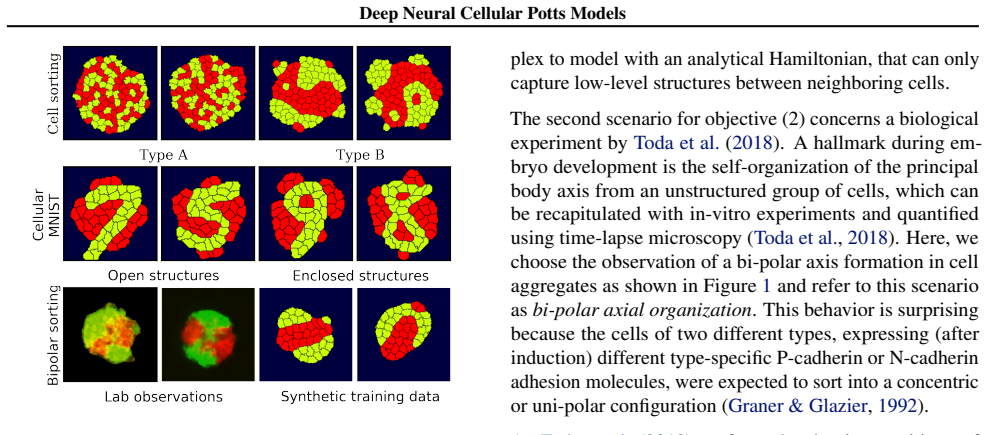
The central claim is that a cellular Potts model whose Hamiltonian is parameterized by a translation- and permutation-equivariant neural network can be trained from static snapshots and can generate collective dynamics that analytical Hamiltonians cannot. Using the bi-polar axial-organization experiment of Toda et al. (2018) as the real-world test, the paper trains on synthetic final configurations in which type-2 cells cluster at two opposite poles, then simulates from a mixed cluster; the resulting trajectories match the observed time course and degree of axial organization, with over 95% of real observations within one standard deviation of the simulations and an axial-alignment RMSE of 37.3 for the hybrid model versus roughly 150 for analytical baselines. The paper explains this success through the Neural Hamiltonian's inductive biases—invariance to lattice translations and cell permutations—and through the biology-informed closure term, which prevents cell fragmentation and stabilizes energy-based training. Validation on parameter recovery for a known cell-sorting Hamiltonian (RMSE 0.021–0.178 at the optimal temperature) and on Cellular MNIST (Classifier Score 4.35 for the hybrid, beating all analytical baselines) supports the broader claim that NeuralCPM provides a general route from observational data to CPM dynamics.
Load-bearing premise
The training objective is a valid likelihood gradient only if the approximate parallel sampler's negative configurations come from the model's stationary distribution, but that sampler is not detailed-balance-correct, so the learned Hamiltonian rests on the unverified premise that its bias is small enough not to distort the gradient.
Editorial extensions
If this is right
- Biologists can fit a CPM directly to end-state observations, without needing full time-lapse trajectories or hand-designed energy terms.
- Simulations with a learned Hamiltonian can extrapolate from synthetic training states to real experimental dynamics, including the temporal pathway of symmetry breaking.
- Hybridizing a symbolic biological prior with the neural closure yields both biological plausibility (compact, unfragmented cells) and the expressiveness needed for patterns that analytical terms alone cannot form.
- The learned energy function is a candidate quantitative description of the effective cell-cell interactions, so it can be interrogated to extract mechanisms rather than treated purely as a simulator.
Reading between the lines
- Because the approximate sampler lacks detailed balance, the learned Hamiltonians may encode sampling bias; running the same Hamiltonian with an exact single-site CPM sampler would reveal how much of the reported behavior is due to the energy function itself.
- The successful recipe—generate synthetic final states with a CPM simulator, train a NeuralCPM, validate on real time-lapse data—could transfer to other morphogenetic systems where only end states are observable.
- The architecture's global receptive field and the equilibrium assumption limit NeuralCPM to small systems; scaling to tissue-level simulations will require locality and history-dependent dynamics, as the paper acknowledges in its limitations.
- If the hybrid's symbolic component is kept fixed at its fitted parameters, the residual neural term may isolate the biological mechanisms the symbolic model misses, offering a tool for hypothesis discovery.
Signed reviews
Editorial analysis
A structured set of objections, weighed in public.
Referee Report
Summary. The paper introduces NeuralCPM, a cellular Potts model whose Hamiltonian is a neural network with built-in translation and cell-permutation symmetries. The Hamiltonian is trained from static snapshots of configurations by minimizing an energy-based negative log-likelihood objective, using a persistent contrastive divergence scheme with an approximate parallelized CPM sampler. The authors validate the approach in three settings: parameter recovery for a known analytical cell-sorting Hamiltonian, a synthetic 'Cellular MNIST' assembly task, and a real biological scenario of bi-polar axial organization from Toda et al. (2018). They find that a hybrid Hamiltonian combining an analytical cell-sorting term with the neural closure term yields the best trade-off between biological realism and collective structural accuracy, and they report that this hybrid model reproduces the temporal development of bi-polar organization.
Significance. If the central claim holds, NeuralCPM is a useful contribution to computational biology and machine learning: it provides a principled way to learn expressive CPM Hamiltonians directly from observational data while retaining the interpretable CPM simulation framework. The architecture is well motivated, the hybrid 'closure' formulation is a practical way to inject domain knowledge, and the temporal prediction against Toda et al. (2018) is an ambitious and nontrivial validation. The explicit comparison with analytical baselines and alternative neural architectures gives the paper a clear empirical message. However, the statistical grounding of the training objective is weakened by the approximate sampler that violates detailed balance, and the equilibrium bi-polar validation is partially circular. These issues affect the strength of the main claim as currently stated, but they are addressable with additional experiments or a reframing of the claims.
major comments (3)
- [§3.2, Eq. (6); Appendix B.1, Algorithm 2] The training loss is presented as an estimate of the negative log-likelihood gradient (Eq. 3), but the negative samples are drawn with ApproxPCPM, whose transition probabilities, as the authors state, 'do not satisfy detailed balance' and for which 'we cannot guarantee that the system has a stationary distribution defined by Hθ(x)'. Therefore the expectation over pθ(x) in Eq. (3) is not estimated from the model distribution, and the learned Hamiltonian is not guaranteed to define the stationary distribution of the sampler used at inference. This is load-bearing for the central claim that NeuralCPM models dynamics that analytical Hamiltonians cannot, because the empirical success could be an artifact of the approximate sampler's particular transition kernel rather than of Hθ. Please either bound the bias introduced by the approximate sampler, validate the learned Hamiltonians under the standard sequential CPM Metropolis dynamics, or explicitly reframe the claims as holding for the ApproxPCPM dynamics.
- [§4.4, Figure 7a; Appendix A] The equilibrium bi-polar validation is partially circular. The synthetic training configurations were generated by prescribing the target location of each type-2 cell for a bi-polar arrangement, so the model is trained to produce the very outcome that is then compared with the real data in Figure 7a. The temporal-dynamics comparison in Figure 7b and the axial-alignment RMSE in Table 2 are not circular and provide the strongest evidence for the real-world claim; the paper should present them as the primary validation and treat the equilibrium overlap as a consistency check.
- [§4.2, Table 8 and Figure 4] The parameter-recovery experiment reports the best RMSE at T = T*, a temperature selected post hoc to minimize the error. Because the same approximate sampler is used both for training and for defining the learned model, this check cannot detect systematic sampler-specific biases, and the T = 1 result for type B (RMSE 0.997) is considerably worse than the T* result (0.178). Please report the selection procedure for T*, provide repeated-seed variability or confidence intervals, and ideally evaluate the fitted Hamiltonian with a detailed-balance sampler to show that the recovered parameters transfer to the standard CPM.
minor comments (6)
- [General] The manuscript does not include a data or code availability statement; adding one would aid reproducibility, especially given the use of the shared Toda et al. (2018) microscopy data.
- [Appendix B.1, Algorithm 2] The notation 'j ∼ M(i)' is ambiguous; the paper should state that j is drawn uniformly from the set of neighboring sites belonging to a different cell.
- [Equation (4) and Algorithm 2] The symbol N(L) is used for the set of neighboring lattice-site pairs in Eq. (4) and for the per-site neighbor set in Algorithm 2; this overloading should be resolved to avoid confusion.
- [Figure 7 caption] The caption states that 'almost all observations' lie within one standard deviation of the simulations, but it does not report the exact number of observations; please give the count (e.g., five of six) and specify the standard-deviation definition used for the shaded region.
- [Figures 4 and 8] The word 'Parmameter' in the captions is a typo and should be corrected to 'Parameter'.
- [Section 2.1] The word 'classs' is a typo and should read 'class'.
Circularity Check
The bi-polar equilibrium validation is partially circular because the synthetic training configurations were generated by prescribing the target bi-polar arrangement, so the equilibrium overlap in Figure 7a and the axial-alignment RMSE in Table 2 are trained properties; the temporal-dynamics prediction in Figure 7b is independent and non-circular.
-
fitted input called prediction
[Section 4.1, 'Bi-polar axial organization'; validation in Section 4.4, Figure 7a and Table 2.]
"As Toda et al. (2018) performed only six repetitions of this experiment, we construct synthetic counterparts of the final configurations for training using Morpheus (Starruß et al., 2014) by prescribing the target location of each cell for a bi-polar arrangement. After training, we validate the cellular dynamics predicted by NeuralCPM against the real biological dynamics reported in the Supplemental Figure S6B of Toda et al. (2018)."
The training distribution is generated 'by prescribing the target location of each cell for a bi-polar arrangement.' The Hamiltonian is fit by maximum likelihood (Eqs. 2-3) to those final configurations, so the trained equilibrium distribution is expected to reproduce the prescribed bi-polar organization. Hence Figure 7a's equilibrium overlap and Table 2's axial-alignment RMSE are trained properties rather than independent predictions: they reduce to the data-generation prescription plus successful NLL fitting.
full rationale
Apart from the bi-polar equilibrium validation, the paper's derivation is self-contained. The parameter-recovery benchmark (Section 4.2) trains on data generated from a known Hamiltonian and compares against known coefficients; the reported T* fit is a disclosed identifiability rescaling, not a hidden prediction. Cellular MNIST (Section 4.3) and the temporal-dynamics part of the bi-polar experiment (Figure 7b) test generalization to dynamics and structures that are not in the training distribution. No load-bearing self-citation or imported uniqueness theorem is used; the citations to Minartz et al. and Morpheus are contextual or tool references. The approximate-parallel-sampler issue in Appendix B.1 (transitions 'do not satisfy detailed balance') is a real correctness risk for the claimed NLL training, but it is not a circularity: the learned Hamiltonian could still be validated or falsified by independent simulation. Overall, one central equilibrium 'prediction' reduces to the training-data construction, but the central claim still has independent support from the non-circular temporal-dynamics prediction, so the circularity is partial.
Assumptions & free parameters
free parameters (2)
- Temperature T* for parameter fitting =
Not stated, varies by scenario
- Regularization weight lambda =
0.0 (Sec 4.2), 0.0005 (Sec 4.3 and 4.4)
assumptions (4)
- domain assumption The CPM Markov chain has a stationary distribution characterized by the Hamiltonian H as a Boltzmann distribution exp(-H/T).
- ad hoc to paper The approximate parallel CPM sampler produces samples close enough to pθ(x) for the gradient estimate to be useful, despite violating detailed balance.
- domain assumption The dynamics of the real biological system are near-equilibrium and Markovian in the CPM sense.
- domain assumption Translation and permutation symmetries are universal in collective cellular dynamics and are sufficient as inductive biases for the Hamiltonian.
Cite this review
Pith. "Pith review of Deep Neural Cellular Potts Models." pith.science (2026). https://pith.science/paper/KTJTPW4J
@misc{pith2026250202129,
  author       = {Pith},
  title        = {Pith review of: Deep Neural Cellular Potts Models},
  year         = {2026},
  howpublished = {\url{https://pith.science/paper/KTJTPW4J}},
  note         = {Machine review of arXiv:2502.02129}
}
read the original abstract
The cellular Potts model (CPM) is a powerful computational method for simulating collective spatiotemporal dynamics of biological cells. To drive the dynamics, CPMs rely on physics-inspired Hamiltonians. However, as first principles remain elusive in biology, these Hamiltonians only approximate the full complexity of real multicellular systems. To address this limitation, we propose NeuralCPM, a more expressive cellular Potts model that can be trained directly on observational data. At the core of NeuralCPM lies the Neural Hamiltonian, a neural network architecture that respects universal symmetries in collective cellular dynamics. Moreover, this approach enables seamless integration of domain knowledge by combining known biological mechanisms and the expressive Neural Hamiltonian into a hybrid model. Our evaluation with synthetic and real-world multicellular systems demonstrates that NeuralCPM is able to model cellular dynamics that cannot be accounted for by traditional analytical Hamiltonians.
Figures


Figures from the paper (7 more)


Forward citations
Cited by 1 Pith paper
-
Active Matter as a framework for living systems-inspired Robophysics
Active-matter physics is presented as the organizing framework for robophysics, with robot swarms designed around local interactions, shared purpose, and adaptive feedback.
Reference graph
Works this paper leans on
-
[1]
We initialize the MCMC chains from datapoints, where we randomly permute the type of each cell. We use persistent chains instead of reinitializing in each iteration, following the Persistent Contrastive Divergence algorithm from (Tieleman, 2008), but with the regularization term from (Du & Mordatch, 2019). While using an approximation of the gradient of t...
work page 2008
-
[2]
Let N (l) define the set of all neighboring lattice sites of lattice site l. The sampler uses a proposal distribution where first, P lattice sites are independently and uniformly sampled from the boundary of cells. This boundary subset B contains all l ∈ L that have a neighboring lattice site that belongs to a different cell than the cell at the lattice s...
work page 2021
-
[3]
Graner, F. and Glazier, J. A. Simulation of biological cell sorting using a two-dimensional extended potts model. Physical Review Letters, 69:2013–2016,
work page 2013
-
[4]
Deep residual learning for image recognition
He, K., Zhang, X., Ren, S., and Sun, J. Deep residual learning for image recognition. In 2016 IEEE Conference on Computer Vision and Pattern Recognition (CVPR), pp. 770–778,
work page 2016
-
[5]
Contact energies for cellular MNIST Medium 0.0 Type 1 6.0 3.0 Type 2 6.0 6.0 3.0 Medium Type 1 Type 2 Bi-polar axial organization The experimental cell aggregates of Toda et al. (2018) consist of 200 to 240 cells in 3D which amounts to about 8 cells along a diameter and about 40 cells in the cross-section. To generate the synthetic training data, we there...
work page 2018
-
[7]
Training hyperparameters used in results of their respective section Hyperparameter 4.2 4.3 4.4 Batch size B 16 16 16 Num training steps 1e4 1e4 1e4 Monte Carlo sweeps 1.0 0.5 0.7 Lattice size 200x200 100x100 125x125 EW Aα 0.0 0.99 0.99 Regularizer λ 0.0 0.0005 0.0005 Num parallel flips P 100 50 50 Sampler reset probability preset 100% 2.5% 2.5% Approxima...
work page 1992
-
[8]
However, rather than setting those parameters up-front as done in the data generation (Appendix A), we learn the parameters through stochastic gradient descent. B.2.2. N EURAL HAMILTONIANS Initial embedding layer . We first compress the sparse one-hot encoded representation to a dense representation by applying a learned downsampling through a single line...
work page 2018
-
[9]
Inspired by the original proposal of the CPM by Graner & Glazier (1992), we consider cells of two distinct cell types that perform cell sorting due to differential adhesion. We distinguish the two scenarios a and b from Edelstein-Keshet & Xiao (2023), characterized by different contact energies between cells, which are laid out in tables 3 and
work page 1992
Show all 17 references
-
[10]
Notably, Hcase-specific(x) now took the form of an external potential Hcase-specific(x) = X i∈L µ(xi)ϕi (8) where µ(xi) can be considered the coupling strength to the potential ϕi
Contact energies for scenario b Medium 0.0 Type 1 2.5 1.0 Type 2 1.0 4.5 1.0 Medium Type 1 Type 2 Cellular MNIST Ground truth data for the synthetic structural assembly experiment in section 4.3 was generated in a similar way to the cell sorting data described above. Notably, ...
2012
-
[12]
12 Deep Neural Cellular Potts Models Table
and Equinox (Kidger & Garcia, 2021). 12 Deep Neural Cellular Potts Models Table
2021
-
[1997]
and Kingma, D
Song, Y . and Kingma, D. P. How to train your energy-based models. arXiv preprint arXiv:2101.03288,
-
[2001]
Towards learned simulators for cell migration
Minartz, K., Poels, Y ., and Menkovski, V . Towards learned simulators for cell migration. In NeurIPS 2022 AI for Science: Progress and Promises,
2022
-
[2017]
and Garcia, C
Kidger, P. and Garcia, C. Equinox: neural networks in JAX via callable PyTrees and filtered transformations. Differ- entiable Programming workshop at Neural Information Processing Systems 2021,
2021
-
[2018]
Bronstein, M
URL http://github.com/jax-ml/jax. Bronstein, M. M., Bruna, J., Cohen, T., and Veli ˇckovi´c, P. Geometric Deep Learning: Grids, Groups, Graphs, Geodesics, and Gauges. arXiv preprint arXiv:2104.13478,
-
[2020]
https://distill.pub/2020/growing-ca. Rens, E. G. and Edelstein-Keshet, L. From energy to cel- lular forces in the cellular potts model: An algorithmic approach. PLOS Computational Biology, 15(12):1–23, 12
2020
-
[2021]
(Barbu & Zhu, 2020))
and standard Gibbs sampling (see e.g. (Barbu & Zhu, 2020)). However, as demonstrated by Table 8, these methods were not effective. The reason for this is that these methods are not constrained to perturb the system along the boundaries of the cells, which are the regions of th...
2020
-
[2023]
Elfwing, S., Uchibe, E., and Doya, K
[Accessed 28-01-2025]. Elfwing, S., Uchibe, E., and Doya, K. Sigmoid-weighted linear units for neural network function approximation in reinforcement learning. Neural Networks, 107:3–11,
2025
Reviewed August 9, 2026 · model on record in the stance chip above.
Discussion (0). Continue with ORCID to comment.