REVIEW 4 major objections 5 minor 102 references
Rigorous analysis of large-space and long-time asymptotics for the short-pulse soliton gases
T0 review · 4 major / 5 minor · reviewed 2026-08-09 · deepseek-v4-flash
Pith's one-line read For generalized reflection coefficients with endpoint and interior singularities, the short-pulse soliton gas converges as t grows to an explicit theta-function profile with O(1/t) error.
desk verdict Serious paper on a real open problem, but a load-bearing phase inconsistency in (1.8) undercuts the central steepest-descent argument as written. read the letter →
The pith
A machine-rendered reading of the paper's core claim, the machinery that carries it, and where it could break.
The reading
What carries the argument
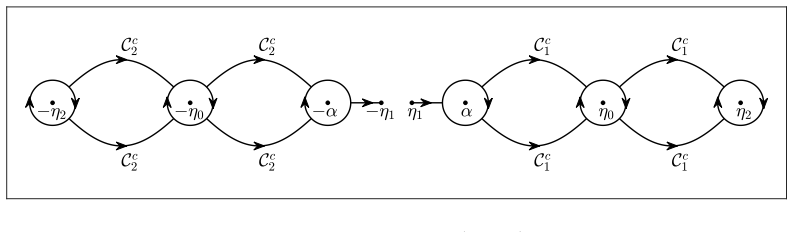
The engine of the proof is a nonlinear steepest descent analysis of the continuum Riemann–Hilbert problem for $M_\infty$. The central object is the $g$-function $g=\theta-p$, defined piecewise so that the singularity of the phase $\theta=\xi\lambda+\lambda^{-1}/4$ at $\lambda=0$ is controlled and the jump matrices become exponentially small away from the spectral interval; the parameter $\alpha$ is fixed by the equation $\xi=-\eta_2^{-2}W(\alpha/\eta_2)$ involving complete elliptic integrals. Local parametrices then match the singular behavior near the endpoints and the interior point: the Airy parametrix and the first modified Bessel parametrix at $\eta_1,\eta_2$, the second modified Bessel parametrix at $\eta_0$ for $r_0$, and a confluent hypergeometric parametrix for $r_c$. The outer parametrix is written as an explicit quotient of $\theta$ functions $\vartheta_3$, with phases and normalization constants built from the spectral data.
What would settle it
Take $\beta_0=-\frac12$, $\eta_1=1$, $\eta_0=2$, $\eta_2=3$, and $r(s)=(s-1)^{-1/2}(3-s)^{-1/2}|s-2|^{-1/2}$, then evaluate numerically the difference between the Riemann sums in (1.13) and the improper integral in (1.14) as $N_1,N_2\to\infty$; if the difference does not tend to zero, the continuum soliton-gas problem and Theorem 2 are not grounded.
Extended reading notes
Core claim
On the paper's own terms, the discovery is that the short-pulse soliton gas has ordered long-time states of $\theta$-function form. Precisely, Theorem 2 states that for the reflection coefficients $r_0(\lambda)=(\lambda-\eta_1)^{\beta_1}(\eta_2-\lambda)^{\beta_2}|\lambda-\eta_0|^{\beta_0}\gamma(\lambda)$ and $r_c(\lambda)=(\lambda-\eta_1)^{\beta_1}(\eta_2-\lambda)^{\beta_2}\chi_c(\lambda)\gamma(\lambda)$, with $\beta_j>-1$, $c>0$, $c\neq1$, and appropriate sign of $\xi$, the gas profile is $u(x,t)=e^{\Delta_\alpha}(\Psi_\alpha\tilde\Phi_\alpha+\Phi_\alpha\tilde\Psi_\alpha)\Theta_\alpha+O(1/t)$, with the $\Psi,\tilde\Psi,\Phi,\tilde\Phi,\Theta$ built from the elliptic $\theta$ function $\vartheta_3$ and phases $\Delta_\alpha$ depending linearly on $\hat{x}$ and $t$. The same analysis yields exponential decay for $\xi>-\eta_2^{-2}$ and a $\theta$-formula for the initial value as $\hat{x}\to-\infty$. In other words, the paper claims that the gas is not a featureless sea but a quasi-periodic coherent structure whose parameters are computable from the reflection coefficient.
Load-bearing premise
The load-bearing premise is that, when any exponent $\beta_j$ lies between $-1$ and $0$, the discrete Riemann sums in (1.13) converge to the improper Cauchy integrals in (1.14); the paper asserts this on the basis of calculus and uniform continuity but does not carry out the proof.
Editorial extensions
If this is right
- For $\xi>-\eta_2^{-2}$, the soliton gas decays exponentially in $t$, so no oscillatory asymptotic state forms in that sector.
- In the sectors $\xi\in(\xi_{\mathrm{crit}},\xi_0)$, $\xi\in(\xi_0,-\eta_2^{-2})$, and $\xi<\xi_{\mathrm{crit}}$, the leading waveform is an explicit quotient of theta functions with error $O(1/t)$.
- The initial profile $u(x,0)$ has the same theta-function form as $\hat{x}\to-\infty$ with error $O(1/|\hat{x}|)$ and decays exponentially as $\hat{x}\to+\infty$.
- For $r_0$ with $\beta_0=0$, the long-time formula holds on the full interval $(\xi_{\mathrm{crit}},-\eta_2^{-2})$; for nonzero $\beta_0$, the admissible ranges of the exponents differ from sector to sector.
- The method extends to any finite number of interior singularities $\eta_{0,j}$, with a modified Bessel parametrix for $r_0$ and a confluent hypergeometric parametrix for $r_c$ around each singularity, as stated in Remark 1.
Reading between the lines
- Editorial: because every constant in the theta formula is explicit in the spectral data, the result can be checked numerically at finite $N$ by solving the $N$-soliton Riemann–Hilbert problem and comparing $u_N(x,t)$ with the right-hand side of (1.29); the $O(1/t)$ rate is the observable prediction.
- Editorial: the piecewise $g$-function construction, designed to control the origin singularity of the phase, should transfer to other negative flows of the WKI hierarchy whose phases share the same $\lambda^{-1}$ structure.
- Editorial: a natural next step is the interaction of a short-pulse soliton gas with a single large soliton; the local parametrices built here are exactly the ingredients such a two-reflection-coefficient analysis would require.
Signed reviews
Editorial analysis
A structured set of objections, weighed in public.
Referee Report
Summary. The manuscript studies asymptotics of soliton gases for the short-pulse equation. Starting from the N-soliton Riemann-Hilbert problem and taking N to infinity, it defines a continuum soliton-gas RH problem with two generalized reflection coefficients r0(λ)=(λ−η1)^{β1}(η2−λ)^{β2}|λ−η0|^{β0}γ(λ) and rc(λ)=(λ−η1)^{β1}(η2−λ)^{β2}χc(λ)γ(λ). It constructs a g-function and, via the transformations Y→T→S→E with Airy, modified Bessel and confluent hypergeometric parametrices, derives explicit theta-function formulas with O(1/t) error for u(x,t) and x=x̂+... in several ξ-regions, together with analogous large-x̂ formulas for u(x,0). The main results are Theorem 1 and Theorem 2. The paper is organized around the standard Deift-Zhou steepest descent machinery and states its constants explicitly, but several load-bearing steps are either internally inconsistent as printed or asserted without proof.
Significance. If correct, this would be a substantial extension of the rigorous soliton-gas asymptotics of Girotti, Grava, Jenkins and McLaughlin to the short-pulse equation, with explicit theta-function constants and no fitted parameters, and it would handle Jacobi-type endpoint singularities and an interior singularity or jump at η0. The paper deserves credit for assembling the full Deift-Zhou architecture and for giving explicit formulas for the outer parametrix. However, the central derivation is not yet certifiable as written: one phase normalization contradicts the g-function normalization, and the discrete-to-continuum limit, the local behavior estimates, and the small-norm Proposition 3 are asserted rather than proved. The result is plausible, but the manuscript needs substantial revision before the claims can be considered rigorous.
major comments (4)
- [§1.2, Eq. (1.8); §3, Eqs. (3.87)–(3.91); RH Problem 5] There is an internal factor-of-four inconsistency in the phase. Equation (1.8) defines θ=ξλ+λ−1/4, while Eq. (3.87) states Re(θ)=Re(λ)/4 (ξ+1/|λ|²), which is the real part of θ=(ξλ+λ−1)/4. From (3.89)–(3.91), Q∼ξy⁴ and R∼y², hence p∼ξλ/4 at infinity. With the printed definition (1.8), g=θ−p behaves like 3ξλ/4, contradicting the required normalization g=O(λ−1) in RH Problem 5 and invalidating the conjugation T=Y e^{t g σ3} used in Eq. (6.161). With the corrected phase θ=(ξλ+λ−1)/4, the g-function behaves like 1/(4λ), and the sign charts and critical value −η2^{-2} become consistent. This is not cosmetic: θ enters the residue conditions, the jump conditions, and the constants Δα and Δ1 in Eqs. (1.36) and (1.43). As printed, the theorem statements and the Riemann-Hilbert problem analyzed in Section 6 are not the same problem. The phase definition must be corrected and all subsequent constants involving θ rechecked.
- [§1.1, Eqs. (1.13)–(1.14)] The passage from the discrete N-soliton RH problem to the continuum soliton-gas RH problem is foundational for the paper, but the convergence of the Riemann sums in (1.13) to the Cauchy integrals in (1.14) for β1,β2,β0∈(−1,0) is only asserted in one sentence. The text states that the proof relies on basic calculus, monotonicity and uniform continuity, but it does not provide the proof. This is load-bearing: if this limit fails, the matrix M∞ defined by RH Problem 3 and all subsequent asymptotic results are not grounded. A complete proof is needed, including control near the singular points η1, η0 and η2, where the equally spaced discrete points approach the singularities.
- [§4, Eqs. (4.100)–(4.104); §6, first paragraph] The local behavior of Y near ±η1, ±η2 and ±η0 is stated without derivation, even though it is used to make the RH problem well-posed and to match the parametrices. Section 6 explicitly says that the detailed examination of the local behaviors of T, S and E is omitted 'for the sake of clarity and simplicity.' These local estimates determine the admissible singularities and the matching conditions that produce the O(1/t) error terms in Propositions 4–6; they are not merely exposition. The estimates in (4.100)–(4.104) should be proved, or a precise reference with verified hypotheses should be supplied.
- [§5.3, Proposition 3] The small-norm estimate for the error matrix E is stated without proof: the proof is described as following 'standard procedures' and is omitted. This estimate is the mechanism behind the O(|x̂|^{-1}) term in Theorem 1, so it cannot be treated as routine in a paper whose title and abstract claim rigorous asymptotics. The authors should either provide a proof or state explicitly which standard theorem is being invoked and verify its hypotheses in this setting. The analogous estimates in Propositions 4–6 also depend on the omitted local behavior analysis.
minor comments (5)
- [§1.1, first paragraph] The sentence containing 'multi-solitons has found been been found' is garbled and should be corrected by proofreading.
- [§2, Figure 1] The caption of Figure 1 appears to swap the names of the Airy and modified Bessel parametrices: the left panel is described as 'Airy parametrix M_mB' and the right as 'first type of modified Bessel parametrix M_Ai'.
- [§1.2, Eqs. (1.32)–(1.33)] In Theorem 2, the quantities Φ_1 and Φ̃_1 in (1.32)–(1.33) should presumably be indexed by α rather than 1, in order to match Ψα, Φα and the α-dependent modulus mα.
- [§6.3, Eq. (6.203)] The error term in (6.203) is written as O(|x̂|^{-1}), while Theorem 2 states O(1/t). Since ξ is fixed away from zero in the regions considered, the two are equivalent, but the notation should be harmonized.
- [§5.4 and §6.3, final computations] In Eqs. (5.155) and (6.203), the statement that 'a straightforward calculation' yields the theta-function formulas in Theorems 1 and 2 hides a substantial amount of algebra. At least the main intermediate steps should be shown, since the paper's value depends on the correctness of these explicit constants.
Circularity Check
No circularity: the theta-function asymptotics are derived from the stated spectral data by an RH steepest-descent chain, not assumed or fitted.
full rationale
The derivation chain is self-contained in the sense relevant to circularity. The inputs are the reflection coefficients r0 and rc, the spectral interval endpoints eta1, eta2, the exponents beta_j, and the constant c; these are stated, not fitted to any output. The N-soliton RH problem is interpolated to a continuum soliton-gas RH problem with Cauchy-integral jumps, and the g-function is then constructed as g = theta - p, with p defined by integrals of Q(y;xi)/(4 y^2 R(y;xi)). The f-function is defined by scalar multiplicative RH conditions, and the outer parametrix is solved explicitly in terms of theta functions. The constants Delta, tau, Omega, and phi in Theorem 2 are explicit functionals of the input spectral data and the Whitham parameter alpha. No step equates the conclusion with an input by construction: the theta-function formulas (1.30)-(1.36) are obtained from the model RH problem rather than inserted as the desired answer, and the reflection coefficients are not calibrated to any target asymptotic. The paper borrows the steepest-descent machinery and the Airy, modified Bessel, and confluent hypergeometric parametrices from prior published work (e.g., [28], [64], [91]), which is legitimate external grounding; the only self-citation ([102]) appears in the reference list and is not load-bearing. Two caveats are correctness risks rather than circularity: (i) the claimed Riemann-sum-to-improper-integral convergence for beta_j in (-1,0) is asserted without proof in Section 1.1, and (ii) the phase theta as printed in (1.8) appears inconsistent with (3.87) and with the g-function normalization required in RH Problem 5. Neither caveat involves assuming the target theorem or fitting a parameter to the predicted quantity, so the circularity score remains zero.
Assumptions & free parameters
assumptions (5)
- domain assumption gamma has an analytic extension to a neighborhood of [eta_1, eta_2], is continuous and positive there; beta_1, beta_2, beta_0 > -1; c > 0 with c != 1.
- ad hoc to paper The discrete pole sums in (1.13) converge to the Cauchy integrals in (1.14) when beta_j lies in (-1, 0).
- domain assumption Existence and uniqueness of M_infinity follows from Zhou's vanishing lemma as implemented in [51].
- domain assumption The parameter alpha is uniquely determined by the Whitham evolution equation xi = -eta_2^{-2} W(alpha/eta_2).
- ad hoc to paper The local behavior of Y near the endpoints and eta_0, stated in (4.100) through (4.104), is correct.
Cite this review
Pith. "Pith review of Rigorous analysis of large-space and long-time asymptotics for the short-pulse soliton gases." pith.science (2026). https://pith.science/paper/7C5EHXEO
@misc{pith2026250202261,
  author       = {Pith},
  title        = {Pith review of: Rigorous analysis of large-space and long-time asymptotics for the short-pulse soliton gases},
  year         = {2026},
  howpublished = {\url{https://pith.science/paper/7C5EHXEO}},
  note         = {Machine review of arXiv:2502.02261}
}
abstract
We rigorously analyze the asymptotics of soliton gases to the short-pulse (SP) equation. The soliton gas is formulated in terms of a RH problem, which is derived from the RH problems of the $N$-soliton solutions with $N \to \infty$. Building on prior work in the study of the KdV soliton gas and orthogonal polynomials with Jacobi-type weights, we extend the reflection coefficient to two generalized forms on the interval $\left[\eta_1, \eta_2\right]$: $r_0(\lambda) = \left(\lambda - \eta_1\right)^{\beta_1}\left(\eta_2 - \lambda\right)^{\beta_2}|\lambda - \eta_0|^{\beta_0}\gamma(\lambda)$, $r_c(\lambda) = \left(\lambda - \eta_1\right)^{\beta_1}\left(\eta_2 - \lambda\right)^{\beta_2}\chi_c(\lambda)\gamma(\lambda)$, where $0 < \eta_1 < \eta_0 < \eta_2$ and $\beta_j > -1$ ($j = 0, 1, 2$), $\gamma(\lambda)$ is continuous and positive on $\left[\eta_1, \eta_2\right]$, with an analytic extension to a neighborhood of this interval, $\chi_c(\lambda) = 1$ for $\lambda \in \left[\eta_1, \eta_0\right)$ and $\chi_c(\lambda) = c^2$ for $\lambda \in \left(\eta_0, \eta_2\right]$, where $c>0$ with $c \neq 1$. The asymptotic analysis is performed using the steepest descent method. A key aspect of the analysis is the construction of the $g$-function. To address the singularity at the origin, we introduce an innovative piecewise definition of $g$-function. To establish the order of the error term, we construct local parametrices near $\eta_j$ for $j = 1, 2$, and singularity $\eta_0$. At the endpoints, we employ the Airy parametrix and the first type of modified Bessel parametrix. At the singularity $\eta_0$, we use the second type of modified Bessel parametrix for $r_0$ and confluent hypergeometric parametrix for $r_c(\lambda)$.
Figures


Figures from the paper (8 more)


Reference graph
Works this paper leans on
-
[1]
M. J. Ablowitz, P. A. Clarkson, Solitons, Nonlinear Evolution Equations and Inverse Scat- tering (Cambridge University Press, Cambridge, 1991)
1991
-
[2]
M. J. Ablowitz, D. J. Kaup, A. C. Newell, H. Segur, Method f or solving the sine-Gordon equation, Phys. Rev. Lett. 30 (1973) 1262–1264
1973
-
[3]
Akhmediev, A
N. Akhmediev, A. Ankiewicz, J. M. Soto-Crespo, Rogue wav es and rational solutions of the nonlinear Schr¨ odinger equation, Phys. Rev. E 80 (2009) 026 601
2009
-
[4]
J. Baik, P. A. Deift, K. Johansson, On the distribution of the length of the longest increasing subsequence of random permutations, J. Amer. Math. Soc. 12 ( 1999) 1119–1178
1999
-
[5]
Balogh, M
F. Balogh, M. Bertola, S.-Y. Lee, K. D. T.-R. Mclaughlin, Strong asymptotics of the orthog- onal polynomials with respect to a measure supported on the p lane, Commun. Pure Appl. Math. 68 (2015) 112–172
2015
-
[6]
Bertola, T
M. Bertola, T. Grava, G. Orsatti, Soliton shielding of th e focusing nonlinear Schr¨ odinger equation, Phys. Rev. Lett. 130 (2023) 127201
2023
-
[7]
Bilman, R
D. Bilman, R. Buckingham, Large-order asymptotics for m ultiple-pole solitons of the focusing nonlinear Schr¨ odinger equation, J. Nonlinear Sci. 29 (201 9) 2185–2229
-
[8]
Bilman, L
D. Bilman, L. Ling, P. D. Miller, Extreme superposition: Rogue waves of infinite order and the Painlev´ e-III hierarchy, Duke Math. J. 169 (2020) 671-7 60. 49
2020
Show all 102 references
-
[9]
Bilman, P
D. Bilman, P. D. Miller, A robust inverse scattering tran sform for the focusing nonlinear Schr¨ odinger equation, Comm. Pure Appl. Math. 72 (2019) 172 2–1805
2019
-
[10]
Biondini, G
G. Biondini, G. Kovaˇ ciˇc, Inverse scattering transform for the focusing nonlinear S chr¨ odinger equation with nonzero boundary conditions, J. Math. Phys. 5 5 (2014) 031506
2014
-
[11]
Biondini, S
G. Biondini, S. Li, D. Mantzavinos, Long-time asymptot ics for the focusing nonlinear Schr¨ odinger equation with nonzero boundary conditions in the presence of a discrete spec- trum, Commun. Math. Phys. 382 (2021) 1495–1577
2021
-
[12]
Biondini, D
G. Biondini, D. Mantzavinos, Long-time asymptotics fo r the focusing nonlinear Schr¨ odinger equation with nonzero boundary conditions at infinity and as ymptotic stage of modulational instability, Comm. Pure Appl. Math. 70 (2017) 2300–2365
2017
-
[13]
A. I. Bobenko, A. Its, The asymptotic behavior of the dis crete holomorphic map Z a via the Riemann–Hilbert method, Duke Math. J. 165 (2016) 2607–2682
2016
-
[14]
Bogatskiy, T
A. Bogatskiy, T. Claeys, A. Its, Hankel determinant and orthogonal polynomials for a Gaus- sian weight with a discontinuity at the edge, Commun. Math. P hys. 347 (2016) 127–162
2016
-
[15]
Boutet de Monvel, A
A. Boutet de Monvel, A. Its, V. Kotlyarov, Long-time asy mptotics for the focusing NLS equation with time-periodic boundary condition on the half -line, Commun. Math. Phys. 290 (2009) 479–522
2009
-
[16]
Boutet de Monvel, D
A. Boutet de Monvel, D. Shepelsky, L. Zielinski, The sho rt pulse equation by a Rie- mann–Hilbert approach, Lett. Math. Phys. 107 (2017) 1345–1 373
2017
-
[17]
J. C. Brunelli, The short pulse equation hierarchy, J. M ath. Phys. 46 (2005) 123507
2005
-
[18]
J. C. Brunelli, The bi-Hamiltonian structure of the sho rt pulse equation, Phys. Lett. A 353 (2006) 475
2006
-
[19]
Buckingham, S
R. Buckingham, S. Venakides, Long-time asymptotics of the nonlinear Schr¨ odinger equation shock problem, Commun. Pure Appl. Math. 60 (2007) 1349–1414
2007
-
[20]
V. B. Bulchandani, On classical integrability of the hy drodynamics of quantum integrable systems, J. Phys. A: Math. Theor. 50 (2017) 435203
2017
-
[21]
G. M. Coclite, L. di Ruvo, Well-posedness results for th e short pulse equation, Z. Angew. Math. Phys. 66 (2015) 1529–1557
2015
-
[22]
Congy, G
T. Congy, G. A. El, G. Roberti, Soliton gas in bidirectio nal dispersive hydrodynamics, Phys. Rev. E 103 (2021) 042201
2021
-
[23]
T. O. Conway, P. A. Deift, Asymptotics of polynomials or thogonal with respect to a loga- rithmic weight, SIGMA 14 (2018) 056
2018
-
[24]
Dea˜no, A
A. Dea˜no, A. B. J. Kuijlaars, P. Rom´ an, Asymptotics of matrix valued orthogonal polynomials on [-1, 1], Adv. Math. 423 (2023) 109043
2023
-
[25]
P. A. Deift, D. Gioev, T. Kriecherbauer, M. Vanlessen, U niversality for orthogonal and sym- plectic Laguerre-type ensembles, J. Stat. Phys. 129 (2007) 949–1053
2007
-
[26]
P. A. Deift, S. Kamvissis, T. Kriecherbauer, X. Zhou, Th e Toda rarefaction problem, Comm. Pure Appl. Math. 49 (1996) 35–83. 50
1996
-
[27]
P. A. Deift, T. Kriecherbauer, K. T.-R. McLaughlin, S. V enakides, X. Zhou, Uniform asymp- totics for polynomials orthogonal with respect to varying e xponential weights and applica- tions to universality questions in random matrix theory, Co mm. Pure Appl. Math. 52 (1999) 1335–1425
1999
-
[28]
P. A. Deift, T. Kriecherbauer, K. T. McLaughlin, S. Vena kides, X. Zhou, Strong asymptotics of orthogonal polynomials with respect to exponential weig hts, Comm. Pure Appl. Math. 52 (1999) 1491–1552
1999
-
[29]
P. A. Deift, M. Piorkowski, Recurrence coefficients for o rthogonal polynomials with a loga- rithmic weight function, SIGMA 20 (2024) 004
2024
-
[30]
P. A. Deift, S. Venakides, X. Zhou, New results in small d ispersion KdV by an extension of the steepest descent method for Riemann-Hilbert problems, Int. Math. Res. Not. 1997 (1997) 285–299
1997
-
[31]
P. A. Deift, X. Zhou, A steepest descent method for oscil latory Riemann–Hilbert problems. Asymptotics for the MKdV equation, Ann. Math. 137 (1993) 295 –368
1993
-
[32]
P. A. Deift, X. Zhou, Asymptotics for the Painlev´ e II eq uation, Comm. Pure Appl. Math. 48 (1995) 277–337
1995
-
[33]
Dyachenko, D
S. Dyachenko, D. Zakharov, V. E. Zakharov, Primitive po tentials and bounded solutions of the KdV equation, Physica D 333 (2016) 148–156
2016
-
[34]
Egorova, Z
I. Egorova, Z. Gladka, V. Kotlyarov, G. Teschl, Long-ti me asymptotics for the Korteweg–de Vries equation with step-like initial data, Nonlinearity 2 6 (2013) 1839–1864
2013
-
[35]
G. A. El, The thermodynamic limit of the Whitham equatio ns, Phys. Lett. A 311 (2003) 374–383
2003
-
[36]
G. A. El, A. M. Kamchatnov, Kinetic equation for a dense s oliton gas, Phys. Rev. Lett. 95 (2005) 204101
2005
-
[37]
G. A. El, A. M. Kamchatnov, M. V. Pavlov, S. A. Zykov, Kine tic equation for a soliton gas and its hydrodynamic reductions, J. Nonlinear Sci. 21 (2010 ) 151–191
2010
-
[38]
G. A. El, A. Tovbis, Spectral theory of soliton and breat her gases for the focusing nonlinear Schr¨ odinger equation, Phys. Rev. E 101 (2020) 052207
2020
-
[39]
B. F. Feng, Complex short pulse and coupled complex shor t pulse equations. Physica D 297 (2015) 62–75
2015
-
[40]
B. F. Feng, L. Ling, and Z. Zhu, Defocusing complex short -pulse equation and its multi-dark- soliton solution, Phys. Rev. E 93 (2016) 052227
2016
-
[41]
B. F. Feng, K. Maruno, Y. Ohta, Integrable discretizati ons of the short pulse equation, J. Phys. A: Math. Theor. 43 (2010) 085203
2010
-
[42]
Ferapontov, M
E. Ferapontov, M. V. Pavlov, Kinetic equation for solit on gas: Integrable reductions, J. Nonlinear Sci. 32 (2022) 26
2022
-
[43]
Filipuk, W
G. Filipuk, W. Van Assche, L. Zhang, The recurrence coeffi cients of semi-classical Laguerre polynomials and the fourth Painlev´ e equation, J. Phys. A: M ath. Theor. 45 (2012) 205201
2012
-
[44]
A. S. Fokas, A. R. Its, A. V. Kitaev, Discrete Painlev´ e e quations and their appearance in quantum gravity, Commun. Math. Phys. 142 (1991) 313–344. 51
1991
-
[45]
A. S. Fokas, A. R. Its, A. V. Kitaev, The isomonodromy app roach to matric models in 2D quantum gravity, Commun. Math. Phys. 147 (1992) 395–430
1992
-
[46]
Fuchssteiner, A.S
B. Fuchssteiner, A.S. Fokas, Symplectic structures, t heir B¨ acklund transformations and hered- itary symmetries, Physica D 4 (1981) 47-66
1981
-
[47]
C. S. Gardner, J. M. Greene, M. D. Kruskal, R. M. Miura, Me thod for solving the Korteweg- de Vries equation, Phys. Rev. Lett. 19 (1967) 1095–1097
1967
-
[48]
A. A. Gelash, D. S. Agafontsev, Strongly interacting so liton gas and formation of rogue waves, Phys. Rev. E 98 (2018) 042210
2018
-
[49]
A. A. Gelash, D. S. Agafontsev, V. E. Zakharov, G. A. El, S . Randoux, P. Suret, Bound state soliton gas dynamics underlying the spontaneous modulatio nal instability, Phys. Rev. Lett. 123 (2019) 234102
2019
-
[50]
Girotti, T
M. Girotti, T. Grava, R. Jenkins, K. D. T. R. McLaughlin, Rigorous asymptotics of a KdV soliton gas, Commun. Math. Phys. 384 (2021) 733–784
2021
-
[51]
Girotti, T
M. Girotti, T. Grava, R. Jenkins, K. T. McLaughlin, A. Mi nakov, Soliton versus the gas: Fred- holm determinants, analysis, and the rapid oscillations be hind the kinetic equation, Comm. Pure Appl. Math. 76 (2023) 3233–3299
2023
-
[52]
Grava, A
T. Grava, A. Minakov, On the long-time asymptotic behav ior of the modified Korteweg–de Vries equation with step-like initial data, SIAM J. Math. An al. 52 (2020) 5892–5993
2020
-
[53]
C. Gu, H. Hu, Z. Zhou, Darboux Transformations in Integrable Systems Theory and the ir Applications to Geometry (Springer, New York, 2005)
2005
-
[54]
B. Guo, L. Ling, Q. P. Liu, Nonlinear Schr¨ odinger equat ion: Generalized Darboux transfor- mation and rogue wave solutions, Phys. Rev. E 85 (2012) 02660 7
2012
-
[55]
Hasegawa, Y
A. Hasegawa, Y. Kodama, Solitons in Optical Communications (Oxford University Press, Oxford, 1995)
1995
-
[56]
Hirota, Exact solution of the Korteweg-de Vries equa tion for multiple collisions of solitons, Phys
R. Hirota, Exact solution of the Korteweg-de Vries equa tion for multiple collisions of solitons, Phys. Rev. Lett. 27 (1971) 1192–1194
1971
-
[57]
A. N. W. Hone, V. Novikov, J. P. Wang, Generalizations of the short pulse equation, Lett. Math. Phys. 108 (2018) 927-947
2018
-
[58]
A. Its, I. Krasovsky, Hankel determinant and orthogona l polynomials for the Gaussian weight with a jump. In: Integrable systems and random matrices. Vol . 458, Contemp. Math. Amer. Math. Soc., Providence, RI (2008) 215–247
2008
-
[59]
Konno, H
K. Konno, H. Oono, New coupled integrable dispersionle ss equations, J. Phys. Soc. Jpn. 63 (1994) 377
1994
-
[60]
Kotlyarov, A
V. Kotlyarov, A. Minakov, Riemann–Hilbert problem to t he modified Korteveg–de Vries equation: Long-time dynamics of the steplike initial data, J. Math. Phys. 51 (2010) 093506
2010
-
[61]
Kriecherbauer, K
T. Kriecherbauer, K. T.-R. McLaughlin, Strong asympto tics of polynomials orthogonal with respect to Freud weights, Int. Math. Res. Not. 1999 (1999) 29 9–333
1999
-
[62]
V. K. Kuetche, S. Youssoufa, T. C. Kofane, Ultrashort op tical waveguide excitations in uniaxial silica fibers: elastic collision scenarios, Phys. Rev. E 90 (2014) 063203. 52
2014
-
[63]
A. B. J. Kuijlaars, K. T. R. McLaughlin, Asymptotic zero behavior of Laguerre polynomials with negative parameter, Constr. Approx. 20 (2004) 497–523
2004
-
[64]
A. B. J. Kuijlaars, K. D. T.-R. McLaughlin, W. Van Assche , M. Vanlessen, The Rie- mann–Hilbert approach to strong asymptotics for orthogona l polynomials on [-1, 1], Adv. Math. 188 (2004) 337–398
2004
-
[65]
Kuijlaars, A
A. Kuijlaars, A. Tovbis, On minimal energy solutions to certain classes of integral equations related to soliton gases for integrable systems, Nonlinear ity 34 (2021) 7227–7254
2021
-
[66]
P. D. Lax, C. D. Levermore, The small dispersion limit of the Korteweg-de Vries equation. I, Comm. Pure Appl. Math. 36 (1983) 253–290
1983
-
[67]
Lenells, The nonlinear steepest descent method for R iemann–Hilbert problems of low regularity, Indiana Univ
J. Lenells, The nonlinear steepest descent method for R iemann–Hilbert problems of low regularity, Indiana Univ. Math. 66 (2017) 1287–1332
2017
-
[68]
Li, S.-F
Z.Q. Li, S.-F. Tian, J.-J. Yang, On the asymptotic stabi lity of N-soliton solution for the short pulse equation with weighted Sobolev initial data, J. Differ. Equ. 377 (2023) 121–187
2023
-
[69]
Y. Liu, D. Pelinovsky, A. Sakovich, Wave breaking in the short-pulse equation. Dyn. PDE 6 (2009) 291–310
2009
-
[70]
G. D. Lyng, P. D. Miller, The N-soliton of the focusing no nlinear Schr¨ odinger equation for N large, Comm. Pure Appl. Math. 60 (2006) 951–1026
2006
-
[71]
H. Mao, Q. Liu, The short pulse equation: B¨ acklund tran sformations and applications, Stud. Appl. Math. 145 (2020) 791–811
2020
-
[72]
McLaughlin, P.D
K.T.R. McLaughlin, P.D. Miller, The ¯∂ steepest descent method and the asymptotic behavior of polynomials orthogonal on the unit circle with fixed and ex ponentially varying non-analytic weights, Int. Math. Res. Not. (2006) 48673
2006
-
[73]
McLaughlin, P.D
K.T.R. McLaughlin, P.D. Miller, The ¯∂ steepest descent method for orthogonal polynomials on the real line with varying weights, Int. Math. Res. Not. (2 008) 075
-
[74]
Matsuno, Multiloop solutions and multibreather sol utions of the short pulse model equa- tion, J
Y. Matsuno, Multiloop solutions and multibreather sol utions of the short pulse model equa- tion, J. Phys. Soc. Jpn. 76 (2007) 084003
2007
-
[75]
Matsuno, Periodic solutions of the short pulse model equation, J
Y. Matsuno, Periodic solutions of the short pulse model equation, J. Phys. Soc. Jpn. 49 (2008) 073508
2008
-
[76]
Matsuno, Integrable multi-component generalizati on of a modified short pulse equation
Y. Matsuno, Integrable multi-component generalizati on of a modified short pulse equation. J. Math. Phys. 57 (2016) 111507
2016
-
[77]
Matveev, M
V. Matveev, M. A. Salle, Darboux Transformations and Solitons (Springer, New York, 1991)
1991
-
[78]
Y. Ohta, J. Yang, Rogue waves in the Davey-Stewartson I e quation, Phys. Rev. E 86 (2012) 036604
2012
-
[79]
Olver, P
P.J. Olver, P. Rosenau, Tri-Hamiltonian duality betwe en solitons and solitary-wave solutions having compact support, Phys. Rev. E 53 (1996) 1900-1906
1996
-
[80]
Pelinovsky, A
D. Pelinovsky, A. Sakovich, Global well-posedness of t he short-pulse and sine-Gordon equa- tions in energy space, Commun. Partial Differ. Equ. 35 (2010) 6 13–629
2010
-
[81]
Qiao, A new integrable equation with cuspons and W/M- shape-peaks solitons, J
Z. Qiao, A new integrable equation with cuspons and W/M- shape-peaks solitons, J. Math. Phys. 47 (2006) 112701. 53
2006
-
[82]
Sakovich, S
A. Sakovich, S. Sakovich, The short pulse equation is in tegrable, J. Phys. Soc. Jpn. 74 (2005) 239–241
2005
-
[83]
Sakovich, S
A. Sakovich, S. Sakovich, Solitary wave solutions of th e short pulse equation, J. Phys. A: Math. Gen. 39 (2006) L361–L367
2006
-
[84]
Sakovich, Transformation and integrability of a gen eralized short pulse equation, Commun
S. Sakovich, Transformation and integrability of a gen eralized short pulse equation, Commun. Nonlinear Sci. Numer. Simul. 39 (2016) 21–28
2016
-
[85]
Sch¨ afer, C.E
T. Sch¨ afer, C.E. Wayne, Propagation of ultra-short op tical pulses in cubic nonlinear media, Physica D 196 (2004) 90-105
2004
-
[86]
S. F. Shen, B. Feng, Y. Ohta, A modified complex short puls e equation of defocusing type, J. Nonlinear Math. Phys. 24 (2017) 195–209
2017
-
[87]
Slunyaev, E
A. Slunyaev, E. Pelinovsky, Role of multiple soliton in teractions in the generation of rogue waves: The modified Korteweg–de Vries framework, Phys. Rev. Lett. 117 (2016) 214501
2016
-
[88]
Suret, S
P. Suret, S. Randoux, A. Gelash, D. Agafontsev, B. Doyon , G. El, Soliton gas: Theory, numerics, and experiments, Phys. Rev. E 109 (2024) 061001
2024
-
[89]
Tang, G.-F
W. Tang, G.-F. Yu, S.-F. Shen, Rogue periodic waves of th e short pulse equation and the coupled integrable dispersionless equation, Wave Motion, 124 (2024) 103234
2024
-
[90]
Tovbis, S
A. Tovbis, S. Venakides, X. Zhou, On semiclassical (zer o dispersion limit) solutions of the focusing nonlinear Schr¨ odinger equation, Comm. Pure Appl . Math. 57 (2004) 877–985
2004
-
[91]
Vanlessen, Strong asymptotics of the recurrence coe fficients of orthogonal polynomials associated to the generalized Jacobi weight, J
M. Vanlessen, Strong asymptotics of the recurrence coe fficients of orthogonal polynomials associated to the generalized Jacobi weight, J. Approx. The ory 125 (2003) 198–237
2003
-
[92]
Vanlessen, Strong asymptotics of Laguerre-type ort hogonal polynomials and applications in random matrix theory, Constr
M. Vanlessen, Strong asymptotics of Laguerre-type ort hogonal polynomials and applications in random matrix theory, Constr. Approx. 25 (2007) 125–175
2007
-
[93]
K. Wang, X. Geng, M. Chen, Riemann–Hilbert approach and long-time asymptotics of the positive flow short-pulse equation, Physica D 439 (2022) 133 383
2022
-
[94]
G. B. Whitham, Linear and Nonlinear Waves (Wiley, 1999)
1999
-
[95]
R. Wong, W. Zhang, Uniform asymptotics for Jacobi polyn omials with varying large negative param- eters—a Riemann-Hilbert approach, Trans. Amer. Mat h. Soc. 358 (2006) 2663–2694
2006
-
[96]
Xu, Long-time asymptotics for the short pulse equati on, J
J. Xu, Long-time asymptotics for the short pulse equati on, J. Differ. Equ. 265 (2018) 3494–3532
2018
-
[97]
B. Yang, J. Yang, Transformations between nonlocal and local integrable equations. Stud. Appl. Math. 140 (2018) 178–201
2018
-
[98]
Y. Yang, E. Fan, Soliton resolution for the short-pulse equation, J. Differ. Equ. 280 (2021) 644–689
2021
-
[99]
Solitons
N. J. Zabusky, M. D. Kruskal, Interaction of “Solitons” in a collisionless plasma and the recurrence of initial states, Phys. Rev. Lett. 15 (1965) 240
1965
-
[100]
V. E. Zakharov, Kinetic equation for solitons, Sov. Ph ys. -JETP 33 (1971) 538–541
1971
-
[101]
V. E. Zakharov, A. Shabat, Interaction between solito ns in a stable medium, Sov. Phys.-JETP 37 (1973) 823–828. 54
1973
-
[102]
Zhang, L
G. Zhang, L. Ling, Z. Yan, Multi-component nonlinear S chr¨ odinger equations with nonzero boundary conditions: Higher-order vector Peregrine solit ons and asymptotic estimates, J. Nonlinear Sci. 31 (2021) 81. 55
2021
Reviewed August 9, 2026 · model on record in the stance chip above.
Discussion (0). Continue with ORCID to comment.