REVIEW 3 major objections 5 minor 114 references
Black Hole Thermodynamics via Tsallis Statistical Mechanics
T0 review · 3 major / 5 minor · reviewed 2026-08-09 · deepseek-v4-flash
Pith's one-line read Tsallis statistics predicts a thermodynamically stable Schwarzschild black hole when the non-extensive parameter is small and negative.
desk verdict A genuinely new Tsallis-statistics derivation of black hole entropy that fails at a key algebraic step: the Γ_q(3) cancellation does not happen, so the main result and stability window are not established. read the letter →
The pith
A machine-rendered reading of the paper's core claim, the machinery that carries it, and where it could break.
The reading
What carries the argument
The load-bearing object is the Tsallis $q$-entropy of the near-horizon gas, computed through the $q$-Laplace transform whose algebraic factor is the $q$-gamma function $\Gamma_q(3)=2/[(2-q)(3-2q)(4-3q)]$. The paper's key move is to choose the internal-energy relation $U_{q,\mathrm{loc}}=u_1\Gamma_q(3)^{u_2}U_{\mathrm{loc}}$ with $u_1=2^{1/3}$, $u_2=-1/3$; this choice cancels $\Gamma_q(3)$ from the gas entropy and makes the resulting black hole entropy a homogeneous function of $M^2$ and $\eta^{-1}$. Homogeneity lets the authors apply Euler's theorem to obtain the generalized Smarr formula $M=2S_{\eta,\mathrm{BH}}T_{\eta,H}-2\eta\Phi_\eta$ and the first law $dM=T_{\eta,H}dS_{\eta,\mathrm{BH}}+\Phi_\eta d\eta$, with $\eta$ acting as a state variable. All subsequent stability conclusions follow from the sign of the heat capacity and free energy computed from this thermodynamic phase space.
What would settle it
Recompute the black hole $q$-entropy and stability window using an alternative legitimate choice of the internal-energy relation, for example $U_{q,\mathrm{loc}}=U_{\mathrm{loc}}$; if the resulting entropy is not homogeneous or admits no negative-$\eta$ window for $S_{\eta,\mathrm{BH}}>0$, then the claimed stabilization is an artifact of the chosen map between Tsallis and ordinary energies rather than a consequence of non-extensive statistics.
Extended reading notes
Core claim
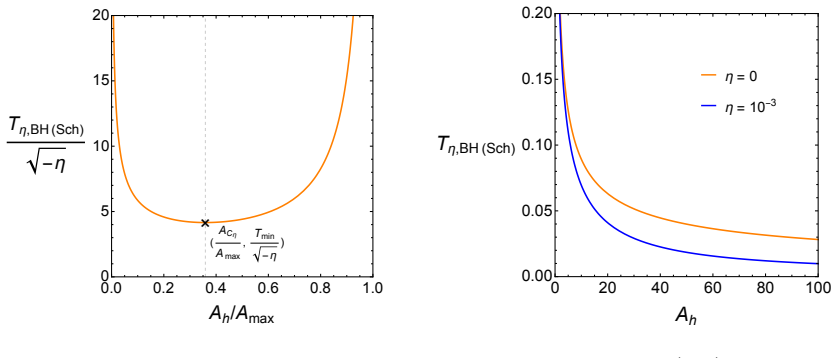
In the paper's own terms, the discovery is that the non-extensivity of Tsallis statistics changes black hole entropy from the area-proportional Bekenstein–Hawking form to the closed expression $S_{\eta,\mathrm{BH}} = \frac{1}{\eta}\left[(1+48\pi M^2\eta)\exp\!\left(-\frac{44\pi M^2\eta}{1+48\pi M^2\eta}\right)-1\right]$, with $\eta=1-q$. This entropy is homogeneous when the Tsallis internal energy is linked to the ordinary local internal energy by the specific relation $U_{q,\mathrm{loc}}=2^{1/3}\Gamma_q(3)^{-1/3}U_{\mathrm{loc}}$, which removes the $q$-generalized gamma function from the entropy. Because the entropy is homogeneous, Euler's theorem gives a generalized Smarr formula and first law in which $\eta$ itself is a thermodynamic variable. The stability analysis then yields a window $-\frac{1}{36}<\eta<0$ in which the entropy has a local maximum at $A_{\max}=-1/(36\eta)$, the heat capacity is positive between $A_C^\eta$ and $A_{\max}$, and the Gibbs free energy is negative above $A_G\approx0.695 A_{\max}$, so a stable large-black-hole phase exists and a Hawking–Page transition appears at $T_{\mathrm{HP}}\approx5.935\sqrt{-\eta}$.
Load-bearing premise
The load-bearing premise is the chosen relation between the Tsallis gas energy and the ordinary gas energy, $U_{q,\mathrm{loc}}=u_1\Gamma_q(3)^{u_2}U_{\mathrm{loc}}$ with $u_1=2^{1/3}$, $u_2=-1/3$; the paper itself says $J(q)$ is not unique, and this specific choice is what removes $\Gamma_q(3)$ and makes the entropy a homogeneous function, so if another allowed choice is used the stability window changes or disappears.
Editorial extensions
If this is right
- A Schwarzschild black hole, usually thought to be thermodynamically unstable because its heat capacity is negative, has a large-size phase with positive heat capacity whenever $-\frac{1}{36}<\eta<0$.
- The generalized entropy is not the power-law form $S\propto A^{\delta}$ often assumed for Tsallis black hole entropy; it contains an exponential factor, so earlier power-law treatments of Tsallis black hole thermodynamics would need to be reconsidered.
- A Hawking–Page type transition from thermal radiation to a stable large black hole occurs at temperature $T_{\mathrm{HP}}\approx5.935\sqrt{-\eta}$, driven by non-extensivity alone in an asymptotically flat spacetime.
- In the limit $\eta\to0$ the standard Bekenstein–Hawking entropy, negative heat capacity, and positive free energy are all recovered, so the construction is a genuine one-parameter deformation of Schwarzschild thermodynamics.
- Along fixed $\Phi_\eta$ processes, the black hole cannot be simultaneously locally and globally stable for any allowed $\eta$, so the stabilization is specific to the fixed-$\eta$ ensemble.
Reading between the lines
- If the stability window is real, it suggests that the microscopic degrees of freedom counted by black hole entropy may be effectively non-extensive with a small negative $\eta$, and that the long-range correlations producing stability could be observable in the thermodynamics of astrophysical black holes.
- The paper leaves open which physical mechanism fixes $\eta$; a testable extension would be to compare the predicted Hawking–Page temperature and the stable-phase heat capacity with the thermodynamics extracted from gravitational-wave ringdown or Lyapunov-exponent analyses of black hole spacetimes.
- Because the paper notes that $J(q)$ and the internal-energy relation are not unique, the most conservative reading is that the stability window is a feature of this particular consistent closure of Tsallis thermodynamics, not a universal prediction of non-extensive statistics; checking other legitimate closures is the natural next step.
- The same construction could be applied to rotating or charged black holes; if the $-\frac{1}{36}<\eta<0$ window survives there, it would give a general mechanism for stabilizing black holes without a cosmological constant.
Editorial analysis
A structured set of objections, weighed in public.
Referee Report
Summary. This paper revisits the derivation of black hole entropy from the statistical mechanics of a thin gas shell near a Schwarzschild horizon. It first reproduces the standard Bekenstein-Hawking result in the Gibbs-Boltzmann limit, then extends the derivation to Tsallis statistics and obtains a modified black hole entropy S_{eta,BH}(Sch) = (1/eta)[(1 + 48 pi M^2 eta) exp(-44 pi M^2 eta/(1 + 48 pi M^2 eta)) - 1] (Eq. 67). Using Euler's theorem on this homogeneity-adapted entropy, the authors construct a generalized Smarr formula and first law, and analyze local and global stability. They conclude that a Schwarzschild black hole becomes locally and globally stable for -1/36 < eta < 0, with a Hawking-Page-like phase transition.
Significance. If correct, this would be an interesting statistical-mechanics route to non-extensive black hole thermodynamics, with a concrete falsifiable prediction: Schwarzschild black holes are thermodynamically stable for a narrow interval of negative non-extensive parameter. The paper is self-contained and careful in several respects: the phase-space calculation of Sec. II is standard and explicit, the q-Laplace transform and Gamma_q(3) are presented in closed form, and the homogeneous-function/Smarr construction is internally consistent once Eq. (54) is taken as given. However, the central new formula currently rests on an algebraic error and on an unconstrained internal-energy ansatz, so the significance is conditional.
major comments (3)
- [III, Eq. (54)] Equation (54) does not follow from Eqs. (47), (49) and (50). Setting M = N(1-q), r = 1 + 3M and X = 4 pi e V_loc/(h^3 c^3 beta_loc^3 N), Eq. (50) gives J^r = (Gamma_q(3)^{1/3}/u1) (X/Gamma_q(3))^M. Substituting this into Eq. (47) yields [X/(J^3 Gamma_q(3))]^M = (2X)^{M/r} Gamma_q(3)^{-2M/r} for u1 = 2^{1/3}. The factor Gamma_q(3)^{-2M/r} is missing from Eq. (54). Since Gamma_q(3) depends on q, equivalently on eta, the resulting black hole entropy is not homogeneous of degree 1 in (M^2, eta^{-1}); consequently Eqs. (68)-(72), the temperature (74), and the stability window (79) do not follow from the derivation as written. The cancellation the authors intend would require u2 = +1/3 in Eq. (49) rather than the value u2 = -1/3 stated in the paper.
- [III, Eq. (49)] Even after the sign of u2 is corrected, the derivation depends on the ansatz U_{q,loc} = u1 Gamma_q(3)^{u2} U_loc with free constants u1 and u2. The paper itself states that J(q) is not unique and that u2 is chosen so that Gamma_q(3) cancels from the q-entropy. This makes Eq. (67) and the stability window (79) calibration-dependent rather than robust outputs of Tsallis statistics. The authors should either derive the internal-energy relation from a physical or thermodynamic principle, or demonstrate that the final claims are invariant under alternative choices of J(q).
- [III, after Eq. (54)] The identification of the gas q-entropy with black hole entropy uses the Gibbs-Boltzmann inverse temperature beta_loc = 4 pi^2 l_loc/(h c) after Eq. (54), while the gas is characterized by beta_q = J(q) beta_loc. For q != 1 these temperatures differ. The paper should justify that a gas in q-equilibrium with this beta_q is in the appropriate equilibrium with a black hole whose Hawking temperature is set by beta_loc, or explain how the q-temperature is related to the physical temperature (for example via Ref. [41]). As written, the identification of S^{(0)}_{q,loc}(bh) with the black hole entropy assumes an equilibrium condition that has not been established for q != 1.
minor comments (5)
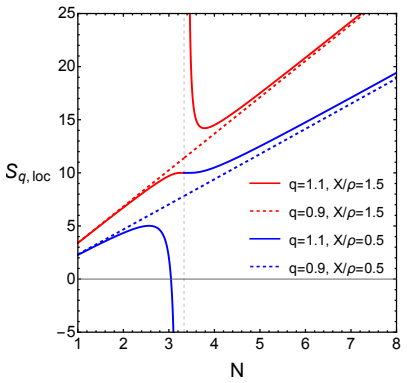
- [IV, Fig. 2 description] The sentence 'it becomes at a certain horizon radius' is incomplete; presumably 'becomes zero' or 'becomes negative' was intended.
- [IV, Eq. (76)] The expression '112/3 (3 sqrt(7869) + 236)^{1/3}' is typeset ambiguously; please use explicit brackets or a cleared decimal form.
- [IV, Figs. 4 and 5] Axis and legend labels such as 'eta C eta(Sch)' and 'eta C eta,BH (Sch)' contain typesetting artifacts; please ensure subscripts and superscripts render correctly.
- [References] Reference [24] is missing its volume and page fields and should be completed.
- [III and IV notation] The paper switches from (1-q) in Sec. III to eta = 1-q in Sec. IV; introducing eta explicitly before Eq. (55) would improve readability.
Circularity Check
The homogeneity behind the claimed generalized Bekenstein-Hawking entropy is imposed by the free choice u2 = −1/3 in the internal-energy relation, and the asserted cancellation of Γq(3) in Eq. (54) is algebraically incorrect; the stability window −1/36 < η < 0 is therefore a property of an implicit ansatz rather than a derived consequence of Tsallis statistics.
-
self definitional
[Sec. III, after Eq. (49), and Sec. IV, after Eq. (67)]
"As will be discussed in Sec. IV, by choosing u2 = −1/3, Γq(3) is eliminated in the q-entropy and then the q-entropy can be treated as a homogeneous function."
Eq. (49) introduces arbitrary constants u1 and u2 in Uq,loc = u1 Γq(3)^{u2} Uloc, and Eq. (50) fixes J(q) through that relation. The text then declares u2 = −1/3 to be the choice that eliminates Γq(3) from Eq. (47), making the black hole entropy homogeneous. The Smarr formula, the first law, the temperature, and the stability window (Eqs. 67–81) all follow from that imposed homogeneity. Thus the advertised result—a locally and globally stable Schwarzschild phase for −1/36 < η < 0—is a property of the entropy form that the free exponent was selected to produce, not an independent output of Tsallis statistics. The paper is explicit about the choice, so this is partial circularity by construction.
-
other
[Sec. III, Eq. (54) (claimed substitution of Eqs. (47) and (50))]
"As expected, this resulting entropy is independent of Γq(3)."
Direct substitution of Eq. (50) into Eq. (47) leaves a Γq(3) factor. With M = N(1−q) and X = 4πe Vloc/(h^3 c^3 β_loc^3 N), Eq. (50) gives J^{1+3M} = (Γq(3)^{1/3}/u1)(X/Γq(3))^M, so (X/(J^3 Γq(3)))^M = 2^{M/(1+3M)} X^{M/(1+3M)} Γq(3)^{−4M/(1+3M)} for u1 = 2^{1/3}. Eq. (54) omits Γq(3)^{−4M/(1+3M)}. Consequently Eq. (55) and Eq. (67), along with the Smarr formula, first law, temperature, and stability bounds, are not consequences of the stated Tsallis calculation; the homogeneous exponential entropy is effectively an implicit ansatz. This is a load-bearing algebraic gap rather than a circular equivalence, but it reinforces that the final prediction is not forced by the stated inputs.
full rationale
The main circularity concern is real but limited. The paper is transparent that the internal-energy relation (49) is a free choice and that u2 = −1/3 is selected to eliminate Γq(3) in order to make the entropy homogeneous. All subsequent thermodynamic structure is built on that homogeneity, so the stability result is a consequence of the chosen construction rather than a unique prediction of Tsallis statistics. Additionally, the text's claim that the elimination works is algebraically incorrect: the Γq(3) factor survives in Eq. (54), so the derivation chain from Tsallis statistics to Eq. (67) has a gap. The self-citations in the paper (Refs. [42] and [89]) are not load-bearing for these claims; the Euler-homogeneity method and the hydrostatic-equilibrium remark are standard or contextual. The paper does not claim machine-checked or externally falsified support for the central entropy, so the score is set at 6 rather than 0–2. The result is partially circular and partly unsupported by the written derivation, but because the free choice is openly identified and the stability analysis itself is carried out consistently from the assumed entropy, this is not a fully tautological score of 8 or 10.
Assumptions & free parameters
free parameters (4)
- u1 =
2^(1/3)
- u2 =
-1/3
- lloc =
e^(15/8) l_P / (4 pi^(5/2)) approximately 0.1 l_P
- q (non-extensive parameter) =
not fitted; stability restricts -1/36 < eta = 1-q < 0
assumptions (6)
- domain assumption Gas shell near the horizon is in thermal equilibrium with the black hole and its particles can be identified with horizon degrees of freedom via N = Ah/lP^2.
- domain assumption The Tsallis total energy of N particles takes the non-additive factorized form Eq. (35) so the q-partition function factorizes as Eq. (33).
- domain assumption Expectation values are defined with normalized f and the f^q-weighted energy: integral dV f = 1, integral dV f^q E = U_q (Eq. 25).
- ad hoc to paper Internal-energy relation U_q,loc = u1 Gamma_q(3)^(u2) U_loc with u1 = 2^(1/3), u2 = -1/3 (Eq. 49).
- standard math q-Laplace transform and q-gamma function identities Eqs. (38)-(39) with the stated convergence ranges.
- standard math Euler's theorem for homogeneous functions is applicable to S_eta,BH viewed as a function of M^2 and eta^(-1).
Cite this review
Pith. "Pith review of Black Hole Thermodynamics via Tsallis Statistical Mechanics." pith.science (2026). https://pith.science/paper/6FPMFJ7J
@misc{pith2026250202522,
  author       = {Pith},
  title        = {Pith review of: Black Hole Thermodynamics via Tsallis Statistical Mechanics},
  year         = {2026},
  howpublished = {\url{https://pith.science/paper/6FPMFJ7J}},
  note         = {Machine review of arXiv:2502.02522}
}
read the original abstract
An investigation of black hole thermodynamics based on Tsallis statistical mechanics is explored through the study of the thermodynamics of a gas system located near the horizon of a black hole. In spite of the difficulty in exploring black hole thermodynamics through statistical mechanics, the entropy of the nearby gas system is found to be proportional to the black hole's horizon area using Gibbs-Boltzmann statistical mechanics. This allows us to study black hole thermodynamics by using statistical mechanics through the thermodynamic behaviors of the gas system. Since the entropy of the black hole is proportional to the horizon area, it is more suitable to use non-extensive statistical mechanics instead of the usual Gibbs-Boltzmann ones. In this work, the black hole entropy is derived based on Tsallis statistical mechanics, one of well-known non-extensive statistical mechanics. It is found that the black hole entropy gets a modification due to non-extensivity. By using such an entropy, the black hole can be stabilized due to the non-extensivity, and the bound on the non-extensive parameter is also determined.
Figures


Figures from the paper (5 more)


Reference graph
Works this paper leans on
-
[41]
I. C ¸ imdiker, M. P. D¸ abrowski, and H. Gohar, Equilibrium temperature for black holes with nonextensive entropy, The European Physical Journal C83, 10.1140/epjc/s10052-023-11317- 0 (2023)
-
[1]
J. M. Bardeen, B. Carter, and S. W. Hawking, The Four laws of black hole mechanics, Commun. Math. Phys. 31, 161 (1973)
1973
-
[2]
J. D. Bekenstein, Black holes and entropy, Phys. Rev. D 7, 2333 (1973)
1973
-
[3]
J. D. Bekenstein, Generalized second law of thermodynamics in black hole physics, Phys. Rev. D 9, 3292 (1974)
1974
-
[4]
S. W. Hawking, Particle Creation by Black Holes, Commun. Math. Phys. 43, 199 (1975), [Erratum: Commun.Math.Phys. 46, 206 (1976)]. 36
1975
-
[5]
Wallace, Gravity, Entropy, and Cosmology: In Search of Clarity, Brit
D. Wallace, Gravity, Entropy, and Cosmology: In Search of Clarity, Brit. J. Phil. Sci. 61, 513 (2010), arXiv:0907.0659 [cond-mat.stat-mech]
arXiv 2010
-
[6]
Padmanabhan, Lessons from Classical Gravity about the Quantum Structure of Space- time, J
T. Padmanabhan, Lessons from Classical Gravity about the Quantum Structure of Space- time, J. Phys. Conf. Ser. 306, 012001 (2011), arXiv:1012.4476 [gr-qc]
arXiv 2011
-
[7]
D. Gregoris and Y. C. Ong, Understanding gravitational entropy of black holes: A new proposal via curvature invariants, Phys. Rev. D 105, 104017 (2022), arXiv:2109.11968 [gr- qc]
arXiv 2022
Show all 114 references
-
[8]
Strominger and C
A. Strominger and C. Vafa, Microscopic origin of the Bekenstein-Hawking entropy, Phys. Lett. B 379, 99 (1996), arXiv:hep-th/9601029
1996 arXiv
-
[9]
Kolekar and T
S. Kolekar and T. Padmanabhan, Ideal Gas in a strong Gravitational field: Area dependence of Entropy, Phys. Rev. D 83, 064034 (2011), arXiv:1012.5421 [gr-qc]
2011 arXiv
-
[10]
Mirza, H
B. Mirza, H. Mohammadzadeh, and Z. Raissi, Condensation of an ideal gas with intermediate statistics on the horizon, Eur. Phys. J. C 72, 2152 (2012), arXiv:1108.6149 [gr-qc]
2012 arXiv
-
[11]
Bhattacharya, S
S. Bhattacharya, S. Chakraborty, and T. Padmanabhan, Entropy of a box of gas in an external gravitational field − revisited, Phys. Rev. D 96, 084030 (2017), arXiv:1702.08723 [gr-qc]
2017 arXiv
-
[12]
D. Li, B. Wu, Z.-M. Xu, and W.-L. Yang, A shell of bosons in spherically symmetric space- times, Phys. Lett. B 820, 136588 (2021), arXiv:2106.08653 [gr-qc]
2021 arXiv
-
[13]
Sourtzinou and C
E. Sourtzinou and C. Anastopoulos, Quantum statistical mechanics near a black hole horizon, Phys. Rev. D 107, 085006 (2023), arXiv:2203.14319 [gr-qc]
2023 arXiv
-
[14]
Pretorius, D
F. Pretorius, D. Vollick, and W. Israel, An Operational approach to black hole entropy, Phys. Rev. D 57, 6311 (1998), arXiv:gr-qc/9712085
1998 arXiv
-
[15]
Oppenheim, Area scaling entropies for gravitating systems, Phys
J. Oppenheim, Area scaling entropies for gravitating systems, Phys. Rev. D 65, 024020 (2002), arXiv:gr-qc/0105101
2002 arXiv
-
[16]
Tsallis, Possible Generalization of Boltzmann-Gibbs Statistics, J
C. Tsallis, Possible Generalization of Boltzmann-Gibbs Statistics, J. Statist. Phys. 52, 479 (1988)
1988
-
[17]
D. J. Louis-Martinez, Classical relativistic ideal gas in thermodynamic equilibrium in a uni- formly accelerated reference frame, Class. Quant. Grav. 28, 035004 (2011), arXiv:1012.3063 [physics.class-ph]
2011 arXiv
-
[19]
Silva and J
R. Silva and J. A. S. Lima, Relativity, nonextensivity, and extended power law distributions, Phys. Rev. E 72, 057101 (2005), arXiv:cond-mat/0510201
2005 arXiv
-
[20]
D. Jiulin, Nonextensive power law distributions and the q-kinetic theory for the systems with self-gravitating long-range interactions, Astrophysics and Space Science 312, 47 (2007), arXiv:cond-mat/0603803
2007 arXiv
-
[21]
Zhipeng, D
L. Zhipeng, D. Jiulin, and G. Lina, Nonextensivity and q-distribution of a relativistic gas under an external electromagnetic field, Chin. Sci. Bull. 56, 3689 (2011), arXiv:0802.2492 [cond-mat.stat-mech]
2011 arXiv
-
[22]
Zheng, J
Y. Zheng, J. Du, and F. Liang, The limit behavior of the evolution of the Tsallis entropy in self-gravitating systems, EPL 118, 50007 (2017), arXiv:1710.03567 [cond-mat.stat-mech]
2017 arXiv
-
[23]
Sheykhi, Modified Friedmann Equations from Tsallis Entropy, Phys
A. Sheykhi, Modified Friedmann Equations from Tsallis Entropy, Phys. Lett. B 785, 118 (2018), arXiv:1806.03996 [gr-qc]
2018 arXiv
-
[24]
E. N. Saridakis, K. Bamba, R. Myrzakulov, and F. K. Anagnostopoulos, Holographic dark energy through Tsallis entropy, JCAP 2018 (012), arXiv:1806.01301 [gr-qc]
2018 arXiv
-
[25]
Lymperis and E
A. Lymperis and E. N. Saridakis, Modified cosmology through nonextensive horizon thermo- dynamics, Eur. Phys. J. C 78, 993 (2018), arXiv:1806.04614 [gr-qc]
2018 arXiv
-
[26]
Jizba and G
P. Jizba and G. Lambiase, Constraints on Tsallis Cosmology from Big Bang Nucleosyn- thesis and the Relic Abundance of Cold Dark Matter Particles, Entropy 25, 1495 (2023), arXiv:2310.19045 [gr-qc]
2023 arXiv
-
[27]
Sheykhi, New explanation for accelerated expansion and flat galactic rotation curves, The European Physical Journal C 80, 10.1140/epjc/s10052-019-7599-1 (2020)
A. Sheykhi, New explanation for accelerated expansion and flat galactic rotation curves, The European Physical Journal C 80, 10.1140/epjc/s10052-019-7599-1 (2020)
2020 doi
-
[28]
Dehpour, Thermal leptogenesis in nonextensive cosmology, Eur
M. Dehpour, Thermal leptogenesis in nonextensive cosmology, Eur. Phys. J. C84, 340 (2024), arXiv:2401.00229 [hep-ph]
2024 arXiv
-
[29]
T. S. Bir´ o and V. G. Czinner, A q-parameter bound for particle spectra based on black hole thermodynamics with R´ enyi entropy, Phys. Lett. B726, 861 (2013), arXiv:1309.4261 [gr-qc]
2013 arXiv
-
[30]
V. G. Czinner and H. Iguchi, R´ enyi Entropy and the Thermodynamic Stability of Black Holes, Phys. Lett. B 752, 306 (2016), arXiv:1511.06963 [gr-qc]
2016 arXiv
-
[31]
V. G. Czinner and H. Iguchi, Thermodynamics, stability and Hawking–Page transition of Kerr black holes from R´ enyi statistics, Eur. Phys. J. C 77, 892 (2017), arXiv:1702.05341 [gr-qc]. 38
2017 arXiv
-
[32]
Tannukij, P
L. Tannukij, P. Wongjun, E. Hirunsirisawat, T. Deesuwan, and C. Promsiri, Thermodynam- ics and phase transition of spherically symmetric black hole in de Sitter space from R´ enyi statistics, Eur. Phys. J. Plus 135, 500 (2020), arXiv:2002.00377 [gr-qc]
2020 arXiv
-
[33]
Promsiri, E
C. Promsiri, E. Hirunsirisawat, and W. Liewrian, Thermodynamics and Van der Waals phase transition of charged black holes in flat spacetime via R´ enyi statistics, Phys. Rev. D 102, 064014 (2020), arXiv:2003.12986 [hep-th]
2020 arXiv
-
[34]
Promsiri, E
C. Promsiri, E. Hirunsirisawat, and W. Liewrian, Solid-liquid phase transition and heat engine in an asymptotically flat Schwarzschild black hole via the R´ enyi extended phase space approach, Phys. Rev. D 104, 064004 (2021), arXiv:2106.02406 [hep-th]
2021 arXiv
-
[35]
Nakarachinda, E
R. Nakarachinda, E. Hirunsirisawat, L. Tannukij, and P. Wongjun, Effective thermodynam- ical system of Schwarzschild–de Sitter black holes from R´ enyi statistics, Phys. Rev. D 104, 064003 (2021), arXiv:2106.02838 [gr-qc]
2021 arXiv
-
[36]
Hirunsirisawat, R
E. Hirunsirisawat, R. Nakarachinda, and C. Promsiri, Emergent phase, thermodynamic ge- ometry, and criticality of charged black holes from R´ enyi statistics, Phys. Rev. D105, 124049 (2022), arXiv:2204.13023 [hep-th]
2022 arXiv
-
[37]
Chunaksorn, E
P. Chunaksorn, E. Hirunsirisawat, R. Nakarachinda, L. Tannukij, and P. Wongjun, Thermo- dynamics of asymptotically de Sitter black hole in dRGT massive gravity from R´ enyi entropy, Eur. Phys. J. C 82, 1174 (2022), arXiv:2208.14770 [gr-qc]
2022 arXiv
-
[38]
Alonso-Serrano, M
A. Alonso-Serrano, M. P. D¸ abrowski, and H. Gohar, Nonextensive Black Hole Entropy and Quantum Gravity Effects at the Last Stages of Evaporation, Phys. Rev. D 103, 026021 (2021), arXiv:2009.02129 [gr-qc]
2021 arXiv
-
[39]
C ¸ imidiker, M
I. C ¸ imidiker, M. P. D¸ abrowski, and H. Gohar, Generalized uncertainty principle im- pact on nonextensive black hole thermodynamics, Class. Quant. Grav. 40, 145001 (2023), arXiv:2301.00609 [gr-qc]
2023 arXiv
-
[40]
Nojiri, S
S. Nojiri, S. D. Odintsov, and V. Faraoni, Area-law versus R´ enyi and Tsallis black hole entropies, Phys. Rev. D 104, 084030 (2021), arXiv:2109.05315 [gr-qc]
2021 arXiv
-
[42]
Nakarachinda, C
R. Nakarachinda, C. Promsiri, L. Tannukij, and P. Wongjun, Thermodynamics of black holes with R´ enyi entropy from classical gravity, Nucl. Phys. B 1011, 116796 (2025), 39 arXiv:2211.05989 [gr-qc]
2025 arXiv
-
[43]
Nojiri, S
S. Nojiri, S. D. Odintsov, and V. Faraoni, From nonextensive statistics and black hole entropy to the holographic dark universe, Phys. Rev. D 105, 044042 (2022), arXiv:2201.02424 [gr-qc]
2022 arXiv
-
[44]
Nojiri, S
S. Nojiri, S. D. Odintsov, and T. Paul, Early and late universe holographic cosmology from a new generalized entropy, Phys. Lett. B 831, 137189 (2022), arXiv:2205.08876 [gr-qc]
2022 arXiv
-
[45]
Nojiri, S
S. Nojiri, S. D. Odintsov, and V. Faraoni, Alternative entropies and consistent black hole thermodynamics, Int. J. Geom. Meth. Mod. Phys. 19, 2250210 (2022), arXiv:2207.07905 [gr-qc]
2022 arXiv
-
[46]
Nojiri, S
S. Nojiri, S. D. Odintsov, and V. Faraoni, New Entropies, Black Holes, and Holographic Dark Energy, Astrophysics 65, 534 (2022), arXiv:2208.10235 [gr-qc]
2022 arXiv
-
[47]
S. D. Odintsov and T. Paul, A non-singular generalized entropy and its implications on bounce cosmology, Phys. Dark Univ. 39, 101159 (2023), arXiv:2212.05531 [gr-qc]
2023 arXiv
-
[48]
D’Agostino and G
R. D’Agostino and G. G. Luciano, Lagrangian formulation of the Tsallis entropy, Phys. Lett. B 857, 138987 (2024), arXiv:2408.13638 [gr-qc]
2024 arXiv
-
[49]
G. E. Volovik, Tsallis-Cirto entropy of black hole and black hole atom, JETP Letters 121, 243 (2025), arXiv:2409.15362 [physics.gen-ph]
2025 arXiv
-
[50]
M. T. Manoharan and N. Shaji, Reconciling fractional entropy and black hole entropy com- positions, Eur. Phys. J. C 85, 373 (2025), arXiv:2501.18151 [gr-qc]
2025 arXiv
-
[51]
H. Lu, S. Di Gennaro, and Y. C. Ong, Generalized entropy implies varying-G: Horizon area dependent field equations and black hole-cosmology coupling, Annals Phys. 474, 169914 (2025), arXiv:2407.00484 [gr-qc]
2025 arXiv
-
[52]
R´ enyi, On the dimension and entropy of probability distributions, Acta Mathematica Academiae Scientiarum Hungarica 10, 193 (1959)
A. R´ enyi, On the dimension and entropy of probability distributions, Acta Mathematica Academiae Scientiarum Hungarica 10, 193 (1959)
1959
-
[53]
J. D. Barrow, The Area of a Rough Black Hole, Phys. Lett. B 808, 135643 (2020), arXiv:2004.09444 [gr-qc]
2020 arXiv
-
[54]
B. D. Sharma and D. P. Mittal, New non-additive measures of entropy for discrete probability distributions, J. Math. Sci 10, 28 (1975)
1975
-
[55]
T. S. Bir´ o and P. V´ an, Zeroth law compatibility of nonadditive thermodynamics, Phys. Rev. E 83, 061147 (2011)
2011
-
[56]
Maleki, Z
M. Maleki, Z. Ebadi, and H. Mohammadzadeh, Nonextensive statistics and the entropy on the horizon, Int. J. Mod. Phys. A 39, 2450019 (2024). 40
2024
-
[57]
Padmanabhan, Phase volume occupied by a test particle around an incipient black hole, Phys
T. Padmanabhan, Phase volume occupied by a test particle around an incipient black hole, Phys. Lett. A 136, 203 (1989)
1989
-
[58]
Poisson, A Relativist’s Toolkit: The Mathematics of Black-Hole Mechanics(Cambridge University Press, 2009)
E. Poisson, A Relativist’s Toolkit: The Mathematics of Black-Hole Mechanics(Cambridge University Press, 2009)
2009
-
[59]
R. C. Tolman and P. Ehrenfest, Temperature equilibrium in a static gravitational field, Phys. Rev. 36, 1791 (1930)
1930
-
[60]
Pathria and P
R. Pathria and P. Beale, Statistical Mechanics (Elsevier Science, 2021)
2021
-
[61]
Calmet, M
X. Calmet, M. Graesser, and S. D. H. Hsu, Minimum length from quantum mechanics and general relativity, Phys. Rev. Lett. 93, 211101 (2004), arXiv:hep-th/0405033
2004 arXiv
-
[62]
Kubiznak, R
D. Kubiznak, R. B. Mann, and M. Teo, Black hole chemistry: thermodynamics with Lambda, Class. Quant. Grav. 34, 063001 (2017), arXiv:1608.06147 [hep-th]
2017 arXiv
-
[63]
Tsallis, F
C. Tsallis, F. Baldovin, R. Cerbino, and P. Pierobon, Introduction to Nonextensive Statistical Mechanics and Thermodynamics, arXiv e-prints , cond-mat/0309093 (2003), arXiv:cond- mat/0309093 [cond-mat.stat-mech]
2003 arXiv
-
[64]
Gell-Mann and C
M. Gell-Mann and C. Tsallis, Nonextensive entropy: interdisciplinary applications(Oxford University Press, 2004)
2004
-
[65]
E. M. F. Curado and C. Tsallis, Generalized statistical mechanics: Connection with thermo- dynamics, J. Phys. A 24, L69 (1991), [Erratum: J.Phys.A 25, 1019 (1992)]
1991
-
[66]
Tsallis, R
C. Tsallis, R. S. Mendes, and A. R. Plastino, The Role of constraints within generalized nonextensive statistics, Physica A 261, 534 (1998)
1998
-
[67]
Taruya and M.-a
A. Taruya and M.-a. Sakagami, Gravothermal catastrophe and generalized entropy of self- gravitating systems, Physica A 307, 185 (2002), arXiv:cond-mat/0107494
2002 arXiv
-
[68]
Taruya and M
A. Taruya and M. Sakagami, Gravothermal catastrophe and Tsallis’ generalized entropy of selfgravitating systems. 2. Thermodynamic properties of stellar polytrope, Physica A 318, 387 (2003), arXiv:cond-mat/0204315
2003 arXiv
-
[69]
Taruya and M.-a
A. Taruya and M.-a. Sakagami, Gravothermal catastrophe and Tsallis’ generalized entropy of selfgravitating systems. 3. Equilibrium structure using normalized q values, Physica A 322, 285 (2003), arXiv:cond-mat/0211305
2003 arXiv
-
[70]
Sakagami and A
M.-a. Sakagami and A. Taruya, Selfgravitating stellar systems and nonextensive thermo- statistics, Contin. Mech. Thermodyn. 16, 279 (2004), arXiv:cond-mat/0310082. 41
2004 arXiv
-
[71]
Zavala, D
J. Zavala, D. Nunez, R. A. Sussman, L. G. Cabral-Rosetti, and T. Matos, Stellar polytropes and NFW halo model: Stellar polytropes and Navarro-Frenk-White halo models: comparison with observations, JCAP 2006 (008), arXiv:astro-ph/0605665
2006 arXiv
-
[72]
Coraddu, G
M. Coraddu, G. Kaniadakis, A. Lavagno, M. Lissia, G. Mezzorani, and P. Quarati, Thermal distributions in stellar plasmas, nuclear reactions and solar neutrinos, Braz. J. Phys. 29, 153 (1999), arXiv:nucl-th/9811081
1999 arXiv
-
[73]
Chakrabarti, R
R. Chakrabarti, R. Chandrashekar, and S. Naina Mohammed, Nonextensive statistics of the classical relativistic ideal gas, Physica A: Statistical Mechanics and its Applications 389, 1571–1584 (2010)
2010
-
[74]
Chandrashekar and S
R. Chandrashekar and S. S. Naina Mohammed, A class of energy-based ensembles in tsallis statistics, Journal of Statistical Mechanics: Theory and Experiment 2011, P05018 (2011)
2011
-
[75]
Tsallis, Entropic nonextensivity: A Possible measure of complexity, Chaos Solitons Frac- tals 13, 371 (2002), arXiv:cond-mat/0010150
C. Tsallis, Entropic nonextensivity: A Possible measure of complexity, Chaos Solitons Frac- tals 13, 371 (2002), arXiv:cond-mat/0010150
2002 arXiv
-
[76]
Wilk and Z
G. Wilk and Z. Wlodarczyk, Nonextensive information entropy for stochastic networks, Acta Phys. Polon. B 35, 871 (2004), arXiv:cond-mat/0212056
2004 arXiv
-
[77]
Wilk and Z
G. Wilk and Z. W lodarczyk, Quasi-power law ensembles, Acta Phys. Polon. B 46, 1103 (2015), arXiv:1501.01936 [cond-mat.stat-mech]
2015 arXiv
-
[78]
Jiulin, Nonextensive in nonequilibrium plasma systems with Coulombian long-range in- teractions, Phys
D. Jiulin, Nonextensive in nonequilibrium plasma systems with Coulombian long-range in- teractions, Phys. Lett. A 329, 262 (2004), arXiv:cond-mat/0404602
2004 arXiv
-
[79]
Jiulin, The Nonextensive parameter and Tsallis distribution for self-gravitating systems, EPL 67, 893 (2004), arXiv:cond-mat/0409480
D. Jiulin, The Nonextensive parameter and Tsallis distribution for self-gravitating systems, EPL 67, 893 (2004), arXiv:cond-mat/0409480
2004 arXiv
-
[80]
Mart ´ ınez, F
S. Mart ´ ınez, F. Nicol´ as, F. Pennini, and A. Plastino, Tsallis’ entropy maximization procedure revisited, Physica A: Statistical Mechanics and its Applications 286, 489–502 (2000)
2000
-
[81]
E. K. Lenzi, R. S. Mendes, and L. R. da Silva, Statistical mechanics based on Renyi entropy, Physica A 280, 337 (2000)
2000
-
[82]
G. L. Ferri, S. Mart ´ ınez, and A. Plastino, The role of constraints in Tsallis’ nonextensive treatment revisited, Physica A 347, 205 (2005)
2005
-
[83]
S. Abe, S. Mart ´ ınez, F. Pennini, and A. Plastino, Classical gas in nonextensive optimal lagrange multipliers formalism, Physics Letters A 278, 249–254 (2001)
2001
-
[84]
G. L. Ferri, S. Mart ´ ınez, and A. Plastino, Equivalence of the four versions of tsallis’s statistics, Journal of Statistical Mechanics: Theory and Experiment 2005, P04009 (2005). 42
2005
-
[85]
Q. A. Wang, M. Pezeril, L. Nivanen, and A. Le M´ ehaut´ e, Nonextensive distribution and factorization of the joint probability, Chaos, Solitons & Fractals 13, 131 (2002)
2002
-
[86]
Q. A. Wang, L. Nivanen, A. L. M eacutehauteacute, and M. Pezeril, On the generalized en- tropy pseudoadditivity for complex systems, Journal of Physics A: Mathematical and General 35, 7003–7007 (2002)
2002
-
[87]
S. R. Naik and H. J. Haubold, On the q-Laplace Transform and Related Special Functions, Axioms 5, 10.3390/axioms5030024 (2016)
2016 doi
-
[88]
Lynden-Bell, R
D. Lynden-Bell, R. Wood, and A. Royal, The Gravo-Thermal Catastrophe in Isothermal Spheres and the Onset of Red-Giant Structure for Stellar Systems, Mon. Not. Roy. Astron. Soc. 138, 495 (1968)
1968
-
[89]
Chunaksorn, R
P. Chunaksorn, R. Nakarachinda, and P. Wongjun, q-equilibrium of gas in spacetime of multi-horizon black holes (2024), arXiv:2402.13742 [gr-qc]
2024 arXiv
-
[90]
Tsallis and L
C. Tsallis and L. J. L. Cirto, Black hole thermodynamical entropy, The European Physical Journal C 73, 10.1140/epjc/s10052-013-2487-6 (2013)
2013 doi
-
[91]
Tsallis, Black hole entropy: A closer look, Entropy 22, 17 (2019)
C. Tsallis, Black hole entropy: A closer look, Entropy 22, 17 (2019)
2019
-
[92]
Black Hole Entropy: A Closer Look
P. Pessoa and B. Arderucio Costa, Comment on “Black Hole Entropy: A Closer Look”, Entropy 22, 1110 (2020), arXiv:2008.13744 [gr-qc]
2020 arXiv
-
[93]
Tsallis, C. Black Hole Entropy: A Closer Look. Entropy 2020, 22, 17
C. Tsallis, Reply to Pessoa, P.; Arderucio Costa, B. Comment on “Tsallis, C. Black Hole Entropy: A Closer Look. Entropy 2020, 22, 17”, Entropy 23, 630 (2021)
2021
-
[94]
Black Hole Entropy: A Closer Look
P. Pessoa, B. Arderucio Costa, and S. Press´ e, Revisiting Claims in “Black Hole Entropy: A Closer Look”, (2022), arXiv:2210.00324 [gr-qc]
2022 arXiv
-
[95]
Smarr, Mass formula for kerr black holes, Phys
L. Smarr, Mass formula for kerr black holes, Phys. Rev. Lett. 30, 71 (1973)
1973
-
[96]
S. W. Hawking and D. N. Page, Thermodynamics of Black Holes in anti-De Sitter Space, Commun. Math. Phys. 87, 577 (1983)
1983
-
[97]
Banerjee and B
R. Banerjee and B. R. Majhi, Quantum Tunneling and Back Reaction, Phys. Lett. B 662, 62 (2008), arXiv:0801.0200 [hep-th]
2008 arXiv
-
[98]
Banerjee and B
R. Banerjee and B. R. Majhi, Quantum Tunneling Beyond Semiclassical Approximation, JHEP 06, 095, arXiv:0805.2220 [hep-th]
-
[99]
R. K. Kaul and P. Majumdar, Logarithmic correction to the Bekenstein-Hawking entropy, Phys. Rev. Lett. 84, 5255 (2000), arXiv:gr-qc/0002040. 43
2000 arXiv
-
[100]
Domagala and J
M. Domagala and J. Lewandowski, Black hole entropy from quantum geometry, Class. Quant. Grav. 21, 5233 (2004), arXiv:gr-qc/0407051
2004 arXiv
-
[101]
X. He, B. Wang, R.-G. Cai, and C.-Y. Lin, Signature of the black hole phase transition in quasinormal modes, Phys. Lett. B 688, 230 (2010), arXiv:1002.2679 [hep-th]
2010 arXiv
-
[102]
Liu, D.-C
Y. Liu, D.-C. Zou, and B. Wang, Signature of the Van der Waals like small-large charged AdS black hole phase transition in quasinormal modes, JHEP 09, 179, arXiv:1405.2644 [hep-th]
-
[103]
Chabab, H
M. Chabab, H. El Moumni, S. Iraoui, and K. Masmar, Behavior of quasinormal modes and high dimension RN–AdS black hole phase transition, Eur. Phys. J. C 76, 676 (2016), arXiv:1606.08524 [hep-th]
2016 arXiv
-
[104]
D.-C. Zou, Y. Liu, and R.-H. Yue, Behavior of quasinormal modes and Van der Waals-like phase transition of charged AdS black holes in massive gravity, Eur. Phys. J. C 77, 365 (2017), arXiv:1702.08118 [gr-qc]
2017 arXiv
-
[105]
Wei and Y.-X
S.-W. Wei and Y.-X. Liu, Photon orbits and thermodynamic phase transition of d- dimensional charged AdS black holes, Phys. Rev. D 97, 104027 (2018), arXiv:1711.01522 [gr-qc]
2018 arXiv
-
[106]
Zhang, S.-Z
M. Zhang, S.-Z. Han, J. Jiang, and W.-B. Liu, Circular orbit of a test particle and phase transition of a black hole, Phys. Rev. D 99, 065016 (2019), arXiv:1903.08293 [hep-th]
2019 arXiv
-
[107]
Zhang and M
M. Zhang and M. Guo, Can shadows reflect phase structures of black holes?, Eur. Phys. J. C 80, 790 (2020), arXiv:1909.07033 [gr-qc]
2020 arXiv
-
[108]
Belhaj, L
A. Belhaj, L. Chakhchi, H. El Moumni, J. Khalloufi, and K. Masmar, Thermal Image and Phase Transitions of Charged AdS Black Holes using Shadow Analysis, Int. J. Mod. Phys. A 35, 2050170 (2020), arXiv:2005.05893 [gr-qc]
2020 arXiv
-
[109]
Du, H.-F
Y.-Z. Du, H.-F. Li, F. Liu, and L.-C. Zhang, Photon orbits and phase transition for non-linear charged anti-de Sitter black holes, JHEP 01, 137, arXiv:2204.01007 [hep-th]
-
[110]
X. Guo, Y. Lu, B. Mu, and P. Wang, Probing phase structure of black holes with Lyapunov exponents, JHEP 08, 153, arXiv:2205.02122 [gr-qc]
-
[111]
S. Yang, J. Tao, B. Mu, and A. He, Lyapunov exponents and phase transitions of Born-Infeld AdS black holes, JCAP 07, 045, arXiv:2304.01877 [gr-qc]
-
[112]
X. Lyu, J. Tao, and P. Wang, Probing the thermodynamics of charged Gauss Bonnet AdS black holes with the Lyapunov exponent, Eur. Phys. J. C 84, 974 (2024), arXiv:2312.11912 [gr-qc]. 44
2024 arXiv
-
[113]
A. N. Kumara, S. Punacha, and M. S. Ali, Lyapunov exponents and phase structure of Lifshitz and hyperscaling violating black holes, JCAP 07, 061, arXiv:2401.05181 [gr-qc]
-
[114]
T. Hale, D. Kubiznak, and J. Menˇ s ´ ıkov´ a, Optical properties of black holes in regularized Maxwell theory, Phys. Rev. D 109, 084061 (2024), arXiv:2401.16259 [gr-qc]
2024 arXiv
-
[115]
Promsiri, W
C. Promsiri, W. Horinouchi, and E. Hirunsirisawat, Observing black hole phase transitions in extended phase space and holographic thermodynamics approaches from optical features, Eur. Phys. J. C 85, 484 (2025), arXiv:2409.01582 [gr-qc]. 45
2025 arXiv
Reviewed August 9, 2026 · model on record in the stance chip above.
Discussion (0). Continue with ORCID to comment.