REVIEW 4 major objections 4 minor 22 references
PH-VAE: A Polynomial Hierarchical Variational Autoencoder Towards Disentangled Representation Learning
T0 review · 4 major / 4 minor · reviewed 2026-08-09 · deepseek-v4-flash
Pith's one-line read A polynomial hierarchical variational autoencoder significantly improves reconstruction and generation accuracy while adding a concrete form of disentanglement.
desk verdict The paper's central ELBO identity is mathematically false, so the theoretical claims collapse; the experiments don't compensate. read the letter →
The pith
A machine-rendered reading of the paper's core claim, the machinery that carries it, and where it could break.
The reading
What carries the argument
The central object is the polynomial hierarchical data format: each sample $x$ is expanded into powers $x^1, \ldots, x^S$, and each power is fed to a separate encoder that outputs its own mean $\mu_s$ and variance $\sigma_s^2$. These are averaged to give the latent $z = \mu + A \cdot \epsilon \cdot \sigma$, where $A$ is a tunable noise amplifier. The loss uses the Polynomial Hierarchical Divergence, $\mathrm{PH}(q(z|x)\|p(z)) = \frac{1}{S} \sum_{s=1}^S \mathrm{KL}[q_s(z|x^s)\|p(z)]$, in place of a single KL term; with Gaussian $q_s$ it has the closed form $\frac{1}{2S} \sum_{s=1}^S (1 + \log \sigma_s^2 - \mu_s^2 - \sigma_s^2)$. The assertion that this is a valid generalization of KL divergence, and the corresponding ELBO derivation, is what carries the claimed improvements.
What would settle it
On the Gaussian-mixture example with known true density $p(x)$, compute the exact marginal log-likelihood $\log p(x)$ and the PH-VAE training objective $L^{\mathrm{PH}}_{\mathrm{ELBO}}$ after convergence; a valid ELBO must satisfy $L^{\mathrm{PH}}_{\mathrm{ELBO}} \le \log p(x)$. Any batch where the computed objective exceeds $\log p(x)$ would falsify the derivation in Eqs. (11)-(17). A second check is to train PH-VAE with $S=1$ and with $S=3$ on identical random seeds and verify that the $S=3$ model's reconstruction error is lower across many initializations, since the paper's central improvement claim is monotonic in $S$.
Extended reading notes
Core claim
The central claim is that the standard VAE's reconstruction and generation failures come from compressing all information through a single latent bottleneck with one KL penalty, and that this can be remedied by a polynomial hierarchical input format. PH-VAE models the joint distribution as $p(x,z) \approx p(x|z) \cdot \frac{1}{S} \sum_{s=1}^S p(z|x^s)$, approximates the posterior by the equal-weight mixture $q(z|x) = \frac{1}{S} \sum_{s=1}^S q_s(z|x^s)$, and trains with the objective $L^{\mathrm{PH}}_{\mathrm{ELBO}} = \mathbb{E}_{q(z|x)}[\log p(x|z)] - \frac{1}{S} \sum_{s=1}^S \mathrm{KL}[q_s(z|x^s) \| p(z)]$. The authors assert that this objective is an ELBO and that the averaged KL penalty, which they call the Polynomial Hierarchical Divergence, is a generalized divergence. The claimed payoff is that higher-order polynomial features inject multi-scale information into the latent space without increasing dataset size, reducing posterior collapse and yielding what the authors describe as systematic and drastic improvements in accuracy and reproducibility.
Load-bearing premise
The load-bearing premise is that $p(x,z) \approx p(x|z)$ times the average of $p(z|x^s)$, with the equal-weight mixture $q(z|x) = \frac{1}{S} \sum_s q_s(z|x^s)$ serving as a valid variational posterior, a step the paper states follows from the IWAE metric without giving the derivation; if this identity does not hold, the ELBO and the mutual-information improvement claimed for PH-VAE collapse.
Editorial extensions
If this is right
- For a fixed dataset size, reconstruction accuracy should improve monotonically as $S$ increases, because each added polynomial feature adds a distinct scale of latent information.
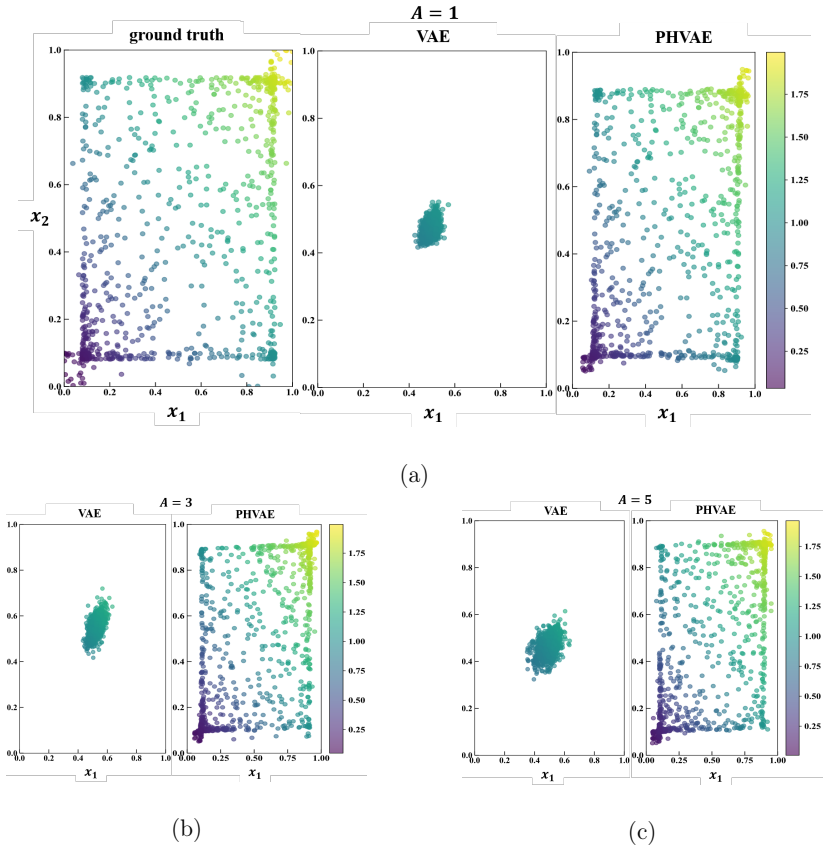
- Increasing the noise amplifier $A$ should not blur reconstructions away from the data; PH-VAE is claimed to remain accurate for $A=3$ and $A=5$ where VAE degrades.
- The averaged KL penalty should prevent latent collapse, keeping the mutual information between data and latent higher than in a standard VAE.
- The same architecture should transfer to other data modalities, such as time series or molecular data, because the polynomial expansion is modality-agnostic.
- Reproducibility of reconstructed distributions should improve in the sense that repeated runs produce similar density estimates, as suggested by the 100-run averaging protocol in Example 1.
Reading between the lines
- If the equal-weight mixture posterior is the right reading, then PH-VAE is effectively an ensemble of $S$ variational posteriors tied to polynomial views of the same input; this connects to multi-view or data-augmentation VAEs, a connection the paper does not make.
- The polynomial divergence's status as a generalized divergence hinges on each $q_s$ being a valid normalized density; if any encoder output drifts from normalization during training, the nonnegativity and ELBO claims would need explicit checking.
- A direct testable extension is to apply PH-VAE to a benchmark with known ground-truth generative factors, such as dSprites or Shapes3D, and measure standard disentanglement metrics to see whether the claimed disentanglement is competitive with existing methods.
- The paper's reproducibility claim could be quantified by computing distributional distances, such as Wasserstein or Kolmogorov-Smirnov, between repeated PH-VAE reconstructions and ground truth, rather than relying on visual inspection.
Signed reviews
Editorial analysis
A structured set of objections, weighed in public.
Referee Report
Summary. The manuscript proposes PH-VAE, a variational autoencoder variant that feeds polynomial powers x^s of the input into separate encoders, averages the resulting latent means and variances, and uses a loss in which the KL regularization is replaced by an average of per-encoder KL divergences to a prior, called the Polynomial Hierarchical Divergence. The authors claim that this construction improves reconstruction accuracy and reproducibility, mitigates posterior collapse, and provides unsupervised disentangled representation learning. The theoretical claims are developed in Section 2.3 and 2.4, and the experimental section reports qualitative comparisons on synthetic distributions, MNIST, and CelebA using only visual inspection of reconstructed images.
Significance. If the central derivation were sound, the proposed architecture would be a simple, easily implementable modification of the standard VAE with a concrete objective, and the code snippet in Section 2.3 is a useful starting point for reproducing the method. However, the load-bearing theoretical steps are incorrect: Eq. (18) does not follow from the preceding definitions, and Eq. (22) misidentifies an average of per-encoder KL terms as mutual information. The experimental section contains no quantitative metrics, no held-out evaluation, and no error bars, so the claimed 'systematic and drastic improvements' are not supported by the reported evidence. The paper does not provide machine-checked proofs or a complete reproducible artifact beyond an illustrative code fragment.
major comments (4)
- [2.3, Eq. (18)] The derivation of Eq. (18) is invalid. Starting from the standard identity log p(x) = E_{q(z|x)}[log p(x|z)] - KL(q(z|x)||p(z)) + KL(q(z|x)||p(z|x)), substituting the PH-ELBO in Eq. (13) gives L_PH = log p(x) - KL(q(z|x)||p(z|x)) - [(1/S)Σ_s KL(q_s(z|x^s)||p(z)) - KL(q(z|x)||p(z))]. The bracketed term is generally nonzero because the paper explicitly constructs distinct encoders and notes q(z|x) ≠ q_1(z|x). Thus Eq. (18) is false in general, and the proposed objective is not a valid lower bound on log p(x) under the stated model. This invalidates the theoretical justification for the polynomial divergence loss.
- [2.4, Eqs. (22)-(23)] The quantity I(x,z) defined in Eq. (23) as (1/S)Σ_{s=2}^S KL[q_s(z|x^s)||p(z)] is not mutual information. The mutual information between x and z is E_{p(x)}[KL[p(z|x)||p(z)]], not an average of per-encoder KL divergences to the prior. Moreover, Eq. (22) merely relabels the KL terms already present in Eq. (13): the first KL term is kept and the remaining KL terms are renamed I(x,z). Consequently, the claim that PH-VAE 'improves mutual information' is true by construction rather than by an independent decomposition, and it does not provide evidence of disentanglement.
- [2.3, Eq. (11)] The joint model p(x,z) ≈ p(x|z) · (1/S)Σ_s p(z|x^s) is stated without a derivation. The text says it follows from the IWAE metric, but no such derivation is given, and the expression is not obviously a properly normalized joint distribution. This premise is load-bearing because it motivates the averaged posterior q(z|x) = (1/S)Σ_s q_s(z|x^s) in Eq. (12) and hence the form of the loss. Without a valid derivation, the theoretical foundation of the method is incomplete.
- [3, Experiments] The experimental evaluation is exclusively qualitative. There are no quantitative metrics such as reconstruction error, negative log-likelihood, FID, or disentanglement scores; there is no held-out test set described for the image experiments; and no error bars or repeated-run statistics are reported. The MNIST and CelebA experiments use only 10 images each, and the figures show reconstructed training images. These results cannot support the abstract's claims of 'systematic and drastic improvements in both accuracy and reproducibility' or the conclusion that PH-VAE 'achieves superior reconstruction accuracy and generative ability.'
minor comments (4)
- [Abstract] The phrase 'polynomial hierarchical date format' should be 'data format'.
- [2.4] The text refers to 'ELBO objective in Eq. (14)', but Eq. (14) defines the KL divergence; the ELBO is defined in Eq. (13).
- [3.1] The text says 'the activation functions g(·) in Eq. (4) and f(·) in Eq. (8)' but Eq. (4) is the polynomial data transformation and Eq. (8) is the log-variance formula; the activation functions appear in Eqs. (6) and (10).
- [2.3, code snippet] In the loss_function code, kl_loss3 is used in the return statement but is not defined in the function body, which prevents the snippet from running as shown.
Circularity Check
The claimed MI/disentanglement improvement is an algebraic identity: Eq. (22) with I defined in Eq. (23) is simply Eq. (13), so PH-VAE's central theoretical benefit is a relabeling of its own KL terms rather than an independent prediction.
-
self definitional
[Section 2.4, Eqs. (22)-(23)]
"According to (Mutual Information) MI decomposition, ELBO objective in Eq. (14) can be modified as, L^PH_ELBO = E_{q(z|x)}[log p(x|z)] − I(x, z) − (1/S) KL[q_1(z|x)∥p(z)], (22) where I(x, z) := (1/S) Σ_{s=2}^S KL[q_s(z|x^s)∥p(z)], (23) where I(x, z) is the mutual information (MI)."
Substituting Eq. (23) into Eq. (22) yields exactly the loss defined in Eq. (13): E_q[log p(x|z)] − (1/S)Σ_{s=1}^S KL[q_s||p(z)] = E_q[log p(x|z)] − (1/S)KL[q_1||p(z)] − I(x,z). Hence I(x,z) is not a standard mutual information such as E[KL(q(z|x)||q(z))]; it is the s≥2 slice of the paper's own average-KL regularizer. The conclusion that PH-VAE improves MI is therefore true by construction: the loss explicitly penalizes those KL terms, and their reduction is reported as MI improvement. The disentanglement claim is a relabeling of the loss components, not a derived prediction.
-
renaming known result
[Section 2.3, Eqs. (14)-(15)]
"We define the average of the Kullback-Leibler (KL) Divergences of all layers as the Polynomial Hierarchical Divergence, i.e. PH(q(z|x)∥p(z)) := 1/S Σ_{s=1}^S KL [q_s(z|x^s)∥p(z)] ."
The Polynomial Hierarchical Divergence is defined as an arithmetic average of ordinary KL divergences between each component posterior and the prior. Averaging a known divergence does not produce a new divergence measure; it is a convex combination of the same KL quantities used in standard VAEs. The paper's presentation of PH as a novel divergence that generalizes KL is thus a renaming of the existing regularization, and the theoretical explanation of the reported gains reduces to the properties of the standard KL term rather than to a new mathematical object.
full rationale
The strongest circularity is in Section 2.4. Eq. (22) presents a mutual information decomposition, but I(x,z) defined in Eq. (23) is exactly the s=2..S portion of the average-KL regularizer already present in Eq. (13). Substituting (23) into (22) recovers (13) algebraically, so the statement that PH-VAE improves MI is an identity, not an independent result. The disentangled parts of higher order scale information are therefore the paper's own KL penalties under another name. Separately, Section 2.3 asserts without proof that Eq. (11) follows from the IWAE metric, and Eqs. (17)-(18) do not constitute a valid ELBO derivation: with distinct q_s, L^PH in Eq. (13) is not equal to log p(x) - (1/S)Σ KL[q_s||p(z|x)] unless a mixture-KL bracket that generally does not vanish is zero. These are correctness defects rather than circularities, but they mean the theoretical foundation is not independently established. The image and probability reconstruction experiments are empirical comparisons rather than circular predictions, though they are confounded by increased model capacity and lack quantitative metrics, held-out evaluation, or error bars. There is no load-bearing self-citation; the main problem is definitional and derivational, not a citation loop.
Assumptions & free parameters
free parameters (3)
- A (noise amplifier) =
1, 3, and 5
- S (number of polynomial feature levels) =
3 for toy data, 5 for MNIST and CelebA
- Equal mixture weight 1/S =
1/S
assumptions (4)
- ad hoc to paper Joint model p(x,z) ≈ p(x|z) * (1/S) Σ_s p(z|x^s)
- ad hoc to paper Variational posterior q(z|x) = (1/S) Σ_s q_s(z|x^s)
- domain assumption Gaussian closed-form KL with factorized posterior
- ad hoc to paper Equation (22): I(x,z) := (1/S) Σ_{s=2}^S KL[q_s(z|x_s)||p(z)] is mutual information
invented entities (1)
-
Polynomial Divergence PH(q||p)
Cite this review
Pith. "Pith review of PH-VAE: A Polynomial Hierarchical Variational Autoencoder Towards Disentangled Representation Learning." pith.science (2026). https://pith.science/paper/DRWSXUNC
@misc{pith2026250202856,
  author       = {Pith},
  title        = {Pith review of: PH-VAE: A Polynomial Hierarchical Variational Autoencoder Towards Disentangled Representation Learning},
  year         = {2026},
  howpublished = {\url{https://pith.science/paper/DRWSXUNC}},
  note         = {Machine review of arXiv:2502.02856}
}
read the original abstract
The variational autoencoder (VAE) is a simple and efficient generative artificial intelligence method for modeling complex probability distributions of various types of data, such as images and texts. However, it suffers some main shortcomings, such as lack of interpretability in the latent variables, difficulties in tuning hyperparameters while training, producing blurry, unrealistic downstream outputs or loss of information due to how it calculates loss functions and recovers data distributions, overfitting, and origin gravity effect for small data sets, among other issues. These and other limitations have caused unsatisfactory generation effects for the data with complex distributions. In this work, we proposed and developed a polynomial hierarchical variational autoencoder (PH-VAE), in which we used a polynomial hierarchical date format to generate or to reconstruct the data distributions. In doing so, we also proposed a novel Polynomial Divergence in the loss function to replace or generalize the Kullback-Leibler (KL) divergence, which results in systematic and drastic improvements in both accuracy and reproducibility of the re-constructed distribution function as well as the quality of re-constructed data images while keeping the dataset size the same but capturing fine resolution of the data. Moreover, we showed that the proposed PH-VAE has some form of disentangled representation learning ability.
Figures


Figures from the paper (6 more)


Reference graph
Works this paper leans on
-
[1]
The autoencoding variational autoencoder
Cemgil T, Ghaisas S, Dvijotham K, Gowal S, Kohli P. The autoencoding variational autoencoder. Advances in Neural Information Processing Systems. 2020;33:15077-15087
work page 2020
-
[2]
Wei R, Mahmood A. Recent advances in variational autoencoders with representation learning for biomedical informatics: A survey. IEEE Access, 9:4939–4956. 2020
work page 2020
-
[3]
Zemouri R, Lévesque M, Boucher É, Kirouac M, Lafleur F, Bernier S, Merkhouf A. Recent research and applications in variational autoencoders for industrial prognosis and health management: A survey. In: 2022 Prognostics and Health Management Conference (PHM-2022 London). IEEE; 2022 May. p. 193-203
work page 2022
-
[4]
An overview of variational autoencoders for source separation, finance, and bio-signal applications
Singh A, Ogunfunmi T. An overview of variational autoencoders for source separation, finance, and bio-signal applications. Entropy. 2021 Jan;24(1):55
work page 2021
-
[5]
Liu, Y., Yang, Z., Yu, Z., Liu, Z., Liu, D., Lin, H., Li, M., Ma, S., Avdeev, M. and Shi, S., Generative artificial intelligence and its applications in materials science: Current situation and future perspectives. Journal of Materiomics, 9(4), pp.798-816. 2023
work page 2023
-
[6]
and Lerchner, A., beta-VAE: Learning basic visual concepts with a constrained variational framework
Higgins, I., Matthey, L., Pal, A., Burgess, C.P., Glorot, X., Botvinick, M.M., Mohamed, S. and Lerchner, A., beta-VAE: Learning basic visual concepts with a constrained variational framework. ICLR (Poster),
-
[7]
and Lerchner, A., Under- standing disentangling inβ-VAE
Burgess, C.P., Higgins, I., Pal, A., Matthey, L., Watters, N., Desjardins, G. and Lerchner, A., Under- standing disentangling inβ-VAE. arXiv preprint arXiv:1804.03599. 2018
arXiv 2018
-
[8]
and Kautz, J., NVAE: A deep hierarchical variational autoencoder
Vahdat, A. and Kautz, J., NVAE: A deep hierarchical variational autoencoder. Advances in neural information processing systems, 33, pp.19667-19679. 2020
work page 2020
Show all 22 references
-
[9]
and Balakrishnan, A
Kumar, A., Sattigeri, P. and Balakrishnan, A. Variational inference of disentangled latent concepts from unlabeled observations. arXiv preprint arXiv:1711.00848, 2017
2017 arXiv
-
[10]
and Ermon, S
Zhao, S., Song, J. and Ermon, S. Infovae: Balancing learning and inference in variational autoencoders. In Proceedings of the AAAI conference on artificial intelligence 33(01), pp. 5885-5892. July, 2019
2019
-
[11]
and Cho, S., Variational autoencoder based anomaly detection using reconstruction probability
An, J. and Cho, S., Variational autoencoder based anomaly detection using reconstruction probability. Special lecture on IE, 2(1), pp.1-18. 2015
2015
-
[12]
and Mnih, A., 2018, July
Kim, H. and Mnih, A., 2018, July. Disentangling by factorising. In International conference on machine learning (pp. 2649-2658). PMLR
2018
-
[13]
and Pavlovic, V., 2019
Kim, M., Wang, Y., Sahu, P. and Pavlovic, V., 2019. Relevance factor vae: Learning and identifying disentangled factors. arXiv preprint arXiv:1902.01568
2019 arXiv
-
[14]
and Roy, N., Task-conditioned variational autoencoders for learning movement primitives
Noseworthy, M., Paul, R., Roy, S., Park, D. and Roy, N., Task-conditioned variational autoencoders for learning movement primitives. In Conference on robot learning (pp. 933-944). PMLR. 2020, May
2020
-
[15]
and Alameda-Pineda, X., Dynamical variational autoencoders: A comprehensive review
Girin, L., Leglaive, S., Bie, X., Diard, J., Hueber, T. and Alameda-Pineda, X., Dynamical variational autoencoders: A comprehensive review. arXiv preprint arXiv:2008.12595. 2020
2008 arXiv
-
[16]
Failure modes of variational autoencoders and their effects on downstream tasks
Yacoby Y, Pan W, Doshi-Velez F. Failure modes of variational autoencoders and their effects on downstream tasks. arXiv:2007.07124. 2020 Jul 14
2007 arXiv
-
[17]
and Zhu, W., Disentangled representation learning
Wang, X., Chen, H., Wu, Z. and Zhu, W., Disentangled representation learning. IEEE Transactions on Pattern Analysis and Machine Intelligence. 2024
2024
-
[18]
arXiv preprint arXiv:2211.07700
Pastrana, R., Disentangling Variational Autoencoders. arXiv preprint arXiv:2211.07700. 2022
2022 arXiv
-
[19]
and Dauwels, J.,α TC-VAE: On the relationship between Disentanglement and Diversity
Meo, C., Mahon, L., Goyal, A. and Dauwels, J.,α TC-VAE: On the relationship between Disentanglement and Diversity. In The Twelfth International Conference on Learning Representations. 2024
2024
-
[20]
Auto-Encoding Variational Bayes
Kingma DP, Welling M. Auto-Encoding Variational Bayes. arXiv:1312.6114. 2014 Dec 20
2014 arXiv
-
[21]
Tutorial on Variational Autoencoders
Doersch C. Tutorial on Variational Autoencoders. arXiv:1606.05908. 2016 Jun 20
2016 arXiv
-
[22]
Deep Learning Face Attributes in the Wild, In Proceedings of International Conference on Computer Vision (ICCV), December, 2015
Liu, Z., Luo, P., Wang, X., and Tang, X. Deep Learning Face Attributes in the Wild, In Proceedings of International Conference on Computer Vision (ICCV), December, 2015. 20
2015
Reviewed August 9, 2026 · model on record in the stance chip above.
Discussion (0). Continue with ORCID to comment.