REVIEW 3 major objections 4 minor 1 cited by
Electronic structure of liquid xenon in the context of light dark matter direct detection
T0 review · 3 major / 4 minor · reviewed 2026-08-09 · deepseek-v4-flash
Pith's one-line read For light dark matter in liquid xenon, the liquid's effect on rates is captured by replacing atomic energy levels with DFT densities of states, while keeping isolated-atom wave functions.
desk verdict A careful and honest first step toward liquid-phase electronic structure for sub-GeV DM rates in xenon, but the central liquid-vs-atom density comparison is made in a regime where the pseudopotential error dominates, so the factor-of-two shifts are plausible, not proven. read the letter →
The pith
A machine-rendered reading of the paper's core claim, the machinery that carries it, and where it could break.
The reading
What carries the argument
The load-bearing object is the material response function $\Delta(q,v)$, the sum over initial and final electron states of the energy-conservation delta times the squared overlap integral $|f_{1\to2}(q)|^2$. In the atomic limit this reduces to a sum over discrete RHF orbitals; in the liquid the discrete energies are replaced by the DFT density of states $\rho_{n\ell}(E_e)$, with the 5p DOS fitted as a triple Gaussian and the 4d and 5s states kept as delta functions at DFT-tuned energies, and with $\Phi$ lowered to $11.05$ eV. The final rate formula shows that the liquid changes the rate only through $\rho_{n\ell}(E_e)$ and $\Phi$, while the wave-function factor $W_{n\ell}(k',q)$ is evaluated with isolated-atom RHF states.
What would settle it
Measure the 4d photoemission binding energy of liquid xenon relative to vacuum on a liquid jet and compare it with the isolated-atom value from photoelectron spectroscopy; a shift larger than about 0.2 eV at the fitted band-top position would invalidate the $\Phi=11.05$ eV reference and, with it, the predicted low-mass rates.
Extended reading notes
Core claim
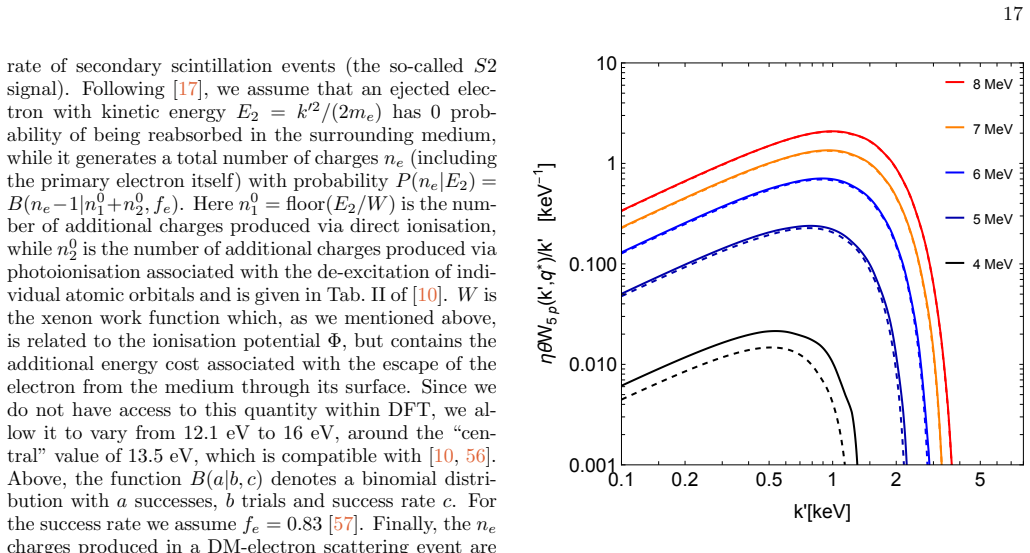
The central discovery is that in liquid xenon the momentum-space electron density is nearly phase-independent, because van der Waals bonding is weak, whereas the density of states is not: the 5p levels broaden into a roughly 3 eV band whose top sits at $\Phi = -11.05$ eV relative to vacuum, compared with $-12.1$ eV in the atom. Consequently the ionisation rate factorises: the response function built from initial-state overlaps, $W_{n\ell}(k',q)$, can be taken from RHF atomic orbitals, and all liquid information enters through the density of states $\rho_{n\ell}(E_e)$ and the ionisation potential $\Phi$ inside the energy-conservation delta. Recomputing rates this way, the paper finds that the 5p broadening raises rates only for $m_\chi \lesssim 6$ MeV, that 4d and 5s energy differences between RHF and DFT dominate at higher masses, and that the resulting 90% C.L. exclusion limits for XENON10 and XENON1T move by up to about a factor of 2 relative to the isolated-atom calculation.
Load-bearing premise
One load-bearing premise is that the liquid's 4d core levels sit at the same energy relative to vacuum as the atom's, so that the top of the 5p valence band at $-11.05$ eV gives the true liquid ionisation potential $\Phi=11.05$ eV; a core-level shift between atom and liquid would change $\Phi$ and rescale every predicted rate and exclusion limit.
Editorial extensions
If this is right
- For dark matter masses above about 6 MeV, the main liquid-phase correction to predicted ionisation rates is the shift of the 4d and 5s binding energies, not the 5p band broadening.
- Using the hybrid DFT-plus-RHF scheme moves the 90% C.L. exclusion limits of XENON10 and XENON1T by up to a factor of about 2 compared with isolated-atom calculations.
- The liquid's lower ionisation potential ($\Phi=11.05$ eV) combined with the broadened 5p DOS increases the ionisation rate only for dark matter masses near 4 to 6 MeV, where XENON10's low threshold makes it visible.
- The recipe of weighting isolated-atom wave functions by a condensed-phase density of states can be carried over to other liquid noble gas targets without recomputing wave functions from scratch.
- The tightly bound 4s and 4p shells can be treated as phase-independent RHF orbitals in liquid xenon rate calculations.
Reading between the lines
- If the same factorisation holds for liquid argon or neon, their sub-GeV dark-matter rates would also be dominated by the valence-band DOS and ionization potential; repeating the DFT supercell calculation for those liquids would test this directly.
- The low-mass (below 6 MeV) sensitivity of liquid xenon detectors hinges on the exact position of the 5p band top; a photoemission measurement of liquid xenon's valence spectrum would either confirm the fitted DOS or falsify the $\Phi=11.05$ eV input.
- Because the final state is a hydrogenic Coulomb wave rather than a conduction-band state, larger momentum transfers may be mis-modelled; switching to a Bloch or Coulomb final state, as done in crystal targets, could be combined with this liquid DOS scheme in future work.
Editorial analysis
A structured set of objections, weighed in public.
Referee Report
Summary. This paper develops a DFT-based description of liquid xenon for dark-matter-electron scattering calculations. The authors benchmark a Quantum Espresso setup (PBE+U+SOC+DFT-D) against the xenon lattice parameter, the liquid radial distribution function, the refractive index, and atomic photoemission energies, and then compute the momentum-space electron densities and densities of states for atomic, solid, and liquid xenon. They propose a hybrid scheme in which the liquid-phase 5p density of states and the DFT-tuned 4d/5s binding energies replace the discrete atomic levels, while the isolated-atom RHF momentum-space wavefunctions are retained for the electron density. Using this scheme, they recompute ionization rates and 90% C.L. exclusion limits for XENON10 and XENON1T and find that the liquid 5p broadening affects rates only for DM masses below about 6 MeV, while the 4d/5s energy shifts change the limits by up to a factor of about two over most of the mass range.
Significance. If the central claims hold, this is a valuable step beyond isolated-atom treatments of DM-electron scattering in liquid xenon: it identifies the liquid DOS and the effective ionization potential as the key phase effects, quantifies their impact on existing experimental limits, and provides a benchmarked DFT setup with data and code available on Zenodo and through the DarkART/QEdark-EFT framework. The rate equations are formally consistent and the DFT validations against lattice parameter, RDF, refractive index, and photoemission energies give reasonable confidence in the electronic-structure input. The main limitations are the unvalidated absolute energy alignment for the liquid and the lack of an all-electron liquid benchmark for the momentum-space density; both are acknowledged in Sec. V but remain load-bearing for the central rate predictions.
major comments (3)
- [Sec. III D, Fig. 7] The liquid ionization potential Phi=11.05 eV is fixed by aligning the 4d DOS of the liquid to the isolated-atom 4d level and reading the top of the 5p valence band. This assumes no core-level shift of the 4d states between the two phases; if even a few tenths of an eV of shift exists, Phi changes and, through the energy-conservation delta in Eq. (35) and v_min in Eq. (41), every rate and exclusion limit shifts, with the largest effect likely at low DM masses where the 5p broadening matters. The manuscript provides no experimental or computational check of this alignment and no sensitivity scan over Phi; the W=12.1-16 eV band in Fig. 14 only varies the detector-response work function, not the Phi used in the rate integrals. I ask for a validation of the 4d alignment or a quantitative sensitivity study of the limits to Phi.
- [Sec. IV B, Figs. 10 and 11] The central replacement of the liquid momentum-space density by isolated-atom RHF densities is justified by showing that the DFT atom vs DFT liquid difference above ~16 keV is smaller than the pseudopotential-induced difference relative to RHF. As the paper itself notes in Sec. III E, the pseudopotential suppresses high-momentum components by orders of magnitude in exactly this window, so the comparison cannot resolve whether the true all-electron liquid 5p density differs from the atomic RHF density at a rate-relevant level. Since the claimed factor-of-two changes in Sec. IV C rest on this premise, the manuscript needs an all-electron benchmark for a liquid supercell (e.g., PAW reconstruction following Ref. [21]) or an explicit estimate of the resulting uncertainty in the exclusion limits. The Sec. V limitation statement acknowledges the need but does not supply the calculation.
- [Sec. III D, Figs. 5 and 7] The liquid DOS shown in Fig. 7 is an average over five 30-atom supercells, and the 5p fit in Eq. (32) uses that average, but no supercell-to-supercell variance or convergence test is reported. The low-mass sensitivity below 6 MeV depends on the upper 5p band edge and the fitted Gaussian parameters in Table II, so the claimed effect should be robust to the choice of supercell sample. Please provide the spread in the DOS, the fitted parameters, and Phi across the five supercells, and test whether five supercells are sufficient for convergence of the rate predictions.
minor comments (4)
- [Sec. IV C, after Eq. (38)] The text reads 'DM masses of ~4 meV' but should read '4 MeV'; the same paragraph elsewhere correctly uses 4-8 MeV.
- [Sec. II B, around Eq. (19)] The text says second derivatives of the initial-state wave function are neglected, yet the gamma term is a second gradient of the density; please clarify the order of the expansion actually retained.
- [Fig. 13 caption] The statement that q* is set to the value that maximizes the integral is ambiguous; please state whether the maximization is over q for each k' and whether it is performed separately for the atomic and liquid phase.
- [Eq. (32)] The sign convention for Ee, defined below Eq. (18), deserves an explicit note in the text, since the fitted cutoffs t1=-2.82 eV and t2=-0.186 eV are otherwise confusing.
Circularity Check
No significant circularity: the liquid-xenon rate calculation is a forward DFT-plus-atomic-response computation, with energy and momentum inputs benchmarked against external data.
full rationale
The paper's central claim—that liquid-xenon DM-electron rates can be obtained by keeping RHF atomic momentum-space densities while replacing discrete energies with the DFT liquid DOS and a liquid ionization potential—is a forward calculation, not a fit to XENON data. Equation (35) is the atomic rate of Eq. (8) with the level sum replaced by a DOS convolution; the result that 5p broadening affects rates only below about 6 MeV follows from the kinematics of v_min and the fitted DOS, and is not forced by construction. The Hubbard-U parameter is fitted to external atomic photoemission (the 5s-4d splitting), the liquid DOS is fitted to the paper's own DFT liquid supercell calculation, and the liquid Phi = 11.05 eV is explicitly derived by aligning the 4d levels to the atom (Fig. 7); none of these inputs are the predicted XENON exclusion limits. The factor-of-two change at higher masses is explicitly attributed to DFT-vs-RHF 4d/5s energy differences, which are benchmarked to experiment rather than to the liquid phase. Self-citations to Refs. [16,18,19,32,55] supply the atomic-response formalism and codes, but the atom-vs-liquid comparison is carried out within this paper using the same W_nl for both phases, so the relative conclusion does not reduce to those references. The acknowledged pseudopotential and final-state limitations in Sec. V are validity risks, not circular steps.
Assumptions & free parameters
free parameters (4)
- Hubbard Ueff for Xe 4d states =
11.1 eV (PBE), 11.5 eV (LDA)
- Liquid ionization potential Phi =
11.05 eV
- Analytical 5p DOS fit parameters =
a=(1,0.81422,1.19924), mu=(-1.27468,-0.73646,-2.46349) eV, sigma=(0.33845,0.34622,0.25364) eV, t1=-2.82 eV…
- Liquid xenon work function W =
13.5 eV central, varied 12.1-16 eV
assumptions (5)
- domain assumption DFT with PBE+DFT-D+SOC+U reliably describes xenon electronic structure
- domain assumption The 4d core level energy is phase-independent and provides the vacuum reference for the liquid
- domain assumption Classical Lennard-Jones MC reproduces the liquid structure relevant to electronic properties
- domain assumption RHF isolated-atom wave functions represent liquid initial-state momentum-space densities
- domain assumption Hydrogen-like positive-energy solutions describe the ejected electron final state
Cite this review
Pith. "Pith review of Electronic structure of liquid xenon in the context of light dark matter direct detection." pith.science (2026). https://pith.science/paper/BGV3FC5C
@misc{pith2026250202965,
  author       = {Pith},
  title        = {Pith review of: Electronic structure of liquid xenon in the context of light dark matter direct detection},
  year         = {2026},
  howpublished = {\url{https://pith.science/paper/BGV3FC5C}},
  note         = {Machine review of arXiv:2502.02965}
}
abstract
We present a description of the electronic structure of xenon within the density-functional theory formalism with the goal of accurately modeling dark-matter-induced ionisation in liquid xenon detectors. We compare the calculated electronic structures of the atomic, liquid and crystalline solid phases, and find that the electronic charge density and its derivatives in momentum space are similar in the atom and the liquid, consistent with the weak interatomic van der Waals bonding. The only notable difference is a band broadening of the highest occupied $5p$ levels, reflected in the densities of states of the condensed phases, as a result of the inter-atomic interactions. We therefore use the calculated density of states of the liquid phase, combined with the standard literature approach for the isolated atom, to recompute ionisation rates and exclusion limit curves for the XENON10 and XENON1T experiments. We find that the broadening of the 5$p$ levels induced by the liquid phase is relevant only for dark matter masses below 6 MeV, where it increases the ionisation rate relative to that of the isolated atom. For most of the explored mass range, the energies of the discrete 4$d$ and 5$s$ levels have the strongest effect on the rate. Our findings suggest a simple scheme for calculating dark matter-electron scattering rates in liquid noble gas detectors, using the calculated values for the atom weighted by the density of states of the condensed phase.
Figures


Figures from the paper (10 more)



Forward citations
Cited by 1 Pith paper
-
Dark Matter Weather: Probing Sub-GeV Interactions with Earth-Shielding Modulation
Daily Earth-shielding modulation of sub-GeV dark matter can separate dark-matter–electron from dark-matter–nucleon scattering, and the isoangle shape statistic provides a new validation handle for liquid-noble detectors.
Reference graph
Works this paper leans on
-
[21]
Light Dark Matter Search with Ionization Signals in XENON1T,
E. Aprile et al. (XENON), “Light Dark Matter Search with Ionization Signals in XENON1T,” Phys. Rev. Lett. 123, 251801 (2019), arXiv:1907.11485 [hep-ex]
arXiv 2019
-
[1]
Atom The energy levels of the outer shell electrons in isolated atomic xenon have been measured using photoelectron spectroscopy [28] and are reported relative to the vacuum level in Tab. I. Note the splitting of the 5 p and 4d levels due to spin-orbit coupling. Energy [eV] 5p 3 2 -12.1 5p 1 2 -13.4 5s -23.3 4d 5 2 -67.5 4d 3 2 -69.5 TABLE I. Energy level...
-
[2]
5) at ∼ 8.5 a.u
Liquid The measured density in the liquid phase at 183.18 K with an overpressure of 2 .53 bar is 2 .02 × 10−3 atoms/a.u.3, with peaks in the atomic radial dis- tribution function (Fig. 5) at ∼ 8.5 a.u. and ∼ 14.7 a.u., corresponding to the first and second nearest neighbour- ing atoms, respectively [36]. In addition, the refractive index of liquid xenon h...
-
[3]
1, left panel) with a zero- kelvin extrapolated value of the cubic lattice param- eter of 11.59 a.u
Solid Xenon crystallizes at 161.1 K in the face-centered- cubic (fcc) structure (Fig. 1, left panel) with a zero- kelvin extrapolated value of the cubic lattice param- eter of 11.59 a.u. [33], corresponding to a density of 2.57×10⁻³ atoms/a.u.3 and a nearest neighbour distance of 8.20 a.u. Solid Xe is an insulator with reflection spec- tra and photoemissi...
-
[4]
Van der Waals correction As mentioned above, since xenon is a noble gas with filled electron shells, the van der Waals interaction is key to the formation of the condensed phase. How- ever, because of its intrinsic non-local character, the van der Waals interaction is not captured in either local or semi-local functionals, such as the PZ and the PBE func-...
-
[5]
supercells
Calculated electronic properties Fig. 4 shows our calculated band structure and density of states (DOS) for solid crystalline xenon, calculated with (pink) and without (blue) spin-orbit coupling, with an 11.1 eV Hubbard- U correction on the 4 d states and using the DFT-D van der Waals correction to the PBE XC functional. The top of the valence band is set...
-
[6]
The electron binding energies / densities of states of the highest occupied 5 p levels are strongly de- pendent on the xenon phase, as shown in Fig. 7. In our calculation of the scattering rate and exclu- sion limit plots, therefore, we will explicitly deter- mine the influence of the DOS of the liquid phase, in comparison to the isolated energy levels of...
-
[7]
As shown in Eq. (14), when the Fourier transform of the final-state electron wave function peaks at a definite value of the linear momentum (as should be the case in ionisation processes), the ionisation rate can be explicitly expressed in terms of the initial- state electron density ρnℓ e (k′ − q) and the deriva- tives ∇k′ρnℓ e (k′ − q) and ∇k′ i ∇k′ i ρ...
Show all 92 references
-
[8]
cen- tral
Concerning the final state, we showed in Sec. II that the gradient terms in the expansion of Eq. (14) are associated with deviations from a plane wave. We find these terms to be non-zero and approxi- mately independent of the xenon phase. Therefore we proceed by using the stan...
-
[9]
Light Dark Matter
We see that XENON1T is not sensitive to DM masses below ∼ 20 MeV, which is a consequence of its signal threshold on the number of detectable photoelec- trons (vertical line in Fig. 12). Its 90% C.L. exclusion limit is therefore insensitive to the broadening of the 5 p states i...
2018
-
[10]
History of dark matter,
G. Bertone and D. Hooper, “History of dark matter,” Rev. Mod. Phys. 90, 045002 (2018), arXiv:1605.04909 [astro-ph.CO]
2018 arXiv
-
[11]
Astroparticle Physics European Consortium (APPEC),
“Astroparticle Physics European Consortium (APPEC),” http://www.appec.org/roadmap
-
[12]
Direct detection of WIMP dark matter: concepts and status,
M. Schumann, “Direct detection of WIMP dark matter: concepts and status,” J. Phys. G: Nucl. Part. Phys. 46, 103003 (2019)
2019
-
[13]
The waning of the WIMP? A review of models, searches, and constraints,
G. Arcadi, M. Dutra, and P. Ghosh, “The waning of the WIMP? A review of models, searches, and constraints,” EPJC 78, 203 (2018)
2018
-
[14]
WIMP dark matter candidates and searches—current status and future prospects,
L. Roszkowski, E. M. Sessolo, and S. Trojanowski, “WIMP dark matter candidates and searches—current status and future prospects,” Rep. Prog. Phys. 81, 066201 (2018)
2018
-
[15]
Emission of single and few electrons in XENON1T and limits on light dark matter,
E. Aprile et al. (XENON), “Emission of single and few electrons in XENON1T and limits on light dark matter,” Phys. Rev. D 106, 022001 (2022)
2022
-
[16]
First dark matter search with nuclear recoils from the XENONnT experiment,
E. Aprile et al.(XENON), “First dark matter search with nuclear recoils from the XENONnT experiment,” Phys. Rev. Lett. 131, 041003 (2023)
2023
-
[17]
US Cosmic Visions: New Ideas in Dark Matter 2017; Community Report,
M. Battaglieri et al., “US Cosmic Visions: New Ideas in Dark Matter 2017; Community Report,” FERMILAB- CONF-17-282-AE-PPD-T (2017), arXiv:1707.04591 [hep-ph]
2017 arXiv
-
[18]
Direct Detec- tion of Sub-GeV Dark Matter,
R. Essig, J. Mardon, and T. Volansky, “Direct Detec- tion of Sub-GeV Dark Matter,” Phys. Rev. D 85, 076007 (2012), arXiv:1108.5383 [hep-ph]
2012 arXiv
-
[19]
New constraints and prospects for sub-GeV dark matter scattering off electrons in xenon,
R. Essig, T. Volansky, and T. T. Yu, “New constraints and prospects for sub-GeV dark matter scattering off electrons in xenon,” Phys. Rev. D 96, 043017 (2017)
2017
-
[20]
Constraints on Sub-GeV Dark-Matter–Electron Scattering from the DarkSide- 50 Experiment,
P. Agnes et al. (DarkSide), “Constraints on Sub-GeV Dark-Matter–Electron Scattering from the DarkSide- 50 Experiment,” Phys. Rev. Lett. 121, 111303 (2018), arXiv:1802.06998 [astro-ph.CO]
2018 arXiv
-
[22]
Excess electronic recoil events in XENON1T,
E. Aprile et al. (XENON), “Excess electronic recoil events in XENON1T,” Phys. Rev. D 102, 072004 (2020)
2020
-
[23]
DAMA/LIBRA and leptonically interacting Dark Mat- ter,
J. Kopp, V. Niro, T. Schwetz, and J. Zupan, “DAMA/LIBRA and leptonically interacting Dark Mat- ter,” Phys. Rev. D 80, 083502 (2009), arXiv:0907.3159 [hep-ph]
2009 arXiv
-
[24]
Direct Detection of sub- GeV Dark Matter with Semiconductor Targets,
R. Essig, M. Fernandez-Serra, J. Mardon, A. Soto, T. Volansky, and T. T. Yu, “Direct Detection of sub- GeV Dark Matter with Semiconductor Targets,” JHEP 05, 046 (2016), arXiv:1509.01598 [hep-ph]
2016 arXiv
-
[25]
Atomic responses to general dark matter-electron interactions,
R. Catena, T. Emken, N. A. Spaldin, and W. Tarantino, “Atomic responses to general dark matter-electron interactions,” Phys. Rev. Res. 2, 033195 (2020), arXiv:1912.08204 [hep-ph]
2020 arXiv
-
[26]
First Direct Detection Limits on sub-GeV Dark Matter from XENON10,
R. Essig, A. Manalaysay, J. Mardon, P. Sorensen, and T. Volansky, “First Direct Detection Limits on sub-GeV Dark Matter from XENON10,” Phys. Rev. Lett. 109, 021301 (2012), arXiv:1206.2644 [astro-ph.CO]
2012 arXiv
-
[27]
Crystal responses to general dark matter- electron interactions,
R. Catena, T. Emken, M. Matas, N. A. Spaldin, and E. Urdshals, “Crystal responses to general dark matter- electron interactions,” Phys. Rev. Res. 3, 033149 (2021), arXiv:2105.02233 [hep-ph]
2021 arXiv
-
[28]
Direct searches for general dark matter- electron interactions with graphene detectors: Part I. Electronic structure calculations,
R. Catena, T. Emken, M. Matas, N. A. Spaldin, and E. Urdshals, “Direct searches for general dark matter- electron interactions with graphene detectors: Part I. Electronic structure calculations,” Phys. Rev. Res. 5, 043257 (2023), arXiv:2303.15497 [hep-ph]
2023 arXiv
-
[29]
Direct searches for general dark matter- electron interactions with graphene detectors: Part II. Sensitivity studies,
R. Catena, T. Emken, M. Matas, N. A. Spaldin, and E. Urdshals, “Direct searches for general dark matter- electron interactions with graphene detectors: Part II. Sensitivity studies,” Phys. Rev. Res. 5, 043258 (2023), arXiv:2303.15509 [hep-ph]
2023 arXiv
-
[30]
Extended calculation of dark matter-electron scattering in crystal targets,
S. M. Griffin, K. Inzani, T. Trickle, Z. Zhang, and K. M. Zurek, “Extended calculation of dark matter-electron scattering in crystal targets,” Phys. Rev. D 104, 095015 (2021), arXiv:2105.05253 [hep-ph]
2021 arXiv
-
[31]
Snowmass white paper: Light dark matter direct de- tection at the interface with condensed matter physics,
A. Mitridate, T. Trickle, Z. Zhang, and K. M. Zurek, “Snowmass white paper: Light dark matter direct de- tection at the interface with condensed matter physics,” Phys. Dark Universe 40, 101221 (2023)
2023
-
[32]
Inhomogeneous electron gas,
P. Hohenberg and W. Kohn, “Inhomogeneous electron gas,” Phys. Rev. 136, B864–B871 (1964)
1964
-
[33]
Self-consistent equations in- cluding exchange and correlation effects,
W. Kohn and L. J. Sham, “Self-consistent equations in- cluding exchange and correlation effects,” Phys. Rev. 140, A1133–A1138 (1965)
1965
-
[34]
Recommended conventions for report- ing results from direct dark matter searches,
D. Baxter et al., “Recommended conventions for report- ing results from direct dark matter searches,” Eur. Phys. J. C 81, 907 (2021), arXiv:2105.00599 [hep-ex]
2021 arXiv
-
[35]
A novel determination of the local dark matter density,
R. Catena and P. Ullio, “A novel determination of the local dark matter density,” JCAP 1008, 004 (2010), arXiv:0907.0018 [astro-ph.CO]
2010 arXiv
-
[36]
Dark matter-electron interactions in materials beyond the dark photon model,
R. Catena, D. Cole, T. Emken, M. Matas, N.A. Spaldin, W. Tarantino, and E. Urdshals, “Dark matter-electron interactions in materials beyond the dark photon model,” JCAP 03, 052 (2023), arXiv:2210.07305 [hep-ph]
2023 arXiv
-
[37]
Photoemission in solids I,
M. Cardona and L. Ley, “Photoemission in solids I,” Springer-Verlag Berlin Heidelberg 1, XI, 293 (1978)
1978
-
[38]
Quantum espresso: a modular and open-source software project for quantum simulations of materials,
P. Giannozzi et al., “Quantum espresso: a modular and open-source software project for quantum simulations of materials,” J. Phys. Condens. Matter 21, 395502 (2009)
2009
-
[39]
Advanced capabilities for materials modelling with quantum espresso,
P. Giannozzi et al., “Advanced capabilities for materials modelling with quantum espresso,” JPCM 29, 465901 (2017)
2017
-
[40]
QuantumESPRESSO toward the exascale,
P. Giannozzi et al., “QuantumESPRESSO toward the exascale,” J. Chem. Phys 152, 154105 (2020)
2020
-
[41]
QEdark-EFT,
E. Urdshals and M. Matas, “QEdark-EFT,” (2021)
2021
-
[42]
Density and expansivity of solid xenon,
D. R. Sears and H. P. Klug, “Density and expansivity of solid xenon,” J. Chem. Phys. 37, 3002–3006 (1962)
1962
-
[43]
Wulf, Direct dark matter search with XENON1T and developments for multi-ton liquid xenon detectors, Ph.D
J. Wulf, Direct dark matter search with XENON1T and developments for multi-ton liquid xenon detectors, Ph.D. thesis, University of Zurich, Z¨ urich (2018)
2018
-
[44]
The NIST Chemistry WebBook: A Chemical Data Resource on the Internet,
P. Linstrom and W. Mallard, “The NIST Chemistry WebBook: A Chemical Data Resource on the Internet,” (2001)
2001
-
[45]
Interatomic poten- tials and x-ray-diffraction intensities for liquid xenon,
A. A. Khan and A. A. Broyles, “Interatomic poten- tials and x-ray-diffraction intensities for liquid xenon,” J. Chem. Phys. 43, 43–48 (1965)
1965
-
[46]
Measurement of the refractive index and attenuation length of liquid xenon for its scintillation light,
V. N. Solovov, V. Chepel, M. I. Lopes, A. Hitachi, R. Fer- reira Marques, and A. J. P. L. Policarpo, “Measurement of the refractive index and attenuation length of liquid xenon for its scintillation light,” Nucl. Instrum. Methods Phys. Res. A 516, 462–474 (2004). 23
2004
-
[47]
Refractive indices of the condensed inert gases,
A. C. Sinnock and B. L. Smith, “Refractive indices of the condensed inert gases,” Phys. Rev. 181, 1297 – 1307 (1969)
1969
-
[48]
Band-structure parame- ters of solid and liquid xenon,
I. T. Steinberger and U. Asaf, “Band-structure parame- ters of solid and liquid xenon,” Phys. Rev. B 8, 914–918 (1973)
1973
-
[49]
Photoemission from single crystal xenon,
K. Horn and A. M. Bradshaw, “Photoemission from single crystal xenon,” Sol. Stat. Commun. 30, 545–549 (1979)
1979
-
[50]
Atoms, molecules, solids, and surfaces: Applications of the gen- eralized gradient approximation for exchange and corre- lation,
J. P. Perdew, J. A. Chevary, S. H. Vosko, K. A. Jackson, M. R. Pederson, D. J. Singh, and C. Fiolhais, “Atoms, molecules, solids, and surfaces: Applications of the gen- eralized gradient approximation for exchange and corre- lation,” Phys. Rev. B 46, 6671–6687 (1992)
1992
-
[51]
Electron-energy-loss spectra and the structural stability of nickel oxide: An LSDA+U study,
S. L. Dudarev, G. A. Botton, S. Y. Savrasov, C. J. Humphreys, and A. P. Sutton, “Electron-energy-loss spectra and the structural stability of nickel oxide: An LSDA+U study,” Phys. Rev. B 57, 1505–1509 (1998)
1998
-
[52]
On the statistical me- chanics of the ideal inert gas solids,
G. K. Horton and J. W. Leech, “On the statistical me- chanics of the ideal inert gas solids,” Proc. Phys. Soc. 82, 816–854 (1963)
1963
-
[53]
Equation of State Calcula- tions by Fast Computing Machines,
N. Metropolis, A. W. Rosenbluth, M. N. Rosenbluth, A. H. Teller, and E. Teller, “Equation of State Calcula- tions by Fast Computing Machines,” J. Chem. Phys. 21, 1087–1092 (1953)
1953
-
[54]
Monte Carlo sampling methods using Markov chains and their applications,
W. K. Hastings, “Monte Carlo sampling methods using Markov chains and their applications,” Biometrika 57, 97–109 (1970)
1970
-
[55]
Dark Matter Search Results from a One Ton-Year Exposure of XENON1T,
E. Aprile et al. (XENON), “Dark Matter Search Results from a One Ton-Year Exposure of XENON1T,” Phys. Rev. Lett. 121 (2018), 10.1103/physrevlett.121.111302
2018 doi
-
[56]
The structure of liquid xenon,
J. A. Campbell and J. H. Hildebrand, “The structure of liquid xenon,” J. Chem. Phys. 11, 334–337 (1943)
1943
-
[57]
X-ray diffraction study of argon and xenon in the liquid state near their triple points,
R. W. Harris and G. T. Clayton, “X-ray diffraction study of argon and xenon in the liquid state near their triple points,” Phys. Rev. 153, 229–234 (1967)
1967
-
[58]
Neutron diffraction of liq- uid neon and xenon along the coexistence line,
M. C. Bellissent-Funel, U. Buontempo, A. Filabozzi, C. Petrillo, and F. P. Ricci, “Neutron diffraction of liq- uid neon and xenon along the coexistence line,” Phys. Rev. B 45, 4605–4613 (1992)
1992
-
[59]
Roothaan-Hartree-Fock Ground-State Atomic Wave Functions: Slater-Type Orbital Expansions and Expec- tation Values for Z = 2-54,
C. F. Bunge, J. A. Barrientos, and A. V. Bunge, “Roothaan-Hartree-Fock Ground-State Atomic Wave Functions: Slater-Type Orbital Expansions and Expec- tation Values for Z = 2-54,” At. Data Nucl. Data Tables 53, 113–162 (1993)
1993
-
[60]
The wavefunction reconstruction effects in calculation of dm- induced electronic transition in semiconductor targets,
Z.L. Liang, L. Zhang, P. Zhang, and F. Zheng, “The wavefunction reconstruction effects in calculation of dm- induced electronic transition in semiconductor targets,” JHEP 2019, 149 (2019)
2019
-
[61]
Fully ab-initio all-electron cal- culation of dark matter–electron scattering in crystals with evaluation of systematic uncertainties,
C. E. Dreyer, R. Essig, M. Fernandez-Serra, A. Sin- gal, and C. Zhen, “Fully ab-initio all-electron cal- culation of dark matter–electron scattering in crystals with evaluation of systematic uncertainties,” (2023), arXiv:2306.14944 [hep-ph]
2023 arXiv
-
[62]
Projector augmented-wave method,
P. E. Bl¨ ochl, “Projector augmented-wave method,” Phys. Rev. B 50, 17953–17979 (1994)
1994
-
[63]
A search for light dark mat- ter in XENON10 data,
J. Angle et al.(XENON10), “A search for light dark mat- ter in XENON10 data,” Phys. Rev. Lett. 107, 051301 (2011), [Erratum: Phys.Rev.Lett. 110, 249901 (2013)], arXiv:1104.3088 [astro-ph.CO]
2011 arXiv
-
[64]
Dark Atomic Response Tabulator (Dark- ART)[Code, v0.1.0],
T. Emken, “Dark Atomic Response Tabulator (Dark- ART)[Code, v0.1.0],” The code can be found under https://github.com/temken/darkart. (2021)
2021
-
[65]
Performance and fundamental processes at low energy in a two-phase liquid xenon dark matter detec- tor,
T. Shutt, C. E. Dahl, J. Kwong, A. Bolozdynya, and P. Brusov, “Performance and fundamental processes at low energy in a two-phase liquid xenon dark matter detec- tor,” Nucl. Instrum. Methods Phys. Res. A 579, 451–453 (2007), Proceedings of the 11th Symposium on Radiation Measu...
2007
-
[66]
NEST: a comprehensive model for scintil- lation yield in liquid xenon,
M. Szydagis, N. Barry, K. Kazkaz, J. Mock, D. Stolp, M. Sweany, M. Tripathi, S. Uvarov, N. Walsh, and M. Woods, “NEST: a comprehensive model for scintil- lation yield in liquid xenon,” JINST 6, P10002–P10002 (2011)
2011
-
[67]
Linear response theory for light dark matter-electron scattering in materials,
R. Catena and N. A. Spaldin, “Linear response theory for light dark matter-electron scattering in materials,” Phys. Rev. Res. 6, 033230 (2024)
2024
-
[68]
Simple extension of the plane-wave final state in photoe- mission: Bringing understanding to the photon-energy dependence of two-dimensional materials,
C. S. Kern, A. Haags, L. Egger, X. Yang, H. Kirschner, S. Wolff, T. Seyller, A. Gottwald, M. Richter, U. De Giovannini, A. Rubio, M. G. Ramsey, F. C. Bocquet, S. Soubatch, F. S. Tautz, P. Puschnig, and S. Moser, “Simple extension of the plane-wave final state in photoe- missio...
2023
-
[69]
Matplotlib: A 2d graphics environment,
J. D. Hunter, “Matplotlib: A 2d graphics environment,” CiSE 9, 90–95 (2007)
2007
-
[70]
T. E. Oliphant, A guide to NumPy, Vol. 1 (Trelgol Pub- lishing USA, 2006)
2006
-
[71]
Scipy 1.0–fundamental algo- rithms for scientific computing in python,
P. Virtanen et al. , “Scipy 1.0–fundamental algo- rithms for scientific computing in python,” (2019), arXiv:1907.10121 [cs.MS]
2019 arXiv
-
[72]
WebPlot- Digitizer v4.2,
A. Rohatgi, S. Rehberg, and Z. Stanojevic, “WebPlot- Digitizer v4.2,” (2019)
2019
-
[73]
Mathematica v12.0,
Wolfram Research, Inc., “Mathematica v12.0,” (2019), champaign, IL, 2019
2019
-
[74]
Xcrysden—a new program for displaying crystalline structures and electron densities,
A. Kokalj, “Xcrysden—a new program for displaying crystalline structures and electron densities,” J. Mol. Graph. Model. 17, 176–179 (1999)
1999
-
[75]
VESTA: a three-dimensional visualization system for electronic and structural analy- sis,
K. Momma and F. Izumi, “ VESTA: a three-dimensional visualization system for electronic and structural analy- sis,” J. Appl. Crystallogr. 41, 653–658 (2008)
2008
-
[76]
Pseudopotentials periodic table: From H to Pu,
A. Dal Corso, “Pseudopotentials periodic table: From H to Pu,” Comput. Mater. Sci. 95, 337–350 (2014)
2014
-
[77]
Optimized norm-conserving Vanderbilt pseudopotentials,
D. R. Hamann, “Optimized norm-conserving Vanderbilt pseudopotentials,” Phys. Rev. B 88, 085117 (2013)
2013
-
[78]
Van der Waals density functional for layered structures,
H. Rydberg, M. Dion, N. Jacobson, E. Schr¨ oder, P. Hyldgaard, S. I. Simak, D. C. Langreth, and B. I. Lundqvist, “Van der Waals density functional for layered structures,” Phys. Rev. Lett. 91, 126402 (2003)
2003
-
[79]
Van der Waals density functional for general geometries,
M. Dion, H. Rydberg, E. Schr¨ oder, D. C. Langreth, and B. I. Lundqvist, “Van der Waals density functional for general geometries,” Phys. Rev. Lett. 92, 246401 (2004)
2004
-
[80]
Comment on “generalized gra- dient approximation made simple
Y. Zhang and W. Yang, “Comment on “generalized gra- dient approximation made simple”,” Phys. Rev. Lett.80, 890–890 (1998)
1998
-
[81]
Higher-accuracy van der Waals density functional,
K. Lee, E. D. Murray, L. Kong, B. I. Lundqvist, and D. C. Langreth, “Higher-accuracy van der Waals density functional,” Phys. Rev. B 82, 081101 (2010)
2010
-
[82]
Accurate and simple density functional for the electronic exchange energy: General- ized gradient approximation,
J. P. Perdew and W. Yue, “Accurate and simple density functional for the electronic exchange energy: General- ized gradient approximation,” Phys. Rev. B 33, 8800– 8802 (1986)
1986
-
[83]
Bench- mark database of accurate (MP2 and CCSD(T) complete basis set limit) interaction energies of small model com- plexes, DNA base pairs, and amino acid pairs,
P. Jurecka, J. Sponer, J. ˇCern´ y, and P. Hobza, “Bench- mark database of accurate (MP2 and CCSD(T) complete basis set limit) interaction energies of small model com- plexes, DNA base pairs, and amino acid pairs,” Phys. 24 Chem. Chem. Phys. 8, 1985–93 (2006)
2006
-
[84]
Basis set consistent revision of the S22 test set of noncovalent interaction energies,
T. Takatani, E. G. Hohenstein, M. Malagoli, M.S. Mar- shall, and C. D. Sherrill, “Basis set consistent revision of the S22 test set of noncovalent interaction energies,” J. Chem. Phys. 132, 144104 (2010)
2010
-
[85]
Nonlocal van der Waals density functional: The simpler the better,
O. A. Vydrov and T. Van Voorhis, “Nonlocal van der Waals density functional: The simpler the better,” J. Chem. Phys. 133, 244103 (2010)
2010
-
[86]
Nonlocal van der Waals density functional made simple and efficient,
R. Sabatini, T. Gorni, and S. de Gironcoli, “Nonlocal van der Waals density functional made simple and efficient,” Phys. Rev. B 87, 041108 (2013)
2013
-
[87]
Accurate description of van der Waals com- plexes by density functional theory including empirical corrections,
S. Grimme, “Accurate description of van der Waals com- plexes by density functional theory including empirical corrections,” J. Comput. Chem. 25, 1463–1473 (2004)
2004
-
[88]
Role and effective treatment of dis- persive forces in materials: Polyethylene and graphite crystals as test cases,
V. Barone, M. Casarin, D. Forrer, M. Pavone, M. Sambi, and A. Vittadini, “Role and effective treatment of dis- persive forces in materials: Polyethylene and graphite crystals as test cases,” J. Comput. Chem. 30, 934–939 (2009)
2009
-
[89]
Semiempirical GGA-type density functional constructed with a long-range dispersion correction,
S. Grimme, “Semiempirical GGA-type density functional constructed with a long-range dispersion correction,” J. Comput. Chem. 27, 1787–1799 (2006)
2006
-
[90]
A consistent and accurate ab initio parametrization of den- sity functional dispersion correction (DFT-D) for the 94 elements H-Pu,
S. Grimme, J. Antony, S. Ehrlich, and H. Krieg, “A consistent and accurate ab initio parametrization of den- sity functional dispersion correction (DFT-D) for the 94 elements H-Pu,” J. Chem. Phys. 132, 154104 (2010)
2010
-
[91]
Accurate molecular van der Waals interactions from ground-state electron den- sity and free-atom reference data,
A. Tkatchenko and M. Scheffler, “Accurate molecular van der Waals interactions from ground-state electron den- sity and free-atom reference data,” Phys. Rev. Lett. 102, 073005 (2009)
2009
-
[92]
Accurate and efficient method for many-body van der Waals interactions,
A. Tkatchenko, R. A. Di Stasio, R. Car, and M. Schef- fler, “Accurate and efficient method for many-body van der Waals interactions,” Phys. Rev. Lett. 108, 236402 (2012)
2012
Reviewed August 9, 2026 · model on record in the stance chip above.
Discussion (0). Continue with ORCID to comment.