REVIEW 3 major objections 5 minor 18 references
Higgs boson precision analysis of two-Higgs-doublet models: Full LHC Run 1 and Run 2 data
T0 review · 3 major / 5 minor · reviewed 2026-08-09 · deepseek-v4-flash
Pith's one-line read The full LHC Higgs dataset, fit across twelve two-Higgs-doublet scenarios, picks the type-I model over the Standard Model.
desk verdict Competent and useful 2HDM fit update, but the model ranking rests on few-percent shifts with no theory-error covariance, so treat the top of the table as provisional. read the letter →
The pith
A machine-rendered reading of the paper's core claim, the machinery that carries it, and where it could break.
The reading
What carries the argument
The machinery is a global $\chi^2$ statistic built from 77 experimental signal strengths and their correlation matrices, combined with a Higgs-basis parameterization in which the couplings of the 125 GeV state are controlled by the mixing angle $\gamma$ and three alignment parameters $\zeta_u$, $\zeta_d$, $\zeta_\ell$. These fix the normalized Yukawa couplings as $c_\gamma - \zeta_f s_\gamma$ and the vector-boson coupling as $c_\gamma$. Theoretical signal strengths are factorized as $\mu(P,D) \simeq \hat{\mu}(P)\,\hat{\mu}(D)$, and loop-induced couplings to $gg$, $\gamma\gamma$, and $Z\gamma$ are computed with form factors that include charged-Higgs contributions. The fit is sensitive to novel combinations such as $-s_\gamma/t_\beta$, $s_\gamma(t_\beta - 1/t_\beta)$, and $-s_\gamma \zeta_f$, which are tightly constrained and can separate accidental degenerate minima.
What would settle it
A concrete test is to redo the global fit with a full theory-error covariance matrix for the signal strengths, including correlated scale and PDF uncertainties; if the few-percent suppression of the type-I Yukawa couplings persists, the preference is robust, and if not, the scenario ordering could revert to the Standard Model. Alternatively, a future combined measurement of μ(gg→h→γγ) or μ(h→ττ) that moves more than about 2% toward the Standard Model prediction would eliminate the type-I best fit.
Extended reading notes
Core claim
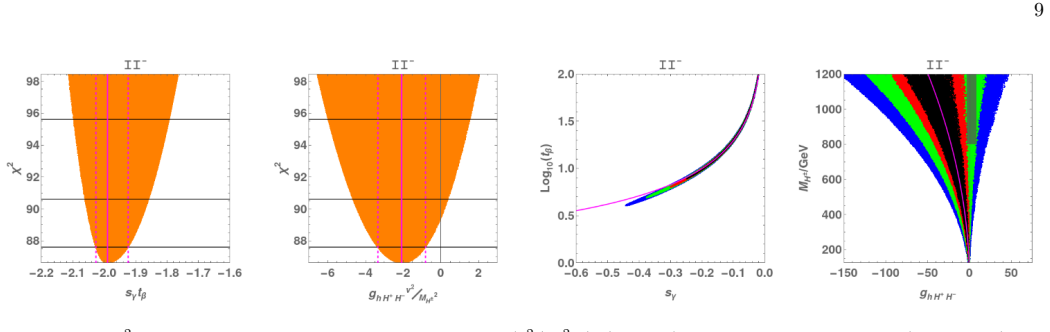
The paper's central claim is that the type-I 2HDM provides the best global fit to the 77 Higgs signal strengths measured at the LHC and Tevatron, with $\chi^2_{\min}/\mathrm{dof} = 75.94/73$ and a goodness of fit of $0.3839$, while the Standard Model yields $\chi^2_{\min}/\mathrm{dof} = 85.29/77$ and a goodness of fit of $0.2424$. At the best-fit point, all normalized Yukawa couplings are equal to $0.929 \pm 0.033$, about $2\sigma$ below 1, while the vector-boson coupling is essentially at its Standard Model value. The wrong-sign type-II and type-IV scenarios, with the down-type Yukawa coupling near $-1$, give the two worst fits among the twelve, at $0.1317$ and $0.1495$, both worse than the Standard Model. The Aligned 2HDM gives the second-best fits when the down-type Yukawa coupling keeps the Standard Model sign, regardless of the charged-lepton coupling sign.
Load-bearing premise
The analysis assumes that each theoretical signal strength is exactly the product of a production and a decay signal strength and that all uncertainties can be described by the experimental covariance matrices, with no correlated theoretical errors included in the chi-square.
Editorial extensions
If this is right
- The type-I 2HDM, with all fermionic Higgs couplings suppressed by a common factor near 0.93, becomes the best-motivated 2HDM benchmark for interpreting the current Higgs rate data.
- Wrong-sign down-type Yukawa coupling solutions in type-II and type-IV 2HDMs are disfavored by the rate data even though flavor constraints alone would admit them.
- Adding the h→Zγ measurement slightly favors a wrong-sign charged-lepton Yukawa coupling, a new effect that strengthens with the current 2.2 ± 0.7 measured signal strength.
- Imposing the perturbative-unitarity, bounded-from-below, and electroweak constraints together with M_H± > 800 GeV pushes the type-II and type-IV fits below the Standard Model, leaving type-I as the best fit among constrained scenarios.
Reading between the lines
- The goodness-of-fit differences separating the leading 2HDM scenarios (0.33–0.38) from the Standard Model (0.24) are driven by few-percent shifts in a handful of channels; including theoretical uncertainties in the likelihood could plausibly erode or sharpen this preference.
- A universal suppression of all fermionic Higgs couplings, as in type-I, may be a sign that the Higgs–fermion sector is globally rescaled rather than modified family by family; this could be tested directly through the tH and ttH production processes, which probe the top Yukawa coupling.
- The factorization approximation for signal strengths, μ(P,D) ≈ μ̂(P) μ̂(D), is an untested simplifying assumption; differential measurements that break it would require a more detailed mapping between rate data and 2HDM parameters.
- The weak preference for a wrong-sign charged-lepton coupling tied to h→Zγ data illustrates that this decay mode, though statistically limited, carries independent information about the sign structure of the Yukawa couplings.
Editorial analysis
A structured set of objections, weighed in public.
Referee Report
Summary. The paper performs global chi-square fits of twelve two-Higgs-doublet-model (2HDM) scenarios—Inert, type I, II, III, IV, and Aligned, with same-sign and wrong-sign Yukawa cases—to a set of 77 Higgs production-times-decay signal strengths from the Tevatron, LHC Run 1, Run 2, and the recent ATLAS+CMS h→Zγ combination. The likelihood is the correlated chi-square of Eq. (18), and the theoretical signal strengths are imported from the same group's previous work (Ref. [5]) under the factorization approximation mu(P,D) ~ bmu(P) bmu(D). The central numerical results are in Table III and Fig. 1: the type-I scenario gives the best fit, chi2_min/dof = 75.94/73 with gof = 0.3839, compared with the SM values 85.29/77 and 0.2424; the wrong-sign type-II and type-IV scenarios fit worse than the SM; and the aligned scenarios with positive down-type coupling give the second-best fits. Appendix C repeats the analysis with additional constraints (t_beta > 1/2 or zeta_u < 2, unitarity/boundedness, b->s-gamma, M_H+ > 800 GeV), which mainly worsens the type-II and type-IV fits.
Significance. If the ranking of scenarios is robust, the paper provides a useful model-building message: the full LHC Higgs coupling data mildly prefer a common suppression of all fermionic Higgs couplings (C_S^f ~ 0.93 in type-I, about 2 sigma below the SM), while disfavoring a wrong-sign down-type Yukawa coupling in type-II and type-IV 2HDMs. The paper's strengths are its systematic mapping of the 12 scenarios, its use of the public Run 1 and Run 2 correlation matrices, the inclusion of h→Zγ data, and the internally consistent chi-square tables with explicit 1-sigma intervals. On the other hand, the paper does not release code or a table of predicted signal strengths, and it does not include any theory-error covariance in Eq. (18); because the decisive differences between scenarios are of order Δchi2 = 0.2-9 over 77 observables, the ordering claim is only as strong as the unstated assumption that the imported predictions are accurate at the few-percent level. The paper is therefore a plausible and competent analysis, but the headline ordering requires a robustness check before it can be regarded as established.
major comments (3)
- [Sec. III, Eq. (18)] The chi-square in Eq. (18) contains only the experimental covariance (sigma^EXP and rho), while the theoretical signal strengths are imported from Sec. III.B of Ref. [5] and are assumed to factorize as mu(P,D) ~ bmu(P) bmu(D). The model ranking in Table III is decided by small differences: I versus SM has Δchi2 = 9.35 for 4 fewer degrees of freedom, A++ versus A+- differs by Δchi2 = 0.18, and II+ versus III+ differs by about 0.7. Since the preferred Yukawa shifts are only 2-5% below unity, a correlated theory uncertainty of a few percent from scale, PDF, or acceptance choices, or from the factorization approximation itself, could plausibly change the ordering. Please add a theory-error covariance to Eq. (18), or perform a sensitivity scan (for example, inflating correlated theory errors by 2-3% and recomputing the scenario ranking), and report whether the type-I preference and the wrong-sign disfavoring survive.
- [Table III and Sec. IV] The statements that II- and IV- are 'disfavored' and that the other scenarios 'yield better gof values than the SM' are based on comparing goodness-of-fit values for models with different numbers of degrees of freedom (73 for the 2HDM scenarios versus 77 for the SM). A lower chi2_min with fewer degrees of freedom is expected even when the additional parameters do not improve the description, so the gof comparison alone does not establish a preference or an exclusion. Please provide a model-comparison statistic (for example, a dof-adjusted p-value, AIC/BIC, or a profile-likelihood ratio) and state the significance of the II-/IV- degradation relative to the SM, as well as the significance of the type-I improvement.
- [Sec. III and Sec. II, Eqs. (10)-(14)] The numerical predictions for all 77 signal strengths and the loop form factors are not derived or tabulated in this paper; the text refers to Sec. III.B of Ref. [5] and to Ref. [14] for the calculational details, and no code is released. Because the main claim rests on small differences among scenarios, the reader cannot independently verify that the factorization approximation and the treatment of loop corrections (for example, the restriction of Delta S_gamma and Delta S_Zgamma to charged-Higgs contributions) do not bias the ranking. Please provide a supplementary table of predicted signal strengths at each best-fit point, or release the fitting code, and give a quantitative estimate of the error introduced by the factorization approximation mu(P,D) ~ bmu(P) bmu(D).
minor comments (5)
- [Table III] The notation C_S^f, C_S^dℓ, C_S^ud, and C_S^uℓ is used without an explicit definition in the Table III caption; defining these in the caption or in the text near Eq. (17) would improve readability.
- [Appendix A, Fig. 10] There is a typo in the description of Fig. 10: the text says 'A++ (upper-left), A+- (upper-right), A+- (lower-left), and A-+ (lower-right)', but the lower-left panel should be A-+ and the lower-right A--.
- [Sec. III] The sentence 'Note that the gof approaches 1 as the value of chi2 per degree of freedom (dof) becomes smaller' is only a heuristic; the goodness-of-fit p-value depends on the number of degrees of freedom in a non-monotonic way for small dof. State explicitly that gof is the p-value of the chi-square distribution with the stated dof.
- [Sec. IV, paragraph on II+] The claim that the two nearly degenerate minima in II+ are 'accidental' rather than parametric, because the degeneracy is lifted when the LHC correlations are turned off, is stated without showing the corresponding calculation. A brief demonstration or a reference to a figure would make this assertion checkable.
- [General] The paper would benefit from a data-availability statement: the 77 experimental signal strengths, correlation matrices, and the fitting code (or a machine-readable table of predictions) are not provided, which limits reproducibility of the central chi-square values.
Circularity Check
No significant circularity: the central 2HDM ranking is a fit to external LHC data, and the same-group calculator cited for the numerical signal strengths is independent support rather than an input that equals the output.
full rationale
The central claims - type-I best fit and wrong-sign type-II/IV disfavored - are outputs of minimizing Eq. (18) against the 77 external ATLAS/CMS/Tevatron signal strengths, not quantities defined in terms of the 2HDM parameters by construction. The 2HDM couplings in Eq. (7) and Table I are free fit parameters; no fitted parameter is relabeled as a prediction, no uniqueness theorem is imported, and no known result is merely renamed. The numerical signal-strength calculations are imported from the same group's Ref. [5] (Sec. III: 'we refer to Sec. III.B of Ref. [5] for the details of the theoretical signal strength calculations'), and the loop-function conventions come from Ref. [14], which is also partly same-authored; these are self-citations with overlapping authors, so the paper is not fully self-contained numerically. However, that citation is real evidence: Ref. [5] is an externally falsifiable calculation anchored to the same LHC data and standard QCD/electroweak loop inputs, and its fitted model-independent coupling modifiers are not the 2HDM ranking being tested here. The factorization mu(P,D) ~ bmu(P)bmu(D) is stated explicitly as an assumption, and the absence of a theory-error covariance is a known limitation; both could affect the small gof differences that separate scenarios, but these are correctness and robustness risks, not circular reductions. The SM baseline gof is computed in this paper's Table III, so the SM-deviation premise does not rest solely on the self-citation. No step in the derivation is equivalent to its own input by construction, so the circularity score is low.
Assumptions & free parameters
free parameters (5)
- s_gamma (CP-even Higgs mixing angle) =
scenario-dependent; 1 sigma interval [0,0.18] for type I
- g_hH+H- (charged-Higgs loop coupling coefficient) =
best-fit values roughly -1 to -2.5 across scenarios
- M_H+ (charged Higgs mass) =
no direct constraint in the unconstrained fits; M_H+ > 800 GeV imposed in constrained fits
- t_beta (or zeta_u) alignment parameter =
e.g., type-II+ minima at t_beta ~ 3 and t_beta ~ 1/3
- zeta_d and zeta_l (Aligned scenarios) =
best fits near +0.9 or -0.9; |zeta| scanned up to 100
assumptions (6)
- domain assumption The lightest CP-even neutral Higgs h is the observed 125 GeV boson.
- domain assumption The 2HDM is CP-conserving: Im(Y3) = Im(Z5,6,7) = 0.
- domain assumption Tree-level Higgs-mediated FCNCs are absent, enforced by the Glashow-Weinberg condition or the aligned Yukawa ansatz.
- domain assumption Theoretical signal strengths factorize as production times decay: mu(P,D) approximately bmu(P) bmu(D).
- domain assumption Only experimental uncertainties from Refs. [3,4,7,15,16,17] enter the chi-square; no theoretical uncertainty covariance is included.
- standard math The loop form factors for gg, gamma gamma, and Z gamma at M_h = 125 GeV from Ref. [14] are correct.
Cite this review
Pith. "Pith review of Higgs boson precision analysis of two-Higgs-doublet models: Full LHC Run 1 and Run 2 data." pith.science (2026). https://pith.science/paper/VJ6R64AJ
@misc{pith2026250202992,
  author       = {Pith},
  title        = {Pith review of: Higgs boson precision analysis of two-Higgs-doublet models: Full LHC Run 1 and Run 2 data},
  year         = {2026},
  howpublished = {\url{https://pith.science/paper/VJ6R64AJ}},
  note         = {Machine review of arXiv:2502.02992}
}
read the original abstract
We present the results obtained by performing global fits of two-Higgs-doublet models (2HDMs) using the full Run 1 and Run 2 Higgs datasets collected at the LHC. Avoiding unwanted tree-level flavor-changing neutral currents and including the wrong-sign cases, we consider 12 scenarios across six types of 2HDMs: Inert, type I, type II, type III, type IV, and Aligned 2HDMs. Our main results are presented in Table III and Fig. 1. We find that the type-I 2HDM provides the best fit, while the wrong-sign scenarios of the type-II and type-IV 2HDMs, where the normalized Yukawa coupling to down-type quarks is opposite in sign to the Standard Model (SM), are disfavored. We also observe that the Aligned 2HDM gives the second-best fit when the Yukawa couplings to down-type quarks take the same sign as in the SM, regardless of the sign of the Yukawa couplings to the charged leptons.
Figures


Figures from the paper (13 more)


Reference graph
Works this paper leans on
-
[5]
Higgs boson precision analysis of the full LHC run 1 and run 2 data,
Y. Heo, D. W. Jung and J. S. Lee, “Higgs boson precision analysis of the full LHC run 1 and run 2 data,” Phys. Rev. D 110, no.1, 013003 (2024) doi:10.1103/PhysRevD.110.013003 [arXiv:2402.02822 [hep-ph]]
arXiv 2024
-
[14]
Decays of Higgs bosons in the Standard Model and beyond,
S. Y. Choi, J. S. Lee and J. Park, “Decays of Higgs bosons in the Standard Model and beyond,” Prog. Part. Nucl. Phys. 120, 103880 (2021) doi:10.1016/j.ppnp.2021.103880 [arXiv:2101.12435 [hep-ph]]
-
[1]
G. Aad et al. [ATLAS], “Observation of a new particle in the search for the Standard Model Higgs boson with the ATLAS detector at the LHC,” Phys. Lett. B 716, 1-29 (2012) doi:10.1016/j.physletb.2012.08.020 [arXiv:1207.7214 [hep-ex]]
arXiv 2012
-
[2]
Observation of a New Boson at a Mass of 125 GeV with the CMS Experiment at the LHC,
S. Chatrchyan et al. [CMS], “Observation of a New Boson at a Mass of 125 GeV with the CMS Experiment at the LHC,” Phys. Lett. B 716, 30-61 (2012) doi:10.1016/j.physletb.2012.08.021 [arXiv:1207.7235 [hep-ex]]
arXiv 2012
-
[3]
A detailed map of Higgs boson interactions by the ATLAS experiment ten years after the discovery,
[ATLAS], “A detailed map of Higgs boson interactions by the ATLAS experiment ten years after the discovery,” Nature 607 (2022) no.7917, 52-59 [erratum: Nature 612 (2022) no.7941, E24] doi:10.1038/s41586-022-04893-w [arXiv:2207.00092 [hep-ex]]
arXiv 2022
-
[4]
A portrait of the Higgs boson by the CMS experiment ten years after the discovery,
A. Tumasyan et al. [CMS], “A portrait of the Higgs boson by the CMS experiment ten years after the discovery,” Nature 607 (2022) no.7917, 60-68 doi:10.1038/s41586-022-04892-x [arXiv:2207.00043 [hep-ex]]
arXiv 2022
-
[6]
Higgs-boson visible and invisible constraints on hidden sectors,
T. Biek¨ otter and M. Pierre, “Higgs-boson visible and invisible constraints on hidden sectors,” Eur. Phys. J. C 82, no.11, 1026 (2022) doi:10.1140/epjc/s10052-022-10990-x [arXiv:2208.05505 [hep-ph]]
arXiv 2022
-
[7]
G. Aad et al. [ATLAS and CMS], “Measurements of the Higgs boson production and decay rates and constraints on its couplings from a combined ATLAS and CMS analysis of the LHC pp collision data at √s = 7 and 8 TeV,” JHEP 08, 045 (2016) doi:10.1007/JHEP08(2016)045 [arXiv:1606.02266 [hep-ex]]
arXiv 2016
Show all 18 references
-
[8]
Theory and phenomenology of two-Higgs- doublet models,
G. C. Branco, P. M. Ferreira, L. Lavoura, M. N. Rebelo, M. Sher and J. P. Silva, “Theory and phenomenology of two-Higgs- doublet models,” Phys. Rept. 516, 1-102 (2012) doi:10.1016/j.physrep.2012.02.002 [arXiv:1106.0034 [hep-ph]]
2012 arXiv
-
[9]
Yukawa Alignment in the Two-Higgs-Doublet Model,
A. Pich and P. Tuzon, “Yukawa Alignment in the Two-Higgs-Doublet Model,” Phys. Rev. D 80 (2009), 091702 doi:10.1103/PhysRevD.80.091702 [arXiv:0908.1554 [hep-ph]]
2009 arXiv
-
[10]
Natural Conservation Laws for Neutral Currents,
S. L. Glashow and S. Weinberg, “Natural Conservation Laws for Neutral Currents,” Phys. Rev. D 15 (1977) 1958
1977
-
[11]
Yukawa alignment revisited in the Higgs basis,
J. S. Lee and J. Park, “Yukawa alignment revisited in the Higgs basis,” Phys. Rev. D 106, no.1, 015023 (2022) doi:10.1103/PhysRevD.106.015023 [arXiv:2110.03908 [hep-ph]]
2022 arXiv
-
[12]
Properties of Charged Higgs Bosons,
J. F. Donoghue and L. F. Li, “Properties of Charged Higgs Bosons,” Phys. Rev. D19 (1979), 945 doi:10.1103/PhysRevD.19.945
1979 doi
-
[13]
Suppression of Flavor Changing Effects From Neutral Spinless Meson Exchange in Gauge Theories,
H. Georgi and D. V. Nanopoulos, “Suppression of Flavor Changing Effects From Neutral Spinless Meson Exchange in Gauge Theories,” Phys. Lett. B 82 (1979), 95-96 doi:10.1016/0370-2693(79)90433-7
1979 doi
-
[15]
Juste, in Proceedings of HCP2012, 15 November 2012, Kyoto, Japan, http://kds.kek.jp/conferenceDisplay.py?confId=9237
A. Juste, in Proceedings of HCP2012, 15 November 2012, Kyoto, Japan, http://kds.kek.jp/conferenceDisplay.py?confId=9237
2012
-
[16]
Higgs Boson Studies at the Tevatron,
K. Herner [CDF and D0], “Higgs Boson Studies at the Tevatron,” Nucl. Part. Phys. Proc. 273-275, 852-856 (2016) doi:10.1016/j.nuclphysbps.2015.09.131
2016 doi
-
[17]
Evidence for the Higgs Boson Decay to a Z Boson and a Photon at the LHC,
G. Aad et al. [ATLAS and CMS], “Evidence for the Higgs Boson Decay to a Z Boson and a Photon at the LHC,” Phys. Rev. Lett. 132, 021803 (2024) doi:10.1103/PhysRevLett.132.021803 [arXiv:2309.03501 [hep-ex]]. 19
2024 arXiv
-
[18]
Towards B → Xsγ at the NNLO in QCD without interpolation in m c,
M. Misiak, A. Rehman and M. Steinhauser, “Towards B → Xsγ at the NNLO in QCD without interpolation in m c,” JHEP 06, 175 (2020) doi:10.1007/JHEP06(2020)175 [arXiv:2002.01548 [hep-ph]]
2020 arXiv
Reviewed August 9, 2026 · model on record in the stance chip above.
Discussion (0). Continue with ORCID to comment.