REVIEW 4 major objections 5 minor 70 references
A Case Study of Interstellar Material Delivery: {\alpha} Centauri
T0 review · 4 major / 5 minor · reviewed 2026-08-09 · deepseek-v4-flash
Pith's one-line read Material ejected from Alpha Centauri can reach our Solar System, and some may already be here.
desk verdict A clean feasibility study with concrete, testable predictions, but the delivery pathway hinges on an unevaluated low-velocity ejection tail and an assumed ejection rate. read the letter →
The pith
A machine-rendered reading of the paper's core claim, the machinery that carries it, and where it could break.
The reading
What carries the argument
The central object is the Galactic trajectory stream formed by low-velocity ejecta from Alpha Centauri. Particles ejected with asymptotic speeds much smaller than the system's Galactic orbital speed share the parent orbit and spread along it through orbital shear, like a meteoroid stream scaled up to interstellar distances. The machinery is the numerical integration of 1.09 million particles over 110 Myr in a Miyamoto-Nagai Galactic potential, with an adopted ejection-speed distribution from Bailer-Jones et al. (2018) for scattering by a binary star; a close approach is registered whenever a particle comes within 100,000 au of the Sun. This stream geometry is what lets the authors predict a radiant, a speed distribution, and a flux that peaks when the Solar System's apparent cross-section as seen from Alpha Cen is largest.
What would settle it
Measure Alpha Centauri's current ejection rate of >100 m bodies by deep imaging of any Oort-cloud or planetesimal reservoir; if no such reservoir exists or the rate is orders of magnitude below the Solar System's ~900 per year, the $10^{6}$-object Oort Cloud population and 10-meteor-per-year estimates collapse, even though the simulated dynamical pathway remains valid.
Extended reading notes
Core claim
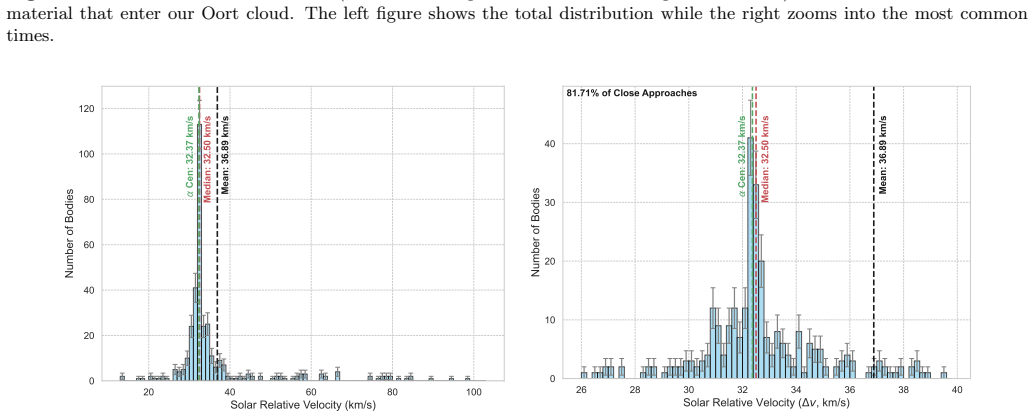
Under an adopted ejection-speed distribution taken from binary-star scattering models, material leaving Alpha Centauri with low asymptotic speeds (mostly <2 km/s) follows nearly the same Galactic orbit as the system itself, and orbital shear spreads it into a stream that sweeps past the Sun. The paper's central quantitative claim is that 350 of 1.$09x10^{6}$ simulated particles come within 100,000 au of the Sun, corresponding to ~0.03% of ejecta; the arrival rate peaks near Alpha Cen's closest approach in ~28,000 years and is concentrated in a ~10-million-year window. Scaling to a Solar System-like ejection rate of ~900 objects >100 m per year, the authors estimate ~$10^{6}$ Alpha Cen particles >100 m currently within the Oort Cloud, ~45 entering per year, a ~$10^{-6}$ chance one is within 10 au of the Sun, and roughly 10 meteors >100 micrometres per year entering Earth's atmosphere, increasing tenfold at closest approach. Particle survival calculations indicate grains as small as a few microns can make the trip, with magnetic deflection the limiting effect.
Load-bearing premise
The argument's numbers assume Alpha Centauri is ejecting material today at about the same rate as our Solar System ejects Oort-cloud comets, although no one has measured or confirmed any planetesimal reservoir around Alpha Centauri.
Editorial extensions
If this is right
- A dedicated search of meteor radar databases for Alpha Cen radiants (currently near RA 292°, Dec -43°) could find the first interstellar meteors from a known source.
- The flux of Alpha Cen material, both into the Oort Cloud and into Earth's atmosphere, should rise by roughly an order of magnitude over the next 28,000 years as the system approaches.
- Most arriving ejecta left Alpha Cen slower than 2 km/s, so any future model or observation of that system's ejection physics should focus on the low-velocity tail.
- Particles down to a few microns in radius can survive the interstellar crossing, so submillimetre and millimetre meteor observations are the most promising detection channel near current instruments.
- If confirmed, the delivered material would be the first case of interstellar transport traced to a specific stellar source, offering a direct test of material exchange between mature systems.
Reading between the lines
- Because the simulation ejects particles isotropically, the ~0.03% delivery fraction is a geometric bound for a Solar System-like ejection; if Alpha Cen's ejection is concentrated in the binary plane or preferentially directed toward us, the flux could differ by orders of magnitude in either direction.
- The predicted radiant splitting into two clusters (one at Alpha Cen's effective radiant, one broad after closest approach) implies that any future detection campaign should expect a time-dependent radiant that drifts over millennia, so a static radiant survey would miss most of the signal.
- The same method could be extended to other nearby approaching stars to build a map of possible sources of interstellar material; the paper's single-system case study suggests that low-velocity ejecta from any mature system form such streams.
- The ejection-rate assumption could be tested indirectly by deep imaging searches for a resolved Oort cloud or tidal debris around Alpha Cen; detecting such a reservoir would raise the credibility of the 10^6-object estimate.
Signed reviews
Editorial analysis
A structured set of objections, weighed in public.
Referee Report
Summary. The paper studies whether material ejected from the α Centauri system could reach the Solar System. The authors integrate 1.09×10^6 test particles over 100 Myr in a Miyamoto–Nagai Galactic potential, adopting an ejection speed distribution from Bailer-Jones et al. (2018) for a binary star, and flag close approaches within 100,000 au of the Sun. They find 350 such encounters, mostly from low-speed (v∞ < 2 km/s) ejecta, with arrival times peaking near α Cen's closest approach in ~28,000 yr. Scaling to a Solar System-like ejection rate, they estimate ~10^6 particles >100 m currently in the Oort Cloud and ~10 meteors >100 µm per year at Earth, increasing by an order of magnitude near closest approach. They also compute meteor radiants and compare them with known interstellar objects and meteor candidates.
Significance. If the dynamical pathway is real, this is a useful case study of interstellar material transport from the nearest stellar system, with concrete, falsifiable predictions for meteor radiants and arrival-time clustering. The paper is clearly written, the numerical setup is reproducible in principle, and the authors are explicit about their main assumptions. The work is significant as an order-of-magnitude estimate, not as a measured flux prediction: the adopted ejection speed distribution and the assumed ejection rate are both unvalidated for α Cen, and the quantitative results scale directly with them. The qualitative claim that low-speed ejecta from α Cen can dynamically reach the Oort Cloud is plausible and worth testing, but needs sensitivity analysis to be robust.
major comments (4)
- [§2.2.1 and §3, Figure 5] The ejection speed distribution is adopted from Bailer-Jones et al. (2018) for a 1 M☉ + 0.1 M☉ binary on a circular 10 au orbit, but α Cen AB has masses 1.1 and 0.9 M☉ on an eccentric 23.3 au orbit, with Proxima at 8200 au. No scattering calculation or sensitivity test is provided for this configuration. This matters because 52% of the close approaches have v∞ < 2 km/s, so the existence of the pathway itself depends on the low-velocity tail of the assumed distribution. If the real α Cen binary produces a suppressed or shifted low-velocity tail, the 350/1.09×10^6 close-approach count and all downstream numbers could change by orders of magnitude. I request a sensitivity test, e.g., rerunning with an alternative ejection distribution (planet-ejection, scaled binary velocity, or a truncated distribution with no sub-2 km/s tail) or at least a threshold analysis showing how the close-approach count depends on v∞.
- [§4.2] The quantitative estimates (10^6 particles >100 m in the Oort Cloud, ~10 meteors/year, factor-of-10 increase at closest approach) all scale linearly with the assumed ejection rate: the paper states 'we assume that α Cen ejects material at a rate similar to that of the Solar System at the current time.' There is no direct evidence that α Cen currently possesses an Oort Cloud or a comet reservoir, so this is an illustrative scaling, not a prediction. The conclusion bullet 'Material from α Centauri can reach and likely is already within our Solar System' is stronger than the support: the 'likely' depends entirely on the assumed rate. I recommend presenting the fluxes per unit ejection rate (e.g., per Solar-System-equivalent rate) and adding an explicit statement that the 10^6 and 10/yr numbers are conditional on that rate.
- [§2.2 (close-approach boundary)] The 100,000 au radius for defining a close approach is described as 'chosen more or less arbitrarily.' This boundary directly sets the close-approach count (350), the Oort Cloud volume used in the 10^6 estimate, and the Earth-crossing probability. No sensitivity test is given for the boundary value. I ask the authors to show how the number of close approaches and the derived fluxes change for, e.g., 50,000 au and 200,000 au, so the reader can assess the robustness of the quantitative claims.
- [§4.2 (meteor flux derivation)] The conversion from a mass influx of 100 m comets to 100 µm meteors assumes that the same total mass is ejected in 100 µm particles, which is not derived from any size-frequency distribution. The paper acknowledges the uncertainty but labels the resulting ~8 meteors per year as 'an upper limit,' which is not strictly justified: the actual number could be lower if the mass is in larger bodies, or higher if the small-particle production is enhanced by fragmentation. I suggest rephrasing this as an order-of-magnitude illustrative estimate rather than an upper limit, or deriving a proper size-distribution-based scaling if one is available.
minor comments (5)
- [§1] The text says 'α Cen A and B are Sun-like stars,' but α Cen B is a K1V star; consider revising to 'the primary is Sun-like' or 'both are lower-main-sequence stars.'
- [§3.1 and §5] The second radiant cluster is quoted as (α, δ) = (249° ± 17°, −60° ± 8°) in Section 3.1 but (249° ± 17°, −61° ± 8°) in the conclusions; please make these consistent.
- [§4.1] The text states the practical detection limit for CMOR is roughly 100 µm in diameter, but later gives a limiting mass of 10^-8 kg corresponding to 200 µm (for a density of 1000 kg/m^3); please reconcile these numbers or clarify the size range.
- [§3] The Monte Carlo Poisson uncertainty on the 350 close approaches is about ±19 (≈5%), which is not large, but the paper does not mention any statistical uncertainty on the close-approach count; adding a brief statement would help.
- [§2.2] The ejection of 10,000 particles per Myr is described, but the text does not specify the exact times of ejection relative to the integration (e.g., whether the first batch is at −100 Myr); clarifying this would improve reproducibility.
Circularity Check
No significant circularity: the dynamical delivery calculation is integrated from an externally adopted ejection model, and the abundance estimates are explicit conditional scalings of an assumed ejection rate, not fitted predictions.
full rationale
The paper's central dynamical result (350 of 1.09e6 ejecta come within 100,000 au of the Sun, with arrival times and radiants) follows from numerical integration in a Milky Way potential under an ejection speed distribution adopted from Bailer-Jones et al. (2018). The paper explicitly acknowledges the mismatch with Alpha Cen in Section 2.2.1: 'these parameters do not exactly match α Cen's', and labels the choice 'a reasonable first approximation'. This is an external model assumption, not a parameter fitted to the target observations or to the simulation output, so it cannot make the derivation circular. The quantitative estimates in Section 4.2 are likewise transparent conditional scalings: 'we assume that α Cen ejects material at a rate similar to that of the Solar System at the current time', then multiply simulated encounter counts by f_sim = 9e4 real objects per simulated particle and by an Oort-cloud residence time. These are stated as consequences of the assumed rate, and the paper repeatedly flags their uncertainty ('very sensitive to the assumed ejected mass distribution'). No equation in the paper reduces to its own input, and no fitted parameter is renamed as a prediction. The self-citations present (Wiegert & Tremaine 1999, cited alongside Weissman 1979 for the factor 1/2 of new Oort-cloud comets ejected; Hallatt & Wiegert 2020, used only for comparison radiants of known interstellar objects) are corroborated by independent sources or are context, so they are not load-bearing. The unmeasured Alpha Cen ejection rate and the non-matching ejection parameters are explicitly disclosed limitations; these are robustness concerns for the quantitative claims, not circularity in the derivation chain.
Assumptions & free parameters
free parameters (4)
- Assumed Alpha Cen ejection rate =
900 objects >100 m per year (Solar System proxy)
- Oort Cloud boundary radius =
100,000 au (chosen)
- Fiducial meteor size =
100 micrometers diameter
- Comet density =
400 kg m^-3
assumptions (5)
- domain assumption Ejecta from Alpha Cen follow the binary-star speed distribution of Bailer-Jones et al. (2018) (1 M_sun and 0.1 M_sun, 10 au circular orbit).
- domain assumption Galactic dynamics can be modeled by the smooth, axisymmetric, time-independent Miyamoto-Nagai potential, neglecting ISM drag, magnetic deflection, and GMC kicks during integration.
- domain assumption Ejection directions are isotropic.
- domain assumption A particle that enters a 100,000 au heliocentric sphere is counted as delivered to the Solar System.
- ad hoc to paper Alpha Cen currently ejects cometary material at a rate equal to the Solar System's Oort-cloud comet ejection rate.
Cite this review
Pith. "Pith review of A Case Study of Interstellar Material Delivery: {\alpha} Centauri." pith.science (2026). https://pith.science/paper/WMK5S4NL
@misc{pith2026250203224,
  author       = {Pith},
  title        = {Pith review of: A Case Study of Interstellar Material Delivery: \alpha Centauri},
  year         = {2026},
  howpublished = {\url{https://pith.science/paper/WMK5S4NL}},
  note         = {Machine review of arXiv:2502.03224}
}
abstract
Interstellar material has been discovered in our Solar System, yet its origins and details of its transport are unknown. Here we present $\alpha$ Centauri as a case study of the delivery of interstellar material to our Solar System. $\alpha$ Centauri is a mature triple star system that likely harbours planets and is moving towards us with the point of closest approach approximately 28,000 years in the future. Assuming a current ejection model for the system, we find that such material can reach our Solar System and may currently be present here. The material that does reach us is mostly a product of low ($<2$ km/s) ejection velocities, and the rate at which it enters our Solar System is expected to peak around the time of $\alpha$ Centauri 's closest approach. If $\alpha$ Centauri ejects material at a rate comparable to our own Solar System, we estimate the current number of $\alpha$ Centauri particles larger than 100 m in diameter within our Oort Cloud to be $10^{6}$, and during $\alpha$ Centauri 's closest approach, this will increase by an order of magnitude. However, the observable fraction of such objects remains low as there is only a probability of $10^{-6}$ that one of them is within 10 au of the Sun. A small number ($\sim 10$) meteors greater than 100 micrometers from $\alpha$ Centauri may currently be entering Earth's atmosphere every year: this number is very sensitive to the assumed ejected mass distribution, but the flux is expected to increase as $\alpha$ Centauri approaches.
Figures


Figures from the paper (6 more)




Reference graph
Works this paper leans on
-
[1]
, " * write output.state after.block = add.period write newline
ENTRY address archivePrefix author booktitle chapter doi edition editor eprint howpublished institution journal key month number organization pages publisher school series title misctitle type volume year version url label extra.label sort.label short.list INTEGERS output.state before.all mid.sentence after.sentence after.block FUNCTION init.state.consts ...
-
[2]
write newline
" write newline "" before.all 'output.state := FUNCTION format.url url empty "" new.block "" url * "" * if FUNCTION format.eprint eprint empty "" archivePrefix empty "" archivePrefix "arXiv" = new.block " " eprint * " " * new.block " " eprint * " " * if if if FUNCTION format.doi doi empty "" " " doi * " " * if FUNCTION format.pid doi empty eprint empty ur...
-
[3]
H; ߰Fpn0t
thebibliography [1] 20pt to REFERENCES 6pt =0pt -12pt 10pt plus 3pt =0pt =0pt =1pt plus 1pt =0pt =0pt -12pt =13pt plus 1pt =20pt =13pt plus 1pt \@M =10000 =-1.0em =0pt =0pt 0pt =0pt =1.0em @enumiv\@empty 10000 10000 `\.\@m \@noitemerr \@latex@warning Empty `thebibliography' environment \@ifnextchar \@reference \@latexerr Missing key on reference command E...
2021
-
[4]
Adams, F. C. 2010, Annual Review of Astronomy and Astrophysics, 48, 47, 10.1146/annurev-astro-081309-130830
-
[5]
Adams, F. C., & Napier, K. J. 2022, Astrobiology, 22, 1429, 10.1089/ast.2021.0187
-
[6]
Akeson, R., Beichman, C., Kervella, P., Fomalont, E., & Benedict, G. F. 2021, The Astronomical Journal, 162, 14, 10.3847/1538-3881/abfaff
-
[7]
2003, Journal of Geophysical Research: Space Physics, 108
Altobelli, N., Kempf, S., Landgraf, M., et al. 2003, Journal of Geophysical Research: Space Physics, 108
work page 2003
-
[8]
Anglada-Escudé, G., Amado, P. J., Barnes, J., et al. 2016, Nature, 536, 437, 10.1038/nature19106
Show all 70 references
-
[9]
F., Belton, M
A’Hearn, M. F., Belton, M. J., Delamere, W. A., et al. 2011, Science, 332, 1396
2011
-
[10]
Baggaley, W. J. 2000, Journal of Geophysical Research: Space Physics, 105, 10353
2000
-
[11]
1995, The High Latitude Heliosphere, 471
Baguhl, M., Gr \"u n, E., Hamilton, D., et al. 1995, The High Latitude Heliosphere, 471
1995
-
[12]
Bailer-Jones, C. A. L., Farnocchia, D., Meech, K. J., et al. 2018, The Astronomical Journal, 156, 205
2018
-
[13]
2008, Galactic Dynamics, 2nd edn
Binney, J., & Tremaine, S. 2008, Galactic Dynamics, 2nd edn. (Princeton, NJ: Princeton University Press)
2008
-
[14]
J., et al
Boe, B., Jedicke, R., Meech, K. J., et al. 2019, Icarus, 333, 252, https://doi.org/10.1016/j.icarus.2019.05.034
2019 doi
-
[15]
2015, The Astrophysical Journal Supplement Series, 216, 29
Bovy, J. 2015, The Astrophysical Journal Supplement Series, 216, 29
2015
-
[16]
2013, Icarus, 225, 40
Brasser, R., & Morbidelli, A. 2013, Icarus, 225, 40
2013
-
[17]
2003, Icarus, 166, 141
Charnoz, S., & Morbidelli, A. 2003, Icarus, 166, 141
2003
-
[18]
A., et al
Chen, B., Stoughton, C., Smith, J. A., et al. 2001, The Astrophysical Journal, 553, 184
2001
-
[19]
A., & Calandra, M
Correa-Otto, J. A., & Calandra, M. F. 2019, Monthly Notices of the Royal Astronomical Society, 490, 2495, 10.1093/mnras/stz2671
2019 doi
-
[20]
2024, Alpha Centauri : Disc Dynamics , Planet Stability , Detectability , arXiv
Cuello, N., & Sucerquia, M. 2024, Alpha Centauri : Disc Dynamics , Planet Stability , Detectability , arXiv. http://arxiv.org/abs/2401.16003
2024 arXiv
-
[21]
2018, The Astrophysical Journal Letters, 852, L15, 10.3847/2041-8213/aaa3e2
\' C uk, M. 2018, The Astrophysical Journal Letters, 852, L15, 10.3847/2041-8213/aaa3e2
2018 doi
-
[22]
2020, Science Advances, 6, eaax7467, 10.1126/sciadv.aax7467
Damasso, M., Del Sordo, F., Anglada-Escudé, G., et al. 2020, Science Advances, 6, eaax7467, 10.1126/sciadv.aax7467
2020 doi
-
[23]
1995, Astronomy and Astrophysics, 300, 117
Dauphole, B., & Colin, J. 1995, Astronomy and Astrophysics, 300, 117
1995
-
[24]
2018, Monthly Notices of the Royal Astronomical Society, 479, 4720, 10.1093/mnras/sty1726
Dehnen, W., & Hasanuddin . 2018, Monthly Notices of the Royal Astronomical Society, 479, 4720, 10.1093/mnras/sty1726
2018 doi
-
[25]
1987, The Astronomical Journal, 94, 1330
Duncan, M., Quinn, T., & Tremaine, S. 1987, The Astronomical Journal, 94, 1330
1987
-
[26]
1967, in Determination of Radial Velocities and their Applications, Vol
Evans, D. 1967, in Determination of Radial Velocities and their Applications, Vol. 30, 57
1967
-
[27]
P., Suárez Mascareño, A., Figueira, P., et al
Faria, J. P., Suárez Mascareño, A., Figueira, P., et al. 2022, Astronomy & Astrophysics, 658, A115, 10.1051/0004-6361/202142337
2022 doi
-
[28]
1974, Classical seventh-, sixth-, and fifth-order Runge-Kutta-Nystr \'o m formulas with stepsize control for general second-order differential equations, Tech
Fehlberg, E. 1974, Classical seventh-, sixth-, and fifth-order Runge-Kutta-Nystr \'o m formulas with stepsize control for general second-order differential equations, Tech. rep., National Aeronautics and Space Administration
1974
-
[29]
1984, Icarus, 58, 109
Fernandez, J., & Ip, W.-H. 1984, Icarus, 58, 109
1984
-
[30]
Froncisz, M., Brown, P., & Weryk, R. J. 2020, Planetary and Space Science, 190, 104980
2020
-
[31]
2009, The Astrophysical Journal, 692, 1075
Gillessen, S., Eisenhauer, F., Trippe, S., et al. 2009, The Astrophysical Journal, 692, 1075
2009
-
[32]
2020, Astronomy & Astrophysics, 638, A120, 10.1051/0004-6361/202037594
Gratton, R., Zurlo, A., Le Coroller, H., et al. 2020, Astronomy & Astrophysics, 638, A120, 10.1051/0004-6361/202037594
2020 doi
-
[33]
B., & Avni, Y
Grishin, E., Perets, H. B., & Avni, Y. 2019, Monthly Notices of the Royal Astronomical Society, 487, 3324, 10.1093/mnras/stz1505
2019 doi
-
[34]
1997, Icarus, 129, 270
Grün, E., Staubach, P., Baguhl, M., et al. 1997, Icarus, 129, 270
1997
-
[35]
2020, Nature Astronomy, 4, 53
Guzik, P., Drahus, M., Rusek, K., et al. 2020, Nature Astronomy, 4, 53
2020
-
[36]
2020, Planetary and Space Science, 192, 105060, 10.1016/j.pss.2020.105060
Hajdukova, M., Sterken, V., Wiegert, P., & Kornoš, L. 2020, Planetary and Space Science, 192, 105060, 10.1016/j.pss.2020.105060
2020
-
[37]
2024, Astronomy & Astrophysics, 691, A8, 10.1051/0004-6361/202449569
Hajduková, M., Stober, G., Barghini, D., et al. 2024, Astronomy & Astrophysics, 691, A8, 10.1051/0004-6361/202449569
2024 doi
-
[38]
2020, The Astronomical Journal, 159, 147
Hallatt, T., & Wiegert, P. 2020, The Astronomical Journal, 159, 147
2020
-
[39]
P., Tamayo, D., Hammond, N., Ali-Dib, M., & Rein, H
Jackson, A. P., Tamayo, D., Hammond, N., Ali-Dib, M., & Rein, H. 2018, Monthly Notices of the Royal Astronomical Society: Letters, 478, L49
2018
-
[40]
1992, Astronomy and Astrophysics, 255, 124
Jaschek, C., & Valbousquet, A. 1992, Astronomy and Astrophysics, 255, 124. https://ui.adsabs.harvard.edu/abs/1992A&A...255..124J
1992
-
[41]
2018, The Astrophysical Journal, 864, 99, 10.3847/1538-4357/aad464
Joyce, M., & Chaboyer, B. 2018, The Astrophysical Journal, 864, 99, 10.3847/1538-4357/aad464
2018 doi
-
[42]
2017, Astronomy & Astrophysics, 598, L7, 10.1051/0004-6361/201629930
Kervella, P., Thévenin, F., & Lovis, C. 2017, Astronomy & Astrophysics, 598, L7, 10.1051/0004-6361/201629930
2017 doi
-
[43]
J., Weryk, R., Micheli, M., et al
Meech, K. J., Weryk, R., Micheli, M., et al. 2017, Nature, 552, 378
2017
-
[44]
1981, Galactic Astronomy (New York: Freeman)
Mihalas, D., & Binney, J. 1981, Galactic Astronomy (New York: Freeman)
1981
-
[45]
1975, Publications of the Astronomical Society of Japan, 27, 533
Miyamoto, M., & Nagai, R. 1975, Publications of the Astronomical Society of Japan, 27, 533
1975
- [46]
-
[47]
2022, The Astrophysical Journal, 924, 96
Moro-Mart \' n, A., & Norman, C. 2022, The Astrophysical Journal, 924, 96
2022
-
[48]
C., & Capobianco, C
Murray, N., Weingartner, J. C., & Capobianco, C. 2004, The Astrophysical Journal, 600, 804
2004
-
[49]
Osmanov, Z. N. 2024, The possibility of panspermia in the deep cosmos by means of the planetary dust grains, arXiv. http://arxiv.org/abs/2402.04990
2024 arXiv
-
[50]
2021, Astronomy and Astrophysics, 647, 10.1051/0004-6361/202038888
Portegies Zwart , S. 2021, Astronomy and Astrophysics, 647, 10.1051/0004-6361/202038888
2021 doi
-
[51]
Portegies Zwart , S., Torres, S., Pelupessy, I., Bédorf, J., & Cai, M. X. 2018, Monthly Notices of the Royal Astronomical Society: Letters, 479, L17, 10.1093/mnrasl/sly088
2018 doi
-
[52]
Rajpaul, V., Aigrain, S., & Roberts, S. J. 2015, Monthly Notices of the Royal Astronomical Society: Letters, 456, L6, 10.1093/mnrasl/slv164
2015 doi
-
[53]
J., & Brunthaler, A
Reid, M. J., & Brunthaler, A. 2004, The Astrophysical Journal, 616, 872
2004
-
[54]
D., Boyajian, T
Ribas, I., Gregg, M. D., Boyajian, T. S., & Bolmont, E. 2017, Astronomy & Astrophysics, 603, A58, 10.1051/0004-6361/201730582
2017 doi
-
[55]
Safronov, V. S. 1972, in The Motion, Evolution of Orbits, and Origin of Comets, ed. G. A. Chebotarev, E. I. Kazimirchak-Polonskaya , & B. G. Marsden (New York: Spinger), 329--334
1972
-
[56]
2010, Monthly Notices of the Royal Astronomical Society, 403, 1829
Sch \"o nrich, R., Binney, J., & Dehnen, W. 2010, Monthly Notices of the Royal Astronomical Society, 403, 1829
2010
-
[57]
L., et al
Sierks, H., Barbieri, C., Lamy, P. L., et al. 2015, Science, 347, aaa1044
2015
-
[58]
B., & Sinapayen, L
Smith, H. B., & Sinapayen, L. 2024, An Agnostic Biosignature Based on Modeling Panspermia and Terraformation , arXiv. http://arxiv.org/abs/2403.14195
2024
-
[59]
A., Kratter, K
Smullen, R. A., Kratter, K. M., & Shannon, A. 2016, Monthly Notices of the Royal Astronomical Society, 461, 1288, 10.1093/mnras/stw1347
2016 doi
-
[60]
J., Altobelli, N., Kempf, S., et al
Sterken, V. J., Altobelli, N., Kempf, S., et al. 2012, Astronomy & Astrophysics, 538, A102, 10.1051/0004-6361/201117119
2012 doi
-
[61]
D., Baggaley, W
Taylor, A. D., Baggaley, W. J., & Steel, D. I. 1996, Nature, 380, 323, 10.1038/380323a0
1996 doi
-
[62]
2002, Astronomy & Astrophysics, 392, L9, 10.1051/0004-6361:20021074
Thévenin, F., Provost, J., Morel, P., et al. 2002, Astronomy & Astrophysics, 392, L9, 10.1051/0004-6361:20021074
2002 doi
-
[63]
X., Brown, A
Torres, S., Cai, M. X., Brown, A. G. A., & Zwart, S. P. 2019, Astronomy & Astrophysics, 629, A139, 10.1051/0004-6361/201935330
2019 doi
-
[64]
1993, in Astron
Tremaine, S. 1993, in Astron. Soc. Pac. Conference Series, Vol. 36, Planets around Pulsars, ed. J. A. Phillips, S. E. Thorsett, & S. R. Kulkarni (San Francisco: Astronomical Society of the Pacific), 335--344
1993
-
[65]
2021, Nature Communications, 12, 922, 10.1038/s41467-021-21176-6
Wagner, K., Boehle, A., Pathak, P., et al. 2021, Nature Communications, 12, 922, 10.1038/s41467-021-21176-6
2021 doi
-
[66]
2004, Atmospheric Chemistry and Physics, 4, 679
Webster, A., Brown, P., Jones, J., Ellis, K., & Campbell-Brown, M. 2004, Atmospheric Chemistry and Physics, 4, 679
2004
-
[67]
Weissman, P. R. 1979, in Dynamics of the S olar S ystem, ed. R. L. Duncombe (Boston: D. Reidel), 277--282
1979
-
[68]
2000, , 143, 9, 10.1051/aas:2000332
Wenger , M., Ochsenbein , F., Egret , D., et al. 2000, , 143, 9, 10.1051/aas:2000332
2000 doi
-
[69]
1999, icarus, 137, 84
Wiegert, P., & Tremaine, S. 1999, icarus, 137, 84
1999
-
[70]
1977, Astronomy and Astrophysics, 60, 263
Wielen, R. 1977, Astronomy and Astrophysics, 60, 263
1977
Reviewed August 9, 2026 · model on record in the stance chip above.
Discussion (0). Continue with ORCID to comment.