REVIEW 4 major objections 4 minor 53 references
SyMANTIC: An Efficient Symbolic Regression Method for Interpretable and Parsimonious Model Discovery in Science and Beyond
T0 review · 4 major / 4 minor · reviewed 2026-08-09 · deepseek-v4-flash
Pith's one-line read SyMANTIC recovers over 95% of benchmark equations in seconds, the paper reports.
desk verdict A useful, open-source SISSO descendant whose headline benchmark advantage is inflated by per-problem operator sets; worth reviewing, but the comparison needs to be made fair. read the letter →
The pith
A machine-rendered reading of the paper's core claim, the machinery that carries it, and where it could break.
The reading
What carries the argument
The load-bearing object is the $\mathrm{C}^2$-SISSO module: a complexity-constrained extension of the sure-independence-screening and sparsifying-operator approach. It first drops candidate features whose structural complexity exceeds a cutoff, where complexity is measured in bits as $C(f) = K(f)\log_2 B(f)$ with $B$ the number of distinct basis functions and $K$ their total usage; then it uses sure independence screening to retain a small number of highly correlated terms, and exhaustively solves $\ell_0$-constrained least squares for up to $T$ terms (default 3). Wrapping this in a loop over expansion levels and complexity cutoffs, and merging all tested models into an approximate Pareto frontier of loss versus complexity, is what lets SyMANTIC return multiple interpretable equations from a huge implicit search space.
What would settle it
Re-run the 20-equation benchmark with a single fixed generic operator set for all problems, the same five-minute cap for every method, and no per-problem tailoring; if SyMANTIC's recovery rate then approaches the comparison methods' rate, the claimed advantage is mostly the operator provisioning rather than the search. Likewise, adding noise to the Lorenz derivative measurements at five time points would test whether the sparse-data result survives realistic derivative estimation.
Extended reading notes
Core claim
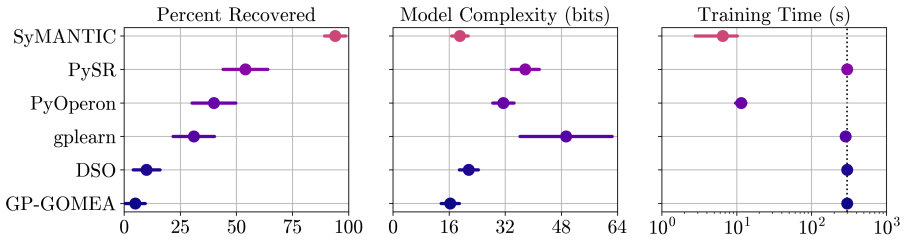
The central claim is that a sparse-regression view of symbolic regression can be made both fast and stable by screening original features with mutual information before expansion, generating a large library of candidate terms by recursive application of operators, and solving sequences of small $\ell_0$-constrained least-squares problems on terms preselected by sure independence screening, with an information-theoretic complexity filter and an automatic scan over complexity cutoffs and expansion depths. The paper argues this combination identifies parsimonious symbolic models even when the candidate space has $10^5$ to $10^{10}$ or more terms, and reports that it recovered over 95% of 20 benchmark equations versus about 50% for the next-best method, with median solution time under ten seconds. It further reports learning the chaotic Lorenz system from clean derivative measurements at five time points where a standard sparse-dynamics method diverges, and a test $R^2$ of 0.88 for redox-potential prediction from 1,444 descriptors and only 115 training points.
Load-bearing premise
The headline recovery rate assumes SyMANTIC is given a per-problem operator set that already contains the operations needed to write each ground-truth equation, while comparison methods run with generic defaults and a five-minute cap, and the Lorenz result assumes clean derivative measurements at the sampled time points.
Editorial extensions
If this is right
- Symbolic regression can be applied to problems with thousands of input features and dozens of training points, since mutual-information screening cuts the primary feature set before expansion.
- Users get a family of candidate equations (an approximate Pareto frontier) rather than a single model, which makes it possible to choose between accuracy and simplicity and to spot overfit alternatives.
- Governing differential equations can be identified from very sparse derivative measurements when derivatives are available, extending equation discovery to chaotic systems.
- Because solutions are found in seconds to minutes, practitioners can afford to try different operator sets and data subsets, which is how the method is meant to be used in practice.
Reading between the lines
- The headline recovery rate is conditional on the per-problem operator provisioning in the benchmark; with one fixed generic operator set across all 20 equations, the recovery gap would likely shrink, so the practical advantage may lie in fast iteration over operator sets rather than in unconditional recovery.
- The information-theoretic complexity measure could be used outside SyMANTIC as a model-selection score for any symbolic or interpretable regression output, since it assigns a bit cost that is comparable across expressions.
- A straightforward extension would be to wrap SyMANTIC in an outer loop over operator sets chosen adaptively from data, or to seed a genetic-programming search with the Pareto-front expressions SyMANTIC returns; the paper mentions a hybrid as future work but does not test it.
- The five-point Lorenz result presumes clean derivatives; applying the same pipeline with total-variation regularized differentiation to noisy state measurements would test whether the low-data advantage survives realistic experimental conditions.
Editorial analysis
A structured set of objections, weighed in public.
Referee Report
Summary. The paper introduces SyMANTIC, a symbolic regression method that combines mutual-information screening of primary features, recursive exhaustive expansion over a user-specified operator set, and a complexity-constrained variant of SISSO (C2-SISSO) to build sparse linear models. The method returns an approximate Pareto frontier trading off a structural complexity measure against predictive loss, with an automated loop over expansion levels and complexity cut-offs. The authors report that SyMANTIC recovers over 95% of 20 benchmark equations (versus about 50% for PySR), learns the chaotic Lorenz equations from derivative data at five time points, achieves a test R2 of 0.88 on a 1,444-feature redox-potential dataset with 115 training points, and runs faster than the compared SR packages. The paper also describes an open-source PyTorch-based implementation and GPU acceleration results.
Significance. If the benchmark findings survive scrutiny, SyMANTIC would be a practically useful addition to the sparse-regression family of symbolic regression: it is clearly specified, open source, GPU-accelerated, and it explicitly returns a Pareto front rather than a single expression. The high-dimensional molecular property result and the low-data Lorenz demonstration are potentially valuable evidence for the method's scalability and robustness. The main weakness is that the headline comparison is not like-for-like, because SyMANTIC receives per-problem operator sets chosen from the known ground truth while competitors receive generic defaults and a short time budget. The absence of a SISSO/TorchSISSO baseline also leaves the marginal contribution of the new components unquantified. These issues are fixable with additional experiments, but they are load-bearing for the central claim of superior recovery.
major comments (4)
- [Section 3.1 and SI Sections S1–S3] The benchmark comparison is not like-for-like. For each of the 20 equations, SyMANTIC is given a per-problem operator set O that is essentially a minimal vocabulary for the ground-truth expression, e.g., Case 11 uses O={×} for v=H0D and Case 17 uses {/,×,^2,−} for the relativistic mass equation, while PySR, PyOperon, gplearn, DSO, and GP-GOMEA are run with generic default operator sets and a 5-minute cap. Because the SyMANTIC feature library is the recursive closure of O, the ground truth often appears at level 1 or 2 as a single descriptor, so recovery largely reduces to fitting one coefficient. The aggregate recovery bars in Figure 3 hide which cases are trivial under the tailored O, and the paper does not report per-equation success. I request a fair comparison: either run SyMANTIC with one fixed generic operator set across all 20 problems, or give the same per-problem operator information to the competing methods; in addition, report a per-equation recovery table and use a time budget consistent with standard SRBench practice.
- [Section 2.2 and Section 3.1] There is no SISSO/TorchSISSO baseline even though SyMANTIC is explicitly built as C2-SISSO with mutual-information screening and automated hyperparameter loops. Since SISSO already performs exhaustive expansion, sure independence screening, and ℓ0 regression, the marginal contribution of MI screening, the complexity constraint, and the Pareto tracking cannot be assessed from the current experiments. Adding SISSO or TorchSISSO as a baseline under the same operator sets and termination criteria is necessary to support the claim that these new components improve on the existing sparse-regression approach.
- [Section 3.5 and Section 2.4.6] The Lorenz result is presented as learning the system 'from just five time points,' but the experiment assumes clean measurements of the derivatives at those points, as the paper itself notes in Section 2.4.6. This assumption is not available in most experimental settings, and PySINDy is only evaluated with its default settings. The comparison should be qualified in the abstract and conclusion, and the experiments should be extended to at least one realistic scenario where derivatives are estimated from noisy state data, or where PySINDy is given a small hyperparameter search over its threshold and library, as is common practice. The current wording overstates the practical claim relative to the experimental setup.
- [SI Sections S1.1–S1.5] The per-problem termination criteria appear to be tuned to the noise level and, in some cases, are internally inconsistent. For example, Case 5 specifies Gaussian noise with standard deviation 0.05 but an RMSE threshold of 0.001 and an R2 threshold of 1.0, which is impossible to achieve on noisy data unless the threshold is not actually enforced; Case 4 says 'Default criteria used' without specifying what that default is. These choices affect early stopping, runtime, and possibly recovery, so the manuscript should state explicitly how the thresholds were selected and whether they were applied uniformly across methods.
minor comments (4)
- [Section 2.2, Eq. (4)] The complexity example f(x)=0.5×x1×x2^2 is said to have B=4 basis functions and K=5 uses, but the counting rule is not specified: it is unclear why the constant 0.5 is not counted and how x2 is counted both inside the square and in the multiplication. Please define the counting procedure precisely.
- [Figure 3] The recovery percentages are averaged over five replicates on only 20 equations, so the 95% confidence intervals are necessarily wide; the figure reports aggregate bars without error per equation, which makes it impossible to see which cases are driving the difference. A per-equation table would be much more informative.
- [Section 3.6] The molecular property experiment uses 115 training samples and 1,444 PaDEL features, but the paper does not state whether the test molecules are disjoint from the training set in terms of chemical scaffolds or how the top-1% MI screening was validated; a brief description of the data-splitting and screening procedure would improve reproducibility.
- [Throughout] There are several small typographical and consistency issues: 'Lorentz system' in the SI S4 title should be 'Lorenz system,' the footnote in Section 3.4 cites 'Radawan et al.' but the reference is to 'Radwan et al.,' and the SI tables use inconsistent capitalization for operators. These should be corrected in a final pass.
Circularity Check
Benchmark 'discovery' reduces to least-squares fit over operator sets chosen from the known answers; asymmetric provisioning inflates SyMANTIC's headline recovery advantage.
-
fitted input called prediction
[Section 3.1 (Results) and Supporting Information S1-S3 (e.g., SI S2.1 Case 11, SI S3.3 Case 17); feature library construction Eq. (6)]
"Case 11: Hubble's Law ... Mathematical Function: v = H0 D ... Operators Used in Symbolic Regression: Multiplication (×). ... The absence of noise and the use of appropriate operators allow the models to recover the exact mathematical forms of the laws. — Main text: SyMANTIC demonstrates superior performance, exactly recovering over 95% of the test equations ... outperforming the next best method, PySR, which recovers approximately 50%."
For each benchmark, the SI fixes the operator set O to a minimal vocabulary containing exactly the operations in the known target equation (e.g., O={×} for v=H0D; O={/,×,^2,−} for the relativistic mass formula). Equation (6) then defines the candidate library as the exhaustive closure of O, so the target expression is itself an element (or a one/two-term linear combination of elements) of the library at low expansion level. C2-SISSO merely fits ℓ0-sparse linear coefficients to that library. Hence the 95% recovery rate is not an independent symbolic discovery; it is a least-squares selection of a feature whose symbolic form was inserted by the benchmark design.
full rationale
SyMANTIC's core algorithm (MI screening, recursive feature expansion, complexity-constrained SISSO, Pareto update) is a legitimate engineering construction; those components are not derived from the benchmark answers, and the real-world redox-potential and Lorenz results are externally grounded under their stated assumptions (clean derivatives, tailored but explicitly disclosed operators). The principal circularity is in the headline benchmark claim. The SI supplies each of the 20 problems with an operator set O chosen to match the operations in the known ground truth (e.g., O={×} for v=H0D; O={/,×,^2,−} for relativistic mass). Since Eq. (6) forms the candidate library as the exhaustive closure of O, the target expression is a member of the library (or a one/two-term sparse linear combination), and C2-SISSO's ℓ0 fit recovers it by construction. Thus the 95% recovery rate is partly a property of the input operator selection, not an independent discovery result. The comparison is further asymmetric: PySR, PyOperon, gplearn, DSO, and GP-GOMEA run with generic default operator sets and a 5-minute cap, while SyMANTIC receives per-problem operators. No load-bearing self-citation or imported uniqueness theorem was found; the self-citations (TorchSISSO, Park et al.) are data/implementation references. The complexity metric C(f)=K log B is a new modeling choice without external validation, but it is not circular. Missing SISSO/TorchSISSO baselines is a benchmarking omission, not circularity. Overall: partial circularity in the central recovery comparison, with independent algorithmic content elsewhere.
Assumptions & free parameters
free parameters (7)
- MI threshold gamma =
0.1
- nscreen (max screened features) =
20
- k (SIS top features) =
20
- T (max model terms) =
3
- ncomp (complexity thresholds) =
4
- nexp (expansion levels) =
3
- Per-problem operator set O =
varies; contains exact operators needed for ground truth
assumptions (5)
- domain assumption Target y can be written as a sparse linear combination of features in the recursively expanded library phi_l(x).
- domain assumption Mutual information estimated by KDE correctly ranks relevant features.
- domain assumption Sure independence screening (SIS) retains the features needed for the final model.
- domain assumption For dynamical systems, clean measurements of state derivatives are available at the sampled time points.
- ad hoc to paper The benchmark equations are exactly representable with the per-problem operator set and termination criteria.
Cite this review
Pith. "Pith review of SyMANTIC: An Efficient Symbolic Regression Method for Interpretable and Parsimonious Model Discovery in Science and Beyond." pith.science (2026). https://pith.science/paper/53JCHGYW
@misc{pith2026250203367,
  author       = {Pith},
  title        = {Pith review of: SyMANTIC: An Efficient Symbolic Regression Method for Interpretable and Parsimonious Model Discovery in Science and Beyond},
  year         = {2026},
  howpublished = {\url{https://pith.science/paper/53JCHGYW}},
  note         = {Machine review of arXiv:2502.03367}
}
abstract
Symbolic regression (SR) is an emerging branch of machine learning focused on discovering simple and interpretable mathematical expressions from data. Although a wide-variety of SR methods have been developed, they often face challenges such as high computational cost, poor scalability with respect to the number of input dimensions, fragility to noise, and an inability to balance accuracy and complexity. This work introduces SyMANTIC, a novel SR algorithm that addresses these challenges. SyMANTIC efficiently identifies (potentially several) low-dimensional descriptors from a large set of candidates (from $\sim 10^5$ to $\sim 10^{10}$ or more) through a unique combination of mutual information-based feature selection, adaptive feature expansion, and recursively applied $\ell_0$-based sparse regression. In addition, it employs an information-theoretic measure to produce an approximate set of Pareto-optimal equations, each offering the best-found accuracy for a given complexity. Furthermore, our open-source implementation of SyMANTIC, built on the PyTorch ecosystem, facilitates easy installation and GPU acceleration. We demonstrate the effectiveness of SyMANTIC across a range of problems, including synthetic examples, scientific benchmarks, real-world material property predictions, and chaotic dynamical system identification from small datasets. Extensive comparisons show that SyMANTIC uncovers similar or more accurate models at a fraction of the cost of existing SR methods.
Figures


Figures from the paper (4 more)


Reference graph
Works this paper leans on
-
[1]
Distilling free-form natural laws from experimental data
Schmidt, M.; Lipson, H. Distilling free-form natural laws from experimental data. Science 2009, 324, 81--85
work page 2009
-
[2]
La Cava, W.; Burlacu, B.; Virgolin, M.; Kommenda, M.; Orzechowski, P.; de Fran c a, F. O.; Jin, Y.; Moore, J. H. Contemporary symbolic regression methods and their relative performance. Advances in Neural Information Processing Systems 2021, 2021, 1
work page 2021
-
[3]
Interpretable scientific discovery with symbolic regression: A review
Makke, N.; Chawla, S. Interpretable scientific discovery with symbolic regression: A review. Artificial Intelligence Review 2024, 57, 2
work page 2024
-
[4]
Rediscovering orbital mechanics with machine learning
Lemos, P.; Jeffrey, N.; Cranmer, M.; Ho, S.; Battaglia, P. Rediscovering orbital mechanics with machine learning. Machine Learning: Science and Technology 2023, 4, 045002
work page 2023
-
[5]
Hernandez, A.; Balasubramanian, A.; Yuan, F.; Mason, S. A.; Mueller, T. Fast, accurate, and transferable many-body interatomic potentials by symbolic regression. npj Computational Materials 2019, 5, 112
work page 2019
-
[6]
Wang, Y.; Wagner, N.; Rondinelli, J. M. Symbolic regression in materials science. MRS Communications 2019, 9, 793--805
work page 2019
-
[7]
Truscott, P.; Korns, M. F. Explaining unemployment rates with symbolic regression. Genetic Programming Theory and Practice XI 2014, 119--135
work page 2014
-
[8]
Virgolin, M.; Wang, Z.; Alderliesten, T.; Bosman, P. A. Machine learning for the prediction of pseudorealistic pediatric abdominal phantoms for radiation dose reconstruction. Journal of Medical Imaging 2020, 7, 046501--046501
work page 2020
Show all 53 references
-
[9]
Constructing parsimonious analytic models for dynamic systems via symbolic regression
Derner, E.; Kubal \' k, J.; Ancona, N.; Babu s ka, R. Constructing parsimonious analytic models for dynamic systems via symbolic regression. Applied Soft Computing 2020, 94, 106432
2020
-
[10]
Symbolic regression for space applications: Differentiable cartesian genetic programming powered by multi-objective memetic algorithms
M \"a rtens, M.; Izzo, D. Symbolic regression for space applications: Differentiable cartesian genetic programming powered by multi-objective memetic algorithms. arXiv preprint 2022, arXiv:2206.06213
2022 arXiv
-
[11]
The Astronomical Revolution: Copernicus-Kepler-Borelli ; Routledge, 2013
Koyr \'e , A. The Astronomical Revolution: Copernicus-Kepler-Borelli ; Routledge, 2013
2013
-
[12]
Virgolin, M.; Pissis, S. P. Symbolic regression is NP -hard. arXiv preprint 2022, arXiv:2207.01018
2022 arXiv
-
[13]
L.; Proctor, J
Brunton, S. L.; Proctor, J. L.; Kutz, J. N. Discovering governing equations from data by sparse identification of nonlinear dynamical systems. Proceedings of the National Academy of Sciences 2016, 113, 3932--3937
2016
-
[14]
Numerical differentiation of noisy, nonsmooth data
Chartrand, R. Numerical differentiation of noisy, nonsmooth data. International Scholarly Research Notices 2011, 2011, 164564
2011
-
[15]
T.; Rubanova, Y.; Bettencourt, J.; Duvenaud, D
Chen, R. T.; Rubanova, Y.; Bettencourt, J.; Duvenaud, D. K. Neural ordinary differential equations. Advances in Neural Information Processing Systems 2018, 31
2018
-
[16]
Data-driven discovery of the governing equations of dynamical systems via moving horizon optimization
Lejarza, F.; Baldea, M. Data-driven discovery of the governing equations of dynamical systems via moving horizon optimization. Scientific Reports 2022, 12, 11836
2022
-
[17]
BACON : A Production System That Discovers Empirical Laws
Langley, P. BACON : A Production System That Discovers Empirical Laws. IJCAI. 1977; p 344
1977
-
[18]
Langley, P.; Zytkow, J. M. Data-driven approaches to empirical discovery. Artificial Intelligence 1989, 40, 283--312
1989
-
[19]
Koza, J. R. Genetic programming as a means for programming computers by natural selection. Statistics and Computing 1994, 4, 87--112
1994
-
[20]
Interpretable machine learning for science with PySR and SymbolicRegression.jl
Cranmer, M. Interpretable machine learning for science with PySR and SymbolicRegression.jl. arXiv preprint 2023, arXiv:2305.01582
2023 arXiv
-
[21]
Virgolin, M.; Alderliesten, T.; Witteveen, C.; Bosman, P. A. N. Improving model-based genetic programming for symbolic regression of small expressions. Evolutionary Computation 2021, 29, 211--237
2021
-
[22]
R.; Machado, M
Brol s, K. R.; Machado, M. V.; Cave, C.; Kasak, J.; Stentoft-Hansen, V.; Batanero, V. G.; Jelen, T.; Wilstrup, C. An approach to symbolic regression using Feyn . arXiv preprint 2021, arXiv:2104.05417
2021 arXiv
-
[23]
K.; Larma, M
Petersen, B. K.; Larma, M. L.; Mundhenk, T. N.; Santiago, C. P.; Kim, S. K.; Kim, J. T. Deep symbolic regression: Recovering mathematical expressions from data via risk-seeking policy gradients. International Conference on Learning Representations. 2021
2021
-
[24]
Learning equations for extrapolation and control
Sahoo, S.; Lampert, C.; Martius, G. Learning equations for extrapolation and control. International Conference on Machine Learning. 2018; pp 4442--4450
2018
-
[25]
End-to-end symbolic regression with transformers
Kamienny, P.-A.; d'Ascoli, S.; Lample, G.; Charton, F. End-to-end symbolic regression with transformers. 2022; https://arxiv.org/abs/2204.10532
2022 arXiv
-
[26]
AI Feynman: A physics-inspired method for symbolic regression
Udrescu, S.-M.; Tegmark, M. AI Feynman: A physics-inspired method for symbolic regression . Science Advances 2020, 6, eaay2631
2020
-
[27]
V.; Miller, D
Cozad, A.; Sahinidis, N. V.; Miller, D. C. Learning surrogate models for simulation-based optimization. AIChE Journal 2014, 60, 2211--2227
2014
-
[29]
Cozad, A.; Sahinidis, N. V. A global MINLP approach to symbolic regression. Mathematical Programming 2018, 170, 97--119
2018
-
[30]
Ouyang, R.; Curtarolo, S.; Ahmetcik, E.; Scheffler, M.; Ghiringhelli, L. M. SISSO : A compressed-sensing method for identifying the best low-dimensional descriptor in an immensity of offered candidates. Physical Review Materials 2018, 2, 083802
2018
-
[31]
Muthyala, M.; Sorourifar, F.; Paulson, J. A. TorchSISSO : A pytorch-based implementation of the sure independence screening and sparsifying operator for efficient and interpretable model discovery. Digital Chemical Engineering 2024, 100198
2024
-
[32]
H.; Yu, B
Hansen, M. H.; Yu, B. Model selection and the principle of minimum description length. Journal of the American Statistical Association 2001, 96, 746--774
2001
-
[33]
Paszke, A. et al. Pytorch: An imperative style, high-performance deep learning library. Advances in Neural Information Processing Systems 2019, 32
2019
-
[34]
Deep Learning [Chapter 5]; MIT Press, Cambridge, MA, USA, 2017; Vol
Bengio, Y.; Goodfellow, I.; Courville, A. Deep Learning [Chapter 5]; MIT Press, Cambridge, MA, USA, 2017; Vol. 1
2017
-
[35]
Using mutual information for selecting features in supervised neural net learning
Battiti, R. Using mutual information for selecting features in supervised neural net learning. IEEE Transactions on Neural Networks 1994, 5, 537--550
1994
-
[36]
A tutorial on kernel density estimation and recent advances
Chen, Y.-C. A tutorial on kernel density estimation and recent advances. Biostatistics & Epidemiology 2017, 1, 161--187
2017
-
[37]
M.; Papini, M.; Tirinzoni, A.; Restelli, M
Beraha, M.; Metelli, A. M.; Papini, M.; Tirinzoni, A.; Restelli, M. Feature selection via mutual information: New theoretical insights. International Joint Conference on Neural Networks. 2019; pp 1--9
2019
-
[38]
Toward an artificial intelligence physicist for unsupervised learning
Wu, T.; Tegmark, M. Toward an artificial intelligence physicist for unsupervised learning. Physical Review E 2019, 100, 033311
2019
-
[39]
Sure independence screening for ultrahigh dimensional feature space
Fan, J.; Lv, J. Sure independence screening for ultrahigh dimensional feature space. Journal of the Royal Statistical Society Series B: Statistical Methodology 2008, 70, 849--911
2008
-
[40]
P.; Paprocki, M.; C ert \' k, O.; Kirpichev, S
Meurer, A.; Smith, C. P.; Paprocki, M.; C ert \' k, O.; Kirpichev, S. B.; Rocklin, M.; Kumar, A.; Ivanov, S.; Moore, J. K.; Singh, S.; others SymPy : symbolic computing in Python. PeerJ Computer Science 2017, 3, e103
2017
-
[41]
Discovery of nonlinear dynamical systems using a Runge--Kutta inspired dictionary-based sparse regression approach
Goyal, P.; Benner, P. Discovery of nonlinear dynamical systems using a Runge--Kutta inspired dictionary-based sparse regression approach. Proceedings of the Royal Society A 2022, 478, 20210883
2022
-
[42]
Rethinking symbolic regression datasets and benchmarks for scientific discovery
Matsubara, Y.; Chiba, N.; Igarashi, R.; Ushiku, Y. Rethinking symbolic regression datasets and benchmarks for scientific discovery. arXiv preprint 2022, arXiv:2206.10540
2022 arXiv
-
[43]
Operon C++ an efficient genetic programming framework for symbolic regression
Burlacu, B.; Kronberger, G.; Kommenda, M. Operon C++ an efficient genetic programming framework for symbolic regression. Proceedings of the 2020 Genetic and Evolutionary Computation Conference Companion. 2020; pp 1562--1570
2020
-
[44]
Evolutionary computation in the chemical industry
Kordon, A. Evolutionary computation in the chemical industry. Evolutionary Computation in Practice 2008, 245--262
2008
-
[45]
2010; https://web.archive.org/web/20120628140646/http://casnew.iti.upv.es/index.php/evocompetitions/105-symregcompetition, Accessed: 2024-09-12
EvoCompetitions Symbolic Regression Competition . 2010; https://web.archive.org/web/20120628140646/http://casnew.iti.upv.es/index.php/evocompetitions/105-symregcompetition, Accessed: 2024-09-12
2010
-
[46]
A.; Kronberger, G.; Winkler, S
Radwan, Y. A.; Kronberger, G.; Winkler, S. A Comparison of Recent Algorithms for Symbolic Regression to Genetic Programming. arXiv preprint 2024, arXiv:2406.03585
2024 arXiv
-
[47]
Lorenz, E. N. Deterministic nonperiodic flow. Journal of Atmospheric Sciences 1963, 20, 130--141
1963
-
[48]
M.; Champion, K.; Quade, M.; Loiseau, J.-C.; Kutz, J
de Silva, B. M.; Champion, K.; Quade, M.; Loiseau, J.-C.; Kutz, J. N.; Brunton, S. L. Pysindy: a python package for the sparse identification of nonlinear dynamics from data. arXiv preprint 2020, arXiv:2004.08424
2020 arXiv
-
[49]
N.; Brunton, B
Fasel, U.; Kutz, J. N.; Brunton, B. W.; Brunton, S. L. Ensemble-SINDy: Robust sparse model discovery in the low-data, high-noise limit, with active learning and control . Proceedings of the Royal Society A 2022, 478, 20210904
2022
-
[50]
R.; Houser, A
Park, J.; Sorourifar, F.; Muthyala, M. R.; Houser, A. M.; Tuttle, M.; Paulson, J. A.; Zhang, S. Zero-Shot Discovery of High-Performance, Low-Cost Organic Battery Materials Using Machine Learning. Journal of the American Chemical Society 2024, 146, 31230--31239
2024
-
[51]
P.; G \'o mez-Bombarelli, R.; Tong, L.; Gordon, R
Tabor, D. P.; G \'o mez-Bombarelli, R.; Tong, L.; Gordon, R. G.; Aziz, M. J.; Aspuru-Guzik, A. Mapping the frontiers of quinone stability in aqueous media: implications for organic aqueous redox flow batteries. Journal of Materials Chemistry A 2019, 7, 12833--12841
2019
-
[52]
Yap, C. W. PaDEL -descriptor: An open source software to calculate molecular descriptors and fingerprints. Journal of computational chemistry 2011, 32, 1466--1474
2011
-
[53]
The Journal of Machine Learning Research 2011, 12, 2825--2830
Pedregosa, F.; Varoquaux, G.; Gramfort, A.; Michel, V.; Thirion, B.; Grisel, O.; Blondel, M.; Prettenhofer, P.; Weiss, R.; Dubourg, V.; others Scikit-learn: Machine learning in Python. The Journal of Machine Learning Research 2011, 12, 2825--2830
2011
-
[54]
y" and primary features
Akiba, T.; Sano, S.; Yanase, T.; Ohta, T.; Koyama, M. Optuna: A next-generation hyperparameter optimization framework. Proceedings of the 25th ACM SIGKDD International Conference on Knowledge Discovery & Data Mining. 2019; pp 2623--2631 mcitethebibliography main_v4_FINAL.tex00...
2019 arXiv
Reviewed August 9, 2026 · model on record in the stance chip above.
Discussion (0). Continue with ORCID to comment.