REVIEW 3 major objections 8 minor 79 references
All-in-One Image Compression and Restoration
T0 review · 3 major / 8 minor · reviewed 2026-08-09 · deepseek-v4-flash
Pith's one-line read A single codec, trained once, compresses and restores hazy, rainy, snowy, and noisy images.
desk verdict Solid multi-degradation codec with honest RD experiments; the real-world generalization claim needs to be downgraded or quantified. read the letter →
The pith
A machine-rendered reading of the paper's core claim, the machinery that carries it, and where it could break.
The reading
What carries the argument
The load-bearing component is the Hybrid-Attention Transformer Block (HATB), a transformer-style block that combines Channel-wise Group Attention (C-GA) with Spatially Decoupled Attention (S-DA). C-GA applies self-attention along the channel dimension in groups, which keeps global spatial context at controllable complexity; the paper visualizes it as separating an elephant from rain streaks in the feature map. S-DA projects the input through vertical and horizontal depth-wise convolutions to form a spatial attention map that emphasizes anisotropic degradation patterns such as streaks versus spots, and its t-SNE visualizations show distinct clusters per degradation type. The encoder and decoder stack HATBs at multiple scales, and a hybrid spatial entropy model estimates the bitrate of the quantized latents; the whole system is trained with the standard rate-distortion loss on mixed clean and degraded patches.
What would settle it
A head-to-head test on a paired real-world degraded dataset, real hazy, snowy, rainy, or noisy scenes with clean ground truth, would settle the claim: if the single codec's PSNR/MS-SSIM at matched bitrate falls below a Restormer+EVC cascade on those images, or if an unseen degradation type such as blur or low light is preserved rather than removed, then the claimed generalization is not established.
Extended reading notes
Core claim
The paper's central claim is that compression and restoration need not be separate stages: a unified encoder-decoder-entropy-model codec, with one set of trained weights, can eliminate degradations while encoding, so the bitstream carries clean content instead of artifacts. This is achieved by training on both clean and degraded data, with clean inputs selected about 20% of the time, and by two aggregation mechanisms: channel-wise group attention (C-GA) captures global context to distinguish content from degradations, while spatially decoupled attention (S-DA) extracts direction-sensitive features that discriminate rain streaks, snow spots, haze, and noise without explicit degradation priors. The paper reports that the large variant outperforms cascaded baselines by 0.85, 2.49, and 0.11 dB BD-PSNR on RESIDE, CSD, and Rain1400 respectively, exceeds AirNet+EVC and a joint EVC baseline on noisy Kodak images including unseen noise levels, and roughly matches the clean-specific EVC codec on clean Kodak with a BD-rate improvement of -0.15%, all with fewer FLOPs and higher speed.
Load-bearing premise
The load-bearing premise is that synthetic degradations, simulated haze, snow, rain, and additive Gaussian noise, are representative enough of real-world degraded images that the network's learned content/degradation separation carries over to real photos; the real-world evidence in the paper is qualitative only.
Editorial extensions
If this is right
- A single deployment can compress degraded images and clean images alike, so storage and transmission pipelines no longer need a separate restoration model in front of the codec.
- Bits are spent on genuine content instead of artifacts, which should give smaller files and higher fidelity for hazy, snowy, rainy, and noisy photographs at the same bitrate.
- The same weights handle unseen noise levels (sigma = 35, 45, 55) and, according to qualitative results, real-world weather images, suggesting one model can serve many cameras without per-degradation retraining.
- Because the framework is an image codec at heart, it preserves near-clean-codec rate-distortion performance on clean inputs, reported as only a -0.15% BD-rate change relative to EVC on Kodak.
- Improved compressed outputs also improve downstream object detection and monocular depth estimation on degraded inputs, as reported in the supplementary study.
Reading between the lines
- The paper does not test this, but the same direction-decoupled attention could plausibly separate other structured corruptions such as JPEG blocking, moire patterns, or motion blur, since those also have directional spatial signatures.
- A straightforward extension would measure the trade-off between clean-image fidelity and degraded-image restoration as the 20% clean-input sampling probability is varied; the paper reports only that single operating point.
- The reported real-world generalization is qualitative on REVIDE, Snow100K, and SPA+; a paired real-world dataset with clean ground truth would let the claimed generalization be quantified rather than inferred from synthetic training data.
Editorial analysis
A structured set of objections, weighed in public.
Referee Report
Summary. This paper presents a unified framework for joint image compression and restoration, aiming to handle multiple degradation types (haze, snow, rain, Gaussian noise) and clean images with a single set of weights. The architecture uses a hybrid-attention transformer block combining channel-wise group attention (C-GA) and spatially decoupled attention (S-DA), trained with a rate-distortion loss on mixtures of clean and degraded images. The authors evaluate rate-distortion performance on RESIDE, CSD, Rain1400, and Gaussian-noised Kodak (including unseen noise levels), compare against cascaded restoration+compression pipelines and a retrained joint EVC* baseline, and provide qualitative results on real-world REVIDE, Snow100K, and SPA+ images. Ablations study the S-DA design, attention variants, group counts, and the progressive training strategy, and downstream object detection and monocular depth estimation experiments are reported.
Significance. Assuming the quantitative results hold, the paper makes a useful contribution: it demonstrates that a single learned codec can restore and compress several degradation types while retaining clean-image RD performance, with substantially lower FLOPs and higher speed than cascaded alternatives. The release of code, the internal consistency of the RD comparisons, and the ablation evidence supporting the S-DA contribution are strengths. The main limitations are the qualitative nature of the real-world generalization evidence and the absence of variance or confidence intervals, which affect the strength of the stated merits rather than the internal validity of the synthetic experiments.
major comments (3)
- [Sec. 4.4 / Supp. Sec. 8.2] The claimed 'strong generalization ability to real-world and unseen scenarios' (abstract, Sec. 1, Sec. 5) is supported only by qualitative image panels of a few selected images (Figs. 8, 18-20) with BPP but no distortion metrics against references. Since this is one of the three central merits, the paper should either report quantitative results on real-world benchmarks with available ground truth or usable references, or explicitly revise the claim to reflect that real-world generalization is demonstrated only qualitatively.
- [Sec. 4.2 / Figs. 5-7] No variance or confidence intervals are reported for the RD curves, and several claimed differences over the best baselines are small (e.g., BD-PSNR of 0.11 dB on Rain1400 in Sec. 4.2, and 0.13 dB over AirNet+EVC at σ=35 in Sec. 4.2). Without multiple seeds or statistical significance, the reported superiority margins could be within run-to-run variation; please report standard deviations over repeated training runs or otherwise justify the margins.
- [Sec. 4.1] The EVC* joint baseline is described as requiring a reduced learning rate and multiple retries due to frequent training collapse, yet it is used as the main joint baseline in Figs. 5 and 6. Please provide the exact training protocol (learning rate, number of retries, selection criterion) and discuss whether the reported EVC* results reflect a fairly optimized model; alternatively, consider a more stable joint baseline or additional joint methods for comparison.
minor comments (8)
- [Sec. 3.2, Eq. (1)] The sentence 'where Gϕa and Gϕa denote the feature encoder and decoder' should read 'Gϕa and Gϕs' for the encoder and decoder, respectively.
- [Sec. 3.3, Eq. (2)] The dimension notation for Q, K, V ∈ R^{Ng×HW×Cg} and the expression Q_i^T K_i / sqrt(Cg) followed by V_i^T is ambiguous; please clarify whether tokens are spatial positions or channels and ensure the tensor shapes are consistent with the 'channel-wise' description.
- [Sec. 3.3, Eq. (3)] The expression 'SDAtt(V, A)) = Linear(A ⊙ V)' contains an extra closing parenthesis.
- [Sec. 4.2] The phrase 'achieves a BD-PSNR for 0.85 dB' should be 'achieves a BD-PSNR of 0.85 dB'.
- [Table 2] The multi-row column headers (FLOPs/G and Speed/ms split across 'Sum / Restor. / Compres.') are hard to parse; consider presenting the table with clear column merges or separate sub-tables.
- [Sec. 11.3] The phrase 'the baseline model that investigates the number of channels Ng' should be 'the number of groups Ng'.
- [Sec. 1] The phrase 'the first attempt' in the contributions may be seen as overclaiming; consider softening to 'a unified framework' given prior joint compression and restoration works exist for individual degradation types.
- [Supp. Sec. 8.4] The phrase 'eye-catching water ripples' is subjective; consider neutral wording.
Circularity Check
No circularity: the model is trained on held-out splits and evaluated on separate test sets; the real-world generalization gap is evidential, not definitional.
full rationale
I find no circular derivation chain in this paper. The core claim is empirical: a unified codec/restoration network is trained once on degraded and clean images and then evaluated on held-out test data. The loss in Eq. (4), L = lambda_d * E||x_gt - x_hat||_p^p - E log p_yhat|zhat(yhat|zhat) - E log p_zhat(zhat), is a standard rate-distortion objective; the distortion term uses ground-truth training pairs, and the rate terms are entropy estimates of the learned latents. Nothing in the loss, the architecture, or the training scheme defines the reported RD curves into existence. The quantitative evaluations in Sec. 4.2 (Figs. 5-7) use test splits of RESIDE, CSD, Rain1400, and Kodak that are distinct from the training splits described in Table 1 and Sec. 11.2, so the reported PSNR/MS-SSIM/BPP results are genuine held-out measurements. The ablation studies (Sec. 4.5, Supp. Sec. 7) compare ablated variants on the same held-out data and therefore test the contribution of S-DA and the progressive training strategy rather than re-fitting the conclusion. The paper's self-citations ([35], [40], [64], [67]) appear in related-work contexts for image restoration and are not load-bearing premises of the proposed method. No uniqueness theorem, ansatz, or fitted parameter is imported from prior work by these authors. The closest point to a circularity concern is the claim of 'strong generalization ability to real-world and unseen scenarios' (Sec. 1 and Conclusion). The paper itself marks the real-world evidence as qualitative: 'We also make qualitative comparisons on REVIDE [70], Snow100K [44] and SPA+ [71], which contain realistic hazy, snowy and rainy images' (Sec. 4.1), and Sec. 4.4 reports only selected BPP values and image panels for those datasets. This is an evidential gap: the synthetic-to-real transfer assumption is not quantitatively validated against reference distortion metrics. However, under- support for an external-validity claim is not circularity. The claim does not reduce by definition to its inputs, and no equation or fitted parameter is renamed as a prediction. The score is therefore 0.
Assumptions & free parameters
free parameters (3)
- lambda_d (rate-distortion trade-off) =
not reported per model
- clean-input sampling probability =
0.2
- C-GA group count Ng and S-DA kernel sizes =
Ng=4, Kv=Kh=5
assumptions (4)
- domain assumption Different degradation types exhibit distinctive spatial patterns, emphasized along vertical and horizontal directions
- domain assumption Synthetic degradation training transfers to real-world degraded images
- domain assumption Quantized latents are modeled by a Gaussian distribution N(mu, sigma^2)
- domain assumption Rate-distortion training with MSE distortion is a valid proxy for visual restoration quality
Cite this review
Pith. "Pith review of All-in-One Image Compression and Restoration." pith.science (2026). https://pith.science/paper/DY6Q6LL6
@misc{pith2026250203649,
  author       = {Pith},
  title        = {Pith review of: All-in-One Image Compression and Restoration},
  year         = {2026},
  howpublished = {\url{https://pith.science/paper/DY6Q6LL6}},
  note         = {Machine review of arXiv:2502.03649}
}
read the original abstract
Visual images corrupted by various types and levels of degradations are commonly encountered in practical image compression. However, most existing image compression methods are tailored for clean images, therefore struggling to achieve satisfying results on these images. Joint compression and restoration methods typically focus on a single type of degradation and fail to address a variety of degradations in practice. To this end, we propose a unified framework for all-in-one image compression and restoration, which incorporates the image restoration capability against various degradations into the process of image compression. The key challenges involve distinguishing authentic image content from degradations, and flexibly eliminating various degradations without prior knowledge. Specifically, the proposed framework approaches these challenges from two perspectives: i.e., content information aggregation, and degradation representation aggregation. Extensive experiments demonstrate the following merits of our model: 1) superior rate-distortion (RD) performance on various degraded inputs while preserving the performance on clean data; 2) strong generalization ability to real-world and unseen scenarios; 3) higher computing efficiency over compared methods. Our code is available at https://github.com/ZeldaM1/All-in-one.
Figures


Figures from the paper (16 more)


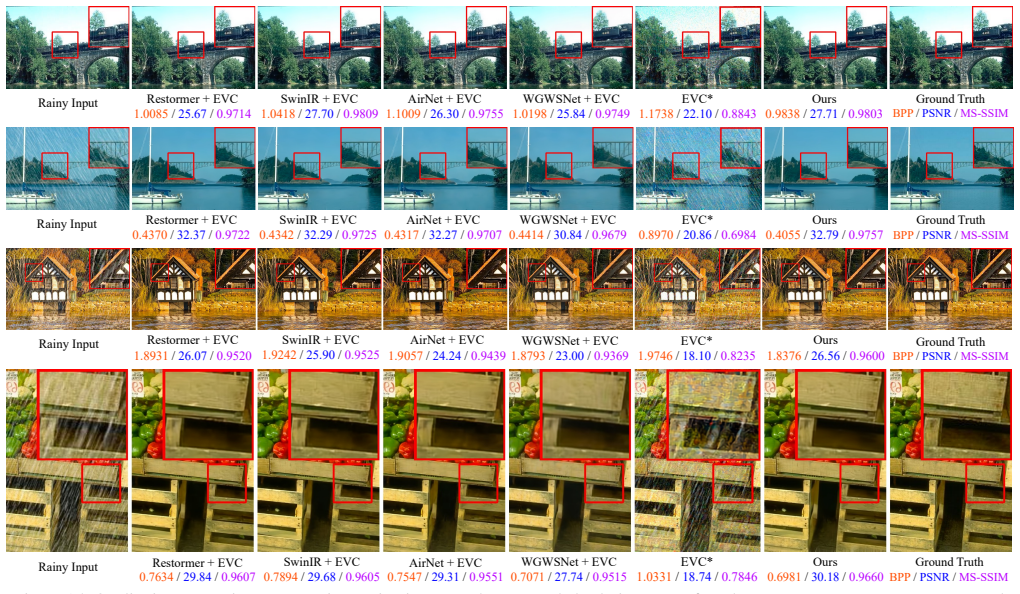


Reference graph
Works this paper leans on
-
[1]
Multi-realism image compression with a conditional generator
Eirikur Agustsson, David Minnen, George Toderici, and Fabian Mentzer. Multi-realism image compression with a conditional generator. In CVPR, pages 22324–22333, 2023. 2
work page 2023
-
[2]
Generative adversarial networks for extreme learned image compression
Eirikur Agustsson, Michael Tschannen, Fabian Mentzer, Radu Timofte, and Luc Van Gool. Generative adversarial networks for extreme learned image compression. In ICCV, pages 221–231, 2019. 2
work page 2019
-
[3]
Johannes Ball ´e, Valero Laparra, and Eero P. Simoncelli. End-to-end optimized image compression. In ICLR, 2017. 2
work page 2017
-
[4]
Variational image compression with a scale hyperprior
Johannes Ball ´e, David Minnen, Saurabh Singh, Sung Jin Hwang, and Nick Johnston. Variational image compression with a scale hyperprior. In ICLR, 2018. 2
work page 2018
-
[5]
Fabrice Bellard. Bpg image format. URL https://bellard. org/bpg, 1(2):1, 2015. 1
work page 2015
-
[6]
Overview of the versatile video coding (vvc) standard and its applications
Benjamin Bross, Ye-Kui Wang, Yan Ye, Shan Liu, Jianle Chen, Gary J Sullivan, and Jens-Rainer Ohm. Overview of the versatile video coding (vvc) standard and its applications. TCSVT, 31(10):3736–3764, 2021. 1
work page 2021
-
[7]
On the importance of denoising when learning to compress images
Benoit Brummer and Christophe De Vleeschouwer. On the importance of denoising when learning to compress images. In WACV, pages 2440–2448, 2023. 2
work page 2023
-
[8]
Make lossy compression meaningful for low-light images
Shilv Cai, Liqun Chen, Sheng Zhong, Luxin Yan, Jiahuan Zhou, and Xu Zou. Make lossy compression meaningful for low-light images. In AAAI, volume 38, pages 8236–8245,
Show all 79 references
-
[9]
Jointly optimizing image compression with low- light image enhancement
Shilv Cai, Xu Zou, Liqun Chen, Luxin Yan, and Sheng Zhong. Jointly optimizing image compression with low- light image enhancement. arXiv preprint arXiv:2305.15030,
-
[10]
Yolobile: Real- time object detection on mobile devices via compression- compilation co-design
Yuxuan Cai, Hongjia Li, Geng Yuan, Wei Niu, Yanyu Li, Xulong Tang, Bin Ren, and Yanzhi Wang. Yolobile: Real- time object detection on mobile devices via compression- compilation co-design. In AAAI, volume 35, pages 955–963,
-
[11]
All snow re- moved: Single image desnowing algorithm using hierarchi- cal dual-tree complex wavelet representation and contradict channel loss
Wei-Ting Chen, Hao-Yu Fang, Cheng-Lin Hsieh, Cheng-Che Tsai, I Chen, Jian-Jiun Ding, Sy-Yen Kuo, et al. All snow re- moved: Single image desnowing algorithm using hierarchi- cal dual-tree complex wavelet representation and contradict channel loss. In ICCV, pages 4196–4205, 2021. 5, 6
2021
-
[12]
Learning multiple adverse weather removal via two-stage knowledge learning and multi-contrastive regularization: Toward a uni- fied model
Wei-Ting Chen, Zhi-Kai Huang, Cheng-Che Tsai, Hao- Hsiang Yang, Jian-Jiun Ding, and Sy-Yen Kuo. Learning multiple adverse weather removal via two-stage knowledge learning and multi-contrastive regularization: Toward a uni- fied model. In CVPR, pages 17653–17662, 2022. 3, 5
2022
-
[13]
Learn- ing a sparse transformer network for effective image derain- ing
Xiang Chen, Hao Li, Mingqiang Li, and Jinshan Pan. Learn- ing a sparse transformer network for effective image derain- ing. In CVPR, pages 5896–5905, 2023. 2
2023
-
[14]
Transformer-based learned image com- pression for joint decoding and denoising
Yi-Hsin Chen, Kuan-Wei Ho, Shiau-Rung Tsai, Guan- Hsun Lin, Alessandro Gnutti, Wen-Hsiao Peng, and Ric- cardo Leonardi. Transformer-based learned image com- pression for joint decoding and denoising. arXiv preprint arXiv:2402.12888, 2024. 3
2024 arXiv
-
[15]
Optimiz- ing image compression via joint learning with denoising
Ka Leong Cheng, Yueqi Xie, and Qifeng Chen. Optimiz- ing image compression via joint learning with denoising. In ECCV, pages 56–73, 2022. 1, 2
2022
-
[16]
Learned image compression with discretized gaussian mixture likelihoods and attention modules
Zhengxue Cheng, Heming Sun, Masaru Takeuchi, and Jiro Katto. Learned image compression with discretized gaussian mixture likelihoods and attention modules. In CVPR, pages 7939–7948, 2020. 2
2020
-
[17]
Fast object detection in compressed jpeg images
Benjamin Deguerre, Cl ´ement Chatelain, and Gilles Gasso. Fast object detection in compressed jpeg images. In 2019 IEEE Intelligent Transportation Systems Conference (ITSC), pages 333–338, 2019. 1
2019
-
[18]
Cswin transformer: A general vision transformer backbone with cross-shaped windows
Xiaoyi Dong, Jianmin Bao, Dongdong Chen, Weiming Zhang, Nenghai Yu, Lu Yuan, Dong Chen, and Baining Guo. Cswin transformer: A general vision transformer backbone with cross-shaped windows. In CVPR, pages 12124–12134, June 2022. 5
2022
-
[19]
An image is worth 16x16 words: Trans- formers for image recognition at scale
Alexey Dosovitskiy, Lucas Beyer, Alexander Kolesnikov, Dirk Weissenborn, Xiaohua Zhai, Thomas Unterthiner, Mostafa Dehghani, Matthias Minderer, Georg Heigold, Syl- vain Gelly, et al. An image is worth 16x16 words: Trans- formers for image recognition at scale. arXiv preprint a...
2010 arXiv
-
[20]
Removing rain from single images via a deep detail network
Xueyang Fu, Jiabin Huang, Delu Zeng, Yue Huang, Xinghao Ding, and John Paisley. Removing rain from single images via a deep detail network. InCVPR, pages 3855–3863, 2017. 5, 6
2017
-
[21]
Joint denoising and decompression using cnn reg- ularization
Mario Gonzalez, Javier Preciozzi, Pablo Muse, and Andres Almansa. Joint denoising and decompression using cnn reg- ularization. In CVPRW, pages 2598–2601, 2018. 2
2018
-
[22]
Causal contextual prediction for learned image com- pression
Zongyu Guo, Zhizheng Zhang, Runsen Feng, and Zhibo Chen. Causal contextual prediction for learned image com- pression. TCSVT, 32(4):2329–2341, 2021. 2
2021
-
[23]
Evc: To- wards real-time neural image compression with mask decay
Wang Guo-Hua, Jiahao Li, Bin Li, and Yan Lu. Evc: To- wards real-time neural image compression with mask decay. In ICLR, 2023. 1, 2, 6, 4
2023
-
[24]
Elic: Efficient learned image compres- sion with unevenly grouped space-channel contextual adap- tive coding
Dailan He, Ziming Yang, Weikun Peng, Rui Ma, Hongwei Qin, and Yan Wang. Elic: Efficient learned image compres- sion with unevenly grouped space-channel contextual adap- tive coding. In CVPR, pages 5718–5727, 2022. 1
2022
-
[25]
Checkerboard context model for efficient learned image compression
Dailan He, Yaoyan Zheng, Baocheng Sun, Yan Wang, and Hongwei Qin. Checkerboard context model for efficient learned image compression. In CVPR, pages 14771–14780,
-
[26]
Conv2former: A simple transformer-style convnet for visual recognition
Qibin Hou, Cheng-Ze Lu, Ming-Ming Cheng, and Jiashi Feng. Conv2former: A simple transformer-style convnet for visual recognition. arXiv preprint arXiv:2211.11943, 2022. 5
2022 arXiv
-
[27]
Narv: An efficient noise-adaptive resnet vae for joint image compres- sion and denoising
Yuning Huang, Zhihao Duan, and Fengqing Zhu. Narv: An efficient noise-adaptive resnet vae for joint image compres- sion and denoising. In ICMEW, pages 188–193. IEEE, 2023. 3
2023
-
[28]
Context-based trit-plane coding for progressive im- age compression
Seungmin Jeon, Kwang Pyo Choi, Youngo Park, and Chang- Su Kim. Context-based trit-plane coding for progressive im- age compression. In CVPR, pages 14348–14357, 2023. 1
2023
-
[29]
Adam: A method for stochastic optimization
Diederik P Kingma and Jimmy Ba. Adam: A method for stochastic optimization. arXiv preprint arXiv:1412.6980 ,
-
[30]
Kodak lossless true color image suite (pho- tocd pcd0992)
Eastman Kodak. Kodak lossless true color image suite (pho- tocd pcd0992). URL http://r0k. us/graphics/kodak, 6, 1993. 5, 6, 7, 1, 2
1993
-
[31]
Con- textformer: A transformer with spatio-channel attention for context modeling in learned image compression
A Burakhan Koyuncu, Han Gao, Atanas Boev, Georgii Gaikov, Elena Alshina, and Eckehard Steinbach. Con- textformer: A transformer with spatio-channel attention for context modeling in learned image compression. In ECCV, pages 447–463, 2022. 2, 3
2022
-
[32]
Openimages: A public dataset for large-scale multi-label and multi-class im- age classification
Ivan Krasin, Tom Duerig, Neil Alldrin, Vittorio Ferrari, Sami Abu-El-Haija, Alina Kuznetsova, Hassan Rom, Jasper Ui- jlings, Stefan Popov, Andreas Veit, et al. Openimages: A public dataset for large-scale multi-label and multi-class im- age classification. Dataset available fr...
2017
-
[33]
All-in-one image restoration for unknown cor- ruption
Boyun Li, Xiao Liu, Peng Hu, Zhongqin Wu, Jiancheng Lv, and Xi Peng. All-in-one image restoration for unknown cor- ruption. In CVPR, pages 17452–17462, 2022. 2, 3, 5, 6
2022
-
[34]
Benchmarking single- image dehazing and beyond
Boyi Li, Wenqi Ren, Dengpan Fu, Dacheng Tao, Dan Feng, Wenjun Zeng, and Zhangyang Wang. Benchmarking single- image dehazing and beyond. TIP, 28(1):492–505, 2018. 5, 6, 7, 1, 4
2018
-
[35]
Toward dnn of luts: Learning efficient image restoration with multiple look-up tables
Jiacheng Li, Chang Chen, Zhen Cheng, and Zhiwei Xiong. Toward dnn of luts: Learning efficient image restoration with multiple look-up tables. TPAMI, 2024. 2
2024
-
[36]
Hybrid spatial-temporal en- tropy modelling for neural video compression
Jiahao Li, Bin Li, and Yan Lu. Hybrid spatial-temporal en- tropy modelling for neural video compression. InMM, pages 1503–1511, 2022. 4, 5
2022
-
[37]
Neural video compression with feature modulation
Jiahao Li, Bin Li, and Yan Lu. Neural video compression with feature modulation. In CVPR, pages 26099–26108,
-
[38]
All in one bad weather removal using architectural search
Ruoteng Li, Robby T Tan, and Loong-Fah Cheong. All in one bad weather removal using architectural search. In CVPR, pages 3175–3185, 2020. 2
2020
-
[39]
Effi- cient and explicit modelling of image hierarchies for image restoration
Yawei Li, Yuchen Fan, Xiaoyu Xiang, Denis Demandolx, Rakesh Ranjan, Radu Timofte, and Luc Van Gool. Effi- cient and explicit modelling of image hierarchies for image restoration. In CVPR, pages 18278–18289, 2023. 2
2023
-
[40]
Look-up table compression for efficient image restoration
Yinglong Li, Jiacheng Li, and Zhiwei Xiong. Look-up table compression for efficient image restoration. In CVPR, pages 26016–26025, June 2024. 2
2024
-
[41]
Swinir: Image restoration us- ing swin transformer
Jingyun Liang, Jiezhang Cao, Guolei Sun, Kai Zhang, Luc Van Gool, and Radu Timofte. Swinir: Image restoration us- ing swin transformer. In ICCV, pages 1833–1844, 2021. 2, 5
2021
-
[42]
Lossy compression with distribution shift as entropy con- strained optimal transport
Huan Liu, George Zhang, Jun Chen, and Ashish J Khisti. Lossy compression with distribution shift as entropy con- strained optimal transport. In ICLR, 2021. 2
2021
-
[43]
Learned image compression with mixed transformer-cnn architectures
Jinming Liu, Heming Sun, and Jiro Katto. Learned image compression with mixed transformer-cnn architectures. In CVPR, pages 14388–14397, 2023. 1, 2, 3
2023
-
[44]
Desnownet: Context-aware deep network for snow removal
Yun-Fu Liu, Da-Wei Jaw, Shih-Chia Huang, and Jenq-Neng Hwang. Desnownet: Context-aware deep network for snow removal. TIP, 27(6):3064–3073, 2018. 5
2018
-
[45]
Swin transformer: Hierarchical vision transformer using shifted windows
Ze Liu, Yutong Lin, Yue Cao, Han Hu, Yixuan Wei, Zheng Zhang, Stephen Lin, and Baining Guo. Swin transformer: Hierarchical vision transformer using shifted windows. In ICCV, pages 10012–10022, 2021. 5, 8, 4
2021
-
[46]
Sgdr: Stochas- tic gradient descent with warm restarts
Ilya Loshchilov and Frank Hutter. Sgdr: Stochas- tic gradient descent with warm restarts. arXiv preprint arXiv:1608.03983, 2016. 5
2016 arXiv
-
[47]
Joint autoregressive and hierarchical priors for learned im- age compression
David Minnen, Johannes Ball ´e, and George D Toderici. Joint autoregressive and hierarchical priors for learned im- age compression. NeurIPS, 31, 2018. 2
2018
-
[48]
Channel-wise autoregres- sive entropy models for learned image compression
David Minnen and Saurabh Singh. Channel-wise autoregres- sive entropy models for learned image compression. InICIP, pages 3339–3343. IEEE, 2020. 2
2020
-
[49]
Rotate to attend: Convolutional triplet at- tention module
Diganta Misra, Trikay Nalamada, Ajay Uppili Arasanipalai, and Qibin Hou. Rotate to attend: Convolutional triplet at- tention module. In WACV, pages 3139–3148, January 2021. 8
2021
-
[50]
All- in-one image restoration for unknown degradations using adaptive discriminative filters for specific degradations
Dongwon Park, Byung Hyun Lee, and Se Young Chun. All- in-one image restoration for unknown degradations using adaptive discriminative filters for specific degradations. In CVPR, pages 5815–5824. IEEE, 2023. 2, 3, 5
2023
-
[51]
Promptir: Prompting for all-in-one blind image restoration
Vaishnav Potlapalli, Syed Waqas Zamir, Salman Khan, and Fahad Shahbaz Khan. Promptir: Prompting for all-in-one blind image restoration. arXiv preprint arXiv:2306.13090 ,
-
[52]
Joint denoising and decompression: A patch- based bayesian approach
Javier Preciozzi, Mario Gonz ´alez, Andr ´es Almansa, and Pablo Mus´e. Joint denoising and decompression: A patch- based bayesian approach. In ICIP, pages 1252–1256, 2017. 2
2017
-
[53]
Entroformer: A transformer-based entropy model for learned image compression
Yichen Qian, Xiuyu Sun, Ming Lin, Zhiyu Tan, and Rong Jin. Entroformer: A transformer-based entropy model for learned image compression. In ICLR, 2022. 2, 3
2022
-
[54]
An advanced lidar point cloud sequence cod- ing scheme for autonomous driving
Xuebin Sun, Sukai Wang, Miaohui Wang, Shing Shin Cheng, and Ming Liu. An advanced lidar point cloud sequence cod- ing scheme for autonomous driving. In MM, pages 2793– 2801, 2020. 1
2020
-
[55]
Jpeg2000: Image compression fundamentals, standards and practice
David S Taubman, Michael W Marcellin, and Majid Rabbani. Jpeg2000: Image compression fundamentals, standards and practice. Journal of Electronic Imaging , 11(2):286–287, 2002. 1
2002
-
[56]
Training data-efficient image transformers & distillation through at- tention
Hugo Touvron, Matthieu Cord, Matthijs Douze, Francisco Massa, Alexandre Sablayrolles, and Herv ´e J´egou. Training data-efficient image transformers & distillation through at- tention. In ICML, pages 10347–10357, 2021. 5
2021
-
[57]
Transweather: Transformer-based restoration of im- ages degraded by adverse weather conditions
Jeya Maria Jose Valanarasu, Rajeev Yasarla, and Vishal M Patel. Transweather: Transformer-based restoration of im- ages degraded by adverse weather conditions. In CVPR, pages 2353–2363, 2022. 2
2022
-
[58]
The jpeg still picture compression stan- dard
Gregory K Wallace. The jpeg still picture compression stan- dard. Communications of the ACM, 34(4):30–44, 1991. 1
1991
-
[59]
Fast object detection in compressed video
Shiyao Wang, Hongchao Lu, and Zhidong Deng. Fast object detection in compressed video. In ICCV, pages 7104–7113,
-
[60]
Spatial attentive single-image deraining with a high quality real rain dataset
Tianyu Wang, Xin Yang, Ke Xu, Shaozhe Chen, Qiang Zhang, and Rynson WH Lau. Spatial attentive single-image deraining with a high quality real rain dataset. In CVPR, pages 12270–12279, 2019. 5
2019
-
[61]
Semantic-aware video compression for automotive cameras
Yiting Wang, Pak Hung Chan, and Valentina Donzella. Semantic-aware video compression for automotive cameras. IEEE Transactions on Intelligent Vehicles, 8(6):3712–3722,
-
[62]
Uformer: A gen- eral u-shaped transformer for image restoration
Zhendong Wang, Xiaodong Cun, Jianmin Bao, Wengang Zhou, Jianzhuang Liu, and Houqiang Li. Uformer: A gen- eral u-shaped transformer for image restoration. In CVPR, pages 17683–17693, 2022. 2
2022
-
[63]
Cbam: Convolutional block attention module
Sanghyun Woo, Jongchan Park, Joon-Young Lee, and In So Kweon. Cbam: Convolutional block attention module. In ECCV, pages 3–19, 2018. 8
2018
-
[64]
Robust web im- age/video super-resolution
Zhiwei Xiong, Xiaoyan Sun, and Feng Wu. Robust web im- age/video super-resolution. TIP, 19(8):2017–2028, 2010. 2
2017
-
[65]
Depth anything: Unleash- ing the power of large-scale unlabeled data
Lihe Yang, Bingyi Kang, Zilong Huang, Xiaogang Xu, Ji- ashi Feng, and Hengshuang Zhao. Depth anything: Unleash- ing the power of large-scale unlabeled data. arXiv preprint arXiv:2401.10891, 2024. 4
2024 arXiv
-
[66]
Visual recognition-driven image restoration for multiple degradation with intrinsic se- mantics recovery
Zizheng Yang, Jie Huang, Jiahao Chang, Man Zhou, Hu Yu, Jinghao Zhang, and Feng Zhao. Visual recognition-driven image restoration for multiple degradation with intrinsic se- mantics recovery. In CVPR, pages 14059–14070, 2023. 1
2023
-
[67]
Neural degradation representation learning for all-in-one image restoration
Mingde Yao, Ruikang Xu, Yuanshen Guan, Jie Huang, and Zhiwei Xiong. Neural degradation representation learning for all-in-one image restoration. TIP, 2024. 2, 3
2024
-
[68]
Accelir: Task-aware image compression for accelerating neural restoration
Juncheol Ye, Hyunho Yeo, Jinwoo Park, and Dongsu Han. Accelir: Task-aware image compression for accelerating neural restoration. In CVPR, pages 18216–18226, 2023. 2
2023
-
[69]
Restormer: Efficient transformer for high-resolution image restoration
Syed Waqas Zamir, Aditya Arora, Salman Khan, Mu- nawar Hayat, Fahad Shahbaz Khan, and Ming-Hsuan Yang. Restormer: Efficient transformer for high-resolution image restoration. In CVPR, pages 5728–5739, 2022. 2, 4, 5, 6, 8, 3
2022
-
[70]
Learning to restore hazy video: A new real-world dataset and a new method
Xinyi Zhang, Hang Dong, Jinshan Pan, Chao Zhu, Ying Tai, Chengjie Wang, Jilin Li, Feiyue Huang, and Fei Wang. Learning to restore hazy video: A new real-world dataset and a new method. In CVPR, pages 9239–9248, 2021. 5
2021
-
[71]
Learn- ing weather-general and weather-specific features for image restoration under multiple adverse weather conditions
Yurui Zhu, Tianyu Wang, Xueyang Fu, Xuanyu Yang, Xin Guo, Jifeng Dai, Yu Qiao, and Xiaowei Hu. Learn- ing weather-general and weather-specific features for image restoration under multiple adverse weather conditions. In CVPR, pages 21747–21758, 2023. 3, 5
2023
-
[72]
Transformer- based transform coding
Yinhao Zhu, Yang Yang, and Taco Cohen. Transformer- based transform coding. In ICLR, 2021. 2, 3
2021
-
[73]
The devil is in the details: Window-based attention for image compression
Renjie Zou, Chunfeng Song, and Zhaoxiang Zhang. The devil is in the details: Window-based attention for image compression. In CVPR, pages 17492–17501, 2022. 2, 3 11 All-in-One Image Compression and Restoration Supplementary Material This supplementary document is organized as ...
2022
-
[74]
Sec.” for sections, “Tab
Rate-Distortion Performance Gaussian noise degradation setting. The RD perfor- mance on the noisy Kodak dataset [30] is reported in Fig- ure 12, where the inputs are degraded by both seen ( i.e., σ = 15, 25, 50) and unseen ( i.e., σ = 35, 45, 55) Gaus- sian noise. We evaluate ...
-
[75]
Ablation Studies We construct a baseline model with the number of groups Ng = 4in Sec. 4.5. In this section, we investigate the rationality of such a configuration, and further demon- strate the effectiveness of the adopted progressive training strategy. All ablation studies a...
-
[76]
Synthetic Weather-degraded Images We provide qualitative comparisons on synthetic hazy, snowy and rainy images in Figure 13, Figure 14 and Fig- ure 15, respectively
Qualitative Comparisons 8.1. Synthetic Weather-degraded Images We provide qualitative comparisons on synthetic hazy, snowy and rainy images in Figure 13, Figure 14 and Fig- ure 15, respectively. For each image, we provide the quan- titative metrics of BPP, PSNR and MS-SSIM. As...
-
[77]
Sequence of Cascaded Solutions For the cascaded solutions, we further discuss the sequence of image restoration and image compres- sion, denoted as restoration+compression and compres- sion+restoration, respectively. We adopt Restormer [69] 3 Rainy Input AirNet + EVC1.1009/ 26...
-
[78]
Real-world Applications In this section, we devote the compressed results to mul- tiple downstream tasks, i.e., Object Detection (OD) and Monocular Depth Estimation (MDE), to evaluate the po- tential of the proposed method in real applications (e.g., au- tonomous driving). We ...
-
[79]
Network Architecture Each stage in the encoder and decoder consists of 4 hybrid-attention transformer blocks
Experimental Settings 11.1. Network Architecture Each stage in the encoder and decoder consists of 4 hybrid-attention transformer blocks. The number of groups Ng in channel-wise group attention (C-GA) is set to 4. For the spatially decoupled attention (S-DA), we set the ker- n...
Reviewed August 9, 2026 · model on record in the stance chip above.
Discussion (0). Continue with ORCID to comment.