REVIEW 3 major objections 3 minor 1 cited by
Dynamic Rank Adjustment in Diffusion Policies for Efficient and Flexible Training
T0 review · 3 major / 3 minor · reviewed 2026-08-09 · deepseek-v4-flash
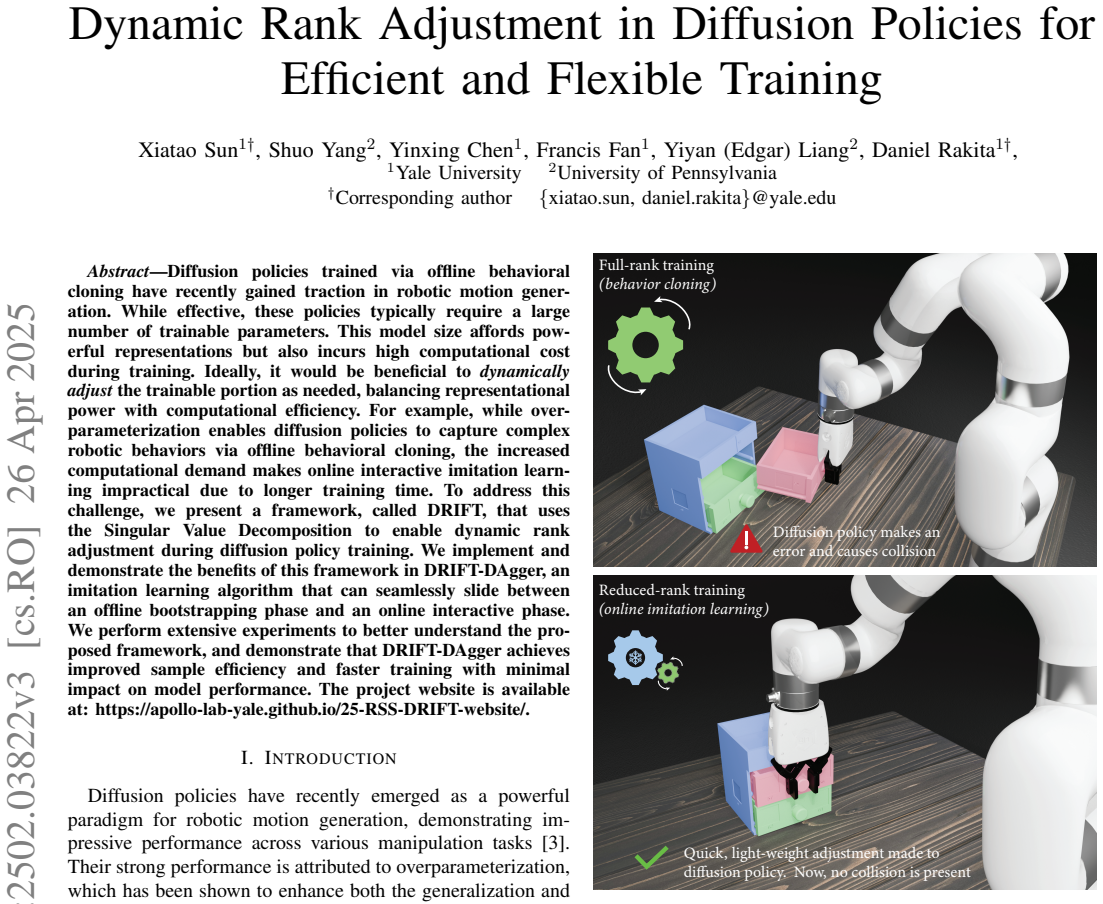
Pith's one-line read This paper claims that dynamically freezing low-significance SVD ranks of a diffusion policy's weight matrices cuts batch training time by roughly 11% overall and 18% in the online stage while keeping success at the full-rank level…
desk verdict A genuinely new mechanism for dynamic low-rank diffusion policy training, but the 'minimal impact' claim rests on single-seed point estimates that can't yet support non-inferiority. read the letter →
The pith
A machine-rendered reading of the paper's core claim, the machinery that carries it, and where it could break.
The reading
What carries the argument
The two components carrying the argument are rank modulation and rank scheduler. Rank modulation uses the singular value decomposition of each reshaped convolution weight to partition the matrix into a trainable block and a frozen block that stores the low-significance singular directions; the scheduler is a decay function (linear, cosine, sigmoid, or exponential) that lowers the number of trainable ranks from a maximum to a terminal value over training. The frozen block keeps the forward pass identical to a standard convolution while shrinking the gradient computation, and the full SVD is recomputed only at epoch boundaries when the rank changes, deliberately skipping per-step re-orthonormalization to save time.
What would settle it
An experiment that would settle the minimal-impact claim: train DRIFT-DAgger on the same task with the same rank schedule but replace the frozen subspace with a randomly chosen fixed orthonormal subspace of the same rank. If success still matches full-rank training, the specific choice of which directions to freeze is irrelevant; if success falls, the claim depends on freezing genuinely low-signal directions and on those directions staying low-signal between SVD recomputations.
Extended reading notes
Core claim
The paper's central claim is that a diffusion policy trained from scratch can tolerate a dynamically shrinking trainable rank. At each rank change, the weight matrix $W$ of every convolutional block is refactored as $W = U \Sigma V^{T}$, then split so that $W_{\mathrm{train}} = U_{\mathrm{train}} \Sigma_{\mathrm{train}} V_{\mathrm{train}}^{T}$ receives gradients while $W_{\mathrm{frozen}} = U_{\mathrm{frozen}} \Sigma_{\mathrm{frozen}} V_{\mathrm{frozen}}^{T}$ stays fixed; the frozen block holds the smaller singular values, and the full $W$ is still used in a single convolution in the forward pass. The paper reports that with a sigmoid decay schedule ending at rank 256, this scheme reaches the same success rate as full-rank training on several simulated and real manipulation tasks, while cutting batch training time and expert label counts. It also reports that schedules that cut ranks too aggressively, or adapter-based low-rank methods that must merge and re-inject new parameters whenever the rank changes, degrade performance or destabilize training.
Load-bearing premise
The load-bearing assumption is that the directions left frozen after each rank change remain genuinely low-significance until the next SVD, even though gradient updates to the trainable part break the orthonormality of the decomposition, so the frozen block is no longer exactly the low-signal subspace it was chosen as.
Editorial extensions
If this is right
- Per-batch training time drops roughly 11% across all stages and about 18% during online adaptation on the pick-and-place task, with success rate held at 1.0.
- Expert-in-the-loop updates become fast enough that interactive imitation learning with diffusion policies is practical, and requires fewer expert labels than offline behavior cloning at the same success level.
- The rank schedule matters: sigmoid decay with a terminal rank of 256 preserves performance, while aggressive exponential decay and terminal ranks near 64 cause success to fall.
- Repeatedly merging and re-injecting new low-rank adapter parameters destabilizes training; recomputing the SVD at rank changes avoids that instability.
- Reduced-rank training from scratch needs substantially more trainable ranks than fine-tuning adapters, so small fixed adapters do not suffice for policies trained from scratch.
Reading between the lines
- Beyond the paper: the same SVD rank-modulation idea could be applied to online reinforcement learning with large policies, since DRIFT itself is demonstrated only within imitation learning.
- Beyond the paper: replacing the fixed monotonic decay schedule with an adaptive rank policy that monitors gradient energy or validation loss could yield further speedups or reduce the task-dependence the authors acknowledge.
- Beyond the paper: the 18% training-time figure is measured on U-Net diffusion policies; transformer-based action generators may need a different grouping of ranks when reshaping weight matrices, so the speedup should not be assumed to transfer unchanged.
Editorial analysis
A structured set of objections, weighed in public.
Referee Report
Summary. The paper proposes DRIFT, a framework for training diffusion policies from scratch with a dynamically adjustable number of trainable ranks. Each weight matrix is decomposed via SVD into trainable and frozen components, and a rank scheduler reduces the trainable rank over training according to a decay function. The authors instantiate this as DRIFT-DAgger, which combines DRIFT with HG-DAgger-style expert gating, and evaluate it on four simulated and three real-world manipulation tasks. They report reduced batch training time and reduced expert-label counts relative to BC, with success rates close to the full-rank HG-DAgger baseline, together with ablations on decay functions, terminal ranks, and LoRA-based variants.
Significance. If the central claim holds, the contribution is practically valuable: it provides a simple mechanism for making online interactive imitation learning with large diffusion policies more tractable, and the authors release an open-source implementation. The SVD-based rank partition is conceptually clean, the forward-pass cost remains constant while the backward pass is reduced, and the empirical scope is substantial, covering four simulation tasks, three real-world tasks, and several ablations. The main weakness is that the non-inferiority claim rests on single-seed success-rate point estimates without error bars or repeated runs, which leaves the central claim statistically underdetermined. The open-source code is a strength that supports reproducibility.
major comments (3)
- [Section VI-C, Tables IV and VI] The central claim of 'minimal impact on model performance' is underdetermined because all success rates are single-run point estimates. With 50 evaluation rollouts in simulation, the binomial standard error near success 0.9 is about 0.04, and with 30 real-world rollouts it is about 0.08. Differences such as Can 0.92 vs HG 0.96 (Table IV), Drawer Assembling 0.73 vs HG 0.77 (Table VI), and Drawer Interaction 0.93 vs 0.90 (Table VI) are within one standard error. The paper reports no seeds, confidence intervals, or paired comparisons, so a true 5-10 point performance drop would not be detectable. Please report multiple seeds (at least 3-5) with confidence intervals or paired statistical tests, or explicitly qualify the non-inferiority claim.
- [Abstract and Section VI-C] The claim of improved sample efficiency is not consistently supported relative to HG-DAgger. In Table IV, D(RR) uses more expert labels than HG on Can (NEL 3.34 vs 3.15), and in Table VI it uses more labels on Block Stacking (4.25 vs 4.22) and Drawer Interaction (4.08 vs 3.94). The advantage over BC is clear, but the advantage over the full-rank interactive baseline is mixed. Please either qualify the sample-efficiency claim or provide statistical evidence that the observed differences are not noise.
- [Section IV-B and Section VI-D] It is unclear whether the reported mean batch training time (MBT) and cumulative training time (CT) include the cost of the full SVD recomputation performed at the start of an epoch whenever the rank changes. Since the paper deliberately avoids per-step QR decomposition for cost reasons, the SVD overhead may be non-negligible and should be reported separately. Please specify exactly what is included in MBT and CT, and report the total time spent on SVD per epoch, so that the claimed training-time reductions can be assessed independently of this overhead.
minor comments (3)
- [Section IV-B] The statement that 'Σfrozen holds smaller singular values than Σtrain' is only guaranteed at the moment of the SVD repartition. After gradient updates to Utrain and Vtrain, the factorization is no longer an exact SVD. It would help to state explicitly that Wtrain has rank at most r by construction and that Wfrozen behaves as a fixed matrix, since this addresses the natural concern about the frozen subspace drifting from its original significance.
- [Appendix IX-A and Table VIII] There are small typographical errors: 'DIRFT-DAgger' should be 'DRIFT-DAgger' in the appendix text, and 'SSummary' should be 'Summary' in the Table VIII caption.
- [Section VI-A] The definition of 'mean batch training time per epoch' is ambiguous; it would be helpful to state whether it is wall-clock time averaged over the batches in an epoch and whether it includes the rank-change SVD computation.
Circularity Check
No significant circularity: the SVD rank-modulation construction is mathematical, and the central efficiency and performance claims are measured against external baselines and benchmarks rather than derived from fitted inputs.
full rationale
The paper's derivation chain is self-contained. Rank modulation (Section IV-B) is a direct SVD construction: W = Wtrain + Wfrozen with Wtrain = Utrain * Sigma_train * Vtrain^T, and the backward-pass cost reduction follows from the construction because only the rank-r block receives gradients, while the forward pass uses the full reconstructed weight. No equation in the paper reduces a claimed prediction to a fitted value. The central claims—faster batch training time, improved sample efficiency, and minimal performance impact—are empirical measurements reported against external baselines (BC and HG-DAgger from Kelly et al., which the paper does not author) on robosuite (an external benchmark), the authors' own MVS tasks, and newly collected real-world tasks. Hyperparameters such as rmin=256 and the sigmoid decay (tau=0.5) are selected by ablation on the MVS Pick-and-Place task and then applied uniformly; this is hyperparameter selection, and the paper explicitly acknowledges in Section VIII-A that these choices are 'likely task-dependent,' so the performance outcomes are not forced by construction. The appendix rmin sweep on the Microwave task provides corroboration outside the tuned task. The self-citations that exist (Mega-DAgger [40], racing benchmark [41], MVS state-action spaces [42]) are used for background context and as a benchmark source; they are not invoked to justify the method's design, to forbid alternatives, or to supply a uniqueness or ansatz result. In particular, no load-bearing premise reduces to a self-citation: the MVS benchmark results could have contradicted the authors' claims, and the external robosuite and real-world results support the same conclusions. The reader's orthonormality concern (frozen U/V drift after gradient steps) is a genuine robustness risk, not a circularity: even if the decomposition is no longer an exact SVD after one update, Wtrain has rank at most r by construction and the performance question is empirical. Overall, the paper is self-contained against external comparisons, and no circular step can be exhibited from its own equations or self-citation chain.
Assumptions & free parameters
free parameters (3)
- terminal trainable rank rmin =
256
- sigmoid decay steepness tau =
0.5
- expert intervention cosine thresholds =
0.94, 0.95, 0.99, 0.99 (simulation tasks)
assumptions (5)
- standard math Existence and properties of the singular value decomposition for real matrices.
- domain assumption The SVD partition into trainable and frozen singular subspaces is an effective parameterization for gradient-based training from scratch.
- domain assumption Frozen singular components may remain fixed between rank changes without per-step reorthonormalization.
- domain assumption All convolutional blocks in the U-Net share the same trainable rank r.
- domain assumption Monotonic rank decay during training will not destroy behavior learned at higher ranks.
Cite this review
Pith. "Pith review of Dynamic Rank Adjustment in Diffusion Policies for Efficient and Flexible Training." pith.science (2026). https://pith.science/paper/LNFE4NJY
@misc{pith2026250203822,
  author       = {Pith},
  title        = {Pith review of: Dynamic Rank Adjustment in Diffusion Policies for Efficient and Flexible Training},
  year         = {2026},
  howpublished = {\url{https://pith.science/paper/LNFE4NJY}},
  note         = {Machine review of arXiv:2502.03822}
}
read the original abstract
Diffusion policies trained via offline behavioral cloning have recently gained traction in robotic motion generation. While effective, these policies typically require a large number of trainable parameters. This model size affords powerful representations but also incurs high computational cost during training. Ideally, it would be beneficial to dynamically adjust the trainable portion as needed, balancing representational power with computational efficiency. For example, while overparameterization enables diffusion policies to capture complex robotic behaviors via offline behavioral cloning, the increased computational demand makes online interactive imitation learning impractical due to longer training time. To address this challenge, we present a framework, called DRIFT, that uses the Singular Value Decomposition to enable dynamic rank adjustment during diffusion policy training. We implement and demonstrate the benefits of this framework in DRIFT-DAgger, an imitation learning algorithm that can seamlessly slide between an offline bootstrapping phase and an online interactive phase. We perform extensive experiments to better understand the proposed framework, and demonstrate that DRIFT-DAgger achieves improved sample efficiency and faster training with minimal impact on model performance. The project website is available at: https://apollo-lab-yale.github.io/25-RSS-DRIFT-website/.
Figures


Figures from the paper (7 more)


Forward citations
Cited by 1 Pith paper
-
Artificial Foveated Perception for Mitigating Shortcut Learning in Robotic Foundation Models
Task-conditioned foveated masks used as auxiliary attention loss during fine-tuning substantially raise OOD success of robotic foundation models by aligning policy attention to action-critical regions.
Reference graph
Works this paper leans on
-
[1]
Intrinsic dimensionality explains the effective- ness of language model fine-tuning
Armen Aghajanyan, Luke Zettlemoyer, and Sonal Gupta. Intrinsic dimensionality explains the effective- ness of language model fine-tuning. arXiv preprint arXiv:2012.13255, 2020
arXiv 2012
-
[2]
Vision-based trajectory planning via imitation learning for autonomous vehicles
Peide Cai, Yuxiang Sun, Yuying Chen, and Ming Liu. Vision-based trajectory planning via imitation learning for autonomous vehicles. In 2019 IEEE Intelligent Transportation Systems Conference (ITSC), pages 2736–
work page 2019
-
[3]
Diffusion policy: Visuomotor policy learning via action diffusion
Cheng Chi, Zhenjia Xu, Siyuan Feng, Eric Cousineau, Yilun Du, Benjamin Burchfiel, Russ Tedrake, and Shuran Song. Diffusion policy: Visuomotor policy learning via action diffusion. The International Journal of Robotics Research, page 02783649241273668, 2023
2023
-
[4]
Directly fine-tuning diffusion models on differen- tiable rewards
Kevin Clark, Paul Vicol, Kevin Swersky, and David J Fleet. Directly fine-tuning diffusion models on differen- tiable rewards. arXiv preprint arXiv:2309.17400 , 2023
arXiv 2023
-
[5]
Yehuda Dar, Vidya Muthukumar, and Richard G Bara- niuk. A farewell to the bias-variance tradeoff? an overview of the theory of overparameterized machine learning. arXiv preprint arXiv:2109.02355 , 2021
arXiv 2021
-
[6]
Qlora: efficient finetuning of quan- tized llms (2023)
Tim Dettmers, Artidoro Pagnoni, Ari Holtzman, and Luke Zettlemoyer. Qlora: efficient finetuning of quan- tized llms (2023). arXiv preprint arXiv:2305.14314 , 52: 3982–3992, 2023
arXiv 2023
-
[7]
On the power of over- parametrization in neural networks with quadratic acti- vation
Simon Du and Jason Lee. On the power of over- parametrization in neural networks with quadratic acti- vation. In International conference on machine learning, pages 1329–1338. PMLR, 2018
work page 2018
-
[8]
Soft actor-critic algorithms and applications
Tuomas Haarnoja, Aurick Zhou, Kristian Hartikainen, George Tucker, Sehoon Ha, Jie Tan, Vikash Kumar, Henry Zhu, Abhishek Gupta, Pieter Abbeel, et al. Soft actor-critic algorithms and applications. arXiv preprint arXiv:1812.05905, 2018
arXiv 2018
Show all 54 references
-
[9]
Furniturebench: Reproducible real-world bench- mark for long-horizon complex manipulation
Minho Heo, Youngwoon Lee, Doohyun Lee, and Joseph J Lim. Furniturebench: Reproducible real-world bench- mark for long-horizon complex manipulation. arXiv preprint arXiv:2305.12821, 2023
2023 arXiv
-
[10]
Denoising diffusion probabilistic models
Jonathan Ho, Ajay Jain, and Pieter Abbeel. Denoising diffusion probabilistic models. Advances in neural infor- mation processing systems , 33:6840–6851, 2020
2020
-
[11]
Thriftydagger: Budget-aware novelty and risk gating for interactive imitation learning
Ryan Hoque, Ashwin Balakrishna, Ellen Novoseller, Albert Wilcox, Daniel S Brown, and Ken Goldberg. Thriftydagger: Budget-aware novelty and risk gating for interactive imitation learning. arXiv preprint arXiv:2109.08273, 2021
2021 arXiv
-
[12]
Lazydagger: Reducing context switching in interactive imitation learning
Ryan Hoque, Ashwin Balakrishna, Carl Putterman, Michael Luo, Daniel S Brown, Daniel Seita, Bri- jen Thananjeyan, Ellen Novoseller, and Ken Goldberg. Lazydagger: Reducing context switching in interactive imitation learning. In 2021 IEEE 17th international con- ference on automa...
2021
-
[13]
Lora: Low-rank adaptation of large language models
Edward J Hu, Phillip Wallis, Zeyuan Allen-Zhu, Yuanzhi Li, Shean Wang, Lu Wang, Weizhu Chen, et al. Lora: Low-rank adaptation of large language models. In International Conference on Learning Representations
-
[14]
Real-time obstacle avoidance in robotic manipulation using imitation learn- ing
Jie Huang, Wei Ge, Hualong Cheng, Chun Xi, Jun Zhu, Fei Zhang, and Weiwei Shang. Real-time obstacle avoidance in robotic manipulation using imitation learn- ing. In 2020 16th International Conference on Control, Automation, Robotics and Vision (ICARCV) , pages 976–
2020
-
[15]
A geometric perspective on visual imitation learning
Jun Jin, Laura Petrich, Masood Dehghan, and Martin Jagersand. A geometric perspective on visual imitation learning. In 2020 IEEE/RSJ International Conference on Intelligent Robots and Systems (IROS), pages 5194–5200. IEEE, 2020
2020
-
[16]
Scal- ing laws for neural language models
Jared Kaplan, Sam McCandlish, Tom Henighan, Tom B Brown, Benjamin Chess, Rewon Child, Scott Gray, Alec Radford, Jeffrey Wu, and Dario Amodei. Scal- ing laws for neural language models. arXiv preprint arXiv:2001.08361, 2020
2001 arXiv
-
[18]
Hg-dagger: Inter- active imitation learning with human experts
Michael Kelly, Chelsea Sidrane, Katherine Driggs- Campbell, and Mykel J Kochenderfer. Hg-dagger: Inter- active imitation learning with human experts. In 2019 International Conference on Robotics and Automation (ICRA), pages 8077–8083. IEEE, 2019
2019
-
[19]
Adam: A method for stochastic optimization
Diederik P Kingma. Adam: A method for stochastic optimization. arXiv preprint arXiv:1412.6980 , 2014
2014 arXiv
-
[20]
Dynamical low-rank approximation
Othmar Koch and Christian Lubich. Dynamical low-rank approximation. SIAM Journal on Matrix Analysis and Applications, 29(2):434–454, 2007
2007
-
[21]
Imagenet classification with deep convolutional neural networks
Alex Krizhevsky, Ilya Sutskever, and Geoffrey E Hinton. Imagenet classification with deep convolutional neural networks. Advances in neural information processing systems, 25, 2012
2012
-
[22]
Beyond pick-and- place: Tackling robotic stacking of diverse shapes
Alex X Lee, Coline Manon Devin, Yuxiang Zhou, Thomas Lampe, Konstantinos Bousmalis, Jost Tobias Springenberg, Arunkumar Byravan, Abbas Abdolmaleki, Nimrod Gileadi, David Khosid, et al. Beyond pick-and- place: Tackling robotic stacking of diverse shapes. In 5th Annual Conferenc...
2021
-
[23]
Diff-dagger: Un- certainty estimation with diffusion policy for robotic manipulation
Sung-Wook Lee and Yen-Ling Kuo. Diff-dagger: Un- certainty estimation with diffusion policy for robotic manipulation. arXiv preprint arXiv:2410.14868 , 2024
2024 arXiv
-
[24]
Measuring the intrinsic dimension of objective landscapes
Chunyuan Li, Heerad Farkhoor, Rosanne Liu, and Jason Yosinski. Measuring the intrinsic dimension of objective landscapes. arXiv preprint arXiv:1804.08838 , 2018
2018 arXiv
-
[25]
Recov- ery guarantee of weighted low-rank approximation via alternating minimization
Yuanzhi Li, Yingyu Liang, and Andrej Risteski. Recov- ery guarantee of weighted low-rank approximation via alternating minimization. In International Conference on Machine Learning, pages 2358–2367. PMLR, 2016
2016
-
[26]
Al- gorithmic regularization in over-parameterized matrix sensing and neural networks with quadratic activations
Yuanzhi Li, Tengyu Ma, and Hongyang Zhang. Al- gorithmic regularization in over-parameterized matrix sensing and neural networks with quadratic activations. In Conference On Learning Theory , pages 2–47. PMLR, 2018
2018
-
[27]
Dora: Weight-decomposed low- rank adaptation
Shih-Yang Liu, Chien-Yi Wang, Hongxu Yin, Pavlo Molchanov, Yu-Chiang Frank Wang, Kwang-Ting Cheng, and Min-Hung Chen. Dora: Weight-decomposed low- rank adaptation. arXiv preprint arXiv:2402.09353, 2024
2024 arXiv
-
[28]
Learning high-speed flight in the wild
Antonio Loquercio, Elia Kaufmann, Ren ´e Ranftl, Matthias M ¨uller, Vladlen Koltun, and Davide Scara- muzza. Learning high-speed flight in the wild. Science Robotics, 6(59):eabg5810, 2021
2021
-
[29]
What matters in learning from offline human demonstra- tions for robot manipulation
Ajay Mandlekar, Danfei Xu, Josiah Wong, Soroush Nasiriany, Chen Wang, Rohun Kulkarni, Li Fei-Fei, Silvio Savarese, Yuke Zhu, and Roberto Mart ´ın-Mart´ın. What matters in learning from offline human demonstra- tions for robot manipulation. In 5th Annual Conference on Robot Lea...
2021
-
[30]
Pytorch: An imperative style, high-performance deep learning library
Adam Paszke, Sam Gross, Francisco Massa, Adam Lerer, James Bradbury, Gregory Chanan, Trevor Killeen, Zem- ing Lin, Natalia Gimelshein, Luca Antiga, et al. Pytorch: An imperative style, high-performance deep learning library. Advances in neural information processing systems, 32, 2019
2019
-
[31]
Consistency policy: Accelerated visuomotor policies via consistency distillation
Aaditya Prasad, Kevin Lin, Jimmy Wu, Linqi Zhou, and Jeannette Bohg. Consistency policy: Accelerated visuomotor policies via consistency distillation. arXiv preprint arXiv:2405.07503, 2024
2024 arXiv
-
[32]
High-resolution image synthesis with latent diffusion models
Robin Rombach, Andreas Blattmann, Dominik Lorenz, Patrick Esser, and Bj ¨orn Ommer. High-resolution image synthesis with latent diffusion models. In Proceedings of the IEEE/CVF conference on computer vision and pattern recognition, pages 10684–10695, 2022
2022
-
[33]
U- net: Convolutional networks for biomedical image seg- mentation
Olaf Ronneberger, Philipp Fischer, and Thomas Brox. U- net: Convolutional networks for biomedical image seg- mentation. In Medical image computing and computer- assisted intervention–MICCAI 2015: 18th international conference, Munich, Germany, October 5-9, 2015, pro- ceedings,...
2015
-
[34]
A reduction of imitation learning and structured prediction to no-regret online learning
St ´ephane Ross, Geoffrey Gordon, and Drew Bagnell. A reduction of imitation learning and structured prediction to no-regret online learning. In Proceedings of the fourteenth international conference on artificial intelli- gence and statistics , pages 627–635. JMLR Workshop an...
2011
-
[35]
Proximal policy optimization algorithms
John Schulman, Filip Wolski, Prafulla Dhariwal, Alec Radford, and Oleg Klimov. Proximal policy optimization algorithms. arXiv preprint arXiv:1707.06347 , 2017
2017 arXiv
-
[36]
Denoising diffusion implicit models
Jiaming Song, Chenlin Meng, and Stefano Ermon. Denoising diffusion implicit models. arXiv preprint arXiv:2010.02502, 2020
2010 arXiv
-
[37]
Feedback in imitation learning: The three regimes of covariate shift
Jonathan Spencer, Sanjiban Choudhury, Arun Venkatra- man, Brian Ziebart, and J Andrew Bagnell. Feedback in imitation learning: The three regimes of covariate shift. arXiv preprint arXiv:2102.02872 , 2021
2021 arXiv
-
[38]
Nomad: Goal masked diffusion policies for navigation and exploration
Ajay Sridhar, Dhruv Shah, Catherine Glossop, and Sergey Levine. Nomad: Goal masked diffusion policies for navigation and exploration. In 2024 IEEE Interna- tional Conference on Robotics and Automation (ICRA) , pages 63–70. IEEE, 2024
2024
-
[39]
Introduction to linear algebra
Gilbert Strang. Introduction to linear algebra . SIAM, 2022
2022
-
[40]
Mega-dagger: Imitation learn- ing with multiple imperfect experts
Xiatao Sun, Shuo Yang, Mingyan Zhou, Kunpeng Liu, and Rahul Mangharam. Mega-dagger: Imitation learn- ing with multiple imperfect experts. arXiv preprint arXiv:2303.00638, 2023
2023 arXiv
-
[41]
A benchmark comparison of imitation learning-based control policies for autonomous racing
Xiatao Sun, Mingyan Zhou, Zhijun Zhuang, Shuo Yang, Johannes Betz, and Rahul Mangharam. A benchmark comparison of imitation learning-based control policies for autonomous racing. In 2023 IEEE Intelligent Vehicles Symposium (IV), pages 1–5. IEEE, 2023
2023
-
[42]
A comparative study on state-action spaces for learning viewpoint selection and manipulation with diffusion policy
Xiatao Sun, Francis Fan, Yinxing Chen, and Daniel Rakita. A comparative study on state-action spaces for learning viewpoint selection and manipulation with diffusion policy. arXiv preprint arXiv:2409.14615, 2024
2024
-
[43]
Dylora: Parameter efficient tuning of pre-trained models using dynamic search-free low-rank adaptation
Mojtaba Valipour, Mehdi Rezagholizadeh, Ivan Kobyzev, and Ali Ghodsi. Dylora: Parameter efficient tuning of pre-trained models using dynamic search-free low-rank adaptation. arXiv preprint arXiv:2210.07558 , 2022
2022 arXiv
-
[44]
Attention is all you need
A Vaswani. Attention is all you need. Advances in Neural Information Processing Systems , 2017
2017
-
[45]
One-step diffusion policy: Fast visuomotor policies via diffusion distillation
Zhendong Wang, Zhaoshuo Li, Ajay Mandlekar, Zhenjia Xu, Jiaojiao Fan, Yashraj Narang, Linxi Fan, Yuke Zhu, Yogesh Balaji, Mingyuan Zhou, et al. One-step diffusion policy: Fast visuomotor policies via diffusion distillation. arXiv preprint arXiv:2410.21257 , 2024
-
[46]
Deep learning for optimization of trajectories for quadrotors
Yuwei Wu, Xiatao Sun, Igor Spasojevic, and Vijay Ku- mar. Deep learning for optimization of trajectories for quadrotors. IEEE Robotics and Automation Letters, 2024
2024
-
[47]
Trained rank pruning for efficient deep neural networks
Yuhui Xu, Yuxi Li, Shuai Zhang, Wei Wen, Botao Wang, Wenrui Dai, Yingyong Qi, Yiran Chen, Weiyao Lin, and Hongkai Xiong. Trained rank pruning for efficient deep neural networks. In 2019 Fifth Workshop on Energy Efficient Machine Learning and Cognitive Computing- NeurIPS Editio...
2019
-
[48]
A survey of imitation learning: Al- gorithms, recent developments, and challenges
Maryam Zare, Parham M Kebria, Abbas Khosravi, and Saeid Nahavandi. A survey of imitation learning: Al- gorithms, recent developments, and challenges. IEEE Transactions on Cybernetics , 2024
2024
-
[49]
Kebria, Abbas Khosravi, and Saeid Nahavandi
Maryam Zare, Parham M. Kebria, Abbas Khosravi, and Saeid Nahavandi. A survey of imitation learning: Al- gorithms, recent developments, and challenges. IEEE Transactions on Cybernetics , pages 1–14, 2024. doi: 10.1109/TCYB.2024.3395626
2024
-
[50]
3d diffusion policy: Generalizable visuomotor policy learning via simple 3d representations
Yanjie Ze, Gu Zhang, Kangning Zhang, Chenyuan Hu, Muhan Wang, and Huazhe Xu. 3d diffusion policy: Generalizable visuomotor policy learning via simple 3d representations. In ICRA 2024 Workshop on 3D Visual Representations for Robot Manipulation , 2024
2024
-
[51]
Improving training efficiency of diffusion models via multi-stage framework and tailored multi-decoder architecture
Huijie Zhang, Yifu Lu, Ismail Alkhouri, Saiprasad Ravis- hankar, Dogyoon Song, and Qing Qu. Improving training efficiency of diffusion models via multi-stage framework and tailored multi-decoder architecture. In Proceedings of the IEEE/CVF Conference on Computer Vision and Pat...
2024
-
[52]
Diffusion meets dagger: Supercharg- ing eye-in-hand imitation learning
Xiaoyu Zhang, Matthew Chang, Pranav Kumar, and Saurabh Gupta. Diffusion meets dagger: Supercharg- ing eye-in-hand imitation learning. arXiv preprint arXiv:2402.17768, 2024
2024 arXiv
-
[53]
A survey of large language models
Wayne Xin Zhao, Kun Zhou, Junyi Li, Tianyi Tang, Xiaolei Wang, Yupeng Hou, Yingqian Min, Beichen Zhang, Junjie Zhang, Zican Dong, et al. A survey of large language models. arXiv preprint arXiv:2303.18223, 2023
2023 arXiv
-
[54]
Developing path planning with behavioral cloning and proximal policy optimization for path-tracking and static obstacle nudging
Mingyan Zhou, Biao Wang, Tian Tan, and Xiatao Sun. Developing path planning with behavioral cloning and proximal policy optimization for path-tracking and static obstacle nudging. arXiv preprint arXiv:2409.05289 , 2024
2024 arXiv
-
[55]
robosuite: A modular simulation frame- work and benchmark for robot learning
Yuke Zhu, Josiah Wong, Ajay Mandlekar, Roberto Mart´ın-Mart´ın, Abhishek Joshi, Soroush Nasiriany, and Yifeng Zhu. robosuite: A modular simulation frame- work and benchmark for robot learning. arXiv preprint arXiv:2009.12293, 2020. IX. A PPENDIX A. Additional Baselines and Var...
2009 arXiv
Reviewed August 9, 2026 · model on record in the stance chip above.
Discussion (0). Continue with ORCID to comment.