REVIEW 3 major objections 4 minor 77 references
Continuously varying critical exponents in an exactly solvable long-range cluster XY mode
T0 review · 3 major / 4 minor · reviewed 2026-08-08 · deepseek-v4-flash
Pith's one-line read In an exactly solvable antiferromagnetic cluster XY chain with interactions decaying as $1/r^\alpha$, the critical exponents $\nu$ and $z$ vary continuously with $\alpha$, and the identity $\nu z=1$ still holds.
desk verdict The analytic z(α)=α−1 result is solid and new, but the numerical verification is circular and Table I contradicts the analytic prediction at α=2; still worth refereeing. read the letter →
The pith
A machine-rendered reading of the paper's core claim, the machinery that carries it, and where it could break.
The reading
What carries the argument
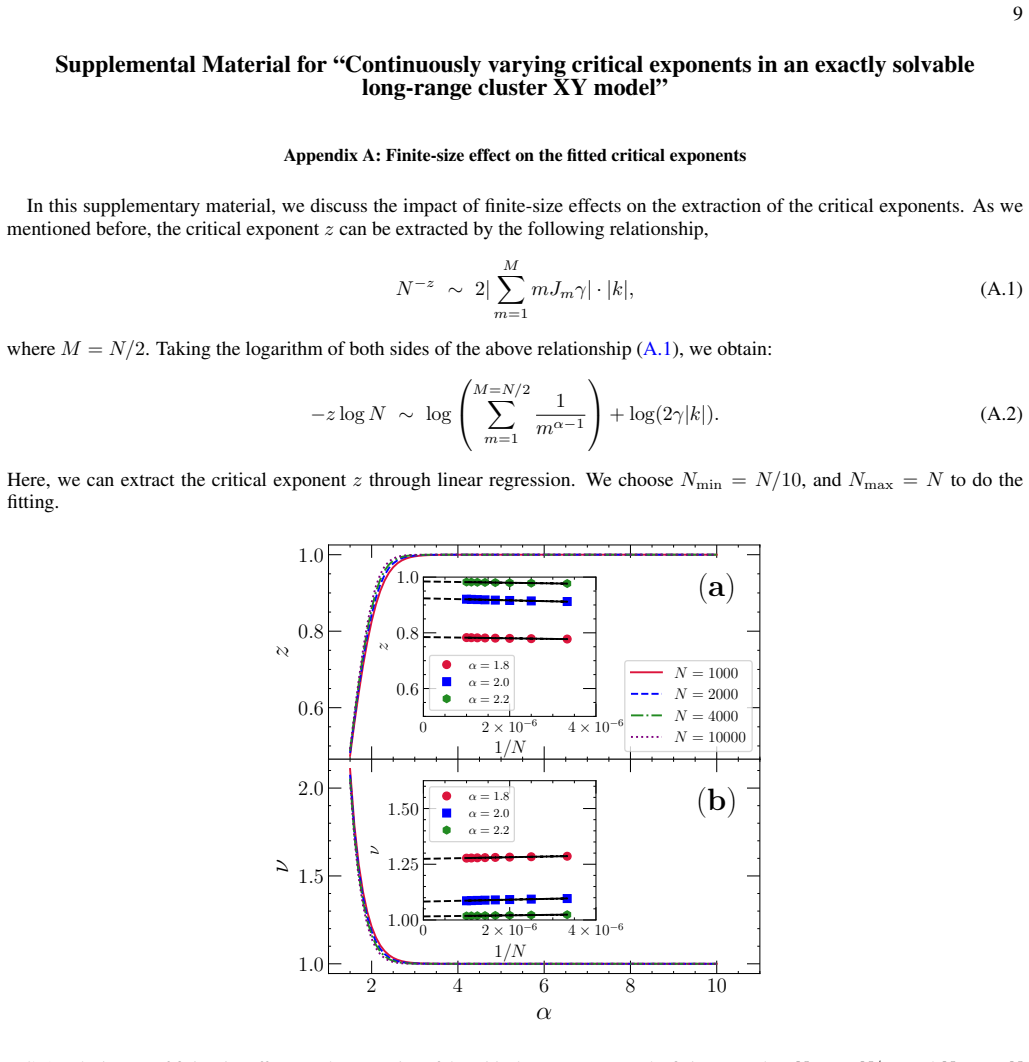
The central object is the free-fermion representation of the cluster XY Hamiltonian obtained by Jordan-Wigner transformation, whose Bogoliubov quasiparticle energies are $\varepsilon_k = 2\sqrt{\delta_k^2 + \epsilon_k^2}$ with $\epsilon_k = \sum_{m=1}^{M} m^{-\alpha}\cos(m k) + h$ and $\delta_k = \gamma \sum_{m=1}^{M} m^{-\alpha}\sin(m k)$. The gap closes at $k=0$ or $k=\pi$ when $h$ reaches $h_{c1} = -\sum_{m} m^{-\alpha}$ or $h_{c2} = -\sum_{m} (-1)^m m^{-\alpha}$. The dynamic exponent is extracted from the finite-size gap $\Delta_N \sim |\sum_{m=1}^{N/2} m^{1-\alpha}|/N$, where the truncation $M=N/2$ is the longest possible interaction range under periodic boundary conditions; the Euler-Maclaurin asymptotic expansion of this sum produces the piecewise formula for $z$.
What would settle it
For $1<\alpha<2$, compute the exact gap at $h_{c1}$ from the free-fermion spectrum for a sequence of increasing $N$ with the interaction range held at $M=N/2$, and fit $z$ from $\Delta_N \propto N^{-z}$; if the fitted $z$ does not approach $\alpha-1$ as $N\to\infty$, the claim fails. A complementary check is to construct the low-energy continuum theory by taking $N\to\infty$ before expanding around $k=0$: if the resulting velocity diverges and the gap instead closes as $N^{-1}$, the order of limits changes the exponent.
Extended reading notes
Core claim
The central claim is that in the long-range antiferromagnetic cluster XY model $H = \sum_{j,m} J_m[(1+\gamma)/2 \sigma_j^x \sigma_{j+m}^x + (1-\gamma)/2 \sigma_j^y \sigma_{j+m}^y] \prod_{p=j+1}^{j+m-1}\sigma_p^z - h\sum_j \sigma_j^z$ with $J_m = m^{-\alpha}$, the critical exponents are continuously varying functions of $\alpha$. The derivation starts from the size dependence of the gap at the critical field $h_{c1}$: $\Delta_N \sim N^{-z}$ with $N^{-z} \sim (1/N)\left|\sum_{m=1}^{N/2} m^{1-\alpha}\right|$. Euler-Maclaurin expansion of the generalized harmonic number yields $z = \alpha-1$ for $1<\alpha<2$ and $z=1$ for $\alpha\ge2$, with logarithmic corrections at $\alpha=2$, and the relation $\nu z = 1$ holds throughout. The same exponents are obtained from scaling collapse of the field derivative of the farthest correlation function and of fidelity susceptibility, and the central charge $c$ from half-chain entanglement entropy varies with $\alpha$, converging to $0.5$ as $\alpha\to\infty$.
Load-bearing premise
The derivation relies on identifying the finite-size gap computed with the interaction range truncated at half the system size with the true thermodynamic dynamical exponent, without proving that the thermodynamic limit and the low-momentum limit commute for $1<\alpha<2$.
Editorial extensions
If this is right
- For all $\alpha>1$, the identity $\nu z = 1$ holds exactly, so measuring either exponent determines the other.
- In the regime $\alpha\ge 2$, the model falls into the standard short-range XY/Ising universality class with $\nu=1$ and $z=1$.
- In the regime $1<\alpha<2$, tuning the interaction decay exponent continuously changes both $\nu$ and $z$, giving a one-parameter family of critical behaviors.
- The central charge $c$ obtained from entanglement entropy at criticality is also $\alpha$-dependent, approaching $0.5$ in the large-$\alpha$ limit.
- The exponents are confirmed numerically by scaling collapse of the correlation-function derivative and fidelity susceptibility, so the prediction is directly checkable in finite-size simulations.
Reading between the lines
- A natural next test is whether the $\alpha$-dependent exponents persist in the true thermodynamic limit if the momentum cutoff is taken before the system size; if they do, the critical theory for $1<\alpha<2$ is nonlocal and has a scale-dependent effective velocity.
- The variation of the central charge $c$ within a free-fermion model hints that the critical theory may be a rescaled free-fermion CFT with a cutoff-dependent Fermi velocity, rather than a genuinely different conformal field theory.
- The same gap-scaling derivation could be applied to other cluster-type models with Jordan-Wigner strings, predicting similarly tunable exponents and providing a family of solvable long-range models for quantum simulation.
- In a Rydberg-atom array with programmable power-law interactions and cluster terms, measuring the gap scaling or correlation length as a function of $\alpha$ would directly test whether $z=\alpha-1$ appears in a real system.
Editorial analysis
A structured set of objections, weighed in public.
Referee Report
Summary. The paper studies a spin-1/2 long-range cluster XY chain with algebraically decaying couplings, maps it to free fermions via the Jordan-Wigner transformation, and derives the critical fields hc1 and hc2 and the relation νz=1. The main claim is that the dynamic exponent z (and therefore ν via νz=1) varies continuously with the decay exponent α, with z=α−1 for 1<α<2 and z=1 for α≥2. The authors then present finite-size scaling analyses of correlation-function derivatives and fidelity susceptibility, using data collapse with adjustable exponents, and compute the entanglement entropy to extract a central charge c that also varies with α. The free-fermion mapping and the formulas for the critical fields are clean, but the derivation of the α-dependent z contains a technical error that undermines the central claim.
Significance. If correct, the result would be notable: an exactly solvable one-dimensional spin model with continuously varying critical exponents and a varying effective central charge is of interest for long-range interacting quantum simulators. The manuscript's strengths are its transparent free-fermion solution, explicit formulas for the critical fields, and the detailed numerical scaling study. However, the load-bearing step that produces z=α−1 is based on an invalid linearization of sin(mk), and the numerical verification treats the exponents being verified as fitting parameters. As it stands, the central claim is not supported and the paper would require a substantially revised derivation and a re-evaluation of the numerical evidence.
major comments (3)
- [Sec. II, Eqs. (18)–(20) and Supplemental Eqs. (A.1)–(B.7)] The derivation of the central result uses an invalid uniform expansion sin(mk)≈mk: for k∼1/N and m up to M=N/2, mk is of order unity. A correct evaluation gives δ_k∼N^{2−α} for α<2 (or δ_∞(k)∼k^{α−2} for 2<α<3), so the gap does not scale as N^{−(α−1)}. This invalidates z=α−1.
- [Sec. III, Eq. (24), Fig. 4, and Table I] The verification section treats the predicted exponents as fitting parameters, and the fitted values deviate from the analytic predictions by up to 14% (α=2.0, ν=1.1438 vs ν=1). The collapse therefore does not independently confirm the claimed exponents.
- [Sec. III, Eq. (30) and Fig. 7] The CFT scaling form used to extract c is not justified for α<2, where the single-particle spectrum has no conventional low-energy continuum and the finite-size gap does not close.
minor comments (4)
- [Eq. (22)] The determinant in Eq. (22) uses the index j in the last row without defining it; the row index should presumably be i+r−1 rather than j−1.
- [Fig. 1 caption] The caption mentions dashed lines indicating the location of the critical point as α→∞, but no dashed lines are visible in the figure.
- [Sec. II, text before Eq. (2)] The text notes that the ground-state energy diverges for α≤1, but the subsequent analysis and figures use α>1; this restriction should be stated explicitly in the model definition.
- [Abstract] The phrase 'To optimize scaling behavior, we verify these critical exponents ... by adjusting fitting parameters' is self-contradictory, since verification by adjusting the exponents being verified is circular; this phrasing should be revised.
Circularity Check
No significant circularity: the z(alpha) derivation is a self-contained exact free-fermion calculation; the data-collapse fits are transparently labeled fitting parameters.
full rationale
The central claim, z = alpha - 1 for 1 < alpha < 2 and z = 1 for alpha >= 2, is derived from the finite-size gap of the exactly diagonalized free-fermion model. Equation (20) and Supplemental Eqs. (A.1)-(B.7) evaluate the gap from the explicitly computed dispersion epsilon_k = 2*sqrt(delta_k^2 + epsilon_k^2), and the Euler-Maclaurin analysis of f(N) = (1/N) sum_{m=1}^{N/2} m^{1-alpha} is a direct asymptotic evaluation of that gap, not a restatement of the input. The scaling verification in Sec. III fixes nu from the analytic relation nu = 1/z and uses beta_P and beta_F, which the paper explicitly labels as 'fitting parameter(s)'; these auxiliary exponents are not dressed up as predictions, and the horizontal scaling variable N^{1/nu}(h - h_c) genuinely tests nu. The collapse is therefore a consistency check rather than an independent derivation, but it is not circular. The truncation M = N/2 and the question of whether this finite-size sequence reproduces the thermodynamic dynamical exponent for alpha < 2 is a limit-interchange correctness concern, not a circularity, and no load-bearing self-citation chain was found; citations to prior work by the authors are used for standard or independently established results, such as the alpha = infinity nearest-neighbor XY limit.
Assumptions & free parameters
free parameters (4)
- βP =
0.5093 (α=2.0, γ=1.0), 0.3643 (α=1.8), 0.0959 (α=1.6)
- βF =
0.7056 (α=2.0), 0.5402 (α=1.8), 0.2449 (α=1.6)
- ν_fit =
1.1438 (α=2.0), 1.3351 (α=1.8), 1.7157 (α=1.6)
- central charge c =
values shown in Fig. 7(b), converging to 0.5 as α increases
assumptions (5)
- domain assumption The Jordan-Wigner transformation with PBC/APBC maps the long-range cluster XY spin chain to an exactly quadratic fermionic Hamiltonian.
- domain assumption The gap expansion near k=0 and k=π is linear in |k|, giving νz=1.
- ad hoc to paper The finite-size gap scaling Δ_N ~ N^{-z} with M=N/2 correctly defines the thermodynamic dynamical exponent.
- domain assumption The scaling forms for P and χF in Eqs. (24) and (28) hold with a single correlation-length exponent ν.
- domain assumption The entanglement entropy at criticality follows SL ~ (c/3) log(N/π sin(πL/N)) for all α.
Cite this review
Pith. "Pith review of Continuously varying critical exponents in an exactly solvable long-range cluster XY mode." pith.science (2026). https://pith.science/paper/BAOCDOJI
@misc{pith2026250204165,
  author       = {Pith},
  title        = {Pith review of: Continuously varying critical exponents in an exactly solvable long-range cluster XY mode},
  year         = {2026},
  howpublished = {\url{https://pith.science/paper/BAOCDOJI}},
  note         = {Machine review of arXiv:2502.04165}
}
abstract
We investigate a generalized antiferromagnetic cluster XY model in a transverse magnetic field, where long-range interactions decay algebraically with distance. This model can be exactly solvable within a free fermion framework. By analyzing the gap, we explicitly derive the critical exponents $\nu$ and $z$, finding that the relationship $\nu z = 1$ still holds. However, the values of $\nu$ and $z$ depend on the decaying exponent $\alpha$, in contrast to those for the quantum long-range antiferromagnetic Ising chain. To optimize scaling behavior, we verify these critical exponents using correlation functions and fidelity susceptibility, achieving excellent data collapse across various system sizes by adjusting fitting parameters. Finally, we compute the entanglement entropy at the critical point to determine the central charge $c$, and find it also varies with $\alpha$. This study provides insights into the unique effect of long-range cluster interactions on the critical properties of quantum spin systems.
Figures


Figures from the paper (5 more)


Reference graph
Works this paper leans on
-
[1]
Sachdev, Quantum Phase Transitions(Cambridge University Press, Cambridge, 2000)
S. Sachdev, Quantum Phase Transitions(Cambridge University Press, Cambridge, 2000)
work page 2000
- [2]
- [3]
-
[4]
Ising, Zeitschrift fur Physik 31, 253 (1925)
E. Ising, Zeitschrift fur Physik 31, 253 (1925). 7
work page 1925
-
[5]
X. Wang, X. Feng, T. Hartung, K. Jansen, and P. Stornati, Phys. Rev. A 108, 022612 (2023)
work page 2023
- [6]
-
[7]
B. H. Elfeky, M. C. Dartiailh, S. M. Farzaneh, and J. Shabani, Phys. Rev. Res. 3, 033108 (2021)
work page 2021
- [8]
Show all 77 references
-
[9]
Carrasquilla and R
J. Carrasquilla and R. G. Melko, Nat. Phys 13, 431 (2017)
2017
-
[10]
Wang, Phys
L. Wang, Phys. Rev. B 94, 195105 (2016)
2016
-
[11]
M.-Y . Mao, Z. Cheng, L. Li, N. Wu, and W.-L. You, Phys. Rev. A 109, 042428 (2024)
2024
-
[12]
Castellano, S
C. Castellano, S. Fortunato, and V . Loreto, Rev. Mod. Phys.81, 591 (2009)
2009
-
[13]
H. A. Kramers and G. H. Wannier, Phys. Rev. 60, 252 (1941)
1941
-
[14]
H. A. Kramers and G. H. Wannier, Phys. Rev. 60, 263 (1941)
1941
-
[15]
Onsager, Phys
L. Onsager, Phys. Rev. 65, 117 (1944)
1944
-
[16]
W. Zhu, C. Han, E. Huffman, J. S. Hofmann, and Y .-C. He, Phys. Rev. X 13, 021009 (2023)
2023
-
[17]
Defenu, T
N. Defenu, T. Donner, T. Macr `ı, G. Pagano, S. Ruffo, and A. Trombettoni, Rev. Mod. Phys.95, 035002 (2023)
2023
-
[18]
Koffel, M
T. Koffel, M. Lewenstein, and L. Tagliacozzo, Phys. Rev. Lett. 109, 267203 (2012)
2012
-
[19]
Hauke and L
P. Hauke and L. Tagliacozzo, Phys. Rev. Lett. 111, 207202 (2013)
2013
-
[20]
Eisert, M
J. Eisert, M. van den Worm, S. R. Manmana, and M. Kastner, Phys. Rev. Lett. 111, 260401 (2013)
2013
-
[21]
M. G. Nezhadhaghighi and M. A. Rajabpour, Phys. Rev. B 88, 045426 (2013)
2013
-
[22]
Juh ´asz, I
R. Juh ´asz, I. A. Kov´acs, and F. Igl´oi, Europhysics Letters 107, 47008 (2014)
2014
-
[23]
V odola, L
D. V odola, L. Lepori, E. Ercolessi, and G. Pupillo, New J. Phys 18, 015001 (2015)
2015
-
[24]
A. S. Buyskikh, M. Fagotti, J. Schachenmayer, F. Essler, and A. J. Daley, Phys. Rev. A93, 053620 (2016)
2016
-
[25]
Fey and K
S. Fey and K. P. Schmidt, Phys. Rev. B 94, 075156 (2016)
2016
-
[26]
Sun, Phys
G. Sun, Phys. Rev. A 96, 043621 (2017)
2017
-
[27]
Z. Zhu, G. Sun, W.-L. You, and D.-N. Shi, Phys. Rev. A 98, 023607 (2018)
2018
-
[28]
Adelhardt, J
P. Adelhardt, J. A. Koziol, A. Schellenberger, and K. P. Schmidt, Phys. Rev. B 102, 174424 (2020)
2020
-
[29]
J. A. Koziol, A. Langheld, S. C. Kapfer, and K. P. Schmidt, Phys. Rev. B 103, 245135 (2021)
2021
-
[30]
Adelhardt, J
P. Adelhardt, J. A. Koziol, A. Langheld, and K. P. Schmidt, Entropy 26, 401 (2024)
2024
-
[31]
H.-K. Tang, I. Yudhistira, U. Chattopadhyay, M. Ulybyshev, P. Sengupta, F. F. Assaad, and S. Adam, Phys. Rev. B 110, 155120 (2024)
2024
-
[32]
Chakraborty and N
D. Chakraborty and N. Angelinos, Phys. Rev. A 110, 042408 (2024)
2024
-
[33]
Solfanelli and N
A. Solfanelli and N. Defenu, Phys. Rev. E 110, 044121 (2024)
2024
-
[34]
B. J. P. Pernack, M. V . Fistul, and I. M. Eremin, Phys. Rev. B 110, 184502 (2024)
2024
-
[35]
Smacchia, L
P. Smacchia, L. Amico, P. Facchi, R. Fazio, G. Florio, S. Pas- cazio, and V . Vedral, Phys. Rev. A84, 022304 (2011)
2011
-
[36]
Ding, Phys
C. Ding, Phys. Rev. E 100, 042131 (2019)
2019
-
[37]
Guo, X.-J
Z.-X. Guo, X.-J. Yu, X.-D. Hu, and Z. Li, Phys. Rev. A 105, 053311 (2022)
2022
-
[38]
Schwartz, D
I. Schwartz, D. Cogan, E. R. Schmidgall, Y . Don, L. Gantz, O. Kenneth, N. H. Lindner, and D. Gershoni, Science 354, 434 (2016)
2016
-
[39]
M. V . Larsen, X. Guo, C. R. Breum, J. S. Neergaard-Nielsen, and U. L. Andersen, Science 366, 369 (2019)
2019
-
[40]
Raussendorf and J
R. Raussendorf and J. Harrington, Phys. Rev. Lett. 98, 190504 (2007)
2007
-
[41]
Raussendorf, J
R. Raussendorf, J. Harrington, and K. Goyal, New J. Phys 9, 199 (2007)
2007
-
[42]
D. L. Zhou, B. Zeng, Z. Xu, and C. P. Sun, Phys. Rev. A 68, 062303 (2003)
2003
-
[43]
C. M. Dawson, H. L. Haselgrove, and M. A. Nielsen, Phys. Rev. A 73, 052306 (2006)
2006
-
[44]
M. A. Nielsen, Phys. Rev. Lett. 93, 040503 (2004)
2004
-
[45]
M. A. Nielsen, Rep. Math. Phys 57, 147 (2006)
2006
-
[46]
A. Y . Kitaev, Annals Phys.303, 2 (2003)
2003
-
[47]
S. Cao, B. Wu, F. Chen, M. Gong, Y . Wu, Y . Ye, C. Zha, H. Qian, C. Ying, S. Guo, et al., Nature 619, 738 (2023)
2023
-
[48]
Ebadi, T
S. Ebadi, T. T. Wang, H. Levine, A. Keesling, G. Semeghini, A. Omran, D. Bluvstein, R. Samajdar, H. Pichler, W. W. Ho, et al., Nature 595, 227 (2021)
2021
-
[49]
Semeghini, H
G. Semeghini, H. Levine, A. Keesling, S. Ebadi, T. T. Wang, D. Bluvstein, R. Verresen, H. Pichler, M. Kalinowski, R. Sama- jdar, et al., Science 374, 1242 (2021)
2021
-
[50]
Zeybek, R
Z. Zeybek, R. Mukherjee, and P. Schmelcher, Phys. Rev. Lett. 131, 203003 (2023)
2023
-
[51]
Bernien, S
H. Bernien, S. Schwartz, A. Keesling, H. Levine, A. Omran, H. Pichler, S. Choi, A. S. Zibrov, M. Endres, M. Greiner,et al., Nature 551, 579 (2017)
2017
-
[52]
Scholl, M
P. Scholl, M. Schuler, H. J. Williams, A. A. Eberharter, D. Barredo, K.-N. Schymik, V . Lienhard, L.-P. Henry, T. C. Lang, T. Lahaye, et al., Nature 595, 233 (2021)
2021
-
[53]
Bluvstein, A
D. Bluvstein, A. Omran, H. Levine, A. Keesling, G. Semeghini, S. Ebadi, T. T. Wang, A. A. Michailidis, N. Maskara, W. W. Ho, et al., Science 371, 1355 (2021)
2021
-
[54]
Browaeys and T
A. Browaeys and T. Lahaye, Nat. Phys 16, 132 (2020)
2020
-
[55]
Labuhn, D
H. Labuhn, D. Barredo, S. Ravets, S. De L ´es´eleuc, T. Macr`ı, T. Lahaye, and A. Browaeys, Nature 534, 667 (2016)
2016
-
[56]
C. Chen, G. Bornet, M. Bintz, G. Emperauger, L. Leclerc, V . S. Liu, P. Scholl, D. Barredo, J. Hauschild, S. Chatterjee, et al., Nature 616, 691 (2023)
2023
-
[57]
Sbierski, M
B. Sbierski, M. Bintz, S. Chatterjee, M. Schuler, N. Y . Yao, and L. Pollet, Phys. Rev. B 109, 144411 (2024)
2024
-
[58]
Deger and T.-C
A. Deger and T.-C. Wei, Quantum Inf Process 18, 1 (2019)
2019
-
[59]
Sinha, M
A. Sinha, M. M. Rams, and J. Dziarmaga, Phys. Rev. B 99, 094203 (2019)
2019
-
[60]
Chepiga and F
N. Chepiga and F. Mila, Nature Communications 12, 414 (2021)
2021
-
[61]
E. Lieb, T. Schultz, and D. Mattis, Annals of Physics 16, 407 (1961)
1961
-
[62]
Defenu, G
N. Defenu, G. Morigi, L. Dell’Anna, and T. Enss, Phys. Rev. B 100, 184306 (2019)
2019
-
[63]
See the Supplemental Material for a detailed discussion of the impact of finite-size effects on the fitted critical exponents
-
[64]
Yi, Y .-R
T.-C. Yi, Y .-R. Ding, J. Ren, Y .-M. Wang, and W.-L. You, Acta Phys. Sin. 67, 140303 (2018)
2018
-
[65]
Yi, W.-L
T.-C. Yi, W.-L. You, N. Wu, and A. M. Ole´s, Phys. Rev. B 100, 024423 (2019)
2019
-
[66]
Liu, T.-C
Z.-A. Liu, T.-C. Yi, J.-H. Sun, Y .-L. Dong, and W.-L. You, Phys. Rev. E 102, 032127 (2020)
2020
-
[67]
Liu, Y .-L
Z.-A. Liu, Y .-L. Dong, N. Wu, Y . Wang, and W.-L. You, Physica A 579, 126122 (2021)
2021
-
[68]
Zhao, T.-C
Z. Zhao, T.-C. Yi, M. Xue, and W.-L. You, Phys. Rev. A 105, 063306 (2022)
2022
-
[69]
M. E. Fisher and M. N. Barber, Phys. Rev. Lett. 28, 1516 (1972)
1972
-
[70]
W. W. Cheng and J.-M. Liu, Phys. Rev. A 82, 012308 (2010). 8
2010
-
[71]
Lv, T.-C
T. Lv, T.-C. Yi, L. Li, G. Sun, and W.-L. You, Phys. Rev. A105, 013315 (2022)
2022
-
[72]
Zanardi, H
P. Zanardi, H. T. Quan, X. Wang, and C. P. Sun, Phys. Rev. A 75, 032109 (2007)
2007
-
[73]
You, Y .-W
W.-L. You, Y .-W. Li, and S.-J. Gu, Phys. Rev. E 76, 022101 (2007)
2007
-
[74]
Campos Venuti and P
L. Campos Venuti and P. Zanardi, Phys. Rev. Lett. 99, 095701 (2007)
2007
-
[75]
Calabrese and J
P. Calabrese and J. Cardy, J. Phys. A: Math. Theor. 42, 504005 (2009)
2009
-
[76]
J. Ren, Z. Wang, W. Chen, and W.-L. You, Phys. Rev. E 105, 034128 (2022)
2022
-
[77]
Continuously varying critical exponents in an exactly solvable long-range cluster XY model
S. O. Skrøvseth and K. Olaussen, Phys. Rev. A 72, 022318 (2005). 9 Supplemental Material for “Continuously varying critical exponents in an exactly solvable long-range cluster XY model” Appendix A: Finite-size effect on the fitted critical exponents In this supplementary mater...
2005
Reviewed August 8, 2026 · model on record in the stance chip above.
Discussion (0). Continue with ORCID to comment.