REVIEW 5 major objections 5 minor 1 cited by
PILAF: Optimal Human Preference Sampling for Reward Modeling
T0 review · 5 major / 5 minor · reviewed 2026-08-08 · deepseek-v4-flash
Pith's one-line read PILAF claims that choosing preference pairs from an interpolated policy makes DPO training follow the true oracle reward, cutting annotation and compute by over 40 percent in iterative settings.
desk verdict A genuinely novel theoretical sampler whose theorems don't yet cover the simplified algorithm actually evaluated; the empirical results are encouraging but need error bars and honest cost accounting. read the letter →
The pith
A machine-rendered reading of the paper's core claim, the machinery that carries it, and where it could break.
The reading
What carries the argument
The load-bearing object is the tilted sampling distribution $\mu$ built from the current policy and the DPO implicit reward: $\pi_\theta^{\pm} \propto \pi_\theta \exp(\pm r_\theta)$, mixed with $\pi_\theta$ at probability $p_0(x)=Z_\theta^+ Z_\theta^-/(1+Z_\theta^+ Z_\theta^-)$, plus the weight $w(x)=(1+Z_\theta^+ Z_\theta^-)/\mathcal{Z}_\theta$. The key identity, proven in the appendix, is that the averaged sampling density satisfies $\bar{\mu}(\vec y_a,\vec y_b|x)/(\pi_\theta(\vec y_a|x)\pi_\theta(\vec y_b|x)) = (1+Z_\theta^+ Z_\theta^-)/(2\sigma'(r_\theta(\vec y_a)-r_\theta(\vec y_b)))$. This identity does the work: it cancels the sigmoid derivative in the MLE gradient and replaces the sigmoid gap with a reward gap, which is exactly the integrand of $\nabla_\theta J(\pi_\theta)$. The practical algorithm replaces exact normalization with logit-level interpolation, giving per-token prediction rules $\pi_\theta^+ = \mathrm{softmax}((1+\beta)h_\theta - \beta h_{\mathrm{ref}})$ and $\pi_\theta^- = \mathrm{softmax}((1-\beta)h_\theta + \beta h_{\mathrm{ref}})$.
What would settle it
Train two matched DPO runs on the same prompts and proxy reward, one with PILAF and one with T-PILAF where the partition functions are estimated by sampling and the Bernoulli probability is computed from the tilted policies; if the simplified PILAF does not reproduce T-PILAF's per-step gradient alignment, measured as the cosine similarity between $\nabla_\theta L$ and $\nabla_\theta J(\pi_\theta)$ using the known proxy reward, then the empirical gains are not attributable to the proved mechanism.
Extended reading notes
Core claim
At its own level of claim, the paper's central discovery is a sampling distribution with a gradient-alignment identity. For T-PILAF, response pairs are drawn from a Bernoulli mixture of the current policy $\pi_\theta$ and the pair of tilted policies $\pi_\theta \exp(r_\theta)$ and $\pi_\theta \exp(-r_\theta)$ (normalized); with the accompanying weight function, the density ratio simplifies to $1/(2\sigma'(\Delta r_\theta))$, and this converts the sigmoid difference $\sigma(\Delta r_\star)-\sigma(\Delta r_\theta)$ in the MLE gradient into the linear difference $\Delta r_\star-\Delta r_\theta$ that appears in $\nabla_\theta J(\pi_\theta)$. The resulting identity is $\nabla_\theta L(\theta) = -\frac{\beta}{Z_\theta}\nabla_\theta J(\pi_\theta) + T_2$, with $T_2$ a second-order error. From the statistical side, the asymptotic covariance of the estimated parameter is bounded by the inverse of the gradient covariance under the optimal policy, and the value gap follows a problem-independent chi-square tail. The practical PILAF replaces the partition functions with 1, fixes the Bernoulli probability at $1/2$, uses the unweighted DPO loss, and implements the tilted policies token-wise as $\mathrm{softmax}((1+\beta)h_\theta - \beta h_{\mathrm{ref}})$ and $\mathrm{softmax}((1-\beta)h_\theta + \beta h_{\mathrm{ref}})$.
Load-bearing premise
The load-bearing premise is that the simplified PILAF used in the experiments—fixed $1/2$ mixing probability, unit partition functions, and the unweighted DPO loss—inherits the proven gradient-alignment and chi-square efficiency of T-PILAF; no theorem in the paper covers that simplified scheme.
Editorial extensions
If this is right
- DPO updates on PILAF-collected data ascend the oracle KL-regularized reward, so each labeled pair is informative in the direction that matters for downstream value.
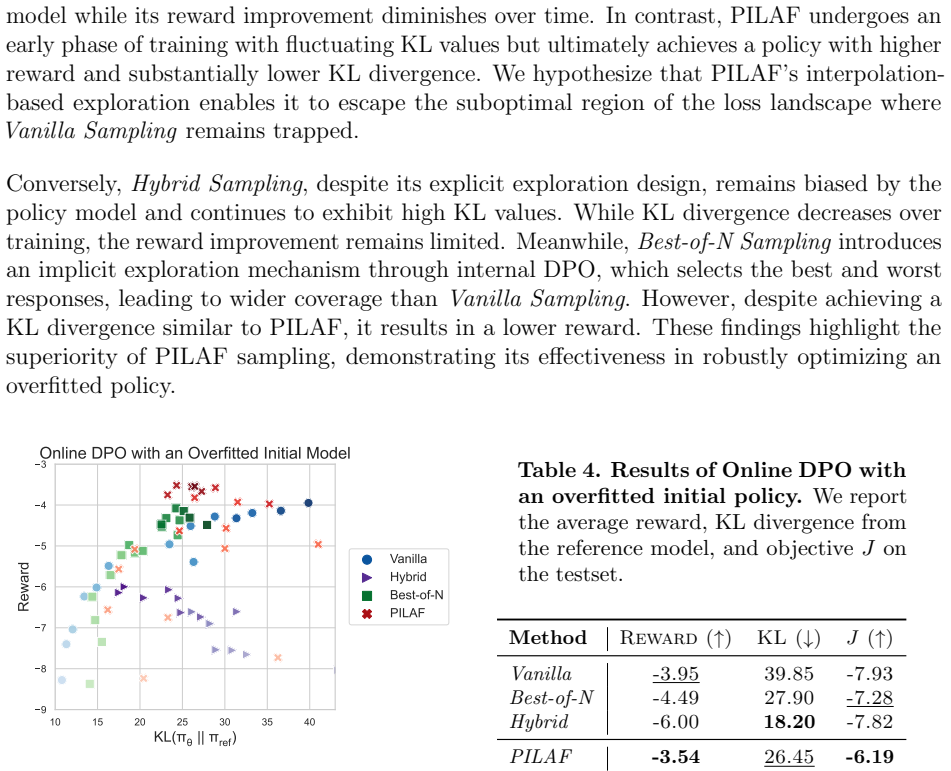
- In iterative DPO, PILAF reaches the endpoint reward of the baselines around halfway through training, which translates to more than 40 percent savings in annotation and computation.
- The statistical result implies the estimator's error concentrates along directions where the Hessian of $J$ is large, so training remains stable even when initialized from an overfitted policy.
- Because the sampling mechanism is decoupled from the loss, the same interpolation can be applied to other preference optimization losses, not only DPO; the paper sketches how it extends to PPO-based RLHF.
Reading between the lines
- Editorial extension: the gradient-alignment identity suggests a direct diagnostic the paper does not report—during training, compute the cosine similarity between the DPO loss gradient and the oracle objective gradient on a held-out proxy reward; PILAF should show higher alignment than vanilla sampling.
- Editorial extension: the claimed cost savings are measured against a reward-model proxy for human labels; with real annotators, inter-annotator noise or label-cost asymmetry could change the observed trade-off, and the theory assumes the Bradley-Terry model holds exactly.
- Editorial extension: the simplified PILAF fixes the mixing probability at $1/2$ and ignores partition functions, and the experiments use $\beta=0.1$; for substantially larger $\beta$, one could test whether estimating $p_0(x)$ or the partition functions preserves the alignment more faithfully.
Editorial analysis
A structured set of objections, weighed in public.
Referee Report
Summary. The paper proposes a response-sampling scheme for preference data in RLHF. It first introduces T-PILAF, a theoretically analyzed scheme in which response pairs are drawn either from the current policy or from reward-tilted policies, using a prompt-dependent Bernoulli probability, normalized tilted policies, and a weighted DPO loss. Theorems 4.1-4.3 claim first-order gradient alignment with the oracle-regularized objective and asymptotic covariance control for T-PILAF. The paper then presents PILAF, a simplified variant that sets the Bernoulli probability to 1/2, drops partition functions, uses the unweighted DPO loss, and implements the tilted policies by per-token logit interpolation. PILAF is evaluated in iterative and online DPO experiments with a reward-model oracle, reporting better reward-KL trade-offs at reduced annotation and computation cost.
Significance. If the theoretical claims held for the method actually evaluated, this would be a valuable contribution: it would give a principled, theoretically motivated way to choose preference pairs during iterative RLHF and reduce annotation cost. The construction of T-PILAF is elegant, and the explicit density-ratio identity in Eq. (15) is a genuine design achievement. The empirical results are encouraging and include a detailed cost comparison. However, the theoretical guarantees are proved only for T-PILAF, while the evaluated PILAF omits or changes several components of that scheme, and no analysis quantifies the effect of those changes. The statistical theorems also contain an equality-to-upper-bound gap. With the claims appropriately scoped, the paper would be a useful contribution to the RLHF data-curation literature.
major comments (5)
- [Section 5 and Algorithm 1 vs. Section 4] Theorems 4.1-4.3 are stated for T-PILAF, whose sampling distribution uses the prompt-dependent Bernoulli probability p0(x), the normalized tilted policies in Eq. (6), and the weighted loss with w(x) in Eq. (7). The practical PILAF in Algorithm 1 and Section 5 replaces p0 by 1/2, sets Z+_theta and Z-_theta to 1, uses the standard unweighted DPO loss, and replaces the tilted policies by per-token softmax interpolation. No theorem, lemma, or numerical bound quantifies the deviation between these two schemes. The footnote in Section 5 saying that partition functions are approximately 1 for small beta is a heuristic, and the per-token approximation is imported from Proposition 1 of Liu et al. (2024b) without verifying that it produces the tilted autoregressive distribution in this setting. A first-order calculation with p0=1/2, Z+=Z-=1, and w=1 changes the density-ratio identity (15) to mu/pi_theta pi_theta = 1/(4 sigma'), so the alignment direction may survive those three simplifications, but the per-token interpolation and the statistical covariance analysis are not covered. The abstract's claim that PILAF is 'theoretically grounded, demonstrating optimality' therefore overstates what is proved for the implemented algorithm.
- [Theorem 4.2 and Appendix B.2.2] The main text states Omega <= C1 * Sigma_star^{-1} with C1 a universal constant and says that under T-PILAF the matrix Sigma_star is given by Eq. (8). The appendix proves only a lower bound, Sigma_star >= (1/(C Z_theta)) E_{rho, pi_star}[Cov(nabla_theta r_star | x)], under Condition (27), where C is problem-dependent. Consequently, the inverse inequality gives an upper bound on Omega in terms of E[Cov], not an equality. The constant C1 is not universal because it inherits the constant from Condition (27), the weight bound ||w||_infty, and Z_theta. The theorem statement should be corrected to an inequality with the correct problem-dependent constants.
- [Theorem 4.3 and Appendix B.2.3] The theorem text says the value gap J(pi_star) - J(pi_hat) 'asymptotically follows a chi-square distribution.' The proof in Appendix B.2.3 derives only an upper bound: the limiting quadratic form is dominated by a rescaled chi-square random variable, as in Eq. (10). Without an exact covariance equality, the asymptotic distribution is a weighted quadratic form with problem-dependent weights, not a chi-square distribution. Eq. (10) is a valid tail bound under the stated inequalities, but the distributional claim in the main text should be weakened to a stochastic dominance or tail-bound statement.
- [Appendix B.2.2, Condition (27)] The comparability condition on conditional variances under r_theta and r_star is introduced only in the appendix and is load-bearing for Theorems 4.2 and 4.3. It is stated without discussion of when it holds; it involves the learned reward r_theta for arbitrary theta and is not implied by the smoothness or realizability assumptions stated elsewhere. The main statements should either include this condition explicitly or provide a justification or a relaxation.
- [Appendix C.2.2, Lemma B.5] The Hessian calculation differentiates the loss expression (14a) while treating the weight w(x) and the sampling distribution mu as independent of theta, although w and mu are defined in terms of pi_theta in Eq. (7) and Section 3. If the expectation is taken over a sampling distribution that varies with theta, the derivatives of mu and w contribute additional terms. If instead mu and w are meant to be frozen at the data-collection policy, this should be stated explicitly, since the Z-estimator argument in Theorem 4.2 relies on the population loss being a fixed objective in theta.
minor comments (5)
- [Throughout] There are several typos: 'Specfically' in Section 1, 'poposed' in Theorem B.1, 'Graident' in the Appendix C.2.3 heading, 'T able' in several table captions, and 'respsect' in Appendix C.1.1.
- [Section 2.3 and Theorem 4.3] The objective J(pi) is defined inline in Section 2.3 but Theorem 4.3 refers to it as 'equation (6)'; the equation numbering is inconsistent.
- [Section 5, Table 1] The cost table reports an average sampling cost of 3 forward passes for PILAF, but the text explains this as a mixture of 2-pass and 4-pass cases. Stating the calculation explicitly in the table caption would improve clarity.
- [Section 6, Figures 2-5] The reward-KL curves appear to come from single runs, and no error bars or multiple seeds are reported. Given the variance of online RLHF training, reporting at least a few seeds for the main comparisons would strengthen the empirical claims.
- [Section 5] The statement that PILAF involves 'no hyperparameter tuning' is somewhat overstated: the KL regularization coefficient beta is a hyperparameter, even though it is taken from the objective and fixed at 0.1 in all experiments.
Circularity Check
No circularity: the theoretical result is a deliberate construction, not a hidden restatement of its assumptions.
full rationale
The paper's central gradient-alignment theorem (Theorem 4.1) is derived by choosing the T-PILAF sampling distribution and weight function so that the density ratio (15) exactly cancels the sigmoid derivative in the MLE gradient. This is an explicit design derivation: Equation (22) defines the mixture sampling law, Equation (15) shows cancellation of σ′, and Equation (7) defines the weight w(x). The final identity ∇θL(θ) = −β/Zθ ∇θJ(πθ) + T2 is obtained by algebra plus a first-order Taylor expansion, not by assuming the conclusion. The statistical results use standard Z-estimator theory (Kosorok 2008) and clearly stated regularity conditions; no parameter is fitted to data and then reported as a prediction. The only notable gap is that the theorems are proven for T-PILAF (with prompt-dependent p0(x), partition functions Z±θ, and weighted loss), while the implemented PILAF (Algorithm 1, Section 5) simplifies these to p0 = 1/2, Z± = 1, and unweighted DPO. This is an unverified transfer of theory to practice, but it is not a circular reduction: the practical scheme is not obtained by defining it as the thing that makes the theorem true, and the simplification is explicitly acknowledged as a heuristic (Section 5 footnote). The per-token softmax approximation is imported from an external reference (Liu et al., 2024b), not from the authors' own prior results, and is not load-bearing self-citation. No fitted quantity is renamed as a prediction, no uniqueness theorem is invoked, and no known empirical pattern is merely renamed. Accordingly, the paper's derivation chain is self-contained with respect to circularity; the theory–implementation mismatch should be treated as a correctness or scope risk, not as circular reasoning.
Assumptions & free parameters
free parameters (2)
- mixing probability p = 1/2 =
1/2
- regularization coefficient beta =
0.1
assumptions (6)
- domain assumption Human preferences follow the Bradley-Terry model with an oracle reward r*
- domain assumption The reward model is well-specified: r* = r_theta* for some parameter theta*
- standard math The reward function, its gradient, and Hessian are uniformly bounded and Lipschitz continuous in theta
- ad hoc to paper Condition (27): the conditional variance of preference indicators under r_theta is comparable to that under r*
- ad hoc to paper The DPO implicit reward decomposes token-wise, so the tilted policies can be sampled autoregressively via logit interpolation
- ad hoc to paper Partition functions Z±_theta(x) are approximately 1
Cite this review
Pith. "Pith review of PILAF: Optimal Human Preference Sampling for Reward Modeling." pith.science (2026). https://pith.science/paper/AMSWVV7R
@misc{pith2026250204270,
  author       = {Pith},
  title        = {Pith review of: PILAF: Optimal Human Preference Sampling for Reward Modeling},
  year         = {2026},
  howpublished = {\url{https://pith.science/paper/AMSWVV7R}},
  note         = {Machine review of arXiv:2502.04270}
}
read the original abstract
As large language models increasingly drive real-world applications, aligning them with human values becomes paramount. Reinforcement Learning from Human Feedback (RLHF) has emerged as a key technique, translating preference data into reward models when oracle human values remain inaccessible. In practice, RLHF mostly relies on approximate reward models, which may not consistently guide the policy toward maximizing the underlying human values. We propose Policy-Interpolated Learning for Aligned Feedback (PILAF), a novel response sampling strategy for preference labeling that explicitly aligns preference learning with maximizing the underlying oracle reward. PILAF is theoretically grounded, demonstrating optimality from both an optimization and a statistical perspective. The method is straightforward to implement and demonstrates strong performance in iterative and online RLHF settings where feedback curation is critical.
Figures


Figures from the paper (2 more)

Forward citations
Cited by 1 Pith paper
-
Inverse Reinforcement Learning Meets Large Language Model Post-Training: Basics, Advances, and Opportunities
A tutorial reviewing LLM alignment through the lens of inverse reinforcement learning, arguing that neural reward models learned from human data are central to post-training.
Reference graph
Works this paper leans on
-
[1]
write newline
" write newline "" before.all 'output.state := FUNCTION n.dashify 't := "" t empty not t #1 #1 substring "-" = t #1 #2 substring "--" = not "--" * t #2 global.max substring 't := t #1 #1 substring "-" = "-" * t #2 global.max substring 't := while if t #1 #1 substring * t #2 global.max substring 't := if while FUNCTION format.date year duplicate empty "emp...
-
[2]
L., Almeida, D., Altenschmidt, J., Altman, S., Anadkat, S., et al
Achiam, J., Adler, S., Agarwal, S., Ahmad, L., Akkaya, I., Aleman, F. L., Almeida, D., Altenschmidt, J., Altman, S., Anadkat, S., et al. Gpt-4 technical report. arXiv preprint arXiv:2303.08774, 2023
arXiv 2023
-
[3]
G., Guo, Z
Azar, M. G., Guo, Z. D., Piot, B., Munos, R., Rowland, M., Valko, M., and Calandriello, D. A general theoretical paradigm to understand learning from human preferences. In International Conference on Artificial Intelligence and Statistics, pp.\ 4447--4455. PMLR, 2024
2024
-
[4]
Training a helpful and harmless assistant with reinforcement learning from human feedback
Bai, Y., Jones, A., Ndousse, K., Askell, A., Chen, A., DasSarma, N., Drain, D., Fort, S., Ganguli, D., Henighan, T., et al. Training a helpful and harmless assistant with reinforcement learning from human feedback. arXiv preprint arXiv:2204.05862, 2022
arXiv 2022
-
[5]
Value-incentivized preference optimization: A unified approach to online and offline rlhf
Cen, S., Mei, J., Goshvadi, K., Dai, H., Yang, T., Yang, S., Schuurmans, D., Chi, Y., and Dai, B. Value-incentivized preference optimization: A unified approach to online and offline rlhf. arXiv preprint arXiv:2405.19320, 2024
arXiv 2024
-
[6]
Das, N., Chakraborty, S., Pacchiano, A., and Chowdhury, S. R. Active preference optimization for sample efficient rlhf. In ICML 2024 Workshop on Theoretical Foundations of Foundation Models, 2024
2024
-
[7]
Degris, T., White, M., and Sutton, R. S. Off-policy actor-critic. arXiv preprint arXiv:1205.4839, 2012
arXiv 2012
-
[8]
Raft: Reward ranked finetuning for generative foundation model alignment
Dong, H., Xiong, W., Goyal, D., Zhang, Y., Chow, W., Pan, R., Diao, S., Zhang, J., KaShun, S., and Zhang, T. Raft: Reward ranked finetuning for generative foundation model alignment. Transactions on Machine Learning Research, 2023
work page 2023
Show all 46 references
-
[9]
Rlhf workflow: From reward modeling to online rlhf, 2024
Dong, H., Xiong, W., Pang, B., Wang, H., Zhao, H., Zhou, Y., Jiang, N., Sahoo, D., Xiong, C., and Zhang, T. Rlhf workflow: From reward modeling to online rlhf, 2024
2024
-
[10]
The llama 3 herd of models
Dubey, A., Jauhri, A., Pandey, A., Kadian, A., Al-Dahle, A., Letman, A., Mathur, A., Schelten, A., Yang, A., Fan, A., et al. The llama 3 herd of models. arXiv preprint arXiv:2407.21783, 2024
2024 arXiv
-
[11]
Kto: Model alignment as prospect theoretic optimization
Ethayarajh, K., Xu, W., Muennighoff, N., Jurafsky, D., and Kiela, D. Kto: Model alignment as prospect theoretic optimization. arXiv preprint arXiv:2402.01306, 2024
2024 arXiv
-
[12]
Scaling laws for reward model overoptimization
Gao, L., Schulman, J., and Hilton, J. Scaling laws for reward model overoptimization. In International Conference on Machine Learning, pp.\ 10835--10866, 2023
2023
-
[13]
L., and Baxter, J
Greensmith, E., Bartlett, P. L., and Baxter, J. Variance reduction techniques for gradient estimates in reinforcement learning. Journal of Machine Learning Research, 5 0 (9), 2004
2004
-
[14]
S., Lillicrap, T., Turner, R
Gu, S. S., Lillicrap, T., Turner, R. E., Ghahramani, Z., Sch \"o lkopf, B., and Levine, S. Interpolated policy gradient: Merging on-policy and off-policy gradient estimation for deep reinforcement learning. Advances in neural information processing systems, 30, 2017
2017
-
[15]
Direct language model alignment from online ai feedback
Guo, S., Zhang, B., Liu, T., Liu, T., Khalman, M., Llinares, F., Rame, A., Mesnard, T., Zhao, Y., Piot, B., et al. Direct language model alignment from online ai feedback. arXiv preprint arXiv:2402.04792, 2024
2024 arXiv
-
[16]
Openrlhf: An easy-to-use, scalable and high-performance rlhf framework
Hu, J., Wu, X., Zhu, Z., Xianyu, Wang, W., Zhang, D., and Cao, Y. Openrlhf: An easy-to-use, scalable and high-performance rlhf framework. arXiv preprint arXiv:2405.11143, 2024
2024 arXiv
-
[17]
Reinforcement learning from human feedback with active queries
Ji, K., He, J., and Gu, Q. Reinforcement learning from human feedback with active queries. arXiv preprint arXiv:2402.09401, 2024
2024 arXiv
-
[18]
and Uehara, M
Kallus, N. and Uehara, M. Statistically efficient off-policy policy gradients. In International Conference on Machine Learning, pp.\ 5089--5100. PMLR, 2020
2020
-
[19]
Kosorok, M. R. Introduction to empirical processes and semiparametric inference, volume 61. Springer, 2008
2008
-
[20]
Y., Chandu, K., Dziri, N., Kumar, S., Zick, T., Choi, Y., Smith, N
Lambert, N., Pyatkin, V., Morrison, J., Miranda, L., Lin, B. Y., Chandu, K., Dziri, N., Kumar, S., Zick, T., Choi, Y., Smith, N. A., and Hajishirzi, H. Rewardbench: Evaluating reward models for language modeling. https://huggingface.co/spaces/allenai/reward-bench, 2024
2024
-
[21]
Let's verify step by step, 2023
Lightman, H., Kosaraju, V., Burda, Y., Edwards, H., Baker, B., Lee, T., Leike, J., Schulman, J., Sutskever, I., and Cobbe, K. Let's verify step by step, 2023. URL https://arxiv.org/abs/2305.20050
2023 arXiv
-
[22]
Limo, F. A. F., Tiza, D. R. H., Roque, M. M., Herrera, E. E., Murillo, J. P. M., Huallpa, J. J., Flores, V. A. A., Castillo, A. G. R., Pe \ n a, P. F. P., Carranza, C. P. M., et al. Personalized tutoring: Chatgpt as a virtual tutor for personalized learning experiences. Przest...
2023
-
[23]
Y., Zeng, L., Liu, J., Yan, R., He, J., Wang, C., Yan, S., Liu, Y., and Zhou, Y
Liu, C. Y., Zeng, L., Liu, J., Yan, R., He, J., Wang, C., Yan, S., Liu, Y., and Zhou, Y. Skywork-reward: Bag of tricks for reward modeling in llms. arXiv preprint arXiv:2410.18451, 2024 a
2024 arXiv
-
[24]
Decoding-time realignment of language models
Liu, T., Guo, S., Bianco, L., Calandriello, D., Berthet, Q., Llinares, F., Hoffmann, J., Dixon, L., Valko, M., and Blondel, M. Decoding-time realignment of language models. arXiv preprint arXiv:2402.02992, 2024 b
2024 arXiv
-
[25]
J., and Liu, J
Liu, T., Zhao, Y., Joshi, R., Khalman, M., Saleh, M., Liu, P. J., and Liu, J. Statistical rejection sampling improves preference optimization. In The Twelfth International Conference on Learning Representations, 2024 c
2024
-
[26]
S., and Lin, M
Liu, Z., Chen, C., Du, C., Lee, W. S., and Lin, M. Sample-efficient alignment for llms. arXiv preprint arXiv:2411.01493, 2024 d
2024 arXiv
-
[27]
Sample efficient reinforcement learning from human feedback via active exploration
Mehta, V., Das, V., Neopane, O., Dai, Y., Bogunovic, I., Schneider, J., and Neiswanger, W. Sample efficient reinforcement learning from human feedback via active exploration. arXiv preprint arXiv:2312.00267, 2023
2023 arXiv
-
[28]
Active preference learning for large language models
Muldrew, W., Hayes, P., Zhang, M., and Barber, D. Active preference learning for large language models. In Forty-first International Conference on Machine Learning, 2024
2024
-
[29]
Training language models to follow instructions with human feedback
Ouyang, L., Wu, J., Jiang, X., Almeida, D., Wainwright, C., Mishkin, P., Zhang, C., Agarwal, S., Slama, K., Ray, A., et al. Training language models to follow instructions with human feedback. Advances in neural information processing systems, 35: 0 27730--27744, 2022
2022
-
[30]
D., Ermon, S., and Finn, C
Rafailov, R., Sharma, A., Mitchell, E., Manning, C. D., Ermon, S., and Finn, C. Direct preference optimization: Your language model is secretly a reward model. Advances in Neural Information Processing Systems, 36, 2023
2023
-
[31]
I., M \'e nard, P., Moulines, E., and Valko, M
Scheid, A., Boursier, E., Durmus, A., Jordan, M. I., M \'e nard, P., Moulines, E., and Valko, M. Optimal design for reward modeling in rlhf. arXiv preprint arXiv:2410.17055, 2024
2024 arXiv
-
[32]
Proximal policy optimization algorithms
Schulman, J., Wolski, F., Dhariwal, P., Radford, A., and Klimov, O. Proximal policy optimization algorithms. arXiv preprint arXiv:1707.06347, 2017
2017 arXiv
-
[33]
Shi, R., Zhou, R., and Du, S. S. The crucial role of samplers in online direct preference optimization. arXiv preprint arXiv:2409.19605, 2024
2024 arXiv
-
[34]
Deterministic policy gradient algorithms
Silver, D., Lever, G., Heess, N., Degris, T., Wierstra, D., and Riedmiller, M. Deterministic policy gradient algorithms. In International conference on machine learning, pp.\ 387--395. Pmlr, 2014
2014
-
[35]
S., McAllester, D., Singh, S., and Mansour, Y
Sutton, R. S., McAllester, D., Singh, S., and Mansour, Y. Policy gradient methods for reinforcement learning with function approximation. Advances in neural information processing systems, 12, 1999
1999
-
[36]
Llama 2: Open foundation and fine-tuned chat models
Touvron, H., Martin, L., Stone, K., Albert, P., Almahairi, A., Babaei, Y., Bashlykov, N., Batra, S., Bhargava, P., Bhosale, S., et al. Llama 2: Open foundation and fine-tuned chat models. arXiv preprint arXiv:2307.09288, 2023
2023 arXiv
-
[37]
Williams, R. J. Simple statistical gradient-following algorithms for connectionist reinforcement learning. Machine learning, 8: 0 229--256, 1992
1992
-
[38]
J., Krishnamurthy, A., Rosset, C., Awadallah, A., and Rakhlin, A
Xie, T., Foster, D. J., Krishnamurthy, A., Rosset, C., Awadallah, A., and Rakhlin, A. Exploratory preference optimization: Harnessing implicit q*-approximation for sample-efficient rlhf. arXiv preprint arXiv:2405.21046, 2024
2024 arXiv
-
[39]
Iterative preference learning from human feedback: Bridging theory and practice for rlhf under kl-constraint
Xiong, W., Dong, H., Ye, C., Wang, Z., Zhong, H., Ji, H., Jiang, N., and Zhang, T. Iterative preference learning from human feedback: Bridging theory and practice for rlhf under kl-constraint. In Forty-first International Conference on Machine Learning, 2024
2024
-
[40]
Xu, H., Sharaf, A., Chen, Y., Tan, W., Shen, L., Van Durme, B., Murray, K., and Kim, Y. J. Contrastive preference optimization: Pushing the boundaries of llm performance in machine translation. In Forty-first International Conference on Machine Learning, 2024
2024
-
[41]
Some things are more cringe than others: Preference optimization with the pairwise cringe loss
Xu, J., Lee, A., Sukhbaatar, S., and Weston, J. Some things are more cringe than others: Preference optimization with the pairwise cringe loss. arXiv preprint arXiv:2312.16682, 2023
2023 arXiv
-
[42]
Inference scaling for long-context retrieval augmented generation
Yue, Z., Zhuang, H., Bai, A., Hui, K., Jagerman, R., Zeng, H., Qin, Z., Wang, D., Wang, X., and Bendersky, M. Inference scaling for long-context retrieval augmented generation. arXiv preprint arXiv:2410.04343, 2024
2024 arXiv
-
[43]
Self-exploring language models: Active preference elicitation for online alignment
Zhang, S., Yu, D., Sharma, H., Zhong, H., Liu, Z., Yang, Z., Wang, S., Hassan, H., and Wang, Z. Self-exploring language models: Active preference elicitation for online alignment. arXiv preprint arXiv:2405.19332, 2024
2024 arXiv
-
[44]
@esa (Ref
\@ifxundefined[1] #1\@undefined \@firstoftwo \@secondoftwo \@ifnum[1] #1 \@firstoftwo \@secondoftwo \@ifx[1] #1 \@firstoftwo \@secondoftwo [2] @ #1 \@temptokena #2 #1 @ \@temptokena \@ifclassloaded agu2001 natbib The agu2001 class already includes natbib coding, so you should ...
-
[45]
\@lbibitem[] @bibitem@first@sw\@secondoftwo \@lbibitem[#1]#2 \@extra@b@citeb \@ifundefined br@#2\@extra@b@citeb \@namedef br@#2 \@nameuse br@#2\@extra@b@citeb \@ifundefined b@#2\@extra@b@citeb @num @parse #2 @tmp #1 NAT@b@open@#2 NAT@b@shut@#2 \@ifnum @merge>\@ne @bibitem@firs...
-
[46]
@open @close @open @close and [1] URL: #1 \@ifundefined chapter * \@mkboth \@ifxundefined @sectionbib * \@mkboth * \@mkboth\@gobbletwo \@ifclassloaded amsart * \@ifclassloaded amsbook * \@ifxundefined @heading @heading NAT@ctr thebibliography [1] @ \@biblabel @NAT@ctr \@bibset...
Reviewed August 8, 2026 · model on record in the stance chip above.
Discussion (0). Continue with ORCID to comment.