REVIEW 3 major objections 4 minor 3 cited by
A New Spectral Library for Modeling the Surfaces of Hot, Rocky Exoplanets
T0 review · 3 major / 4 minor · reviewed 2026-08-08 · deepseek-v4-flash
Pith's one-line read Texture can alter a rocky exoplanet's albedo sevenfold, so a single broadband brightness measurement cannot identify what its surface is made of; mid-infrared spectral features can, at the cost of roughly five to twenty stacked JWST…
desk verdict A genuinely useful lab-data paper with a robust albedo-degeneracy result; treat the JWST eclipse-count forecasts as optimistic because the reflectance-to-emissivity conversion is not independently validated. read the letter →
The pith
A machine-rendered reading of the paper's core claim, the machinery that carries it, and where it could break.
The reading
What carries the argument
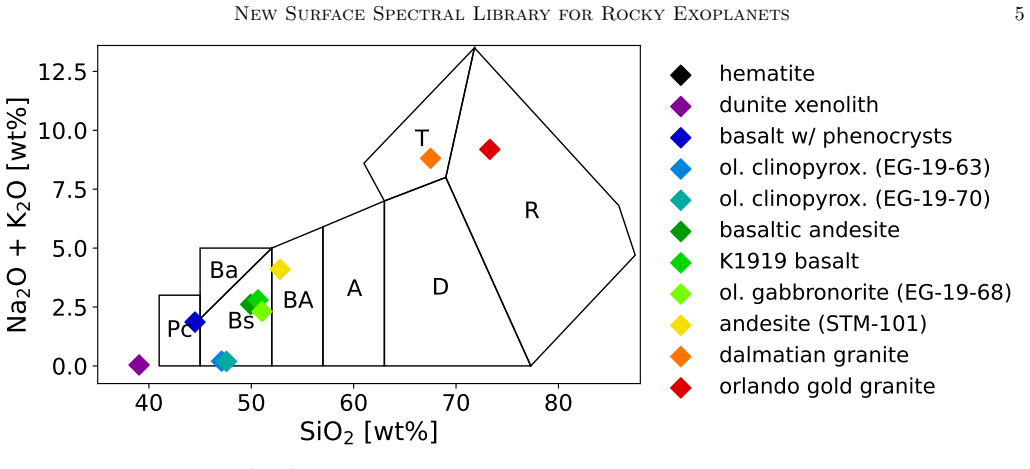
The load-bearing object is the new laboratory spectral library: hemispherical reflectance spectra (0.35 to 25 \mu m, room temperature) of 11 igneous rocks spanning roughly 39 to 73 wt\% SiO$_2$ plus hematite, each prepared as a solid slab, crushed grains (500 \mu m to 1 mm), and fine powder (25 to 63 \mu m), together with direct emissivity measurements of ten samples at 500 to 800 K. The argument runs through the Hapke (2012) conversion from hemispherical reflectance $r_h$ to single-scattering albedo $\omega$ and hemispheric emissivity $\varepsilon_h$, with directional emissivity taken as $\varepsilon_d = 1 - r_h$ in the LHS 3844 b energy-balance model (Eq. 7), which fixes each surface's dayside temperature and predicted eclipse-depth spectrum. A redistribution factor $f$, calibrated against the 2D models of Hu et al. (2012), maps the 1D temperature model onto the flux seen at eclipse. The four diagnostic features, the 5.6 \mu m olivine overtone-combination band, the transparency feature (enhanced multiple scattering of fine grains), the Si-O asymmetric stretch fundamental (8 to 12 \mu m), and the Christiansen feature (emissivity maximum where the refractive index of the material matches the vacuum), are the identities used to separate composition and texture. Detection tests simulate JWST MIRI LRS noise with Pandexo and use nested-sampling Bayes factors on 1000 noise realizations to set the required eclipse counts.
What would settle it
Compare feature depths in direct high-temperature (800 to 1000 K) directional emissivity measurements, taken with a shielded cavity so no sample-cup emission contaminates the spectrum and with propagated uncertainties, against the $\varepsilon_d = 1 - r_h$ prediction from the same samples' room-temperature hemispherical reflectance. If the measured-to-predicted depth ratio differs from the fitted scale factor $s$ by more than the measurement uncertainty, the paper's predicted eclipse-count thresholds shift accordingly; a stacked 5 to 7 eclipse MIRI LRS spectrum of LHS 3844 b that fails to show the expected Si-O or olivine feature would likewise falsify the detection predictions.
Extended reading notes
Core claim
The central claim is that for hot, bare-rock exoplanets observed in thermal emission, albedo alone is a weak and degenerate indicator of surface composition, while spectrally resolved mid-infrared features are the reliable diagnostics. The paper demonstrates this by measuring hemispherical reflectance for 11 igneous rock types in up to three textures and showing that texture changes albedo by up to a factor of seven within a single sample, shifts predicted dayside temperatures by up to 70 K, and can mimic or mask compositional differences. It then shows that the 5.6 \mu m olivine feature, the transparency feature (a steep slope between roughly 4 and 7 \mu m caused by multiple scattering in fine grains), the Si-O stretching feature (8 to 12 \mu m), and the location of the Christiansen feature (7 to 9 \mu m emissivity maximum that tracks SiO$_2$ content) are the features that carry composition and texture information obtainable with JWST MIRI LRS, and it quantifies the observing cost: roughly 5 eclipses to detect a deep Si-O feature (dalmatian granite slab), 7 for the olivine feature (dunite xenolith powder), and 20 for the transparency feature with MIRI LRS alone, improving to 2 NIRSpec G395H plus 3 MIRI LRS eclipses. Applied to LHS 3844 b, the new library shows that one Spitzer 4.5 \mu m measurement admits 18 of the 31 surface-texture combinations, ruling out fine powders but not distinguishing among granite, basalt, and other mafic and ultramafic slabs and crushed rocks. The paper concludes that the absolute depths of emission features predicted from room-temperature reflectance are systematically too large, its own 500 to 800 K emissivity measurements are shallower, so feature presence, shape, and location, rather than albedo or absolute contrast, are the robust observables.
Load-bearing premise
The whole predictive chain rests on the assumption that a room-temperature hemispherical reflectance measurement, converted to emissivity through $\varepsilon_d = 1 - r_h$, reproduces the spectral contrast a JWST would see from a hot planetary surface, but the paper's own 500 to 800 K emission measurements show features coming out systematically shallower, and that offset is absorbed by a fitted scale factor rather than derived from physics.
Editorial extensions
If this is right
- Single-band dayside photometry (for example, one Spitzer or JWST broadband point) cannot uniquely determine the surface composition of a hot bare-rock exoplanet; multi-wavelength mid-infrared spectroscopy is required to break the albedo-texture-composition degeneracy.
- For the most favorable target, LHS 3844 b, a stacked spectrum of about five MIRI LRS eclipses can detect a deep Si-O stretching feature if the surface is coarse-grained, about seven eclipses can detect the olivine feature for an olivine-rich surface, and about twenty MIRI eclipses (or two NIRSpec G395H plus three MIRI) are needed for the transparency feature.
- Existing room-temperature reflectance libraries are adequate for predicting where features appear and whether they should be detectable, but they overstate feature contrast; measured high-temperature emissivities are systematically shallower, so amplitude-based claims should carry the scale-factor caveat.
- On LHS 3844 b, the Spitzer 4.5 \mu m measurement is consistent with most slab and crushed silicate surfaces and with hematite, and inconsistent with fine silicate powders; the earlier conclusion that basaltic surfaces are preferred and feldspathic or granitoid surfaces are excluded no longer holds.
- Temperature-dependent spectral changes (Christiansen feature shifts and Si-O depth changes) are expected to be below the noise floor of current JWST observations of hot rocky planets, so temperature effects do not need to be modeled explicitly for feature detection.
Reading between the lines
- The fitted scale factor $s$ in the emissivity calibration (Eq. 1) is, in effect, an admission that reflectance-derived feature depths are too large; an independent high-temperature emissivity campaign with strict cavity control could turn this correction into a physical model and revise the quoted eclipse counts.
- Because the transparency feature is a grain-size diagnostic, its detectability with combined NIRSpec and MIRI observations suggests a path toward constraining whether exoplanet surfaces are regolith-covered or bedrock, an observable tied to surface age and resurfacing history, not just composition.
- The quasi-linear Christiansen-feature-versus-SiO$_2$ relation, with its texture-dependent offset, could be exploited at lower spectral resolution; a few carefully placed photometric channels (as done for the Moon and Mercury) might classify exoplanet lithologies without full LRS spectra.
- The albedo variability within a single compositional class implies that Bond-albedo-based inferences about a planet's volatile history or interior are fragile; surface texture is a confounder that planetary geology models will need to treat as a free parameter.
Editorial analysis
A structured set of objections, weighed in public.
Referee Report
Summary. The paper presents a new laboratory spectral library of 11 igneous rock samples (ultramafic through felsic, plus hematite) measured in three textures (solid slab, crushed, powder), together with high-temperature (500-800 K) emissivity measurements for a subset of samples. The library is incorporated into PLATON v6.3, and the authors use it to model bare-rock dayside emission spectra of hot rocky exoplanets. The central claims are that (i) albedo is a degenerate and unreliable proxy for surface composition because both composition and texture strongly affect reflectance; (ii) four mid-infrared features (5.6 μm olivine, transparency feature, Si-O stretching, Christiansen feature) are useful diagnostics of silicate abundance and texture; (iii) JWST MIRI LRS detectability of these features on LHS 3844 b requires approximately 7, 20, and 5 eclipse observations respectively; and (iv) published Spitzer 4.5 μm photometry of LHS 3844 b is consistent with a wide range of slab/crushed silicate compositions, contrary to the earlier basaltic-only interpretation. The paper also concludes that temperature-dependent spectral changes are likely too small to detect with current precision.
Significance. If the central claims hold, the paper provides a timely and useful community resource: a broader, well-characterized set of laboratory reflectance and emissivity measurements than the widely used Hu et al. (2012) library, integrated into an open-source retrieval package. The sample characterization (chemical analyses, XRD mineralogy, TAS classification, screening for aqueous alteration) is thorough, and the direct comparison of slab/crushed/powder textures is a genuine addition, as is the high-temperature emissivity dataset. The qualitative conclusion that single-band albedo measurements cannot uniquely identify surface composition is convincingly demonstrated and is robust to the calibration concerns discussed below. The quantitative JWST feasibility forecasts (eclipse counts and Christiansen-feature wavelength constraints) are the most directly actionable claims for observers, and those are precisely the claims most sensitive to the assumed reflectance-to-emissivity conversion.
major comments (3)
- [§4.2, §4.3; Eqs. (1), (8)]
- [§2.4, Eq. (1), Figure 5]
- [§4.2.2–§4.2.4]
minor comments (4)
- [Section 1]
- [Section 2.2.1 / Introduction]
- [Figure 5 caption and §4.3]
- [§4.3]
Circularity Check
No significant circularity: the core claims rest on new laboratory reflectance and emissivity measurements, and the JWST detectability forecasts are explicit conditional sensitivity tests.
full rationale
The paper's central claims are grounded in new, externally measured laboratory data rather than in the model outputs. The albedo degeneracy and texture dependence follow directly from measured hemispherical reflectances for 11 rock types in three textures; these are new data, not quantities defined in terms of the conclusions. The identification of the 5.6 micron olivine feature, transparency feature, Si-O stretching feature, and Christiansen feature is empirical, supported by the measured spectra and compositional analysis, and is framed as a library characterization rather than a derivation from first principles. The JWST eclipse-count forecasts (5, 7, and 20 eclipses for the Si-O, olivine, and transparency features) are conditional signal-injection/recovery tests: the authors simulate Pandexo observations with their modeled spectra as inputs and then test whether a feature-amplitude parameter is recoverable against a feature-removed or blackbody null hypothesis. This is a standard sensitivity forecast and does not claim that the features have been detected on LHS 3844 b. The thresholds depend on the assumed reflectance-to-emissivity conversion, but that is a model assumption, not a circular reduction: epsilon_d = 1 - r_h is Kirchhoff's law applied to the measured reflectance, and the paper explicitly acknowledges in Section 4.3 that directly measured high-temperature emission features are systematically shallower than reflectance-derived emissivities, listing this as a caveat for feature detectability rather than as a validation of the conversion. The scale factor s in Equation 1 is used only for determining the blackbody temperature in the high-temperature emissivity calibration; the calibrated emissivity is computed as the measured intensity divided by the reference blackbody intensity, so the shallower feature depths seen in Figure 5 are data-driven rather than forced by s. The high-temperature measurements themselves are presented with explicit caveats about cup contamination and the lack of an independent empty-cup calibration, which affects model uncertainty but does not constitute circular reasoning. There are self-citations (Hu et al. 2012 for the earlier spectral library and modeling approach; Zhang et al. 2019, 2020, 2024 for PLATON), but the central claims do not reduce to these citations. The new library is measured independently, the energy-balance model is standard, and the f-factor calibration against Hu et al.
Assumptions & free parameters
free parameters (3)
- Scale factor s in emissivity calibration =
not tabulated; each sample/temperature step fitted in range 0 to 1
- Redistribution factor f =
linear coefficients m=-0.137, b=0.620; f values in Table 4 for Hu et al. (2012) surfaces
- Best-fit sample temperature T_best for each emissivity spectrum =
reported in Figure 5 legends, e.g., 497 K, 603 K, 697 K, 795 K, 825 K
assumptions (5)
- domain assumption Hapke model assumptions: particles scatter isotropically, opposition effect negligible, roughness negligible, porosity parameter set to unity
- domain assumption Kirchhoff's law applies: directional emissivity equals 1 minus hemispherical reflectance (ε_d = 1 - r_h)
- domain assumption A single uniform dayside temperature with a redistribution factor f reproduces the 2D dayside temperature gradient models
- domain assumption Laboratory igneous rock samples with minimal aqueous alteration are representative proxies for hot, airless exoplanet surfaces
- domain assumption Pandexo noise simulations and dynesty nested sampling faithfully represent JWST MIRI LRS/NIRSpec performance for eclipse observations
Cite this review
Pith. "Pith review of A New Spectral Library for Modeling the Surfaces of Hot, Rocky Exoplanets." pith.science (2026). https://pith.science/paper/K42XGHCO
@misc{pith2026250204433,
  author       = {Pith},
  title        = {Pith review of: A New Spectral Library for Modeling the Surfaces of Hot, Rocky Exoplanets},
  year         = {2026},
  howpublished = {\url{https://pith.science/paper/K42XGHCO}},
  note         = {Machine review of arXiv:2502.04433}
}
read the original abstract
JWST's MIRI LRS provides the first opportunity to spectroscopically characterize the surface compositions of close-in terrestrial exoplanets. Models for the bare-rock spectra of these planets often utilize a spectral library from R. Hu et al., which is based on room temperature reflectance measurements of materials that represent archetypes of rocky planet surfaces. Here we present an expanded library that includes hemispherical reflectance measurements for a greater variety of compositions, varying textures (solid slab, coarsely crushed, and fine powder), as well as high temperature (500-800 K) emissivity measurements for select samples. We incorporate this new library into version 6.3 of the retrieval package PLATON and use it to show that surfaces with similar compositions can have widely varying albedos and surface temperatures. We additionally demonstrate that changing the texture of a material can significantly alter its albedo, making albedo a poor proxy for surface composition. We identify key spectral features -- the 5.6 \textmu{m} olivine feature, the transparency feature, the Si-O stretching feature, and the Christiansen feature -- that indicate silicate abundance and surface texture. We quantify the number of JWST observations needed to detect these features in the spectrum of the most favorable super-Earth target, LHS 3844 b, and revisit the interpretation of its Spitzer photometry. Lastly, we show that temperature-dependent changes in spectral features are likely undetectable at the precision of current exoplanet observations. Our results illustrate the importance of spectroscopically-resolved thermal emission measurements, as distinct from surface albedo constraints, for characterizing the surface compositions of hot, rocky exoplanets.
Figures


Figures from the paper (12 more)


Forward citations
Cited by 3 Pith papers
-
First JWST thermal phase curves of temperate terrestrial exoplanets reveal no thick atmosphere around TRAPPIST-1 b and c
First JWST phase curves of TRAPPIST-1 b and c rule out thick, heat-redistributing atmospheres; b is likely airless, c may retain a tenuous O2 atmosphere.
-
Silicate mineralogy and bulk composition of exoplanetary material in polluted white dwarfs
New ultraviolet abundances for two white dwarfs, combined with a re-analysis of eight systems, support a tentative correlation between the Mg/Si ratio of accreted exoplanetary material and whether its dust is olivine-...
-
A first look at rocky exoplanets with JWST
This review of JWST rocky exoplanet observations finds no confirmed atmospheres and sets a five scale height precision target for future transmission spectroscopy.
Reference graph
Works this paper leans on
-
[1]
, " * write output.state after.block = add.period write newline
ENTRY address archivePrefix author booktitle chapter doi edition editor eprint howpublished institution journal key month number organization pages publisher school series title misctitle type volume year version url label extra.label sort.label short.list INTEGERS output.state before.all mid.sentence after.sentence after.block FUNCTION init.state.consts ...
-
[2]
write newline
" write newline "" before.all 'output.state := FUNCTION format.url url empty "" new.block "" url * "" * if FUNCTION format.eprint eprint empty "" archivePrefix empty "" archivePrefix "arXiv" = new.block " " eprint * " " * new.block " " eprint * " " * if if if FUNCTION format.doi doi empty "" " " doi * " " * if FUNCTION format.pid doi empty eprint empty ur...
-
[3]
Se w3l T1V|2K ۬^lf| 7 e0 L3x?f5yp |1hĈJf-l þ4nޢ 4A lja 6n[GCL Fq 6* c1 6<s4l ¶#fnIfHCjݝ 3y]9n'38`^ Ef # R կ)!l zj> 7ތw lj6Ù|>XlK a Gk2Z˽!Ɂ ? oA/ ۘ|; mWa oo[gGG e6 gl h(<¡؛MOvmsKbˏ
thebibliography [1] 20pt to REFERENCES 6pt =0pt -12pt 10pt plus 3pt =0pt =0pt =1pt plus 1pt =0pt =0pt -12pt =13pt plus 1pt =20pt =13pt plus 1pt \@M =10000 =-1.0em =0pt =0pt 0pt =0pt =1.0em @enumiv\@empty 10000 10000 `\.\@m \@noitemerr \@latex@warning Empty `thebibliography' environment \@ifnextchar \@reference \@latexerr Missing key on reference command E...
2021
-
[4]
Anderson , D. E., Ehlmann , B. L., Forni , O., et al. 2017, Journal of Geophysical Research (Planets), 122, 744, 10.1002/2016JE005164
-
[5]
E., Mandell , A., Pontoppidan , K., et al
Batalha , N. E., Mandell , A., Pontoppidan , K., et al. 2017, , 129, 064501, 10.1088/1538-3873/aa65b0
-
[6]
Bowey , J. E., & Hofmeister , A. M. 2005, , 358, 1383, 10.1111/j.1365-2966.2005.08848.x
arXiv 2005
-
[7]
Brinkman , C. L., Polanski , A. S., Huber , D., et al. 2024 a , arXiv e-prints, arXiv:2409.08361, 10.48550/arXiv.2409.08361
-
[8]
Brinkman , C. L., Weiss , L. M., Huber , D., et al. 2024 b , arXiv e-prints, arXiv:2410.00213, 10.48550/arXiv.2410.00213
Show all 77 references
-
[9]
L., & Zuber , M
Charlier , B., Grove , T. L., & Zuber , M. T. 2013, Earth and Planetary Science Letters, 363, 50, 10.1016/j.epsl.2012.12.021
2013 doi
-
[10]
R., Bandfield , J
Christensen , P. R., Bandfield , J. L., Hamilton , V. E., et al. 2001, , 106, 23823, 10.1029/2000JE001370
2001 doi
-
[11]
Clark, R. N. 1999, Spectroscopy of Rocks and Minerals and Principles of Spectroscopy (Wiley), 3–58
1999
-
[12]
Conel , J. E. 1969, , 74, 1614, 10.1029/JB074i006p01614
1969 doi
-
[13]
L., Salisbury , J
Cooper , B. L., Salisbury , J. W., Killen , R. M., & Potter , A. E. 2002, Journal of Geophysical Research (Planets), 107, 5017, 10.1029/2000JE001462
2002 doi
-
[14]
Crossfield , I. J. M., Malik , M., Hill , M. L., et al. 2022, , 937, L17, 10.3847/2041-8213/ac886b
2022 doi
-
[15]
N., & Zeng , L
Dai , F., Masuda , K., Winn , J. N., & Zeng , L. 2019, , 883, 79, 10.3847/1538-4357/ab3a3b
2019 doi
-
[16]
L., Chapman , C
Domingue , D. L., Chapman , C. R., Killen , R. M., et al. 2014, , 181, 121, 10.1007/s11214-014-0039-5
2014 doi
-
[17]
L., Greenhagen , B
Donaldson Hanna , K. L., Greenhagen , B. T., Patterson , W. R., et al. 2017, , 283, 326, 10.1016/j.icarus.2016.05.034
2017 doi
-
[18]
L., & Edwards, C
Ehlmann, B. L., & Edwards, C. S. 2014, Annual Review of Earth and Planetary Sciences, 42, 291, https://doi.org/10.1146/annurev-earth-060313-055024
2014 doi
-
[19]
T., Hess , P
Elkins-Tanton , L. T., Hess , P. C., & Parmentier , E. M. 2005, Journal of Geophysical Research (Planets), 110, E12S01, 10.1029/2005JE002480
2005 doi
-
[20]
2020, Earth and Planetary Science Letters, 534, 116089, 10.1016/j.epsl.2020.116089
Ferrari , S., Maturilli , A., Carli , C., et al. 2020, Earth and Planetary Science Letters, 534, 116089, 10.1016/j.epsl.2020.116089
2020
-
[21]
C., Mishra , I., Gazel , E., et al
First , E. C., Mishra , I., Gazel , E., et al. 2024, Nature Astronomy, 10.1038/s41550-024-02412-7
2024 doi
-
[22]
B., et al
Fortin , M.-A., Gazel , E., Williams , D. B., et al. 2024, , 974, L7, 10.3847/2041-8213/ad7d89
2024 doi
-
[23]
2022, Earth and Planetary Science Letters, 577, 117255, 10.1016/j.epsl.2021.117255
Gaillard , F., Bernadou , F., Roskosz , M., et al. 2022, Earth and Planetary Science Letters, 577, 117255, 10.1016/j.epsl.2021.117255
2022
-
[24]
D., Lucey , P
Glotch , T. D., Lucey , P. G., Bandfield , J. L., et al. 2010, Science, 329, 1510, 10.1126/science.1192148
2010 doi
-
[25]
P., Bell , T
Greene , T. P., Bell , T. J., Ducrot , E., et al. 2023, , 618, 39, 10.1038/s41586-023-05951-7
2023 doi
-
[26]
H., et al
Gressier , A., Espinoza , N., Allen , N. H., et al. 2024, , 975, L10, 10.3847/2041-8213/ad73d1
2024 doi
- [27]
-
[28]
Hansen , B. M. S. 2008, , 179, 484, 10.1086/591964
2008 doi
-
[29]
2001, , 106, 10039, 10.1029/2000JE001338
Hapke , B. 2001, , 106, 10039, 10.1029/2000JE001338
2001 doi
-
[30]
2012, Theory of Reflectance and Emittance Spectroscopy (Cambridge University Press), 10.1017/CBO9781139025683
---. 2012, Theory of Reflectance and Emittance Spectroscopy (Cambridge University Press), 10.1017/CBO9781139025683
2012 doi
-
[31]
2013, Earth and Planetary Science Letters, 371, 252, 10.1016/j.epsl.2013.03.038
Helbert , J., Nestola , F., Ferrari , S., et al. 2013, Earth and Planetary Science Letters, 371, 252, 10.1016/j.epsl.2013.03.038
2013 doi
-
[32]
2020, , 216, 110, 10.1007/s11214-020-00732-4
Hiesinger , H., Helbert , J., Alemanno , G., et al. 2020, , 216, 110, 10.1007/s11214-020-00732-4
2020 doi
-
[33]
L., & Seager , S
Hu , R., Ehlmann , B. L., & Seager , S. 2012, , 752, 7, 10.1088/0004-637X/752/1/7
2012 doi
-
[34]
2024, , 630, 609, 10.1038/s41586-024-07432-x
Hu , R., Bello-Arufe , A., Zhang , M., et al. 2024, , 630, 609, 10.1038/s41586-024-07432-x
2024 doi
-
[35]
2002, Bull Volcanol, 64, 229, 10.1007/s00445-001-0196-8
Kauahikaua , J., Cashman , K., Clague , D., Champion , D., & Hagstrum , J. 2002, Bull Volcanol, 64, 229, 10.1007/s00445-001-0196-8
2002 doi
-
[36]
Kreidberg , L., Koll , D. D. B., Morley , C., et al. 2019, , 573, 87, 10.1038/s41586-019-1497-4
2019 doi
- [37]
-
[38]
2023, , 955, L22, 10.3847/2041-8213/acf7c4
Lim , O., Benneke , B., Doyon , R., et al. 2023, , 955, L22, 10.3847/2041-8213/acf7c4
2023 doi
-
[39]
M., Hunt , G
Logan , L. M., Hunt , G. R., Salisbury , J. W., & Balsamo , S. R. 1973, , 78, 4983, 10.1029/JB078i023p04983
1973 doi
-
[40]
2022, Science, 377, 1211, 10.1126/science.abl7164
Luque , R., & Pall \'e , E. 2022, Science, 377, 1211, 10.1126/science.abl7164
2022 doi
-
[41]
M., et al
Lustig-Yaeger , J., Fu , G., May , E. M., et al. 2023, Nature Astronomy, 7, 1317, 10.1038/s41550-023-02064-z
2023 doi
-
[42]
S., Hu , R., et al
Mansfield , M., Kite , E. S., Hu , R., et al. 2019, , 886, 141, 10.3847/1538-4357/ab4c90
2019 doi
-
[43]
2014, Journal of Applied Remote Sensing, 8, 084985, 10.1117/1.JRS.8.084985
Maturilli , A., & Helbert , J. 2014, Journal of Applied Remote Sensing, 8, 084985, 10.1117/1.JRS.8.084985
2014 doi
-
[44]
2019, in Society of Photo-Optical Instrumentation Engineers (SPIE) Conference Series, Vol
Maturilli , A., Helbert , J., & Arnold , G. 2019, in Society of Photo-Optical Instrumentation Engineers (SPIE) Conference Series, Vol. 11128, Infrared Remote Sensing and Instrumentation XXVII, ed. M. Strojnik & G. E. Arnold , 111280T, 10.1117/12.2529266
2019 doi
-
[45]
2006, , 54, 1057, 10.1016/j.pss.2005.12.021
Maturilli , A., Helbert , J., Witzke , A., & Moroz , L. 2006, , 54, 1057, 10.1016/j.pss.2005.12.021
2006 doi
-
[46]
M., MacDonald , R
May , E. M., MacDonald , R. J., Bennett , K. A., et al. 2023, , 959, L9, 10.3847/2041-8213/ad054f
2023 doi
-
[47]
E., Hiroi , T., Scholes , D., Slavney , S., & Arvidson , R
Milliken , R. E., Hiroi , T., Scholes , D., Slavney , S., & Arvidson , R. 2021, in LPI Contributions, Vol. 2654, Astromaterials Data Management in the Era of Sample-Return Missions Community Workshop, 2021
2021
-
[48]
E., Stevenson , K
Moran , S. E., Stevenson , K. B., Sing , D. K., et al. 2023, , 948, L11, 10.3847/2041-8213/accb9c
2023 doi
-
[49]
F., & Hays , J
Mustard , J. F., & Hays , J. E. 1997, , 125, 145, 10.1006/icar.1996.5583
1997
- [50]
-
[51]
A., Foote , M
Paige , D. A., Foote , M. C., Greenhagen , B. T., et al. 2010, , 150, 125, 10.1007/s11214-009-9529-2
2010 doi
-
[52]
Rogers , L. A. 2015, , 801, 41, 10.1088/0004-637X/801/1/41
2015 doi
-
[53]
R., & Ehlmann, B
Rossman, G. R., & Ehlmann, B. L. 2019, Electronic Spectra of Minerals in the Visible and Near-Infrared Regions, Cambridge Planetary Science (Cambridge University Press), 3–20
2019
-
[54]
W., Christensen , P
Ruff , S. W., Christensen , P. R., Barbera , P. W., & Anderson , D. L. 1997, , 102, 14899, 10.1029/97JB00593
1997 doi
-
[55]
Salisbury, J. W. 1993, Mid-Infrared Spectroscopy: Laboratory Data, Cambridge Planetary Science (Cambridge University Press)
1993
-
[56]
W., D'Aria , D
Salisbury , J. W., D'Aria , D. M., & Jarosewich , E. 1991, , 92, 280, 10.1016/0019-1035(91)90052-U
1991 doi
-
[57]
W., Wald , A., & D'Aria , D
Salisbury , J. W., Wald , A., & D'Aria , D. M. 1994, , 99, 11897, 10.1029/93JB03600
1994 doi
-
[58]
W., & Walter , L
Salisbury , J. W., & Walter , L. S. 1989, , 94, 9192, 10.1029/JB094iB07p09192
1989 doi
-
[59]
2009, , 703, 1884, 10.1088/0004-637X/703/2/1884
Seager , S., & Deming , D. 2009, , 703, 1884, 10.1088/0004-637X/703/2/1884
2009 doi
-
[60]
Speagle , J. S. 2020, , 493, 3132, 10.1093/mnras/staa278
2020 doi
-
[61]
Thayer, T. P. 1934, PhD thesis, Division of Geological and Planetary Sciences, California Institute of Technology
1934
- [62]
-
[63]
X., Vanderburg , A., et al
Vanderspek , R., Huang , C. X., Vanderburg , A., et al. 2019, , 871, L24, 10.3847/2041-8213/aafb7a
2019 doi
-
[64]
K., Diamond-Lowe , H., et al
Wachiraphan , P., Berta-Thompson , Z. K., Diamond-Lowe , H., et al. 2024, arXiv e-prints, arXiv:2410.10987, 10.48550/arXiv.2410.10987
2024 doi
-
[65]
2024, , 975, L22, 10.3847/2041-8213/ad8161
Weiner Mansfield , M., Xue , Q., Zhang , M., et al. 2024, , 975, L22, 10.3847/2041-8213/ad8161
2024 doi
- [66]
-
[67]
A., Malik , M., Ih , J., et al
Whittaker , E. A., Malik , M., Ih , J., et al. 2022, , 164, 258, 10.3847/1538-3881/ac9ab3
2022 doi
-
[68]
2015, , 806, 183, 10.1088/0004-637X/806/2/183
Wolfgang , A., & Lopez , E. 2015, , 806, 183, 10.1088/0004-637X/806/2/183
2015 doi
-
[69]
2022, , 60, 159, 10.1146/annurev-astro-052920-125632
Wordsworth , R., & Kreidberg , L. 2022, , 60, 159, 10.1146/annurev-astro-052920-125632
2022 doi
-
[70]
L., Zhang , M., et al
Xue , Q., Bean , J. L., Zhang , M., et al. 2024, , 973, L8, 10.3847/2041-8213/ad72e9
2024 doi
-
[71]
J., & Catling , D
Zahnle , K. J., & Catling , D. C. 2017, , 843, 122, 10.3847/1538-4357/aa7846
2017 doi
-
[72]
Zhang , M., Chachan , Y., Kempton , E. M. R., & Knutson , H. A. 2019, , 131, 034501, 10.1088/1538-3873/aaf5ad
2019 doi
-
[73]
Zhang , M., Chachan , Y., Kempton , E. M. R., Knutson , H. A., & Chang , W. H. 2020, , 899, 27, 10.3847/1538-4357/aba1e6
2020 doi
-
[74]
2024, , 961, L44, 10.3847/2041-8213/ad1a07
Zhang , M., Hu , R., Inglis , J., et al. 2024, , 961, L44, 10.3847/2041-8213/ad1a07
2024 doi
-
[75]
2023, , 391, 115346, 10.1016/j.icarus.2022.115346
Zhuang , Y., Zhang , H., Ma , P., et al. 2023, , 391, 115346, 10.1016/j.icarus.2022.115346
2023
-
[76]
2022, , 664, A79, 10.1051/0004-6361/202142912
Zieba , S., Zilinskas , M., Kreidberg , L., et al. 2022, , 664, A79, 10.1051/0004-6361/202142912
2022 doi
-
[77]
2023, , 620, 746, 10.1038/s41586-023-06232-z
Zieba , S., Kreidberg , L., Ducrot , E., et al. 2023, , 620, 746, 10.1038/s41586-023-06232-z
2023 doi
Reviewed August 8, 2026 · model on record in the stance chip above.
Discussion (0). Continue with ORCID to comment.