REVIEW 3 major objections 4 minor 56 references
Evidence of Athermal Metastable Phase in a Halide Perovskite: Optically Tracked Thermal-Breach Memory
T0 review · 3 major / 4 minor · reviewed 2026-08-08 · deepseek-v4-flash
Pith's one-line read Thermal history is stored and read out in the luminescence of MAPbI3, a halide perovskite.
desk verdict A bold, well-argued claim of athermal metastability and thermal-breach memory in MAPbI3, with two independent probes, that still needs raw data and error bars before I'd bet on it. read the letter →
The pith
A machine-rendered reading of the paper's core claim, the machinery that carries it, and where it could break.
The reading
What carries the argument
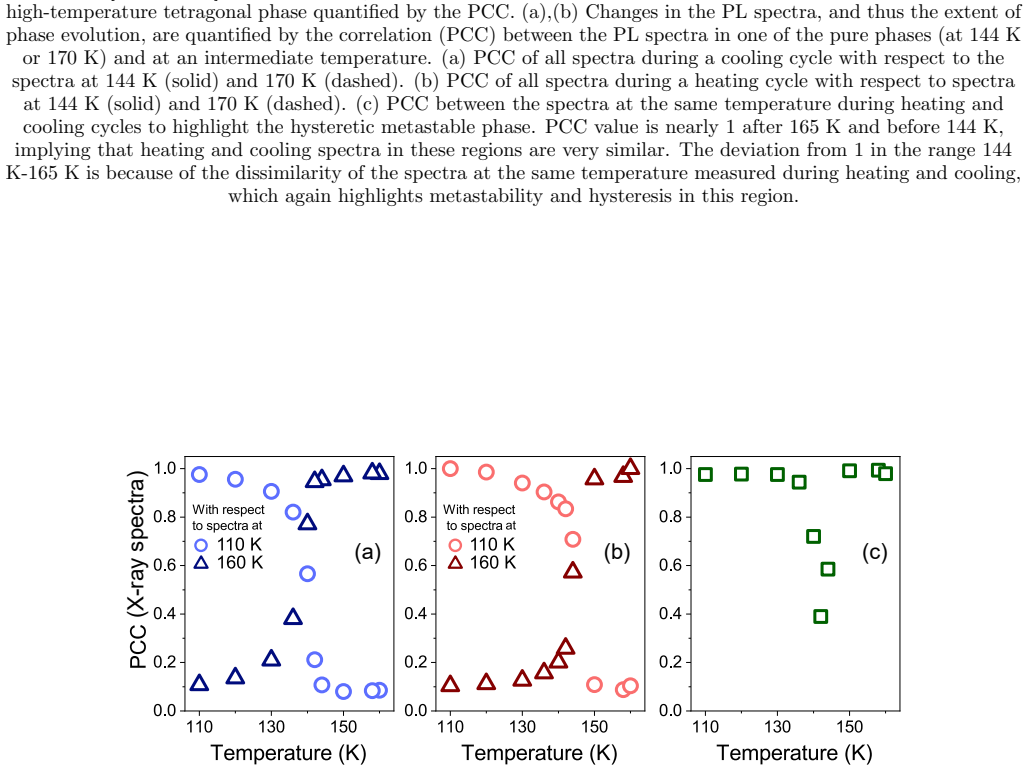
The central object is the metastable mixed-phase region inside the hysteresis loop, modeled as an ensemble of Preisach hysterons: bistable switches with distinct heating and cooling switching temperatures, visualized as a triangle in the (T_c raise, T_h raise) plane. The Pearson correlation coefficient between successive photoluminescence spectra serves as a highly sensitive, absolute-intensity-free measure of phase-fraction change, with the x-ray (202)/(220) peak ratio providing an independent structural confirmation. Return-point memory is demonstrated through nested minor thermal loops whose states correspond to two-color configurations of the Preisach triangle; the vertical- and horizontal-sweep switching rules reproduce both the hierarchical encoding and the sequential erasure of states as temperature crosses each reversal point.
What would settle it
Perform a month-long isothermal hold at 158.000 ± 0.005 K on a MAPbI3 sample prepared in a known metastable state, recording the orthorhombic (202) and tetragonal (220) x-ray diffraction intensities and photoluminescence spectra continuously; if the phase-fraction ratio drifts beyond the roughly 2e-5 Pearson correlation noise, or if the logarithmic integrated-luminescence creep is mirrored by the x-ray phase fraction, the athermal-arrest claim is falsified. Repeating the same test at several temperatures inside the 144-164 K window would show whether the arrest is generic or peculiar to 158 K.
Extended reading notes
Core claim
The paper reports that the hysteretic orthorhombic-to-tetragonal phase transition in MAPbI3 behaves as an athermal martensitic transition rather than a classical first-order transition governed by diffusive nucleation. The metastable mixed-phase states inside the hysteresis loop are arrested: holding the sample at 158.000 ± 0.005 K for 12 hours leaves the photoluminescence spectrum essentially unchanged, and equivalent x-ray diffraction measurements show the orthorhombic and tetragonal phase fractions are likewise stationary. The states are path-dependent and deterministic; small thermal spikes applied to these states either recover completely, demonstrating return-point memory, or drive a nonrecoverable phase evolution, depending on how the state was prepared and on the sign of the spike. The spectral change induced by a nonrecoverable spike is detectable at the 1 K level, making the material an optically readable thermal-breach sensor.
Load-bearing premise
The athermal claim collapses if the photoluminescence spectral shape and the x-ray peak intensities are not faithful measures of phase fraction, or if a hold longer than 12 hours (or at a different temperature) reveals slow phase evolution; the paper itself attributes a small logarithmic drift in integrated photoluminescence intensity to defect healing, not phase evolution.
Editorial extensions
If this is right
- Isothermal holds at fixed temperature produce essentially no phase evolution, so the metastable phase can serve as a stable, optically readable state that does not require continuous power or active stabilization.
- A hierarchy of roughly 2^20 - 1, about 10^6, distinguishable hierarchical states is accessible within the approximately 20 K hysteresis window at 1 K resolution, according to the authors' counting based on nested temperature reversals.
- A thermal spike of only 1 K produces a change of about 10^-3 in the spectral Pearson correlation coefficient, making sub-kelvin thermal breaches detectable without measuring absolute photoluminescence intensity.
- The return-point memory behavior is observed both in photoluminescence and in x-ray phase fractions, indicating the effect is a bulk structural property rather than an optical artifact.
- Return-point memory implies that the material can also store hierarchical information, not just binary bits, with the hierarchy being sequentially erased as temperature excursions cross their previous reversal points.
Reading between the lines
- Editorial inference: other halide perovskites and martensitic materials with sensitive phase-fraction probes may exhibit the same athermal arrest and thermal-breach memory, which would make the memory effect a general materials phenomenon rather than a MAPbI3-specific curiosity.
- Editorial inference: the small logarithmic increase in integrated photoluminescence intensity reported in the Supplementary Material could be directly tested against x-ray phase fractions; if the phase fraction stays truly arrested while the intensity creeps, the defect-healing attribution is confirmed, and if the phase fraction drifts, the athermal claim would need revision.
- Editorial inference: the 2^N - 1 state-counting estimate assumes 1 K resolution and deterministic switching; a direct experimental census of states prepared by all temperature-reversal sequences up to N = 20 would test whether the counting and the independence of states hold in practice.
- Editorial inference: since the readout uses spectral shape rather than absolute intensity, the same procedure could work across different spectrometers and sample geometries, suggesting a practical tamper-evident coating for temperature-controlled transport.
Signed reviews
Editorial analysis
A structured set of objections, weighed in public.
Referee Report
Summary. The paper reports that the orthorhombic-to-tetragonal phase transition in MAPbI3 is athermal: within the thermal hysteresis window, isothermal holds at a fixed temperature show almost no temporal evolution of the phase, as inferred from the constancy of a photoluminescence (PL) spectral overlap coefficient and corroborated by powder XRD. The authors further show that thermal cycling prepares many distinguishable metastable states exhibiting return-point memory, that a thermal spike in one direction causes a nonrecoverable phase change while the opposite spike is recoverable ('thermal-breach memory'), and that the phenomenology is captured by a Preisach hysteron model. The claimed applications include optically readable tags for thermal-history breaches.
Significance. If the athermal claim holds, this is a striking and potentially high-impact result: a thermally driven first-order transition whose metastable states are kinetically arrested against diffusive evolution, reminiscent of martensites, in a widely studied halide perovskite. The paper has solid strengths: the experiments are direct, combining PL spectroscopy and powder XRD; the temperature stability of ±0.005 K is excellent; the return-point memory is demonstrated by nested cycling in both PL and XRD; and the Preisach model provides a quantitative consistency check. The claim of optically readable thermal-breach memory is plausible and would be of practical interest. The main risk is that the central quantitative evidence for the athermal character, the PCC constancy in Fig. 2(c), is based on a metric whose sensitivity to small phase-fraction changes is not established; this must be addressed before the central claim can be accepted.
major comments (3)
- [Eq. (1), Fig. 2(c)] The constancy of C(t0,tk) to 2×10^-5 is the primary quantitative evidence for arrested phase evolution, but the metric in Eq. (1) is an uncentered cosine similarity, not the Pearson correlation coefficient, and its first-order sensitivity to a phase-fraction change vanishes. If the mixed-phase spectrum is S(f)=fO+(1-f)T, then for small δf one finds 1-C ∝ δf^2 times a factor set by the spectral contrast ||O-T||^2/||S||^2. Using the reported dynamic range (C≈0.7 between the 144 K and 170 K spectra), a 1% phase-fraction drift would already produce 1-C≈3×10^-5, comparable to the quoted 2×10^-5 bound. The paper should therefore provide a phase-fraction decomposition of the PL spectra into the two end-member components, or explicitly derive an upper bound on δf from the PCC sensitivity, before claiming that the spectral shape is 'arrested to a much higher degree' than the intensity (footnote 43).
- [Supplement VIII, Fig. 14] The argument that the few-percent logarithmic increase in integrated PL intensity is unrelated to phase evolution rests on the observation that the increase has the same sign for two protocols that, if phase evolution were occurring, would be expected to show opposite signs. This is a plausible but indirect test; it assumes that the PL-intensity/phase-fraction relation is identical for the two histories and that defect healing and mechanical accommodation do not also have history-dependent components. A direct check would be to monitor a phase-fraction-sensitive observable independent of the uncentered PCC during the same isothermal hold (e.g., the weight of the orthorhombic (202) reflection) and to state the resulting bound on the phase-fraction drift.
- [Fig. 4(e)-(f)] The XRD time trace used to corroborate the absence of phase evolution is reported without error bars or a specified time sampling. If panels (e) and (f) show only two scans taken at the start and end of an isothermal hold, the counting statistics of the peak intensities must be quantified to demonstrate that the measurement is sensitive enough to rule out a percent-level drift in the phase fraction; the reader should be informed of the integration time per scan, the number of scans during the hold, and the uncertainty in the extracted phase fraction.
minor comments (4)
- [Eq. (1) and text throughout] The quantity C defined in Eq. (1) is called the Pearson correlation coefficient, but it omits mean subtraction and is actually the cosine similarity of the two spectra. Please use the correct name or define the centered Pearson coefficient explicitly.
- [Fig. 2] The text states that 'Figure 2(c) shows that C(t0, tk)... is constant within 2×10^-5', but panel (c) (and panel (d)) display the PL spectra, while the PCC values are shown in panels (e) and (f); the reference should be corrected.
- [Supplement VII, Eq. (3)] The state count 2^N−1 in Eq. (3) counts distinct temperature-reversal histories but not necessarily distinct optically measured phase-fraction states; the text should clarify that this is an upper bound under the Preisach assumption and is not a demonstration of 10^6 distinguishable optical readouts.
- [Fig. 4(d), Supplement II] The quantity called 'phase fraction' is defined in the supplement as I[O]/(I[O]+I[T]); given that the hysteresis loop in Fig. 4(d) likely plots the orthorhombic fraction, please define the quantity explicitly in the main text to avoid ambiguity about which phase fraction is shown.
Circularity Check
No circularity: the athermal claim rests on direct isothermal PL and XRD observations, and the Preisach fit is a consistency check rather than a load-bearing derivation.
full rationale
The central claim of an athermal metastable phase is supported by direct measurements: isothermal PL spectra held at 158.000 +/- 0.005 K showing spectral-shape arrest to 2e-5 over 12 h (Eq. 1 and Fig. 2), and powder XRD phase fractions showing the same arrest and thermal-breach behavior (Fig. 4). These are measurements of observable spectra and diffraction peaks, not outputs of a fitted model, so the athermal conclusion is not derived from its own assumptions. The Preisach measure is fitted to first-order reversal curves in Supplement VI and then used to visualize the return-point memory experiment of Fig. 5; the paper explicitly calls this an interpretation and visualization tool, and the return-point memory itself is observed directly in both PL (Fig. 5, Supplement V) and XRD (Supplement Fig. 10). Thus no prediction reduces by construction to a fit. The uncentered PCC metric's quadratic insensitivity to small phase-fraction drift, and the attribution of logarithmic integrated-intensity creep to defect healing rather than phase evolution, are robustness and interpretation concerns that affect confidence in the quantitative bound but do not constitute circularity: the paper's own XRD phase-fraction data provide an independent, if less dense, check. Self-citations (Refs. 21, 22, 24, 25, 49) are background citations and are not load-bearing, and no uniqueness theorem is imported from the authors' prior work. The paper also explicitly acknowledges its limitations, including the absence of a microscopic mechanism and the unresolved statistical mechanics of finite-temperature athermal behavior, which is consistent with a non-circular report of an empirical phenomenology.
Assumptions & free parameters
free parameters (3)
- S, t0 (logarithmic relaxation parameters) =
fit values not reported in text
- Preisach measure mu(Th,Tc) =
derived from FORC data (Supplement Fig. 12)
- Temperature resolution delta T = 1 K =
1 K
assumptions (4)
- domain assumption PL spectral shape and integrated PL intensity track the orthorhombic-to-tetragonal phase fraction monotonically.
- domain assumption A 12-hour isothermal hold at one temperature is enough to establish that the metastable phase is athermal.
- ad hoc to paper The logarithmic increase of integrated PL intensity over time is caused by defect healing or mechanical accommodation, not by phase evolution.
- domain assumption The metastable phase can be represented as an ensemble of noninteracting Preisach hysterons.
Cite this review
Pith. "Pith review of Evidence of Athermal Metastable Phase in a Halide Perovskite: Optically Tracked Thermal-Breach Memory." pith.science (2026). https://pith.science/paper/SY2L3WLG
@misc{pith2026250204534,
  author       = {Pith},
  title        = {Pith review of: Evidence of Athermal Metastable Phase in a Halide Perovskite: Optically Tracked Thermal-Breach Memory},
  year         = {2026},
  howpublished = {\url{https://pith.science/paper/SY2L3WLG}},
  note         = {Machine review of arXiv:2502.04534}
}
read the original abstract
Halide perovskite materials have been extensively studied in the last decade because of their impressive optoelectronic properties. However, their one characteristic that is uncommon for semiconductors is that many undergo thermally induced structural phase transitions. The transition is hysteretic, with the hysteresis window marking the boundary of the metastable phase. We have discovered that in methylammonium lead iodide, this hysteretic metastable phase is athermal, meaning it shows almost no temporal phase evolution under isothermal conditions. We also show that a large number of distinguishable metastable states can be prepared following different thermal pathways. Furthermore, under a reversible thermal perturbation, the states in the metastable phase either show return-point memory or undergo a systematic nonrecoverable phase evolution, depending on the thermal history and the sign of the temperature perturbation. Since the phase fraction can be probed with extreme sensitivity via luminescence, we have an optically retrievable memory that reliably records any breach in temperature stability. Such thermal-breach memory in athermal martensites, of which there are numerous examples, may be useful for tagging packages requiring strict temperature control during transportation or preservation.
Figures


Figures from the paper (16 more)




Reference graph
Works this paper leans on
-
[1]
P. M. Chaikin and T. C. Lubensky, Principles of Con- densed Matter Physics (Cambridge University Press, Cambridge, England, 1995)
work page 1995
-
[2]
M. Stern and A. Murugan, Learning without neurons in physical systems, Annu. Rev. Condens. Matter Phys. 14, 417 (2023)
work page 2023
-
[3]
We have further shown that PCC [Figs
is recorded via a nonrecoverable phase evolution and a corresponding change in the emission spectrum. We have further shown that PCC [Figs. 3(d) and 3(h)] with respect to the original spectrum makes a sensitive and reliable measure of the breach. Moreover, PCC does not require the knowledge of the absolute PL intensity and thus, can easily be computed fro...
work page 2018
-
[4]
N. C. Keim, J. D. Paulsen, Z. Zeravcic, S. Sastry, and S. R. Nagel, Memory formation in matter, Rev. Mod. Phys. 91, 035002 (2019)
2019
-
[5]
H. Bensea and M. van Hecke, Complex pathways and memory in compressed corrugated sheets, Proc. Nat. Acad. Sci. U.S.A. 118, e2111436118 (2021)
work page 2021
-
[6]
Mungan, Putting memories on paper, Proc
M. Mungan, Putting memories on paper, Proc. Nat. Acad. Sci. U.S.A., 119, e2208743119 (2022)
work page 2022
-
[7]
Y. V. Pershin and M. Di Ventra, Memory effects in com- plex materials and nanoscale systems, Adv. Phys. 60, 145 (2011)
work page 2011
-
[8]
T. F. Nova, A. S. Disa, M. Fechner, and A. Cavalleri, Metastable ferroelectricity in optically strained SrTiO 3, Science 364, 1075 (2019)
2019
Show all 56 references
-
[9]
Ordonez-Miranda, Y
J. Ordonez-Miranda, Y. Ezzahri, J. A. Tiburcio-Moreno, K. Joulain, and J. Drevillon, Radiative thermal memris- tor, Phys. Rev. Lett. 123, 025901 (2019)
2019
-
[10]
Jiang, X
Y. Jiang, X. Ma, L. Wang, J. Zhang, Z. Wang, R. Zhao, G. Liu, Y. Li, C. Zhang, C. Ma, Y. Qi, L. Wu, and J. Gao, Observation of electric hysteresis, polarization os- cillation, and pyroelectricity in nonferroelectric p–n het- erojunctions, Phys. Rev. Lett. 130, 196801 (2023)
2023
-
[11]
J. A. Barker, D. E. Schreiber, B. G. Huth, and D. H. Everett, Magnetic hysteresis and minor loops: Models and experiments, Proc. R. Soc. A 386, 251 (1983)
1983
-
[12]
Mayergoyz, Mathematical Models of Hysteresis and their Applications 2nd ed
I. Mayergoyz, Mathematical Models of Hysteresis and their Applications 2nd ed. (Elsevier, New York 2003)
2003
-
[13]
Bertotti, Hysteresis in Magnetism (Academic Press, San Diego 1998)
G. Bertotti, Hysteresis in Magnetism (Academic Press, San Diego 1998)
1998
-
[14]
Kronm¨ uller and M
H. Kronm¨ uller and M. F¨ ahnle, Micromagnetism and the Microstructure of Ferromagnetic Solids (Cambridge Uni- versity Press, Cambridge, England, 2003)
2003
-
[15]
Reichhardt, I
C. Reichhardt, I. Regev, K. Dahmen, S. Okuma, and C. J. O. Reichhardt, Reversible to irreversible transitions in periodic driven many-body systems and future directions for classical and quantum systems, Phys. Rev. Res. 5, 021001 (2023)
2023
-
[16]
Candela, Complex memory formation in frictional granular media, Phys
D. Candela, Complex memory formation in frictional granular media, Phys. Rev. Lett. 130, 268202 (2023)
2023
-
[17]
T. M. Brenner, D. A. Egger, L. Kronik, G. Hodes, and D. Cahen, Hybrid organic–inorganic perovskites: Low-cost semiconductors with intriguing charge-transport proper- ties, Nat. Rev. Mater. 1, 15007 (2016)
2016
-
[18]
Hutter, M
M. Hutter, M. C. G´ elvez-Rueda, A. Osherov, V. Bulovic, F. C. Grozema, S. D. Stranks, and T. J. Savenije, Direct- indirect character of the bandgap in methylammonium lead iodide perovskite, Nat. Mat. 16, 115 (2017)
2017
-
[19]
Keshavarz, M
M. Keshavarz, M. Ottesen, S. Wiedmann, M. Wharmby, R. K¨ uchler, H. Yuan, E. Debroye, J. A. Steele, J. Martens, N. E. Hussey, M. Bremholm, M. B. J. Roeffaers, and J. Hofkens, Tracking structural phase transitions in lead-halide perovskites by means of thermal expansion, Adv. M...
2019
-
[20]
Abdi-Jalebi, Z
M. Abdi-Jalebi, Z. Andaji-Garmaroudi, S. Cacovich, et al., Maximizing and stabilizing luminescence from halide perovskites with potassium passivation, Nature (London) 555, 497 (2018)
2018
-
[21]
Q. A. Akkerman, G. Rain´ o, M. V. Kovalenko, and L. Manna, Genesis, Challenges and opportunities for col- loidal lead halide perovskite nanocrystals, Nat. Mat. 17, 6 394 (2018)
2018
-
[22]
Sharada, P
G. Sharada, P. Mahale, B. P. Kore, S. Mukherjee, M. S. Pavan, C. De, S. Ghara, A. Sundaresan, A. Pandey, T. N. Guru Row, and D. D. Sarma, Is CH 3NH3PbI3 polar?, J. Phys. Chem. Lett. 7, 2412 (2016)
2016
-
[23]
Mohanty, D
A. Mohanty, D. Swain, S. Govinda, T. N. Guru Row, and D. D. Sarma, Phase diagram and dielectric properties of MA1−xF AxPbI3, ACS Energy Lett. 4 , 2045 (2019)
2019
-
[24]
D. H. Fabini, G. Laurita, J. S. Bechtel, C. C. Stoumpos, H. A. Evans, A. G. Kontos, Y. S. Raptis, P. Falaras, A. Van der Ven, M. G. Kanatzidis, and R. Seshadri, Dynamic stereochemical activity of the Sn 2+ lone pair in perovskite CsSnBr 3, J. Am. Chem. Soc. 138, 11820 (2016)
2016
-
[25]
Pariari, S
D. Pariari, S. Mehta, S. Mandal, A. Mahata, T. Pra- manik, S. Kamilya, A. Vidhan, T. N. Guru Row, P. K. Santra, S. K. Sarkar, F. De Angelis, A. Mondal, and D. D. Sarma, Realizing the lowest bandgap and exciton binding energy in a two-dimensional lead halide system, J. Am. Chem...
2023
-
[26]
Pariari, P
D. Pariari, P. Acharyya, A. Sinha, A. Mohanty, S. Sett, N. K. Gill, A. Ghosh, U. V. Waghmare, K. Biswas, and D. D. Sarma, Non-monotonic thermal conductivity of F AxMA1−xPbI3 achieving ultralow values: The role of anharmonic low energy rotation of organic moieties, ACS Energy L...
2024
-
[27]
K. Kang, W. Hu, and X. Tang, Halide perovskites for re- sistive switching memory, J. Phys. Chem. Lett 12, 11673 (2021)
2021
-
[28]
J. Lin, M. Lai, L. Dou, C. S. Kley, H. Chen, F. Peng, J. Sun, D. Lu, S. A. Hawks, C. Xie, F. Cui, A. P. Alivisatos, D. T. Limmer, and P. Yang, Thermochromic halide per- ovskite solar cells, Nat. Mat. 17, 261 (2018)
2018
-
[29]
L. Jin, Y. Shi, F. I. Allen, L.-Q. Chen, and J. Wu, Prob- ing the critical nucleus size in the metal-insulator phase transition of VO 2, Phys. Rev. Lett. 129, 245701 (2022)
2022
-
[30]
Ortin, A
J. Ortin, A. Planes, and L. Delaey, Hysteresis in shape- memory materials, The Science of Hysteresis, edited by G. Bertotti and I. Mayergoyz (Elsevier, Oxford, U. K., 2005), Vol. III, p. 467
2005
-
[31]
H. K. D. H. Bhadeshia and C.M. Wayman, Phase trans- formations: Nondiffusive in Physical Metallurgy, 5th ed., edited by D. E. Laughlin and K. Hono (Elsevier, Ams- terdam, 2014), pp 1021-1072
2014
-
[32]
Nishiyama, Martensitic Transformation (Academic Press, New York 1978)
Z. Nishiyama, Martensitic Transformation (Academic Press, New York 1978)
1978
-
[33]
S. K. Nandi, G. Biroli, and G. Tarjus, Spinodals with disorder: From avalanches in random magnets to glassy dynamics, Phys. Rev. Lett. 116, 145701 (2016)
2016
-
[34]
Chandni, A
U. Chandni, A. Ghosh, H.S. Vijaya, and S. Mohan, Criti- cality of tuning in athermal phase transitions, Phys. Rev. Lett. 102, 025701 (2009)
2009
-
[35]
F. J. P´ erez-Reche, E. Vives, L. Ma˜ nosa, and A. Planes, Athermal Character of Structural Phase Transitions, Phys. Rev. Lett. 87, 195701 (2001)
2001
-
[36]
See Supplemental Material, which includes Refs. 36–42, for the details of the growth, the structural characteri- zation of MAPbI 3 samples and more data including the return-point memory behavior seen from the x-ray mea- surements and the Preisach analysis of the hysterons maps
-
[37]
I. D. Mayergoyz, Mathematical models of hysteresis, Phys. Rev. Lett. 56, 1518 (1986)
1986
-
[38]
Perkovi´ c and J
O. Perkovi´ c and J. P. Sethna, Improved magnetic in- formation storage using return-point memory, J. Appl. Phys. 81, 1590 (1997)
1997
-
[39]
K. -H. M¨ uller, Magnetic viscosity, The Encyclopedia of Materials: Science and Technology, edited by K. H. J. Buschow, R. W. Cahn, M. C. Flemings, B. Ilschner, E. Kramer, and S. Mahajan (Elsevier Science Ltd., New York, 2001), pp. 4997–5004
2001
-
[40]
Yeshurun, A
Y. Yeshurun, A. P. Malozemoff, and A. Shaulov, Mag- netic relaxation in high-temperature superconductors, Rev. Mod. Phys. 68, 911 (1996)
1996
-
[41]
A. S. Balankin, O. S. Huerta, F. Hern´ andez M´ endez, and J. Patino Ortiz, Slow dynamics of stress and strain relax- ation in randomly crumpled elasto-plastic sheets, Phys. Rev. E 84, 021118 (2011)
2011
-
[42]
Eisenbach, T
A. Eisenbach, T. Havdala, J. Delahaye, T. Grenet, A. Amir, and A. Frydman, Glassy dynamics in disordered electronic systems reveal striking thermal memory ef- fects, Phys. Rev. Lett. 117, 116601 (2016); Phys. Rev. Lett. 117, 139901(E) (2016)
2016
-
[43]
A. O. Rankine, The behaviour of over-strained materials, Sci. Prog. Twentieth Century (1906-1916), 1, 465 (1907)
1907
-
[44]
This is discussed in the Supplementary Material
The PL intensity shows a small logarithmic increase with time following due to the mechanical accommodation as- sociated with the structural transition and the healing of defects. This is discussed in the Supplementary Material. The spectral shape, which is a more direct measu...
-
[45]
J. P. Sethna, K. Dahmen, S. Kartha, J. A. Krumhansl, B. W. Roberts, and J. D. Shore, Hysteresis and hierarchies: Dynamics of disorder-driven first-order phase transfor- mations, Phys. Rev. Lett. 70, 3347 (1993)
1993
-
[46]
P. G. Debenedetti, Metastable Liquids: Concepts and Principles (Princeton University Press, Princeton, NJ 1997)
1997
-
[47]
Z. Z. Wang and N. P. Ong, Disequilibration of the pinned charge-density-wave state by slight changes in tempera- ture, Phys. Rev. B 34, 5967 (1986); N.P. Ong and Z.Z. Wang, Non-equilibrium behavior, hysteresis and conden- sate quakes in the pinned charge density wave in Non- l...
1986
-
[48]
Gottschall, A
T. Gottschall, A. Gr` acia-Condal, M. Fries, A. Taubel, L. Pfeuffer, L. Ma˜ nosa, A. Planes, K. P. Skokov, and O. Gutfleisch, A multicaloric cooling cycle that exploits thermal hysteresis, Nat. Mater. 17, 929 (2018)
2018
-
[49]
O. I. Olemskoi and A. A. Katsnelson, Structural transfor- mations far off equilibrium, Usp. Fiz. Met. 3, 1 (2002) (in Russian)
2002
-
[50]
Kundu, T
S. Kundu, T. Bar, R. K. Nayak, and B. Bansal, Criti- cal slowing down at the abrupt Mott transition: When the first-order phase transition becomes zeroth order and looks like second order, Phy. Rev. Lett. 124, 095703 (2020)
2020
-
[51]
Bhattacharya, Microstructure of Martensite: Why It Forms and How It Gives Rise to the Shape Memory Effect (Oxford University Press, New York, 2003)
K. Bhattacharya, Microstructure of Martensite: Why It Forms and How It Gives Rise to the Shape Memory Effect (Oxford University Press, New York, 2003)
2003
-
[52]
Zhang, R
Z. Zhang, R. D. James, and S. M¨ uller, Energy barriers and hysteresis in martensitic phase transformations, Acta Mater. 57, 4332 (2009)
2009
-
[53]
Latella, A
I. Latella, A. P´ erez-Madrid, A. Campa, L. Casetti, and S. Ruffo, Thermodynamics of nonadditive systems, Phys. 7 Rev. Lett. 114, 230601 (2015)
2015
-
[54]
C. J. Gagne, H. Gould, W. Klein, T. Lookman, and A. Saxena, Simulations of spinodal nucleation in systems with elastic interactions, Phys. Rev. Lett. 95, 095701 (2005)
2005
-
[55]
P´ azm´ andi, G
F. P´ azm´ andi, G. Zar´ and, and G. T. Zim´ anyi, Self- organized criticality in the hysteresis of the Sherrington- Kirkpatrick model, Phys. Rev. Lett. 83, 1034 (1999)
1999
-
[56]
cooling protocol,
J. Ladyman and K. Wiesner, What Is a Complex System? (Yale University Press, New Haven 2020). ∗∗∗∗∗∗∗∗ Supplemental Material In this Supplemental Material, we discuss some background details regarding the preparation and characterization of the sample, and elaborate on some ot...
2020
Reviewed August 8, 2026 · model on record in the stance chip above.
Discussion (0). Continue with ORCID to comment.