REVIEW 4 major objections 7 minor 1 cited by
Learning Strategic Language Agents in the Werewolf Game with Iterative Latent Space Policy Optimization
T0 review · 4 major / 7 minor · reviewed 2026-08-08 · deepseek-v4-flash
Pith's one-line read LSPO claims that an iterative loop—cluster an LLM's utterances into latent strategies, solve the abstracted game with CFR, fine-tune with DPO—builds Werewolf agents whose win rates improve each iteration and beat all tested baselines.
desk verdict The iterative cluster–CFR–DPO loop is a real step forward; the win-rate comparison is softer than the abstract suggests. read the letter →
The pith
A machine-rendered reading of the paper's core claim, the machinery that carries it, and where it could break.
The reading
What carries the argument
The load-bearing object is the latent strategy space: a finite set of clusters obtained by embedding each free-form discussion utterance with a sentence embedder and applying k-means. Each cluster is treated as an atomic action in an abstracted extensive-form game, so CFR/Deep CFR can solve it despite the unbounded original text space. The second half of the loop is the DPO fine-tuning step, which converts the abstracted policy's regret values into preference labels over the LLM's utterance candidates, so the model learns to say things that the solved latent policy would choose. Iteration adds one cluster per role, so the latent space expands as the model improves.
What would settle it
A direct test is to take one LSPO agent, freeze it, and replay its games while swapping each utterance with another utterance from the same cluster; if win rates change as much as when utterances are swapped across clusters, the latent abstraction is not capturing the strategic content. A second test is to shuffle cluster labels after training and check whether the win-rate gap between LSPO and its ablations persists.
Extended reading notes
Core claim
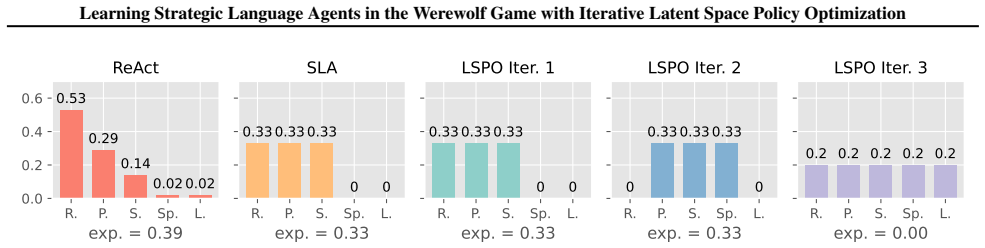
The paper establishes that an agent can learn to play a free-form language game by solving an abstracted version of the game in a learned discrete latent strategy space and then aligning the LLM's language output to the solved policy. Each iteration works as follows: the current LLM self-plays and generates discussion utterances; those utterances are embedded and k-means clustered into latent strategies; the game is reformulated as an extensive-form game whose discussion actions are the clusters; Deep CFR learns a near-equilibrium policy in that abstracted game; and DPO fine-tunes the LLM using the regret values of the clusters as preference labels. The next iteration regenerates utterances with the fine-tuned model and expands the cluster count, so the latent space grows. The paper reports that this loop raises prediction accuracy and win rates over iterations, achieves the Nash equilibrium in Rock-Paper-Scissors-Spock-Lizard by iteration 3, and reaches the highest win rates among the compared agents in seven-player Werewolf.
Load-bearing premise
The load-bearing premise is that grouping similar-sounding utterances into strategy clusters does not destroy the strategic differences between them; if two statements that mean different things land in the same cluster, the solver's equilibrium is for the wrong game and the fine-tuning labels can reinforce the model's original biases.
Editorial extensions
If this is right
- Iterating the LSPO loop improves both role-prediction accuracy and win rate in seven-player Werewolf, with reported performance converging by iteration five.
- A game-theoretic solver can shape an LLM's free-form language behavior without requiring hand-designed action taxonomies or human preference data.
- The final LSPO agent beats prompt-based agents (ReAct, ReCon), a fixed-action Cicero-like agent, and a fixed-LLM RL agent (SLA) on both the Werewolf side and the Village side.
- The framework transfers from the toy RPSLS game (where it reaches zero exploitability) to the conversational Werewolf setting, suggesting scalability to other free-form language games.
- Ablations show both the CFR policy-learning component and the DPO fine-tuning component contribute, and reported performance is stable across cluster counts and DPO temperatures in a simpler four-player variant.
Reading between the lines
- Editorial inference: LSPO is a general template: any game with unbounded text actions could be approached by clustering utterances into a latent strategy set, solving the abstraction, and aligning the model—so social-deduction variants like Avalon or negotiation games are natural next tests.
- Editorial inference: the method's ceiling depends on clustering granularity; if the paper's premise holds, better semantic representations or hierarchical clustering could push win rates further, and cluster-quality metrics could predict how well the abstraction transfers.
- Editorial inference: a direct human-play or cross-agent evaluation would test whether the equilibrium learned against LLM opponents transfers to human conversational tactics, since the paper evaluates against LLM-based agents.
Editorial analysis
A structured set of objections, weighed in public.
Referee Report
Summary. The paper proposes LSPO, an iterative framework for building LLM agents in free-form strategic language games such as Werewolf. The method maps LLM-generated utterances into a finite latent strategy space via k-means clustering of sentence embeddings, solves the resulting abstracted extensive-form game with Deep CFR, and fine-tunes the LLM with Direct Preference Optimization (DPO) using CFR regret values as preferences. Iterating this loop expands the latent strategy space. Experiments in a seven-player Werewolf game report improved prediction accuracy and win rates over iterations, and the final agent is claimed to outperform ReAct, ReCon, Cicero-like, and SLA baselines on both the Werewolf and Village sides.
Significance. If the results hold, LSPO is a novel and potentially influential combination of game-theoretic abstraction and LLM alignment, directly addressing two known weaknesses of prompt-based language agents: intrinsic action bias and insufficient exploration of the text action space. The paper is clearly written, includes detailed appendices with prompts, game logs, and hyperparameters, and demonstrates a concrete iterative pipeline. However, the empirical support for the headline claims is weakened by an asymmetric evaluation design, a lack of statistical significance testing, and an unvalidated clustering assumption that is central to the method. These issues are fixable in a revision, and the core idea is worth pursuing.
major comments (4)
- [Section 4.4, Table 2] The head-to-head comparison is asymmetric. In the first setup, LSPO always plays the Werewolf side and each of the five agents (including LSPO itself) plays the Village side; in the second setup, LSPO always plays the Village side and each of the five agents plays the Werewolf side. Consequently, LSPO's reported win rates are aggregated over matches against all five opponents, while each baseline's win rates are computed only from matches against LSPO. This makes the 'highest win rate' claim unsupported because the opponent pools differ across agents. Please re-run a symmetric round-robin evaluation (or report per-pair win rates for every agent in both roles) and provide significance tests for the pairwise differences.
- [Section 3.1] The k-means latent abstraction is the core mechanism, but the paper provides no quantitative evidence that utterances in the same cluster are strategically interchangeable. The validation is qualitative (Figure 3), and the RPSLS proof-of-concept in Section 4.1 does not involve clustering because the action space is already discrete. Table 4 shows that final win rates are similar for k=1,2,3 in a four-player game, which suggests that clustering granularity is not the active ingredient, but it does not validate cluster equivalence. Because DPO preference labels are derived from CFR regrets in the abstracted game, a lossy clustering can train the LLM toward an objective that diverges from the original game's utility. Please add a direct validation of the abstraction, such as measuring intra-cluster outcome variance, comparing to an oracle clustering conditioned on game state, or showing that within-cluster utterances have statistically indistinguishable win rates when played in the original game.
- [Section 4.5] The ablations do not isolate the latent-space clustering component. The paper removes fine-tuning and policy learning, but there is no ablation without clustering (e.g., treating each generated utterance as a separate action, or using raw LLM action probabilities). The cluster-size sensitivity analysis (Table 4) is also run in a four-player game, which may not capture the strategic complexity of seven-player Werewolf. Without an ablation that varies the abstraction itself, the paper's claim that clustering is what enables policy transfer to the original language game is not established.
- [Section 4.4, Table 2] The reported win-rate differences between LSPO and the strongest baseline (SLA) are within one standard deviation (0.73 ± 0.11 vs 0.69 ± 0.12 as Werewolf; 0.27 ± 0.11 vs 0.25 ± 0.08 as Village). The number of games per cell is not reported, and no significance tests are provided. Please report confidence intervals, p-values, or effect sizes for the pairwise comparisons to support the claim that LSPO outperforms all baselines.
minor comments (7)
- [Appendix B.4] The theoretical convergence argument via a finite vocabulary N_v^L is trivial and does not explain the empirical convergence in five iterations; please replace it with a more substantive discussion of when the cluster expansion is sufficient to cover the strategic space.
- [Section 4.3] Please clarify whether the 'additional prediction phase' before each voting phase is purely internal (not affecting the game state) or whether it changes the agents' observations or the game flow.
- [Table 2] Please specify how the mean and standard deviation for LSPO's row are computed: over 100 games per opponent or over the aggregated 500 games.
- [Section 3.2, Eq. (1)] The regret update equation omits the player index, information-set index, and iteration superscripts used in standard CFR notation; please align it with the notation in Appendix B.2.
- [Figure 3] The qualitative description of clusters would be strengthened by reporting quantitative cluster-quality metrics (e.g., silhouette score) to support the claim that clusters become clearer over iterations.
- [Section 4.1] The RPSLS proof-of-concept uses discrete actions and does not exercise the clustering step; please clarify how the latent-space construction applies to this setting or explain why the analogy is valid.
- [Throughout] There are several typos, including 'human-AI interation' in Section 1, 'out-fo-distribution' in Section 2.2, and 'startegy' in Appendix B.2; these should be corrected.
Circularity Check
No significant circularity: LSPO is an iterative training loop whose central claims are validated against fixed external baselines, not against its own fitted values.
full rationale
The paper's derivation chain is an algorithmic bootstrap rather than a derivation that presupposes its conclusion. Section 3.1 constructs a latent strategy space by embedding and k-means clustering utterances generated by the current LLM; Section 3.2 solves the resulting abstracted game with Deep CFR; Section 3.3 uses the resulting regret values as DPO preference labels to fine-tune the same LLM and expand the latent space. Each step depends on the previous step's output, but that is a standard self-play/iterative training loop, not a circular reduction: the final agent is not defined in terms of the win rates it is claimed to achieve, and no equation equates the prediction with an input by construction. The load-bearing empirical claims are external: Table 2 compares final LSPO win rates against ReAct, ReCon, a Cicero-like agent, and SLA in head-to-head games, and Table 1 measures iteration-to-iteration improvement against a fixed final-iteration opponent. These measurements do not reduce to the method's own fitted parameters. The only notable self-citation is the attribution of intrinsic action bias to Xu et al. (2023c), the authors' earlier SLA paper, but that observation is not load-bearing: LSPO is empirically compared with SLA rather than justified by the citation, and the bias claim is also demonstrated in the paper's own RPSLS proof-of-concept (Figure 2). No uniqueness theorem, ansatz smuggled via citation, or renaming of a known result appears. The k-means abstraction's fidelity to the original language game is a correctness/validation concern (the paper's validation is qualitative and toy-game based), but it is not a circularity: assuming the abstraction is lossy would undermine transfer, not make the argument presuppose its conclusion.
Assumptions & free parameters
free parameters (5)
- Number of latent strategy clusters per role (k) =
k=3 for Werewolf, k=2 for Seer/Doctor/Villager; +1 per iteration
- Number of discussion candidates N per call =
3
- DPO temperature beta =
0.1
- Cluster expansion rate =
+1 cluster per iteration
- Deep CFR network hyperparameters =
lr 1e-3, buffer 5e5, 1500 iterations, batch 4096
assumptions (5)
- standard math The free-form language action space has finite vocabulary and bounded length, so it is finite.
- ad hoc to paper The underlying strategic space is relatively compact, so a few clusters suffice.
- ad hoc to paper Sentence embeddings and k-means yield clusters that correspond to distinct latent strategies.
- domain assumption Deep CFR with the search-depth restriction converges to a near-optimal policy in the abstracted game.
- ad hoc to paper Regret values in the abstracted game are valid preference labels for DPO in the original game.
invented entities (1)
-
Latent strategy space (cluster-level actions)
Cite this review
Pith. "Pith review of Learning Strategic Language Agents in the Werewolf Game with Iterative Latent Space Policy Optimization." pith.science (2026). https://pith.science/paper/KA2Y4KY4
@misc{pith2026250204686,
  author       = {Pith},
  title        = {Pith review of: Learning Strategic Language Agents in the Werewolf Game with Iterative Latent Space Policy Optimization},
  year         = {2026},
  howpublished = {\url{https://pith.science/paper/KA2Y4KY4}},
  note         = {Machine review of arXiv:2502.04686}
}
read the original abstract
Large language model (LLM) agents have recently demonstrated impressive capabilities in various domains like open-ended conversation and multi-step decision-making. However, it remains challenging for these agents to solve strategic language games, such as Werewolf, which demand both strategic decision-making and free-form language interactions. Existing LLM agents often suffer from intrinsic bias in their action distributions and limited exploration of the unbounded text action space, resulting in suboptimal performance. To address these challenges, we propose Latent Space Policy Optimization (LSPO), an iterative framework that combines game-theoretic methods with LLM fine-tuning to build strategic language agents. LSPO leverages the observation that while the language space is combinatorially large, the underlying strategy space is relatively compact. We first map free-form utterances into a finite latent strategy space, yielding an abstracted extensive-form game. Then we apply game-theoretic methods like Counterfactual Regret Minimization (CFR) to optimize the policy in the latent space. Finally, we fine-tune the LLM via Direct Preference Optimization (DPO) to align with the learned policy. By iteratively alternating between these steps, our LSPO agents progressively enhance both strategic reasoning and language communication. Experiment on the Werewolf game shows that our agents iteratively expand the strategy space with improving performance and outperform existing Werewolf agents, underscoring their effectiveness in free-form language games with strategic interactions.
Figures


Forward citations
Cited by 1 Pith paper
-
Auditing Belief-Conditioned LLM Agents in Hidden-Information Social Deduction Games
An external belief audit framework for LLM Werewolf agents associates active belief with higher good-side win rates while exposing low action-belief consistency and rejecting forced consumption.
Reference graph
Works this paper leans on
-
[1]
Do as i can, not as i say: Grounding language in robotic affordances
Ahn, M., Brohan, A., Brown, N., Chebotar, Y ., Cortes, O., David, B., Finn, C., Fu, C., Gopalakrishnan, K., Hausman, K., et al. Do as i can, not as i say: Grounding language in robotic affordances. arXiv preprint arXiv:2204.01691,
-
[5]
D., Dhariwal, P., Neelakantan, A., Shyam, P., Sastry, G., Askell, A., et al
Brown, T., Mann, B., Ryder, N., Subbiah, M., Kaplan, J. D., Dhariwal, P., Neelakantan, A., Shyam, P., Sastry, G., Askell, A., et al. Language models are few-shot learners. Advances in neural information processing systems, 33: 1877–1901,
1901
-
[9]
Heinrich, J. and Silver, D. Deep reinforcement learning from self-play in imperfect-information games. arXiv preprint arXiv:1603.01121,
-
[10]
Lan- guage models as zero-shot planners: Extracting ac- tionable knowledge for embodied agents
Huang, W., Abbeel, P., Pathak, D., and Mordatch, I. Lan- guage models as zero-shot planners: Extracting ac- tionable knowledge for embodied agents. In Interna- tional Conference on Machine Learning, pp. 9118–9147. PMLR, 2022a. Huang, W., Xia, F., Xiao, T., Chan, H., Liang, J., Florence, P., Zeng, A., Tompson, J., Mordatch, I., Chebotar, Y ., et al. Inner ...
-
[12]
Llm-powered hierarchical language agent for real-time human-ai coordination
Liu, J., Yu, C., Gao, J., Xie, Y ., Liao, Q., Wu, Y ., and Wang, Y . Llm-powered hierarchical language agent for real-time human-ai coordination. arXiv preprint arXiv:2312.15224,
-
[13]
Large language models play starcraft ii: Bench- marks and a chain of summarization approach
Ma, W., Mi, Q., Yan, X., Wu, Y ., Lin, R., Zhang, H., and Wang, J. Large language models play starcraft ii: Bench- marks and a chain of summarization approach. arXiv preprint arXiv:2312.11865,
-
[14]
Playing atari with deep reinforcement learning
Mnih, V . Playing atari with deep reinforcement learning. arXiv preprint arXiv:1312.5602,
-
[15]
A generalized training approach for multiagent learning
Muller, P., Omidshafiei, S., Rowland, M., Tuyls, K., Perolat, J., Liu, S., Hennes, D., Marris, L., Lanctot, M., Hughes, E., et al. A generalized training approach for multiagent learning. arXiv preprint arXiv:1909.12823,
arXiv 1909
Show all 25 references
-
[16]
Webgpt: Browser-assisted question-answering with hu- man feedback
Nakano, R., Hilton, J., Balaji, S., Wu, J., Ouyang, L., Kim, C., Hesse, C., Jain, S., Kosaraju, V ., Saunders, W., et al. Webgpt: Browser-assisted question-answering with hu- man feedback. arXiv preprint arXiv:2112.09332,
-
[17]
S., O’Brien, J
Park, J. S., O’Brien, J. C., Cai, C. J., Morris, M. R., Liang, P., and Bernstein, M. S. Generative agents: In- teractive simulacra of human behavior. arXiv preprint arXiv:2304.03442,
-
[18]
Reflexion: an au- tonomous agent with dynamic memory and self-reflection
Shinn, N., Labash, B., and Gopinath, A. Reflexion: an au- tonomous agent with dynamic memory and self-reflection. arXiv preprint arXiv:2303.11366,
-
[20]
V oyager: An open- ended embodied agent with large language models
Wang, G., Xie, Y ., Jiang, Y ., Mandlekar, A., Xiao, C., Zhu, Y ., Fan, L., and Anandkumar, A. V oyager: An open- ended embodied agent with large language models. arXiv preprint arXiv:2305.16291, 2023a. Wang, S., Liu, C., Zheng, Z., Qi, S., Chen, S., Yang, Q., Zhao, A., Wang, ...
-
[21]
Describe, explain, plan and select: Interactive planning with large language models enables open-world multi-task agents
Wang, Z., Cai, S., Liu, A., Ma, X., and Liang, Y . Describe, explain, plan and select: Interactive planning with large language models enables open-world multi-task agents. arXiv preprint arXiv:2302.01560, 2023c. Wei, J., Wang, X., Schuurmans, D., Bosma, M., Xia, F., Chi, E., ...
-
[23]
Exploring large language models for communication games: An empirical study on werewolf
Xu, Y ., Wang, S., Li, P., Luo, F., Wang, X., Liu, W., and Liu, Y . Exploring large language models for communication games: An empirical study on werewolf. arXiv preprint arXiv:2309.04658, 2023a. Xu, Z., Liang, Y ., Yu, C., Wang, Y ., and Wu, Y . Fictitious cross-play: Learni...
2023 arXiv
-
[24]
Web- shop: Towards scalable real-world web interaction with grounded language agents
Yao, S., Chen, H., Yang, J., and Narasimhan, K. Web- shop: Towards scalable real-world web interaction with grounded language agents. Advances in Neural Informa- tion Processing Systems, 35:20744–20757, 2022a. Yao, S., Zhao, J., Yu, D., Du, N., Shafran, I., Narasimhan, K., and...
-
[64]
idle”, “target player_0
B.2. Counterfactual Regret Minimization Counterfactual Regret Minimization (CFR) ((Zinkevich et al., 2007)) is a self-play algorithm, and each player continuously updates their strategies according to regret matching to achieve a Nash equilibrium. We use the following notation...
2007
-
[1995]
Enhance reasoning for large language models in the game werewolf
Wu, S., Zhu, L., Yang, T., Xu, S., Fu, Q., Wei, Y ., and Fu, H. Enhance reasoning for large language models in the game werewolf. arXiv preprint arXiv:2402.02330,
-
[2017]
Li, G., Hammoud, H. A. A. K., Itani, H., Khizbullin, D., and Ghanem, B. Camel: Communicative agents for" mind" exploration of large scale language model society. arXiv preprint arXiv:2303.17760,
-
[2018]
Solving large imperfect information games using cfr+
Tammelin, O. Solving large imperfect information games using cfr+. arXiv preprint arXiv:1407.5042,
-
[2019]
Rt-2: Vision-language-action models transfer web knowledge to robotic control
Brohan, A., Brown, N., Carbajal, J., Chebotar, Y ., Chen, X., Choromanski, K., Ding, T., Driess, D., Dubey, A., Finn, C., et al. Rt-2: Vision-language-action models transfer web knowledge to robotic control. arXiv preprint arXiv:2307.15818,
-
[2020]
Fireact: Toward language agent fine-tuning
Chen, B., Shu, C., Shareghi, E., Collier, N., Narasimhan, K., and Yao, S. Fireact: Toward language agent fine-tuning. arXiv preprint arXiv:2310.05915, 2023a. Chen, M., Tworek, J., Jun, H., Yuan, Q., Pinto, H. P. D. O., Kaplan, J., Edwards, H., Burda, Y ., Joseph, N., Brockman,...
-
[2021]
Agentverse: Facili- tating multi-agent collaboration and exploring emergent behaviors in agents
Chen, W., Su, Y ., Zuo, J., Yang, C., Yuan, C., Qian, C., Chan, C.-M., Qin, Y ., Lu, Y ., Xie, R., et al. Agentverse: Facili- tating multi-agent collaboration and exploring emergent behaviors in agents. arXiv preprint arXiv:2308.10848, 2023b. Deng, X., Gu, Y ., Zheng, B., Chen...
-
[2022]
Werewolf arena: A case study in llm evaluation via social deduction
Bailis, S., Friedhoff, J., and Chen, F. Werewolf arena: A case study in llm evaluation via social deduction. arXiv preprint arXiv:2407.13943,
-
[2023]
Gandhi, K., Sadigh, D., and Goodman, N. D. Strate- gic reasoning with language models. arXiv preprint arXiv:2305.19165,
-
[2024]
Dota 2 with large scale deep reinforcement learning
Berner, C., Brockman, G., Chan, B., Cheung, V ., Debiak, P., Dennison, C., Farhi, D., Fischer, Q., Hashme, S., Hesse, C., et al. Dota 2 with large scale deep reinforcement learning. arXiv preprint arXiv:1912.06680,
1912 arXiv
Reviewed August 8, 2026 · model on record in the stance chip above.
Discussion (0). Continue with ORCID to comment.