REVIEW 4 major objections 4 minor 4 cited by
Be Water, My Antennas: Riding on Radio Wave Fluctuation in Nature for Spatial Multiplexing using Programmable Meta-Fluid Antenna
T0 review · 4 major / 4 minor · reviewed 2026-08-08 · deepseek-v4-flash
Pith's one-line read A programmable meta-fluid antenna can avoid interference and achieve spatial multiplexing by shifting its receiving position across 120 points to ride the natural ups and downs of radio wave fluctuation.
desk verdict First FAMA hardware demo with an electronically steered metasurface, but the paper's own Figure 5 contradicts its '>15 dB average SINR' conclusion. read the letter →
The pith
A machine-rendered reading of the paper's core claim, the machinery that carries it, and where it could break.
The reading
What carries the argument
The meta-fluid antenna: a waveguide-fed metasurface of 8×15 = 120 meta-atoms, each with two PIN-diode-controlled slots ('+' and '−'), where activating one slot switches that position into a radiating magnetic dipole while the rest stay dark. An FPGA controller can switch positions at 20 MHz, so the receiver can scan all positions and settle on the argmax-SINR one. The rich-scattering generators are 30 waveguide-fed slot arrays with arbitrarily placed slots that create disordered E-field patterns to emulate Rayleigh-like spatial fading.
What would settle it
Recompute the average selected-position SINR from the ten cases at 26.5 GHz in Figure 5; the per-transmitter case averages are 8.04, 7.74, and 9.69 dB. If the average over all cases is not above 15 dB, the paper's headline claim is contradicted by its own data. Separately, a statistical comparison (for example, a Kolmogorov–Smirnov test) of the generator's spatial field statistics against a measured indoor channel at 26.5 GHz would settle whether the emulation is representative.
Extended reading notes
Core claim
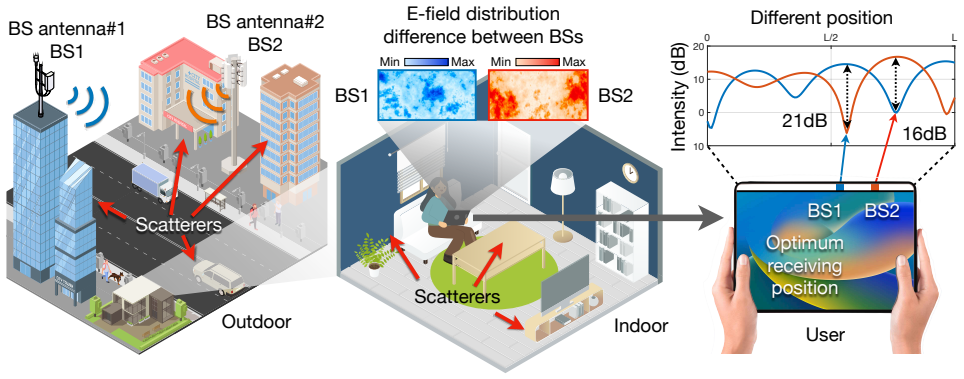
The paper's central claim is that a position-flexible aperture can exploit natural spatial fading to separate users on the same time–frequency resource, and that this is experimentally realizable with a fully electronic antenna. For each user, the meta-fluid antenna measures the SINR at every one of its 120 positions and switches to the position that maximizes it. In measurements with three waveguide-fed transmitters and 30 rich-scattering generators, the best position at 26.5 GHz yielded SINR values between 5.05 dB and 14.33 dB depending on the case, with per-plot case averages of 8.04, 7.74, and 9.69 dB for the three desired transmitters. The paper interprets the large spread of SINR over positions as evidence that the channel varies enough in space for interference nulls to be found, and it claims this is the first experimental validation that FAMA works with a fully electronic antenna, outperforming a fixed horn antenna benchmark.
Load-bearing premise
The load-bearing premise is that the paper's 30 waveguide-fed slot-array 'rich-scattering generators' faithfully reproduce the statistical behavior of real wireless channels, so that SINR values measured against them predict performance in actual rich-scattering environments.
Editorial extensions
If this is right
- FAMA can deliver spatial multiplexing on a single RF chain without CSI feedback or precoding, so dense multiuser networks could scale without the signaling overhead that limits massive MIMO.
- Position-selection at 20 MHz switching can track channel changes fast enough for mmWave bands, unlike liquid-metal antennas with roughly second-scale reconfiguration.
- The approach turns rich scattering from a problem into a resource: the more multipath, the more spatial variation for a fluid antenna to exploit.
- The prototype's 13 dB contrast between radiating and non-radiating states is sufficient to emulate a moving aperture, validating pixel-based metasurface designs as a practical path to FAS.
- The measured SINR advantage over a fixed horn antenna suggests that even simple position scanning outperforms a large fixed aperture in the same scattering environment.
Reading between the lines
- Beyond the paper, the reported case averages in Figure 5 (8.04, 7.74, and 9.69 dB) fall below the claimed >15 dB overall average, so the averaging procedure is a detail worth checking before relying on the quantitative headline.
- The static rich-scattering generators represent one snapshot of a channel; testing with moving scatterers or real indoor and outdoor channels would show whether the selected position stays near-optimal as the field evolves.
- The same position-flexible aperture could double as a spatial key for physical-layer security or as a scanning aperture for sensing, since the 120 positions give a spatial signature of the environment.
- Combining FAMA with a small number of RF chains in a hybrid MIMO architecture is a natural next step: use one meta-fluid antenna per chain to get both spatial nulling and array gain.
Editorial analysis
A structured set of objections, weighed in public.
Referee Report
Summary. The manuscript proposes a 'meta-fluid antenna'—a 120-element waveguide-fed metasurface with PIN-diode-controlled slot elements—as a position-flexible fluid antenna system (FAS). It describes a three-user downlink experiment in which the receiving FAS selects the element position maximizing SINR, using 30 custom-built waveguide-fed slot-array 'rich-scattering generators' to emulate fading channels. The authors report that FAMA is feasible and that an average SINR above 15 dB is obtained across all cases considered.
Significance. The work is significant as a first hardware prototype that reconfigures the radiation aperture position and applies it to fluid antenna multiple access. The measurements are direct VNA S-parameter data, the prototype is described in enough detail to be reproduced, and ten independent channel realizations are used. However, the headline quantitative claim is not supported by the reported data, and the validation of the emulated fading environment is asserted rather than demonstrated, so the manuscript needs substantial revision before its central claims can be accepted.
major comments (4)
- [Conclusion and Figure 5] The paper claims that 'an average of more than 15 dB received SINR is obtained over all the cases considered' (Conclusion), but the data in Figure 5 at the stated 26.5 GHz reporting frequency give per-user averages of 8.04 dB, 7.74 dB, and 9.69 dB and a maximum single-case value of 14.33 dB (Tx3, Case 5). None of the ten cases reaches 15 dB, and recomputing the average from the plotted values reproduces the figure's marked averages, so this is not a reading error. Please disclose the exact computation that yields 15 dB (for example, averaging over 26–27 GHz or reporting SIR without noise) and correct the Conclusion; as written, the central validation statement is contradicted by the paper's own data.
- [Results, Rich-scattering generators] The assertion 'the method used to generate the environment does not affect the conclusion of this work' and the claim that the setup 'more closely aligns with what are expected in Rayleigh fading environments' are unsupported. No statistical test (for example, a goodness-of-fit test of the measured field magnitude distribution to Rayleigh, fade-depth statistics, or spatial correlation analysis) and no comparison with a measured real-world channel is provided. Please add such an analysis or temper the claim, because the validity of the emulated environment is load-bearing for interpreting the SINR values as evidence of FAMA in realistic rich scattering.
- [Results, Experimental validation and Figure 4] The terms SIR and SINR are used interchangeably: the body text and Figure 5 label the metric SINR, while Figure 4's caption reports 'Max SIR = 17.89 dB' and the axis labels in Figure 4 alternate between SINR and SIR. No definition of the noise term or the exact post-processing of the VNA measurements is given, so the absolute dB values cannot be independently reproduced. Please define the SINR computation, including how noise was measured or modeled, and make the labeling consistent throughout.
- [Results, Experimental validation] Each of the ten cases appears to be based on a single VNA sweep, with no repeated trials, error bars, or uncertainty analysis. The claim that the meta-fluid antenna 'performs much better than this optimistic benchmark' (horn antenna) would be stronger if accompanied by some measure of variability across repeated measurements or across frequency. Please report repeated measurements or otherwise quantify the reliability of the reported SINR values.
minor comments (4)
- [Results, Experimental validation and Figure 4 caption] The text identifies Figure 4 as 'Case 5 of the generators', while the figure caption and the following paragraph refer to 'Case 9'; please unify the case labeling.
- [Equation (2)] Equation (2) drops the expectation in the second expression; please clarify whether the metric is an instantaneous ratio or an averaged value.
- [Throughout] The abstract uses 'meta-fluid antenna architecture' while the main text uses 'meta-fluidic architecture'; please choose one term for consistency.
- [References] Reference [48] is listed in the bibliography but appears uncited in the text; please check the citation usage.
Circularity Check
No significant circularity: the FAMA feasibility result is a direct measurement, not a fitted or self-citation-derived prediction.
full rationale
The paper's central claim—that the meta-fluid antenna can realize FAMA by switching to the position with maximum SINR—is supported by direct VNA measurements of the received signal at each of the 120 antenna positions across 30 waveguide-fed generator environments. No parameter is fitted to a subset of data and then reported as a prediction: the reported 'best' SINR values are simply the maxima of the measured SINR maps, and the per-case averages in Figure 5 (8.04, 7.74, and 9.69 dB) are arithmetic summaries of the plotted data. Equation (2) defines the FAMA optimal position as the argmax of SINR; using that definition to select a measured position is a measurement protocol, not an equivalence that manufactures the result. The many self-citations to the authors' prior FAS/FAMA theory papers motivate the selection rule and the rich-scattering assumption, but the experimental evidence does not reduce to those citations: the SINR values are measured, not computed from the cited theory. The unsupported assertion in 'Rich-scattering generators' that 'the method used to generate the environment does not affect the conclusion of this work' and the Conclusion's 'average of more than 15 dB received SINR' (which is inconsistent with the Figure 5 values) are evidentiary and correctness weaknesses, but they are not circularity because they do not cause the experimental result to be identical to its inputs. The Discussion's statement that testing in real environments remains future work reinforces that the demonstration is environment-specific, but that limitation does not make the derivation circular.
Assumptions & free parameters
assumptions (2)
- domain assumption The artificial rich-scattering generators emulate Rayleigh fading environments.
- domain assumption The SINR computed from VNA S-parameter measurements at a single frequency and static positions corresponds to communication performance.
Cite this review
Pith. "Pith review of Be Water, My Antennas: Riding on Radio Wave Fluctuation in Nature for Spatial Multiplexing using Programmable Meta-Fluid Antenna." pith.science (2026). https://pith.science/paper/5EGKTDYU
@misc{pith2026250204693,
  author       = {Pith},
  title        = {Pith review of: Be Water, My Antennas: Riding on Radio Wave Fluctuation in Nature for Spatial Multiplexing using Programmable Meta-Fluid Antenna},
  year         = {2026},
  howpublished = {\url{https://pith.science/paper/5EGKTDYU}},
  note         = {Machine review of arXiv:2502.04693}
}
read the original abstract
Interference and scattering, often deemed undesirable, are inevitable in wireless communications, especially when the current mobile networks and upcoming sixth generation (6G) have turned into ultra-dense networks. Current approaches relying on multiple-input multiple-output (MIMO) combined with artificial-intelligence-aided (AI) signal processing have drawbacks of being power-hungry and requiring wide bandwidth that raise scalability concerns. In this article, we take a radical approach and utilize the channel fading phenomenon to our advantage. Specifically, we propose a novel meta-fluid antenna architecture, referred to as the `fluid' antenna system (FAS), that can freely surf on radio wave fluctuations, like `fluid' figuratively speaking, with fine resolution in space to opportunistically avoid interference, eliminating the need for expensive signal processing. Our experimental results demonstrate that under rich scattering conditions, the proposed meta-fluidic architecture is able to exploit the natural ups and downs of radio waves in space for spatial multiplexing. These breakthrough results show that scattering can be desirable not harmful and interference can be dodged not suppressed, fundamentally changing our perception of fading and our understanding on how interference should be managed in wireless communications networks.
Figures


Figures from the paper (2 more)


Forward citations
Cited by 4 Pith papers
-
Fluid Antenna System-Assisted Self-Interference Cancellation for In-Band Full Duplex Communications
A receiver-side fluid antenna that selects the port minimizing the loopback-to-desired channel power ratio delivers 14 to 40 dB self-interference cancellation in in-band full duplex links.
-
JEPA-CFM: A Joint Embedding Predictive Architecture-based Channel Foundation Model for Robust Fluid Antenna Systems
A JEPA-style self-supervised model for fluid antenna channels improves sparse channel extrapolation and achieves sub-3 m positioning at 25% known CSI in DeepMIMO simulation.
-
Toward Practical Fluid Antenna Systems: Co-Optimizing Hardware and Software for Port Selection and Beamforming
A graph neural network with random port selection, accelerated on an FPGA, achieves competitive weighted sum-rate in fluid antenna MIMO systems.
-
Iterative Sparse Asymptotic Minimum Variance Based Channel Estimation in Fluid Antenna System
The paper applies an iterative sparse covariance estimation algorithm, similar to SPICE, to fluid antenna channel estimation and reports simulation gains in BER and capacity over OMP and MMSE baselines.
Reference graph
Works this paper leans on
-
[1]
Holographic communication in 5G networks.Ericsson Technol
El Essaili, A.et al. Holographic communication in 5G networks.Ericsson Technol. Rev.2022, 2–11 (2022)
work page 2022
-
[2]
Zhang, J. C.et al. A 6G meta-device for 3D varifocal.Sci. Adv.9, eadf8478 (2023)
work page 2023
-
[3]
Fettweis, G. P. The tactile Internet: Applications and challenges.IEEE Veh. Technol. Mag.9, 64–70 (2014)
work page 2014
-
[4]
Simsek, M., Aijaz, A., Dohler, M., Sachs, J. & Fettweis, G. 5G-enabled tactile Internet.IEEE J. on Sel. Areas Commun. 34, 460–473 (2016)
work page 2016
-
[5]
Jia, R. et al. Valley-conserved topological integrated antenna for 100-Gbps THz 6G wireless.Sci. Adv.9, eadi8500 (2023)
work page 2023
-
[6]
Dang, S., Amin, O., Shihada, B. & Alouini, M.-S. What should 6G be?Nat. Electron.3, 20–29 (2020)
work page 2020
-
[7]
A speculative study on 6G.IEEE Wirel
Tariq, F.et al. A speculative study on 6G.IEEE Wirel. Commun.27, 118–125 (2020)
work page 2020
-
[8]
Toward 6G TKµ extreme connectivity: Architecture, key technologies and experiments.IEEE Wirel
You, X.et al. Toward 6G TKµ extreme connectivity: Architecture, key technologies and experiments.IEEE Wirel. Commun.30, 86–95 (2023)
work page 2023
Show all 57 references
-
[9]
Shannon, C. E. A mathematical theory of communication.The Bell Syst. Tech. J.27, 379–423 (1948)
1948
-
[10]
Breaking the limitation of polarization multiplexing in optical metasurfaces with engineered noise
Xiong, B.et al. Breaking the limitation of polarization multiplexing in optical metasurfaces with engineered noise. Science 379, 294–299 (2023)
2023
-
[11]
Terabit-scale orbital angular momentum mode division multiplexing in fibers.science 340, 1545–1548 (2013)
Bozinovic, N.et al. Terabit-scale orbital angular momentum mode division multiplexing in fibers.science 340, 1545–1548 (2013)
2013
-
[12]
A., OdetAlla, H., Fernández-Getino García, M
Urquiza Villalonga, D. A., OdetAlla, H., Fernández-Getino García, M. J. & Flizikowski, A. Spectral efficiency of precoded 5G-NR in single and multi-user scenarios under imperfect channel knowledge: A comprehensive guide for implementation.Electronics 11, 4237 (2022)
2022
-
[13]
Extremely large-scale MIMO: Fundamentals, challenges, solutions, and future directions.IEEE Wirel
Wang, Z.et al. Extremely large-scale MIMO: Fundamentals, challenges, solutions, and future directions.IEEE Wirel. Commun.(2023)
2023
-
[14]
Non-orthogonal multiple access for 5G: Solutions, challenges, opportunities, and future research trends
Dai, L.et al. Non-orthogonal multiple access for 5G: Solutions, challenges, opportunities, and future research trends. IEEE Commun. Mag.53, 74–81 (2015)
2015
-
[15]
Mao, Y.et al.Rate-splitting multiple access: Fundamentals, survey, and future research trends.IEEE Commun. Surv. & Tutorials24, 2073–2126 (2022)
2022
-
[16]
Chen, Y. et al. Toward the standardization of non-orthogonal multiple access for next generation wireless networks. IEEE Commun. Mag.56, 19–27 (2018)
2018
-
[17]
B., Chen, W., Shi, Y., Zhang, J
Letaief, K. B., Chen, W., Shi, Y., Zhang, J. & Zhang, Y.-J. A. The roadmap to 6G: AI empowered wireless networks. IEEE Commun. Mag.57, 84–90 (2019)
2019
-
[18]
& Jin, S
Wen, C.-K., Shih, W.-T. & Jin, S. Deep learning for massive MIMO CSI feedback.IEEE Wirel. Commun. Lett. 7, 748–751 (2018). 11/13
2018
-
[19]
Model-driven deep learning for physical layer communications.IEEE Wirel
He, H.et al. Model-driven deep learning for physical layer communications.IEEE Wirel. Commun.26, 77–83 (2019)
2019
-
[20]
K., Shojaeifard, A., Tong, K.-F
Wong, K. K., Shojaeifard, A., Tong, K.-F. & Zhang, Y. Performance limits of fluid antenna systems.IEEE Commun. Lett.24, 2469–2472 (2020)
2020
-
[21]
& Zhang, Y
Wong, K.-K., Shojaeifard, A., Tong, K.-F. & Zhang, Y. Fluid antenna systems.IEEE Transactions on Wirel. Commun. 20, 1950–1962 (2020)
2020
-
[22]
New, W. K.et al. A tutorial on fluid antenna system for 6G networks: Encompassing communication theory, optimization methods and hardware designs.IEEE Commun. Surv. & Tutorials(2024)
2024
-
[23]
& Chae, C.-B
Wong, K.-K., Morales-Jimenez, D., Tong, K.-F. & Chae, C.-B. Slow fluid antenna multiple access.IEEE Transactions on Commun.71, 2831–2846 (2023)
2023
-
[24]
& Tong, K.-F
Wong, K.-K. & Tong, K.-F. Fluid antenna multiple access. IEEE Transactions on Wirel. Commun.21, 4801–4815 (2021)
2021
-
[25]
& Zhang, Y
Waqar, N., Wong, K.-K., Tong, K.-F., Sharples, A. & Zhang, Y. Deep learning enabled slow fluid antenna multiple access. IEEE Commun. Lett.27, 861–865 (2023)
2023
-
[26]
Opportunistic fluid antenna multiple access via team-inspired reinforcement learning.IEEE Transactions on Wirel
Waqar, N.et al. Opportunistic fluid antenna multiple access via team-inspired reinforcement learning.IEEE Transactions on Wirel. Commun.(2024)
2024
-
[27]
& Elhouni, F
Huang, Y., Xing, L., Song, C., Wang, S. & Elhouni, F. Liquid antennas: Past, present and future.IEEE Open J. Antennas Propag.2, 473–487 (2021)
2021
-
[28]
& Krikidis, I
Dash, S., Psomas, C. & Krikidis, I. Selection of metallic liquid in sub-6 GHz antenna design for 6G networks. Sci. Reports13, 20551 (2023)
2023
-
[29]
Design and implementation of mmwave surface wave enabled fluid antennas and experimental results for fluid antenna multiple access.arXiv preprint arXiv:2405.09663(2024)
Shen, Y.et al. Design and implementation of mmwave surface wave enabled fluid antennas and experimental results for fluid antenna multiple access.arXiv preprint arXiv:2405.09663(2024)
2024
-
[30]
& Murch, R
Song, S. & Murch, R. D. An efficient approach for optimizing frequency reconfigurable pixel antennas using genetic algorithms. IEEE Transactions on Antennas Propag.62, 609–620 (2013)
2013
-
[31]
A novel pixel-based reconfigurable antenna applied in fluid antenna systems with high switching speed
Zhang, J.et al. A novel pixel-based reconfigurable antenna applied in fluid antenna systems with high switching speed. IEEE Open J. Antennas Propag.(2024)
2024
-
[32]
Wang, H. L.et al. Multichannel highly secure wireless communication system with information camouflage capability. Sci. Adv.10, eadk7557 (2024)
2024
-
[33]
Space-time-coding digital metasurfaces.Nat
Zhang, L.et al. Space-time-coding digital metasurfaces.Nat. communications9, 4334 (2018)
2018
-
[34]
Fusco, V., Abbasi, M. A. B., Yurduseven, O.et al. Single-pixel polarimetric direction of arrival estimation using programmable coding metasurface aperture.Nat. Sci. Reports11, 23830 (2021)
2021
-
[35]
A wireless communication scheme based on space-and frequency-division multiplexing using digital metasurfaces
Zhang, L.et al. A wireless communication scheme based on space-and frequency-division multiplexing using digital metasurfaces. Nat. Electron.4, 218–227 (2021)
2021
-
[36]
Y., Cheng, Q., Cui, T
Wu, G.-B., Dai, J. Y., Cheng, Q., Cui, T. J. & Chan, C. H. Sideband-free space-time-coding metasurface antennas. Nat. Electron.5, 808–819 (2022)
2022
-
[37]
Wang, S. R. et al. Manipulations of multi-frequency waves and signals via multi-partition asynchronous space-time-coding digital metasurface.Nat. Commun.14, 5377 (2023)
2023
-
[38]
Wu, G.-B.et al.A universal metasurface antenna to manipulate all fundamental characteristics of electromagnetic waves. Nat. Commun.14, 5155 (2023)
2023
-
[39]
Wu, G.-B.et al.A synthetic moving-envelope metasurface antenna for independent control of arbitrary harmonic orders. Nat. Commun.15, 7202 (2024)
2024
-
[40]
J., McKinney, R
Karl, N. J., McKinney, R. W., Monnai, Y., Mendis, R. & Mittleman, D. M. Frequency-division multiplexing in the terahertz range using a leaky-wave antenna.Nat. Photonics9, 717–720 (2015)
2015
-
[41]
& Eleftheriades, G
Memarian, M. & Eleftheriades, G. V. Dirac leaky-wave antennas for continuous beam scanning from photonic crystals. Nat. Commun.6, 5855 (2015)
2015
-
[42]
& Monnai, Y
Matsumoto, H., Watanabe, I., Kasamatsu, A. & Monnai, Y. Integrated terahertz radar based on leaky-wave coherence tomography.Nat. Electron.3, 122–129 (2020)
2020
-
[43]
Arbitrary aperture synthesis with nonlocal leaky-wave metasurface antennas.Nat
Xu, G.et al. Arbitrary aperture synthesis with nonlocal leaky-wave metasurface antennas.Nat. Commun.14, 4380 (2023)
2023
-
[44]
& Wong, K.-K
Zhu, L. & Wong, K.-K. Historical review of fluid antenna and movable antenna.arXiv preprint arXiv:2401.02362 (2024)
2024 arXiv
-
[45]
& Chae, C.-B
Yang, H., Wong, K.-K., Tong, K.-F., Zhang, Y. & Chae, C.-B. Performance analysis of slow fluid antenna multiple access in noisy channels using Gauss-Laguerre and Gauss-Hermite quadratures.IEEE Commun. Lett. 27, 1734–1738 (2023)
2023
-
[46]
Revisiting outage probability analysis for two-user fluid antenna multiple access system.IEEE 12/13 Transactions on Wirel
Xu, H.et al. Revisiting outage probability analysis for two-user fluid antenna multiple access system.IEEE 12/13 Transactions on Wirel. Commun.23, 9534–9548 (2024)
2024
-
[47]
F., Guo, Y
Wu, Y. F., Guo, Y. & Cheng, Y. J. Self-progressive near-field focusing 2-D full frequency scanning slot array antenna based on ridge-gap waveguide.IEEE Transactions on Antennas Propag.71, 639–649 (2022)
2022
-
[48]
Stüber, G. L. & Steuber, G. L.Principles of mobile communication, vol. 2 (Springer, 2001)
2001
-
[49]
Xu, H. et al. Channel estimation for FAS-assisted multiuser mmWave systems.IEEE Commun. Lett.28, 632–636 (2024)
2024
-
[50]
& Zhang, Y
Chai, Z., Wong, K.-K., Tong, K.-F., Chen, Y. & Zhang, Y. Port selection for fluid antenna systems.IEEE Commun. Lett.26, 1180–1184 (2022)
2022
-
[51]
K., Tong, K
Waqar, N., Wong, K. K., Tong, K. F., Sharples, A. & Zhang, Y. Deep learning enabled slow fluid antenna multiple access. IEEE Commun. Lett.27, 861–865 (2023)
2023
-
[52]
Wong, K.-K. et al. Virtual FAS by learning-based imaginary antennas.IEEE Wirel. Commun. Lett.13, 1581–1585 (2024)
2024
-
[53]
Learning-induced channel extrapolation for fluid antenna systems using asymmetric graph masked autoencoder
Zhang, H.et al. Learning-induced channel extrapolation for fluid antenna systems using asymmetric graph masked autoencoder. IEEE Wirel. Commun. Lett.13, 1665–1669 (2024)
2024
-
[54]
Fluid antenna system liberating multiuser MIMO for ISAC via deep reinforcement learning
Wang, C.et al. Fluid antenna system liberating multiuser MIMO for ISAC via deep reinforcement learning. IEEE Transactions on Wirel. Commun.23, 10879–10894 (2024)
2024
-
[55]
Opportunistic fluid antenna multiple access via team-inspired reinforcement learning.IEEE Transactions on Wirel
Waqar, N.et al. Opportunistic fluid antenna multiple access via team-inspired reinforcement learning.IEEE Transactions on Wirel. Commun.23, 12068–12083 (2024)
2024
-
[56]
& Wong, K.-K
Eskandari, M., Burr, A., Cumanan, K. & Wong, K.-K. cGAN-based slow fluid antenna multiple access.IEEE Wirel. Commun. Lett.13, 2907–2911 (2024)
2024
-
[57]
K., Chae, C.-B
Wang, C., Li, Z., Wong, K. K., Chae, C.-B. & Jin, S. AI-empowered fluid antenna systems: Opportunities, challenges, and future directions.IEEE Wirel. Commun.31, 34–41 (2024). 13/13
2024
Reviewed August 8, 2026 · model on record in the stance chip above.
Discussion (0). Continue with ORCID to comment.