REVIEW 2 major objections 6 minor 48 references
Fluid Antenna System-Assisted Self-Interference Cancellation for In-Band Full Duplex Communications
T0 review · 2 major / 6 minor · reviewed 2026-08-07 · deepseek-v4-flash
Pith's one-line read A receiver-side fluid antenna can cancel in-band full-duplex self-interference by selecting the port with the smallest loopback-to-desired gain ratio; the average residual power is bounded below by $\kappa_y E_{SI}/(N-1)$.
desk verdict Worth refereeing: loopback-aware FAS selection is a genuinely new SIC mechanism, but Theorem 1's lower bound rests on an unproven stochastic-ordering assertion. read the letter →
The pith
A machine-rendered reading of the paper's core claim, the machinery that carries it, and where it could break.
The reading
What carries the argument
The load-bearing object is the random variable $R = \min_n |g_{SI,n}|^2/|g_{D,n}|^2$, the smallest loopback-to-desired power ratio across the $N$ fluid-antenna ports; the selected port makes the residual self-interference power proportional to it. The argument runs on the distribution of the ratio of two independent unit-mean exponential variables, $\Pr(\hat{X}/X \le r) = 1 - 1/(r+1)$, which exponentiates to $1 - (1/(r+1))^N$ for the decorrelated $N$-port case and gives $\mathbb{E}[R'] = 1/(N-1)$. The approximation machinery replaces the full fluid-antenna correlation matrix by its $M$ dominant eigenvalues, reducing the channel to a low-rank form whose ratio distribution is expressed with Marcum Q-functions and a $2M$-fold integral.
What would settle it
Simulate the paper's rich-scattering model with a small correlated fluid antenna, e.g., $N=4$ ports in a $0.2\lambda \times 0.2\lambda$ square, and compute the empirical CDF of $R = \min_n |g_{SI,n}|^2/|g_{D,n}|^2$. If at any $r$ the empirical CDF exceeds $1 - (1/(r+1))^N$, or if the measured average residual power falls below $\kappa_y E_{SI}/(N-1)$, then Theorem 1's bound is not a genuine lower bound for correlated channels.
Extended reading notes
Core claim
The central claim is that a two-dimensional fluid antenna at an in-band full-duplex receiver can suppress self-interference purely by port selection. With perfect channel knowledge of both the forward and loopback links, the receiver picks the port $n^* = \arg\min_n |g_{SI,n}|^2/|g_{D,n}|^2$, so the residual interference power is $P = \kappa_y E_{SI} R$ with $R = \min_n |g_{SI,n}|^2/|g_{D,n}|^2$. Under the rich-scattering model, a unitary transformation decorrelates the fluid-antenna ports; at every decorrelated port the ratio is that of two independent exponential variables, whose CDF is $1 - 1/(r+1)$. Taking the minimum over $N$ independent ports gives the CDF $1 - (1/(r+1))^N$ and expectation $1/(N-1)$, which the paper states lower-bounds the correlated case, yielding $P_{lb} = \kappa_y E_{SI}/(N-1)$. A second result approximates the same quantity using the $M$ largest eigenvalues of the port-correlation matrix, leading to a $2M$-fold integral. Simulations validate the bound and the approximation, and show that cancellation improves with port count and physical antenna size until port correlation makes further gains vanish.
Load-bearing premise
The lower bound assumes that correlated ports never produce a smaller best loopback-to-desired ratio, in distribution, than independent ports; in Appendix A the proof asserts this ordering as a special case rather than proving it.
Editorial extensions
If this is right
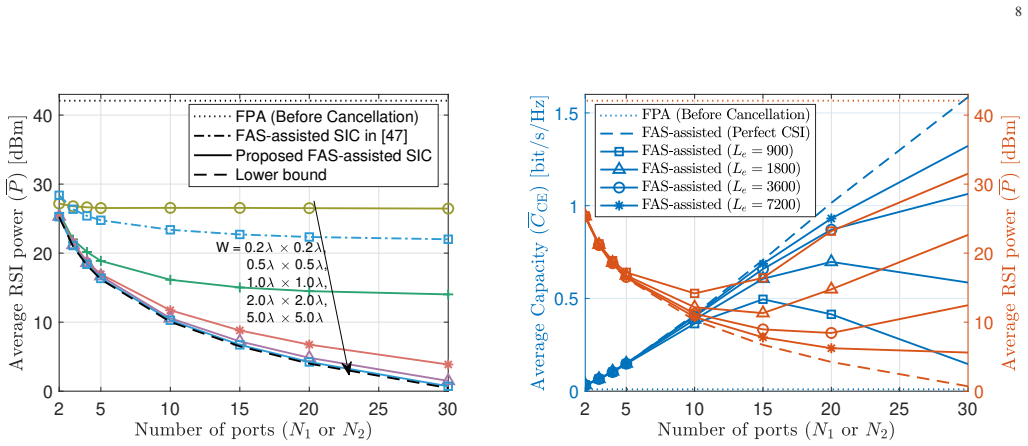
- The bound $P \ge \kappa_y E_{SI}/(N-1)$ means each doubling of the number of ports lowers the floor on residual interference by about 3 dB; with 30x30 ports and a large aperture the simulations reach roughly 40 dB of cancellation in rich scattering.
- Because the scheme acts only at the receiver and does not touch the transmitted waveform, it can be stacked with analog or digital SIC; combining it with frequency-domain RF SIC yields about 37 dB total cancellation in wideband channels.
- In finite-scattering Rician loopback channels, rich-scattering performance is an upper bound, and the scheme still delivers roughly 12 to 25 dB of cancellation depending on the Rice factor and number of scatterers.
- Port selection in wideband OFDM uses the subcarrier-averaged ratio $(1/F)\sum_f |g_{SI,n}[f]|^2/|g_{D,n}[f]|^2$, giving 14 to 25 dB cancellation in an integrated access and backhaul channel with a three-tap delay profile.
- Training overhead is the main practical cost: with too few pilot symbols per port, adding ports degrades performance, while sufficient pilots restore the gain.
Reading between the lines
- This is selection diversity applied to the interference channel, so any receive structure that can choose among $N$ correlated observations of the interference field should inherit a similar $1/(N-1)$ floor; that generalisation is testable beyond fluid antennas.
- The size of the gap between the true residual power and the bound at a fixed aperture $W$ is left open, so a closed-form expression for that gap would turn the bound into a design curve for choosing ports versus physical size.
- Because the rule needs channel estimates for both links, an implicit extension is to select the port using estimated ratios plus a penalty for estimation error; the paper's pilot-symbol results show this trade-off is nontrivial.
- The bound implies a scaling law: for a target residual interference level at a given transmit power, the number of ports $N$ must grow roughly as $\kappa_y E_{SI}$ divided by that target, making the port count set by the self-interference budget rather than by fading statistics.
Editorial analysis
A structured set of objections, weighed in public.
Referee Report
Summary. The paper proposes a receiver-side fluid antenna system (FAS) for self-interference cancellation in in-band full-duplex communications. The receiver selects the FAS port that minimizes the instantaneous ratio of loopback channel power to forward channel power, and the paper derives two analytical results in rich-scattering channels: a claimed lower bound on average residual SI power, P_lb = kappa_y E_SI / (N-1) in Eq. (25), based on a stochastic-ordering argument in Appendix A, and an approximation based on retaining M dominant eigenvalues of the Jakes correlation matrix (Theorem 2, Eqs. (30)-(31)). Simulations validate the lower bound and approximation, and additional simulations cover finite-scattering channels, wideband IAB channels, channel-estimation overhead, and combination with frequency-domain RF SIC. The central analytical claim is the lower bound, but the proof as written does not establish the required stochastic ordering.
Significance. If the lower bound is correct, the result is significant: it gives a simple, parameter-free design target for FAS-based SIC, highlights the number of ports as the key resource, and explicitly accounts for spatial correlation through the Jakes model. The paper also provides a useful numerical approximation in Theorem 2, and the Monte Carlo results are internally consistent with the bound for the tested configurations. Credit is due for the closed-form bound, the careful treatment of correlation via the eigenvalue-based channel model, and the broad simulation study including finite-scattering and wideband IAB channels. The main weakness is that the proof of Theorem 1 is incomplete at a load-bearing step, and the FPA benchmark used for the reported dB-cancellation numbers is not fully well defined. These issues are fixable within the scope of the manuscript.
major comments (2)
- [Appendix A / Theorem 1] The proof of Theorem 1 does not establish the claimed stochastic ordering. Equation (33) shows that after the unitary transform, each eigen-domain ratio equals |a_n^SI|^2 / |a_n^D|^2, but R' in Eq. (23) is the minimum over the eigen-domain components, whereas R in Eq. (10) is the minimum over the original physical ports. Because the unitary matrix U mixes the ports, min_n |g_n^SI|^2 / |g_n^D|^2 is not equal in distribution to min_n |h_n^SI|^2 / |h_n^D|^2. The statement in Appendix A that the uncorrelated channel in Eq. (35) is a 'special case' refers to the parameter regime Sigma = I, not to a coupling between R and R'. The paper therefore needs a direct proof that F_R(r) <= 1 - (1+r)^{-N}, for example by proving that P(|g_SI,n|^2 > r |g_D,n|^2 for all n) >= (1+r)^{-N} via positive association of the channel envelopes. Without such an argument, Eq. (25) is not a proven lower bound, and this is the central analytical claim of the paper.
- [Section IV-A2 / Fig. 5] The FPA baseline used to quantify cancellation is not well defined if it is the linear average of |g_SI|^2 / |g_D|^2. For Rayleigh fading this ratio has an F(2,2) distribution with infinite mean, so the sample mean over 10^6 realizations is not a consistent estimator of a population quantity. The dB-cancellation numbers reported in Figs. 5, 7, 9, and 10, such as '15 to 40 dB', are therefore dependent on the Monte Carlo sample size unless the plotted quantity is E[10 log10 P] or another finite statistic. The paper should specify the exact statistic used for the FPA curve and, if it is the linear average, replace it with a finite benchmark such as the median or the dB-domain mean.
minor comments (6)
- [Section II.B, Eq. (5)] The text calls J0 the 'zero-order Bessel function of the first order'; it should be the 'first kind'.
- [Section IV.A1] The text contains the typo 'bit /z/Hz'; it should be 'bit/s/Hz'.
- [Section IV.C] The heading contains the typo 'finit-scatterer'; it should be 'finite-scattering'.
- [Appendix A, Eq. (35)] The uncorrelated model introduced after the proof uses the notation ilde y, which is not defined in the main text; please define it or remove it.
- [Fig. 3] The legend calls Eq. (24) an 'upper bound'; since Eq. (24) is an upper bound on the CDF, it would be clearer to state explicitly that a larger CDF means a stochastically smaller R, to avoid confusion with the RSI-power lower bound.
- [Eqs. (30) and (31)] The displayed formulas contain LaTeX artifacts such as '/radicaltp' and '/radicalvertex'; the camera-ready equations should be cleaned up.
Circularity Check
No circularity: the lower bound and approximation are derived from the stated channel model with no fitted parameters; the stochastic-ordering gap in Appendix A is a proof issue, not input-output equivalence.
full rationale
The derivation of the central quantities is self-contained. The port-selection metric R = min_n |g_SI,n|^2/|g_D,n|^2 is defined in (10), and the claimed lower bound in Theorem 1 is obtained by computing the CDF of the iid ratio in (34)-(38), giving E[R'] = 1/(N-1); no parameter is fitted to the simulated RSI values, and the bound in (25) is then checked against independent Monte Carlo simulations of the exact correlated model. The approximation in Theorem 2 is an explicit 2M-fold integral based on truncation of the eigenvalue expansion in (6), with M a complexity/accuracy order rather than a fitted constant. References to the authors' prior FAS work are contextual and not load-bearing for the claimed cancellation result, and the cited first-stage channel approximation comes from an externally authored source [30]. The only contentious step is the assertion in Appendix A, after Eq. (35), that the uncorrelated R' is a 'special case' and therefore its CDF upper-bounds that of the correlated R; this is an unproven stochastic-ordering argument, a proof gap rather than a circularity, because the theorem's conclusion is not assumed in the inputs, no fitted parameter is renamed as a prediction, and the simulations do not refit the bound. Accordingly, no circular step is present and the score is 0.
Assumptions & free parameters
free parameters (1)
- M (number of dominant eigenvalues retained in the first-stage approximation) =
1, 3, 5, 7 in Fig. 4
assumptions (7)
- domain assumption Jakes spatial correlation model [Sigma]_n,m = J0(2*pi*distance/lambda) for rich-scattering FAS ports
- domain assumption Eigenvalue-based channel representation g = sigma_g U Lambda^(1/2) a
- domain assumption Constant nonlinear SI power E{|Psi|^2} = E_SI
- domain assumption Perfect CSI at the receiver for all N ports in the analytical section
- domain assumption Noise is negligible compared to the self-interference, so SINR is approximated by SIR
- domain assumption First-stage FAS approximation of Equation 26 from [30],[41]
- domain assumption Finite-scattering Rician channel model of Equation 8 for the loopback channel
Cite this review
Pith. "Pith review of Fluid Antenna System-Assisted Self-Interference Cancellation for In-Band Full Duplex Communications." pith.science (2026). https://pith.science/paper/4Z5XKRAN
@misc{pith2026250605569,
  author       = {Pith},
  title        = {Pith review of: Fluid Antenna System-Assisted Self-Interference Cancellation for In-Band Full Duplex Communications},
  year         = {2026},
  howpublished = {\url{https://pith.science/paper/4Z5XKRAN}},
  note         = {Machine review of arXiv:2506.05569}
}
read the original abstract
In-band full-duplex (IBFD) systems are expected to double the spectral efficiency compared to half-duplex systems, provided that loopback self-interference (SI) can be effectively suppressed. The inherent interference mitigation capabilities of the emerging fluid antenna system (FAS) technology make it a promising candidate for addressing the SI challenge in IBFD systems. This paper thus proposes a FAS-assisted self-interference cancellation (SIC) framework, which leverages a receiver-side FAS to dynamically select an interference-free port. Analytical results include a lower bound and an approximation of the residual SI (RSI) power, both derived for rich-scattering channels by considering the joint spatial correlation amongst the FAS ports. Simulations of RSI power and forward link rates validate the analysis, showing that the SIC performance improves with the number of FAS ports. Additionally, simulations under practical conditions, such as finite-scattering environments and wideband integrated access and backhaul (IAB) channels, reveal that the proposed approach offers superior SIC capability and significant forward rate gains over conventional IBFD SIC schemes.
Figures


Figures from the paper (4 more)


Reference graph
Works this paper leans on
-
[47]
C. Skouroumounis and I. Krikidis, ”Fluid antenna-aide d full duplex communications: a macroscopic point-of-view,” IEEE J. Sel. Areas Commun., vol. 41, no. 9, pp. 2879-2892, Sept. 2023
work page 2023
-
[30]
A new analy tical ap- proximation of the fluid antenna system channel,
M. Khammassi, A. Kammoun and M.-S. Alouini, “A new analy tical ap- proximation of the fluid antenna system channel,” IEEE Trans. Wireless Commun., vol. 22, no. 12, pp. 8843–8858, Dec. 2023
2023
-
[1]
Co-creating a cyber-physical world,
Ericsson. “Co-creating a cyber-physical world,” Avail able [Online]: https://www.ericsson.com/en/reports-and-papers/white-papers/co-creating-a-cyber-physical-world , Last Accessed on 2024-08-12
work page 2024
-
[2]
On the road to 6G: visions, requirements, key technologies, and testbeds,
C.-X. Wang et al. , “On the road to 6G: visions, requirements, key technologies, and testbeds,” IEEE Commun. Surveys Tuts., vol. 25, no. 2, pp. 905–974, 2nd Quart. 2023
work page 2023
-
[3]
A speculative study on 6G,
F. Tariq et al. , “A speculative study on 6G,” IEEE Wireless Commun. , vol. 27, no. 4, pp. 118–125, Aug. 2020
2020
-
[4]
Intelligent reflecting surface enabled integrated sensi ng, communication and computation,
S. Xu et al. , “Intelligent reflecting surface enabled integrated sensi ng, communication and computation,” IEEE Trans. Wireless Commun. , vol. 23, no. 3, pp. 2212–2225, Mar. 2024
2024
-
[5]
Full-duplex wireless commu nications using off-the-shelf radios: Feasibility and first results,
M. Duarte and A. Sabharwal, “Full-duplex wireless commu nications using off-the-shelf radios: Feasibility and first results, ” in Proc. Asilomar Conf. Sig., Syst. & Comput. , Nov. 2010, pp. 1558–1562
work page 2010
-
[6]
In-band full-duplex wireless: challenges and opportunities,
A. Sabharwal et al. , “In-band full-duplex wireless: challenges and opportunities,” IEEE J. Sel. Areas in Commun. , vol. 32, no. 9, pp. 1637– 1652, Sept. 2014
work page 2014
Show all 48 references
-
[7]
Full-duplex wireless for 6G: Progress brings new opportunities and challenges,
B. Smida et al. , “Full-duplex wireless for 6G: Progress brings new opportunities and challenges,” IEEE J. Sel. Areas in Commun. , vol. 41, no. 9, pp. 2729–2750, Sep. 2023
2023
-
[8]
A state-of-the art survey on full duplex network design,
Y . Kim, et al., “A state-of-the art survey on full duplex network design,” Proc. of the IEEE , vol. 112, no. 5, pp. 463-486, May 2024
2024
-
[9]
A comprehensive survey on full-duplex communication: curre nt solutions, future trends, and open issues,
M. Mohammadi, Z. Mobini, D. Galappaththige and C. Tellam bura, “A comprehensive survey on full-duplex communication: curre nt solutions, future trends, and open issues,” IEEE Commun. Surveys Tuts. , vol. 25, no. 4, pp. 2190–2244, 4th Quart. 2023
2023
-
[10]
Full duplex integrated access and backhaul for 5G NR: analyses and prototype measurements,
G. Y . Suk et al. , “Full duplex integrated access and backhaul for 5G NR: analyses and prototype measurements,” IEEE Wireless Commun. , vol. 29, no. 4, pp. 40–46, Aug. 2022
2022
-
[11]
5G-advanced toward 6G: Past, present, and future,
W. Chen et al. , “5G-advanced toward 6G: Past, present, and future,” IEEE J. Sel. Areas Commun. , vol. 41, no. 6, pp. 1592–1619, Jun. 2023
2023
-
[12]
Subband full-duplex large-scale deployed network d esigns and tradeoffs,
M. Abdelghaffar, T. V . P . Santhappan, Y . Tokgoz, K. Mukk avilli and T. Ji, “Subband full-duplex large-scale deployed network d esigns and tradeoffs,” Proc. IEEE , vol. 112, no. 5, pp. 487–510, May 2024
2024
-
[13]
Passive self-i nterference suppression for full-duplex infrastructure nodes,
E. Everett, A. Sahai, and A. Sabharwal, “Passive self-i nterference suppression for full-duplex infrastructure nodes,” IEEE Trans. Wireless Commun., vol. 13, no. 2, pp. 680–694, Jan. 2014
2014
-
[14]
Full duplex radi os,
D. Bharadia, E. McMilin, and S. Katti, “Full duplex radi os,” in Proc. ACM SIGCOMM , pp. 375–386, Aug. 2013
2013
-
[15]
Channel estimation and sel f-interference cancelation in full-duplex communication systems,
A. Masmoudi and T. Le-Ngoc, “Channel estimation and sel f-interference cancelation in full-duplex communication systems,” IEEE Trans. V eh. Technol., vol. 66, no. 1, pp. 321–334, Jan. 2017
2017
-
[16]
A two-stage analog self- interference cancelation structure for high transmit power in-band full -duplex radios,
A. T. Le, X. Huang and Y . J. Guo, “A two-stage analog self- interference cancelation structure for high transmit power in-band full -duplex radios,” IEEE Wireless Commun. Lett. , vol. 11, no. 11, pp. 2425–2429, Nov. 2022
2022
-
[17]
Frequency-domain RF self-interference cancellation for in-band full-duplex communications,
Z. H. Hong et al. , “Frequency-domain RF self-interference cancellation for in-band full-duplex communications,” IEEE Trans. Wireless Com- mun., vol. 22, no. 4, pp. 2352–2363, April 2023
2023
-
[18]
On dee p learning assisted self-interference estimation in a full-duplex re lay link,
K. Muranov, M. A. Islam, B. Smida, and N. Devroye, “On dee p learning assisted self-interference estimation in a full-duplex re lay link,” IEEE Wireless Commun. Lett. , vol. 10, no. 12, pp. 2762–2766, Dec. 2021
2021
-
[19]
Augmentation of self- interference cancellation for full-duplex using NARX neur al networks,
Q. Dong, A. C. M. Austin and K. W. Sowerby, “Augmentation of self- interference cancellation for full-duplex using NARX neur al networks,” IEEE Wireless Commun. Lett. , vol. 13, no. 3, pp. 810–813, Mar. 2024
2024
-
[20]
A hybrid quantum-classical ma- chine learning approach for self-interference cancellati on in full-duplex transceivers,
M. Elsayed and O. A. Dobre, “A hybrid quantum-classical ma- chine learning approach for self-interference cancellati on in full-duplex transceivers,” IEEE Commun. Lett. , vol. 29, no. 4, pp. 774–778, Apr. 2025
2025
-
[21]
Flu id antenna systems,
K. K. Wong, A. Shojaeifard, K. F. Tong, and Y . Zhang, “Flu id antenna systems,” IEEE Trans. Wireless Commun., vol. 20, no. 3, pp. 1950–1962, Mar. 2021
1950
-
[22]
Fluid ante nna system for 6G: When Bruce Lee inspires wireless communications,
K. K. Wong, K. F. Tong, Y . Zhang, and Z. Zheng, “Fluid ante nna system for 6G: When Bruce Lee inspires wireless communications,” Elect. Lett., vol. 56, no. 24, pp. 1288–1290, Nov. 2020
2020
-
[23]
A tutorial on fluid antenna system for 6G networks: Encompassing communication theory, optimizati on methods and hardware designs,
W. K. New, et al. , “A tutorial on fluid antenna system for 6G networks: Encompassing communication theory, optimizati on methods and hardware designs,” IEEE Commun. Surv. & Tutor . , early access, doi:10.1109/COMST.2024.3498855, Nov. 2024
2024
-
[24]
Fluid antennas: Reshaping intrinsic properties for flexible radiation characteristics in intelligent wireles s networks,
W.-J. Lu et al. , “Fluid antennas: Reshaping intrinsic properties for flexible radiation characteristics in intelligent wireles s networks,” IEEE Commun. Mag. , vol. 63, no. 5, pp. 40–45, May 2025
2025
-
[25]
Computa- tional polarimetric imaging using two-dimensional dynami c metasurface apertures,
T. V . Hoang, V . Fusco, T. Fromenteze and O. Y urduseven, “ Computa- tional polarimetric imaging using two-dimensional dynami c metasurface apertures,” IEEE Open J. Antennas & Propag. , vol. 2, pp. 488–497, 2021
2021
-
[26]
Reconfigurable holographic surfaces for ultra-massive MIMO in 6G: Practical design, optimization and implementat ion,
R. Deng et al. , “Reconfigurable holographic surfaces for ultra-massive MIMO in 6G: Practical design, optimization and implementat ion,” IEEE J. Select. Areas Commun. , vol. 41, no. 8, pp. 2367–2379, Aug. 2023
2023
-
[27]
Design and implementation of mmWave surface wave enabled fluid antennas and experimental results for fluid ant enna multi- ple access,
Y . Shen et al. , “Design and implementation of mmWave surface wave enabled fluid antennas and experimental results for fluid ant enna multi- ple access,” arXiv preprint, arXiv:2405.09663, May 2024
2024
-
[28]
A novel pixel-based reconfigurable antenna applied in fluid antenna systems with high switching speed,
J. Zhang et al. , “A novel pixel-based reconfigurable antenna applied in fluid antenna systems with high switching speed,” IEEE Open J. Antennas & Propag. , vol. 6, no. 1, pp. 212–228, Feb. 2025
2025
-
[29]
Be water, my antennas: Riding on radio wave fluctuation in nature for sp atial multiplexing using programmable meta-fluid antenna,
B. Liu, K. F. Tong, K. K. Wong, C.-B. Chae, and H. Wong, “Be water, my antennas: Riding on radio wave fluctuation in nature for sp atial multiplexing using programmable meta-fluid antenna,” arXiv preprint , arXiv:2502.04693, 2025
2025 arXiv
-
[31]
Flu id antenna system: New insights on outage probability and dive rsity gain,
W. K. New, K. K. Wong, H. Xu, K. F. Tong and C.-B. Chae, “Flu id antenna system: New insights on outage probability and dive rsity gain,” IEEE Trans. Wireless Commun. , vol. 23, no. 1, pp. 128–140, Jan. 2024
2024
-
[32]
An information-theoretic characterization of MIMO-FAS: Optimiza- tion, diversity-multiplexing tradeoff and q-outage capacity,
W. K. New, K. K. Wong, H. Xu, K. F. Tong and C.-B. Chae, “An information-theoretic characterization of MIMO-FAS: Optimiza- tion, diversity-multiplexing tradeoff and q-outage capacity,” IEEE Trans. Wireless Commun., vol. 23, no. 6, pp. 5541–5556, Jun. 2024
2024
-
[33]
Channel estimation for FAS-assisted multiuser mmWave systems,
H. Xu et al. , “Channel estimation for FAS-assisted multiuser mmWave systems,” IEEE Commun. Lett. , vol. 28, no. 3, pp. 632–636, Mar. 2024
2024
-
[34]
Channel estimation and reconstruction in fluid antenna system: Oversampling is essential,
W. K. New et al. , “Channel estimation and reconstruction in fluid antenna system: Oversampling is essential,” IEEE Trans. Wireless Com- mun., vol. 24, no. 1, pp. 309–322, Jan. 2025
2025
-
[35]
Successive Bayesian reconstructor for channel estimation in fluid antenna syste ms,
Z. Zhang, J. Zhu, L. Dai and R. W. Heath, Jr., “Successive Bayesian reconstructor for channel estimation in fluid antenna syste ms,” IEEE Trans. Wireless Commun. , vol. 24, no. 3, pp. 1992–2006, March 2025
1992
-
[36]
Cod ed fluid antenna multiple access over fast fading channels,
H. Hong, K. K. Wong, K. F. Tong, H. Shin, and Y . Zhang, “Cod ed fluid antenna multiple access over fast fading channels,” IEEE Wireless Commun. Lett. , vol. 14, no. 4, pp. 1249–1253, Apr. 2025
2025
-
[37]
Downlink OFDM-FAMA in 5G-NR systems,
H. Hong et al. , “Downlink OFDM-FAMA in 5G-NR systems,” arXiv preprint, arxiv:2501.06974, Jan. 2025
2025 arXiv
-
[38]
Fluid antenna system empowering 5G NR,
H. Hong et al. , “Fluid antenna system empowering 5G NR,” arXiv preprint, arxiv:2503.05384, Mar. 2025
2025 arXiv
-
[39]
Fluid antenna multiple access ,
K. K. Wong and K. F. Tong, “Fluid antenna multiple access ,” IEEE Trans. Wireless Commun. , vol. 21, no. 7, pp. 4801–4815, Jul. 2022
2022
-
[40]
Compact ultra mass ive antenna array: A simple open-loop massive connectivity sch eme,
K. K. Wong, C. B. Chae, and K. F. Tong, “Compact ultra mass ive antenna array: A simple open-loop massive connectivity sch eme,” IEEE Trans. Wireless Commun. , vol. 23, no. 6, pp. 6279–6294, Jun. 2024
2024
-
[41]
Revisiting outage probability analysis for two-user flui d antenna multiple access system,
H. Xu et al. , “Revisiting outage probability analysis for two-user flui d antenna multiple access system,” IEEE Trans. Wireless Commun. , vol. 23, no. 8, pp. 9534–9548, Aug. 2024
2024
-
[42]
Capacity maximization for FAS-assisted multiple access channels,
H. Xu et al. , “Capacity maximization for FAS-assisted multiple access channels,” IEEE Trans. Commun. , early access, doi:10.1109/TCOMM.2024.3516499, Dec. 2024
2024
-
[43]
On performance of RIS-aided fluid antenna systems,
F. Rostami Ghadi et al. , “On performance of RIS-aided fluid antenna systems,” IEEE Wireless Commun. Lett. , vol. 13, no. 8, pp. 2175–2179, Aug. 2024
2024
-
[44]
A first look at the performance enhancement potential of fluid reconfigurable intelligent surface,
A. Salem et al. , “A first look at the performance enhancement potential of fluid reconfigurable intelligent surface,” arXiv preprint , arXiv:2502.17116v1, 2025
2025 arXiv
-
[45]
Fluid reconfigurable intelligent surfaces: Joint on-off selection and beamforming with discrete phase shifts,
H. Xiao et al. , “Fluid reconfigurable intelligent surfaces: Joint on-off selection and beamforming with discrete phase shifts,” arXiv preprint , arXiv:2503.14601v1, 2025
2025 arXiv
-
[46]
FIRES: Fluid integrated reflecting and emitting surfaces,
F. Rostami Ghadi et al., “FIRES: Fluid integrated reflecting and emitting surfaces,” arXiv preprint, arXiv:6455283, 2025
2025
-
[48]
On clustered statistical MIM O millimeter wave channel simulation,
S. Buzzi and C. D’Andrea, “On clustered statistical MIM O millimeter wave channel simulation,” arXiv preprint , arXiv:1604.00648v2, May 2016
2016 arXiv
Reviewed August 7, 2026 · model on record in the stance chip above.
Discussion (0). Sign in to comment.