REVIEW 5 major objections 4 minor 1 cited by
Symbolic Regression of Data-Driven Reduced Order Model Closures for Under-Resolved, Convection-Dominated Flows
T0 review · 5 major / 4 minor · reviewed 2026-08-08 · deepseek-v4-flash
Pith's one-line read Symbolic regression can learn compact closure formulas that beat neural-network closures in under-resolved flow ROMs.
desk verdict A solid, genuinely new application of symbolic regression to ROM closure modeling, but the headline generalizability claim is weakened by a mislabeled 'extrapolation' interval in the lid-driven cavity test and by abstract claims that outrun the table values. read the letter →
The pith
A machine-rendered reading of the paper's core claim, the machinery that carries it, and where it could break.
The reading
What carries the argument
The load-bearing mechanism is the symbolic regression search for the closure map g_i in equation (3.14), inside the data-driven variational multiscale ROM. The VMS-ROM closure term tau_i is the difference between the projected nonlinear convection term of the full-rank solution and that of the reduced solution, and it represents the action of the discarded modes. Rather than postulating a linear or quadratic form, SR evolves a population of algebraic expressions built from arithmetic, trigonometric, and exponential primitives, optimizing each expression's constants and selecting by fitness, so the model form itself is learned from data. The resulting formulas are then inserted directly into the VMS-ROM equations and integrated in time.
What would settle it
Train an SR closure on lid-driven cavity data at one Reynolds number and integrate it at another Reynolds number (or with a time-delayed input u_r(t - dt) added to the feature set). If the transfer error is large or if the best formulas change markedly when history is allowed, the time-local, single-Reynolds-number assumption underlying (3.14) is the weak point.
Extended reading notes
Core claim
The central claim is that symbolic regression can produce data-driven ROM closure models that are at once interpretable, parsimonious, accurate, generalizable, and robust, and that they outperform both structural closures (linear regression and quadratic d2-VMS) and neural-network closures. For each resolved mode i, the VMS-ROM closure component tau_i is approximated as a symbolic function g_i(u_r) of the current resolved ROM coefficients, with the expression found by genetic-programming search that maximizes the coefficient of determination against closure data extracted from full-order simulations. In numerical tests on 2D flow past a cylinder (Re=400,500) and lid-driven cavity flow (Re=10000,15000,20000), the SR closures give the lowest relative kinetic-energy error in the extrapolation region for most reduced dimensions r considered, are the most stable as r varies, and achieve results comparable to neural networks with far fewer parameters.
Load-bearing premise
The load-bearing premise is that each closure component tau_i depends only on the current values of the resolved ROM coefficients u_r, with no dependence on their history and with the Reynolds number fixed during training.
Editorial extensions
If this is right
- In the two test problems considered, the discovered SR closure formulas give kinetic-energy errors in the extrapolation region that are usually the smallest among the four closures, with several cases an order of magnitude better than the nearest competitor.
- SR-ROM is the most stable closure as the ROM dimension r changes, avoiding the divergence seen in LR-ROM, d2-VMS-ROM, and NN-ROM for some r values.
- The closure formulas contain tens of parameters, orders of magnitude fewer than the neural network closures, while achieving similar or better accuracy.
- Because the closure expressions are closed-form, they can be inserted into a standard VMS-ROM integrator at negligible extra cost and are amenable to mathematical analysis.
Reading between the lines
- Training SR on data pooled from several Reynolds numbers (as the authors list as future work) could reveal whether a common closure structure exists across the parameter range; the present results show no common structure across Re.
- The same symbolic-regression closure strategy could be tested inside other ROM closure frameworks, such as filtered or LES-ROM formulations, to see whether the interpretability and parsimony advantages survive outside VMS.
- Since the discovered expressions are explicit, they can be inspected term-by-term; relating their dominant terms to known physical mechanisms (e.g., energy transfer to unresolved scales) would be a natural next step, though the paper itself does not do this.
- A direct head-to-head with sparse identification methods like SINDy on the same closure data would clarify how much of the advantage comes from symbolic search versus the VMS data formulation.
Editorial analysis
A structured set of objections, weighed in public.
Referee Report
Summary. The paper proposes using symbolic regression (SR) to construct closure models for data-driven variational multiscale reduced-order models (VMS-ROMs) of under-resolved, convection-dominated flows. Four closures are compared: linear regression (LR-ROM), a quadratic data-driven closure (d2-VMS-ROM), the proposed symbolic-regression closure (SR-ROM), and a neural-network closure (NN-ROM). The test problems are flow past a cylinder at Re=400,500 and lid-driven cavity flow at Re=10000,15000,20000. The authors report that SR-ROM closures are interpretable, parsimonious, accurate, generalizable, and robust, and that they outperform the structural and neural-network closures. The paper includes explicit SR expressions, hyperparameter choices, and rMSE tables.
Significance. If fully supported, the contribution would be valuable: compact, explicit closure formulas (Tables 3 and 6) with orders of magnitude fewer parameters than the NN closures, together with a systematic comparison in a well-known ROM framework. The cylinder temporal extrapolation is a genuine out-of-sample test, and the authors disclose the SR hyperparameters and the fitted expressions, which aids reproducibility. However, the main high-Re evidence is weakened by an in-sample testing interval for the lid-driven cavity, and several Table 4 entries contradict the blanket 'more accurate' claim. The significance is therefore conditional on the claims being re-scoped and the LDC experiments being recomputed on a truly held-out interval.
major comments (5)
- [Section 4.2, Table 4] The extrapolation region for the lid-driven cavity is defined as [T0, T0+400], but training is performed on [T0, T0+80] and hyperparameter selection on [T0+80, T0+160]. Therefore the rMSEtest values in Table 4 are not a pure out-of-sample metric: they include the training and validation intervals. Since this chaotic high-Re test is the primary evidence for the 'generalizable' and 'more accurate' conclusions, Table 4 should be recomputed on a genuinely held-out interval, for example [T0+160, T0+400], and the conclusions re-examined. The cylinder test on [540,600] is truly extrapolatory, but it is a periodic wake at Re=400/500 rather than the chaotic, convection-dominated regime.
- [Table 4] The blanket claim that SR-ROM is more accurate than the structural and neural-network closures is not supported by several cells in Table 4. For example, at Re=10000, r=2, SR-ROM gives (2.8±0.0)×10^-5 while NN-ROM gives (4.1±4.2)×10^-6; at Re=15000, r=2, SR-ROM gives (2.8±0.6)×10^-4 while NN-ROM gives (4.5±4.3)×10^-5; at Re=15000, r=5, SR-ROM gives 0.01±0.01 while d2-VMS-ROM gives 9.2×10^-5; and at Re=20000, r=7, LR-ROM gives 2×10^-4 while SR-ROM gives (3.4±2.6)×10^-4. The abstract and conclusions should be revised to state that SR-ROM is best in many configurations and competitive overall, rather than uniformly more accurate.
- [Section 4.2, Figure 4.8] The robustness claim is weakened by the treatment of diverging runs. Table 4 reports 'nan' for SR-ROM at Re=20000, r=6, and the text states that the SR-ROM result is omitted from Figure 4.8 because the kinetic energy of one of the SR-ROM best models diverges. With five runs, a single divergence is a 20% failure rate; the text nevertheless calls SR-ROM 'the most robust model'. Please report the failure count explicitly, consider using the median or a failure-aware metric, and qualify the robustness claim accordingly.
- [Table 6] The Re=15000 expressions in Table 6 use an undefined variable u0 (e.g., g1 contains '0.0004u20(1.9712 + 0.5332u0)' and g2 contains '9.6691u0'), but the closure input in Eq. (3.14) is ur=(u1,...,ur). If u0 is the zeroth-mode coefficient or a constant, its role must be defined and included in the formulation; if it is a typographical artifact, the expressions must be corrected. As printed, these key interpretable formulas are not reproducible from the stated inputs.
- [Section 3.2, Eq. (3.14)] Equation (3.14) postulates a time-local, memoryless closure gi(ur) at a fixed Reynolds number. The paper acknowledges in Section 5 that Re is fixed and that parametric extensions are future work, but the abstract and conclusions use the unqualified term 'generalizable'. Please scope 'generalizable' explicitly to temporal extrapolation at a fixed Reynolds number and state the time-local assumption at the point where (3.14) is introduced, so that the reader understands the limits of the claim.
minor comments (4)
- [Table 4] Entries such as '0.6 ± 1.2 × 10^6' are ambiguous; use parentheses, as in '(0.6 ± 1.2) × 10^6', consistently across all tables.
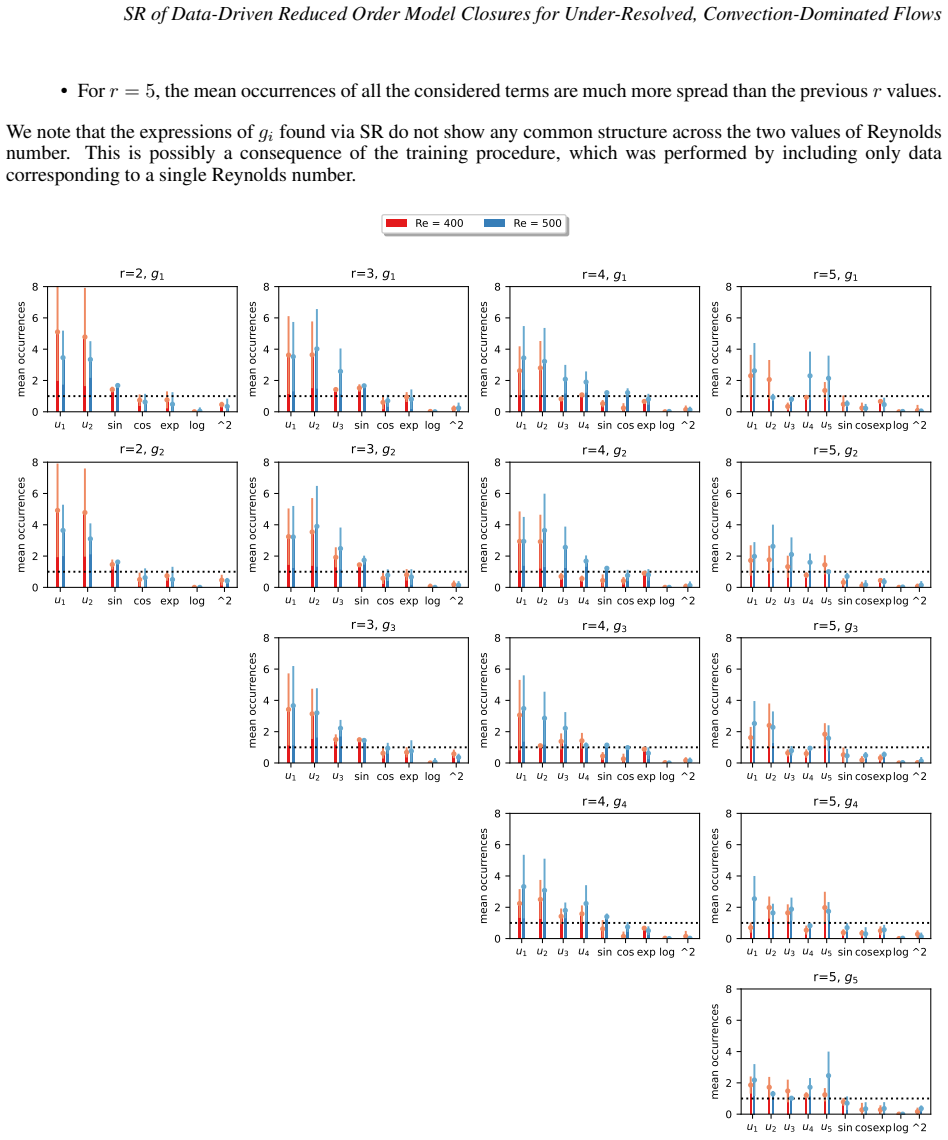
- [Figures 4.4, 4.9, 4.10] The text says that mean and standard deviation of term occurrences are computed, but the figures appear to show only means; either add error bars or state that only means are plotted.
- [References] The reference list uses 'P.T. Tsai' in references [3] and [9], while the byline gives 'Ping-Hsuan Tsai'; please standardize the name.
- [Reproducibility] Given the many hyperparameters and stochastic runs, consider adding a data/code availability statement so that the SR expressions and rMSE tables can be reproduced.
Circularity Check
Core SR-ROM derivation is not circular, but the LDC 'extrapolation region' includes the training/validation intervals, and the closure-reconstruction conclusion restates the SR objective.
-
fitted input called prediction
[Section 4.2 (data split paragraph; Table 4 results)]
"The data-driven closure of each model is trained in the time interval [T0, T0 + 80] by minimizing (3.15), and is selected based on the optimal hyperparameters that minimize (4.2) in the time interval [T0 + 80, T0 + 160]. Finally, we assess the generalization capabilities of all the ROMs in the extrapolation region, that is, in the time interval [T0, T0 + 400]."
The 'extrapolation region' used for the rMSEtest in Table 4 contains the training interval [T0, T0 + 80] and the validation interval [T0 + 80, T0 + 160]. Thus the reported generalization metric for the lid-driven cavity is computed partly on the very data used to fit each closure and to select hyperparameters; it is not a purely out-of-sample prediction. The claim that SR-ROM is 'generalizable' in the chaotic high-Re regime is therefore partially in-sample by construction. The cylinder test (training [500, 520], validation [520, 540], test [540, 600]) is properly extrapolative, so the flaw is partial rather than total, but the LDC headline numbers are contaminated.
-
self definitional
[Section 3.2.3 Eq. (3.20) and Section 5 conclusions bullet]
"gi = arg max_{f in F} [1 - (Σ_j (τ_i^j - f(û_r^j))^2)/(Σ_j (τ_i^j - τ_i)^2)] ... The SR strategy is more accurate than the other three data-driven approaches in reconstructing the ROM closure term."
The SR closure is defined as the function maximizing the coefficient of determination (equivalently minimizing the closure MSE) on the training samples; the conclusion that SR is 'more accurate ... in reconstructing the ROM closure term' is the same training objective evaluated in-sample. This is a restatement of the fitting criterion, not an independent discovery. It does not invalidate the full ROM comparisons based on kinetic energy, which use a separate metric, but the closure-reconstruction bullet is tautological.
full rationale
The paper's central derivation is a data-driven fit: the VMS-ROM closure term (3.16) is computed from FOM snapshots, each model's g_i is learned by minimizing MSE (3.15), and the learned closure is inserted into the ROM (3.12) and compared against FOM kinetic energy on test intervals. That chain is not circular: the SR expressions are genuinely fitted to closure data, and the main ROM comparison uses an independent energy metric. However, two specific steps are circular or contaminated. First, in Section 4.2 the 'extrapolation region' [T0, T0 + 400] contains the training and validation intervals, so the lid-driven-cavity rMSEtest values in Table 4 are partly in-sample; the 'generalizable' claim for the chaotic high-Re cases is thus partially by construction. Second, the conclusion that SR-ROM is most accurate at reconstructing the closure term is the same MSE objective used to define the SR model, so it is self-definitional. These issues are partial: the cylinder problem has a clean extrapolation interval, and the main accuracy/robustness comparison does not reduce to a single fitted quantity. Score 4 reflects the partial in-sample evaluation and tautological closure-reconstruction claim while recognizing the independent content of the core ROM comparison.
Assumptions & free parameters
free parameters (2)
- SR expression constants =
e.g., -0.039, 0.002, -0.034 (Tables 3 and 6)
- SR hyperparameters (max length, generations, primitive set) =
grid-selected per case: max length {5,...,50}, generations {10,...,100}, primitive set among six options
assumptions (4)
- standard math The POD basis is weakly divergence-free, so pressure and divergence terms drop out of the reduced equations.
- domain assumption The VMS-ROM closure term can be represented as a time-local function g_i of the current resolved ROM coefficients u_r.
- domain assumption Stiffness terms in the closure are negligible in the convection-dominated regime.
- domain assumption Training snapshots at a fixed Reynolds number are representative of the extrapolation time interval.
Cite this review
Pith. "Pith review of Symbolic Regression of Data-Driven Reduced Order Model Closures for Under-Resolved, Convection-Dominated Flows." pith.science (2026). https://pith.science/paper/DISU56VU
@misc{pith2026250204703,
  author       = {Pith},
  title        = {Pith review of: Symbolic Regression of Data-Driven Reduced Order Model Closures for Under-Resolved, Convection-Dominated Flows},
  year         = {2026},
  howpublished = {\url{https://pith.science/paper/DISU56VU}},
  note         = {Machine review of arXiv:2502.04703}
}
read the original abstract
Data-driven closures correct the standard reduced order models (ROMs) to increase their accuracy in under-resolved, convection-dominated flows. There are two types of data-driven ROM closures in current use: (i) structural, with simple ansatzes (e.g., linear or quadratic); and (ii) machine learning-based, with neural network ansatzes. We propose a novel symbolic regression (SR) data-driven ROM closure strategy, which combines the advantages of current approaches and eliminates their drawbacks. As a result, the new data-driven SR closures yield ROMs that are interpretable, parsimonious, accurate, generalizable, and robust. To compare the data-driven SR-ROM closures with the structural and machine learning-based ROM closures, we consider the data-driven variational multiscale ROM framework and two under-resolved, convection-dominated test problems: the flow past a cylinder and the lid-driven cavity flow at Reynolds numbers Re = 10000, 15000, and 20000. This numerical investigation shows that the new data-driven SR-ROM closures yield more accurate and robust ROMs than the structural and machine learning ROM closures.
Figures


Figures from the paper (9 more)




Forward citations
Cited by 1 Pith paper
-
Verifiability and Limit Consistency of Eddy Viscosity Large Eddy Simulation Reduced Order Models
L-ROM and S-ROM are proved verifiable and limit consistent, with ROM error bounded by closure error plus projection error and vanishing as dimension grows and lengthscale shrinks.
Reference graph
Works this paper leans on
-
[1]
J. S. Hesthaven, G. Rozza, and B. Stamm. Certified Reduced Basis Methods for Parametrized Partial Differential Equations. Springer, 2015
work page 2015
-
[2]
A. Quarteroni, A. Manzoni, and F. Negri. Reduced Basis Methods for Partial Differential Equations: An Intro- duction, volume 92. Springer, 2015
work page 2015
-
[3]
P.T. Tsai, P. Fischer, and E. Solomonik. Accelerating the Galerkin reduced-order model with the tensor decom- position for turbulent flows. arXiv preprint, http: // arxiv. org/ abs/ 2311. 03694, 2023
work page 2023
-
[4]
S. E. Ahmed, S. Pawar, O. San, A. Rasheed, T. Iliescu, and B. R. Noack. On closures for reduced order models − A spectrum of first-principle to machine-learned avenues. Phys. Fluids, 33(9):091301, 2021
work page 2021
-
[5]
L. Fick, Y . Maday, A. T. Patera, and T. Taddei. A stabilized POD model for turbulent flows over a range of Reynolds numbers: Optimal parameter sampling and constrained projection. J. Comp. Phys. , 371:214–243, 2018
work page 2018
-
[6]
K. Kaneko. An augmented basis method for reduced order models of turbulent flow. PhD thesis, 2022
work page 2022
-
[7]
K. Kaneko, P.-H. Tsai, and P. Fischer. Towards model order reduction for fluid-thermal analysis. Nucl. Eng. Des., 370:110866, 2020
work page 2020
-
[8]
E. J. Parish, M. Yano, I. Tezaur, and T. Iliescu. Residual-based stabilized reduced-order models of the tran- sient convection-diffusion-reaction equation obtained through discrete and continuous projection.Arch. Comput. Methods Eng., pages 1–45, 2024
work page 2024
Show all 44 references
-
[9]
P.H. Tsai, P. Fischer, and T. Iliescu. A time-relaxation reduced order model for the turbulent channel flow. J. Comput. Phys., page 113563, 2024
2024
-
[10]
Sanderse, P
B. Sanderse, P. Stinis, R. Maulik, and S. E. Ahmed. Scientific machine learning for closure models in multiscale problems: A review. arXiv preprint arXiv:2403.02913, 2024
2024 arXiv
-
[11]
C. Mou, B. Koc, O. San, L. G. Rebholz, and T. Iliescu. Data-driven variational multiscale reduced order models. Comput. Methods Appl. Mech. Engrg., 373:113470, 2021
2021
-
[12]
X. Xie, M. Mohebujjaman, L. G. Rebholz, and T. Iliescu. Data-driven filtered reduced order modeling of fluid flows. SIAM J. Sci. Comput., 40(3):B834–B857, 2018
2018
-
[13]
S. E. Ahmed, O. San, A. Rasheed, T. Iliescu, and A. Veneziani. Physics guided machine learning for variational multiscale reduced order modeling. SIAM J. Sci. Comput., 45(3):B283–B313, 2023
2023
-
[14]
X. Xie, C. Webster, and T. Iliescu. Closure learning for nonlinear model reduction using deep residual neural network. Fluids, 5(1):39, 2020
2020
-
[15]
C. Mou, Z. Wang, D. R. Wells, X. Xie, and T. Iliescu. Reduced order models for the quasi-geostrophic equations: A brief survey. Fluids, 6(1):16, 2021
2021
-
[16]
T. J. R. Hughes. Multiscale phenomena: Green’s functions, the Dirichlet-to-Neumann formulation, subgrid scale models, bubbles and the origins of stabilized methods.Comput. Methods Appl. Mech. Engrg., 127(1-4):387–401, 1995
1995
-
[17]
Maday, A
Y . Maday, A. T. Patera, and E. M. Ronquist. A well-posed optimal spectral element approximation for the Stokes problem. Technical report, 1987
1987
-
[18]
Fischer, M
P. Fischer, M. Schmitt, and A. Tomboulides. Recent developments in spectral element simulations of moving- domain problems. In Recent Progress and Modern Challenges in Applied Mathematics, Modeling and Compu- tational Science, pages 213–244. Springer, 2017
2017
-
[19]
Tsai and P
P.T. Tsai and P. Fischer. Parametric model-order-reduction development for unsteady convection. Front. Phys., 10:903169, 2022
2022
-
[20]
Berkooz, P
G. Berkooz, P. Holmes, and J. L. Lumley. The proper orthogonal decomposition in the analysis of turbulent flows. Ann. Rev. Fluid Mech., 25(1):539–575, 1993
1993
-
[21]
V olkwein
S. V olkwein. Proper Orthogonal Decomposition: Theory and Reduced-Order Modelling. Lecture Notes, Univer- sity of Konstanz, 2013. http://www.math.uni-konstanz.de/numerik/personen/volkwein/teaching/ POD-Book.pdf
2013
-
[22]
Ballarin, A
F. Ballarin, A. Manzoni, A. Quarteroni, and G. Rozza. Supremizer stabilization of POD–Galerkin approximation of parametrized steady incompressible Navier–Stokes equations. Int. J. Numer. Meth. Engng., 102:1136–1161, 2015. 22 SR of Data-Driven Reduced Order Model Closures for U...
2015
-
[23]
DeCaria, T
V . DeCaria, T. Iliescu, W. Layton, M. McLaughlin, and M. Schneier. An artificial compression reduced order model. SIAM J. Numer. Anal., 58(1):565–589, 2020
2020
-
[24]
B. R. Noack, P. Papas, and P. A. Monkewitz. The need for a pressure-term representation in empirical Galerkin models of incompressible shear flows. J. Fluid Mech., 523:339–365, 2005
2005
-
[25]
T. J. R. Hughes, G. R. Feij ´oo, L. Mazzei, and J.-B. Quincy. The variational multiscale method – a paradigm for computational mechanics. Comput. Methods Appl. Mech. Engrg., 166(1):3–24, 1998
1998
-
[26]
Ahmed, T
N. Ahmed, T. C. Rebollo, V . John, and S. Rubino. A review of variational multiscale methods for the simulation of turbulent incompressible flows. Arch. Comput. Method. E., 24(1):115–164, 2017
2017
-
[27]
Codina, S
R. Codina, S. Badia, J. Baiges, and J. Principe. Variational multiscale methods in computational fluid dynamics. Encyclopedia of Computational Mechanics Second Edition, pages 1–28, 2018
2018
-
[28]
B. Koc, M. Mohebujjaman, C. Mou, and T. Iliescu. Commutation error in reduced order modeling of fluid flows. Adv. Comput. Math., 45(5-6):2587–2621, 2019
2019
-
[29]
Trevor, T
H. Trevor, T. Robert, and F. Jerome. The Elements of Statistical Learning: Data Mining, Inference and Predic- tion. Springer, 2009
2009
-
[30]
Gareth, W
J. Gareth, W. Daniela, H. Trevor, and T. Robert. An Introduction to Statistical Learning: With Applications in R. Springer, 2021
2021
-
[31]
Peherstorfer and K
B. Peherstorfer and K. Willcox. Data-driven operator inference for nonintrusive projection-based model reduc- tion. Comput. Methods Appl. Mech. Engrg., 306:196–215, 2016
2016
-
[32]
Kronberger, B
G. Kronberger, B. Burlacu, M. Kommenda, S. M. Winkler, and M. Affenzeller.Symbolic Regression. CRC Press, 2024
2024
-
[33]
Manti and A
S. Manti and A. Lucantonio. Discovering interpretable physical models using symbolic regression and discrete exterior calculus. Mach. Learn.: Sci. Technol., 5(1):015005, 2024
2024
-
[34]
J. R. Koza. Genetic Programming as a Means for Programming Computers by Natural Selection, volume 4. Stat. Comput., 1994
1994
-
[35]
Poli, W.B
R. Poli, W.B. Langdon, and N.F. McPhee. A Field Guide to Genetic Programming. Lulu Enterprises UK, 2009
2009
-
[36]
Burlacu, G
B. Burlacu, G. Kronberger, and M. Kommenda. Operon C++: An efficient genetic programming framework for symbolic regression. GECCO ’20, page 1562–1570, New York, NY , USA, 2020. Association for Computing Machinery
2020
-
[37]
La Cava, B
W. La Cava, B. Burlacu, M. Virgolin, M. Kommenda, P. Orzechowski, F. O. de Franc ¸a, Y . Jin, and J. H. Moore. Contemporary symbolic regression methods and their relative performance. NeurIPS, 2021(DB1):1, 2021
2021
-
[38]
D. E. Rumelhart, G. E. Hinton, and R. J. Williams. Learning representations by back-propagating errors. Nature, 323(6088):533–536, 1986
1986
-
[39]
Goodfellow, Y
I. Goodfellow, Y . Bengio, and A. Courville. Deep Learning . MIT Press, 2016. http://www. deeplearningbook.org
2016
-
[40]
Tietz, T
M. Tietz, T. J. Fan, D. Nouri, B. Bossan, and Skorch Developers. skorch: A scikit-learn compatible neural network library that wraps pytorch. https: // skorch. readthedocs. io/ en/ stable, 2017
2017
-
[41]
Aretz and K
N. Aretz and K. Willcox. Exploiting structure via nested operator inference in physics-based learning. MORe 2024, page 12
2024
-
[42]
S. L. Brunton, J. L. Proctor, and J. N. Kutz. Discovering governing equations from data by sparse identification of nonlinear dynamical systems. Proc. Natl. Acad. Sci., 113(15):3932–3937, 2016
2016
-
[43]
D. A. Messenger and D. M. Bortz. Weak SINDy for partial differential equations. J. Comput. Phys., 443:110525, 2021
2021
-
[44]
W. D. Fries, X. He, and Y . Choi. Lasdi: Parametric latent space dynamics identification.Comput. Methods Appl. Mech. Engrg., 399:115436, 2022. 23
2022
Reviewed August 8, 2026 · model on record in the stance chip above.
Discussion (0). Continue with ORCID to comment.