REVIEW 3 major objections 5 minor 58 references
Spin-free orbital entropy, mutual information, and correlation analysis
T0 review · 3 major / 5 minor · reviewed 2026-08-08 · deepseek-v4-flash
Pith's one-line read The paper introduces spin-free orbital entropy, pair entropy, and mutual information that are invariant with respect to the spin projection component and can separate static correlation due to spin couplings from genuine strong correlation.
desk verdict Useful spin-free orbital entanglement diagnostics, but the central pair-entropy inequality is false and the Ms-invariance proof over-reaches; the idea survives, the theorems need rewriting. read the letter →
The pith
A machine-rendered reading of the paper's core claim, the machinery that carries it, and where it could break.
The reading
What carries the argument
The central object is the spin-free orbital basis, which identifies the two singly occupied spin states of an orbital as a single microstate, and the corresponding spin-summed eigenvalues of the pair density matrix, defined by projecting the pair reduced density matrix's eigenstates onto the nine spin-free pair basis states. This construction gives a valid reduced density matrix whose partial traces recover the spin-free one-orbital reduced density matrices, and it is what carries the spin-projection invariance argument through the separation of spatial and spin degrees of freedom.
What would settle it
Compute the spin-free orbital entropy and mutual information for a small multiconfigurational state that is a linear combination of two spin-adapted configuration state functions with different spatial parts but the same total spin, for example a complete-active-space wave function for a diradical with two active orbitals. If the spin-free quantities differ between the maximum and lower spin-projection components, the invariance claim fails outside the single-factorization regime.
Extended reading notes
Core claim
The paper claims that by collapsing the four-dimensional on-site orbital basis to the three-dimensional spin-free basis, where the singly occupied state treats alpha and beta spins as one microstate, one obtains orbital and pair entropies and mutual information that are invariant to the spin projection component of a spin multiplet. The spin-free pair entropy is constructed from spin-summed eigenvalues of the pair density matrix in the nine-dimensional product basis, which preserves additivity for uncorrelated orbitals. The paper further proves the inequalities that the spin-free quantities cannot exceed the original spin-including ones, so the spin-free measures are a coarsening of the original ones. In test calculations, spin-free total quantum information is constant across spin projection components while spin-including values grow sharply as the component decreases, and comparison of the two identifies how much apparent correlation is just spin coupling.
Load-bearing premise
The proof of spin-projection invariance assumes the N-electron wave function factorizes as a single product of a spatial function and a spin function, an assumption that holds for one spin-adapted configuration but not for a general multiconfigurational spin eigenfunction.
Editorial extensions
If this is right
- Spin-free total quantum information and total mutual information can be tabulated for a spin multiplet without repeating calculations for every spin projection component.
- The gap between spin-free and spin-including entropy for a low-component state quantifies how much of the apparent orbital correlation is an artifact of spin coupling rather than genuine strong correlation.
- Because spin-free measures are invariant to the spin projection, they expose trends such as increasing total spin-free entropy with decreasing total spin, which spin-including values obscure.
- The method adds negligible cost to an existing DMRG or full-CI entropy analysis, so it can be reported routinely as a complement to spin-including values.
Reading between the lines
- The same spin-free projection could be applied to other one- and two-orbital correlation measures, such as negativity or discord, raising the question of which entanglement diagnostics remain invariant after spin summation.
- For wave functions that are superpositions of several spin-adapted configurations, the formal spin-projection invariance proof would need to be generalized; numerical tests suggest invariance may still hold, but this is not established by the paper.
- The spin-free pair information could serve as an orbital-ordering cost function for DMRG that is less sensitive to spin contamination in non-spin-adapted calculations.
- One testable extension is to apply the analysis to spin-adapted wave functions where the spatial and spin product factorization is exact per configuration, and check whether across-configuration interference breaks the invariance.
Signed reviews
Editorial analysis
A structured set of objections, weighed in public.
Referee Report
Summary. The paper introduces spin-free analogues of the standard orbital entropy, pair entropy, and mutual information for quantum-chemical wave functions. The spin-free quantities are defined by coarse-graining the four-dimensional orbital basis {empty, spin-up, spin-down, doubly occupied} to a three-dimensional occupation-number basis, and the spin-free pair entropy is defined through spin-summed eigenvalues of the pair density matrix. The central claims are that (i) the spin-free entropy, pair entropy, and mutual information cannot exceed their spin-including counterparts; (ii) the spin-free quantities are invariant with respect to the spin projection M_s of a given spin multiplet; and (iii) comparing spin-free with spin-including quantities separates static correlation due to spin couplings from genuine strong correlation. The approach is illustrated on a non-interacting dimer of CH2 diradicals and on [Fe(SCH3)4]^- and [Fe2S2(SCH3)4]^2- complexes computed with DMRG. Numerical results show that the spin-free quantities are indeed invariant across M_s in the studied examples and that the comparison with spin-including values can simplify correlation diagrams.
Significance. If the formal claims were fully correct, the proposed spin-free analysis would be a useful, cheap supplement to standard DMRG-based entanglement analysis, particularly for open-shell transition-metal complexes where low-M_s components of high-spin states contain many spin-coupling-dominated determinants. The paper's main positive contribution is the clear definition of spin-free orbital and pair entropies and the extensive numerical demonstration on realistic iron-sulfur systems. The observation that spin-free quantities filter out much of the spin-coupling-dominated correlation in these systems is interesting and potentially valuable. However, the theoretical foundation contains a demonstrably false inequality and an incomplete invariance proof, both of which are load-bearing for the advertised interpretation. The numerical work itself is honest about convergence limitations, and the single-orbital entropy inequality is correctly proved by concavity; the same cannot be said for the pair entropy claim.
major comments (3)
- [Section 2, after Eq. (23)] The claim that the spin-free pair entropy is never larger than the original pair entropy, S̃_ij ≤ S_ij, is false. The argument 'by the same argument as for orbital entropy' does not apply, because Eq. (20) defines a column-stochastic map, not a deterministic merging of eigenvalues. A concrete counterexample is the one-electron two-orbital spin doublet |Ψ> = (|↑0> + |0↑>)/√2. Its pair density matrix is pure, so S_ij = 0. Applying Eq. (20) with the single eigenvalue ω = 1 and eigenvector (1/√2)(|↑0> + |0↑>) gives ω̃_{|10>} = 1/2 and ω̃_{|01>} = 1/2, hence S̃_ij = ln 2 > S_ij. This is a valid wave function of the form (4) and a spin eigenfunction, so the counterexample cannot be dismissed as unphysical. The inequality in Eq. (23) must therefore be withdrawn or restated under additional restrictions, and the interpretation that a positive difference S_ij - S̃_ij always quantifies spin-coupling static correlation is not generally justified.
- [Section 2, Eqs. (30)-(39)] The proof of M_s invariance assumes that the total N-electron wave function factorizes as Ψ = Ψ_P(N,S) Ψ_S(N,S,M_s), as stated in Eq. (30). This factorization holds for a single spin-adapted configuration but not for a general multiconfigurational spin eigenfunction, which is a linear combination of such products with different spatial functions. The derivation that follows, leading to Eq. (39), therefore does not establish the advertised invariance for general CAS/DMRG wave functions. The numerical evidence in Tables 2, 3, and 5 is supportive but approximate, and Table 5 itself shows small deviations for higher DMRG roots. The invariance claim needs either a proof that avoids the product assumption, or a clear restriction of the theorem to the cases where the factorization is valid.
- [Section 2, after Eq. (29)] The derivation of Ĩ_ij ≤ I_ij from the classical data processing inequality is not rigorous as written. The argument states that the spin summation (20) is a function mapping between two probability distributions, but Eq. (20) is not a deterministic function of the original eigenvalue index p: it mixes contributions from different eigenvectors through the coefficients c_pk. A stochastic map can also obey a data-processing inequality under suitable conditional-independence conditions, but that additional structure is not demonstrated in the manuscript. The mutual-information bound may be true, and it may follow from a more careful argument, but the proof given here is incomplete.
minor comments (5)
- [Section 2, paragraph after Eq. (3)] There is a typo: 'measures' is written as 'mesures'.
- [Section 3, first paragraph] The text says 'an equilateral triangular geometry with bond lengths 1.121 Å and angle 152.7°'; an equilateral triangle has all angles 60°, so the description is inconsistent and should be clarified.
- [Table 1 and Section 4.1] For the (CH2)2 rows, some entries in parentheses contain two values (e.g., 0.040,0.693); the caption says the original entropies may differ for equivalent orbitals, but the table would be clearer if columns for the two monomer orbitals were shown explicitly.
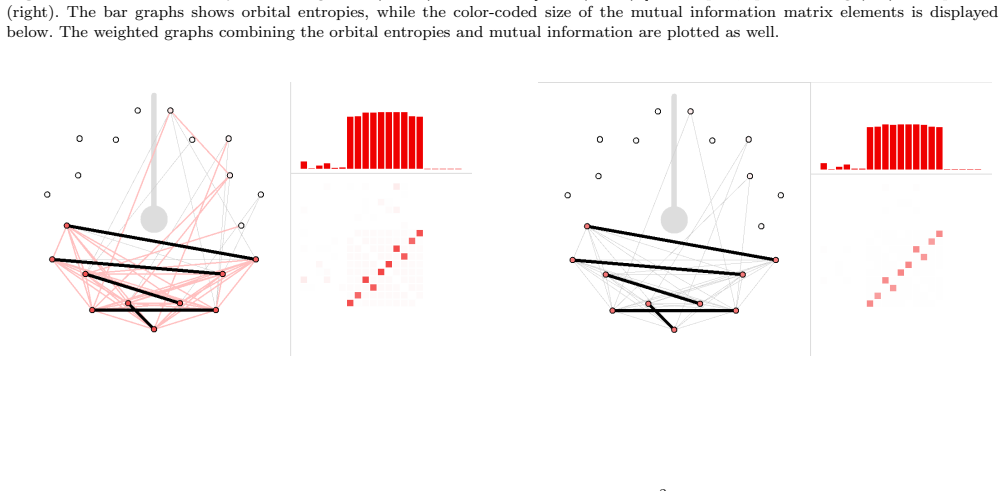
- [Figure captions 3-7] The phrases 'The bar graphs shows' and 'the color-coded size of the mutual information matrix elements is displayed' contain grammatical errors; please rephrase.
- [Section 4.1] The statement that the spin-free mutual information 'vanishes' in the open-shell 4x4 subspace is interesting but would be easier to evaluate if the actual numerical values or a representative matrix were given, since the total Itot values in Table 5 are nonzero.
Circularity Check
No significant circularity: the spin-free quantities are defined directly from the spin-including RDMs, and the interpretive and invariance claims are not obtained by fitting or by self-citation.
full rationale
The paper introduces spin-free orbital entropy, pair entropy, and mutual information by explicit definitions (Eqs. 16-20) as spin summations over the existing spin-including RDMs. No free parameter is fitted and no subset of data is used to force a later 'prediction'; the numerical examples are illustrations rather than fitted outputs. The central claim that differences between spin-free and spin-including measures reveal spin-coupling static correlation is an interpretation of the construction, not a derivation whose conclusion is assumed in its inputs. The invariance proof rests on the product ansatz in Eq. (30), which is an assumption about the wave function form rather than a circular step, and the inequality ̃S_ij ≤ S_ij is asserted from Eq. (20) without a valid convexity argument; both are correctness concerns, not circularity. Self-citations (e.g., Ref. 47 for orbital-localization analysis) are not load-bearing for the paper's new definitions. The derivation chain is therefore self-contained.
Assumptions & free parameters
assumptions (5)
- ad hoc to paper A general N-electron spin eigenfunction factorizes as Ψ = Ψ_P(N,S) Ψ_S(N,S,M_s) (Eq. 30)
- ad hoc to paper The classical data processing inequality applies to the eigenvalue distributions of orbital and pair RDMs (Section 2, after Eq. 29)
- domain assumption The spin-free pair RDM can be represented as a diagonal matrix with entries ω~_q (Eq. 25)
- domain assumption DMRG bond dimensions 512 and 2048 are sufficient for qualitative correlation analysis (Section 3)
- domain assumption The same molecular orbital set is used for all M_s components of a multiplet
Cite this review
Pith. "Pith review of Spin-free orbital entropy, mutual information, and correlation analysis." pith.science (2026). https://pith.science/paper/JT6LW54L
@misc{pith2026250204800,
  author       = {Pith},
  title        = {Pith review of: Spin-free orbital entropy, mutual information, and correlation analysis},
  year         = {2026},
  howpublished = {\url{https://pith.science/paper/JT6LW54L}},
  note         = {Machine review of arXiv:2502.04800}
}
abstract
Orbital entropies, pair entropies, and mutual information have become popular tools for analysis of strongly correlated wave functions. They can quantitatively measure how strongly an orbital (e.g. from the DMRG active space) participates in the strong correlation and reveal the entanglement pattern between different orbitals. However, this pattern can become rather complicated and sometimes difficult to interpret for large active spaces and is not invariant with respect to the spin projection ($M_s$) component of the spin multiplet state. We introduce a modified spin-free orbital entropy, pair entropy, and mutual information, which simplify the entanglement analysis and are invariant with respect to $M_s$. By comparison of these quantities with their ``original'' spin-including counterparts one can distinguish static correlation due to spin couplings from the ``genuine'' strong correlation due to a multiconfigurational character of the wave function. We illustrate the approach on a model consisting of a non-interacting dimer of triplet diradicals and on a more realistic example of iron-sulfur bound complexes with one and two iron atoms.
Figures


Figures from the paper (4 more)


Reference graph
Works this paper leans on
-
[1]
Many-Electron Theory of Atoms and Molecules
Sinanoglu, O.; tai Tuan, F. Many-Electron Theory of Atoms and Molecules. m. Effect of Correlation on Orbitals. J. Chem. Phys.1963, 38, 1740
work page 1963
-
[2]
Correlation strength and information entropy
Ziesche, P. Correlation strength and information entropy. Int. J. Quant. Chem.1995, 56, 363–369
work page 1995
-
[3]
Nagy, A.; Parr, R. G. Information entropy as a measure of the quality of an approximate electronic wave function. Int. J. Quant. Chem.1996, 58, 323–327
work page 1996
-
[4]
Nalewajski, R. F. Entropic Measures of Bond Multiplicity from the Information Theory. J. Phys. Chem. A 2000, 104, 11940–11951
work page 2000
-
[5]
Szalay, S.; Zimbor´ as, Z.; M´ at´ e, M.; Barcza, G.; Schilling, C.; ¨Ors Legeza Fermionic systems for quantum information people. J. Phys. A: Math. Theor.2021, 54, 393001
work page 2021
-
[6]
Correlation Paradox of the Dissociation Limit: A Quantum Information Perspective
Ding, L.; Schilling, C. Correlation Paradox of the Dissociation Limit: A Quantum Information Perspective. J. Chem. Theory Comput.2020, 16, 4159
work page 2020
-
[7]
Concept of Orbital Entanglement and Correlation in Quantum Chemistry
Ding, L.; Mardazad, S.; Das, S.; Szalay, S.; Schollw¨ ock, U.; Zimbor´ as, Z.; Schilling, C. Concept of Orbital Entanglement and Correlation in Quantum Chemistry. J. Chem. Theory Comput.2021, 17, 79–95
work page 2021
-
[8]
Physical entanglement between localized orbitals
Ding, L.; D¨ unnweber, G.; Schilling, C. Physical entanglement between localized orbitals. Quantum Sci. Tech- nol. 2024, 9, 015005
work page 2024
Show all 58 references
-
[9]
Optimizing the density-matrix renormalization group method using quantum informa- tion entropy
Legeza, O.; S´ olyom, J. Optimizing the density-matrix renormalization group method using quantum informa- tion entropy. Phys. Rev. B2003, 68, 195116
-
[10]
Optimizing density-matrix renormalization group method using quantum information entropy
Legeza, O.; S´ olyom, J. Optimizing density-matrix renormalization group method using quantum information entropy. International Workshop on Recent Progress and Prospects in Density-Matrix Renormalization. 2004
2004
-
[11]
Quantum data compression, quantum information generation, and the density-matrix renormalization-group method
Legeza, O.; S´ olyom, J. Quantum data compression, quantum information generation, and the density-matrix renormalization-group method. Phys. Rev. B2004, 70, 205118
-
[12]
Two-Site Entropy and Quantum Phase Transitions in Low-Dimensional Models.Phys
Legeza, ¨O.; S´ olyom, J. Two-Site Entropy and Quantum Phase Transitions in Low-Dimensional Models.Phys. Rev. Lett.2006, 96, 116401
2006
-
[13]
M.; White, S
Rissler, J.; Noack, R. M.; White, S. R. Measuring orbital interaction using quantum information theory. Chem. Phys. 2006, 323, 519 – 531
2006
-
[14]
H.; Reiher, M
Barcza, G.; Legeza, ¨O.; Marti, K. H.; Reiher, M. Quantum-information analysis of electronic states of different molecular structures. Phys. Rev. A2011, 83, 012508
-
[15]
Entanglement Measures for Single- and Multireference Correlation Effects
Boguslawski, K.; Tecmer, P.; Legeza, O.; Reiher, M. Entanglement Measures for Single- and Multireference Correlation Effects. J. Phys. Chem. Lett.2012, 3, 3129–3135
2012
-
[16]
Orbital Entanglement in Bond-Formation Processes
Boguslawski, K.; Tecmer, P.; Barcza, G.; Legeza, O.; Reiher, M. Orbital Entanglement in Bond-Formation Processes. J. Chem. Theory Comput.2013, 9, 2959–2973
2013
-
[17]
M.; S´ olyom, J.; Legeza,¨O
Barcza, G.; Noack, R. M.; S´ olyom, J.; Legeza,¨O. Entanglement patterns and generalized correlation functions in quantum many-body systems. Phys. Rev. B2015, 92, 125140
-
[18]
Orbital entanglement in quantum chemistry
Boguslawski, K.; Tecmer, P. Orbital entanglement in quantum chemistry. Int. J. Quant. Chem.2015, 115, 1289–1295
2015
-
[19]
Boguslawski, K.; Tecmer, P.; ¨Ors Legeza Analysis of two-orbital correlations in wave functions restricted to electron-pair states. Phys. Rev. B2016, 94, 155126
-
[20]
Orbital entanglement and correlation from pCCD-tailored coupled cluster wave functions
Nowak, A.; ¨Ors Legeza; Boguslawski, K. Orbital entanglement and correlation from pCCD-tailored coupled cluster wave functions. J. Chem. Phys.2021, 154, 084111
2021
-
[21]
Resolving the π-assisted U-N σf -bond formation using quantum information theory
Leszczyk, A.; Dome, T.; Tecmer, P.; Kedziera, D.; Boguslawski, K. Resolving the π-assisted U-N σf -bond formation using quantum information theory. Phys. Chem. Chem. Phys.2022, 24, 21296–21307
2022
-
[22]
H.; Ond ´ ık, I
Marti, K. H.; Ond ´ ık, I. M.; Moritz, G.; Reiher, M. Density matrix renormalization group calculations on relative energies of transition metal complexes and clusters. J. Chem. Phys.2008, 128, 014104
2008
-
[23]
K.-L.; Sharma, S
Chan, G. K.-L.; Sharma, S. The Density Matrix Renormalization Group in Quantum Chemistry. Ann. Rev. Phys. Chem. 2011, 62, 465–481, PMID: 21219144
2011
-
[24]
Chan, G. K.-L. Low entanglement wavefunctions. Wiley Int. Revs.: Comp. Mol. Sci.2012, 2, 907–920
2012
-
[25]
V.; Kurashige, Y.; Yanai, T.; Morokuma, K
Harris, T. V.; Kurashige, Y.; Yanai, T.; Morokuma, K. Ab initio density matrix renormalization group study of magnetic coupling in dinuclear iron and chromium complexes. J. Chem. Phys.2014, 140, 054303
2014
-
[26]
Sharma, S.; Sivalingam, K.; Neese, F.; Chan, G. K.-L. Low-energy spectrum of iron-sulfur clusters directly from many-particle quantum mechanics. Nat. Chem. 2014, 6, 927–933
2014
-
[27]
Duperrouzel, C.; Tecmer, P.; Boguslawski, K.; Barcza, G.; ¨Ors Legeza; Ayers, P. W. A quantum informational approach for dissecting chemical reactions. Chem. Phys. Lett.2015, 621, 160–164. 16
2015
-
[28]
F.; Delcey, M
Freitag, L.; Knecht, S.; Keller, S. F.; Delcey, M. G.; Aquilante, F.; Pedersen, T. B.; Lindh, R.; Reiher, M.; Gonz´ alez, L. Orbital entanglement and CASSCF analysis of the Ru-NO bond in a Ruthenium nitrosyl complex. Phys. Chem. Chem. Phys.2015, 17, 14383–14392
2015
-
[29]
Tzeli, D.; Golub, P.; Brabec, J.; Matouˇ sek, M.; Pernal, K.; Veis, L.; Raugei, S.; Xantheas, S. S. Importance of Electron Correlation on the Geometry and Electronic Structure of [2Fe-2S] Systems: A Benchmark Study of the [Fe 2S2(SCH3)4]2−,3−,4−, [Fe2S2(SCys)4]2−, [Fe2S2(S-p-t...
2024
-
[30]
A.; Reiher, M
Moritz, G.; Hess, B. A.; Reiher, M. Convergence behavior of the density-matrix renormalization group algo- rithm for optimized orbital orderings. The Journal of Chemical Physics2005, 122, 024107
-
[31]
J.; Reiher, M
Stein, C. J.; Reiher, M. Automated Selection of Active Orbital Spaces. J. Chem. Theory Comput.2016, 12, 1760–1771
2016
-
[32]
Quantum Information-Assisted Complete Active Space Optimization (QI- CAS)
Ding, L.; Knecht, S.; Schilling, C. Quantum Information-Assisted Complete Active Space Optimization (QI- CAS). J. Phys. Chem. Lett.2023, 14, 11022–11029
2023
-
[33]
G.; DeBeer, S.; Neese, F
Chilkuri, V. G.; DeBeer, S.; Neese, F. Revisiting the Electronic Structure of FeS Monomers Using Ab Initio Ligand Field Theory and the Angular Overlap Model. Inorg. Chem.2017, 56, 10418–10436
2017
-
[34]
G.; DeBeer, S.; Neese, F
Chilkuri, V. G.; DeBeer, S.; Neese, F. Ligand Field Theory and Angular Overlap Model Based Analysis of the Electronic Structure of Homovalent Iron-Sulfur Dimers. Inorg. Chem.2020, 59, 984–995
2020
-
[35]
L.; Maganas, D.; Neese, F
da Costa Gouveia, T. L.; Maganas, D.; Neese, F. Restricted Open-Shell Hartree-Fock Method for a General Configuration State Function Featuring Arbitrarily Complex Spin-Couplings. J. Phys. Chem. A2024, 128, 5041
-
[36]
A.; Guther, K.; Alavi, A
Li Manni, G.; Dobrautz, W.; Bogdanov, N. A.; Guther, K.; Alavi, A. Resolution of Low-Energy States in Spin- Exchange Transition-Metal Clusters: Case Study of Singlet States in [Fe(III) 4S4] Cubanes. J. Phys. Chem. A 2021, 125, 4727–4740
2021
-
[37]
A.; Alavi, A.; Li Manni, G
Dobrautz, W.; Weser, O.; Bogdanov, N. A.; Alavi, A.; Li Manni, G. Spin-Pure Stochastic-CASSCF via GUGA- FCIQMC Applied to Iron-Sulfur Clusters. J. Chem. Theory Comput.2021, 17, 5684–5703
2021
-
[38]
S.; Chan, G
Verstraete, F.; Nishino, T.; amd Mari Carmen Ba´ nuls, U. S.; Chan, G. K.-L.; Stoudenmire, M. E. Density matrix renormalization group, 30 years on. Nat. rev. phys.2023, 5, 273–276
2023
-
[39]
A.; Chuang, I
Nielsen, M. A.; Chuang, I. L. Quantum Computation and Quantum Information, 1st ed.; Cambridge University Press: Cambridge, 2000
2000
-
[40]
Unified View of Quantum and Classical Correla- tions
Modi, K.; Paterek, T.; Son, W.; Vedral, V.; Williamson, M. Unified View of Quantum and Classical Correla- tions. Phys. Rev. Lett.2010, 104, 080501
2010
-
[41]
What can quantum information theory offer to quantum chemistry? Faraday Discuss.2024, 254, 76
Aliverti-Piuri, D.; Chatterjee, K.; Ding, L.; Liao, K.; Liebert, J.; Schilling, C. What can quantum information theory offer to quantum chemistry? Faraday Discuss.2024, 254, 76
2024
-
[42]
Class of ansatz wave functions for one-dimensional spin systems and their relation to the density matrix renormalization group
Rommer, S.; ¨Ostlund, S. Class of ansatz wave functions for one-dimensional spin systems and their relation to the density matrix renormalization group. Phys. Rev. B1997, 55, 2164–2181
-
[43]
The density-matrix renormalization group in the age of matrix product states
Schollw¨ ock, U. The density-matrix renormalization group in the age of matrix product states. Annals of Physics 2011, 326, 96 – 192, January 2011 Special Issue
2011
-
[44]
M.; Thomas, J
Cover, T. M.; Thomas, J. A. Elements of Information Theory; Wiley: Hoboken, New Jersey, 2006
2006
-
[45]
Quantum correlations in molecules: from quantum resourcing to chemical bonding
Ding, L.; Knecht, S.; Zimbor´ as, Z.; Schilling, C. Quantum correlations in molecules: from quantum resourcing to chemical bonding. Quantum Sci. Technol.2023, 8, 015015
2023
-
[46]
Entanglement and Mutual Information in Molecules: Comparing Localized and Delocalized Orbitals
Tenti, L.; Peeters, S.; Giner, E.; Angeli, C. Entanglement and Mutual Information in Molecules: Comparing Localized and Delocalized Orbitals. J. Chem. Theory Comput.2024, 20, 10861–10874
2024
-
[47]
Quantum information-based analysis of electron-deficient bonds
Brandejs, J.; Veis, L.; Szalay, S.; Barcza, G.; Pittner, J.; Legeza, O. Quantum information-based analysis of electron-deficient bonds. J. Chem. Phys.2019, 150, 204117
2019
-
[48]
Quantum Theory of Many-Particle Systems
L¨ owdin, P.-O. Quantum Theory of Many-Particle Systems. I. Physical Interpretations by Means of Density Matrices, Natural Spin-Orbitals, and Convergence Problems in the Method of Configurational Interaction. Phys. Rev.1955, 97, 1474–1489
1955
-
[49]
Fermionic Orbital Optimization in Tensor Network States
Krumnow, C.; Veis, L.; Legeza, O.; Eisert, J. Fermionic Orbital Optimization in Tensor Network States. Phys. Rev. Lett.2016, 117, 210402
2016
-
[50]
M´ at´ e, M.; Petrov, K.; Szalay, S.; ¨Ors Legeza Compressing multireference character of wave functions via fermionic mode optimization. J. Math. Chem.2023, 61, 362–375
2023
-
[51]
Resolution of Electronic States in Heisenberg Cluster Models within the Unitary Group Approach
Li Manni, G.; Kats, D.; Liebermann, N. Resolution of Electronic States in Heisenberg Cluster Models within the Unitary Group Approach. J. Chem. Theory Comput.2023, 19, 1218–1230
2023
-
[52]
M.; Bogdanov, N
Dobrautz, W.; Katukuri, V. M.; Bogdanov, N. A.; Kats, D.; Li Manni, G.; Alavi, A. Combined unitary and 17 symmetric group approach applied to low-dimensional Heisenberg spin systems. Phys. Rev. B 2022, 105, 195123
2022
-
[53]
Modeling magnetic interactions in high-valent trinuclear [Mn 3(IV)O4]4+ complexes through highly compressed multi-configurational wave functions
Li Manni, G. Modeling magnetic interactions in high-valent trinuclear [Mn 3(IV)O4]4+ complexes through highly compressed multi-configurational wave functions. Phys. Chem. Chem. Phys.2021, 23, 19766
2021
-
[54]
Compression of Spin-Adapted Multiconfgurational Wave Functions in Exchange-Coupled Polynuclear Spin Systems
Li Manni, G.; Dobrautz, W.; Alavi, A. Compression of Spin-Adapted Multiconfgurational Wave Functions in Exchange-Coupled Polynuclear Spin Systems. J. Chem. Theory Comput.2020, 16, 2202–2215
2020
-
[55]
Quantum Information Orbitals (QIO): Unveiling Intrinsic Many-Body Com- plexity by Compressing Single-Body Triviality
Liao, K.; Ding, L.; Schilling, C. Quantum Information Orbitals (QIO): Unveiling Intrinsic Many-Body Com- plexity by Compressing Single-Body Triviality. J. Phys. Chem. Lett.2024, 15, 6782–6790
2024
-
[56]
Charmol 2.2 - program for molecular graphics, Prague, Czech Republic
Chalupsk´ y, J. Charmol 2.2 - program for molecular graphics, Prague, Czech Republic. 2012; https://sourceforge.net/projects/charmol
2012
-
[57]
WIREs Comput
Neese, F. WIREs Comput. Mol. Sci.2012, 2, 73–78
2012
-
[58]
Massively parallel quantum chemical density matrix renormalization group method
Brabec, J.; Brandejs, J.; Kowalski, K.; Xantheas, S.; Legeza, O.; Veis, L. Massively parallel quantum chemical density matrix renormalization group method. J. Comp. Chem.2021, 42, 534–544. 18 Figure 3. Correlation analysis for the ground state ( S = 5 /2) of the [Fe(SCH 3)4]− ...
2021
Reviewed August 8, 2026 · model on record in the stance chip above.
Discussion (0). Continue with ORCID to comment.