REVIEW 4 major objections 5 minor 52 references
Effective Sampling for Robot Motion Planning Through the Lens of Lattices
T0 review · 4 major / 5 minor · reviewed 2026-08-08 · deepseek-v4-flash
Pith's one-line read A*_d lattice sampling gives PRM-style planners finite-time guarantees and at least an order-of-magnitude speedup.
desk verdict Sound lattice-based finite-time sample sets with a useful new practical metric, but the abstract overstates the speedup; deserves peer review after a qualified rewrite. read the letter →
The pith
A machine-rendered reading of the paper's core claim, the machinery that carries it, and where it could break.
The reading
What carries the argument
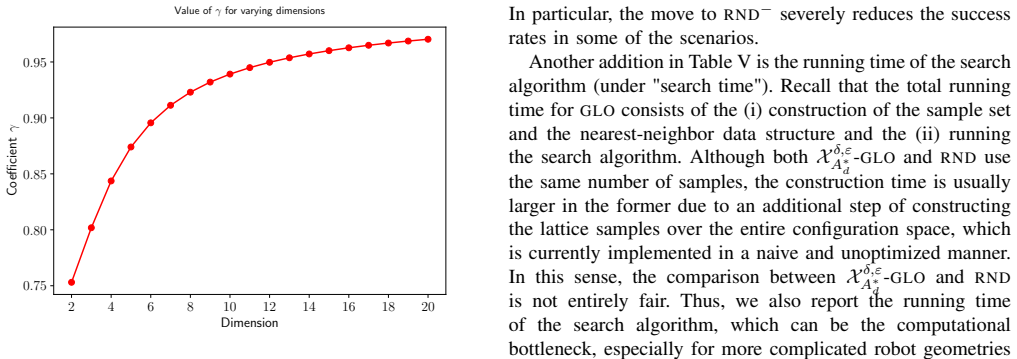
The load-bearing object is the $(\delta,\varepsilon)$-complete sample set $X^{\delta,\varepsilon}_\Lambda$, obtained from a lattice $\Lambda$ by rescaling so its covering radius becomes $\beta^* = \delta\varepsilon/\sqrt{1+\varepsilon^2}$; this turns a geometric covering into a guarantee that the roadmap graph contains a path of length at most $(1+\varepsilon)\,\mathrm{OPT}_\delta$ with connection radius $r^* = 2\delta(1+\varepsilon)/\sqrt{1+\varepsilon^2}$. For the $A^*_d$ lattice, the machinery includes an isometric embedding $T$ from $\mathbb{R}^{d+1}$ into $\mathbb{R}^d$ that preserves the covering radius, rational-ellipsoid lattice-point bounds to estimate sample complexity, and an annulus partition that improves the collision-check-complexity bound by the factor $\zeta = 1 - (\xi^{d+2}-\xi)/(d\xi-(d+1))$ with $\xi=(d/(d+1))^d$.
What would settle it
Run the implicit A* planner with $X^{\delta,\varepsilon}_{A^*_d}$ on a $\delta$-clear problem whose full PRM graph contains a $(1+\varepsilon)$-optimal path; if the planner returns no path or a strictly longer one, then the implicit search does not preserve the guarantee.
Extended reading notes
Core claim
The paper's central claim is that the covering radius of a lattice controls the quality of the sampling set: rescaling any lattice by the factor $\beta^*/f_\Lambda$ turns it into a $\beta^*$-cover, and Lemma 1 then gives a $(\delta,\varepsilon)$-complete PRM graph. Applying this to $A^*_d$, after an isometric embedding into $\mathbb{R}^d$ that preserves its covering radius, yields the sample set $X^{\delta,\varepsilon}_{A^*_d}$, which the paper proves has the smallest sample complexity among $\mathbb{Z}^d$, $D^*_d$, and $A^*_d$ and enjoys a tight collision-check bound. Theorems 2 and 3 quantify these costs, and the experimental section reports that the $A^*_d$ set reduces running time by at least an order of magnitude compared with the staggered grid and often by two to three orders compared with uniform random sampling, while keeping success rates high in the tested scenarios.
Load-bearing premise
The paper assumes, without proof, that the implicit A* search inherits the $(\delta,\varepsilon)$-completeness guarantee of the full roadmap graph, and that the scenario-by-scenario tuning of $\delta$ does not favor the lattice sampler.
Editorial extensions
If this is right
- Any PRM-style planner that builds its roadmap on $X^{\delta,\varepsilon}_{A^*_d}$ with the radius $r^*$ inherits a finite-time guarantee: a returned path is within $(1+\varepsilon)$ of the $\delta$-clear optimum, and failure to find a path certifies that no $\delta$-clear solution exists.
- Because sample complexity grows with the $d$-th power of the covering radius, the lattice with the smallest covering radius dominates in high dimensions; the paper reports that $A^*_d$ is the best known covering for dimensions up to 21.
- Lattice regularity lets a planner compute any vertex's neighbor set as a translation of the origin's neighbor set, removing the nearest-neighbor data structure from roadmap construction for deterministic samples.
- In the reported experiments, $A^*_d$ sampling is at least an order of magnitude faster than staggered-grid sampling, and often two to three orders of magnitude faster than uniform random sampling, with higher success rates and comparable or shorter paths.
Reading between the lines
- Beyond the paper: the speedups observed with the implicit search combine a proven guarantee on the full roadmap graph with an unproved inheritance by the search; replacing that search with one that provably preserves the roadmap's shortest paths would close that gap.
- Beyond the paper: the paper's own parameter experiments show solutions appearing for combinations of $\delta$ and $\varepsilon$ where its sufficient condition predicts none, suggesting the $\beta^*$-cover relation is loose and that tighter bounds could cut the required sample count substantially.
- Beyond the paper: instrumenting a planner to count actual collision checks rather than using the analytic proxy could reveal how much of $A^*_d$'s advantage comes from fewer vertex expansions versus fewer edge checks, which would refine the collision-check-complexity model.
Editorial analysis
A structured set of objections, weighed in public.
Referee Report
Summary. The paper develops deterministic lattice-based sample sets for sampling-based motion planning that carry finite-time (δ,ε)-completeness guarantees. Starting from known covering radii of the lattices Z^d, D*_d, and A*_d, the authors rescale each lattice so that it becomes a β*-cover and invoke the completeness–cover lemma of Tsao et al. to obtain (δ,ε)-complete sample sets. The A*_d lattice, which is the best-known covering in low dimensions, is embedded into R^d by an explicit isometry, and the paper derives asymptotic expressions for sample complexity and a constant-factor improvement for a new collision-check complexity measure. The method is evaluated in multi-robot and 7-DOF manipulator scenarios through an implicit A* planner (iA*) that exploits the translational regularity of lattices, with reported speedups of orders of magnitude over rectangular grids, staggered grids, and uniform random sampling.
Significance. If the claims hold, this is a useful practical step for sampling-based motion planning: it supplies deterministic sample sets with finite-time worst-case path-quality guarantees, and the use of A*_d is a natural and well-motivated contribution over earlier staggered-grid constructions. The mathematical core is credible and self-contained: Theorem 1 correctly combines known covering radii with Lemma 1, and the derivation of the A*_d embedding in the appendix is explicit. The sample-complexity and collision-check-complexity bounds in Theorems 2 and 3 are also grounded in standard lattice-point-counting arguments. The paper is accompanied by a public code repository, which strengthens its reproducibility. However, the headline empirical claim of 'at least an order-of-magnitude speedup' is not uniformly supported by the reported data, and the transfer of the finite-time guarantee to the iA* planner used in all experiments is not formally established. These issues are local and fixable, so the paper is a credible candidate for publication after revision.
major comments (4)
- [§VI-C, Algorithm 2] The paper claims that lattice-based sample sets 'endow their planners with strong finite-time guarantees,' yet the planner used in all experiments is iA*, which searches an implicitly constructed partial graph G′ rather than the full PRM graph G_M(X,r*). No proof is given that the A* search over the implicit graph preserves the (δ,ε)-completeness path-length guarantee of the full graph. A correctly implemented A* with a consistent heuristic on an implicitly defined graph would indeed return a shortest path in the full graph, but this must be stated and proved, or the experimental claims should be explicitly decoupled from the theoretical guarantee.
- [§VII-B, §VII-E, Tables II and III] The δ tuning protocol may favor the lattice method. In both the multi-robot and manipulator experiments, δ is decreased until iA* with X_{A*_d} succeeds, while random sampling receives the same number of samples but a different connection radius r_rnd(n)=ψ(log n/n)^{1/d}. Thus the comparison is not at matched success rates or matched connection radii, and the reported speedups confound sampling quality with parameter tuning. The authors should either provide comparisons at matched success rates, report results for RND with radii comparable to r*, or substantially qualify the interpretation of the speedups.
- [Abstract, §I, §VII-C, Tables I and III] The abstract's claim of 'at least an order-of-magnitude speedup over existing deterministic and uniform random sampling methods' is not uniformly supported by the data. In Table I, the speedup of A*_d over D*_d is about 2.3× for BT5 (0.14 s vs 0.06 s) and about 3.5× for UM4 (8.47 s vs 2.43 s), not an order of magnitude. In Table III, RND at equal sample count is faster than iA*-LOC in window (2.9 ms vs 3.6 ms), sleeve (108.9 ms vs 160.2 ms), and sandwich (5.1 ms vs 9.7 ms), despite lower success rates. The paper also states in §VII-C that A*_d is 'at least 3×' faster than D*_d, which is contradicted by the BT5 row. The empirical claim should be reworded to match the data, or the missing matched-success-rate experiments should be added.
- [§VI-C, §VIII, Appendix E] The argument in Appendix E that failure to find a solution for δ=4 and ε∈{2,4,5} 'implies that no 4-clear solution exists' relies on the (δ,ε)-completeness of the pair (X_{A*_d}, r*) and on iA* correctly deciding non-reachability in the full graph. Since the iA* guarantee is not proved, the infeasibility interpretation is premature. This is the same issue as the first major comment, but it has a concrete consequence in the parameter study, so it should be resolved before the paper's theoretical claims are tied to the experimental planner.
minor comments (5)
- [§VI-B, Algorithm 1] The pseudo-code is unclear about the distinction between integer index vectors v ∈ Z^d and lattice points x = v·G_Λ. Line 14 writes 'pnew = p + e · GΛ' as if p were an integer vector, while line 15 tests '∥p∥ ≤ R' as if p were a lattice point. Please rewrite the algorithm so that the integer search state and the lattice point are separate variables, e.g., v and x = v·G_Λ, and check ∥x∥ ≤ R.
- [§II] There is a typo in the second paragraph: 'We concider a holonomic robot' should be 'We consider a holonomic robot.'
- [§IV, last paragraph] The sentence 'In the next session, we show...' should read 'In the next section, we show...'.
- [Appendix E, Figure 10] The text states that δ ∈ {2.75, 4}, but the caption of Figure 10 reports δ = 2.5 for the left column. The figure and text should be made consistent.
- [Tables I, II, III] The normalized solution-length columns are labeled 'Length (r)' without defining r in the caption. Please state explicitly that the length is normalized with respect to the A*_d solution length.
Circularity Check
The lattice-based derivation is self-contained; no circular reduction found.
full rationale
The derivation chain proceeds from externally established lattice covering radii (Conway & Sloane, cited as [3]), through a covering-radius rescaling argument (Theorem 1) to the completeness-cover lemma of Tsao et al. (Lemma 1). Lemma 1 is cited from prior peer-reviewed work and is a general theorem relating β*-covers to (δ,ε)-completeness; it is not tailored to the present claim or fitted to the reported speedups. The sample-complexity and collision-check bounds are derived from lattice point counting and rational ellipsoid estimates, not from the experimental outcomes. The speedup claims are empirical observations from Section VII, not outputs of a fitted model. The δ-tuning protocol in Section VII-B is a methodological fairness concern, but it does not make any derived guarantee equivalent to its own inputs: no equation is defined in terms of the conclusion, and no fitted parameter is renamed as a prediction. The self-citations to [4] and [50] are to independently published, checkable results, so they do not constitute load-bearing circularity. The unproved inheritance of the guarantee by iA* is a proof gap rather than a circular step, since A* on the implicit graph would return the graph's shortest path if fully explored.
Assumptions & free parameters
free parameters (3)
- delta (clearance parameter) =
per scenario, decreased until A*_d succeeded
- epsilon (stretch factor) =
10 for main experiments
- psi (random baseline radius constant) =
not specified
assumptions (4)
- domain assumption Lemma 1: a beta*-cover with beta*=delta*epsilon/sqrt(1+epsilon^2) and connection radius r*=2delta(1+epsilon)/sqrt(1+epsilon^2) yields (delta,epsilon)-completeness
- standard math Known covering radii of Z^d, D*_d, and A*_d from Conway-Sloane
- standard math Rational ellipsoid lattice point discrepancy bounds (Ivic et al.)
- domain assumption The iA* algorithm preserves the (delta,epsilon)-completeness of the full PRM graph
Cite this review
Pith. "Pith review of Effective Sampling for Robot Motion Planning Through the Lens of Lattices." pith.science (2026). https://pith.science/paper/HRF5WNKJ
@misc{pith2026250204908,
  author       = {Pith},
  title        = {Pith review of: Effective Sampling for Robot Motion Planning Through the Lens of Lattices},
  year         = {2026},
  howpublished = {\url{https://pith.science/paper/HRF5WNKJ}},
  note         = {Machine review of arXiv:2502.04908}
}
abstract
Sampling-based methods for motion planning, which capture the structure of the robot's free space via (typically random) sampling, have gained popularity due to their scalability, simplicity, and for offering global guarantees, such as probabilistic completeness and asymptotic optimality. Unfortunately, the practicality of those guarantees remains limited as they do not provide insights into the behavior of motion planners for a finite number of samples (i.e., a finite running time). In this work, we harness lattice theory and the concept of $(\delta,\epsilon)$-completeness by Tsao et al. (2020) to construct deterministic sample sets that endow their planners with strong finite-time guarantees while minimizing running time. In particular, we introduce a highly-efficient deterministic sampling approach based on the $A_d^*$ lattice, which is the best-known geometric covering in dimensions $\leq 21$. Using our new sampling approach, we obtain at least an order-of-magnitude speedup over existing deterministic and uniform random sampling methods for complex motion-planning problems. Overall, our work provides deep mathematical insights while advancing the practical applicability of sampling-based motion planning.
Figures


Figures from the paper (7 more)




Reference graph
Works this paper leans on
-
[1]
James P. Bailey, Alex Nash, Craig A. Tovey, and Sven Koenig. Path-length analysis for grid-based path plan- ning. Artificial Intelligence, 301:103560, 2021
work page 2021
-
[2]
Francesco Bullo and Andrew D. Lewis. Geometric Control of Mechanical Systems , volume 49 of Texts in Applied Mathematics. Springer Verlag, 2004
work page 2004
-
[3]
Sphere packings, lattices and groups , volume 290
John Horton Conway and Neil James Alexander Sloane. Sphere packings, lattices and groups , volume 290. Springer Science & Business Media, 2013
work page 2013
-
[4]
Near-optimal multi-robot motion planning with finite sampling
Dror Dayan, Kiril Solovey, Marco Pavone, and Dan Halperin. Near-optimal multi-robot motion planning with finite sampling. IEEE Transactions on Robotics , 2023
work page 2023
-
[5]
Christopher M. Dellin and Siddhartha S. Srinivasa. A unifying formalism for shortest path problems with ex- pensive edge evaluations via lazy best-first search over paths with edge selectors. In International Conference on Automated Planning and Scheduling , pages 459–467. AAAI Press, 2016
work page 2016
-
[6]
Andrew Dobson and Kostas E. Bekris. Sparse roadmap spanners for asymptotically near-optimal motion plan- ning. Int. J. Robotics Res. , 33(1):18–47, 2014
work page 2014
-
[7]
Andrew Dobson, George V . Moustakides, and Kostas E. Bekris. Geometric probability results for bounding path quality in sampling-based roadmaps after finite compu- tation. In International Conference on Robotics and Automation, pages 4180–4186. IEEE, 2015
work page 2015
-
[8]
Wolfgang Ebeling. Lattices and Codes: A Course Total time (s) Search time (s) Length (r) Success (%)Scenario (Robot #) A∗ d LOC A∗ d GLO RND GLO RND − GLO A∗ d GLO RND GLO RND − GLO RND GLO RND − GLO RND GLO RND − GLO N1(5) 0.36 3.05 4.16 3.40 0.84 3.37 2.59 1.48 1.46 80.00 90 N2(5) 0.41 2.67 2.74 4.28 0.82 2.11 3.62 2.43 3.31 65.00 95 N3(5) 0.59 3.83 5.4...
Show all 52 references
-
[9]
Asymptotically optimal inspection planning via efficient near-optimal search on sampled roadmaps
Mengyu Fu, Alan Kuntz, Oren Salzman, and Ron Al- terovitz. Asymptotically optimal inspection planning via efficient near-optimal search on sampled roadmaps. Int. J. Robotics Res. , 42(4-5):150–175, 2023
2023
-
[10]
Toward certifiable optimal motion planning for medical steerable needles
Mengyu Fu, Kiril Solovey, Oren Salzman, and Ron Alterovitz. Toward certifiable optimal motion planning for medical steerable needles. Int. J. Robotics Res. , 42 (10):798–826, 2023
2023
-
[11]
Gammell, Timothy D
Jonathan D. Gammell, Timothy D. Barfoot, and Sid- dhartha S. Srinivasa. Batch informed trees (BIT*): Informed asymptotically optimal anytime search. Int. J. Robotics Res., 39(5), 2020
2020
-
[12]
Resolu- tion independent density estimation for motion planning in high-dimensional spaces
Bryant Gipson, Mark Moll, and Lydia E Kavraki. Resolu- tion independent density estimation for motion planning in high-dimensional spaces. In 2013 IEEE international conference on robotics and automation , pages 2437–
2013
-
[13]
Al- gorithmic motion planning
Dan Halperin, Oren Salzman, and Micha Sharir. Al- gorithmic motion planning. In Csaba D. Tóth, Joseph O’Rourke, and Jacob E. Goodman, editors, Handbook of Discrete and Computational Geometry , pages 1311–
-
[14]
Asymptotically optimal planning by feasible kinodynamic planning in a state-cost space
Kris Hauser and Yilun Zhou. Asymptotically optimal planning by feasible kinodynamic planning in a state-cost space. IEEE Trans. Robotics , 32(6):1431–1443, 2016
2016
-
[15]
Householder
Alston S. Householder. Unitary triangularization of a nonsymmetric matrix. Journal of the ACM , 5(4):339– 342, 1958
1958
-
[16]
Lattice points in large regions and related arithmetic functions: recent developments in a very classic topic
A Ivic, E Krätzel, M Kühleitner, and WG Nowak. Lattice points in large regions and related arithmetic functions: recent developments in a very classic topic. arXiv preprint math/0410522, 2004
2004 arXiv
-
[17]
Clark, and Marco Pavone
Lucas Janson, Edward Schmerling, Ashley A. Clark, and Marco Pavone. Fast marching tree: A fast marching sampling-based method for optimal motion planning in many dimensions. I. J. Robotics Res. , 34(7):883–921, 2015
2015
-
[18]
De- terministic sampling-based motion planning: Optimality, complexity, and performance
Lucas Janson, Brian Ichter, and Marco Pavone. De- terministic sampling-based motion planning: Optimality, complexity, and performance. The International Journal of Robotics Research , 37(1):46–61, 2018
2018
-
[19]
Sampling-based al- gorithms for optimal motion planning
Sertac Karaman and Emilio Frazzoli. Sampling-based al- gorithms for optimal motion planning. The international journal of robotics research , 30(7):846–894, 2011
2011
-
[20]
Probabilistic roadmaps for path planning in high-dimensional configuration spaces
Lydia E Kavraki, Petr Svestka, J-C Latombe, and Mark H Overmars. Probabilistic roadmaps for path planning in high-dimensional configuration spaces. IEEE transac- tions on Robotics and Automation , 12(4):566–580, 1996
1996
-
[21]
Collision detection or nearest-neighbor search? On the computational bottleneck in sampling-based motion plan- ning
Michal Kleinbort, Oren Salzman, and Dan Halperin. Collision detection or nearest-neighbor search? On the computational bottleneck in sampling-based motion plan- ning. In Workshop on the Algorithmic Foundations of Robotics, pages 624–639. Springer, 2016
2016
-
[22]
Bekris, and Dan Halperin
Michal Kleinbort, Kiril Solovey, Zakary Littlefield, Kostas E. Bekris, and Dan Halperin. Probabilistic com- pleteness of RRT for geometric and kinodynamic plan- ning with forward propagation. Robotics and Automation Letters, 4(2):277–283, 2019
2019
-
[23]
Uniform distribution of sequences
Lauwerens Kuipers and Harald Niederreiter. Uniform distribution of sequences . Courier Corporation, 2012
2012
-
[24]
Kinodynamic RRTs with fixed time step and best-input extension are not proba- bilistically complete
Tobias Kunz and Mike Stilman. Kinodynamic RRTs with fixed time step and best-input extension are not proba- bilistically complete. In Workshop on the Algorithmic Foundations of Robotics, pages 233–244, 2014
2014
-
[25]
Steven M. LaValle. Planning Algorithms . Cambridge University Press, 2006
2006
-
[26]
LaValle and James J
Steven M. LaValle and James J. Kuffner. Randomized kinodynamic planning. I. J. Robotics Res. , 20(5), 2001
2001
-
[27]
A sampling and learning framework to prove motion planning infeasibility
Sihui Li and Neil T Dantam. A sampling and learning framework to prove motion planning infeasibility. The International Journal of Robotics Research , 42(10):938– 956, 2023
2023
-
[28]
A hexagonal grid-based sampling planner for aquatic environmental monitoring using un- manned surface vehicles
Teng Li, Min Xia, Jiahong Chen, Shujun Gao, and Clarence de Silva. A hexagonal grid-based sampling planner for aquatic environmental monitoring using un- manned surface vehicles. In IEEE International Con- ference on Systems, Man, and Cybernetics , pages 3683– 3688, 2017
2017
-
[29]
Yanbo Li, Zakary Littlefield, and Kostas E. Bekris. Asymptotically optimal sampling-based kinodynamic planning. I. J. Robotics Res. , 35(5):528–564, 2016
2016
-
[30]
Calculus of variations and optimal con- trol theory: A concise introduction
Daniel Liberzon. Calculus of variations and optimal con- trol theory: A concise introduction . Princeton University Press, 2011
2011
-
[31]
Tenenbaum, and Yilun Du
Yunhao Luo, Chen Sun, Joshua B. Tenenbaum, and Yilun Du. Potential based diffusion motion planning. In Forty- first International Conference on Machine Learning , 2024
2024
-
[32]
Malyuta, T
D. Malyuta, T. P. Reynolds, M. Szmuk, T. Lew, R. Bonalli, M. Pavone, and B. Acikmese. Convex optimization for trajectory generation. IEEE Control Systems Magazine, 42(5):40–113, 2022
2022
-
[33]
Srinivasa
Aditya Mandalika, Oren Salzman, and Siddhartha S. Srinivasa. Lazy receding horizon A* for efficient path planning in graphs with expensive-to-evaluate edges. In International Conference on Automated Planning and Scheduling, pages 476–484. AAAI Press, 2018
2018
-
[34]
Srinivasa
Aditya Mandalika, Sanjiban Choudhury, Oren Salzman, and Siddhartha S. Srinivasa. Generalized lazy search for robot motion planning: Interleaving search and edge evaluation via event-based toggles. In International Con- ference on Automated Planning and Scheduling , pages 745–7...
2019
-
[35]
Motion planning around obstacles with convex optimization
Tobia Marcucci, Mark Petersen, David von Wrangel, and Russ Tedrake. Motion planning around obstacles with convex optimization. Science Robotics, 8(84), 2023
2023
-
[36]
Andreas Orthey, Constantinos Chamzas, and Lydia E. Kavraki. Sampling-based motion planning: A compar- ative review. Annual Review of Control, Robotics, and Autonomous Systems, 7(1), 2024
2024
-
[37]
FCL: A general purpose library for collision and proximity queries
Jia Pan, Sachin Chitta, and Dinesh Manocha. FCL: A general purpose library for collision and proximity queries. In 2012 IEEE International Conference on Robotics and Automation , pages 3859–3866, 2012
2012
-
[38]
Solution of the problem of least dense lattice covering of five-dimensional space by equal spheres
Sergei Sergeevich Ryshkov and Evgenii Petrovich Bara- novskii. Solution of the problem of least dense lattice covering of five-dimensional space by equal spheres. In Doklady Akademii Nauk , volume 222, pages 39–42. Russian Academy of Sciences, 1975
1975
-
[39]
Donald E. Sands. Introduction to Crystallography. Dover Publications, New York, 1994
1994
-
[40]
AMRA*: Anytime multi-resolution multi- heuristic A*
Dhruv Mauria Saxena, Tushar Kusnur, and Maxim Likhachev. AMRA*: Anytime multi-resolution multi- heuristic A*. In IEEE International Conference on Robotics and Automation , pages 3371–3377, 2022
2022
-
[41]
Lee, Ibrahim Awwal, Henry Bradlow, Jia Pan, Sachin Patil, Ken Goldberg, and Pieter Abbeel
John Schulman, Yan Duan, Jonathan Ho, Alex X. Lee, Ibrahim Awwal, Henry Bradlow, Jia Pan, Sachin Patil, Ken Goldberg, and Pieter Abbeel. Motion planning with sequential convex optimization and convex collision checking. Int. J. Robotics Res. , 33(9):1251–1270, 2014
2014
-
[42]
Towards prac- tical finite sample bounds for motion planning in TAMP
Seiji A Shaw, Aidan Curtis, Leslie Pack Kaelbling, Tomás Lozano-Pérez, and Nicholas Roy. Towards prac- tical finite sample bounds for motion planning in TAMP. In Workshop on the Algorithmic Foundations of Robotics, 2024
2024
-
[43]
Rahul Shome, Kiril Solovey, Andrew Dobson, Dan Halperin, and Kostas E. Bekris. dRRT *: Scalable and informed asymptotically-optimal multi-robot motion planning. Auton. Robots, 44(3-4):443–467, 2020
2020
-
[44]
Lectures on the Geometry of Numbers, volume 201 of Springer-Verlag Grundlehren der mathematischen Wissenschaften
Carl Ludwig Siegel. Lectures on the Geometry of Numbers, volume 201 of Springer-Verlag Grundlehren der mathematischen Wissenschaften. Springer, 1989
1989
-
[45]
Finding a needle in an exponential haystack: Discrete RRT for exploration of implicit roadmaps in multi-robot motion planning
Kiril Solovey, Oren Salzman, and Dan Halperin. Finding a needle in an exponential haystack: Discrete RRT for exploration of implicit roadmaps in multi-robot motion planning. Int. J. Robotics Res. , 35(5):501–513, 2016
2016
-
[46]
Strub and Jonathan D
Marlin P. Strub and Jonathan D. Gammell. Adaptively informed trees (AIT*) and effort informed trees (EIT*): Asymmetric bidirectional sampling-based path planning. Int. J. Robotics Res. , 41(4):390–417, 2022
2022
-
[47]
¸ Sucan, Mark Moll, and Lydia E
Ioan A. ¸ Sucan, Mark Moll, and Lydia E. Kavraki. The Open Motion Planning Library. IEEE Robotics & Automation Magazine , 19(4):72–82, December 2012. https://ompl.kavrakilab.org
2012
-
[48]
Wil Thomason, Zachary Kingston, and Lydia E. Kavraki. Motions in microseconds via vectorized sampling-based planning. In IEEE International Conference on Robotics and Automation, pages 8749–8756
-
[49]
Strub, and Jonathan D
Wil Thomason, Marlin P. Strub, and Jonathan D. Gam- mell. Task and motion informed trees (TMIT*): Almost- surely asymptotically optimal integrated task and motion planning. IEEE Robotics Autom. Lett. , 7(4):11370– 11377, 2022
2022
-
[50]
Sample complexity of probabilistic roadmaps via ε-nets
Matthew Tsao, Kiril Solovey, and Marco Pavone. Sample complexity of probabilistic roadmaps via ε-nets. In International Conference on Robotics and Automation , pages 2196–2202. IEEE, 2020
2020
-
[51]
Anna Yershova and Steven M. LaValle. Deterministic sampling methods for spheres and SO(3). In IEEE International Conference on Robotics and Automation , pages 3974–3980, 2004
2004
-
[1342]
Chapman and Hall/CRC, 3rd edition, 2017
2017
Reviewed August 8, 2026 · model on record in the stance chip above.
Discussion (0). Continue with ORCID to comment.