REVIEW 3 major objections 6 minor 3 cited by
Mobile Network-specialized Large Language Models for 6G: Architectures, Innovations, Challenges, and Future Trends
T0 review · 3 major / 6 minor · reviewed 2026-08-08 · deepseek-v4-flash
Pith's one-line read This paper argues that the LLM should become an intrinsic building block of the 6G mobile core, and it compares four integration architectures, showing that a standalone LLM network function can autonomously resolve a network-slicing…
desk verdict Useful four-architecture taxonomy of LLM-6G integration, but the abstract's 'prove effectiveness' oversells a qualitative walkthrough. read the letter →
The pith
A machine-rendered reading of the paper's core claim, the machinery that carries it, and where it could break.
The reading
What carries the argument
The central mechanism is the LLM-based Network Function (LNF), a control-plane NF in the 6G service-based architecture. Its processing pipeline uses a sliding window to feed recent data plus memory summaries into the prompt, CoT/ToT prompting to break solutions into instructions, an NL-to-REST Mapper that consults 3GPP technical specifications to generate API calls, an Executor that invokes them, a Parser for JSON payloads, and a REST-to-NL Mapper for human-readable answers. This modular chain carries the argument: if the mapping from natural-language instructions to correct REST calls is reliable, the autonomous resolution workflow in Section IV works as described.
What would settle it
Present the slicing-conflict scenario to the proposed LNF in a testbed where the generated REST API calls are validated against 3GPP specifications and the network's actual response. If the NL-to-REST Mapper produces malformed, unauthorized, or semantically wrong API calls beyond a small tolerance, or the NWDAF analytics fail to confirm the remedy, the autonomous workflow described in Section IV would not operate as claimed.
Extended reading notes
Core claim
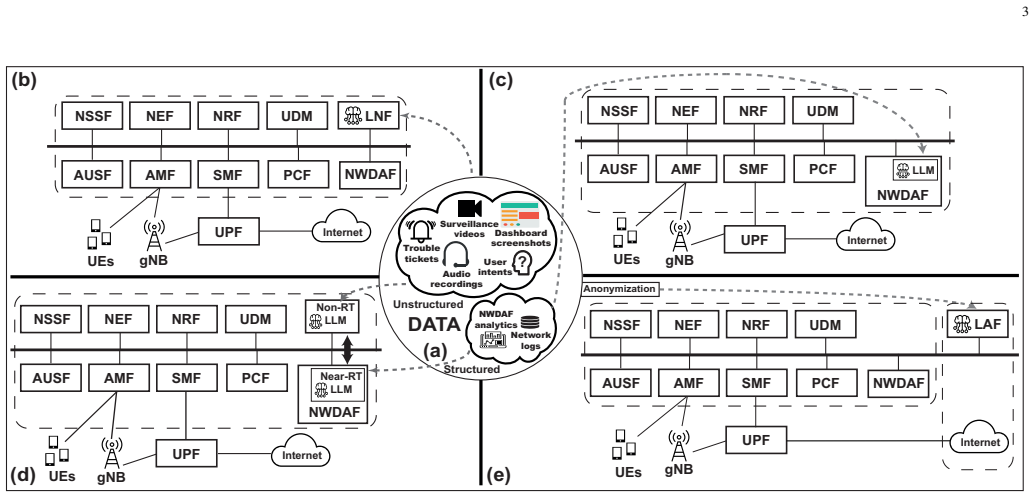
The central claim is that the LLM, deployed as a standalone network function in the 6G control plane, can close the loop on anomaly resolution: it ingests multi-modal network data, detects unusual traffic patterns, uses chain-of-thought and tree-of-thought reasoning to produce a step-by-step plan, maps each step to 3GPP RESTful API calls, executes them through an Executor, and verifies the outcome by subscribing to NWDAF analytics. The paper contrasts this with three alternatives: embedding the LLM inside an existing NF, a hybrid near-real-time/non-real-time split, and an external application function. It argues that the standalone and hybrid designs inherit 6G's security-by-design properties, while the external option raises data sovereignty and latency concerns. In the illustrative scenario, the LNF detects a traffic surge in an immersive-communications slice, generates a Pareto-optimal QoS policy, enforces it through PCF, SMF, AMF, and UPF, and receives NWDAF analytics confirming the remedy.
Load-bearing premise
The paper assumes that a fine-tuned LLM, augmented with RAG and CoT/ToT prompting, can turn network observations into correct and safe 3GPP RESTful API calls, a capability that has not yet been demonstrated in a prototype.
Editorial extensions
If this is right
- An MNO can start with the standalone LNF and migrate to the hybrid design by gradually upgrading an existing NF such as NWDAF to host the near-real-time LLM.
- Slicing conflicts of the type described, where a traffic surge in one slice raises latency in another, can be resolved without waiting for human consultation because the LNF generates and enforces a Pareto-optimal QoS policy directly through existing 3GPP control-plane functions.
- Security-by-design in 6G would extend to the LLM itself when it is an internal NF, reducing attack surfaces compared to an external application function.
- Explainable AI and NOC approval checkpoints can keep a human in the loop, so full autonomy is not required for the LNF to be useful.
Reading between the lines
- The real bottleneck is not the architecture but the correctness of the LLM's API generation; a benchmark that measures NL-to-REST accuracy against 3GPP specifications would settle whether the standalone LNF can operate without human oversight.
- The same four-way architectural comparison could be applied to other generative-AI integration points in 6G, such as intent-based management or automated service negotiation, since the trade-offs of latency, coupling, security, and scalability are generic.
- A testable extension is to compare the LNF's autonomous QoS policy against the Pareto-optimal allocation computed by a classical optimizer in the same slicing scenario; the paper describes the optimization but does not quantify its outcome.
- The paper's assumption that the MNO's historical data is sufficient for fine-tuning may be the softest link; federated governance and knowledge distillation are proposed as mitigations but the data volume and quality requirements are not derived.
Signed reviews
Editorial analysis
A structured set of objections, weighed in public.
Referee Report
Summary. This paper identifies itself as a first in-depth architectural analysis of integrating large language models (LLMs) into 6G mobile networks. It proposes four deployment options: a standalone LLM-based Network Function (LNF) within the 6G core control plane; a fully integrated LLM embedded inside an existing NF such as NWDAF; a hybrid near-real-time/non-real-time split; and an external LLM-based Application Function (LAF) communicating via NEF. For each option it discusses internal structure, interfaces, advantages, and drawbacks, summarized in Table I. The LNF design in Section III-A includes a data aggregation pipeline, sliding-window summarization, RAG-enhanced prompting, CoT/ToT-based instruction generation, and NL-to-REST mapping to 3GPP SBI calls. Section IV presents a slicing-conflict scenario in which the LNF detects a traffic surge in an immersive-communications slice, proposes a QoS policy change, interacts with PCF/SMF/AMF/UPF via standard procedures, and verifies the outcome via NWDAF analytics. The paper's stated second contribution is that this scenario 'prove[s] the effectiveness' of the framework. The final section surveys challenges and future trends.
Significance. If the architectural taxonomy is accepted, the paper offers a practically useful framing for MNOs: the four architectures map onto concrete 3GPP concepts (NRF, NEF, NWDAF, SBI), and Table I condenses the trade-offs in a readable way. The slicing scenario is also valuable as a concrete end-to-end walkthrough, showing how an LLM-driven loop could attach to standard QoS enforcement procedures. The paper does not ship machine-checked proofs or a prototype; its strength is as a position/architecture paper. The central limitation is that the 'effectiveness' claim for autonomous anomaly handling goes beyond the evidence: the key NL-to-REST mapping step is assumed reliable rather than demonstrated, and the QoS optimization step is described without a formal model. With those claims recalibrated, the paper could be a useful guide for operators and a foundation for future prototype work.
major comments (3)
- [Abstract and Section IV] The abstract states that the slicing-conflict scenario is used to 'prove the effectiveness' of the proposed framework, and Section IV concludes that the LNF architecture 'can autonomously and efficiently handle such slicing conflicts.' However, the scenario is entirely qualitative; no numerical results, simulation, or prototype are provided, and Section VI explicitly states that a proof-of-concept is 'ongoing.' The load-bearing capability in this workflow—the NL-to-REST Mapper and Executor of Section III-A (Fig. 2)—is assumed to translate CoT/ToT instructions into valid 3GPP RESTful API calls and to execute them safely, but the paper offers no correctness mechanism, validation step, or fallback (e.g., checking against 3GPP TS schemas, sandboxed execution, or mandatory human approval beyond the optional NOC step). A single malformed payload could disrupt live PDU sessions. The claims should be reframed as an illustrative proposal, and the reliability/open-problem status of the API mapping should be stated explicitly.
- [Section IV] The narrative asserts that the LNF 'can find the optimal and precise QoS policy' by performing 'multi-objective optimization among the conflicting slices' and selecting among 'Pareto-optimal solutions,' yet no optimization formulation, objective functions, decision variables, or input metrics are defined anywhere in the paper. The actual policy change described (reducing slice I's bandwidth from 50% to 30%) is identical to the conventional manual solution described earlier, so the reader cannot see what the LNF's optimization contributes. This step is central to the claim of autonomous decision-making; it should be formalized at least at a conceptual level (e.g., a small mathematical example) or explicitly labeled as a future research item.
- [Section III-A] The sliding window parameters W and T are introduced as 'adaptively chosen' to balance context, latency, and token limits, but no adaptation rule or even a heuristic is provided. Since the entire LNF pipeline's input construction depends on these parameters, and since the paper does not report any sensitivity analysis or example selection, the architecture as described cannot be assessed for its ability to meet the latency and accuracy requirements that the Section IV scenario assumes. Please either specify a concrete adaptation mechanism or explicitly scope W and T as tunable parameters for the future proof-of-concept.
minor comments (6)
- [Fig. 2] The flow from 'Sliding window Wt' and 'Memory Summaries' into 'Prompt engineering' is not visually annotated; consider adding a labeled aggregation step to clarify how context is assembled within the token limit.
- [Throughout] There are several typos and spacing errors, e.g., 'Copyr ight' on the first page, 'V odafone' in the author affiliation, and 'Y et another benefit' in Section III-C.
- [Section I] The claim of being 'the first attempt' would be more convincing if the authors briefly positioned the four architectures against the closest existing proposals (e.g., the LLM-augmented NWDAF of [4] and the INGR roadmap [13]) in a short related-work paragraph.
- [Fig. 3] The box 'Approval required (Optional)' and step 4 'Approval granted' are ambiguous; the text says the policy change is 'subject to MNO's approval.' Please clarify whether the scenario assumes mandatory or optional human approval.
- [Table I] Consider adding columns for typical deployment latency and data-privacy exposure to make the trade-offs more directly comparable across the four options.
- [References] Reference [14] is an arXiv preprint; if a peer-reviewed version of RestGPT exists, cite that instead, and also note in the text that RestGPT has not been evaluated on 3GPP-specific APIs.
Circularity Check
No circularity: the paper is a qualitative architecture survey with an illustrative scenario; no quantitative prediction or fitted parameter reduces to its inputs.
full rationale
This paper is a qualitative architecture survey. It makes no quantitative predictions, fits no parameters, and derives no closed-form results. The four integration architectures are presented as a taxonomy with trade-offs; the slicing-conflict scenario is explicitly illustrative, and the conclusion states that a proof-of-concept is ongoing. Self-citations [1] and [13] provide background context on self-organizing networks and the INGR roadmap but are not used to derive the paper's central architectural claim. The assumed reliability of the NL-to-REST Mapper is an unsupported premise rather than a circular one: no equation, fitted value, or definition equates the conclusion to the input. Hence no step reduces to its own inputs by construction.
Assumptions & free parameters
free parameters (1)
- Sliding window size W and period T =
not specified
assumptions (3)
- domain assumption A fine-tuned and RAG-powered LLM can produce correct, safe, and complete 3GPP REST API calls from natural-language instructions.
- domain assumption LLM-generated QoS policy changes can be mapped onto the existing 3GPP policy and session management workflow without breaking SLA guarantees.
- standard math The existing 3GPP service-based architecture and NWDAF analytics can provide the data and enforcement mechanisms the LLM needs.
invented entities (2)
-
LNF, LLM-based Network Function
-
LAF, LLM-based Application Function
Cite this review
Pith. "Pith review of Mobile Network-specialized Large Language Models for 6G: Architectures, Innovations, Challenges, and Future Trends." pith.science (2026). https://pith.science/paper/BPNE7T2Q
@misc{pith2026250204933,
  author       = {Pith},
  title        = {Pith review of: Mobile Network-specialized Large Language Models for 6G: Architectures, Innovations, Challenges, and Future Trends},
  year         = {2026},
  howpublished = {\url{https://pith.science/paper/BPNE7T2Q}},
  note         = {Machine review of arXiv:2502.04933}
}
read the original abstract
Conventional 5G network management mechanisms, that operate in isolated silos across different network segments, will experience significant limitations in handling the unprecedented hyper-complexity and massive scale of the sixth generation (6G). Holistic intelligence and end-to-end automation are, thus, positioned as key enablers of forthcoming 6G networks. The Large Language Model (LLM) technology, a major breakthrough in the Generative Artificial Intelligence (AI) field, enjoys robust human-like language processing, advanced contextual reasoning and multi-modal capabilities. These features foster a holistic understanding of network behavior and an autonomous decision-making. This paper investigates four possible architectural designs for integrated LLM and 6G networks, detailing the inherent technical intricacies, the merits and the limitations of each design. As an internal functional building block of future 6G networks, the LLM will natively benefit from their improved design-driven security policies from the early design and specification stages. An illustrative scenario of slicing conflicts is used to prove the effectiveness of our architectural framework in autonomously dealing with complicated network anomalies. We finally conclude the paper with an overview of the key challenges and the relevant research trends for enabling Mobile Networkspecialized LLMs. This study is intended to provide Mobile Network Operators (MNOs) with a comprehensive guidance in their paths towards embracing the LLM technology.
Figures


Figures from the paper (1 more)

Forward citations
Cited by 3 Pith papers
-
WiLLM: an Open Framework for LLM Services over Wireless Systems
WiLLM is a new open-source platform plus dataset for running and measuring LLM services over live wireless networks, with evidence that LLM traffic is bidirectional, bursty, and coupled to network slicing.
-
OSI Stack Redesign for Quantum Networks: Requirements, Technologies, Challenges, and Future Directions
The paper proposes a Quantum-Converged OSI stack with nine layers, adding Layer 0 (Quantum Substrate) and Layer 8 (Cognitive Intent Plane) to the classical OSI model for quantum networks.
-
Exploring the Role of Large Language Models in Cybersecurity: A Systematic Survey
A survey that organizes LLM-based cybersecurity defense by attack-phase, threat-intelligence, and deployment categories, and identifies post-intrusion defense as the main understudied area.
Reference graph
Works this paper leans on
-
[1]
A. Chaoub, A. M¨ ammel¨ a, P . Martinez-Julia, R. Chaparadza, M. Elkotob, L. Ong, D. Krishnaswamy, A. Anttonen, and A. Dutta, “Hybrid S elf- Organizing Networks: Evolution, Standardization Trends, and a 6G Ar- chitecture Vision,” IEEE Communications Standards Magazine , vol. 7, no. 1, pp. 14–22, 2023
work page 2023
-
[2]
A. V aswani, N. Shazeer, N. Parmar, J. Uszkoreit, L. Jones , A. N. Gomez, L. Kaiser, and I. Polosukhin, “Attention is all you need,” in Proceedings of the 31st International Conference on Neural Information Processing Systems, 2017, p. 6000–6010
work page 2017
-
[3]
Large Language Models for Telecom: Forthcoming Impact on t he Industry,
A. Maatouk, N. Piovesan, F. Ayed, A. De Domenico, and M. De bbah, “Large Language Models for Telecom: Forthcoming Impact on t he Industry,” IEEE Communications Magazine , vol. 63, no. 1, pp. 62–68, 2025
work page 2025
-
[4]
Mobile-LLaMA: Instr uction Fine-Tuning Open-Source LLM for Network Analysis in 5G Netw orks,
K. B. Kan, H. Mun, G. Cao, and Y . Lee, “Mobile-LLaMA: Instr uction Fine-Tuning Open-Source LLM for Network Analysis in 5G Netw orks,” IEEE Network , vol. 38, no. 5, pp. 76–83, 2024
work page 2024
-
[5]
NetConfEval: Can LLMs Facilitate Network Config ura- tion?
C. Wang, M. Scazzariello, A. Farshin, S. Ferlin, D. Kosti ´ c, and M. Chiesa, “NetConfEval: Can LLMs Facilitate Network Config ura- tion?” Proc. ACM Netw. , vol. 2, no. CoNEXT2, 2024
work page 2024
-
[6]
Tele-Knowledge Pre-training for Fault Analys is,
Z. Chen, W. Zhang, Y . Huang, M. Chen, Y . Geng, H. Y u, Z. Bi, Y. Zhang, Z. Y ao, W. Song, X. Wu, Y . Y ang, M. Chen, Z. Lian, Y . Li, L. Cheng , and H. Chen, “Tele-Knowledge Pre-training for Fault Analys is,” in 2023 IEEE 39th International Conference on Data Engineering (IC DE), 2023, pp. 3453–3466
work page 2023
-
[7]
5G INSTRUCT Forge: An Advanced Data Engineerin g Pipeline for Making LLMs Learn 5G,
A. I. A. Said, A. Mekrache, K. Boutiba, K. Ramantas, A. Kse ntini, and M. Rahmani, “5G INSTRUCT Forge: An Advanced Data Engineerin g Pipeline for Making LLMs Learn 5G,” IEEE Transactions on Cognitive Communications and Networking , pp. 1–1, 2024
work page 2024
-
[8]
Large Generative AI Models for Telecom: The Next Big Thing?
L. Bariah, Q. Zhao, H. Zou, Y . Tian, F. Bader, and M. Debbah , “Large Generative AI Models for Telecom: The Next Big Thing? ” IEEE Communications Magazine, vol. 62, no. 11, pp. 84–90, 2024
work page 2024
Show all 15 references
-
[9]
Large Language Model (LLM) for Telecommunications: A Comprehens ive Survey on Principles, Key Techniques, and Opportunities,
H. Zhou, C. Hu, Y . Y uan, Y . Cui, Y . Jin, C. Chen, H. Wu, D. Y ua n, L. Jiang, D. Wu, X. Liu, C. Zhang, X. Wang, and J. Liu, “Large Language Model (LLM) for Telecommunications: A Comprehens ive Survey on Principles, Key Techniques, and Opportunities,” IEEE Com- munications ...
2024
-
[10]
Resilienc e-by-Design in 6G Networks: Literature Review and Novel Enabling Concep ts,
L. Khaloopour, Y . Su, F. Raskob, T. Meuser, R. Bless, L. J anzen, K. Abedi, M. Andjelkovic, H. Chaari, P . Chakraborty, M. Kreu tzer, M. Hollick, T. Strufe, N. Franchi, and V . Jamali, “Resilienc e-by-Design in 6G Networks: Literature Review and Novel Enabling Concep ts,” IEE...
2024
-
[11]
Understanding Telecom Language Through Large Language Mo dels,
L. Bariah, H. Zou, Q. Zhao, B. Mouhouche, F. Bader, and M. Debbah, “Understanding Telecom Language Through Large Language Mo dels,” in GLOBECOM 2023 - 2023 IEEE Global Communications Conference , 2023, pp. 6542–6547
2023
-
[12]
Observations on LLMs for telecom dom ain: capabilities and limitations,
S. Soman and R. HG, “Observations on LLMs for telecom dom ain: capabilities and limitations,” in Proceedings of the Third International Conference on AI-ML Systems , 2023, pp. 1–5
2023
-
[13]
INGR Road map System Optimization Chapter,
R. Chaparadza, A. Chaoub, B. Chng, N. Davis, A. Dutta, M. Elkotob, D. Krishnaswamy, K. Mahdi, A. M¨ ammel¨ a, P . Martinez-Julia , N. K. Narang, L. Ong, M. Patwary, M. Simsek, J. V oigt, C. Polk, K. Mc - Donnell, J. Niem ¨ oller, D. Milham, and J. Cadman, “INGR Road map System...
2023
-
[14]
RestGPT: Connectin g Large Language Models with Real-World RESTful APIs,
Y . Song, W. Xiong, D. Zhu, W. Wu, H. Qian, M. Song, H. Huang , C. Li, K. Wang, R. Y ao, Y . Tian, and S. Li, “RestGPT: Connectin g Large Language Models with Real-World RESTful APIs,” arXiv preprint arXiv:2306.06624, 2023. 9
2023 arXiv
-
[15]
A Survey on Sym bolic Knowledge Distillation of Large Language Models,
K. Acharya, A. V elasquez, and H. H. Song, “A Survey on Sym bolic Knowledge Distillation of Large Language Models,” IEEE Transactions on Artificial Intelligence , vol. 5, no. 12, pp. 5928–5948, 2024. BIOGRAPHY Abdelaali Chaoub [SM] has been an Associate Professor in Telecommuni...
2024
Reviewed August 8, 2026 · model on record in the stance chip above.
Discussion (0). Continue with ORCID to comment.