REVIEW 3 major objections 4 minor 57 references
Nuclear size, electric monopole transitions, and the location of $0^+_2$ states
T0 review · 3 major / 4 minor · reviewed 2026-08-08 · deepseek-v4-flash
Pith's one-line read The paper claims that one configuration-mixing mechanism, fixed by energy levels, reproduces both the calcium charge-radius isotopic shift and the electric monopole strengths $\rho^2(E0)$, establishing a direct size–E0 correlation.
desk verdict First IBM-CM treatment of the Ca charge-radius puzzle reproduces the 48Ca dip and links radii to E0 strengths, but the central correlation rests on an untested κ_int scaling assumption that a referee should probe. read the letter →
The pith
A machine-rendered reading of the paper's core claim, the machinery that carries it, and where it could break.
The reading
What carries the argument
The central machinery is the IBM-CM Hamiltonian $\hat H' = \hat H_{\rm reg} + (\hat H_{\rm int}+\Delta)+\hat V_{\rm mix}$ acting in the direct sum of the regular $[n_b]$ and intruder $[n_b+2]$ boson spaces, together with the charge-radius operator $\hat T(r^2) = \langle r^2\rangle_c + \kappa\,\hat n_b + \eta\,\hat n_d/\hat n_b$. The load-bearing identity is the linear-scaling constraint $\kappa_{\rm int} = \frac{n_b}{n_b+2}\kappa_{\rm reg}$, which keeps the radius linear when moving from the regular to the intruder space. Once the wave functions are fixed from energy levels, the isotopic-shift formula and the E0 formula express both observables in terms of the same $\eta_{\rm reg}$ and $\eta_{\rm int}$, so the radius and the monopole strength are locked together by construction. The mixing probabilities of the ground and $0_2^+$ states carry the physical content: the $^{48}$Ca ground state is 78% intruder and $^{50}$Ca is 98% intruder.
What would settle it
Measure the electric monopole strength $\rho^2(E0;0_2^+\to0_1^+)$ in $^{46}$Ca: the model's parameters are already fixed by the Ca isotopic shifts, so Eq. (6) gives a definite value, and a significant deviation would show the claimed size–E0 correlation is not quantitative.
Extended reading notes
Core claim
The central claim is that the location of the $0_2^+$ state and the size of the nucleus are not independent: both are governed by the mixing between the regular $[n_b]$ (0p-0h) and intruder $[n_b+2]$ (2p-2h) boson spaces. In IBM-CM, wave functions fitted to level energies give ground-state mixing probabilities in which $^{48}$Ca is 78% intruder and $^{50}$Ca is 98% intruder, and the radius operator with the imposed linear-scaling constraint then predicts the Ca isotopic shift, including the $^{48}$Ca dip. Taking the same $\eta_{\rm reg}$ and $\eta_{\rm int}$ from the isotopic-shift fit, the E0 formula yields $\rho^2(E0)$ values for $^{44}$Ca and $^{48}$Ca in reasonable agreement with experiment; thus the paper establishes a direct correlation between nuclear size and electric monopole transitions. The mechanism is that the $^{48}$Ca ground state is strongly intruder-dominated but blocked, giving a small radius, while $^{50}$Ca is almost pure intruder, giving the steep rise; the same wave functions explain why the $0_2^+$ state is isomeric in $^{40}$Ca but less so in $^{48}$Ca. Calculations for the Ar and Ti isotopes show a similar, though weaker, connection.
Load-bearing premise
The load-bearing premise is that the radius contribution of the intruder $[n_b+2]$ configuration scales with the regular $[n_b]$ configuration through the imposed linear relation $\kappa_{\rm int} = \frac{n_b}{n_b+2}\kappa_{\rm reg}$; if a microscopic calculation showed otherwise, the fitted $\eta$ values and the derived $\rho^2(E0)$ strengths would lose their meaning.
Editorial extensions
If this is right
- If the correlation is correct, the $^{48}$Ca radius dip and the $^{50}$Ca rise require no new physics beyond two-configuration mixing; the same wave functions that fit energies already produce them.
- Because the same $\eta_{\rm reg}$ and $\eta_{\rm int}$ enter the radius and E0 formulas, measured charge radii become predictions for unmeasured $\rho^2(E0)$ values, for example in $^{46}$Ca.
- The $0_2^+$ energy becomes a size-relevant observable: interactions that misplace the $0_2^+$ state, as the paper notes for the $^{36,38}$Ca shell-model results, will also fail on radii.
- The binding-energy argument yields a qualitative rule for other chains: isotopes with similar binding energy per nucleon, such as $^{40}$Ca and $^{48}$Ca, should have similar radii, while unequal pairs such as $^{38}$Ar and $^{46}$Ar should differ.
Reading between the lines
- A testable extension is to apply the same parameter-sharing to other mass regions with known charge radii and E0 data, such as the tin or lead isotopes; if the correlation persists there, it is a structural feature of configuration mixing rather than a Ca-specific fit.
- The linear-scaling constraint is a modeling assumption; a shell-model calculation that computed the intruder 2p-2h space's radius directly could verify or falsify the $\kappa_{\rm int}$ relation without new experiment.
- The paper's failure to describe $^{42}$Ca suggests the two-configuration truncation may be too restrictive there; adding 4p-4h admixtures or a different intruder Hamiltonian could be the next step.
- A sharp, implied prediction is the sign and magnitude of $\rho^2(E0)$ in $^{46}$Ca, which is measurable with current electron-conversion techniques and would provide a clean test of the size–E0 link.
Editorial analysis
A structured set of objections, weighed in public.
Referee Report
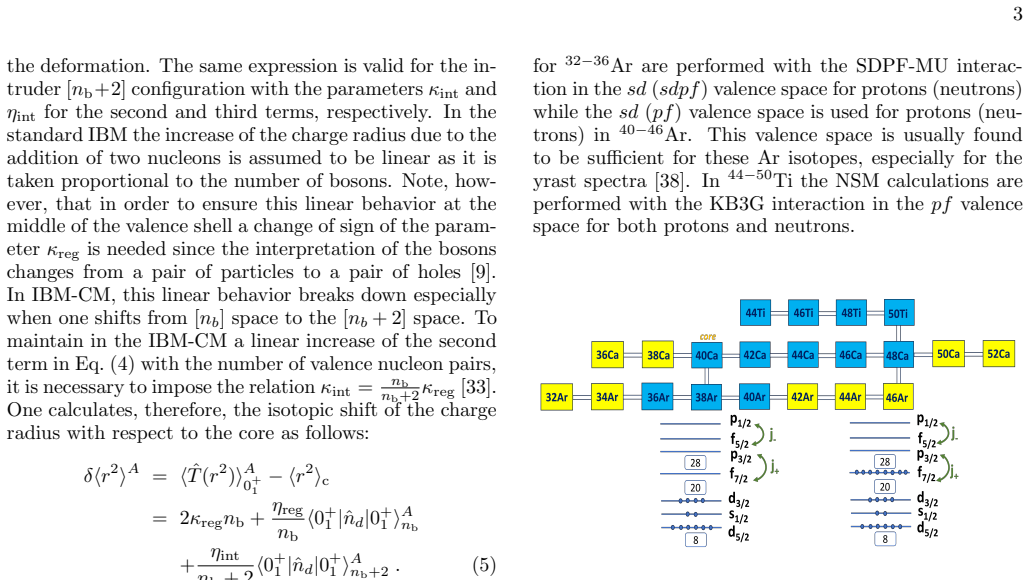
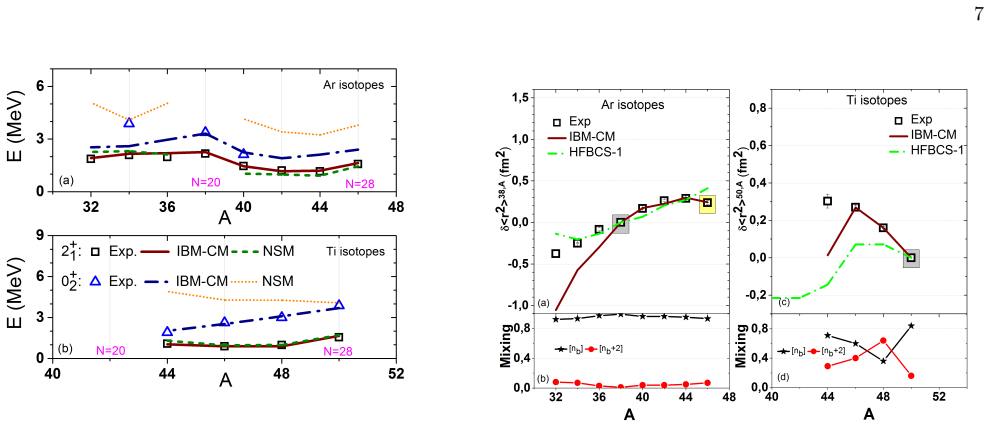
Summary. The paper uses the interacting boson model with configuration mixing (IBM-CM) to study the even-even Ca, Ar, and Ti isotopic chains. Hamiltonian parameters are fitted to low-energy spectra, and the resulting wave functions are combined with the radius operator of Eq. (4) to compute charge-radius isotopic shifts, including the scaling relation κ_int = nb/(nb+2) κ_reg between regular and intruder configurations. The same η parameters are then used in Eq. (6) to compute ρ²(E0; 0+2 → 0+1) for the Ca isotopes. The calculation reproduces the isotopic-shift dip at 48Ca and the rise at 50Ca, and gives E0 strengths in agreement with data for 44Ca and 48Ca. The paper also reports NSM energy comparisons and discusses the role of binding energy and shell gaps in the Ar and Ti chains.
Significance. If the proposed correlation could be rigorously established, it would provide a simple phenomenological bridge between ground-state charge radii and 0+2 → 0+1 electric monopole strengths in shape-coexisting nuclei, which is of practical interest for interpreting isomerism and configuration mixing. The paper is transparent about its caveats, and the E0 comparison for 44,48Ca is genuinely nontrivial because those E0 data are not used in the fits. The main weaknesses are that the radius comparison is partly circular, since the same isotopic-shift data determine the fitted parameters, and that the E0 formula depends on an unverified scaling relation for the intruder bosons. The Ar and Ti results are presented as exploratory and are not backed by E0 data. Overall, the manuscript is a reasonable phenomenological study, but the central claim needs to be supported by additional justification and quantitative assessment.
major comments (3)
- [Sec. II, Eqs. (4)-(6)] The cancellation of the κ contribution to ρ(E0; 0+2 → 0+1) rests on the exact relation κ_int = nb/(nb+2) κ_reg introduced before Eq. (5). Under this relation, κ_reg nb P_reg + κ_int(nb+2) P_int is proportional to the identity, so the κ term has zero matrix element between orthogonal 0+ states. The paper cites ref. [33] for this scaling but gives no microscopic derivation or empirical test for the 2p-2h intruder bosons. If the scaling is violated, a term proportional to (κ_reg nb − κ_int(nb+2)) times the regular-space overlap enters Eq. (6), and the η values fitted to isotopic shifts no longer determine the E0 strength by themselves. Because the claimed radius–E0 correlation is the central result, the authors should either justify the scaling specifically for the intruder configuration or present a sensitivity analysis with respect to deviations from it.
- [Sec. III A, Fig. 4(a); Sec. III B, Fig. 7] The agreement in the radius plots is not an independent test of the model. For each chain, κ_reg, η_reg, and η_int are fitted to the isotopic-shift data displayed in those figures, so the comparison largely reflects the fitting procedure. The paper is honest about the fitting, but the abstract and conclusions should not present the radius agreement as independent evidence for the correlation without distinguishing it from the non-fitted E0 results in Fig. 5. To make the assessment quantitative, the authors should add a residual or rms deviation and state explicitly that only the E0 strengths in 44,48Ca, which were not used in any fit, provide independent support.
- [Sec. III A, Fig. 5; Sec. III B] The successful E0 points are only two (44Ca and 48Ca), and the model fails for 42Ca in both radius and E0, for 38Ca and 42Ca in radius, and for 44Ti in radius. These failures are not marginal but are attributed to structural reasons, such as the 'limited number of active bosons' in Sec. III A. The claim that a 'direct correlation' is established is therefore too strong. The authors should either give a systematic condition for when the correlation is expected to hold or reduce the claim to one of a correlation suggested by the 44,48Ca data and the IBM-CM mechanism.
minor comments (4)
- [Eqs. (4) and (5)] Equation (5) has a factor 2 multiplying κ_reg nb, whereas Eq. (4) has κ_reg nb. The origin of this factor, presumably the number of nucleons per boson pair, should be stated explicitly so the two equations do not appear inconsistent.
- [Sec. III A] The sentence 'The calculated results are in an overall agreement with the data for the long chain of Ca isotopes' is difficult to reconcile with the immediately following admission that the isotopic shifts of 38Ca and 42Ca are not explained; please qualify the claim.
- [Sec. III A] The text refers to the experimental 2+1 level of 52Ca at 2.563 MeV while also saying that experimental data for 52Ca are quite limited; please provide the source or clarify that this value is taken from ENSDF.
- [Table II] Several levels in Table II are marked with asterisks for unconfirmed spin-parity assignments, but the text does not discuss how this affects the 50Ca comparison; a brief note would help the reader.
Circularity Check
No significant circularity: E0 strengths are predicted from η parameters fitted to radii, and the E0 data are not used in the fit.
full rationale
The paper fits κ_reg, η_reg, and η_int to the Ca isotopic-shift data (Sec. III A: 'The parameter κreg = 0.0005 fm2 is adjusted to the overall slope of the isotopic shift... ηreg = 8.69 fm2 and ηint = 0.59 fm2'), then uses those same η values in Eq. (6) to compute ρ2(E0). This is a parameter-transfer prediction, not a circular reduction: the E0 strengths also depend on the off-diagonal matrix elements ⟨0+1|n_d|0+2⟩ in the regular and intruder spaces, which are not fixed by the ground-state radii used in the fit, and the E0 data for 40,42,44,48Ca are never used in the fit. The reported agreement for 44,48Ca therefore provides independent, cross-observable support for the assumed common operator. The relation κ_int = nb/(nb+2) κ_reg, cited to Ref. [33] (which shares an author with the present paper), is stated as a consistency condition to preserve linearity of the radius and to eliminate the κ contribution from the E0 matrix element. It is an unverified model assumption, but it is not circular: the E0 predictions are not equivalent to that assumption, and the quoted condition is explicitly derived from the stated linearity requirement rather than from the E0 data. The self-citation to Ref. [19] supplies Hamiltonian parameters fitted to level energies, not to radii or E0, so it is standard prior work rather than load-bearing circularity. Overall the derivation chain is self-contained with respect to external data; the only caveat is that the radius agreement for the fitted isotopes is a fit, not an independent test, but that is not presented as a prediction.
Assumptions & free parameters
free parameters (4)
- Radius operator parameters for Ca: κ_reg=0.0005 fm², η_reg=8.69 fm², η_int=0.59 fm² =
κ_reg=0.0005, η_reg=8.69, η_int=0.59 fm²
- Radius operator parameters for Ar: κ_reg=0.024 fm², η_reg=5.47 fm², η_int=0.01 fm² =
κ_reg=0.024, η_reg=5.47, η_int=0.01 fm²
- Radius operator parameters for Ti: κ_reg=-0.0002 fm², η_reg=4.1 fm², η_int=-1.5 fm² =
κ_reg=-0.0002, η_reg=4.1, η_int=-1.5 fm²
- IBM-CM Hamiltonian parameters (ϵ, a1, a2, χ, α=β, Δ) per isotope =
Table I values
assumptions (4)
- domain assumption Boson mapping: valence nucleon pairs are represented as s and d bosons with nb = nπ + nν counted from the 40Ca core.
- domain assumption Configuration mixing includes only regular [nb] and intruder [nb+2] spaces, with mixing operator V_mix of Eq. (3) and α=β fixed per chain (except 48Ca).
- ad hoc to paper Charge radius operator depends only on nb and nd/nb, Eq. (4), with κ_int = nb/(nb+2) κ_reg to enforce linearity.
- domain assumption 40Ca is the inert core for Ca, Ar, and Ti chains; neutron-deficient 36,38Ca and 32-38Ar bosons are interpreted as hole pairs with negative κ/η.
Cite this review
Pith. "Pith review of Nuclear size, electric monopole transitions, and the location of $0^+_2$ states." pith.science (2026). https://pith.science/paper/LOPE4QGN
@misc{pith2026250204999,
  author       = {Pith},
  title        = {Pith review of: Nuclear size, electric monopole transitions, and the location of $0^+_2$ states},
  year         = {2026},
  howpublished = {\url{https://pith.science/paper/LOPE4QGN}},
  note         = {Machine review of arXiv:2502.04999}
}
abstract
The work addresses the isotopic shift of nuclear radii for the even-even $^{36-52}$Ca isotopes using the interacting boson model (IBM) that includes the mixing from normal and intruder configurations. We obtain a good agreement between the calculated and experimental data, particularly for the dip at $^{48}$Ca. A direct correlation between nuclear size and electric monopole transitions is established to compute the electric monopole transition strengths, $\rho^2(E0)$. We further study the isotopic shift for the even-even $^{32-46}$Ar and $^{44-50}$Ti isotopes.
Figures


Figures from the paper (3 more)


Reference graph
Works this paper leans on
- [33]
- [29]
-
[1]
M. Goeppert-Mayer and J. H. D. Jensen, Elementary the- ory of nuclear shell structure (Wiley, New York, 1955)
work page 1955
-
[2]
Exotic Nuclear Structure and Dy- namics
are not. Figure 2 shows the empirical binding energy per nu- cleon (BE/A) for even-even Ca, Ar, and Ti isotopes [42]. The binding energy per nucleon is rather flat for the Ca isotopes between doubly-magic 40Ca and 48Ca, and it 5 FIG. 3. (Color online) Experimental [24] and calculated en- ergies E of the yrast 2 + 1 and yrare 0 + 2 levels in the even-even ...
work page 1975
- [3]
-
[4]
Otsuka, A
T. Otsuka, A. Gade, O. Sorlin, T. Suzuki, and Y. Utsuno, Rev. Mod. Phys. 92, 015002 (2020)
2020
-
[5]
O. Sorlin and M.-G. Porquet, Prog. in Part. Nucl. Phys. 61, 602 (2008)
work page 2008
-
[6]
Otsuka, R
T. Otsuka, R. Fujimoto, Y. Utsuno, B. A. Brown, M. Honma, and T. Mizusaki, Phys. Rev. Lett. 87, 082502 (2001)
2001
Show all 57 references
-
[7]
A. J. Miller et al. , Nature Phys. 15, 432 (2019)
2019
-
[8]
Otsuka, T
T. Otsuka, T. Suzuki, R. Fujimoto, H. Grawe, and Y. Akaishi, Phys. Rev. Lett. 95, 232502 (2005)
2005
-
[9]
Iachello and A
F. Iachello and A. Arima, The interacting boson model (Cambridge University Press, 1987)
1987
-
[10]
R. F. Garcia Ruiz et al. , Nat. Phys. 12, 594 (2016)
2016
-
[11]
Zerguine, P
S. Zerguine, P. Van Isacker, and A. Bouldjedri, Phys. Rev. C 85, 034331 (2012)
2012
-
[12]
Zerguine, P
S. Zerguine, P. Van Isacker, A. Bouldjedri, and S. Heinze, Phys. Rev. Lett. 101, 022502 (2008)
2008
-
[13]
Nomura, R
K. Nomura, R. Rodr ´ ıguez-Guzm´ an, and L. M. Robledo, Phys. Rev. C 87, 064313 (2013)
2013
-
[14]
Van Isacker, Nucl
P. Van Isacker, Nucl. Data Sheets 120, 119 (2014). 9
2014
-
[15]
Mizusaki, T
T. Mizusaki, T. Otsuka, M. Honma, and B. A. Brown, Phys. Rev. C 63, 044306 (2001)
2001
-
[16]
Force et al
C. Force et al. , Phys. Rev. Lett. 105, 102501 (2010)
2010
-
[17]
https://www-phynu.cea.fr/science_en_ligne/ carte_potentiels_microscopiques/carte_potentiel_ nucleaire_eng.htm
-
[18]
Delaroche, M
J.-P. Delaroche, M. Girod, J. Libert, H. Goutte, S. Hi- laire, S. P´ eru, N. Pillet, and G. F. Bertsch, Phys. Rev. C 81, 014303 (2010)
2010
-
[19]
Maheshwari and K
B. Maheshwari and K. Nomura, J. Phys. G: Nucl. Part. Phys. 51, 095101 (2024)
2024
-
[20]
The measurements sup- port the doubly-magic nature of 40Ca and 48Ca, which have almost equal charge radii [8]
are now known over a long range, from proton-rich 36Ca [7] to neutron-rich 52Ca [8]. The measurements sup- port the doubly-magic nature of 40Ca and 48Ca, which have almost equal charge radii [8]. The local maximum of the charge radius of 44Ca and its very steep increase beyond...
2025 arXiv
-
[21]
Heyde and J.L
K. Heyde and J.L. Wood, Rev. Mod. Phys. 83, 1467 (2011)
2011
-
[22]
Garrett, M
P. Garrett, M. Zielinska, and E. Clement, Prog. Part. and Nucl. Phys. 124, 103931 (2022)
2022
-
[23]
Leoni, B
S. Leoni, B. Fornal, A. Bracco, Y. Tsunoda, and T. Ot- suka, Prog. Part. and Nucl. Phys. 139, 104119 (2024)
2024
-
[24]
Gorodetzky, N
S. Gorodetzky, N. Schulz, J. Chevallier, and A. C. Knip- per, J. Phys. (Paris) 27, 521 (1966)
1966
-
[25]
Schulz, Ann
N. Schulz, Ann. Phys. (Paris) 2, 81 (1967)
1967
-
[26]
nndc.bnl.gov/ensdf/
Evaluated Nuclear Structure Data File, https://www. nndc.bnl.gov/ensdf/
-
[27]
Kibedi, A
T. Kibedi, A. B. Garnsworthy, and J. L. Wood, Prog. Part. Nucl. Phys. 123, 103930 (2022)
2022
-
[28]
P. D. Duval and B. R. Barrett, Phys. Lett. B 100, 223 (1981)
1981
-
[30]
Otsuka, A
T. Otsuka, A. Arima, and F. Iachello, Nucl. Phys. A 309, 1 (1978)
1978
-
[31]
Van Isacker, IBM-1 code, unpublished
P. Van Isacker, IBM-1 code, unpublished
-
[32]
Elliott and A.P
J.P. Elliott and A.P. White, Phys. Lett. B97, 169 (1980)
1980
-
[34]
Lac, J.P
V.S. Lac, J.P. Elliott, J.A. Evans and G.L. Long, Nucl. Phys. A 587, 101 (1995)
1995
-
[35]
M. K. Harder, K. T. Tang, and P. Van Isacker, Phys. Lett. B 405, 25 (1997)
1997
-
[36]
Angeli, and K
I. Angeli, and K. P. Marinova, Atomic Data and Nuclear Data Tables 99, 69 (2013)
2013
-
[37]
Shimizu, T
N. Shimizu, T. Mizusaki, Y. Utsuno, and Y. Tsunoda, Comp. Phys. Comm. 244, 372 (2019)
2019
-
[38]
Utsuno, T
Y. Utsuno, T. Otsuka, B. A. Brown, M. Honma, T. Mizusaki, and N. Shimizu, Phys. Rev. C 86, 051301 (R) (2012)
2012
-
[39]
Poves, J
A. Poves, J. Sanchez-Solano, E. Caurier, and F. Nowacki, Nucl. Phys. A 694, 157 (2001)
2001
-
[40]
Speidel et al
K.-H. Speidel et al. , Phys. Rev. C 78, 017304 (2008)
2008
-
[41]
Blaum, W
K. Blaum, W. Geithner, J. Lassen, P. Lievens, K. Mari- nova, and R. Neugart, Nucl. Phys. A 799, 30 (2008)
2008
-
[42]
H. D. Wohlfahrt, E. B. Shera, M. V. Hoehn, Y. Ya- mazaki, and R. M. Steffen, Phys. Rev. C 23, 533 (1981)
1981
-
[43]
Anastassov, Yu
A. Anastassov, Yu. P. Gangrsky, K. P. Marinova, B. N. Markov, and S. G. Zemlyanoi, Z. Phys. D 30, 275 (1994)
1994
-
[44]
National Nuclear Data Center, https://www.nndc.bnl. gov/
-
[45]
https://www.chem.ualberta.ca/~massspec/atomic_ mass_abund.pdf
-
[46]
A. R. L. Kennington et al., Phys. Rev. C 103(3), 035805 (2021)
2021
-
[47]
Lalanne et al
L. Lalanne et al. , Phys. Rev. Lett. 129, 122501 (2022)
2022
-
[48]
Caurier, K
E. Caurier, K. Langanke, G. Mart ´ ınez-Pinedo, F. Nowacki, and P. Vogel, Phys. Lett. B 522, 240 (2001)
2001
-
[49]
Otsuka,Y
T. Otsuka,Y. Tsunoda, T. Abe, N. Shimizu, and P. Van Duppen, Phys. Rev. Lett. 123, 222502 (2019)
2019
-
[50]
R. A. Ricci and P. R. Maurenzig, Riv. Nuovo Cimento 1, 291 (1969)
1969
-
[51]
Retamosa, E
J. Retamosa, E. Caurier, F. Nowacki, and A. Poves, Phys. Rev. C 55, 1266 (1997)
1997
-
[52]
Bhuyan et al
M. Bhuyan et al. , J. Phys. G: Nucl. Part. Phys. 48, 075105 (2021)
2021
-
[53]
Goriely, F
S. Goriely, F. Tondeur, and J. M. Pearson, Atomic Data and Nuclear Data Tables 77, 311 (2001)
2001
-
[54]
K. H. Souw, J. C. Adloff, D. Disdier, and P. Chevallier, Phys. Rev. C 12, 1103 (1975)
1975
-
[55]
Ernst et al
R. Ernst et al. , Phys. Rev. Lett. 84, 416 (2000)
2000
-
[56]
Adhikari et al
D. Adhikari et al. (CREX), Phys. Rev. Lett. 129, 042501 (2022)
2022
-
[57]
Adhikari et al
D. Adhikari et al. (PREX), Phys. Rev. Lett. 126, 172502 (2021)
2021
Reviewed August 8, 2026 · model on record in the stance chip above.
Discussion (0). Continue with ORCID to comment.