REVIEW 3 major objections 4 minor 300 references
Computing and Learning on Combinatorial Data
T0 review · 3 major / 4 minor · reviewed 2026-08-08 · deepseek-v4-flash
Pith's one-line read This dissertation claims that persistence computation is mostly local—not algebraic—and uses that locality to build fast GPU barcodes, near-linear Wasserstein approximations, and better graph and hypergraph learners.
desk verdict A credible dissertation that compiles five peer-reviewed papers; the new-to-this-document background contains a false proposition, and the headline GPU speedup claim rests on a plausible but unvalidated heavy-hitter condition. read the letter →
The pith
A machine-rendered reading of the paper's core claim, the machinery that carries it, and where it could break.
The reading
What carries the argument
The load-bearing object is the apparent pair. In a Vietoris-Rips coboundary matrix ordered by simplex diameter, a pair $(s,t)$ is apparent when $t$ is the oldest cofacet of $s$ and $s$ is the youngest facet of $t$; equivalently, the matrix entry $(t,s)$ has zeros everywhere to its left and below. The Apparent Pairs Lemma shows such pairs are already persistence pairs, so they can be identified in parallel from local neighbor information, with no matrix reduction. Around this core, the dissertation deploys three supporting devices: $\delta$-condensation followed by well-separated pair decomposition to sparsify the min-cost flow network for the 1-Wasserstein distance; a virtual cone node in extended persistence to resolve graph cycles in subquadratic time; and hyperedge-based symmetry breaking that lowers the symmetry of a hypergraph viewed through its universal cover.
What would settle it
Take a point cloud engineered to defeat locality—for example, uniform samples in a high-dimensional space with metric perturbations that spread diameters—and measure the apparent-pair fraction as $n$ grows; if it does not stay bounded away from zero, the heavy-hitter condition fails and the advertised speedups would vanish.
Extended reading notes
Core claim
On its own terms, the discovery is that persistence, though defined over a causal sequence of homology vector spaces, has most of its output fixed by the neighboring connectivity of the filtration rather than by algebraic operations. The technical form is the heavy-hitter theorem for apparent pairs: under the uniform sampling condition, for large $n$ a constant fraction of all persistence pairs in a Vietoris-Rips filtration are apparent, with matching lower bounds. Those pairs are read off directly from the coboundary matrix, and only the residual non-apparent submatrix needs sequential reduction. The same connectivity-over-algebra stance yields a near-linear-time $(1+\epsilon)$-approximation of the 1-Wasserstein distance between persistence diagrams, with the diagonal handled exactly, and it informs the graph and hypergraph learning chapters.
Load-bearing premise
The load-bearing premise is that real point clouds inherit the locality that uniform sampling guarantees, so that a constant fraction of persistence pairs are apparent pairs; if a dataset's geometry makes most pairs non-local, the GPU speedups do not transfer.
Editorial extensions
If this is right
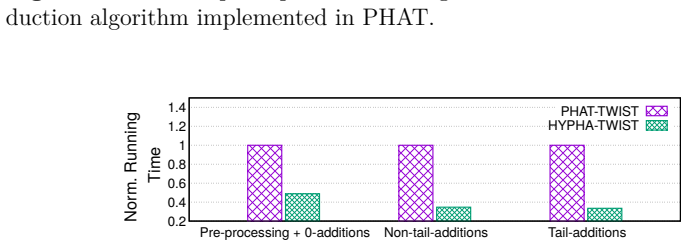
- For Vietoris-Rips filtrations on large point samples, most barcode pairs are apparent, so GPU parallel enumeration plus a small CPU submatrix reduction replaces full sequential matrix reduction.
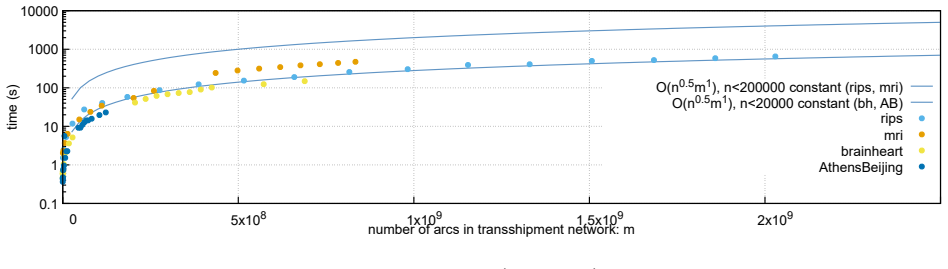
- The 1-Wasserstein distance between persistence diagrams can be approximated within $(1+\epsilon)$ in near-linear time with the diagonal handled exactly, avoiding the factor-2 distortion of finite diagonal sampling.
- Extended persistence gives graph neural networks access to cycle structure that ordinary persistence cannot express, and the virtual cone can be simulated in subquadratic time.
- Breaking hypergraph symmetry by adding hyperedges lowers the symmetry of the generalized Weisfeiler-Lehman-1 (GWL-1) aggregator and improves transductive higher-order link prediction whenever the testing automorphism group has more entropy than the training group.
Reading between the lines
- Beyond the paper: if the locality principle is generic, similar apparent-pair-style shortcuts should accelerate persistence computations for alpha-shape filtrations and graph filtrations, not just Vietoris-Rips complexes.
- Beyond the paper: the $\delta$-condensation and well-separated pair decomposition treatment of the diagonal could be adapted to other ground metrics or to multiparameter persistence, where the diagonal is replaced by a higher-dimensional set of comparable points.
- Beyond the paper: the hypergraph symmetry-breaking idea is a general design principle—adding controlled asymmetry to a learning problem can help when the test distribution has more symmetry entropy than the training distribution; this could be tested on graph and knowledge-graph link prediction as well.
Editorial analysis
A structured set of objections, weighed in public.
Referee Report
Summary. The dissertation proposes and evaluates computational and learning methods for combinatorial data. The main chapters present HYPHA and Ripser++ for GPU-accelerated persistent homology, PDoptFlow for approximating the 1-Wasserstein distance between persistence diagrams, GEFL for graph classification via extended persistence, and a hypergraph symmetry-breaking method for higher-order link prediction. The abstract's central thesis is that much of the algebraic computation in persistence depends only on neighboring connectivity, which enables CPU-GPU hybrid algorithms. The dissertation is largely a compilation of the author's prior peer-reviewed work, with background chapters on logic, algebra, topology, statistics, and combinatorial data.
Significance. If the central claims hold, the contributions are significant: HYPHA and Ripser++ address real performance bottlenecks in persistent homology, PDoptFlow offers a practical near-linear-time approximation with an exact diagonal treatment, and the GEFL and hypergraph methods target expressivity limitations of standard graph neural networks. Strengths include open-source software, substantial experimental evaluations, and theoretical results on apparent-pair heavy hitters, Wasserstein approximation bounds, and a characterization of GWL-1. The main caveat is that the headline CPU-GPU speedup claim is established only under a uniform-sampling locality condition, while the abstract states it without qualification; additionally, the background chapter contains a demonstrably false linear-algebra proposition.
major comments (3)
- [Abstract; §5.4.5, §5.4.7, §5.6.9–§5.6.11; Tables 5.2, 5.4] The abstract's claim that 'much of the algebraic computation only depends on the neighboring connectivity of the data' is load-bearing and is not established in the generality stated. The heavy-hitter theorem for apparent pairs is proved under a uniform sampling condition in Section 5.4.5, with lower bounds reported under that condition in Section 5.4.7, while Sections 5.6.9–5.6.11 construct distance assignments with apparent fractions near 1/3 and 1/2, showing that the fraction is geometry- and filtration-order-dependent. The empirical speedups in Tables 5.2 and 5.4 are reported on uniform-like benchmarks. To support the abstract's generalization, the paper should either restrict the claim to the uniform-sampling regime or validate apparent-pair fractions and speedups on non-uniform, clustered, and multi-scale point clouds.
- [§2.4, Proposition 2.4.29] Proposition 2.4.29 is false as stated: a linear subspace U of a vector space V generally has many complementary subspaces (for example, in R^2, the x-axis is complemented by any line not equal to itself). The proof's step 'U + W = V = U + W' implies W = W'' is invalid. This is a background result, not the main theorem, but it is a genuine mathematical error in a foundational chapter and should be corrected or removed.
- [Chapter 1; Chapter 8] The motivation for hypergraph symmetry breaking is stated in Chapter 1 as 'Assuming the testing automorphism group is smaller, meaning having more entropy, then it would be beneficial to break the symmetry of the training hypergraph.' Neither 'smaller' nor 'entropy' is defined for automorphism groups in this context, and the direction of the implication is not self-evident. Since the method's expected benefit is argued from this asymmetry, the manuscript should provide a precise formal statement of the assumption and, ideally, a direct empirical test of it.
minor comments (4)
- [Throughout] The document contains numerous LaTeX/OCR artifacts and broken notation (for example, 'damb', '/parallel.alt1', '/slash.left', and incomplete cross-references). A careful copyedit is needed.
- [§2.4, Proposition 2.4.38] Proposition 2.4.38 is true, but its proof is flawed: from v in S'_V \ S_V it does not follow that v is not in span(S_V), since v could be a linear combination of other basis vectors. The proof should be replaced with a standard exchange argument.
- [Introduction; Chapters 4–8] The dissertation repeatedly cites the author's own prior papers [1]–[7] for the main results. This is not inappropriate, but the text should clearly indicate which theorems and experiments are fully contained in this document and which are quoted from those papers, especially for the heavy-hitter bounds and the GWL-1 characterization.
- [Table 5.4] The apparent-pair percentages per dimension are reported without error bars or number of runs; if these are single runs, adding repetitions and standard deviations would strengthen the empirical claim.
Circularity Check
No significant circularity: the core algorithmic claims are supported by in-thesis proofs and external benchmarks; chapter self-citations are bibliographic pointers, not load-bearing reductions.
full rationale
This dissertation is a compilation of the author's previously published algorithms (HYPHA, Ripser++, PDoptFlow, GEFL, and hypergraph symmetry breaking), and the citations [1]-[7] are chapter-level pointers to those papers. That structure is self-citational but not circular in the sense used here: the load-bearing mathematical claims are not merely asserted via the author's own citations. The apparent-pairs heavy-hitter statement (Section 5.4.5) is presented with a proof section and lower bounds under an explicit uniform-sampling condition, and the dissertation itself reports adversarial distance assignments (Sections 5.6.9-5.6.11) where the apparent-pair fraction is lower, which would be impossible if the speedup claim were true by definition. The PDoptFlow approximation guarantee is argued from δ-condensation and well-separated pair decomposition error bounds rather than from fitted values, and the empirical comparisons are against external baselines (Ripser, PHAT, hera, graph neural networks). The GWL-1 characterization and symmetry-breaking guarantees have proof sections (8.10) and are used conditionally on an explicit assumption about testing versus training automorphism-group entropy. The main caveat, that real point clouds may violate the uniform-locality condition needed for the heavy-hitter theorem, is a domain-condition limitation rather than a circular reduction: it is explicitly acknowledged in the paper's own construction of low-apparent-fraction examples. No step was found where a fitted parameter is renamed as a prediction, where an ansatz is smuggled in solely by self-citation, or where a claimed derivation is equivalent to its inputs by construction.
Assumptions & free parameters
free parameters (4)
- Condensation threshold delta (PDoptFlow) =
Dataset-specific (0.99-delta grid snapping)
- WSPD separation ratio s (PDoptFlow) =
Chosen per experiment
- GEFL learned filtration parameters =
Trained on each dataset
- Random apparent-pairs model parameters (Section 5.6.11) =
Curve matched to empirical fraction
assumptions (4)
- standard math ZFC set theory, category theory, algebra, and topology as presented in Chapter 2
- domain assumption Uniform-sampling and locality condition for apparent-pair heavy-hitters (Section 5.4.7)
- domain assumption Testing automorphism group is smaller (more entropy) than the training hypergraph's group
- ad hoc to paper A (1+epsilon) approximate EMD between persistence diagrams cannot be computed in O(n^{1+o(1)-delta}) time for any delta > 0
invented entities (1)
-
Diagonal super-node in the PDoptFlow transportation network
independent evidence
Cite this review
Pith. "Pith review of Computing and Learning on Combinatorial Data." pith.science (2026). https://pith.science/paper/P5SHM2YL
@misc{pith2026250205063,
  author       = {Pith},
  title        = {Pith review of: Computing and Learning on Combinatorial Data},
  year         = {2026},
  howpublished = {\url{https://pith.science/paper/P5SHM2YL}},
  note         = {Machine review of arXiv:2502.05063}
}
read the original abstract
The twenty-first century is a data-driven era where human activities and behavior, physical phenomena, scientific discoveries, technology advancements, and almost everything that happens in the world resulting in massive generation, collection, and utilization of data. Connectivity in data is a crucial property. A straightforward example is the World Wide Web, where every webpage is connected to other web pages through hyperlinks, providing a form of directed connectivity. Combinatorial data refers to combinations of data items based on certain connectivity rules. Other forms of combinatorial data include social networks, meshes, community clusters, set systems, and molecules. This Ph.D. dissertation focuses on learning and computing with combinatorial data. We study and examine topological and connectivity features within and across connected data to improve the performance of learning and achieve high algorithmic efficiency.
Figures


Figures from the paper (60 more)






Reference graph
Works this paper leans on
-
[1]
Hypha: A framework based on separation of parallelisms to accelerate persistent homology matrix reduc- tion,
S. Zhang, M. Xiao, C. Guo, L. Geng, H. Wang, and X. Zhang, “Hypha: A framework based on separation of parallelisms to accelerate persistent homology matrix reduc- tion,” in Proceedings of the ACM International Conference on Supercomputing, ACM, 2019, pp. 69–81
2019
-
[2]
Gpu-accelerated computation of Vietoris-Rips persistence barcodes,
S. Zhang, M. Xiao, and H. Wang, “Gpu-accelerated computation of Vietoris-Rips persistence barcodes,” arXiv preprint arXiv:2003.07989 , 2020
arXiv 2003
-
[3]
GPU-accelerated computation of Vietoris-Rips persistence barcodes,
S. Zhang, M. Xiao, and H. Wang, “GPU-accelerated computation of Vietoris-Rips persistence barcodes,” in 36th International Symposium on Computational Geometry (SoCG 2020) , Schloss Dagstuhl-Leibniz-Zentrum für Informatik, 2020
2020
-
[4]
Approximating 1-wasserstein distance between persis- tence diagrams by graph sparsification,
T. K. Dey and S. Zhang, “Approximating 1-wasserstein distance between persis- tence diagrams by graph sparsification,” in 2022 Proceedings of the Symposium on Algorithm Engineering and Experiments (ALENEX) , pp. 169–183. doi: 10.1137/1. 9781611977042.14 . eprint: https://epubs.siam.org/doi/pdf/10.1137/1.9781611977042. 14 . [Online]. A vailable: https://epu...
doi:10.1137/1 2022
-
[5]
Gefl: Extended filtration learning for graph classification,
S. Zhang, S. Mukherjee, and T. K. Dey, “Gefl: Extended filtration learning for graph classification,” in Learning on Graphs Conference , PMLR, 2022, pp. 16–1
2022
-
[6]
Expressive higher-order link prediction through hypergraph symmetry breaking,
S. Zhang, C. Xin, and T. K. Dey, “Expressive higher-order link prediction through hypergraph symmetry breaking,” arXiv preprint arXiv:2402.11339 , 2024
arXiv 2024
-
[7]
Expressive higher-order link prediction through hypergraph symmetry breaking,
S. Zhang, C. Xin, and T. K. Dey, “Expressive higher-order link prediction through hypergraph symmetry breaking,” Transactions on Machine Learning Research , 2024. [Online]. A vailable: https://openreview.net/forum?id=oG65SjZNIF
2024
-
[8]
S. J. Russell and P. Norvig, Artificial intelligence: a modern approach . Pearson, 2016
2016
Show all 300 references
-
[9]
Survey article: The real numbers–a survey of constructions,
I. Weiss, “Survey article: The real numbers–a survey of constructions,” 2015
2015
-
[10]
C. F. Gauss, Theoria residuorum biquadraticorum. Commentatio secunda . Typis Di- eterichchianis, 1832
-
[11]
K. H. Rosen and K. Krithivasan, Discrete mathematics and its applications . McGraw- Hill New York, 1999, vol. 6. 471
1999
-
[12]
General theory of natural equivalences,
S. Eilenberg and S. MacLane, “General theory of natural equivalences,” Transactions of the American Mathematical Society , vol. 58, no. 2, pp. 231–294, 1945
1945
-
[13]
Acyclic categories,
D. Kozlov, “Acyclic categories,” Combinatorial Algebraic Topology, pp. 151–178, 2008
2008
-
[14]
Quiver representations,
H. Derksen and J. Weyman, “Quiver representations,” Notices of the AMS , vol. 52, no. 2, pp. 200–206, 2005
2005
-
[15]
Ueber die theorie der algebraischen formen,
D. Hilbert, “Ueber die theorie der algebraischen formen,” Mathematische annalen , vol. 36, no. 4, pp. 473–534, 1890
-
[16]
D. S. Dummit and R. M. Foote, Abstract algebra. Wiley Hoboken, 2004, vol. 3
2004
-
[17]
Hoffman and R
K. Hoffman and R. Kunze, Linear algebra, engelewood cliffs , 1961
1961
-
[18]
P. R. Halmos, Finite-dimensional vector spaces . Courier Dover Publications, 2017
2017
-
[19]
Idealtheorie in ringbereichen,
E. Noether, “Idealtheorie in ringbereichen,” Mathematische Annalen , vol. 83, no. 1, pp. 24–66, 1921
1921
-
[20]
I. M. Gelfand, R. A. Silverman, et al. , Calculus of variations . Courier Corporation, 2000
2000
-
[21]
The group of isometries of a riemannian manifold,
S. B. Myers and N. E. Steenrod, “The group of isometries of a riemannian manifold,” Annals of Mathematics , vol. 40, no. 2, pp. 400–416, 1939
1939
-
[22]
Boyd and L
S. Boyd and L. Vandenberghe, Convex optimization . Cambridge university press, 2004
2004
-
[23]
G. M. Ziegler, Lectures on polytopes. Springer Science & Business Media, 2012, vol. 152
2012
-
[24]
Causal inference in statistics: An overview,
J. Pearl, “Causal inference in statistics: An overview,” 2009
2009
-
[25]
Pearl, Causality
J. Pearl, Causality. Cambridge university press, 2009
2009
-
[26]
Birkhoff, Lattice theory
G. Birkhoff, Lattice theory. American Mathematical Soc., 1940, vol. 25
1940
-
[27]
Schiffler, Quiver representations
R. Schiffler, Quiver representations. Springer, 2014, vol. 1. 472
2014
-
[28]
Steele, The Persistence of Memory (1931) by Salvador Dali (CC BY-NC-ND 2.0)
M. Steele, The Persistence of Memory (1931) by Salvador Dali (CC BY-NC-ND 2.0) . Nov. 2014. [Online]. A vailable: https : / / www . flickr . com / photos / 21022123 @ N04 / 15694508911
1931
-
[29]
Unzerlegbare darstellungen i,
P. Gabriel, “Unzerlegbare darstellungen i,” Manuscripta mathematica, vol. 6, pp. 71– 103, 1972
1972
-
[30]
Topological sorting of large networks,
A. B. Kahn, “Topological sorting of large networks,” Communications of the ACM , vol. 5, no. 11, pp. 558–562, 1962
1962
-
[31]
Representations of quivers,
M. Brion, “Representations of quivers,” 2008
2008
-
[32]
Morin, Quiver algebras , 2014
M. Morin, Quiver algebras , 2014
2014
-
[33]
Infinite root systems, representations of graphs and invariant theory,
V. G. Kac, “Infinite root systems, representations of graphs and invariant theory,” Inventiones mathematicae , vol. 56, no. 1, pp. 57–92, 1980
1980
-
[34]
Infinite root systems, representations of graphs and invariant theory, ii,
V. G. Kac, “Infinite root systems, representations of graphs and invariant theory, ii,” Journal of algebra , vol. 78, no. 1, pp. 141–162, 1982
1982
-
[35]
A multiprocessor system design,
M. E. Conway, “A multiprocessor system design,” in Proceedings of the November 12-14, 1963, fall joint computer conference , 1963, pp. 139–146
1963
-
[36]
A bridging model for parallel computation,
L. G. Valiant, “A bridging model for parallel computation,” Communications of the ACM, vol. 33, no. 8, pp. 103–111, 1990
1990
-
[37]
Dot: A matrix model for analyzing, optimizing and deploying software for big data analytics in distributed systems,
Y. Huai, R. Lee, S. Zhang, C. H. Xia, and X. Zhang, “Dot: A matrix model for analyzing, optimizing and deploying software for big data analytics in distributed systems,” in Proceedings of the 2nd ACM Symposium on Cloud Computing , 2011, pp. 1–14
2011
-
[38]
Mapreduce: Simplified data processing on large clusters,
J. Dean and S. Ghemawat, “Mapreduce: Simplified data processing on large clusters,” 2004
2004
-
[39]
The theory of multidimensional persistence,
G. Carlsson and A. Zomorodian, “The theory of multidimensional persistence,” in Proceedings of the twenty-third annual symposium on Computational geometry , 2007, pp. 184–193
2007
-
[40]
Invariants and metrics for multiparameter persistent homology,
A. L. Thomas, “Invariants and metrics for multiparameter persistent homology,” Ph.D. dissertation, Duke University, 2019. 473
2019
-
[41]
Stratifying multiparameter persistent homology,
H. A. Harrington, N. Otter, H. Schenck, and U. Tillmann, “Stratifying multiparameter persistent homology,” SIAM Journal on Applied Algebra and Geometry , vol. 3, no. 3, pp. 439–471, 2019
2019
-
[42]
Generalized persistence diagrams for persistence modules over posets,
W. Kim and F. Mémoli, “Generalized persistence diagrams for persistence modules over posets,” Journal of Applied and Computational Topology , vol. 5, no. 4, pp. 533– 581, 2021
2021
-
[43]
Computing generalized rank invariant for 2- parameter persistence modules via zigzag persistence and its applications,
T. K. Dey, W. Kim, and F. Mémoli, “Computing generalized rank invariant for 2- parameter persistence modules via zigzag persistence and its applications,” Discrete & Computational Geometry , vol. 71, no. 1, pp. 67–94, 2024
2024
-
[44]
T. K. Dey and Y. Wang, Computational topology for data analysis . Cambridge Uni- versity Press, 2022
2022
-
[45]
The structure of semi-simple algebras,
E. B. Dynkin, “The structure of semi-simple algebras,” Uspekhi Matematicheskikh Nauk, vol. 2, no. 4, pp. 59–127, 1947
1947
-
[46]
Fulton and J
W. Fulton and J. Harris, Representation theory: a first course . Springer Science & Business Media, 2013, vol. 129
2013
-
[47]
Zigzag persistence,
G. Carlsson and V. De Silva, “Zigzag persistence,” Foundations of computational mathematics, vol. 10, pp. 367–405, 2010
2010
-
[48]
Strang, Linear algebra and its applications
G. Strang, Linear algebra and its applications . 2012
2012
-
[49]
Elder-rule-staircodes for augmented metric spaces,
C. Cai, W. Kim, F. Mémoli, and Y. Wang, “Elder-rule-staircodes for augmented metric spaces,” SIAM Journal on Applied Algebra and Geometry , vol. 5, no. 3, pp. 417– 454, 2021
2021
-
[50]
S. eilenberg homological algebra,
H. Cartan, “S. eilenberg homological algebra,” Princeton Math. Ser , vol. 19, 1956
1956
-
[51]
Topology and data,
G. Carlsson, “Topology and data,” Bulletin of the American Mathematical Society , vol. 46, no. 2, pp. 255–308, 2009
2009
-
[52]
Coverage in sensor networks via persistent homology,
V. De Silva and R. Ghrist, “Coverage in sensor networks via persistent homology,” Algebraic & Geometric Topology , vol. 7, no. 1, pp. 339–358, 2007. 474
2007
-
[53]
A topological paradigm for hippocampal spatial map formation using persistent homology,
Y. Dabaghian, F. Mémoli, L. Frank, and G. Carlsson, “A topological paradigm for hippocampal spatial map formation using persistent homology,” PLoS computational biology, vol. 8, no. 8, e1002581, 2012
2012
-
[54]
Finding the homology of submanifolds with high confidence from random samples,
P. Niyogi, S. Smale, and S. Weinberger, “Finding the homology of submanifolds with high confidence from random samples,” Discrete & Computational Geometry , vol. 39, no. 1-3, pp. 419–441, 2008
2008
-
[55]
A study on validating non-linear dimensionality reduction using persistent homology,
R. Paul and S. K. Chalup, “A study on validating non-linear dimensionality reduction using persistent homology,” Pattern Recognition Letters, vol. 100, pp. 160–166, 2017
2017
-
[56]
Deep learning with topological signatures,
C. Hofer, R. Kwitt, M. Niethammer, and A. Uhl, “Deep learning with topological signatures,” in Advances in Neural Information Processing Systems , 2017, pp. 1634– 1644
2017
-
[57]
A roadmap for the computation of persistent homology,
N. Otter, M. A. Porter, U. Tillmann, P. Grindrod, and H. A. Harrington, “A roadmap for the computation of persistent homology,” EPJ Data Science , vol. 6, no. 1, p. 17, 2017
2017
-
[58]
Javaplex tutorial,
H. Adams and A. Tausz, “Javaplex tutorial,” Google Scholar, 2011
2011
-
[59]
Phat–persistent homology algorithms toolbox,
U. Bauer, M. Kerber, J. Reininghaus, and H. Wagner, “Phat–persistent homology algorithms toolbox,” Journal of symbolic computation , vol. 78, pp. 76–90, 2017
2017
-
[60]
Morozov, Dionysus software , 2017
D. Morozov, Dionysus software , 2017. [Online]. A vailable: http://www.mrzv.org / software/dionysus/
2017
-
[61]
Distributed computation of persistent homology,
U. Bauer, M. Kerber, and J. Reininghaus, “Distributed computation of persistent homology,” in Proceedings of the Meeting on Algorithm Engineering & Expermiments , Portland, Oregon: Society for Industrial and Applied Mathematics, 2014, pp. 31–38
2014
-
[62]
Bauer, Ripser: Efficient computation of vietorisrips persistence barcodes , 2018
U. Bauer, Ripser: Efficient computation of vietorisrips persistence barcodes , 2018. [Online]. A vailable: https://github.com/Ripser/ripser
2018
-
[63]
Matroid filtrations and computational persistent ho- mology,
G. Henselman and R. Ghrist, “Matroid filtrations and computational persistent ho- mology,” arXiv preprint arXiv:1606.00199 , 2016
2016 arXiv
-
[64]
A new data structure for cumulative frequency tables,
P. M. Fenwick, “A new data structure for cumulative frequency tables,” Softw. Pract. Exper., vol. 24, no. 3, pp. 327–336, Mar. 1994, issn: 0038-0644. 475
1994
-
[65]
Cramming more components onto integrated circuits,
I. Present, “Cramming more components onto integrated circuits,” Readings in com- puter architecture, vol. 56, 2000
2000
-
[66]
Design of ion-implanted mosfet’s with very small physical dimensions,
R. H. Dennard, F. H. Gaensslen, V. L. Rideout, E. Bassous, and A. R. LeBlanc, “Design of ion-implanted mosfet’s with very small physical dimensions,”IEEE Journal of Solid-State Circuits , vol. 9, no. 5, pp. 256–268, 1974
1974
-
[67]
Edelsbrunner and J
H. Edelsbrunner and J. Harer, Computational topology: an introduction . American Mathematical Soc., 2010
2010
-
[68]
Clear and compress: Computing persistent homology in chunks,
U. Bauer, M. Kerber, and J. Reininghaus, “Clear and compress: Computing persistent homology in chunks,” in Topological methods in data analysis and visualization III , Springer, 2014, pp. 103–117
2014
-
[69]
Persistent homology computation with a twist,
C. Chen and M. Kerber, “Persistent homology computation with a twist,” in Pro- ceedings 27th European Workshop on Computational Geometry , vol. 11, 2011
2011
-
[70]
Vines and vineyards by updat- ing persistence in linear time,
D. Cohen-Steiner, H. Edelsbrunner, and D. Morozov, “Vines and vineyards by updat- ing persistence in linear time,” in Proceedings of the twenty-second annual symposium on Computational geometry , ACM, 2006, pp. 119–126
2006
-
[71]
Parallel multi-scale reduction of persistent ho- mology filtrations,
R. Mendoza-Smith and J. Tanner, “Parallel multi-scale reduction of persistent ho- mology filtrations,” arXiv preprint arXiv:1708.04710 , 2017
2017 arXiv
-
[72]
E. H. Spanier, Algebraic topology. Springer Science & Business Media, 1989, vol. 55
1989
-
[73]
The nonlinear statistics of high-contrast patches in natural images,
A. B. Lee, K. S. Pedersen, and D. Mumford, “The nonlinear statistics of high-contrast patches in natural images,” International Journal of Computer Vision , vol. 54, no. 1-3, pp. 83–103, 2003
2003
-
[74]
Introduction to alpha shapes,
K. Fischer, “Introduction to alpha shapes,” Department of Information and Comput- ing Sciences, Faculty of Science, Utrecht University , vol. 17, 2000
2000
-
[75]
Loops skewing: The wavefront method revisited,
M. Wolfe, “Loops skewing: The wavefront method revisited,” International Journal of Parallel Programming , vol. 15, no. 4, pp. 279–293, 1986. 476
1986
-
[76]
Peerwave: Exploiting wavefront parallelism on gpus with peer-sm synchronization,
M. E. Belviranli, P. Deng, L. N. Bhuyan, R. Gupta, and Q. Zhu, “Peerwave: Exploiting wavefront parallelism on gpus with peer-sm synchronization,” in Proceedings of the 29th ACM on International Conference on Supercomputing , ser. ICS ’15, Newport Beach, California, USA: ACM, 2...
2015
-
[77]
Highly efficient compensation- based parallelism for wavefront loops on gpus,
K. Hou, H. Wang, W.-c. Feng, J. S. Vetter, and S. Lee, “Highly efficient compensation- based parallelism for wavefront loops on gpus,” in 2018 IEEE International Parallel and Distributed Processing Symposium (IPDPS) , IEEE, 2018, pp. 276–285
2018
-
[78]
The pareto, zipf and other power laws,
W. J. Reed, “The pareto, zipf and other power laws,” Economics letters, vol. 74, no. 1, pp. 15–19, 2001
2001
-
[79]
The tail at scale,
J. Dean and L. A. Barroso, “The tail at scale,” Communications of the ACM , vol. 56, no. 2, pp. 74–80, 2013
2013
-
[80]
Fibonacci heaps and their uses in improved network optimization algorithms,
M. L. Fredman and R. E. Tarjan, “Fibonacci heaps and their uses in improved network optimization algorithms,” J. ACM, vol. 34, no. 3, pp. 596–615, Jul. 1987, issn: 0004-
1987
-
[81]
The yin and yang of processing data warehousing queries on gpu devices,
Y. Yuan, R. Lee, and X. Zhang, “The yin and yang of processing data warehousing queries on gpu devices,” Proceedings of the VLDB Endowment, vol. 6, no. 10, pp. 817– 828, 2013
2013
-
[82]
Persistent cohomology and circular coordinates,
V. De Silva, D. Morozov, and M. Vejdemo-Johansson, “Persistent cohomology and circular coordinates,” Discrete & Computational Geometry , vol. 45, no. 4, pp. 737– 759, 2011
2011
-
[83]
Dualities in persistent (co) homology,
V. De Silva, D. Morozov, and M. Vejdemo-Johansson, “Dualities in persistent (co) homology,” Inverse Problems , vol. 27, no. 12, p. 124 003, 2011
2011
-
[84]
Austria, Phat (persistent homology algorithm toolbox), v1.5 , 2017
I. Austria, Phat (persistent homology algorithm toolbox), v1.5 , 2017. [Online]. A vail- able: https://bitbucket.org/phat-code/phat
2017
-
[85]
Custinger: Supporting dynamic graph algorithms for gpus,
O. Green and D. A. Bader, “Custinger: Supporting dynamic graph algorithms for gpus,” in High Performance Extreme Computing Conference (HPEC), 2016 IEEE , IEEE, 2016, pp. 1–6
2016
-
[86]
Accelerating dynamic graph analytics on gpus,
M. Sha, Y. Li, B. He, and K.-L. Tan, “Accelerating dynamic graph analytics on gpus,” Proc. VLDB Endow. , vol. 11, no. 1, pp. 107–120, Sep. 2017, issn: 2150-8097. 477
2017
-
[87]
Hornet: An efficient data struc- ture for dynamic sparse graphs and matrices on gpus,
F. Busato, O. Green, N. Bombieri, and D. A. Bader, “Hornet: An efficient data struc- ture for dynamic sparse graphs and matrices on gpus,” in 2018 IEEE High Perfor- mance extreme Computing Conference (HPEC) , IEEE, 2018, pp. 1–7
2018
-
[88]
Faimgraph: High performance management of fully-dynamic graphs under tight memory constraints on the gpu,
M. Winter, D. Mlakar, R. Zayer, H.-P. Seidel, and M. Steinberger, “Faimgraph: High performance management of fully-dynamic graphs under tight memory constraints on the gpu,” in Proceedings of the International Conference for High Performance Com- puting, Networking, Storage, a...
2018
-
[89]
Performance enhance- ment of a computational persistent homology package,
A. Hylton, J. Sang, G. Henselman-Petrusek, and R. Short, “Performance enhance- ment of a computational persistent homology package,” in 2017 IEEE 36th Inter- national Performance Computing and Communications Conference (IPCCC) , IEEE, 2017, pp. 1–8
2017
-
[90]
Morse theory for filtrations and efficient computation of persistent homology,
K. Mischaikow and V. Nanda, “Morse theory for filtrations and efficient computation of persistent homology,” Discrete & Computational Geometry , vol. 50, no. 2, pp. 330– 353, 2013
2013
-
[91]
GUDHI Editorial Board,
The GUDHI Project, GUDHI User and Reference Manual . GUDHI Editorial Board,
-
[92]
The compressed annotation matrix: An efficient data structure for computing persistent cohomology,
J.-D. Boissonnat, T. K. Dey, and C. Maria, “The compressed annotation matrix: An efficient data structure for computing persistent cohomology,” in European Symposium on Algorithms , Springer, 2013, pp. 695–706
2013
-
[93]
Computing topological persistence for simplicial maps,
T. K. Dey, F. Fan, and Y. Wang, “Computing topological persistence for simplicial maps,” in Proceedings of the thirtieth annual symposium on Computational geometry , ACM, 2014, p. 345
2014
-
[94]
Accelerating pathol- ogy image data cross-comparison on cpu-gpu hybrid systems,
K. Wang, Y. Huai, R. Lee, F. Wang, X. Zhang, and J. H. Saltz, “Accelerating pathol- ogy image data cross-comparison on cpu-gpu hybrid systems,” Proc. VLDB Endow. , vol. 5, no. 11, pp. 1543–1554, Jul. 2012, issn: 2150-8097
2012
-
[95]
Throughput-oriented gpu memory allocation,
I. Gelado and M. Garland, “Throughput-oriented gpu memory allocation,” in Pro- ceedings of the 24th Symposium on Principles and Practice of Parallel Programming , ACM, 2019, pp. 27–37
2019
-
[96]
Mega-kv: A case for gpus to maximize the throughput of in-memory key-value stores,
K. Zhang, K. Wang, Y. Yuan, L. Guo, R. Lee, and X. Zhang, “Mega-kv: A case for gpus to maximize the throughput of in-memory key-value stores,” Proceedings of the VLDB Endowment , vol. 8, no. 11, pp. 1226–1237, 2015. 478
2015
-
[97]
Persistence homology of networks: Methods and applications,
M. E. Aktas, E. Akbas, and A. El Fatmaoui, “Persistence homology of networks: Methods and applications,” Applied Network Science , vol. 4, no. 1, p. 61, 2019
2019
-
[98]
Computing persistent homology of directed flag complexes,
D. Luetgehetmann, D. Govc, J. Smith, and R. Levi, “Computing persistent homology of directed flag complexes,” arXiv preprint arXiv:1906.10458 , 2019
1906 arXiv
-
[99]
Proof of bijection for combinatorial number system,
A. B. Siddique, S. Farid, and M. Tahir, “Proof of bijection for combinatorial number system,” arXiv preprint arXiv:1601.05794 , 2016
2016 arXiv
-
[100]
D. E. Knuth, The art of computer programming . Pearson Education, 1997, vol. 3
1997
-
[101]
Pascal, Sopra una formola numerica
E. Pascal, Sopra una formola numerica . 1887
-
[102]
Topological persistence and sim- plification,
H. Edelsbrunner, D. Letscher, and A. Zomorodian, “Topological persistence and sim- plification,” in Proceedings 41st annual symposium on foundations of computer sci- ence, IEEE, 2000, pp. 454–463
2000
-
[103]
Ripser: Efficient computation of vietoris-rips persistence barcodes,
U. Bauer, “Ripser: Efficient computation of vietoris-rips persistence barcodes,” arXiv preprint arXiv:1908.02518 , 2019
1908 arXiv
-
[104]
The gudhi library: Simpli- cial complexes and persistent homology,
C. Maria, J.-D. Boissonnat, M. Glisse, and M. Yvinec, “The gudhi library: Simpli- cial complexes and persistent homology,” in International Congress on Mathematical Software, Springer, 2014, pp. 167–174
2014
-
[105]
Fast construction of the vietoris-rips complex,
A. Zomorodian, “Fast construction of the vietoris-rips complex,” Computers & Graph- ics, vol. 34, no. 3, pp. 263–271, 2010
2010
-
[106]
Distributed computation of persistent homology,
U. Bauer, M. Kerber, and J. Reininghaus, “Distributed computation of persistent homology,” in 2014 proceedings of the sixteenth workshop on algorithm engineering and experiments (ALENEX) , SIAM, 2014, pp. 31–38
2014
-
[107]
Henselman, Eirene: A platform for computational homological algebra , 2016
G. Henselman, Eirene: A platform for computational homological algebra , 2016
2016
-
[108]
Persistent and zigzag homology: A matrix factorization viewpoint,
G. Carlsson, A. Dwaraknath, and B. J. Nelson, “Persistent and zigzag homology: A matrix factorization viewpoint,” arXiv preprint arXiv:1911.10693 , 2019
1911 arXiv
-
[109]
A framework for the automatic vectorization of parallel sort on x86-based processors,
K. Hou, H. Wang, and W.-C. Feng, “A framework for the automatic vectorization of parallel sort on x86-based processors,” IEEE Transactions on Parallel and Distributed Systems, vol. 29, no. 5, pp. 958–972, 2018. 479
2018
-
[110]
Designing efficient sorting algorithms for manycore gpus,
N. Satish, M. Harris, and M. Garland, “Designing efficient sorting algorithms for manycore gpus,” in Proceedings of the 2009 IEEE International Symposium on Par- allel&Distributed Processing, ser. IPDPS ’09, Washington, DC, USA: IEEE Computer Society, 2009, pp. 1–10, isbn: 978-1...
2009
-
[111]
Fast parallel gpu-sorting using a hybrid algorithm,
E. Sintorn and U. Assarsson, “Fast parallel gpu-sorting using a hybrid algorithm,” J. Parallel Distrib. Comput. , vol. 68, no. 10, pp. 1381–1388, Oct. 2008, issn: 0743-7315. doi: 10.1016/j.jpdc.2008.05.012 . [Online]. A vailable: https://doi.org/10.1016/j.jpdc. 2008.05.012
2008 doi
-
[112]
Skeletonization and partitioning of digital images using discrete morse theory,
O. Delgado-Friedrichs, V. Robins, and A. Sheppard, “Skeletonization and partitioning of digital images using discrete morse theory,” IEEE transactions on pattern analysis and machine intelligence , vol. 37, no. 3, pp. 654–666, 2014
2014
-
[113]
Simba: An efficient tool for approximating rips- filtration persistence via simplicial batch collapse,
T. K. Dey, D. Shi, and Y. Wang, “Simba: An efficient tool for approximating rips- filtration persistence via simplicial batch collapse,” Journal of Experimental Alsgorith- mics (JEA) , vol. 24, no. 1, pp. 1–5, 2019
2019
-
[114]
Linear-size approximations to the Vietoris-Rips filtration,
D. R. Sheehy, “Linear-size approximations to the Vietoris-Rips filtration,” Discrete & Computational Geometry , vol. 49, no. 4, pp. 778–796, 2013
2013
-
[115]
A geometric perspective on sparse filtrations,
N. J. Cavanna, M. Jahanseir, and D. R. Sheehy, “A geometric perspective on sparse filtrations,” arXiv preprint arXiv:1506.03797 , 2015
2015 arXiv
-
[116]
On the shortest spanning subtree of a graph and the traveling salesman problem,
J. B. Kruskal, “On the shortest spanning subtree of a graph and the traveling salesman problem,” Proceedings of the American Mathematical society , vol. 7, no. 1, pp. 48–50, 1956
1956
-
[117]
Sort vs. hash revisited: Fast join implementation on modern multi-core cpus,
C. Kim et al., “Sort vs. hash revisited: Fast join implementation on modern multi-core cpus,” Proc. VLDB Endow. , vol. 2, no. 2, pp. 1378–1389, Aug. 2009, issn: 2150-8097. doi: 10 . 14778 / 1687553 . 1687564 . [Online]. A vailable: https : / / doi . org / 10 . 14778 / 1687553.1687564
2009
-
[118]
The simplex tree: An efficient data structure for general simplicial complexes,
J.-D. Boissonnat and C. Maria, “The simplex tree: An efficient data structure for general simplicial complexes,” in European Symposium on Algorithms, Springer, 2012, pp. 731–742
2012
-
[119]
An Efficient Representation for Filtrations of Sim- plicial Complexes,
J.-D. Boissonnat and C. Karthik, “An Efficient Representation for Filtrations of Sim- plicial Complexes,” ACM Transactions on Algorithms , vol. 14, Sep. 2018. [Online]. A vailable: https://hal.inria.fr/hal-01883836 . 480
2018
-
[120]
Persistent homology for detection of objects from mobile lidar point cloud data in autonomous vehicles,
M. Syzdykbayev and H. A. Karimi, “Persistent homology for detection of objects from mobile lidar point cloud data in autonomous vehicles,” in Science and Information Conference, Springer, 2019, pp. 458–472
2019
-
[121]
Persistent homology analysis of brain artery trees,
P. Bendich, J. S. Marron, E. Miller, A. Pieloch, and S. Skwerer, “Persistent homology analysis of brain artery trees,” The annals of applied statistics , vol. 10, no. 1, p. 198, 2016
2016
-
[122]
Über eine besondere art von umkehrung der reihen.,
A. F. Möbius, “Über eine besondere art von umkehrung der reihen.,” 1832
-
[123]
Generalized persistence diagrams,
A. Patel, “Generalized persistence diagrams,” Journal of Applied and Computational Topology, vol. 1, no. 3, pp. 397–419, 2018
2018
-
[124]
Computing persistent homology,
A. Zomorodian and G. Carlsson, “Computing persistent homology,” in Proceedings of the twentieth annual symposium on Computational geometry , 2004, pp. 347–356
2004
-
[125]
The representation theorem of persistence revisited and generalized,
R. Corbet and M. Kerber, “The representation theorem of persistence revisited and generalized,” Journal of Applied and Computational Topology , vol. 2, no. 1, pp. 1–31, 2018
2018
-
[126]
T. K. Dey and Y. Wang, Computational topology for Data Analysis . Cambridge University Press, 2022. [Online]. A vailable: https : / / www . cs . purdue . edu / homes / tamaldey/book/CTDAbook/CTDAbook.html
2022
-
[127]
Stability of persistence diagrams,
D. Cohen-Steiner, H. Edelsbrunner, and J. Harer, “Stability of persistence diagrams,” Discrete & computational geometry , vol. 37, no. 1, pp. 103–120, 2007
2007
-
[128]
Wasserstein stability for persistence diagrams,
P. Skraba and K. Turner, “Wasserstein stability for persistence diagrams,” arXiv preprint arXiv:2006.16824 , 2020
2006 arXiv
-
[129]
Fuzzy c-means clustering for persistence diagrams,
T. Davies, J. Aspinall, B. Wilder, and L. Tran-Thanh, “Fuzzy c-means clustering for persistence diagrams,” arXiv preprint arXiv:2006.02796 , 2020
2006 arXiv
-
[130]
Large scale computation of means and clusters for persistence diagrams using optimal transport,
T. Lacombe, M. Cuturi, and S. Oudot, “Large scale computation of means and clusters for persistence diagrams using optimal transport,” in Advances in Neural Information Processing Systems, 2018, pp. 9770–9780
2018
-
[131]
K- means clustering on the space of per- sistence diagrams,
A. Marchese, V. Maroulas, and J. Mike, “K- means clustering on the space of per- sistence diagrams,” in Wavelets and Sparsity XVII , International Society for Optics and Photonics, vol. 10394, 2017, 103940W. 481
2017
-
[132]
Sliced wasserstein kernel for persistence dia- grams,
M. Carrière, M. Cuturi, and S. Oudot, “Sliced wasserstein kernel for persistence dia- grams,” in International conference on machine learning , PMLR, 2017, pp. 664–673
2017
-
[133]
Entropy partial transport with tree metrics: Theory and practice,
T. Le and T. Nguyen, “Entropy partial transport with tree metrics: Theory and practice,” arXiv preprint arXiv:2101.09756 , 2021
2021 arXiv
-
[134]
Perturbation robust representations of topological persistence diagrams,
A. Som, K. Thopalli, K. N. Ramamurthy, V. Venkataraman, A. Shukla, and P. Turaga, “Perturbation robust representations of topological persistence diagrams,” in Proceed- ings of the European Conference on Computer Vision (ECCV) , 2018, pp. 617–635
2018
-
[135]
TopoGAN: A topology-aware generative adversarial network,
F. Wang, H. Liu, D. Samaras, and C. Chen, “TopoGAN: A topology-aware generative adversarial network,”
-
[136]
Geometry helps to compare persistence diagrams,
M. Kerber, D. Morozov, and A. Nigmetov, “Geometry helps to compare persistence diagrams,” Journal of Experimental Algorithmics (JEA) , vol. 22, pp. 1–20, 2017
2017
-
[137]
Dionysus software,
D. Morozov, “Dionysus software,” Retrieved December, vol. 24, p. 2018, 2012
2018
-
[138]
C. T. Nathaniel Saul, Scikit-tda: Topological data analysis for python , 2019. doi: 10. 5281/zenodo.2533369 . [Online]. A vailable: https://doi.org/10.5281/zenodo.2533369
2019 doi
-
[139]
Burkard, M
R. Burkard, M. Dell’Amico, and S. Martello, Assignment problems: revised reprint . SIAM, 2012
2012
-
[140]
Deterministic decremental sssp and approximate min-cost flow in almost-linear time,
A. Bernstein, M. P. Gutenberg, and T. Saranurak, “Deterministic decremental sssp and approximate min-cost flow in almost-linear time,” arXiv preprint arXiv:2101.07149, 2021
2021 arXiv
-
[141]
The auction algorithm: A distributed relaxation method for the assignment problem,
D. P. Bertsekas, “The auction algorithm: A distributed relaxation method for the assignment problem,” Annals of Operations Research , vol. 14, no. 1, pp. 105–123, 1988
1988
-
[142]
Minimum cost flows, MDPs, and l1 -regression in nearly linear time for dense instances,
J. v. d. Brand et al. , “Minimum cost flows, MDPs, and l1 -regression in nearly linear time for dense instances,” arXiv preprint arXiv:2101.05719 , 2021
2021 arXiv
-
[143]
Improving the Hungarian assignment algorithm,
R. Jonker and T. Volgenant, “Improving the Hungarian assignment algorithm,” Op- erations Research Letters, vol. 5, no. 4, pp. 171–175, 1986
1986
-
[144]
Path finding ii: An /slash.right ˜ o (m sqrt (n)) algorithm for the minimum cost flow problem,
Y. T. Lee and A. Sidford, “Path finding ii: An /slash.right ˜ o (m sqrt (n)) algorithm for the minimum cost flow problem,” arXiv preprint arXiv:1312.6713 , 2013. 482
2013 arXiv
-
[145]
New effective multithreaded matching algorithms,
F. Manne and M. Halappanavar, “New effective multithreaded matching algorithms,” in 2014 IEEE 28th International Parallel and Distributed Processing Symposium , IEEE, 2014, pp. 519–528
2014
-
[146]
Understanding the topology and the geometry of the per- sistence diagram space via optimal partial transport,
V. Divol and T. Lacombe, “Understanding the topology and the geometry of the per- sistence diagram space via optimal partial transport,” arXiv preprint arXiv:1901.03048, 2019
1901 arXiv
-
[147]
Flamary and N
R. Flamary and N. Courty, POT python optimal transport library , 2017. [Online]. A vailable: https://pythonot.github.io/
2017
-
[148]
Better and simpler error analysis of the sinkhorn– knopp algorithm for matrix scaling,
D. Chakrabarty and S. Khanna, “Better and simpler error analysis of the sinkhorn– knopp algorithm for matrix scaling,” Mathematical Programming, pp. 1–13, 2020
2020
-
[149]
Approximation algorithms for 1-Wasserstein distance between persistence diagrams,
S. Chen and Y. Wang, “Approximation algorithms for 1-Wasserstein distance between persistence diagrams,” arXiv preprint arXiv:2104.07710 , 2021
2021 arXiv
-
[150]
Fast image retrieval via embeddings,
P. Indyk and N. Thaper, “Fast image retrieval via embeddings,” in 3rd international workshop on statistical and computational theories of vision , vol. 2, 2003, p. 5
2003
-
[151]
Scalable near- est neighbor search for optimal transport,
A. Backurs, Y. Dong, P. Indyk, I. Razenshteyn, and T. Wagner, “Scalable near- est neighbor search for optimal transport,” in International Conference on Machine Learning, PMLR, 2020, pp. 497–506
2020
-
[152]
Approximate nearest neighbors in the space of persistence diagrams,
B. T. Fasy, X. He, Z. Liu, S. Micka, D. L. Millman, and B. Zhu, “Approximate nearest neighbors in the space of persistence diagrams,” arXiv preprint arXiv:1812.11257 , 2018
2018 arXiv
-
[153]
Indexing point sets for approximate bottleneck distance queries,
B. Mumey, “Indexing point sets for approximate bottleneck distance queries,” arXiv preprint arXiv:1810.09482 , 2018
2018 arXiv
-
[154]
From word embeddings to doc- ument distances,
M. Kusner, Y. Sun, N. Kolkin, and K. Weinberger, “From word embeddings to doc- ument distances,” in International conference on machine learning , PMLR, 2015, pp. 957–966
2015
-
[155]
Sinkhorn distances: Lightspeed computation of optimal transport,
M. Cuturi, “Sinkhorn distances: Lightspeed computation of optimal transport,” in Advances in neural information processing systems , 2013, pp. 2292–2300. 483
2013
-
[156]
Fast parallel algorithms for euclidean min- imum spanning tree and hierarchical spatial clustering,
Y. Wang, S. Yu, Y. Gu, and J. Shun, “Fast parallel algorithms for euclidean min- imum spanning tree and hierarchical spatial clustering,” in Proceedings of the 2021 International Conference on Management of Data , 2021, pp. 1982–1995
2021
-
[157]
Matching point sets with re- spect to the earth movers distance,
S. Cabello, P. Giannopoulos, C. Knauer, and G. Rote, “Matching point sets with re- spect to the earth movers distance,” in European Symposium on Algorithms, Springer, 2005, pp. 520–531
2005
-
[158]
Persistence stability for geometric complexes,
F. Chazal, V. de Silva, and S. Oudot, “Persistence stability for geometric complexes,” Geometriae Dedicata, vol. 173, no. 1, pp. 193–214, 2014
2014
-
[159]
The earth mover’s distance as a metric for image retrieval,
Y. Rubner, C. Tomasi, and L. J. Guibas, “The earth mover’s distance as a metric for image retrieval,” International journal of computer vision , vol. 40, no. 2, pp. 99–121, 2000
2000
-
[160]
Emergence of scaling in random networks,
A.-L. Barabási and R. Albert, “Emergence of scaling in random networks,” Science, vol. 286, no. 5439, pp. 509–512, 1999
1999
-
[161]
Linear-complexity data-parallel earth movers distance approximations,
K. Atasu and T. Mittelholzer, “Linear-complexity data-parallel earth movers distance approximations,” in International Conference on Machine Learning , PMLR, 2019, pp. 364–373
2019
-
[162]
Parallel algorithms,
G. E. Blelloch and B. M. Maggs, “Parallel algorithms,” in Algorithms and Theory of Computation Handbook: Special Topics and Techniques , 2010, pp. 25–25
2010
-
[163]
Well-separated pair decomposition in linear time?
T. M. Chan, “Well-separated pair decomposition in linear time?” Information Pro- cessing Letters, vol. 107, no. 5, pp. 138–141, 2008
2008
-
[164]
Har-Peled, Geometric approximation algorithms
S. Har-Peled, Geometric approximation algorithms . American Mathematical Soc., 2011
2011
-
[165]
Approximation algorithms for shortest path motion planning,
K. Clarkson, “Approximation algorithms for shortest path motion planning,” in Pro- ceedings of the Nineteenth Annual ACM Symposium on Theory of Computing , 1987, pp. 56–65
1987
-
[166]
Approximating the complete euclidean graph,
J. M. Keil, “Approximating the complete euclidean graph,” in Scandinavian Workshop on Algorithm Theory , Springer, 1988, pp. 208–213. 484
1988
-
[167]
Fast greedy algorithms for constructing sparse geometric spanners,
J. Gudmundsson, C. Levcopoulos, and G. Narasimhan, “Fast greedy algorithms for constructing sparse geometric spanners,” SIAM Journal on Computing , vol. 31, no. 5, pp. 1479–1500, 2002
2002
-
[168]
Light euclidean spanners with steiner points,
H. Le and S. Solomon, “Light euclidean spanners with steiner points,” arXiv preprint arXiv:2007.11636, 2020
2007 arXiv
-
[169]
Cgal: The computational geometry algorithms library,
A. Fabri and S. Pion, “Cgal: The computational geometry algorithms library,” in Proceedings of the 17th ACM SIGSPATIAL international conference on advances in geographic information systems , 2009, pp. 538–539
2009
-
[170]
Local routing in WSPD- based spanners,
J.-L. De Carufel, P. Bose, F. Paradis, and V. Dujmovic, “Local routing in WSPD- based spanners,” Journal of Computational Geometry , vol. 12, no. 1, pp. 1–34, 2021
2021
-
[171]
A decomposition of multidimensional point sets with applications to k-nearest-neighbors and n-body potential fields,
P. B. Callahan and S. R. Kosaraju, “A decomposition of multidimensional point sets with applications to k-nearest-neighbors and n-body potential fields,” Journal of the ACM (JACM), vol. 42, no. 1, pp. 67–90, 1995
1995
-
[172]
Optimal parallel all-nearest-neighbors using the well-separated pair decomposition,
P. B. Callahan, “Optimal parallel all-nearest-neighbors using the well-separated pair decomposition,” in Proceedings of 1993 IEEE 34th Annual Foundations of Computer Science, IEEE, 1993, pp. 332–340
1993
-
[173]
Parallel prefix computation,
R. E. Ladner and M. J. Fischer, “Parallel prefix computation,” Journal of the ACM (JACM), vol. 27, no. 4, pp. 831–838, 1980
1980
-
[174]
Efficient implementations of minimum-cost flow algo- rithms,
Z. Király and P. Kovács, “Efficient implementations of minimum-cost flow algo- rithms,” arXiv preprint arXiv:1207.6381 , 2012
2012 arXiv
-
[175]
An efficient implementation of the network simplex method,
M. D. Grigoriadis, “An efficient implementation of the network simplex method,” in Netflow at Pisa , Springer, 1986, pp. 83–111
1986
-
[176]
G. B. Dantzig and M. N. Thapa, Linear programming 2: theory and extensions . Springer Science & Business Media, 2006
2006
-
[177]
New finite pivoting rules for the simplex method,
R. G. Bland, “New finite pivoting rules for the simplex method,” Mathematics of operations Research, vol. 2, no. 2, pp. 103–107, 1977
1977
-
[178]
Lemon–an open source c++ graph template library,
B. Dezs, A. Jüttner, and P. Kovács, “Lemon–an open source c++ graph template library,” Electronic Notes in Theoretical Computer Science , vol. 264, no. 5, pp. 23–45, 2011. 485
2011
-
[179]
Dynamic trees as search trees via euler tours, applied to the network simplex algorithm,
R. E. Tarjan, “Dynamic trees as search trees via euler tours, applied to the network simplex algorithm,” Mathematical Programming, vol. 78, no. 2, pp. 169–177, 1997
1997
-
[180]
A faster primal network simplex algorithm,
C. C. Aggarwal, H. Kaplan, and R. E. Tarjan, “A faster primal network simplex algorithm,” 1996
1996
-
[181]
Efficiency of the network simplex algorithm for the maximum flow problem,
A. V. Goldberg, M. D. Grigoriadis, and R. E. Tarjan, “Efficiency of the network simplex algorithm for the maximum flow problem,” Princeton Univ., Dept. Computer Science, Tech. Rep., 1988
1988
-
[182]
van den Brand et al
J. van den Brand et al. , A deterministic almost-linear time algorithm for minimum- cost flow , 2023. arXiv: 2309.16629 [cs.DS] . [Online]. A vailable: https://arxiv.org/ abs/2309.16629
2023 arXiv
-
[183]
Hardness of Easy Problems: Basing Hardness on Popular Conjectures such as the Strong Exponential Time Hypothesis,
V. Vassilevska Williams, “Hardness of Easy Problems: Basing Hardness on Popular Conjectures such as the Strong Exponential Time Hypothesis,” in 10th International Symposium on Parameterized and Exact Computation (IPEC 2015) , T. Husfeldt and I. Kanj, Eds., ser. Leibniz Interna...
2015 doi
-
[184]
On some fine-grained questions in algorithms and complexity,
V. V. Williams, “On some fine-grained questions in algorithms and complexity,” in Proceedings of the international congress of mathematicians: Rio de janeiro 2018 , World Scientific, 2018, pp. 3447–3487
2018
-
[185]
A near-linear time ε-approximation algorithm for geometric bipartite matching,
S. Raghvendra and P. K. Agarwal, “A near-linear time ε-approximation algorithm for geometric bipartite matching,” Journal of the ACM (JACM) , vol. 67, no. 3, pp. 1–19, 2020
2020
-
[186]
Deterministic, near-linear -approximation algorithm for geometric bipartite matching,
P. K. Agarwal, H.-C. Chang, S. Raghvendra, and A. Xiao, “Deterministic, near-linear -approximation algorithm for geometric bipartite matching,” in Proceedings of the 54th Annual ACM SIGACT Symposium on Theory of Computing , 2022, pp. 1052– 1065
2022
-
[187]
Conditional hardness of earth mover distance,
D. Rohatgi, “Conditional hardness of earth mover distance,” arXiv preprint arXiv:1909.11068, 2019. 486
1909 arXiv
-
[188]
Approximation and fixed parameter sub- quadratic algorithms for radius and diameter in sparse graphs,
A. Abboud, V. V. Williams, and J. Wang, “Approximation and fixed parameter sub- quadratic algorithms for radius and diameter in sparse graphs,” in Proceedings of the twenty-seventh annual ACM-SIAM symposium on Discrete Algorithms , SIAM, 2016, pp. 377–391
2016
-
[189]
O. S. Center, Pitzer supercomputer, 2018. [Online]. A vailable: http://osc.edu/ark: /19495/hpc56htp
2018
-
[190]
Graph reconstruction by discrete Morse theory,
T. K. Dey, J. Wang, and Y. Wang, “Graph reconstruction by discrete Morse theory,” in Proceedings 34th International Symposium on Computational Geometry (SoCG) , 2018, 31:1–31:15
2018
-
[191]
7 Tesla MRI of the ex vivo human brain at 100 micron resolution,
B. L. Edlow et al., “7 Tesla MRI of the ex vivo human brain at 100 micron resolution,” Scientific data , vol. 6, no. 1, pp. 1–10, 2019
2019
-
[192]
Ripser. py: A lean persistent homology library for python.,
C. Tralie, N. Saul, and R. Bar-On, “Ripser. py: A lean persistent homology library for python.,” J. Open Source Software , vol. 3, no. 29, p. 925, 2018
2018
-
[193]
Paraview: An end-user tool for large data visual- ization,
J. Ahrens, B. Geveci, and C. Law, “Paraview: An end-user tool for large data visual- ization,” The Visualization Handbook , vol. 717, 2005
2005
-
[194]
An open, multi-vendor, multi-field-strength brain mr dataset and analysis of publicly available skull stripping methods agreement,
R. Souza et al. , “An open, multi-vendor, multi-field-strength brain mr dataset and analysis of publicly available skull stripping methods agreement,” NeuroImage, vol. 170, pp. 482–494, 2018
2018
-
[195]
Efficient and generalizable statistical models of shape and appearance for analysis of cardiac mri,
A. Andreopoulos and J. K. Tsotsos, “Efficient and generalizable statistical models of shape and appearance for analysis of cardiac mri,” Medical Image Analysis , vol. 12, no. 3, pp. 335–357, 2008
2008
-
[196]
Array programming with NumPy,
C. R. Harris et al. , “Array programming with NumPy,” Nature, vol. 585, no. 7825, pp. 357–362, Sep. 2020. doi: 10.1038/s41586-020-2649-2 . [Online]. A vailable: https: //doi.org/10.1038/s41586-020-2649-2
2020 doi
-
[197]
Similarity-based classification: Concepts and algorithms.,
Y. Chen, E. K. Garcia, M. R. Gupta, A. Rahimi, and L. Cazzanti, “Similarity-based classification: Concepts and algorithms.,” Journal of Machine Learning Research , vol. 10, no. 3, 2009
2009
-
[198]
Content-based multimedia information retrieval: State of the art and challenges,
M. S. Lew, N. Sebe, C. Djeraba, and R. Jain, “Content-based multimedia information retrieval: State of the art and challenges,” ACM Transactions on Multimedia Com- puting, Communications, and Applications (TOMM) , vol. 2, no. 1, pp. 1–19, 2006. 487
2006
-
[199]
Parallel algorithms for nearest neighbor search problems in high dimensions,
B. Xiao and G. Biros, “Parallel algorithms for nearest neighbor search problems in high dimensions,” SIAM Journal on Scientific Computing , vol. 38, no. 5, S667–S699, 2016
2016
-
[200]
A simple algorithm for nearest neighbor search in high dimensions,
S. A. Nene and S. K. Nayar, “A simple algorithm for nearest neighbor search in high dimensions,” IEEE Transactions on pattern analysis and machine intelligence , vol. 19, no. 9, pp. 989–1003, 1997
1997
-
[201]
Finding the positive nearest-neighbor in rec- ommender systems.,
A. M. Roumani and D. B. Skillicorn, “Finding the positive nearest-neighbor in rec- ommender systems.,” in DMIN, 2007, pp. 190–196
2007
-
[202]
The (new) Yale sparse matrix package,
S. C. Eisenstat, H. C. Elman, M. H. Schultz, and A. H. Sherman, “The (new) Yale sparse matrix package,” in Elliptic Problem Solvers , Elsevier, 1984, pp. 45–52
1984
-
[203]
Parallel merge sort,
R. Cole, “Parallel merge sort,” SIAM Journal on Computing , vol. 17, no. 4, pp. 770– 785, 1988
1988
-
[204]
GPU accelerated pivoting rules for the simplex algo- rithm,
N. Ploskas and N. Samaras, “GPU accelerated pivoting rules for the simplex algo- rithm,” Journal of Systems and Software , vol. 96, pp. 1–9, 2014
2014
-
[205]
Fast unbalanced optimal transport on tree,
R. Sato, M. Yamada, and H. Kashima, “Fast unbalanced optimal transport on tree,” arXiv preprint arXiv:2006.02703 , 2020
2006 arXiv
-
[206]
A faster strongly polynomial minimum cost flow algorithm,
J. B. Orlin, “A faster strongly polynomial minimum cost flow algorithm,” Operations research, vol. 41, no. 2, pp. 338–350, 1993
1993
-
[207]
Learning representations of persistence barcodes.,
C. D. Hofer, R. Kwitt, and M. Niethammer, “Learning representations of persistence barcodes.,” J. Mach. Learn. Res. , vol. 20, no. 126, pp. 1–45, 2019
2019
-
[208]
Topo- logical graph neural networks,
M. Horn, E. De Brouwer, M. Moor, Y. Moreau, B. Rieck, and K. Borgwardt, “Topo- logical graph neural networks,” arXiv preprint arXiv:2102.07835 , 2021
2021 arXiv
-
[209]
Extending persistence using poincaré and lefschetz duality,
D. Cohen-Steiner, H. Edelsbrunner, and J. Harer, “Extending persistence using poincaré and lefschetz duality,” Foundations of Computational Mathematics , vol. 9, no. 1, pp. 79–103, 2009
2009
-
[210]
Link prediction with persistent homology: An interactive view,
Z. Yan, T. Ma, L. Gao, Z. Tang, and C. Chen, “Link prediction with persistent homology: An interactive view,” in International Conference on Machine Learning , PMLR, 2021, pp. 11 659–11 669. 488
2021
-
[211]
Graph filtration learn- ing,
C. Hofer, F. Graf, B. Rieck, M. Niethammer, and R. Kwitt, “Graph filtration learn- ing,” in International Conference on Machine Learning , PMLR, 2020, pp. 4314–4323
2020
-
[212]
The reduction of a graph to canonical form and the algebra which appears therein,
B. Weisfeiler and A. Leman, “The reduction of a graph to canonical form and the algebra which appears therein,” NTI, Series , vol. 2, no. 9, pp. 12–16, 1968
1968
-
[213]
Deep sets,
M. Zaheer, S. Kottur, S. Ravanbakhsh, B. Poczos, R. R. Salakhutdinov, and A. J. Smola, “Deep sets,” Advances in neural information processing systems , vol. 30, 2017
2017
-
[214]
What graph neural networks cannot learn: Depth vs width,
A. Loukas, “What graph neural networks cannot learn: Depth vs width,” arXiv preprint arXiv:1907.03199 , 2019
1907 arXiv
-
[215]
How powerful are graph neural net- works?
K. Xu, W. Hu, J. Leskovec, and S. Jegelka, “How powerful are graph neural net- works?” arXiv preprint arXiv:1810.00826 , 2018
2018 arXiv
-
[216]
A comprehensive survey on graph neural networks,
Z. Wu, S. Pan, F. Chen, G. Long, C. Zhang, and S. Y. Philip, “A comprehensive survey on graph neural networks,” IEEE transactions on neural networks and learning systems, vol. 32, no. 1, pp. 4–24, 2020
2020
-
[217]
Inductive representation learning on large graphs,
W. L. Hamilton, R. Ying, and J. Leskovec, “Inductive representation learning on large graphs,” in Proceedings of the 31st International Conference on Neural Information Processing Systems, 2017, pp. 1025–1035
2017
-
[218]
Semi-supervised classification with graph convolutional networks,
T. N. Kipf and M. Welling, “Semi-supervised classification with graph convolutional networks,” arXiv preprint arXiv:1609.02907 , 2016
2016 arXiv
-
[219]
Power and limits of the weisfeiler-leman algorithm,
S. Kiefer, N. Immerman, P. Schweitzer, and M. Grohe, “Power and limits of the weisfeiler-leman algorithm,” Fachgruppe Informatik, Tech. Rep., 2020
2020
-
[220]
Identity-aware graph neural networks,
J. You, J. Gomes-Selman, R. Ying, and J. Leskovec, “Identity-aware graph neural networks,” arXiv preprint arXiv:2101.10320 , 2021
2021 arXiv
-
[221]
Weisfeiler and leman go neural: Higher-order graph neural net- works,
C. Morris et al. , “Weisfeiler and leman go neural: Higher-order graph neural net- works,” in Proceedings of the AAAI Conference on Artificial Intelligence , vol. 33, 2019, pp. 4602–4609
2019
-
[222]
Weisfeiler and lehman go cellular: Cw networks,
C. Bodnar et al. , “Weisfeiler and lehman go cellular: Cw networks,” Advances in Neural Information Processing Systems , vol. 34, 2021. 489
2021
-
[223]
Topology-aware graph pooling networks,
H. Gao, Y. Liu, and S. Ji, “Topology-aware graph pooling networks,” IEEE Transac- tions on Pattern Analysis and Machine Intelligence , vol. 43, no. 12, pp. 4512–4518, 2021
2021
-
[224]
Self-attention graph pooling,
J. Lee, I. Lee, and J. Kang, “Self-attention graph pooling,” in International conference on machine learning , PMLR, 2019, pp. 3734–3743
2019
-
[225]
Gated graph sequence neural networks,
Y. Li, D. Tarlow, M. Brockschmidt, and R. Zemel, “Gated graph sequence neural networks,” arXiv preprint arXiv:1511.05493 , 2015
2015 arXiv
-
[226]
Hierarchical graph representation learning with differentiable pooling,
Z. Ying, J. You, C. Morris, X. Ren, W. Hamilton, and J. Leskovec, “Hierarchical graph representation learning with differentiable pooling,” Advances in neural information processing systems, vol. 31, 2018
2018
-
[227]
Graph pooling for graph neural networks: Progress, challenges, and opportunities,
C. Liu et al. , “Graph pooling for graph neural networks: Progress, challenges, and opportunities,” arXiv preprint arXiv:2204.07321 , 2022
2022 arXiv
-
[228]
Dist2cycle: A simplicial neural network for homology localization,
A. D. Keros, V. Nanda, and K. Subr, “Dist2cycle: A simplicial neural network for homology localization,” Proceedings of the AAAI Conference on Artificial Intelligence, vol. 36, no. 7, pp. 7133–7142, Jun. 2022. doi: 10.1609/aaai.v36i7.20673 . [Online]. A vailable: https://ojs.aa...
2022 doi
-
[229]
Topological feature extraction and visualization of whole slide images using graph neural net- works,
J. Levy, C. Haudenschild, C. Barwick, B. Christensen, and L. Vaickus, “Topological feature extraction and visualization of whole slide images using graph neural net- works,” in BIOCOMPUTING 2021: Proceedings of the Pacific Symposium , World Scientific, 2020, pp. 285–296
2021
-
[230]
Can neural networks learn persistent homology features?
G. Montúfar, N. Otter, and Y. Wang, “Can neural networks learn persistent homology features?” arXiv preprint arXiv:2011.14688 , 2020
2011 arXiv
-
[231]
Neural approximation of extended persistent homology on graphs,
Z. Yan, T. Ma, L. Gao, Z. Tang, Y. Wang, and C. Chen, “Neural approximation of extended persistent homology on graphs,” CoRR, vol. abs/2201.12032, 2022. arXiv: 2201.12032 . [Online]. A vailable: https://arxiv.org/abs/2201.12032
2022 arXiv
-
[232]
Persistence enhanced graph neural network,
Q. Zhao, Z. Ye, C. Chen, and Y. Wang, “Persistence enhanced graph neural network,” in Proceedings of the Twenty Third International Conference on Artificial Intelligence and Statistics , S. Chiappa and R. Calandra, Eds., ser. Proceedings of Machine Learn- ing Research, vol. 108...
2020
-
[233]
Cycle representation learning for in- ductive relation prediction,
Z. Yan, T. Ma, L. Gao, Z. Tang, and C. Chen, “Cycle representation learning for in- ductive relation prediction,” in ICLR 2022 Workshop on Geometrical and Topological Representation Learning, 2022
2022
- [234]
-
[235]
Peano and G
G. Peano and G. Peano, Sur une courbe, qui remplit toute une aire plane . Springer, 1990
1990
-
[236]
Sagan, Space-filling curves
H. Sagan, Space-filling curves . Springer Science & Business Media, 2012
2012
-
[237]
Sur le probleme des courbes gauches en topologie,
C. Kuratowski, “Sur le probleme des courbes gauches en topologie,” Fundamenta mathematicae, vol. 15, no. 1, pp. 271–283, 1930
1930
-
[238]
Three-dimensional graph drawing,
R. F. Cohen, P. Eades, T. Lin, and F. Ruskey, “Three-dimensional graph drawing,” in Graph Drawing: DIMACS International Workshop, GD’94 Princeton, New Jersey, USA, October 10–12, 1994 Proceedings 2 , Springer, 1995, pp. 1–11
1994
-
[239]
Edelsbrunner, Algorithms in combinatorial geometry
H. Edelsbrunner, Algorithms in combinatorial geometry . Springer Science & Business Media, 1987, vol. 10
1987
-
[240]
Matouek, A
J. Matouek, A. Björner, G. M. Ziegler, et al., Using the Borsuk-Ulam theorem: lectures on topological methods in combinatorics and geometry . Springer, 2003, vol. 2003
2003
-
[241]
Building powerful and equivariant graph neural networks with structural message-passing,
C. Vignac, A. Loukas, and P. Frossard, “Building powerful and equivariant graph neural networks with structural message-passing,” Advances in Neural Information Processing Systems, vol. 33, pp. 14 143–14 155, 2020
2020
-
[242]
Repre- sentation learning on graphs with jumping knowledge networks,
K. Xu, C. Li, Y. Tian, T. Sonobe, K.-i. Kawarabayashi, and S. Jegelka, “Repre- sentation learning on graphs with jumping knowledge networks,” in International conference on machine learning , PMLR, 2018, pp. 5453–5462
2018
-
[243]
Beyond homophily in graph neural networks: Current limitations and effective designs,
J. Zhu, Y. Yan, L. Zhao, M. Heimann, L. Akoglu, and D. Koutra, “Beyond homophily in graph neural networks: Current limitations and effective designs,” Advances in Neural Information Processing Systems , vol. 33, pp. 7793–7804, 2020
2020
-
[244]
Tackling over-smoothing for general graph convolutional networks,
W. Huang, Y. Rong, T. Xu, F. Sun, and J. Huang, “Tackling over-smoothing for general graph convolutional networks,” arXiv preprint arXiv:2008.09864 , 2020. 491
2008 arXiv
-
[245]
Optimization and generalization analysis of transduction through gradient boosting and application to multi-scale graph neural networks,
K. Oono and T. Suzuki, “Optimization and generalization analysis of transduction through gradient boosting and application to multi-scale graph neural networks,” Advances in Neural Information Processing Systems , vol. 33, pp. 18 917–18 930, 2020
2020
-
[246]
Deterministic parallel list ranking,
R. J. Anderson and G. L. Miller, “Deterministic parallel list ranking,” Algorithmica, vol. 6, no. 1, pp. 859–868, 1991
1991
-
[247]
Can graph neural networks count sub- structures?
Z. Chen, L. Chen, S. Villar, and J. Bruna, “Can graph neural networks count sub- structures?” arXiv preprint arXiv:2002.04025 , 2020
2002 arXiv
-
[248]
An end-to-end deep learning archi- tecture for graph classification,
M. Zhang, Z. Cui, M. Neumann, and Y. Chen, “An end-to-end deep learning archi- tecture for graph classification,” in Proceedings of the AAAI conference on artificial intelligence, vol. 32, 2018
2018
-
[249]
Generalization and representational limits of graph neural networks,
V. Garg, S. Jegelka, and T. Jaakkola, “Generalization and representational limits of graph neural networks,” in International Conference on Machine Learning , PMLR, 2020, pp. 3419–3430
2020
-
[250]
Tu- dataset: A collection of benchmark datasets for learning with graphs,
C. Morris, N. M. Kriege, F. Bause, K. Kersting, P. Mutzel, and M. Neumann, “Tu- dataset: A collection of benchmark datasets for learning with graphs,” arXiv preprint arXiv:2007.08663, 2020
2007 arXiv
-
[251]
Fast graph representation learning with pytorch geomet- ric,
M. Fey and J. E. Lenssen, “Fast graph representation learning with pytorch geomet- ric,” arXiv preprint arXiv:1903.02428 , 2019
1903 arXiv
-
[252]
Pytorch: An imperative style, high-performance deep learning li- brary,
A. Paszke et al. , “Pytorch: An imperative style, high-performance deep learning li- brary,” Advances in neural information processing systems , vol. 32, 2019
2019
-
[253]
Adversarial graph augmentation to im- prove graph contrastive learning,
S. Suresh, P. Li, C. Hao, and J. Neville, “Adversarial graph augmentation to im- prove graph contrastive learning,” Advances in Neural Information Processing Sys- tems, vol. 34, 2021
2021
-
[254]
Infograph: Unsupervised and semi- supervised graph-level representation learning via mutual information maximization,
F.-Y. Sun, J. Hoffmann, V. Verma, and J. Tang, “Infograph: Unsupervised and semi- supervised graph-level representation learning via mutual information maximization,” arXiv preprint arXiv:1908.01000 , 2019
1908 arXiv
-
[255]
Sets2sets: Learning from sequential sets with neural networks,
H. Hu and X. He, “Sets2sets: Learning from sequential sets with neural networks,” in Proceedings of the 25th ACM SIGKDD International Conference on Knowledge Discovery & Data Mining , 2019, pp. 1491–1499. 492
2019
-
[256]
Distance encoding: Design provably more powerful neural networks for graph representation learning,
P. Li, Y. Wang, H. Wang, and J. Leskovec, “Distance encoding: Design provably more powerful neural networks for graph representation learning,” Advances in Neural Information Processing Systems , vol. 33, pp. 4465–4478, 2020
2020
-
[257]
On weisfeiler-leman invariance: Subgraph counts and related graph properties,
V. Arvind, F. Fuhlbrück, J. Köbler, and O. Verbitsky, “On weisfeiler-leman invariance: Subgraph counts and related graph properties,” Journal of Computer and System Sciences, vol. 113, pp. 42–59, 2020
2020
-
[258]
On the combinatorial power of the weisfeiler-lehman algorithm,
M. Fürer, “On the combinatorial power of the weisfeiler-lehman algorithm,” in Inter- national Conference on Algorithms and Complexity , Springer, 2017, pp. 260–271
2017
-
[259]
Open graph benchmark: Datasets for machine learning on graphs,
W. Hu et al. , “Open graph benchmark: Datasets for machine learning on graphs,” arXiv preprint arXiv:2005.00687 , 2020
2005 arXiv
-
[260]
Hatcher, a. algebraic topology (cambridge university press, 2002), 556 pp., 0 521 79540 0 (softback),č 20.95, 0 521 79160 x (hardback),č 60,
S. MERKULOV, “Hatcher, a. algebraic topology (cambridge university press, 2002), 556 pp., 0 521 79540 0 (softback),č 20.95, 0 521 79160 x (hardback),č 60,” Proceedings of the Edinburgh Mathematical Society , vol. 46, no. 2, pp. 511–512, 2003
2002
-
[261]
Slink: An optimally efficient algorithm for the single-link cluster method,
R. Sibson, “Slink: An optimally efficient algorithm for the single-link cluster method,” The computer journal , vol. 16, no. 1, pp. 30–34, 1973
1973
-
[262]
An improved equivalence algorithm,
B. A. Galler and M. J. Fisher, “An improved equivalence algorithm,” Communications of the ACM , vol. 7, no. 5, pp. 301–303, 1964
1964
-
[263]
A data structure for dynamic trees,
D. D. Sleator and R. E. Tarjan, “A data structure for dynamic trees,” in Proceedings of the thirteenth annual ACM symposium on Theory of computing , 1981, pp. 114–122
1981
-
[264]
Self-adjusting binary search trees,
D. D. Sleator and R. E. Tarjan, “Self-adjusting binary search trees,” Journal of the ACM (JACM), vol. 32, no. 3, pp. 652–686, 1985
1985
-
[265]
Measuring and relieving the over-smoothing problem for graph neural networks from the topological view,
D. Chen, Y. Lin, W. Li, P. Li, J. Zhou, and X. Sun, “Measuring and relieving the over-smoothing problem for graph neural networks from the topological view,” in Proceedings of the AAAI Conference on Artificial Intelligence , vol. 34, 2020, pp. 3438– 3445
2020
-
[266]
Recommender systems,
L. Lü, M. Medo, C. H. Yeung, Y.-C. Zhang, Z.-K. Zhang, and T. Zhou, “Recommender systems,” Physics reports, vol. 519, no. 1, pp. 1–49, 2012. 493
2012
-
[267]
Hypergraph neural networks,
Y. Feng, H. You, Z. Zhang, R. Ji, and Y. Gao, “Hypergraph neural networks,” in Proceedings of the AAAI conference on artificial intelligence , vol. 33, 2019, pp. 3558– 3565
2019
-
[268]
Link prediction in social networks based on hyper- graph,
D. Li, Z. Xu, S. Li, and X. Sun, “Link prediction in social networks based on hyper- graph,” in Proceedings of the 22nd international conference on world wide web , 2013, pp. 41–42
2013
-
[269]
Unignn: A unified framework for graph and hypergraph neural networks,
J. Huang and J. Yang, “Unignn: A unified framework for graph and hypergraph neural networks,” arXiv preprint arXiv:2105.00956 , 2021
2021 arXiv
-
[270]
Improving graph neural network expressivity via subgraph isomorphism counting,
G. Bouritsas, F. Frasca, S. Zafeiriou, and M. M. Bronstein, “Improving graph neural network expressivity via subgraph isomorphism counting,” IEEE Transactions on Pattern Analysis and Machine Intelligence , vol. 45, no. 1, pp. 657–668, 2022
2022
-
[271]
Random features strengthen graph neural networks,
R. Sato, M. Yamada, and H. Kashima, “Random features strengthen graph neural networks,” in Proceedings of the 2021 SIAM international conference on data mining (SDM), SIAM, 2021, pp. 333–341
2021
-
[272]
Invariant and equivariant graph networks,
H. Maron, H. Ben-Hamu, N. Shamir, and Y. Lipman, “Invariant and equivariant graph networks,” arXiv preprint arXiv:1812.09902 , 2018
2018 arXiv
-
[273]
Higher order learning with graphs,
S. Agarwal, K. Branson, and S. Belongie, “Higher order learning with graphs,” in Proceedings of the 23rd international conference on Machine learning , 2006, pp. 17– 24
2006
-
[274]
Structural equivalence of individuals in social networks,
F. Lorrain and H. C. White, “Structural equivalence of individuals in social networks,” The Journal of mathematical sociology , vol. 1, no. 1, pp. 49–80, 1971
1971
-
[275]
Hypergraph isomorphism computation,
Y. Feng, J. Han, S. Ying, and Y. Gao, “Hypergraph isomorphism computation,” arXiv preprint arXiv:2307.14394 , 2023
2023 arXiv
-
[276]
Hnhn: Hypergraph networks with hyperedge neurons,
Y. Dong, W. Sawin, and Y. Bengio, “Hnhn: Hypergraph networks with hyperedge neurons,” arXiv preprint arXiv:2006.12278 , 2020
2006 arXiv
-
[277]
Hypergcn: A new method for training graph convolutional networks on hypergraphs,
N. Yadati, M. Nimishakavi, P. Yadav, V. Nitin, A. Louis, and P. Talukdar, “Hypergcn: A new method for training graph convolutional networks on hypergraphs,” Advances in neural information processing systems , vol. 32, 2019. 494
2019
-
[278]
Hgnn+: General hypergraph neural networks,
Y. Gao, Y. Feng, S. Ji, and R. Ji, “Hgnn+: General hypergraph neural networks,” IEEE Transactions on Pattern Analysis and Machine Intelligence , 2022
2022
-
[279]
Learning over families of sets-hypergraph representation learning for higher order tasks,
B. Srinivasan, D. Zheng, and G. Karypis, “Learning over families of sets-hypergraph representation learning for higher order tasks,” in Proceedings of the 2021 SIAM International Conference on Data Mining (SDM) , SIAM, 2021, pp. 756–764
2021
-
[280]
You are allset: A multiset function framework for hypergraph neural networks,
E. Chien, C. Pan, J. Peng, and O. Milenkovic, “You are allset: A multiset function framework for hypergraph neural networks,” in International Conference on Learning Representations, 2022. [Online]. A vailable: https : / / openreview . net / forum ? id = hp BTIv2uy_E
2022
-
[281]
Beyond link prediction: Predicting hy- perlinks in adjacency space,
M. Zhang, Z. Cui, S. Jiang, and Y. Chen, “Beyond link prediction: Predicting hy- perlinks in adjacency space,” in Proceedings of the AAAI Conference on Artificial Intelligence, vol. 32, 2018
2018
-
[282]
Principled hyperedge prediction with structural spectral features and neural networks,
C. Wan, M. Zhang, W. Hao, S. Cao, P. Li, and C. Zhang, “Principled hyperedge prediction with structural spectral features and neural networks,” arXiv preprint arXiv:2106.04292, 2021
2021 arXiv
-
[283]
Hyper-sagnn: A self-attention based graph neural network for hypergraphs,
R. Zhang, Y. Zou, and J. Ma, “Hyper-sagnn: A self-attention based graph neural network for hypergraphs,” arXiv preprint arXiv:1911.02613 , 2019
1911 arXiv
-
[284]
A survey on hyperlink prediction,
C. Chen and Y.-Y. Liu, “A survey on hyperlink prediction,” arXiv preprint arXiv:2207.02911, 2022
2022 arXiv
-
[285]
A theoretical comparison of graph neural net- work extensions,
P. A. Papp and R. Wattenhofer, “A theoretical comparison of graph neural net- work extensions,” in International Conference on Machine Learning , PMLR, 2022, pp. 17 323–17 345
2022
-
[286]
Nested graph neural networks,
M. Zhang and P. Li, “Nested graph neural networks,” in Advances in Neural In- formation Processing Systems , M. Ranzato, A. Beygelzimer, Y. Dauphin, P. Liang, and J. W. Vaughan, Eds., vol. 34, Curran Associates, Inc., 2021, pp. 15 734–15 747. [Online]. A vailable: https://proc...
2021
-
[287]
Local vertex colouring graph neural networks,
S. Li, D. Kim, and Q. Wang, “Local vertex colouring graph neural networks,” 2023
2023
-
[288]
Substructure aware graph neural networks,
D. Zeng, W. Liu, W. Chen, L. Zhou, M. Zhang, and H. Qu, “Substructure aware graph neural networks,” in Proceedings of the AAAI Conference on Artificial Intelligence , vol. 37, 2023, pp. 11 129–11 137. 495
2023
-
[289]
A new perspective on
A. Wijesinghe and Q. Wang, “A new perspective on" how graph neural networks go be- yond weisfeiler-lehman?",” in International Conference on Learning Representations , 2021
2021
-
[290]
Rethinking the expressive power of gnns via graph biconnectivity,
B. Zhang, S. Luo, L. Wang, and D. He, “Rethinking the expressive power of gnns via graph biconnectivity,” arXiv preprint arXiv:2301.09505 , 2023
2023 arXiv
-
[291]
Cycle to clique (cy2c) graph neural network: A sight to see beyond neighborhood aggregation,
Y. Y. Choi, S. W. Park, Y. Woo, and U. J. Choi, “Cycle to clique (cy2c) graph neural network: A sight to see beyond neighborhood aggregation,” in The Eleventh International Conference on Learning Representations
-
[292]
Cell attention networks,
L. Giusti, C. Battiloro, L. Testa, P. Di Lorenzo, S. Sardellitti, and S. Barbarossa, “Cell attention networks,” arXiv preprint arXiv:2209.08179 , 2022
2022 arXiv
-
[293]
Improving out-of-distribution robustness via selective augmentation,
H. Yao et al. , “Improving out-of-distribution robustness via selective augmentation,” in International Conference on Machine Learning , PMLR, 2022, pp. 25 407–25 437
2022
-
[294]
A group-theoretic framework for data augmen- tation,
S. Chen, E. Dobriban, and J. H. Lee, “A group-theoretic framework for data augmen- tation,” Journal of Machine Learning Research , vol. 21, no. 245, pp. 1–71, 2020
2020
-
[295]
Smote: Synthetic minority over-sampling technique,
N. V. Chawla, K. W. Bowyer, L. O. Hall, and W. P. Kegelmeyer, “Smote: Synthetic minority over-sampling technique,” Journal of artificial intelligence research , vol. 16, pp. 321–357, 2002
2002
-
[296]
Mocl: Data-driven molecular fingerprint via knowledge-aware contrastive learning from molecular graph,
M. Sun, J. Xing, H. Wang, B. Chen, and J. Zhou, “Mocl: Data-driven molecular fingerprint via knowledge-aware contrastive learning from molecular graph,” in Pro- ceedings of the 27th ACM SIGKDD conference on knowledge discovery & data mining , 2021, pp. 3585–3594
2021
-
[297]
Variational graph auto-encoders,
T. N. Kipf and M. Welling, “Variational graph auto-encoders,”arXiv preprint arXiv:1611.07308, 2016
2016 arXiv
-
[298]
Data augmenta- tion for graph neural networks,
T. Zhao, Y. Liu, L. Neves, O. Woodford, M. Jiang, and N. Shah, “Data augmenta- tion for graph neural networks,” in Proceedings of the aaai conference on artificial intelligence, vol. 35, 2021, pp. 11 015–11 023
2021
-
[2015]
A vailable: http://gudhi.gforge.inria.fr/doc/latest/
[Online]. A vailable: http://gudhi.gforge.inria.fr/doc/latest/
-
[5411]
[Online]
doi: 10.1145/28869.28874 . [Online]. A vailable: https://doi.org/10.1145/28869. 28874
Reviewed August 8, 2026 · model on record in the stance chip above.
Discussion (0). Continue with ORCID to comment.