REVIEW 4 major objections 6 minor 1 cited by
Experimental validation of boson sampling using detector binning
T0 review · 4 major / 6 minor · reviewed 2026-08-08 · deepseek-v4-flash
Pith's one-line read Binned-mode photon-number distributions validate boson sampling, and their Haar-averaged variance exactly tracks photon indistinguishability.
desk verdict The genuinely new result is the exact finite-(n,m) variance formula for binned boson sampling; the experimental confirmation is suggestive but rides on an unverified visibility calibration. read the letter →
The pith
A machine-rendered reading of the paper's core claim, the machinery that carries it, and where it could break.
The reading
What carries the argument
The central object is the binned photon-number observable $\hat N_{K_z}=\sum_{j\in K_z}\hat n_j$, whose outcome probabilities are recovered from the characteristic function $x(\eta)=\mathrm{perm}(X\odot V_n(\eta))$ evaluated on a Fourier grid of $(n+1)^K$ points. This makes binned distributions computable efficiently for fixed numbers of bins. Haar averaging the second moment with Weingarten identities yields the variance formula $\langle\sigma^2_K(X)\rangle_U = |K|n(m-|K|)(m^2-n)/(m^2(m^2-1)) + (m|K|-|K|^2)/(m(m^2-1))\sum_{i\neq j}|x_{ij}|^2$, where $x_{ij}=\langle\phi_i|\phi_j\rangle$ are the overlaps between input-photon wave functions.
What would settle it
Redo the 50-unitary sweep while measuring full Hong-Ou-Mandel dip curves immediately before and after each delay setting, then compare the variance of bins of size one and two against Eq. (22) using those overlaps; any systematic departure of the difference $\sigma^2_{|K|=2}-\sigma^2_{|K|=1}$ from linearity in $\sum_{i\neq j}|x_{ij}|^2$ would falsify the exact variance claim.
Extended reading notes
Core claim
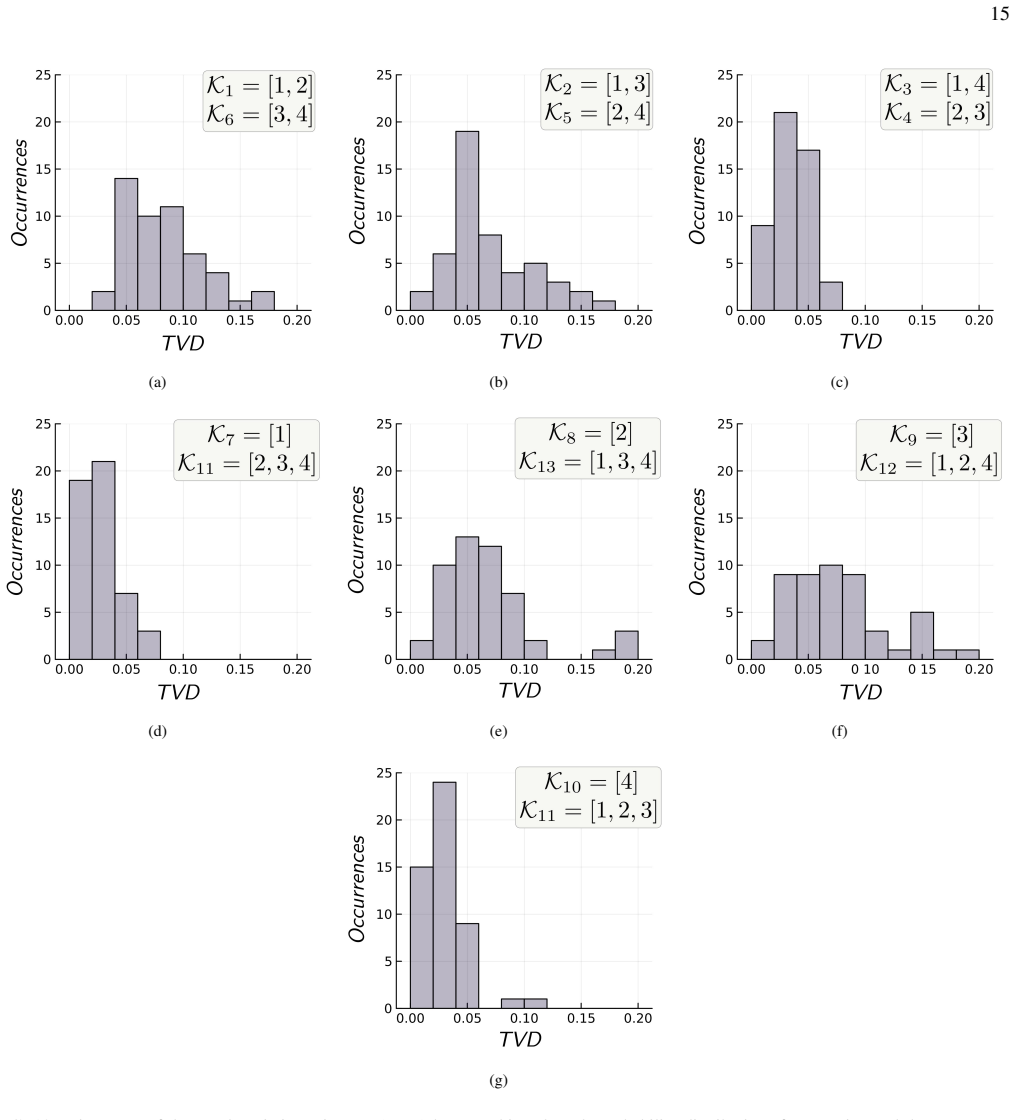
On its own terms, the paper establishes that binned-mode photon-number distributions are a workable validation tool for boson sampling and that the Haar-averaged variance of a single bin has a closed form, valid for any number of photons, any number of modes, any bin size, and any partial-distinguishability Gram matrix. The experiment confirms this formula: for three photons in four modes, the variance of the binned count increases with the squared quadratic-mean overlap and falls on the predicted lines for bins of size one and two. It also shows that the binned distributions reproduce both the unitary-specific and bin-specific fluctuations of an ideal boson sampler, with total-variation distances to the ideal prediction that grow as distinguishability is increased. The same data show that generalized bunching probabilities decrease with distinguishability, with residual deviations traced to phase errors in programming the chip.
Load-bearing premise
The quantitative match between theory and experiment depends on converting measured Hong-Ou-Mandel dip visibilities into real-valued overlaps $x_{ij}$ via $V=x^2$ and assuming that drift between before/after calibrations interpolates linearly; if overlaps are complex or drift is nonlinear, the reported confirmation of Eq. (22) is not established.
Editorial extensions
If this is right
- Because binned distributions can be computed efficiently for a constant number of bins, the same validation strategy can run on larger devices without exponential classical cost.
- The Haar-averaged variance formula turns raw click data into a direct estimate of the average pairwise photon overlap, so distinguishability can be monitored from the same data used for sampling.
- The single-unitary comparison shows that bin-dependent fluctuations distinguish a real boson sampler from fixed-output or uniform mock-up samplers, quantified through total variation distance.
- In the sparse regime $m \gg n^2$, larger bins avoid the photon-starved single-mode distributions, making the variance measurement more reliable as boson samplers scale.
- The method generalizes earlier validation tests: single-mode marginals are one-mode bins, and generalized bunching probabilities are single-bin outcomes.
Reading between the lines
- A natural extension is to use joint variances and covariances of several bins: the same Weingarten technique likely yields closed forms, giving more constraints per experimental dataset.
- Because multi-mode bins are phase-sensitive and single-mode bins are not, comparing the two can separate chip programming errors from photon distinguishability without additional hardware.
- The variance formula is parameter-free in $n$, $m$, and $|K|$; a scaled experiment could test it as a calibration-independent witness by checking the slope of variance versus squared overlap before trusting any overlap calibration.
Editorial analysis
A structured set of objections, weighed in public.
Referee Report
Summary. The paper reports an experimental test of the detector-binning validation strategy for boson sampling. Three photons are sent into a four-mode reconfigurable interferometer implementing 50 Haar-random unitaries, with the pairwise overlap of the input photons tuned by optical delays. The authors compare binned-mode photon-number distributions with exact simulations for various bin partitions, study the total variation distance as a function of distinguishability, measure generalized bunching probabilities, and derive an analytic Haar-averaged variance formula for a single bin (Eq. (22)) that depends linearly on the sum of squared pairwise overlaps. The main claims are that binned distributions reproduce the unitary- and bin-dependent fluctuations of an ideal boson sampler, that the test is sensitive to partial distinguishability, and that the measured variance as a function of (x̄_q)^2 confirms Eq. (22), providing a scalable way to infer photon indistinguishability.
Significance. The theoretical result in Appendix B is a clean, self-contained derivation and is likely correct; it extends earlier single-mode indistinguishability witnesses to arbitrary bins in a way that is useful for the collision-free regime. The experimental dataset is substantial (50 unitaries at 9 delay settings), the data are publicly archived, and the simulations use the open-source BOSON SAMPLING.jl package. At high indistinguishability the binned distributions show good agreement with theory, and the generalized-bunching analysis with a noisy-unitary model is a thoughtful attempt to identify error sources. However, the quantitative confirmation of Eq. (22) and the sensitivity curves in Fig. 4 rest on a distinguishability metric whose definition is inconsistent with the reported numbers, and on a HOM-visibility calibration that is not independently validated in the mid-range. These issues are fixable by reanalysis and do not undermine the theoretical derivation, but they must be resolved before the experimental claims can be accepted at face value.
major comments (4)
- [V, Eq. (23)] The definition of the distinguishability metric is not consistent with the reported numbers and with Eq. (22). Eq. (23) defines ¯x_q as the root sum of squares sqrt(x_12^2+x_13^2+x_23^2), but the reported values ¯x_q≈0.933 for the high-indistinguishability dataset in Section V.A and ¯x_q≈0.993 in Appendix D are of order one, whereas the measured HOM visibilities V_ij≈0.98, 0.95, 0.90 together with V=x^2 would give a root sum of squares of about 1.68 for that setting. The abstract also refers to an 'average' of squared overlaps, which suggests the standard quadratic mean with a factor 1/3. Please correct Eq. (23), state which convention is used on the x-axis of Fig. 7, and ensure that the theoretical curves computed from Eq. (22) are plotted with the same convention; the factor of 3 changes the slope of the predicted line and therefore affects the claimed quantitative confirmation.
- [V.B, Fig. 7, Appendix C] The central confirmation of Eq. (22) is conditional on the HOM-based calibration of the x-axis. The overlaps are inferred from HOM visibilities through x_ij=sqrt(V_ij) with the assumption that they are real, and drift between the HOM measurements of 21/08 and 29/08 is interpolated linearly (Appendix C). The experimental variance points lie above the theoretical curves mainly in the mid-range, and the paper attributes this to an underestimation of the visibilities without an independent check that the true overlaps are indeed larger. Because every point shares the same calibration procedure, a systematic drift or a nonlinear delay-to-overlap mapping would move precisely the mid-range points, and agreement at the two extremes does not rule out such a displacement. I request that the authors either implement the direct fitting of simulated curves to the data that they themselves suggest, or provide a quantitative analysis showing that the drift range in Fig. 9 contains the corrected overlaps needed to bring the points onto the theoretical curves.
- [V.A, Fig. 4] In the middle range of partial distinguishability the experimental TVD falls below the noiseless simulation curves, a region that is inaccessible if the x-axis overlaps are correct. The text attributes this to HOM visibility underestimation, but no independent measurement or fitting is provided. Since this anomaly affects the same x-calibration that underlies the sensitivity claim, the demonstrated sensitivity of the binned-distribution test to partial distinguishability is presently established only at the extreme regimes. Please quantify the required visibility correction from the measured HOM dips, for example by fitting the simulated TVD curve to the data, and state explicitly how the sensitivity claim is affected by that correction.
- [V.B, Fig. 7] The comparison of experimental and simulated variances with the exact Haar-average formula does not include a quantitative treatment of the finite 50-unitary ensemble. The text notes that the simulated points lie slightly below the theoretical curves because of finite-size effects, but no analogous uncertainty is shown for the experimental variance points and no error bars are displayed in Fig. 7. Without an estimate of the finite-ensemble spread, for instance a bootstrap over the 50 unitaries or the theoretical variance of the empirical Haar-average estimator, the deviations of the black markers above the curves cannot be distinguished from statistical fluctuations, which weakens the claim that Eq. (22) is accurately confirmed.
minor comments (6)
- [II.B, Eq. (6)] The symbol x(η) for the characteristic function clashes with the overlap notation x_ij; using χ(η) throughout would improve readability.
- [IV] The sentence 'we post-select on observing outcome |⟩ [52]' contains a placeholder; please insert the actual Fock state or define it explicitly.
- [Appendix C and Fig. 9] The text gives the HOM calibration dates as 21/08 and 29/08 while the measurement period is 22/08–28/08, and the figure caption labels the before/after dips as 22/08 and 28/08. Please align the dates and state explicitly which HOM datasets are used for the linear drift interpolation.
- [Appendix G, Eq. (G2)] The model U_noisy = e^{ε log(U~_H)} U_target uses the logarithm of a unitary, which is multi-valued; please specify the principal branch and clarify that matrix logarithms and exponentials are used.
- [Appendix G] The statement that the noisy simulations 'match the experimental data almost exactly' is not quantified; please provide a goodness-of-fit statistic or confidence interval for the agreement shown in Fig. 13.
- [Appendix D] The highest-indistinguishability value is quoted as ¯x_q ∼ 0.993, whereas Section V.A gives ¯x_q ∼ 0.933 for the highest degree achieved; please reconcile these values or clarify that they refer to different runs.
Circularity Check
No significant circularity: Eq. (22) is derived from Haar-averaged permanents with no fitted parameters, and the experimental overlaps come from independent HOM calibrations.
full rationale
The paper's central theoretical result, Eq. (22), is derived in Appendix B from the characteristic-function representation of binned distributions (B1), itself taken from the authors' prior work [18], but the subsequent steps—expanding c1 and c2, applying the Haar-average Weingarten identities (B8)–(B9)—are reproduced in the paper and do not assume Eq. (22). The variance formula therefore does not reduce to any fitted input. The experimental comparison in Figs. 4 and 7 uses pairwise overlaps x_ij inferred from two-photon HOM-dip measurements (with V = x^2), which are independent of the binned three-photon distributions being predicted; no parameter of Eq. (22) is extracted from the same binned data. The x-axis calibration does involve auxiliary assumptions (real overlaps, linear drift interpolation between HOM calibrations on 21/08 and 29/08, and attribution of mid-range deviations to visibility underestimation), but these are testable calibration assumptions and are explicitly flagged as limitations in Appendix C and Sec. V; they affect whether the agreement is conclusively established, not whether the derivation is circular. The paper's use of [18] for the binned-distribution formalism is self-citation, but that prior result is an externally published, parameter-free identity and is not used to forbid alternatives or to define the predicted quantity. No step in the derivation chain is equivalent, by construction, to its own input.
Assumptions & free parameters
free parameters (1)
- epsilon (unitary noise strength) =
0.424
assumptions (6)
- domain assumption Partial distinguishability is fully captured by the Gram matrix X with entries x_ij = <phi_i|phi_j>, and detectors are insensitive to internal degrees of freedom (Eqs. 1 and 2).
- domain assumption The overlaps x_ij are real; the authors state this assumption explicitly in Section IV, justified by time-delay distinguishability.
- domain assumption Photon losses can be neglected after postselecting on n-photon events, and the extra-pair noise contributes less than 1% relative error.
- ad hoc to paper The implemented unitary differs from the target by a random isotropic unitary noise model U_noisy = e^(epsilon log(U_H)) U_target, with epsilon calibrated to the manufacturer-reported amplitude fidelity.
- domain assumption HOM visibility drift between calibration dates is linear on average, so the true partial distinguishability lies between the pre- and post-experiment HOM dip values.
- standard math Haar-averaging formulas for unitary moments (Weingarten calculus, Eqs. B8 and B9) are valid and applicable to the m-mode interferometer averages.
Cite this review
Pith. "Pith review of Experimental validation of boson sampling using detector binning." pith.science (2026). https://pith.science/paper/CAZXVRUH
@misc{pith2026250205093,
  author       = {Pith},
  title        = {Pith review of: Experimental validation of boson sampling using detector binning},
  year         = {2026},
  howpublished = {\url{https://pith.science/paper/CAZXVRUH}},
  note         = {Machine review of arXiv:2502.05093}
}
read the original abstract
We experimentally demonstrate a testing strategy for boson samplers that is based on efficiently computable expressions for the output photon counting distributions binned over multiple optical modes. We apply this method to validate boson sampling experiments with three photons on a reconfigurable photonic chip, which implements a four-mode interferometer, analyzing 50 Haar-random unitary transformations while tuning photon distinguishability via controlled delays. We show that for high values of indistinguishability, the experiment accurately reproduces the ideal boson sampling binned-mode distributions, which exhibit variations that depend both on the specific interferometer implemented as well as the choice of bin, confirming the usefulness of the method to diagnose imperfections such as partial distinguishability or imperfect chip control. Finally, we analyze the behavior of Haar-averaged binned-mode distributions with partial distinguishability and demonstrate analytically that its variance is proportional to the average of the square of the photons' indistinguishability parameter. These findings highlight the central role of binning in boson sampling validation, offering a scalable and efficient framework for assessing multiphoton interference and experimental performance.
Figures


Figures from the paper (11 more)




Forward citations
Cited by 1 Pith paper
-
Error Mitigation in Bosonic Systems via Virtual Distillation
Passive linear interferometers implement virtual distillation for bosonic observables, recovering noise-suppressed number, phase-shift and quadrature expectations under loss and dephasing.
Reference graph
Works this paper leans on
-
[1]
Generalised bunching probabilities In an ideal boson sampler with indistinguishable bosons, bunching phenomena are expected be more prominent than in an imperfect boson sampler with partially distinguish- able particles [26, 46–48]. Binned-mode outcome probability distribution capture such generalized bunching phenomena, namely, the tendency for bosons to...
-
[2]
Photon 1’s delay is adjusted directly, while photon 3 is offset in the opposite direction, enabling control over the rela- tive delays between photon pairs within the constraints of the system. This choice of delays ensures that while the partial distinguishability between photon pairs 1&2 and 2&3 is of a similar order, the delay offset for pair 1&3 is tw...
work page 2024
-
[3]
Phase-programmable gaussian boson sam- pling using stimulated squeezed light
Han-Sen Zhong, Yu-Hao Deng, Jian Qin, Hui Wang, Ming- Cheng Chen, Li-Chao Peng, Yi-Han Luo, Dian Wu, Si-Qiu Gong, Hao Su, et al. Phase-programmable gaussian boson sam- pling using stimulated squeezed light. Physical review letters, 127(18):180502, 2021
work page 2021
-
[4]
Quantum computational advantage using photons
Han-Sen Zhong, Hui Wang, Yu-Hao Deng, Ming-Cheng Chen, Li-Chao Peng, Yi-Han Luo, Jian Qin, Dian Wu, Xing Ding, Yi Hu, et al. Quantum computational advantage using photons. Science, 370(6523):1460–1463, 2020
2020
-
[5]
Quantum computational advantage with a pro- grammable photonic processor
Lars S Madsen, Fabian Laudenbach, Mohsen Falamarzi Askarani, Fabien Rortais, Trevor Vincent, Jacob FF Bulmer, Filippo M Miatto, Leonhard Neuhaus, Lukas G Helt, Matthew J Collins, et al. Quantum computational advantage with a pro- grammable photonic processor. Nature, 606(7912):75–81, 2022
work page 2022
-
[6]
Strong quantum computational advantage using a superconducting quantum processor
Yulin Wu, Wan-Su Bao, Sirui Cao, Fusheng Chen, Ming-Cheng Chen, Xiawei Chen, Tung-Hsun Chung, Hui Deng, Yajie Du, Daojin Fan, et al. Strong quantum computational advantage using a superconducting quantum processor. Physical review letters, 127(18):180501, 2021
work page 2021
-
[7]
Yu-Hao Deng, Yi-Chao Gu, Hua-Liang Liu, Si-Qiu Gong, Hao Su, Zhi-Jiong Zhang, Hao-Yang Tang, Meng-Hao Jia, Jia-Min Xu, Ming-Cheng Chen, et al. Gaussian boson sampling with pseudo-photon-number resolving detectors and quantum com- putational advantage. arXiv preprint arXiv:2304.12240, 2023
arXiv 2023
-
[8]
Quantum supremacy using a programmable superconducting processor
Frank Arute, Kunal Arya, Ryan Babbush, Dave Bacon, Joseph C Bardin, Rami Barends, Rupak Biswas, Sergio Boixo, Fernando GSL Brandao, David A Buell, et al. Quantum supremacy using a programmable superconducting processor. Nature, 574(7779):505–510, 2019
2019
Show all 77 references
-
[9]
Quantum Supremacy
Hangleiter, Dominik and Kliesch, Martin and Eisert, Jens and Gogolin, Christian. Sample Complexity of Device- Independently Certified “Quantum Supremacy”. Phys. Rev. Lett., 122:210502, May 2019
2019
-
[10]
Establishing a new benchmark in quantum com- putational advantage with 105-qubit zuchongzhi 3.0 processor
Dongxin Gao, Daojin Fan, Chen Zha, Jiahao Bei, Guoqing Cai, Jianbin Cai, Sirui Cao, Xiangdong Zeng, Fusheng Chen, Jiang Chen, et al. Establishing a new benchmark in quantum com- putational advantage with 105-qubit zuchongzhi 3.0 processor. arXiv preprint arXiv:2412.11924, 2024
2024 arXiv
-
[11]
The computational com- plexity of linear optics
Scott Aaronson and Alex Arkhipov. The computational com- plexity of linear optics. In Proceedings of the forty-third an- nual ACM symposium on Theory of computing, pages 333–342, 2011
2011
-
[12]
Effi- cient classical algorithm for boson sampling with partially dis- tinguishable photons
Jelmer J Renema, Adrian Menssen, William R Clements, Gil Triginer, William S Kolthammer, and Ian A Walmsley. Effi- cient classical algorithm for boson sampling with partially dis- tinguishable photons. Physical review letters, 120(22):220502, 2018
2018
-
[13]
Boson sampling cannot be faithfully sim- ulated by only the lower-order multi-boson interferences.arXiv preprint arXiv:2204.07792, 2022
Valery Shchesnovich. Boson sampling cannot be faithfully sim- ulated by only the lower-order multi-boson interferences.arXiv preprint arXiv:2204.07792, 2022
2022 arXiv
-
[14]
Efficient approximation of experimental gaussian boson sam- pling
Benjamin Villalonga, Murphy Yuezhen Niu, Li Li, Hartmut Neven, John C Platt, Vadim N Smelyanskiy, and Sergio Boixo. Efficient approximation of experimental gaussian boson sam- pling. arXiv:2109.11525, 2021
2021 arXiv
-
[15]
Classical simulation of linear optics subject to nonuniform losses
Daniel Jost Brod and Michał Oszmaniec. Classical simulation of linear optics subject to nonuniform losses. Quantum, 4:267, 2020
2020
-
[16]
Classical simulation of photonic linear optics with lost particles
Michał Oszmaniec and Daniel J Brod. Classical simulation of photonic linear optics with lost particles. New Journal of Physics, 20(9):092002, 2018
2018
-
[17]
Simulating boson sampling in lossy architectures
Ra ´ul Garc ´ıa-Patr´on, Jelmer J Renema, and Valery Shches- novich. Simulating boson sampling in lossy architectures. Quantum, 3:169, 2019
2019
-
[18]
Efficient validation of boson sampling from binned 20 photon-number distributions
Benoit Seron, Leonardo Novo, Alex Arkhipov, and Nicolas J Cerf. Efficient validation of boson sampling from binned 20 photon-number distributions. Quantum, 8:1479, 2024
2024
-
[19]
Classical simulability of noisy boson sampling
Jelmer Renema, Valery Shchesnovich, and Raul Garcia-Patron. Classical simulability of noisy boson sampling. arXiv preprint arXiv:1809.01953, 2018
2018 arXiv
-
[20]
Assessing the qual- ity of near-term photonic quantum devices
Mezher, Rawad and Mansfield, Shane. Assessing the qual- ity of near-term photonic quantum devices. arXiv preprint arXiv:2202.04735, 2022
2022 arXiv
-
[21]
Simulating complex networks in phase space: Gaussian boson sampling
Drummond, Peter D and Opanchuk, Bogdan and Dellios, Alexander and Reid, Margaret D. Simulating complex networks in phase space: Gaussian boson sampling. Physical Review A, 105(1):012427, 2022
2022
-
[22]
Gaussian boson sampling validation via detector binning
Gabriele Bressanini, Benoit Seron, Leonardo Novo, Nicolas J Cerf, and MS Kim. Gaussian boson sampling validation via detector binning. arXiv preprint arXiv:2310.18113, 2023
2023 arXiv
-
[23]
(23) This metric provides an effective representation of the overall distinguishability and is sensitive to inhomogeneities between photon pairs, making it well-suited for analyzing these exper- iments within our setup. To validate our experimental results, we estimate the bin...
-
[24]
Simulating and assessing boson sam- pling experiments with phase-space representations
Bogdan Opanchuk, Laura Rosales-Z ´arate, Margaret D Reid, and Peter D Drummond. Simulating and assessing boson sam- pling experiments with phase-space representations. Physical Review A, 97(4):042304, 2018
2018
-
[25]
Validation tests for GBS quantum computers using grouped count probabilities
Dellios, Alexander S and Reid, Margaret D and Opanchuk, Bogdan and Drummond, Peter D. Validation tests for GBS quantum computers using grouped count probabilities. arXiv:2211.03480, 2022
2022 arXiv
-
[26]
Jacob F. F. Bulmer, Javier Mart ´ınez-Cifuentes, Bryn A. Bell, and Nicol ´as Quesada. Simulating lossy and partially distin- guishable quantum optical circuits: theory, algorithms and ap- plications to experiment validation and state preparation, 2024
2024
-
[27]
Statistical benchmark for BosonSampling
Mattia Walschaers, Jack Kuipers, Juan-Diego Urbina, Klaus Mayer, Malte Christopher Tichy, Klaus Richter, and An- dreas Buchleitner. Statistical benchmark for BosonSampling. 18(3):032001. Publisher: IOP Publishing
-
[28]
D. S. Phillips, M. Walschaers, J. J. Renema, I. A. Walmsley, N. Treps, and J. Sperling. Benchmarking of gaussian boson sampling using two-point correlators. 99(2):023836. Publisher: American Physical Society
-
[29]
Universality of generalized bunching and efficient assessment of boson sampling
VS Shchesnovich. Universality of generalized bunching and efficient assessment of boson sampling. Physical review letters, 116(12):123601, 2016
2016
-
[30]
Distinguishing noisy boson sampling from classical simulations
Valery Shchesnovich. Distinguishing noisy boson sampling from classical simulations. Quantum, 5:423, March 2021
2021
-
[31]
Linear cross-entropy certification of quantum computa- tional advantage in gaussian boson sampling
Javier Mart ´ınez-Cifuentes, Hubert de Guise, and Nicol ´as Que- sada. Linear cross-entropy certification of quantum computa- tional advantage in gaussian boson sampling. PRX Quantum, 5(4):040312, 2024
2024
-
[32]
Computational advantage of quantum random sampling
Dominik Hangleiter and Jens Eisert. Computational advantage of quantum random sampling. Reviews of Modern Physics , 95(3):035001, 2023
2023
-
[33]
Spoofing cross- entropy measure in boson sampling
Changhun Oh, Liang Jiang, and Bill Fefferman. Spoofing cross- entropy measure in boson sampling. Physical Review Letters, 131(1):010401, 2023
2023
-
[34]
Bayesian approach to boson sampling validation
Marco Bentivegna, Nicol `o Spagnolo, Chiara Vitelli, Daniel J Brod, Andrea Crespi, Fulvio Flamini, Roberta Ramponi, Paolo Mataloni, Roberto Osellame, Ernesto F Galv˜ao, et al. Bayesian approach to boson sampling validation. International Journal of Quantum Information, 12(07n0...
2015
-
[35]
Renema, Hui Wang, Jian Qin, Xiang You, Chaoyang Lu, and Jianwei Pan
Jelmer J. Renema, Hui Wang, Jian Qin, Xiang You, Chaoyang Lu, and Jianwei Pan. Sample-efficient benchmarking of mul- tiphoton interference on a boson sampler in the sparse regime. Phys. Rev. A, 103:023722, Feb 2021
2021
-
[36]
Proof-of-work consensus by quantum sam- pling
Deepesh Singh, Gopikrishnan Muraleedharan, Boxiang Fu, Chen-Mou Cheng, Nicolas Roussy Newton, Peter P Rohde, and Gavin K Brennen. Proof-of-work consensus by quantum sam- pling. Quantum Science and Technology , 10(2):025020, feb 2025
2025
-
[37]
Decision and function problems based on boson sampling
Georgios M Nikolopoulos and Thomas Brougham. Decision and function problems based on boson sampling. Physical Re- view A, 94(1):012315, jul 2016
2016
-
[38]
Cryptographic one-way function based on boson sampling
Nikolopoulos, Georgios M. Cryptographic one-way function based on boson sampling. Quantum Information Processing , 18(8):1–25, jul 2019
2019
-
[39]
and Jin, Xian-Min
Wang, Xiao-Wei and Zhou, Wen-Hao and Fu, Yu-Xuan and Gao, Jun and Lu, Yong-Heng and Chang, Yi-Jun and Qiao, Lu- Feng and Ren, Ruo-Jing and Jiang, Ze-Kun and Jiao, Zhi-Qiang and Nikolopoulos, Georgios M. and Jin, Xian-Min. Experimen- tal boson sampling enabling cryptographic on...
2023
-
[40]
Brod, Leonardo Novo, Nicol`o Spagnolo, Ernesto F
Giovanni Rodari, Carlos Fernandes, Eugenio Caruccio, Alessia Suprano, Francesco Hoch, Taira Giordani, Gonzalo Carvacho, Riccardo Albiero, Niki Di Giano, Giacomo Corrielli, Francesco Ceccarelli, Roberto Osellame, Daniel J. Brod, Leonardo Novo, Nicol`o Spagnolo, Ernesto F. Galv ...
2024 arXiv
-
[41]
Classically simulating near-term partially- distinguishable and lossy boson sampling
Alexandra E Moylett, Ra ´ul Garc´ıa-Patr´on, Jelmer J Renema, and Peter S Turner. Classically simulating near-term partially- distinguishable and lossy boson sampling. Quantum Science and Technology, 5(1):015001, nov 2019
2019
-
[42]
S. N. van den Hoven, E. Kanis, and J. J. Renema. Efficient classical algorithm for simulating boson sampling with inho- mogeneous partial distinguishability, 2024
2024
-
[43]
Sampling of partially distinguishable bosons and the relation to the multidimensional permanent
Malte C Tichy. Sampling of partially distinguishable bosons and the relation to the multidimensional permanent. Physical Review A, 91(2):022316, February 2015. Publisher: American Physical Society
2015
-
[44]
Partial indistinguishability theory for mul- tiphoton experiments in multiport devices
VS Shchesnovich. Partial indistinguishability theory for mul- tiphoton experiments in multiport devices. Physical Review A, 91(1):013844, 2015
2015
-
[45]
Partial distinguishability and photon counting probabilities in linear multiport devices
Valery Shchesnovich. Partial distinguishability and photon counting probabilities in linear multiport devices. arXiv preprint arXiv:1712.03191, 2017
2017 arXiv
-
[46]
Experimental demonstration of an ef- ficient, semi-device-independent photonic indistinguishability witness
Reinier van der Meer, Peter Hooijschuur, Franciscus HB Somhorst, Pim Venderbosch, Michiel de Goede, Ben Kassen- berg, Henk Snijders, Caterina Taballione, Jorn Epping, Hans van den Vlekkert, et al. Experimental demonstration of an ef- ficient, semi-device-independent photonic i...
2021 arXiv
-
[47]
Experimental statistical signature of many-body quantum inter- ference
Taira Giordani, Fulvio Flamini, Matteo Pompili, Niko Vig- gianiello, Nicol`o Spagnolo, Andrea Crespi, Roberto Osellame, Nathan Wiebe, Mattia Walschaers, Andreas Buchleitner, et al. Experimental statistical signature of many-body quantum inter- ference. Nature Photonics, 12(3):...
2018
-
[48]
Young, Shawn Geller, William J
Aaron W. Young, Shawn Geller, William J. Eckner, Nathan Schine, Scott Glancy, Emanuel Knill, and Adam M. Kaufman. An atomic boson sampler, 2023
2023
-
[49]
The permanent-on-top conjecture is false
Valery S Shchesnovich. The permanent-on-top conjecture is false. Linear Algebra and its Applications, 490:196–201, 2016
2016
-
[50]
Boson bunching is not maximized by indistinguishable particles
Benoit Seron, Leonardo Novo, and Nicolas J Cerf. Boson bunching is not maximized by indistinguishable particles. Na- ture Photonics, 17(8):702–709, 2023
2023
-
[51]
Enhanced bunching of nearly indistinguishable bosons
L ´eo Pioge, Benoit Seron, Leonardo Novo, and Nicolas J Cerf. Enhanced bunching of nearly indistinguishable bosons. arXiv preprint arXiv:2308.12226, 2023
2023 arXiv
-
[52]
Quantum de moivre–laplace theorem for noninteracting indistinguishable particles in random net- works
VS Shchesnovich. Quantum de moivre–laplace theorem for noninteracting indistinguishable particles in random net- works. Journal of Physics A: Mathematical and Theoretical , 50(50):505301, 2017
2017
-
[53]
Asymptotic gaussian law for noninter- acting indistinguishable particles in random networks
Valery S Shchesnovich. Asymptotic gaussian law for noninter- acting indistinguishable particles in random networks. Scien- tific reports, 7(1):1–11, 2017
2017
-
[54]
P. G. Evans, R. S. Bennink, W. P. Grice, T. S. Hum- ble, and J. Schaake. Bright Source of Spectrally Uncorre- lated Polarization-Entangled Photons with Nearly Single-Mode Emission. Phys. Rev. Lett., 105(25):253601, December 2010
2010
-
[55]
Experimental boson 21 sampling
Max Tillmann, Borivoje Daki ´c, Ren´e Heilmann, Stefan Nolte, Alexander Szameit, and Philip Walther. Experimental boson 21 sampling. Nature Phot., 7(7):540–544, May 2013
2013
-
[56]
C. K. Hong, Z. Y . Ou, and L. Mandel. Measurement of subpi- cosecond time intervals between two photons by interference. Phys. Rev. Lett., 59:2044–2046, Nov 1987
1987
-
[57]
Distinguishability and many- particle interference
Menssen, Adrian J and Jones, Alex E and Metcalf, Benjamin J and Tichy, Malte C and Barz, Stefanie and Kolthammer, W Steven and Walmsley, Ian A. Distinguishability and many- particle interference. Physical review letters, 118(15):153603, April 2017. Publisher: American Physical Society
2017
-
[58]
Giovanni Rodari, Leonardo Novo, Riccardo Albiero, Alessia Suprano, Carlos T. Tavares, Eugenio Caruccio, Francesco Hoch, Taira Giordani, Gonzalo Carvacho, Marco Gardina, Niki Di Giano, Serena Di Giorgio, Giacomo Corrielli, Francesco Ceccarelli, Roberto Osellame, Nicol `o Spagno...
2024
-
[59]
Chris G. H. Roeloffzen, Marcel Hoekman, Edwin J. Klein, Lennart S. Wevers, Roelof Bernardus Timens, Denys Marchenko, Dimitri Geskus, Ronald Dekker, Andrea Alippi, Robert Grootjans, Albert van Rees, Ruud M. Oldenbeuving, J¨orn P. Epping, Ren ´e G. Heideman, Kerstin W ¨orhoff, A...
2018
-
[60]
A universal fully re- configurable 12-mode quantum photonic processor
Caterina Taballione, Reinier van der Meer, Henk J Snijders, Pe- ter Hooijschuur, J¨orn P Epping, Michiel de Goede, Ben Kassen- berg, Pim Venderbosch, Chris Toebes, Hans van den Vlekkert, Pepijn W H Pinkse, and Jelmer J Renema. A universal fully re- configurable 12-mode quantum...
2021
-
[61]
Clements, Peter C
William R. Clements, Peter C. Humphreys, Benjamin J. Met- calf, W. Steven Kolthammer, and Ian A. Walmsley. Optimal design for universal multiport interferometers. Optica, 3:1460– 1465, 2016
2016
-
[62]
Holzman and Y
I. Holzman and Y . Ivry. Superconducting nanowires for single- photon detection: Progress, challenges, and opportunities. Adv. Quant. Tech., page 1800058, 2019
2019
-
[63]
Molnar, and Karl K
Francesco Marsili, Faraz Najafi, Eric Dauler, Francesco Bellei, Xiaolong Hu, Maria Csete, Richard J. Molnar, and Karl K. Berggren. Single-photon detectors based on ultranarrow super- conducting nanowires. Nano Lett., 11(5):2048–2053, 2011
2011
-
[64]
Feito, J
A. Feito, J. S. Lundeen, H. Coldenstrodt-Ronge, J. Eisert, M. B. Plenio, and I. A. Walmsley. Measuring measurement: theory and practice. Nature Phys., 5:27, 2009
2009
-
[65]
F. H. B. Somhorst, R. van der Meer, M. Correa Anguita, R. Schadow, H. J. Snijders, M. de Goede, B. Kassenberg, P. Venderbosch, C. Taballione, J. P. Epping, H. H. van den Vlekkert, J. Timmerhuis, J. F. F. Bulmer, J. Lugani, I. A. Walm- sley, P. W. H. Pinkse, J. Eisert, N. Walk,...
2023
-
[66]
Bosonsampling
Benoit Seron and Antoine Restivo. Bosonsampling. jl: A ju- lia package for quantum multi-photon interferometry. arXiv preprint arXiv:2212.09537, 8:1378, 2022
2022 arXiv
-
[67]
Tight bound on the trace distance between a realistic device with partially indistinguishable bosons and the ideal bosonsampling
VS Shchesnovich. Tight bound on the trace distance between a realistic device with partially indistinguishable bosons and the ideal bosonsampling. Physical Review A, 91(6):063842, 2015
2015
-
[68]
and Galvao, Ernesto F
Spagnolo, Nicolo and Vitelli, Chiara and Sansoni, Linda and Maiorino, Enrico and Mataloni, Paolo and Sciarrino, Fabio and Brod, Daniel J. and Galvao, Ernesto F. and Crespi, Andrea and Ramponi, Roberta and Osellame, Roberto. General Rules for Bosonic Bunching in Multimode Inter...
2013
-
[69]
Four-photon indistinguishability transition
Tichy, Malte C and Lim, Hyang-Tag and Ra, Young-Sik and Mintert, Florian and Kim, Yoon-Ho and Buchleitner, Andreas. Four-photon indistinguishability transition. Physical Review A, 83(6):062111, June 2011. Publisher: American Physical Soci- ety
2011
-
[70]
Moments and cumulants of polynomial ran- dom variables on unitarygroups, the Itzykson-Zuber integral, and free probability
Beno ˆıt Collins. Moments and cumulants of polynomial ran- dom variables on unitarygroups, the Itzykson-Zuber integral, and free probability. International Mathematics Research No- tices, 2003(17):953–982, 01 2003
2003
-
[71]
Jabbour, Leonardo Novo, and Nico- las J
Marco Robbio, Michael G. Jabbour, Leonardo Novo, and Nico- las J. Cerf. A central limit theorem for partially distinguishable bosons, 2024
2024
-
[72]
Nonmonotonic quantum-to-classical tran- sition in multiparticle interference
Ra, Young-Sik and Tichy, Malte C and Lim, Hyang-Tag and Kwon, Osung and Mintert, Florian and Buchleitner, Andreas and Kim, Yoon-Ho. Nonmonotonic quantum-to-classical tran- sition in multiparticle interference. Proceedings of the National Academy of Sciences, 110(4):1227–1231, ...
2013
-
[73]
Non-monotonic projection probabilities as a function of distinguishability
Gunnar Bj ¨ork and Saroosh Shabbir. Non-monotonic projection probabilities as a function of distinguishability. New Journal of Physics, 16(1):013006, January 2014. Publisher: IOP Publish- ing
2014
-
[74]
Com- ment on ‘Non-monotonic projection probabilities as a function of distinguishability’
Young-Sik Ra, Malte C Tichy, Hyang-Tag Lim, Osung Kwon, Florian Mintert, Andreas Buchleitner, and Yoon-Ho Kim. Com- ment on ‘Non-monotonic projection probabilities as a function of distinguishability’. New Journal of Physics, 16(11):118003, November 2014. Publisher: IOP Publishing
2014
-
[75]
Tichy, Young-Sik Ra, Hyang-Tag Lim, Clemens Gneiting, Yoon-Ho Kim, and Klaus Mølmer
Malte C. Tichy, Young-Sik Ra, Hyang-Tag Lim, Clemens Gneiting, Yoon-Ho Kim, and Klaus Mølmer. Double-Fock Su- perposition Interferometry for Differential Diagnosis of Deco- herence. New Journal of Physics, 17(2):023008, January 2015. arXiv:1410.1299 [quant-ph]
2015 arXiv
-
[76]
Spring, Paolo L
Justin B. Spring, Paolo L. Mennea, Benjamin J. Metcalf, Pe- ter C. Humphreys, James C. Gates, Helen L. Rogers, Christoph S¨oller, Brian J. Smith, W. Steven Kolthammer, Peter G. R. Smith, and Ian A. Walmsley. Chip-based array of near-identical, pure, heralded single-photon sour...
2017
-
[77]
Anthony Laing and Jeremy L. O’Brien. Super-stable tomogra- phy of any linear optical device
Reviewed August 8, 2026 · model on record in the stance chip above.
Discussion (0). Continue with ORCID to comment.