REVIEW 4 major objections 6 minor 51 references
Beyond and Free from Diffusion: Invertible Guided Consistency Training
T0 review · 4 major / 6 minor · reviewed 2026-08-08 · deepseek-v4-flash
Pith's one-line read The paper proposes iGCT, a one-stage, data-driven training framework that gives consistency models guidance and one-step inversion without a pretrained diffusion teacher.
desk verdict Real empirical recipe for guidance in consistency training without distillation, but the theoretical justification of the guided direction is wrong and overclaims CFG-like behavior. read the letter →
The pith
A machine-rendered reading of the paper's core claim, the machinery that carries it, and where it could break.
The reading
What carries the argument
The carrying object is the pair of coupled consistency objectives. The guided consistency loss is $L_{\mathrm{gct}} = \lambda(t)\,d(D_\theta(x_t, t, c, w), D_{\theta^-}(x_r, r, c, w))$, where $x_r$ is built from the extrapolated direction $w z^* + (1-w)z$ and the guidance weight $w$ is sampled uniformly from $[1,15]$ and fed into the network as an embedding. The inverse consistency loss is $L_{\mathrm{inv}} = \lambda'(t)\,d(N_\phi(x_r, r, c), N_{\phi^-}(x_t, t, c))$, which trains the noiser to reverse the denoising map; its preconditioning $c_{\mathrm{skip}}(t)=1$, $c_{\mathrm{out}}(t)=t_{\max}-t$ is shown to give the effective target unit variance. The reconstruction loss couples the two networks and stabilizes the noiser. Together these losses turn the consistency-model objective into a trainable, invertible, guidance-conditioned map instead of a distillation target.
What would settle it
Train the iGCT objective on a 1D or 2D mixture of two classes with known conditional distributions, and compare the learned one-step map $D_\theta(x_t,t,c,w)$ with the true conditional posterior mean $\mathbb{E}[x_0\mid x_t,c]$ and with the class-mean direction $\mathbb{E}[x_0\mid c]$. If the learned update tracks the class mean rather than the posterior mean as within-class variance grows, the model's precision on the true conditional distribution will degrade measurably, and the claim that iGCT learns the CFG-like guided vector field would be settled against it.
Extended reading notes
Core claim
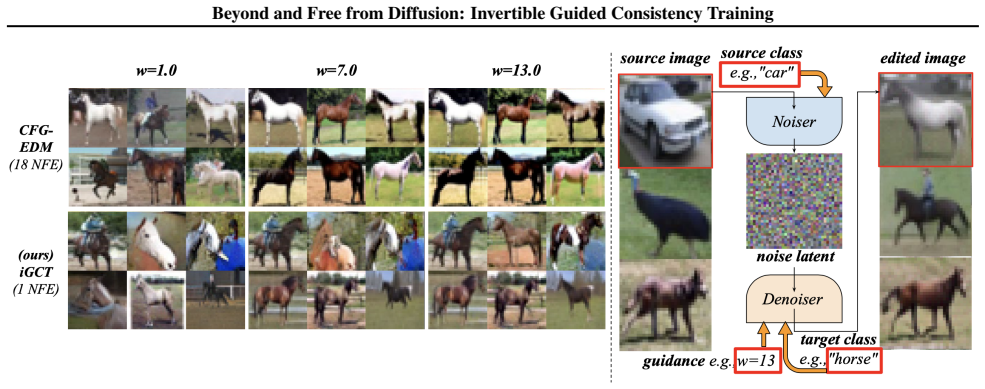
The central claim is that classifier-free-guidance-style behavior can be learned without a classifier-free-trained teacher. For a noisy latent $x_t = x^{\mathrm{src}}_0 + t z$, iGCT uses the same noise $z$ as an estimate of the unconditional noise and uses $z^* = (x_t - x^{\mathrm{tar}}_0)/t$, the direction to a random image from the target class, as an estimate of the conditional noise. The guided consistency step is formed by extrapolating these two directions, $x_r = x_t + (r-t)[w z^* + (1-w)z]$, and the denoiser is trained to map $x_t$ to $x_r$ under the conditioning pair $(c,w)$, mirroring the extrapolation CFG performs at inference. In parallel, the noiser $N_\phi$ is trained on the reverse consistency objective so that it maps images to the same-dimensional noise latent in one step, and a reconstruction loss $d(D_\theta(N_\phi(x_0, t_{\min}, c), t_{\max}, c, 0), x_0)$ aligns the noiser's latent with the denoiser's input. The paper reports that this procedure removes the saturation artifacts CFG produces under high guidance, yields better precision and FID at high guidance scales, and enables class-based editing with a single-step inversion, establishing what the paper says is the first framework to put guidance directly into consistency training.
Load-bearing premise
The whole guided objective rests on identifying the noise that produced a source image with the unconditional direction, and the direction from the noisy image to a random target-class image with the conditional direction; in expectation that second direction points at the average image of the class, not at the class-specific denoising direction that CFG would use.
Editorial extensions
If this is right
- A single iGCT checkpoint covers the guidance range $w\in[1,15]$ because $w$ is a conditioning input, so high guidance does not require two separate forward passes as CFG does.
- Because training is one-stage and data-driven, new diffusion schedulers can be used by training iGCT directly; adoption no longer has to wait for a matching pretrained diffusion teacher.
- The noiser provides one-step inversion, so class-based editing drops from roughly 18 function evaluations for each of inversion and generation to one step for each.
- Empirically, high guidance stops hurting: on CIFAR-10 at $w=13$, iGCT's precision is 0.80 and FID is 14.0, versus 0.47 and 32.6 for CFG-EDM, so guidance strength can be raised without the usual saturation collapse.
- The paper's augmentation experiments show iGCT-synthesized data continues to improve classifier accuracy at guidance scales where CFG-EDM augmentation stops helping.
Reading between the lines
- Because $z^*$ as used in training points to a random target-class image rather than to the posterior denoising target, the learned conditional direction is in expectation a pull toward the class-conditional mean image; if that bias is real, iGCT's advantage at high guidance may come partly from a class-mean regularization rather than from true score extrapolation, and the two effects could be sepa
- The same decoupling suggests a symmetric negative-guidance use the paper does not test: using source-class images in place of target-class images in $z^*$ should push the generated sample away from the source class, which would give a one-step class-removal or negative-prompt editing operator.
- Because the noiser is deterministic and one-step, the latent it produces is a candidate for latent-space arithmetic, such as noising two real images and denoising their average under a target class, an interpolation test the paper does not run.
Editorial analysis
A structured set of objections, weighed in public.
Referee Report
Summary. The paper proposes Invertible Guided Consistency Training (iGCT), a consistency-model training framework that aims to provide classifier-free-guidance-like control and single-step inversion without distilling a pretrained diffusion model. In the guided branch, it samples a source image, a target-class image, and a noise z, forms x_t = x_src0 + t z, and uses z* = (x_t - x_tar0)/t as a proxy for the conditional noise; the consistency objective is then evaluated between D_theta(x_t, t, c_tar, w) and D_theta-(x_r, r, c_tar, w), where x_r is obtained by moving along w z* + (1-w)z. A separate noiser N_phi is trained with an inverse consistency objective and a reconstruction loss to map images to a noise latent in one step. The paper reports FID, precision, and recall at w in {1,7,13} on CIFAR-10 and ImageNet64, claiming that iGCT improves precision and FID over CFG-EDM and guided-CD at high guidance, and it demonstrates one-step class-based editing.
Significance. If the claims held as stated, the paper would make a useful contribution: it would remove the two-stage DM-distillation requirement for guided consistency models, provide one-step inversion, and report gains in high-guidance regimes. The manuscript is commendable for including pseudocode for all three losses, full hyperparameters, GPU-hour comparisons, and explicit limitations. However, the central theoretical identification, namely that z* is the conditional noise, is incorrect, and the reported precision gains are consistent with a pull toward class centroids rather than with learning the CFG-guided vector field. The empirical study also lacks error bars, and the w=1 ImageNet64 results are far behind the baseline. The method may still be viable as a different kind of target-anchored guidance, but the paper in its current form overstates and mischaracterizes its mechanism.
major comments (4)
- [Sec. 3.1, Eq. (5), Algorithm 1] The identification of z* := (x_t - x_tar0)/t as the conditional noise is incorrect. Since x_tar0 is drawn independently of x_t from class c_tar, conditioning on x_t and c_tar gives E[z* | x_t, c_tar] = (x_t - mu_{c_tar})/t, whereas the conditional score direction is (x_t - E[x0 | x_t, c_tar])/t. These agree only when the posterior mean equals the class mean, which fails whenever x_t retains information about the source image. Substituting z* into Algorithm 1's guided step, x_r = x_t - Delta t [w z* + (1-w)z], therefore trains the model toward the vector field z + w(x_src0 - mu_c)/t, not toward the CFG-guided PF-ODE of Eq. (3). The claimed equivalence with CFG guidance is thus unsupported, and the precision improvements at high w are consistent with centroid attraction. This is load-bearing because the method's stated contribution depends on learning a CFG-like guided field.
- [Sec. 5] The conclusion states that 'the theory for guided consistency training remains intuitive and informal.' Because the central objective in Eq. (5) defines the method, an informal theory is not sufficient to support the abstract's unconditional claim that iGCT 'significantly improves FID and precision compared to CFG.' The authors should either provide a rigorous fixed-point characterization of the consistency training under the z* update, or explicitly re-frame iGCT as a different form of target-anchored guidance and remove the claim that it learns the CFG field.
- [Sec. 4.1, Table 1] The headline numbers, e.g., precision 0.80 versus 0.47 at w=13 on CIFAR-10, are reported without error bars or multiple seeds. Given the stochasticity of consistency training and the fact that iGCT uses two networks (Table A2), single-run comparisons are insufficient to support the claim of significant improvement. Additionally, ImageNet64 at w=1 shows iGCT FID 13.16 versus CFG-EDM 3.38 (Table 1b), so the abstract's unqualified 'significantly improves FID and precision compared to CFG' should be restricted to the high-guidance regime.
- [Sec. 3.1 and Table 1] The proposed guidance mechanism is not isolated. Add a controlled ablation comparing the guided target z*=(x_t - x_tar0)/t with (i) the class-mean direction (x_t - mu_c)/t and (ii) standard conditional CT with label dropout, keeping the noiser and inversion modules fixed. This would distinguish the contribution of the specific z* construction from generic centroid attraction and would provide evidence for the claimed mechanism.
minor comments (6)
- [Algorithm 2, line 7] The target network is written as D_phi-(x_t, t, c), but it should be N_phi-(x_t, t, c) to match Eq. (6).
- [Eq. (7)] The arguments of D_theta(N_phi(x0, tmin, c), tmax, c, 0) are not fully defined; in particular, the final argument 0, presumably the guidance weight, should be named, and the roles of tmin and tmax in the inversion/reconstruction chain should be clarified.
- [Sec. 1 and elsewhere] References to 'Appendix 5' should be updated to the actual appendix labels (A-E); as written, the pointer does not exist.
- [Appendix C, Table A2] The text says CIFAR-10 consistency training is organized into nine stages of 400k iterations, while Table A2 reports 360k total training iterations; these numbers are inconsistent.
- [Figure 3] The 1D toy example is presented without specifying the model, the training procedure, or the quantitative definition of 'overshooting'; please provide this information.
- [Appendix E.1] The text contains two placeholder references ('Fig. ??'), which should point to Figure A4 or the relevant inversion figures.
Circularity Check
No load-bearing circularity; the central z* identification is an unproven assumption, not a circular reduction.
full rationale
After walking the derivation chain, I find no step in which a claimed prediction or first-principles result reduces, by construction or by self-citation, to its own inputs. The guided consistency target is defined in Sec. 3.1 by xr = xt + (r - t)[w z* + (1 - w) z] with z* := (xt - xtar0)/t, and Lgct in Eq. (5) trains D_theta to map xt back to that constructed target; the headline FID and precision values in Table 1 are measured after training against held-out dataset statistics, so they are not logically forced by the loss definition. The contested statement that z* serves as an estimate of the true conditional noise is an assumption about what z* represents, not a consequence of the optimization; even if E[z* | xt, ctar] = (xt - mu_c)/t rather than the true conditional score, that is a correctness or bias issue in the method's mechanism, not a circularity of the type where a fitted parameter is renamed a prediction. The paper's own Sec. 5 admits that the theory for guided consistency training remains intuitive and informal, which I weigh as a non-circular correctness caveat. Training choices such as the guidance mask q(t), the guidance range w, and the lambda_recon schedule were tuned, but tuning hyperparameters is not circular reasoning. Baselines CFG-EDM and guided-CD are specified externally, and the preceding methods used as building blocks (ECT's continuous-time schedule, iCD's reconstruction loss) are cited prior work by other authors, not load-bearing self-citations. I therefore find no significant circularity.
Assumptions & free parameters
free parameters (4)
- guidance mask thresholds t_low and t_high =
t_low=11.0, t_high=14.3
- reconstruction loss weight lambda_recon schedule =
2e-5, then 4e-5 and 6e-5 at specified iterations on ImageNet64
- guidance strength range [wmin, wmax] sampled at training =
[1, 15]
- ECT continuous-time curriculum hyperparameters =
P_mean=-1.1, P_std=2.0, d=40k, t_min=0.002, t_max=80.0, n(t)=1+8*sigmoid(-t)
assumptions (4)
- domain assumption Consistency training with the ECT continuous-time schedule and stop-gradient target converges to the PF-ODE solution as the step size shrinks.
- ad hoc to paper Treating z as the unconditional noise and z* = (x_t - x_tar_0)/t as the conditional noise gives the correct guided vector field.
- ad hoc to paper At low noise levels, unconditional and conditional noise are indistinguishable, so ordinary (unguided) CT targets can be used there.
- ad hoc to paper The clean-to-noise map on PF-ODE trajectories is a deterministic function of (x0, c), so a single noiser network can invert it.
invented entities (1)
-
Noiser N_phi
Cite this review
Pith. "Pith review of Beyond and Free from Diffusion: Invertible Guided Consistency Training." pith.science (2026). https://pith.science/paper/RDW7LLTI
@misc{pith2026250205391,
  author       = {Pith},
  title        = {Pith review of: Beyond and Free from Diffusion: Invertible Guided Consistency Training},
  year         = {2026},
  howpublished = {\url{https://pith.science/paper/RDW7LLTI}},
  note         = {Machine review of arXiv:2502.05391}
}
read the original abstract
Guidance in image generation steers models towards higher-quality or more targeted outputs, typically achieved in Diffusion Models (DMs) via Classifier-free Guidance (CFG). However, recent Consistency Models (CMs), which offer fewer function evaluations, rely on distilling CFG knowledge from pretrained DMs to achieve guidance, making them costly and inflexible. In this work, we propose invertible Guided Consistency Training (iGCT), a novel training framework for guided CMs that is entirely data-driven. iGCT, as a pioneering work, contributes to fast and guided image generation and editing without requiring the training and distillation of DMs, greatly reducing the overall compute requirements. iGCT addresses the saturation artifacts seen in CFG under high guidance scales. Our extensive experiments on CIFAR-10 and ImageNet64 show that iGCT significantly improves FID and precision compared to CFG. At a guidance of 13, iGCT improves precision to 0.8, while DM's drops to 0.47. Our work takes the first step toward enabling guidance and inversion for CMs without relying on DMs.
Figures


Figures from the paper (5 more)


Reference graph
Works this paper leans on
-
[1]
Arjovsky, M. and Bottou, L. Towards principled methods for training generative adversarial networks. arXiv preprint arXiv:1701.04862,
-
[5]
URL https://arxiv.org/abs/ 2302.05496. Bradley, A. and Nakkiran, P. Classifier-free guidance is a predictor-corrector,
-
[8]
URL https://arxiv.org/abs/ 1707.08819. Dhariwal, P. and Nichol, A. Diffusion models beat gans on image synthesis,
-
[10]
Dong, W., Xue, S., Duan, X., and Han, S
URL https://benanne.github.io/ 2022/05/26/guidance.html. Dong, W., Xue, S., Duan, X., and Han, S. Prompt tuning inversion for text-driven image editing using diffusion models. In Proceedings of the IEEE/CVF International Conference on Computer Vision, pp. 7430–7440,
work page 2022
-
[11]
Renoise: Real image inversion through iterative noising
Garibi, D., Patashnik, O., V oynov, A., Averbuch-Elor, H., and Cohen-Or, D. Renoise: Real image inversion through iterative noising. arXiv preprint arXiv:2403.14602,
-
[14]
Ho, J. and Salimans, T. Classifier-free diffusion guidance. arXiv preprint arXiv:2207.12598,
-
[16]
Hu, M., Zhu, M., Zhou, X., Yan, Q., Li, S., Liu, C., and Chen, Q
URL https: //arxiv.org/abs/2210.02303. Hu, M., Zhu, M., Zhou, X., Yan, Q., Li, S., Liu, C., and Chen, Q. Efficient text-driven motion generation via latent consistency training,
-
[17]
URL https: //arxiv.org/abs/2405.02791. 9 Beyond and Free from Diffusion: Invertible Guided Consistency Training Huang, L., Chen, D., Liu, Y ., Shen, Y ., Zhao, D., and Zhou, J. Composer: Creative and controllable image synthesis with composable conditions,
Show all 51 references
-
[18]
Huberman-Spiegelglas, I., Kulikov, V ., and Michaeli, T
URL https:// arxiv.org/abs/2302.09778. Huberman-Spiegelglas, I., Kulikov, V ., and Michaeli, T. An edit friendly ddpm noise space: Inversion and manipu- lations. In Proceedings of the IEEE/CVF Conference on Computer Vision and Pattern Recognition, pp. 12469– 12478,
-
[19]
Karras, T., Aittala, M., Hellsten, J., Laine, S., Lehtinen, J., and Aila, T
URL https://arxiv.org/abs/1812.04948. Karras, T., Aittala, M., Hellsten, J., Laine, S., Lehtinen, J., and Aila, T. Training generative adversarial networks with limited data,
-
[20]
Karras, T., Aittala, M., Laine, S., H¨ark¨onen, E., Hellsten, J., Lehtinen, J., and Aila, T
URL https://arxiv.org/ abs/2006.06676. Karras, T., Aittala, M., Laine, S., H¨ark¨onen, E., Hellsten, J., Lehtinen, J., and Aila, T. Alias-free generative adversarial networks. In Proc. NeurIPS,
2006 arXiv
-
[21]
Guiding a diffusion model with a bad version of itself
Karras, T., Aittala, M., Kynk¨a¨anniemi, T., Lehtinen, J., Aila, T., and Laine, S. Guiding a diffusion model with a bad version of itself. arXiv preprint arXiv:2406.02507, 2024a. Karras, T., Aittala, M., Kynk¨a¨anniemi, T., Lehtinen, J., Aila, T., and Laine, S. Guiding a diffu...
-
[23]
Consis- tency trajectory models: Learning probability flow ode trajectory of diffusion
Kim, D., Lai, C.-H., Liao, W.-H., Murata, N., Takida, Y ., Uesaka, T., He, Y ., Mitsufuji, Y ., and Ermon, S. Consis- tency trajectory models: Learning probability flow ode trajectory of diffusion. arXiv preprint arXiv:2310.02279,
-
[24]
Krizhevsky, A
URL https://arxiv.org/abs/ 1412.6980. Krizhevsky, A. Learning multiple layers of features from tiny images. University of Toronto, 05
-
[26]
org/abs/1904.06991
URL https://arxiv. org/abs/1904.06991. Kynk¨a¨anniemi, T., Aittala, M., Karras, T., Laine, S., Aila, T., and Lehtinen, J. Applying guidance in a limited in- terval improves sample and distribution quality in dif- fusion models,
1904 arXiv
-
[27]
Lee, S., Xu, Y ., Geffner, T., Fanti, G., Kreis, K., Vahdat, A., and Nie, W
URL https://arxiv.org/ abs/2404.07724. Lee, S., Xu, Y ., Geffner, T., Fanti, G., Kreis, K., Vahdat, A., and Nie, W. Truncated consistency models,
-
[29]
S., Hou, Q., Wang, Y ., and Yang, J
Li, S., van de Weijer, J., Hu, T., Khan, F. S., Hou, Q., Wang, Y ., and Yang, J. Stylediffusion: Prompt- embedding inversion for text-based editing. arXiv preprint arXiv:2303.15649,
-
[30]
Liu, S., Liang, Y ., and Gitter, A
URL https://arxiv.org/abs/ 2211.10440. Liu, S., Liang, Y ., and Gitter, A. Loss-balanced task weight- ing to reduce negative transfer in multi-task learning. In Proceedings of the AAAI conference on artificial intelli- gence, volume 33, pp. 9977–9978,
-
[31]
Lu, C., Zhou, Y ., Bao, F., Chen, J., Li, C., and Zhu, J
URLhttps: //arxiv.org/abs/2410.11081. Lu, C., Zhou, Y ., Bao, F., Chen, J., Li, C., and Zhu, J. Dpm-solver: A fast ode solver for diffusion probabilistic 10 Beyond and Free from Diffusion: Invertible Guided Consistency Training model sampling in around 10 steps,
-
[32]
Lu, C., Zhou, Y ., Bao, F., Chen, J., Li, C., and Zhu, J
URL https: //arxiv.org/abs/2206.00927. Lu, C., Zhou, Y ., Bao, F., Chen, J., Li, C., and Zhu, J. Dpm- solver++: Fast solver for guided sampling of diffusion probabilistic models,
-
[33]
org/abs/2211.01095
URL https://arxiv. org/abs/2211.01095. Luo, S., Tan, Y ., Huang, L., Li, J., and Zhao, H. La- tent consistency models: Synthesizing high-resolution images with few-step inference. arXiv preprint arXiv:2310.04378,
-
[34]
Meng, C., Rombach, R., Gao, R., Kingma, D., Ermon, S., Ho, J., and Salimans, T
URL https://arxiv.org/abs/2108.01073. Meng, C., Rombach, R., Gao, R., Kingma, D., Ermon, S., Ho, J., and Salimans, T. On distillation of guided diffu- sion models. In Proceedings of the IEEE/CVF Conference on Computer Vision and Pattern Recognition (CVPR), pp. 14297–14306, June
-
[35]
Un- rolled generative adversarial networks
Metz, L., Poole, B., Pfau, D., and Sohl-Dickstein, J. Un- rolled generative adversarial networks. arXiv preprint arXiv:1611.02163,
-
[37]
org/abs/2102.09672
URL https://arxiv. org/abs/2102.09672. Park, Y .-H., Lai, C.-H., Hayakawa, S., Takida, Y ., and Mit- sufuji, Y .Jump Your Steps: Optimizing sampling sched- ule of discrete diffusion models,
-
[38]
Podell, D., English, Z., Lacey, K., Blattmann, A., Dockhorn, T., M ¨uller, J., Penna, J., and Rombach, R
URL https: //arxiv.org/abs/2410.07761. Podell, D., English, Z., Lacey, K., Blattmann, A., Dockhorn, T., M ¨uller, J., Penna, J., and Rombach, R. Sdxl: Im- proving latent diffusion models for high-resolution image synthesis,
-
[39]
Rombach, R., Blattmann, A., Lorenz, D., Esser, P., and Ommer, B
URL https://arxiv.org/abs/ 2307.01952. Rombach, R., Blattmann, A., Lorenz, D., Esser, P., and Ommer, B. High-resolution image synthesis with latent diffusion models. In Proceedings of the IEEE/CVF con- ference on computer vision and pattern recognition, pp. 10684–10695,
-
[40]
Salimans, T
URL https://arxiv.org/abs/2205.11487. Salimans, T. and Ho, J. Progressive distillation for fast sampling of diffusion models,
-
[41]
Song, J., Meng, C., and Ermon, S
URL https:// arxiv.org/abs/2202.00512. Song, J., Meng, C., and Ermon, S. Denoising diffusion implicit models,
-
[42]
URL https://arxiv.org/ abs/2010.02502. Song, Y . and Dhariwal, P. Improved techniques for training consistency models. arXiv preprint arXiv:2310.14189,
2010 arXiv
-
[43]
Song, Y ., Sohl-Dickstein, J., Kingma, D
URL https: //arxiv.org/abs/1907.05600. Song, Y ., Sohl-Dickstein, J., Kingma, D. P., Kumar, A., Ermon, S., and Poole, B. Score-based generative model- ing through stochastic differential equations,
1907 arXiv
-
[44]
Song, Y ., Dhariwal, P., Chen, M., and Sutskever, I
URL https://arxiv.org/abs/2011.13456. Song, Y ., Dhariwal, P., Chen, M., and Sutskever, I. Consis- tency models. arXiv preprint arXiv:2303.01469,
2011 arXiv
-
[45]
Invertible consistency distillation for text- guided image editing in around 7 steps
Starodubcev, N., Khoroshikh, M., Babenko, A., and Baranchuk, D. Invertible consistency distillation for text- guided image editing in around 7 steps. arXiv preprint arXiv:2406.14539,
-
[46]
11 Beyond and Free from Diffusion: Invertible Guided Consistency Training Zhang, L., Rao, A., and Agrawala, M
URL https://arxiv.org/abs/ 2204.08610. 11 Beyond and Free from Diffusion: Invertible Guided Consistency Training Zhang, L., Rao, A., and Agrawala, M. Adding conditional control to text-to-image diffusion models,
-
[47]
Zheng, K., Lu, C., Chen, J., and Zhu, J
URL https://arxiv.org/abs/2302.05543. Zheng, K., Lu, C., Chen, J., and Zhu, J. Dpm-solver-v3: Im- proved diffusion ode solver with empirical model statis- tics. Advances in Neural Information Processing Systems, 36:55502–55542,
-
[48]
First, we present the pseudocode for the key components of iGCT
12 Beyond and Free from Diffusion: Invertible Guided Consistency Training Our Appendix is organized as follows. First, we present the pseudocode for the key components of iGCT. We also include the proof for unit variance and boundary conditions in preconditioning iGCT’s noiser...
2024
-
[49]
C. Baselines & Training Details For our diffusion model baseline, we follow EDM’s official repository (https://github.com/NVlabs/edm) instructions for training and set label dropout to 0.1 to optimize a CFG (classifier-free guided) DM. We will use this DM as the teacher model ...
2023
-
[50]
For ImageNet64, iGCT employs a reduced ADM architecture (Dhariwal & Nichol,
3968 iGCT (ours) 2032 weight λrecon is fixed at 2 × 10⁻⁵ throughout the entire training process. For ImageNet64, iGCT employs a reduced ADM architecture (Dhariwal & Nichol,
-
[51]
A higher dropout rate and Pseudo-Huber loss with c = 0.06 is used, following prior works (Geng et al., 2024; Song & Dhariwal, 2023)
with smaller channel sizes to address computational constraints. A higher dropout rate and Pseudo-Huber loss with c = 0.06 is used, following prior works (Geng et al., 2024; Song & Dhariwal, 2023). During our experiments, we observed that training on ImageNet64 is sensitive to...
2024
-
[52]
All models are trained for 250 epochs, with batch size 64, using an Adam optimizer (Kingma & Ba, 2017)
is used to train on all different augmented datasets. All models are trained for 250 epochs, with batch size 64, using an Adam optimizer (Kingma & Ba, 2017). For each augmentation dataset, we train the 17 Beyond and Free from Diffusion: Invertible Guided Consistency Training (...
2017
-
[2014]
Gulrajani, I., Ahmed, F., Arjovsky, M., Dumoulin, V ., and Courville, A
URLhttps: //arxiv.org/abs/1406.2661. Gulrajani, I., Ahmed, F., Arjovsky, M., Dumoulin, V ., and Courville, A. C. Improved training of wasserstein gans. Advances in neural information processing systems, 30,
-
[2015]
Heek, J., Hoogeboom, E., and Salimans, T
URL https:// arxiv.org/abs/1512.03385. Heek, J., Hoogeboom, E., and Salimans, T. Multistep con- sistency models. arXiv preprint arXiv:2403.06807,
-
[2016]
Negative- prompt inversion: Fast image inversion for editing with text-guided diffusion models
Miyake, D., Iohara, A., Saito, Y ., and Tanaka, T. Negative- prompt inversion: Fast image inversion for editing with text-guided diffusion models. arXiv preprint arXiv:2305.16807,
-
[2017]
Blended diffusion for text-driven editing of natural images
Avrahami, O., Lischinski, D., and Fried, O. Blended diffusion for text-driven editing of natural images. In 2022 IEEE/CVF Conference on Computer Vision and Pattern Recognition (CVPR) . IEEE, June
2022
-
[2018]
Kim, B., Kim, J., Kim, J., and Ye, J. C. Generalized consis- tency trajectory models for image manipulation. arXiv preprint arXiv:2403.12510,
-
[2019]
Chrabaszcz, P., Loshchilov, I., and Hutter, F
URL https://arxiv.org/abs/1809.11096. Chrabaszcz, P., Loshchilov, I., and Hutter, F. A downsam- pled variant of imagenet as an alternative to the cifar datasets,
-
[2020]
Ho, J., Chan, W., Saharia, C., Whang, J., Gao, R., Gritsenko, A., Kingma, D
URL https://arxiv.org/ abs/2006.11239. Ho, J., Chan, W., Saharia, C., Whang, J., Gao, R., Gritsenko, A., Kingma, D. P., Poole, B., Norouzi, M., Fleet, D. J., and Salimans, T. Imagen video: High definition video generation with diffusion models,
2006 arXiv
-
[2021]
Dieleman, S
URL https://arxiv.org/ abs/2105.05233. Dieleman, S. Guidance: a cheat code for diffusion mod- els,
-
[2022]
URL http://dx
doi: 10.1109/cvpr52688.2022.01767. URL http://dx. doi.org/10.1109/CVPR52688.2022.01767. Bar-Tal, O., Yariv, L., Lipman, Y ., and Dekel, T. Multi- diffusion: Fusing diffusion paths for controlled image generation,
2022
-
[2023]
Bashkirova, D., Lezama, J., Sohn, K., Saenko, K., and Essa, I
URL https://arxiv.org/abs/ 2302.08113. Bashkirova, D., Lezama, J., Sohn, K., Saenko, K., and Essa, I. Masksketch: Unpaired structure-guided masked image generation,
-
[2024]
org/abs/2408.09000
URL https://arxiv. org/abs/2408.09000. Brock, A., Donahue, J., and Simonyan, K. Large scale gan training for high fidelity natural image synthesis,
-
[2025]
URL https://arxiv.org/abs/2410.14895. Li, L. and He, J. Bidirectional consistency models. arXiv preprint arXiv:2403.18035,
Reviewed August 8, 2026 · model on record in the stance chip above.
Discussion (0). Continue with ORCID to comment.