REVIEW 4 major objections 6 minor 107 references
Efficient learning and optimizing non-Gaussian correlated noise in digitally controlled qubit systems
T0 review · 4 major / 6 minor · reviewed 2026-08-08 · deepseek-v4-flash
Pith's one-line read Finite pulse count controls non-Gaussian noise complexity
desk verdict A genuinely new saturation-order claim for digital QNS, backed by clean small-L numerics but resting on a contraction lemma that is sketched rather than proven. read the letter →
The pith
A machine-rendered reading of the paper's core claim, the machinery that carries it, and where it could break.
The reading
What carries the argument
Window frames $\{W_n(t)\}$—orthonormal piecewise-constant basis functions on L equal time slots—expand the control switching functions into frame filter functions $F^{(1)}_{[q],u}(n)$; the control tensor $\mathcal{T}^{(k)}_{\vec q;\vec\mu}(\vec n)$ is the product of these filter functions with Pauli strings and is the object that convolves with the noise correlators. Proposition 1 states that a 3-streak in the window index string contracts a single-qubit control tensor to a $(k-2)$-dimensional tensor, using $[U_0^\dagger(n\tau)\sigma_z U_0(n\tau)]^2 = I$; Proposition 2 requires a 5-streak for two-qubit contraction. These contractions create binding symmetry, forcing high-order control-adapted spectra to be learned only in bound form with lower-order spectra, and create dark spectra whose tensors vanish identically. Counting the remaining learnable spectra gives the saturation sample complexities $N_{\mathcal C_W}^{(\infty)}(L)\sim\Theta(e^{1.1L})$ (single-qubit classical), $O(e^{2L})$ (single-qubit quantum), and $O(e^{5.1L})$ (two-qubit classical).
What would settle it
Take an exactly solvable non-Gaussian dephasing model (for example, a qubit strongly coupled to a random telegraph fluctuator) and implement L=4 digital control with pulses of finite duration comparable to the inter-pulse spacing. If the spectra reconstructed from the K=8 protocol fail to reproduce the exact coherence decay, the saturation theorem is shown to break outside the instantaneous-gate assumption. Within the assumption, a direct algebraic check would be to compute the Dyson contribution of a $k>2L$ control-adapted spectrum whose window string has no 3-streak; the theorem predicts no such contributing spectrum exists.
Extended reading notes
Core claim
The central discovery is a set of saturation theorems for digitally controlled dephasing qubits. In the window-frame (piecewise-constant) representation of digital control, a single-qubit control tensor that contains three equal consecutive window indices—a '3-streak'—contracts to a tensor of dimension k−2 because the toggled operator squares to the identity, and a two-qubit control tensor contracts on a '5-streak'. Since any time-window string of length greater than 2L (or 4L for two qubits) must contain such a streak, every control tensor at higher order reduces to a lower-order one. This contraction is backacted onto the noise correlators as binding symmetry: the associated control-adapted spectra enter the dynamics only in fixed combinations with lower-order spectra; other spectra are dark, with identically vanishing control tensors for all control parameters. Consequently the exact qubit dynamics, even for an environment whose non-Gaussian expansion does not terminate, are determined by spectra of order at most 2L (single qubit), 4L (two qubits), or 2|Q|L (fully correlated multi-qubit noise), and fundamental digital QNS truncated at that order is both necessary and sufficient.
Load-bearing premise
The load-bearing assumption is that every control pulse is instantaneous, equally spaced, and perfect, with the time between pulses much longer than each pulse's duration; the invariance identities behind the contraction fail if pulses have finite duration or amplitude noise, a restriction the paper itself notes in its Discussion.
Editorial extensions
If this is right
- For any L-pulse digital control, truncating the Dyson expansion at K=2L (single qubit) or K=4L (two qubits) is sufficient to capture the exact qubit dynamics; truncating beyond saturation adds no new learnable spectra.
- The QNS sample complexity for non-Gaussian dephasing is bounded by the control size: classical single-qubit spectra require $\Theta(e^{1.1L})$ samples and classical two-qubit spectra $O(e^{5.1L})$, instead of an unbounded number tied to the noise order.
- In the instantaneous-gate regime, fundamental digital QNS removes the heuristic choice of truncation order: the saturated protocol yields the best achievable spectral reconstruction, and protocols truncated below saturation are valid only where neglected high-order spectra are negligible.
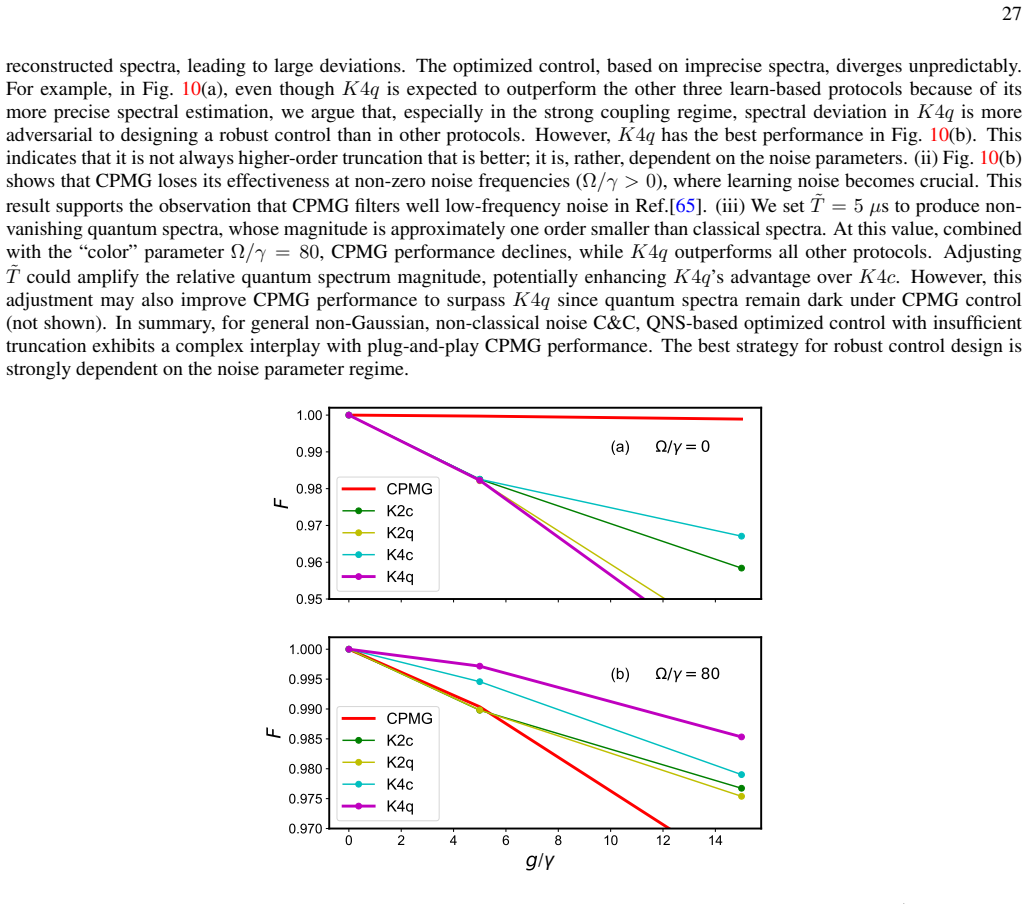
- Noise-tailored optimal control can be designed directly from the bound-form spectra; for the two-qubit idle circuit studied, the optimized control raises process fidelity relative to bare control, with the gap increasing with coupling strength.
- The mechanism also covers strong non-perturbative environments: because all orders above saturation are bound or dark, features such as random-telegraph-noise coherence steps with effective orders far beyond K=14 become controllable and characterizable with finite L.
Reading between the lines
- I infer that the saturation order is a property of the digital control frame rather than of the noise, so analogous contraction identities for overlapping, non-uniform, or finite-duration pulse frames would give different (possibly still finite) saturation orders; the paper does not claim this extension.
- A testable extension is to treat finite-duration pulses by subdividing each pulse into smaller digital windows; the theorem would then apply with a larger effective L at correspondingly higher sample cost, but the paper explicitly leaves non-instantaneous controls out of scope.
- The dark-spectrum structure hints at a control-theoretic design principle: one could deliberately choose control frames that maximize dark spectra, turning noise characterization into a tool for identifying decoherence-free subspaces for non-Gaussian environments; this is my speculation, not a claim of the paper.
Editorial analysis
A structured set of objections, weighed in public.
Referee Report
Summary. The paper develops a control-adapted quantum noise spectroscopy (QNS) framework for single- and two-qubit systems under digital control, and claims that the effective Dyson-series complexity saturates at perturbation order K=2L for a single qubit, K=4L for two qubits, and K=2|Q|L for fully correlated multi-qubit dephasing noise. The central mechanism is a control-tensor contraction: window-frame tensors containing a 3-streak (single qubit) or 5-streak (two qubit) reduce to lower-dimensional tensors with control-independent coefficients, inducing a 'binding symmetry' among CA spectra. Based on this, the paper derives fundamental digital QNS sample complexities that depend on L but not on the non-Gaussianity order, and demonstrates the approach numerically on random-telegraph-noise models, including single-qubit coherence prediction and two-qubit noise-tailored control optimization.
Significance. If the saturation theorems are correct, this is a substantial conceptual advance: it would show that non-perturbative dephasing noise under digital control can be characterized with finite, control-dependent resources rather than resources growing with noise complexity. The numerical demonstrations against exact RTN solutions are encouraging and provide explicit falsifiable predictions, and the paper includes detailed QNS protocols in Tables IV and V. However, the central algebraic contraction property is not proved at the level required by the claims: Proposition 1 is essentially asserted after a local identity, Proposition 2 is left as 'can be verified', and the multi-qubit bound is stated without proof. In addition, the asymptotic sample-complexity exponents are obtained by numerical fitting rather than by analytic derivation. The potential impact is high, but the current manuscript does not yet close these load-bearing gaps.
major comments (4)
- [V.A, Proposition 1 and Eq. (17)] The proof of the contraction identity is incomplete. Equation (16) demonstrates that two adjacent identical single-qubit switching functions multiply to the identity inside one Hamiltonian string, but the control tensor T^{(k)}_{\mu}(\vec n) in Eq. (7) is a signed sum over permutations l, \pi, \vec u, \vec c with signs (-1)^{\bar f_\pi^{(k)}(\vec\mu)}. The step from the local identity to the factorization T^{(k)}_{\vec\mu}(\vec n)=c_{\vec\mu}T^{(k-2)}_{\vec\mu'}(\vec n') with a universal, control-independent coefficient is asserted rather than proved. Since Theorem 1 and the entire saturation bound depend on this property for general k, a complete proof is required.
- [V.A, Proposition 2 and VI.C] The two-qubit 5-streak contraction is not proved: the key sentence 'which can be verified to form a lower-order control tensor' replaces the needed argument, and the multi-qubit bound K=2|Q|L is stated without proof. These claims are load-bearing for Theorem 2 and for the multi-qubit generalization, so they need a full derivation or an explicit statement of the conditions under which they hold.
- [VI.A and Appendix F, Conclusion 1.1] The asymptotic estimates N^{(\infty)}_{C_W}(L)|_{1,C} \approx \Theta(e^{1.1L}) and N^{(\infty)}_{C_W}(L)|_{1,Q} \approx O(e^{2L}) are not derived analytically; Appendix F states that the bounds are 'obtained by fitting the exponent for large L'. As written, the \Theta and O notation is therefore not justified. Please either provide rigorous asymptotic bounds or clearly relabel these as numerical extrapolations rather than proven complexity statements.
- [VI.A, Theorem 1 proof] The proof of Theorem 1 is a single sentence: 'All control tensors at order k > 2L are contractible (\forall \vec n) as described in Proposition 1.' Even accepting Proposition 1, the proof should show carefully that every n-string of length k>2L contains a 3-streak and that iterative contraction terminates at order at most 2L, with the same control-independent coefficients. This is a straightforward pigeonhole argument, but it should be written out because it is the logical bridge from the local contraction to the global saturation claim.
minor comments (6)
- [Eq. (16)] In the second line of Eq. (16), with the definition \bar\sigma_u=-\tilde O^{-1}(T)\sigma_u\tilde O(T), the product of two \bar\sigma factors is +I because the two minus signs cancel; the displayed leading minus appears to be a typo, as it would give -I.
- [Theorem 1] The statement of Theorem 1 contains the typo 'non-Gassianity'; it should read 'non-Gaussianity'.
- [Fig. 8 caption] The word 'insect' should be 'inset' in the caption of Fig. 8.
- [Appendix E] The phrase 'Cast Study 2' should read 'Case Study 2'.
- [Eq. (19)] The notation for the two-qubit bound spectra is confusing: the six-window strings such as (n,n,n,n,n,m) and (n,m,m,m,m,m) appear to have one index too many for the spectra being described, and the subscript notation alternates between (q,q') and (\vec q,q'). Please clarify the indexing.
- [Figs. 6 and 7] The figures label spectra as 'S' while the text defines them as \bar S; please unify the notation.
Circularity Check
No significant circularity: the saturation theorems are derived from an in-paper contraction argument, not from fitting or self-citation.
full rationale
The central claim (single-qubit K=2L, two-qubit K=4L saturation) rests on Propositions 1 and 2, which assert that control tensors with 3- or 5-streaks contract to lower-dimensional tensors (Eq. 17). The proof exhibits the key local identity [U0†(nτ)σzU0(nτ)]^2 = I (Eq. 16) and claims the summed Dyson tensor factors out an identity; this is an in-paper algebraic derivation rather than a parameter fit or a restatement of the conclusion. The CA spectra (Eq. 10) are defined as window-frame projections of noise, but the saturation bound does not follow from that definition alone; it requires the contraction identity and the pigeonhole fact that any length-k string over L windows with k>2L contains a 3-streak. The numerical validation against the exact random-telegraph-noise solution (Fig. 5c) is an external benchmark. Self-citations to [43] and [65] supply the frame-based formalism and prior digital CA QNS; these are published, parameter-free frameworks, and the novel symmetry/saturation argument does not reduce to them, nor does the paper import a uniqueness theorem from them. The asymptotic exponents Θ(e^{1.1L}), O(e^{2L}), O(e^{5.1L}) are obtained by fitting the exact combinatorial counting sums (Appendix F), which is a presentational overreach but not circular. The main unverified link is the fully general contraction identity for arbitrary k (and the unproved multi-qubit bound K=2|Q|L); these are proof-gap/correctness risks, not circularity, so the score is 0.
Assumptions & free parameters
free parameters (1)
- sample complexity exponents =
1.1 (single-qubit classical), 5.1 (two-qubit classical)
assumptions (3)
- domain assumption Control is digital: L instantaneous, equidistant, perfect gates with inter-pulse delay much longer than gate duration.
- domain assumption Environment couples through pure dephasing: H_QE = Σ_q σ_z^[q] ⊗ B_q(t), with factorizable initial state ρ_Q ⊗ ρ_E.
- standard math Dyson series with nested-bracket correlators is an exact representation of the reduced dynamics.
Cite this review
Pith. "Pith review of Efficient learning and optimizing non-Gaussian correlated noise in digitally controlled qubit systems." pith.science (2026). https://pith.science/paper/TBOCNUYV
@misc{pith2026250205408,
  author       = {Pith},
  title        = {Pith review of: Efficient learning and optimizing non-Gaussian correlated noise in digitally controlled qubit systems},
  year         = {2026},
  howpublished = {\url{https://pith.science/paper/TBOCNUYV}},
  note         = {Machine review of arXiv:2502.05408}
}
read the original abstract
Precise qubit control in the presence of spatio-temporally correlated noise is pivotal for transitioning to fault-tolerant quantum computing. Generically, such noise can also have non-Gaussian statistics, which hampers existing non-Markovian noise spectroscopy protocols. By utilizing frame-based characterization and a novel symmetry analysis, we show how to achieve higher-order spectral estimation for noise-optimized circuit design. Remarkably, we find that the digitally driven qubit dynamics can be solely determined by the complexity of the applied control, rather than the non-perturbative nature of the non-Gaussian environment. This enables us to address certain non-perturbative qubit dynamics more simply. We delineate several complexity bounds for learning such high-complexity noise and demonstrate our single and two-qubit digital characterization and control using a series of numerical simulations. Our results not only provide insights into the exact solvability of (small-sized) open quantum dynamics but also highlight a resource-efficient approach for optimal control and possible error reduction techniques for current qubit devices.
Figures


Figures from the paper (7 more)


Reference graph
Works this paper leans on
-
[1]
Derivation of Dyson series Recall that E[O(T )]ρQ⊗ρE = TrQ h ⟨T+e−i R T −T HO(t)dt⟩ρQ ˜O(T ) i = Tr[ ∞X k=0 D(k) O (T )/k!ρQ ˜O(T )]. (A1) The Dyson term is defined as D(k) O (T )/k! = (−i)k Z T −T d>⃗t[k]⟨HO(t1)...HO(tk)⟩ = (−i)k X ⃗ q kX l=0 X π∈Πl;k Z T 0 d>⃗t[k] D lY j=1 ¯Hqj (tπ(j)) kY j′=l+1 ˜Hqj′ (tπ(j′)) E = (−i)k X ⃗ q kX l=0 X π∈Πl;k Z T 0 d>⃗t[...
-
[2]
CA filter strings
Completeness of nested bracket representation This section is fully dedicated to the details of nested bracket representation introduced above. To begin with, recall that Card ({Πl;k}k l=0) = 2 k on the Q side, and we explain why there are only 2k−1 distinct noise correlators in E. We already know that in any ˜H ( ¯H) string the times are ordered (reverse...
-
[3]
Fault-Tolerant Quantum Computation with Constant Error Rate,
Dorit Aharonov and Michael Ben-Or, “Fault-Tolerant Quantum Computation with Constant Error Rate,” SIAM J. Comput. (2008)
2008
-
[4]
Resilient Quantum Computation,
Emanuel Knill, Raymond Laflamme, and Wojciech H. Zurek, “Resilient Quantum Computation,” Science 279, 342–345 (1998)
1998
-
[5]
An Introduction to Quantum Error Correction and Fault-Tolerant Quantum Computation,
Daniel Gottesman, “An Introduction to Quantum Error Correction and Fault-Tolerant Quantum Computation,” arXiv (2009), 10.48550/arXiv.0904.2557, 0904.2557
-
[6]
The resource overhead to characterize correlated noise and intrinsic non-Markovian noise for optimal qubit control purposes is the same within our framework
Here non-Markovian refers to noise-induced non-Markovian qubit error dynamics, not meant to be classical or quantum non- Markovianity of the environment itself. The resource overhead to characterize correlated noise and intrinsic non-Markovian noise for optimal qubit control purposes is the same within our framework
-
[7]
Non-Gaussian noise spectroscopy with a superconducting qubit sensor,
Youngkyu Sung, Félix Beaudoin, Leigh M. Norris, Fei Yan, David K. Kim, Jack Y . Qiu, Uwe von Lüpke, Jonilyn L. Yoder, Terry P. Orlando, Simon Gustavsson, Lorenza Viola, and William D. Oliver, “Non-Gaussian noise spectroscopy with a superconducting qubit sensor,” Nat. Commun. 10, 3715 (2019)
2019
-
[8]
Two-qubit spectroscopy of spatiotemporally correlated quantum noise in superconducting qubits,
U. von Lüpke, F. Beaudoin, L. M. Norris, Y . Sung, R. Winik, J. Y . Qiu, M. Kjaergaard, D. Kim, J. Yoder, S. Gustavsson, L. Viola, and W. D. Oliver, “Two-qubit spectroscopy of spatiotemporally correlated quantum noise in superconducting qubits,” PRX Quantum1, 010305 (2020)
2020
Show all 107 references
-
[9]
Characterizing Low-Frequency Qubit Noise,
Filip Wudarski, Yaxing Zhang, Alexander N. Korotkov, A. G. Petukhov, and M. I. Dykman, “Characterizing Low-Frequency Qubit Noise,” Phys. Rev. Appl.19, 064066 (2023)
2023
-
[10]
Nonergodic Measurements of Qubit Frequency Noise,
Filip Wudarski, Yaxing Zhang, and M. I. Dykman, “Nonergodic Measurements of Qubit Frequency Noise,” Phys. Rev. Lett. 131, 230201 (2023)
2023
-
[11]
Qubit control noise spectroscopy with optimal suppression of dephasing,
Vivian Maloney, Yasuo Oda, Gregory Quiroz, B. David Clader, and Leigh M. Norris, “Qubit control noise spectroscopy with optimal suppression of dephasing,” Phys. Rev. A106, 022425 (2022)
2022
-
[12]
Decoherence and 1/f noise in Josephson qubits,
E. Paladino, L. Faoro, G. Falci, and Rosario Fazio, “Decoherence and 1/f noise in Josephson qubits,” Phys. Rev. Lett. 88, 228304 (2002)
2002
- [13]
-
[14]
N. Y . Haboubi and R. D. Montgomery,The Theory of Open Quantum Systems, V ol. 21 (Oxford University Press, Oxford, England, UK, 1992)
1992
-
[15]
Colloquium: Non-Markovian dynamics in open quantum systems,
Heinz-Peter Breuer, Elsi-Mari Laine, Jyrki Piilo, and Bassano Vacchini, “Colloquium: Non-Markovian dynamics in open quantum systems,” Rev. Mod. Phys.88, 021002 (2016)
2016
-
[16]
Concepts of quantum non-Markovianity: A hierarchy,
Li Li, Michael J. W. Hall, and Howard M. Wiseman, “Concepts of quantum non-Markovianity: A hierarchy,” Phys. Rep. 759, 1–51 (2018)
2018
-
[17]
General transfer-function approach to noise filtering in open-loop quantum control,
Gerardo A. Paz-Silva and Lorenza Viola, “General transfer-function approach to noise filtering in open-loop quantum control,” Phys. Rev. Lett. 113, 250501 (2014)
2014
-
[18]
Dynamics of non-Markovian open quantum systems,
Inés de Vega and Daniel Alonso, “Dynamics of non-Markovian open quantum systems,” Rev. Mod. Phys.89, 015001 (2017)
2017
-
[19]
Introduction to quantum noise, measurement, and amplification,
A. A. Clerk, M. H. Devoret, S. M. Girvin, Florian Marquardt, and R. J. Schoelkopf, “Introduction to quantum noise, measurement, and amplification,” Rev. Mod. Phys.82, 1155–1208 (2010)
2010
-
[20]
QIC 890: Quantum Error Correction and Fault Tolerance,
Daniel Gottesman and Beni Yoshita, “QIC 890: Quantum Error Correction and Fault Tolerance,” (2018), [Online; accessed 29. Apr. 2024]
2018
-
[21]
Rotating-frame relaxation as a noise spectrum analyser of a superconducting qubit undergoing driven evolution,
Fei Yan, Simon Gustavsson, Jonas Bylander, Xiaoyue Jin, Fumiki Yoshihara, David G. Cory, Yasunobu Nakamura, Terry P. Orlando, and William D. Oliver, “Rotating-frame relaxation as a noise spectrum analyser of a superconducting qubit undergoing driven evolution,” Nat. Commun. 4,...
2013
-
[22]
Multiaxis quantum noise spectroscopy robust to errors in state preparation and measurement,
Muhammad Qasim Khan, Wenzheng Dong, Leigh M. Norris, and Lorenza Viola, “Multiaxis quantum noise spectroscopy robust to errors in state preparation and measurement,” Phys. Rev. Appl.22, 024074 (2024)
2024
-
[23]
Application of optimal band-limited control protocols to quantum noise sensing,
V . M. Frey, S. Mavadia, L. M. Norris, W. de Ferranti, D. Lucarelli, L. Viola, and M. J. Biercuk, “Application of optimal band-limited control protocols to quantum noise sensing,” Nat. Commun. 8, 2189 (2017)
2017
-
[24]
Quantum Crosstalk Robust Quantum Control,
Zeyuan Zhou, Ryan Sitler, Yasuo Oda, Kevin Schultz, and Gregory Quiroz, “Quantum Crosstalk Robust Quantum Control,” Phys. Rev. Lett. 131, 210802 (2023)
2023
-
[25]
Randomized benchmarking for non-Markovian noise,
P. Figueroa-Romero, K. Modi, R. J. Harris, T. M. Stace, and M.-H. Hsieh, “Randomized benchmarking for non-Markovian noise,” PRX Quantum 2, 040351 (2021)
2021
-
[26]
Unifying non-markovian characterisation with an efficient and self-consistent framework,
Gregory A. L. White, Petar Jurcevic, Charles D. Hill, and Kavan Modi, “Unifying non-markovian characterisation with an efficient and self-consistent framework,” (2023), arXiv:2312.08454 [quant-ph]
2023 arXiv
-
[27]
Extracting quantum dynamical resources: consumption of non- Markovianity for noise reduction,
Graeme D. Berk, Simon Milz, Felix A. Pollock, and Kavan Modi, “Extracting quantum dynamical resources: consumption of non- Markovianity for noise reduction,” npj Quantum Inf. 9, 1–13 (2023)
2023
-
[28]
How to enhance dephasing time in superconducting qubits,
Ł. Cywi ´nski, R. M. Lutchyn, C. P. Nave, and S. Das Sarma, “How to enhance dephasing time in superconducting qubits,” Phys. Rev. B 77, 174509 (2008)
2008
-
[29]
Limitations to Dynamical Error Suppression and Gate-Error Virtualization from Temporally Correlated Nonclassical Noise,
Michiel Burgelman, Nattaphong Wonglakhon, Diego N. Bernal-García, Gerardo A. Paz-Silva, and Lorenza Viola, “Limitations to Dynamical Error Suppression and Gate-Error Virtualization from Temporally Correlated Nonclassical Noise,” PRX Quantum6, 010323 (2025)
2025
-
[30]
Efficient learning of quantum noise,
Robin Harper, Steven T. Flammia, and Joel J. Wallman, “Efficient learning of quantum noise,” Nat. Phys. 16, 1184–1188 (2020)
2020
-
[31]
Demonstration of non-Markovian process characterisation and control on a quantum processor,
G. A. L. White, C. D. Hill, F. A. Pollock, L. C. L. Hollenberg, and K. Modi, “Demonstration of non-Markovian process characterisation and control on a quantum processor,” Nat. Commun. 11, 6301 (2020)
2020
- [32]
-
[33]
Quantum Circuit Optimization with AlphaTensor,
Francisco J. R. Ruiz, Tuomas Laakkonen, Johannes Bausch, Matej Balog, Mohammadamin Barekatain, Francisco J. H. Heras, Alexander Novikov, Nathan Fitzpatrick, Bernardino Romera-Paredes, John van de Wetering, Alhussein Fawzi, Konstantinos Meichanetzidis, and Pushmeet Kohli, “Quan...
- [34]
-
[35]
Dynamical decoupling for superconducting qubits: A performance survey,
Nic Ezzell, Bibek Pokharel, Lina Tewala, Gregory Quiroz, and Daniel A. Lidar, “Dynamical decoupling for superconducting qubits: A performance survey,” Phys. Rev. Appl.20, 064027 (2023)
2023
-
[36]
A shortcut tour of quantum control methods for modern quantum technologies,
D. Stefanatos and E. Paspalakis, “A shortcut tour of quantum control methods for modern quantum technologies,” Europhys. Lett. 132, 60001 (2021)
2021
-
[37]
Robust Quantum Control by a Single-Shot Shaped Pulse,
D. Daems, A. Ruschhaupt, D. Sugny, and S. Guérin, “Robust Quantum Control by a Single-Shot Shaped Pulse,” Phys. Rev. Lett. 111, 050404 (2013)
2013
-
[38]
Dynamically corrected gates from geometric space curves,
Edwin Barnes, Fernando A. Calderon-Vargas, Wenzheng Dong, Bikun Li, Junkai Zeng, and Fei Zhuang, “Dynamically corrected gates from geometric space curves,” Quantum Sci. Technol.7, 023001 (2022)
2022
-
[39]
Designing Globally Time-Optimal Entangling Gates Using Geometric Space Curves,
Ho Lun Tang, Kyle Connelly, Ada Warren, Fei Zhuang, Sophia E. Economou, and Edwin Barnes, “Designing Globally Time-Optimal Entangling Gates Using Geometric Space Curves,” Phys. Rev. Appl.19, 044094 (2023)
2023
-
[40]
Designing dynamically corrected gates robust to multiple noise sources using geometric space curves,
Hunter T. Nelson, Evangelos Piliouras, Kyle Connelly, and Edwin Barnes, “Designing dynamically corrected gates robust to multiple noise sources using geometric space curves,” Phys. Rev. A108, 012407 (2023)
2023
-
[41]
Dynamically Correcting a CNOT Gate for any Systematic Logical Error,
F. A. Calderon-Vargas and J. P. Kestner, “Dynamically Correcting a CNOT Gate for any Systematic Logical Error,” Phys. Rev. Lett. 118, 150502 (2017)
2017
-
[42]
Noise-Resistant Control for a Spin Qubit Array,
J. P. Kestner, Xin Wang, Lev S. Bishop, Edwin Barnes, and S. Das Sarma, “Noise-Resistant Control for a Spin Qubit Array,” Phys. Rev. Lett. 110, 140502 (2013)
2013
-
[43]
Neural-network-designed three-qubit gates robust against charge noise and crosstalk in silicon,
David W. Kanaar and J. P. Kestner, “Neural-network-designed three-qubit gates robust against charge noise and crosstalk in silicon,” Quantum Sci. Technol. 9, 035011 (2024)
2024
-
[44]
Composite pulses for robust universal control of singlet–triplet qubits,
Xin Wang, Lev S. Bishop, J. P. Kestner, Edwin Barnes, Kai Sun, and S. Das Sarma, “Composite pulses for robust universal control of singlet–triplet qubits,” Nat. Commun. 3, 1–7 (2012)
2012
-
[45]
Frame-based filter-function formalism for quantum characterization and control,
T. Chalermpusitarak, B. Tonekaboni, Y . Wang, L. M. Norris, L. Viola, and G. A. Paz-Silva, “Frame-based filter-function formalism for quantum characterization and control,” PRX Quantum 2, 030315 (2021)
2021
-
[46]
Qubit noise spectroscopy for non-Gaussian dephasing environments,
Leigh M. Norris, Gerardo A. Paz-Silva, and Lorenza Viola, “Qubit noise spectroscopy for non-Gaussian dephasing environments,” Phys. Rev. Lett. 116, 150503 (2016)
2016
-
[48]
Selective Detection of Dynamics-Complete Set of Correlations via Quantum Channels,
Ze Wu, Ping Wang, Tianyun Wang, Yuchen Li, Ran Liu, Yuquan Chen, Xinhua Peng, and Ren-Bao Liu, “Selective Detection of Dynamics-Complete Set of Correlations via Quantum Channels,” Phys. Rev. Lett.132, 200802 (2024)
2024
-
[49]
Detection of Quantum Signals Free of Classical Noise via Quantum Correlation,
Yang Shen, Ping Wang, Chun Tung Cheung, Jörg Wrachtrup, Ren-Bao Liu, and Sen Yang, “Detection of Quantum Signals Free of Classical Noise via Quantum Correlation,” Phys. Rev. Lett.130, 070802 (2023)
2023
-
[50]
Sampling Complexity of Open Quantum Systems,
I. A. Aloisio, G. A. L. White, C. D. Hill, and K. Modi, “Sampling Complexity of Open Quantum Systems,” PRX Quantum 4, 020310 (2023)
2023
-
[51]
Non-Markovian stochastic Schr\
Jay Gambetta and H. M. Wiseman, “Non-Markovian stochastic Schr\"odinger equations: Generalization to real-valued noise using quantum-measurement theory,” Phys. Rev. A66, 012108 (2002)
2002
-
[52]
Optimal Control of a Qubit Coupled to a Non-Markovian Envi- ronment,
P. Rebentrost, I. Serban, T. Schulte-Herbrüggen, and F. K. Wilhelm, “Optimal Control of a Qubit Coupled to a Non-Markovian Envi- ronment,” Phys. Rev. Lett.102, 090401 (2009)
2009
- [53]
-
[54]
Measuring the spectrum of colored noise by dynamical decoupling,
G. A. Álvarez and D. Suter, “Measuring the spectrum of colored noise by dynamical decoupling,” Phys. Rev. Lett. 107, 230501 (2011)
2011
-
[55]
Characterization and control of open quantum systems beyond quantum noise spectroscopy,
Akram Youssry, Gerardo A. Paz-Silva, and Christopher Ferrie, “Characterization and control of open quantum systems beyond quantum noise spectroscopy,” npj Quantum Inf.6, 95 (2020)
2020
-
[56]
Bayesian quantum noise spectroscopy,
C. Ferrie, C. Granade, G. Paz-Silva, and H. M. Wiseman, “Bayesian quantum noise spectroscopy,” New J. Phys. 20, 123005 (2018)
2018
-
[57]
Extending comb-based spectral estimation to multiaxis quantum noise,
G. A. Paz-Silva, L. M. Norris, F. Beaudoin, and L. Viola, “Extending comb-based spectral estimation to multiaxis quantum noise,” Phys. Rev. A 100, 042334 (2019)
2019
-
[58]
Multi-level quantum noise spectroscopy,
Y . Sung, A. Vepsäläinen, J. Braumüller, F. Yan, J. I.-J. Wang, M. Kjaergaard, R. Winik, P. Krantz, A. Bengtsson, A. J. Melville, B. M. Niedzielski, M. E. Schwartz, D. K. Kim, J. L. Yoder, T. P. Orlando, S. Gustavsson, and W. D. Oliver, “Multi-level quantum noise spectroscopy,...
2021
-
[59]
Fourier transform noise spectroscopy,
Arian Vezvaee, Nanako Shitara, Shuo Sun, and Andrés Montoya-Castillo, “Fourier transform noise spectroscopy,” npj Quantum Inf. 10, 1–12 (2024)
2024
-
[60]
Digital noise spectroscopy with a quantum sensor,
G. Wang, Y . Zhu, B. Li, C. Li, L. Viola, A. Cooper, and P. Cappellaro, “Digital noise spectroscopy with a quantum sensor,” Quantum Sci. Technol. 9, 035006 (2024)
2024
-
[61]
Environmental noise spectroscopy with qubits subjected to dynamical decoupling,
P. Sza ´nkowski, G. Ramon, J. Krzywda, D. Kwiatkowski, and Ł. Cywi ´nski, “Environmental noise spectroscopy with qubits subjected to dynamical decoupling,” J. Phys.: Cond. Mat. 29, 333001 (2017)
2017
-
[62]
Simultaneous spectral estimation of dephasing and amplitude noise on a qubit sensor via optimally band-limited control,
V . Frey, L. M. Norris, L. Viola, and M. J. Biercuk, “Simultaneous spectral estimation of dephasing and amplitude noise on a qubit sensor via optimally band-limited control,” Phys. Rev. Appl.14, 024021 (2020)
2020
-
[63]
Measurement of the noise spectrum using a multiple-pulse sequence,
Tatsuro Yuge, Susumu Sasaki, and Yoshiro Hirayama, “Measurement of the noise spectrum using a multiple-pulse sequence,” Phys. Rev. Lett. 107, 170504 (2011)
2011
-
[64]
Optimally band- limited spectroscopy of control noise using a qubit sensor,
Leigh M. Norris, Dennis Lucarelli, Virginia M. Frey, Sandeep Mavadia, Michael J. Biercuk, and Lorenza Viola, “Optimally band- limited spectroscopy of control noise using a qubit sensor,” Phys. Rev. A98, 032315 (2018). 35
2018
-
[65]
Multiqubit spectroscopy of Gaussian quantum noise,
Gerardo A. Paz-Silva, Leigh M. Norris, and Lorenza Viola, “Multiqubit spectroscopy of Gaussian quantum noise,” Phys. Rev. A 95, 022121 (2017)
2017
-
[66]
Spectroscopy of cross correlations of environmental noises with two qubits,
Piotr Sza ´nkowski, Marek Trippenbach, and Łukasz Cywi ´nski, “Spectroscopy of cross correlations of environmental noises with two qubits,” Phys. Rev. A94, 012109 (2016)
2016
-
[67]
Resource-efficient digital characterization and control of classical non- Gaussian noise,
Wenzheng Dong, Gerardo A. Paz-Silva, and Lorenza Viola, “Resource-efficient digital characterization and control of classical non- Gaussian noise,” Appl. Phys. Lett. 122 (2023), 10.1063/5.0153530
2023 doi
-
[68]
Trispectrum reconstruction of non-gaussian noise,
G. Ramon, “Trispectrum reconstruction of non-gaussian noise,” Phys. Rev. B 100, 161302 (2019)
2019
-
[69]
Stochastic unravelings of non-Markovian completely positive and trace-preserving maps,
G. Gasbarri and L. Ferialdi, “Stochastic unravelings of non-Markovian completely positive and trace-preserving maps,” Phys. Rev. A 98, 042111 (2018)
2018
-
[70]
Dynamically error-corrected gates for universal quantum computation,
Kaveh Khodjasteh and Lorenza Viola, “Dynamically error-corrected gates for universal quantum computation,” Phys. Rev. Lett. 102, 080501 (2009)
2009
-
[71]
Arbitrarily accurate dynamical control in open quantum systems,
Kaveh Khodjasteh, Daniel A. Lidar, and Lorenza Viola, “Arbitrarily accurate dynamical control in open quantum systems,” Phys. Rev. Lett. 104, 090501 (2010)
2010
-
[72]
Training Schrödinger’s cat: quantum optimal control,
Steffen J. Glaser, Ugo Boscain, Tommaso Calarco, Christiane P. Koch, Walter Köckenberger, Ronnie Kosloff, Ilya Kuprov, Burkhard Luy, Sophie Schirmer, Thomas Schulte-Herbrüggen, Dominique Sugny, and Frank K. Wilhelm, “Training Schrödinger’s cat: quantum optimal control,” Eur. P...
2015
-
[73]
Fault-tolerant quantum dynamical decoupling,
K. Khodjasteh and D. A. Lidar, “Fault-tolerant quantum dynamical decoupling,” Phys. Rev. Lett. 95, 180501 (2005)
2005
-
[74]
Robustness of composite pulses to time-dependent control noise,
Chingiz Kabytayev, Todd J. Green, Kaveh Khodjasteh, Michael J. Biercuk, Lorenza Viola, and Kenneth R. Brown, “Robustness of composite pulses to time-dependent control noise,” Phys. Rev. A90, 012316 (2014)
2014
-
[75]
Dynamical suppression of decoherence in two-state quantum systems,
Lorenza Viola and Seth Lloyd, “Dynamical suppression of decoherence in two-state quantum systems,” Phys. Rev. A 58, 2733–2744 (1998)
1998
-
[76]
Dynamical Decoupling of Open Quantum Systems,
Lorenza Viola, Emanuel Knill, and Seth Lloyd, “Dynamical Decoupling of Open Quantum Systems,” Phys. Rev. Lett. 82, 2417–2421 (1999)
1999
-
[77]
Optimized dynamical decoupling in a model quantum memory,
Michael J. Biercuk, Hermann Uys, Aaron P. VanDevender, Nobuyasu Shiga, Wayne M. Itano, and John J. Bollinger, “Optimized dynamical decoupling in a model quantum memory,” Nature 458, 996–1000 (2009)
2009
-
[78]
Optimized Noise Filtration through Dynamical Decoupling,
Hermann Uys, Michael J. Biercuk, and John J. Bollinger, “Optimized Noise Filtration through Dynamical Decoupling,” Phys. Rev. Lett. 103, 040501 (2009)
2009
-
[79]
Dynamical decoupling sequence construction as a filter-design problem,
M. J. Biercuk, A. C. Doherty, and H. Uys, “Dynamical decoupling sequence construction as a filter-design problem,” J. Phys. B: At. Mol. Opt. Phys. 44, 154002 (2011)
2011
-
[80]
Phase-Modulated Decoupling and Error Suppression in Qubit-Oscillator Systems,
Todd J. Green and Michael J. Biercuk, “Phase-Modulated Decoupling and Error Suppression in Qubit-Oscillator Systems,” Phys. Rev. Lett. 114, 120502 (2015)
2015
-
[81]
Notch filtering the nuclear environment of a spin qubit,
Filip K. Malinowski, Frederico Martins, Peter D. Nissen, Edwin Barnes, Łukasz Cywi ´nski, Mark S. Rudner, Saeed Fallahi, Geoffrey C. Gardner, Michael J. Manfra, Charles M. Marcus, and Ferdinand Kuemmeth, “Notch filtering the nuclear environment of a spin qubit,” Nat. Nanotechn...
2017
-
[82]
Demonstration of fidelity improvement using dynamical decoupling with superconducting qubits,
Bibek Pokharel, Namit Anand, Benjamin Fortman, and Daniel A. Lidar, “Demonstration of fidelity improvement using dynamical decoupling with superconducting qubits,” Phys. Rev. Lett.121, 220502 (2018)
2018
-
[83]
1/f noise: Implications for solid-state quantum information,
E. Paladino, Y . M. Galperin, G. Falci, and B. L. Altshuler, “ 1/f noise: Implications for solid-state quantum information,” Rev. Mod. Phys. 86, 361 (2014)
2014
-
[84]
Dynamically corrected gates in silicon singlet-triplet spin qubits,
Habitamu Y . Walelign, Xinxin Cai, Bikun Li, Edwin Barnes, and John M. Nichol, “Dynamically corrected gates in silicon singlet-triplet spin qubits,” Phys. Rev. Appl.22, 064029 (2024)
2024
-
[85]
Robust Quantum Gates against Correlated Noise in Integrated Quantum Chips,
Kangyuan Yi, Yong-Ju Hai, Kai Luo, Ji Chu, Libo Zhang, Yuxuan Zhou, Yao Song, Song Liu, Tongxing Yan, Xiu-Hao Deng, Yuanzhen Chen, and Dapeng Yu, “Robust Quantum Gates against Correlated Noise in Integrated Quantum Chips,” Phys. Rev. Lett. 132, 250604 (2024)
2024
- [86]
-
[87]
Noise-correlation spectrum for a pair of spin qubits in silicon,
J. Yoneda, J. S. Rojas-Arias, P. Stano, K. Takeda, A. Noiri, T. Nakajima, D. Loss, and S. Tarucha, “Noise-correlation spectrum for a pair of spin qubits in silicon,” Nat. Phys. 19, 1793–1798 (2023)
2023
-
[88]
Spatial noise correlations beyond nearest neighbors in 28Si/Si-Ge spin qubits,
J. S. Rojas-Arias, A. Noiri, P. Stano, T. Nakajima, J. Yoneda, K. Takeda, T. Kobayashi, A. Sammak, G. Scappucci, D. Loss, and S. Tarucha, “Spatial noise correlations beyond nearest neighbors in 28Si/Si-Ge spin qubits,” Phys. Rev. Appl.20, 054024 (2023)
2023
-
[89]
Tutorial on higher-order statistics (spectra) in signal processing and system theory: theoretical results and some applica- tions,
J. M. Mendel, “Tutorial on higher-order statistics (spectra) in signal processing and system theory: theoretical results and some applica- tions,” Proc. IEEE 79, 278–305 (1991)
1991
-
[90]
Characterization of Arbitrary-Order Correlations in Quan- tum Baths by Weak Measurement,
Ping Wang, Chong Chen, Xinhua Peng, Jörg Wrachtrup, and Ren-Bao Liu, “Characterization of Arbitrary-Order Correlations in Quan- tum Baths by Weak Measurement,” Phys. Rev. Lett.123, 050603 (2019)
2019
-
[91]
Learning noise via dynamical decoupling of entangled qubits,
Trevor McCourt, Charles Neill, Kenny Lee, Chris Quintana, Yu Chen, Julian Kelly, Jeffrey Marshall, V . N. Smelyanskiy, M. I. Dykman, Alexander Korotkov, Isaac L. Chuang, and A. G. Petukhov, “Learning noise via dynamical decoupling of entangled qubits,” Phys. Rev. A 107, 052610 (2023)
2023
-
[92]
Controlled dephasing of electrons by non- gaussian shot noise,
Izhar Neder, Florian Marquardt, Moty Heiblum, Diana Mahalu, and Vladimir Umansky, “Controlled dephasing of electrons by non- gaussian shot noise,” Nat. Phys. 3, 534–537 (2007)
2007
-
[93]
Non-Gaussian dephasing in flux qubits due to $xn–1f-6bv$ noise,
Y . M. Galperin, B. L. Altshuler, J. Bergli, D. Shantsev, and V . Vinokur, “Non-Gaussian dephasing in flux qubits due to $xn–1f-6bv$ noise,” Phys. Rev. B76, 064531 (2007)
2007
-
[94]
Nonlinear Single-Spin Spectrum Analyzer,
Shlomi Kotler, Nitzan Akerman, Yinnon Glickman, and Roee Ozeri, “Nonlinear Single-Spin Spectrum Analyzer,” Phys. Rev. Lett.110, 110503 (2013)
2013
-
[95]
Dynamical control of qubit coherence: Random versus deterministic schemes,
L. F. Santos and L. Viola, “Dynamical control of qubit coherence: Random versus deterministic schemes,” Phys. Rev. A 72, 062303 (2005). 36
2005
-
[96]
Suppressing quantum errors by scaling a surface code logical qubit,
Google Quantum AI, “Suppressing quantum errors by scaling a surface code logical qubit,” (2023), [Online; accessed 22. Apr. 2024]
2023
-
[97]
Noise-induced barren plateaus in variational quantum algorithms,
Samson Wang, Enrico Fontana, M. Cerezo, Kunal Sharma, Akira Sone, Lukasz Cincio, and Patrick J. Coles, “Noise-induced barren plateaus in variational quantum algorithms,” Nat. Commun. 12, 1–11 (2021)
2021
-
[98]
A general procedure for the derivation of principal domains of higher-order spectra,
V . Chandran and S. Elgar, “A general procedure for the derivation of principal domains of higher-order spectra,” IEEE Trans. Signal Process. 42, 229 (1994)
1994
-
[99]
Decoherence in qubits due to low-frequency noise,
J. Bergli, Y . M. Galperin, and B. L. Altshuler, “Decoherence in qubits due to low-frequency noise,” New J. Phys.11, 025002 (2009)
2009
-
[100]
Non-Gaussian Low-Frequency Noise as a Source of Qubit Decoherence,
Y . M. Galperin, B. L. Altshuler, J. Bergli, and D. V . Shantsev, “Non-Gaussian Low-Frequency Noise as a Source of Qubit Decoherence,” Phys. Rev. Lett. 96, 097009 (2006)
2006
-
[101]
Optimized mitigation of random-telegraph-noise dephasing by spectator-qubit sensing and control,
Hongting Song, Areeya Chantasri, Behnam Tonekaboni, and Howard M. Wiseman, “Optimized mitigation of random-telegraph-noise dephasing by spectator-qubit sensing and control,” Phys. Rev. A107, L030601 (2023)
2023
-
[102]
Electronic noise—From advanced materials to quantum technolo- gies,
Alexander A. Balandin, Elisabetta Paladino, and Pertti J. Hakonen, “Electronic noise—From advanced materials to quantum technolo- gies,” Appl. Phys. Lett. 124 (2024), 10.1063/5.0197142
2024 doi
-
[103]
The digital CA spectra QNS measured at time T can also be used to design optimal controls for other times {nT /L| 1 ≤ n < L, n∈ Z}, where n is an integer. Simultaneous optimization beyond a single time can be done through a non-Markovian Choi-chanel representation (e.g., as pr...
- [104]
-
[105]
Wenzheng Dong et al., (unpublished)
-
[106]
Barren plateaus in quantum neural network training landscapes,
Jarrod R. McClean, Sergio Boixo, Vadim N. Smelyanskiy, Ryan Babbush, and Hartmut Neven, “Barren plateaus in quantum neural network training landscapes,” Nat. Commun. 9, 1–6 (2018)
2018
-
[107]
V . I. Klyatskin,Dynamics of Stochastic Systems (Elsevier Science, Waltham, MA, USA, 2005)
2005
-
[108]
Y . M. Galperin, B. L. Altshuler, and D. V . Shantsev,Fundamental Problems of Mesoscopic Physics (Springer, Dordrecht, The Nether- lands, 2004) pp. 141–165
2004
Reviewed August 8, 2026 · model on record in the stance chip above.
Discussion (0). Continue with ORCID to comment.